tire size DODGE POWER WAGON 2007 2.G User Guide
[x] Cancel search | Manufacturer: DODGE, Model Year: 2007, Model line: POWER WAGON, Model: DODGE POWER WAGON 2007 2.GPages: 492, PDF Size: 8.25 MB
Page 334 of 492
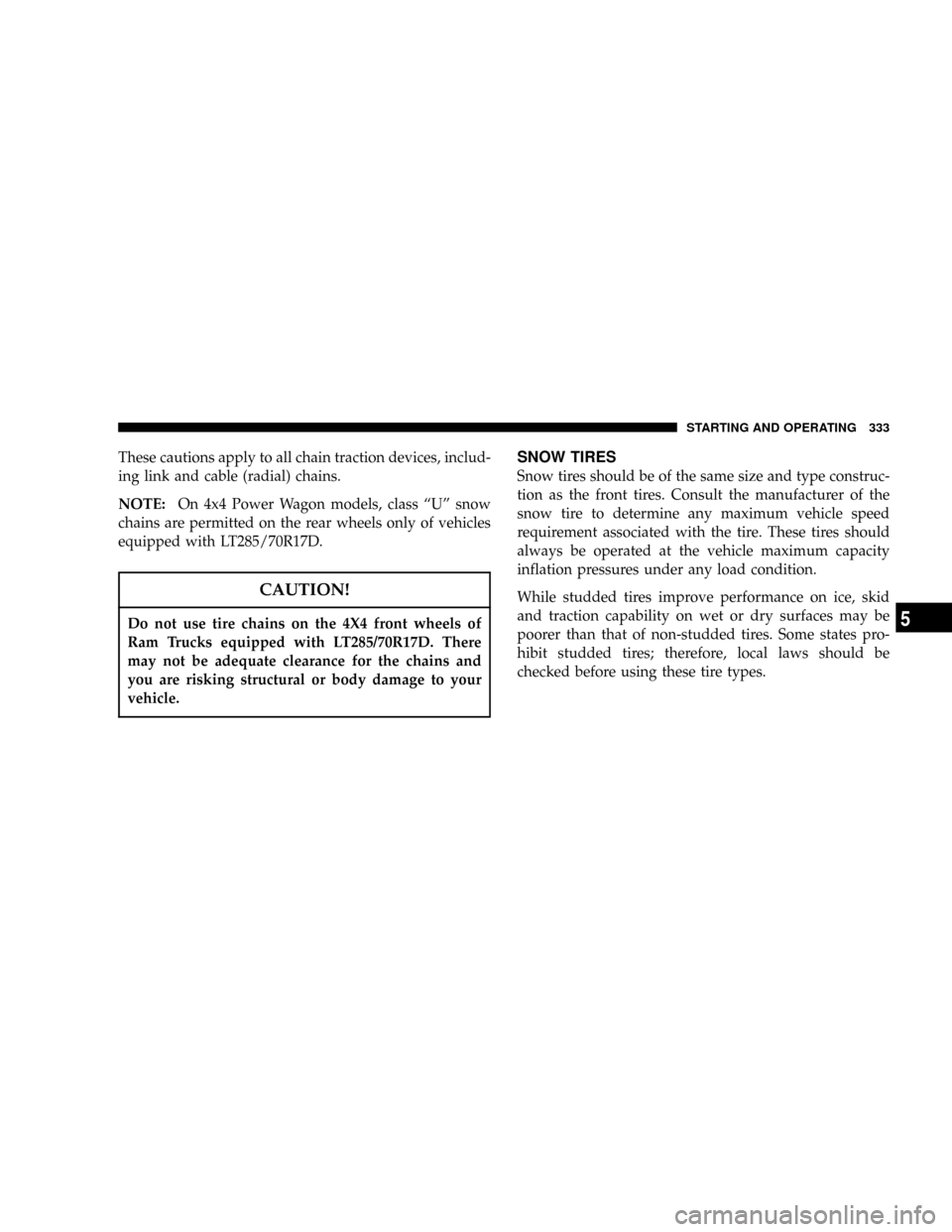
These cautions apply to all chain traction devices, includ-
ing link and cable (radial) chains.
NOTE:On 4x4 Power Wagon models, class ªUº snow
chains are permitted on the rear wheels only of vehicles
equipped with LT285/70R17D.
CAUTION!
Do not use tire chains on the 4X4 front wheels of
Ram Trucks equipped with LT285/70R17D. There
may not be adequate clearance for the chains and
you are risking structural or body damage to your
vehicle.
SNOW TIRES
Snow tires should be of the same size and type construc-
tion as the front tires. Consult the manufacturer of the
snow tire to determine any maximum vehicle speed
requirement associated with the tire. These tires should
always be operated at the vehicle maximum capacity
inflation pressures under any load condition.
While studded tires improve performance on ice, skid
and traction capability on wet or dry surfaces may be
poorer than that of non-studded tires. Some states pro-
hibit studded tires; therefore, local laws should be
checked before using these tire types.
STARTING AND OPERATING 333
5
Page 343 of 492
included on this label and indicates the Month, Day and
Hour of manufacture. The bar code that appears on the
bottom of the label is your Vehicle Identification Number
(VIN).
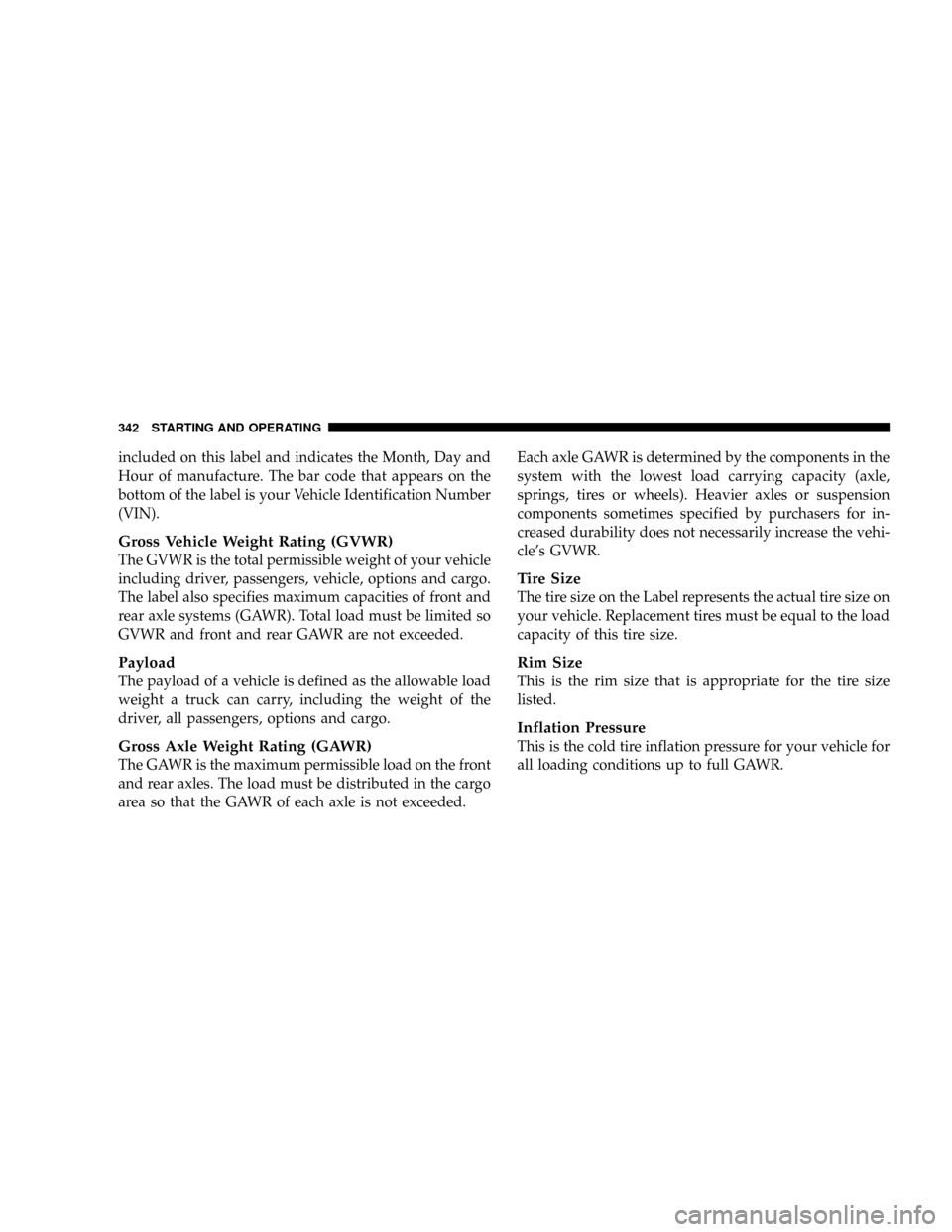
Gross Vehicle Weight Rating (GVWR)
The GVWR is the total permissible weight of your vehicle
including driver, passengers, vehicle, options and cargo.
The label also specifies maximum capacities of front and
rear axle systems (GAWR). Total load must be limited so
GVWR and front and rear GAWR are not exceeded.
Payload
The payload of a vehicle is defined as the allowable load
weight a truck can carry, including the weight of the
driver, all passengers, options and cargo.
Gross Axle Weight Rating (GAWR)
The GAWR is the maximum permissible load on the front
and rear axles. The load must be distributed in the cargo
area so that the GAWR of each axle is not exceeded.Each axle GAWR is determined by the components in the
system with the lowest load carrying capacity (axle,
springs, tires or wheels). Heavier axles or suspension
components sometimes specified by purchasers for in-
creased durability does not necessarily increase the vehi-
cle's GVWR.
Tire Size
The tire size on the Label represents the actual tire size on
your vehicle. Replacement tires must be equal to the load
capacity of this tire size.
Rim Size
This is the rim size that is appropriate for the tire size
listed.
Inflation Pressure
This is the cold tire inflation pressure for your vehicle for
all loading conditions up to full GAWR.
342 STARTING AND OPERATING
Page 375 of 492
Wheel Nuts
All wheel nuts should be tightened occasionally to elimi-
nate the possibility of wheel studs being sheared or the
bolt holes in the wheels becoming elongated. This is
especially important during the first few hundred miles
of operation to allow the wheel nuts to become properly
set. All nuts should first be firmly seated against the
wheel. The nuts should then be tightened to recom-
mended torque. Tighten the nuts to final torque in
increments. Progress around the bolt circle, tightening
the nut opposite to the nut just previously tightened until
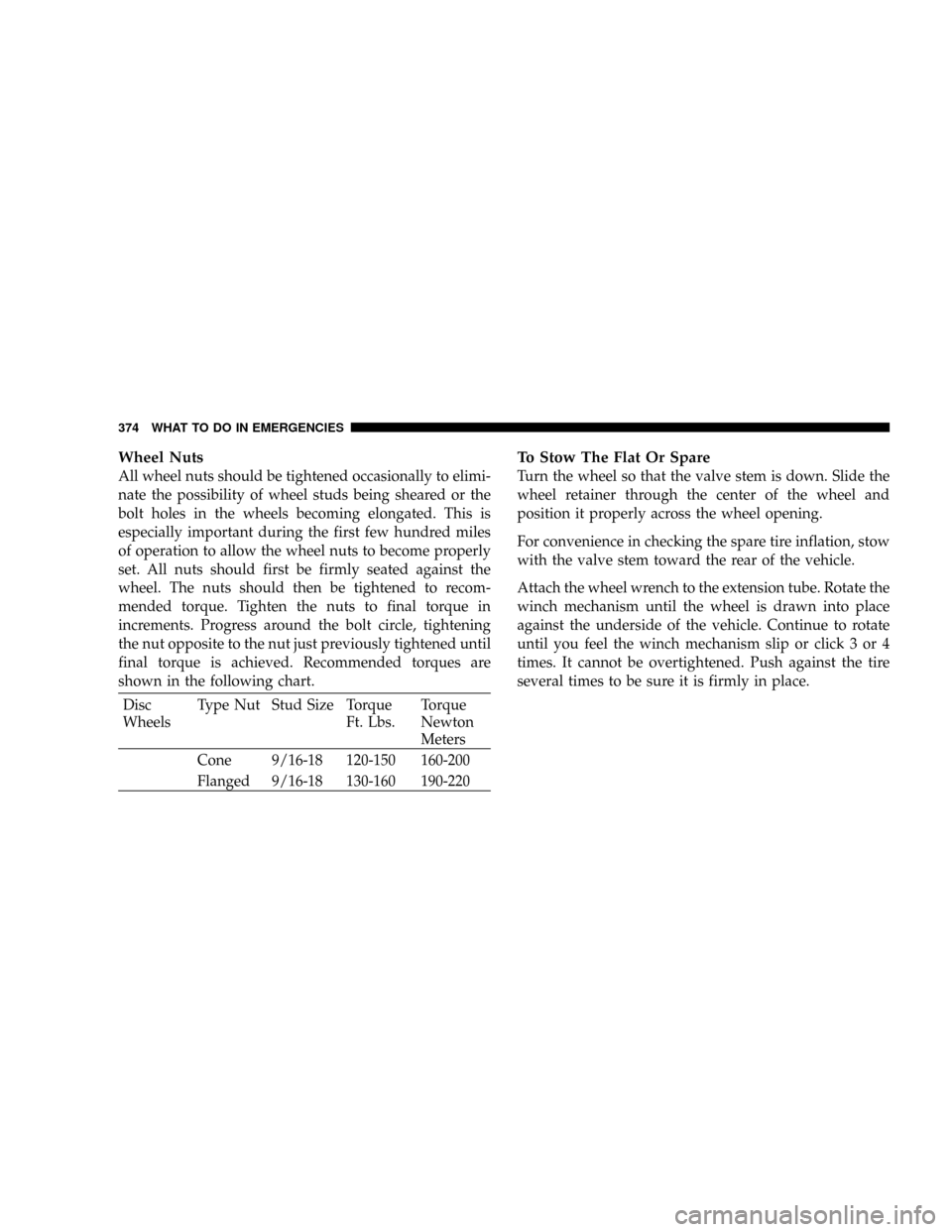
final torque is achieved. Recommended torques are
shown in the following chart.
Disc
WheelsType Nut Stud Size Torque
Ft. Lbs.Torque
Newton
Meters
Cone 9/16-18 120-150 160-200
Flanged 9/16-18 130-160 190-220
To Stow The Flat Or Spare
Turn the wheel so that the valve stem is down. Slide the
wheel retainer through the center of the wheel and
position it properly across the wheel opening.
For convenience in checking the spare tire inflation, stow
with the valve stem toward the rear of the vehicle.
Attach the wheel wrench to the extension tube. Rotate the
winch mechanism until the wheel is drawn into place
against the underside of the vehicle. Continue to rotate
until you feel the winch mechanism slip or click 3 or 4
times. It cannot be overtightened. Push against the tire
several times to be sure it is firmly in place.
374 WHAT TO DO IN EMERGENCIES
Page 489 of 492
Air Pressure.......................... 322
Alignment........................... 331
Chains.............................. 332
Changing............................ 368
Compact Spare........................ 327
General Information.................... 322
High Speed.......................... 325
Inflation Pressures..................... 323
Jacking............................. 369
Life of Tires.......................... 330
Load Capacity.....................318,319
Off-Road............................. 80
Quality Grading....................... 471
Radial.............................. 326
Replacement......................... 330
Rotation............................. 334
Safety...........................313,322
Sizes............................... 315
Snow Tires........................... 333Spare Tire........................... 368
Spinning............................ 328
Tread Wear Indicators................... 329
Wheel Mounting....................... 369
Wheel Nut Torque..................... 372
Tongue Weight/Trailer Weight.............. 350
Torque Converter Clutch.................. 255
Tow Hooks, Emergency................... 379
Towing............................... 345
Disabled Vehicle....................... 380
Guide.............................. 350
Recreational.......................... 360
Weight.............................. 350
Traction.............................. 263
Trailer Towing.......................... 345
Cooling System Tips.................... 357
Hitches............................. 349
Minimum Requirements................. 351
Mirrors...........................86,358
488 INDEX