oil DODGE POWER WAGON 2007 2.G Owner's Manual
[x] Cancel search | Manufacturer: DODGE, Model Year: 2007, Model line: POWER WAGON, Model: DODGE POWER WAGON 2007 2.GPages: 492, PDF Size: 8.25 MB
Page 403 of 492
To prevent freeze-up of your windshield washer system
in cold weather, select a solution or mixture that meets or
exceeds the temperature range of your climate. This
rating information can be found on most washer fluid
containers.
WARNING!
Commercially available windshield washer solvents
are flammable. They could ignite and burn you. Care
must be exercised when filling or working around
the washer solution.
After the engine has warmed, operate the defroster for a
few minutes to reduce the possibility of smearing or
freezing the fluid on the cold windshield. Mopar All
Weather Windshield Washer Solution, used with water asdirected on the container, aids cleaning action, reduces
the freezing point to avoid line clogging, and is not
harmful to paint or trim.
Exhaust System
The best protection against carbon monoxide entry into
the vehicle body is a properly maintained engine exhaust
system.
Whenever a change is noticed in the sound of the exhaust
system, when exhaust fumes can be detected inside the
vehicle, or when the underside or rear of the vehicle is
damaged, have a competent mechanic inspect the com-
plete exhaust system and adjacent body areas for broken,
damaged, deteriorated, or mispositioned parts. Open
seams or loose connections could permit exhaust fumes
to seep into the passenger compartment. In addition,
inspect the exhaust system each time the vehicle is raised
for lubrication or oil change. Replace as required.
402 MAINTAINING YOUR VEHICLE
Page 410 of 492
Inspect all hose connections such as clamps and cou-
plings to make sure they are secure and no leaks are
present.
Components should be replaced immediately if there is
any evidence of wear or damage that could cause failure.
Brake System
Power Disc Brakes (front and rear)
Disc brakes do not require adjustment; however, several
hard stops during the break-in period are recommended
to seat the linings and wear off any foreign material.
Brake Master Cylinder
The fluid level of the master cylinder should be checked
when performing under the hood service, or immedi-
ately if the brake system warning lamp indicates system
failure.
The brake master cylinder has a translucent plastic
reservoir. On the outboard side of the reservoir, there is aªMAXº dot and an ªMINº dot. The fluid level must be
kept within these two dots. Do not add fluid above the
MAX mark, because leakage may occur at the cap.
With disc brakes the fluid level can be expected to fall as
the brake linings wear. However, an unexpected drop in
fluid level may be caused by a leak and a system check
should be conducted.
Refer to Fluids, Lubricants and Genuine Parts for the
correct Fluid type.
WARNING!
Use of a brake fluid that may have a lower initial
boiling point, or is unidentified as to specification,
may result in sudden brake failure during hard
prolonged braking. You could have an accident.
MAINTAINING YOUR VEHICLE 409
7
Page 412 of 492
Rear Axle And 4x4 Front Driving Axle Fluid Level
Refer to Fluids, Lubricants and Genuine Parts for the
correct Fluid type. For normal service, periodic fluid level
checks are not required. When the vehicle is serviced for
other reasons the exterior surfaces of the axle assembly
should be inspected. If gear oil leakage is suspected
inspect the fluid level.
This inspection should be made with the vehicle in a level
position. The fluid level should be even with the bottom
of the fill hole for the Manufacturer's C205F HD Front
Axles. The fluid level should be 5/8º (16 mm) below on
9 1/4º Manufacturer's Rear Axles.
For all 2500 Model axles, the fluid level should be 1/4º
1/4º (6.4 mm 6.4 mm) below the fill hole on the 9.25º
Front and 3/4º 1/4º (19 mm 6.4 mm) on 10.5º Rear
axles.
Drain and Refill
Vehicles operated in normal service do not have regularly
scheduled oil changes. If fluid has become contaminated
with water or to provide the correct viscosity grade, drain
and refill.
Lubricant Selection
Refer to Fluids, Lubricants and Genuine Parts for correct
fluid type.
NOTE:The presence of water in the gear lubricant will
result in corrosion and possible failure of differential
components. Operation of the vehicle in water, as may be
encountered in some off-highway types of service, will
require draining and refilling the axle to avoid damage.
Limited-Slip Differentials
Power Wagon AxlesDO NOT REQUIREany limited slip
oil additive (friction modifiers).
MAINTAINING YOUR VEHICLE 411
7
Page 413 of 492
Transfer Case
Fluid Level Check
This fluid level can be checked by removing the filler
plug. The fluid level should be to the bottom edge of the
filler plug hole with the vehicle in a level position.
Lubricant Selection
Refer to Fluids, Lubricants and Genuine Parts for correct
fluid type.
Front Drive Shaft
The front drive shaft contains a grease fitting which
should be serviced at every oil change (see maintenance
schedule A/B).
Manual Transmission
Fluid Level Check
This fluid level can be checked by removing the filler
plug. If the level of the lubricant is more than 1/4º (6.4
mm) below the bottom of the filler hole while the vehicleis on level ground, enough lubricant should be added to
bring the level to the bottom of the filler hole.
Lubricant Selection G56 (6 ± Speed Manual
Transmission Ð If Equipped)
This transmission does not require periodic changing. If
it becomes necessary to add or change the fluid in this
transmission, refer to Fluids, Lubricants and Genuine
Parts for correct fluid type.
Automatic Transmission
Fluid Level Check
The fluid level should be checked when the engine is
fully warmed up and the fluid in the transmission is at
normal operating temperature. Operation of the trans-
mission with an improper fluid level will greatly reduce
the life of the transmission and of the fluid. Check the
fluid level whenever the vehicle is serviced.
412 MAINTAINING YOUR VEHICLE
Page 414 of 492
Fluid Level Check ± 545RFE
Check the fluid level while the transmission is at normal
operating temperature 82ÉC (180ÉF). This occurs after at
least 15 miles (25 km) of driving. At normal operating
temperature the fluid cannot be held comfortably be-
tween the fingertips.
To check the automatic transmission fluid level properly,
the following procedure must be used:
1. Operate the engine at idle speed and normal operating
temperature.
2. The vehicle must be on level ground.
3. Fully apply the parking brake and press the brake
pedal.
4. Place the gear selector momentarily in each gear
position ending with the lever in P (Park).5. Remove the dipstick, wipe it clean and reinsert it until
seated.
6. Remove the dipstick again and note the fluid level on
both sides. The fluid level should be between the ªHOTº
(upper) reference holes on the dipstick at normal operat-
ing temperature. Verify that solid coating of oil is seen on
both sides of the dipstick. If the fluid is low, add as
required into the dipstick tube.Do not overfill.After
adding any quantity of oil through the oil fill tube, wait
a minimum of two (2) minutes for the oil to fully drain
into the transmission before rechecking the fluid level.
NOTE:If it is necessary to check the transmissionbelow
the operating temperature, the fluid level should be
between the two ªCOLDº (lower) holes on the dipstick
with the fluid at approximately 70ÉF (21ÉC) (room tem-
perature). If the fluid level is correctly established at
room temperature, it should be between the ªHOTº
MAINTAINING YOUR VEHICLE 413
7
Page 424 of 492
heavy soil, use MopartWheel Cleaner or select a non-
abrasive, non-acidic cleaner. Do not use scouring pads,
steel wool, a bristle brush or metal polishes. Only Mo-
partcleaners are recommended. Do not use oven cleaner.
Avoid automatic car washes that use acidic solutions or
harsh brushes that may damage the wheels' protective
finish.
YES EssentialstFabric Cleaning Procedure ± If
equipped
YES Essentialstseats may be cleaned in the following
manner:
²Remove as much of the stain as possible by blotting
with a clean, dry towel.
²Blot any remaining stain with a clean, damp towel.
²For tough stains, apply MopartTotal Clean or a mild
soap solution to a clean, damp cloth and remove stain.
Use a fresh, damp towel to remove soap residue.
²For grease stains, apply MopartMulti-purpose
cleaner to a clean, damp cloth and remove stain. Use a
fresh, damp towel to remove soap residue.
²Do not use any solvents or protectants on Yes Essen-
tials products.
Interior Care
Use MopartTotal Clean to clean fabric upholstery and
carpeting.
Use MopartTotal Clean to clean vinyl upholstery.
MopartTotal Clean is specifically recommended for
leather upholstery.
Your leather upholstery can be best preserved by regular
cleaning with a damp soft cloth. Small particles of dirt
can act as an abrasive and damage the leather upholstery
and should be removed promptly with a damp cloth.
Stubborn soils can be removed easily with a soft cloth
and MopartTotal Clean. Care should be taken to avoid
MAINTAINING YOUR VEHICLE 423
7
Page 425 of 492
soaking your leather upholstery with any liquid. Please
do not use polishes, oils, cleaning fluids, solvents, deter-
gents, or ammonia based cleaners to clean your leather
upholstery. Application of a leather conditioner is not
required to maintain the original condition.
WARNING!
Do not use volatile solvents for cleaning purposes.
Many are potentially flammable, and if used in
closed areas they may cause respiratory harm.
Glass Surfaces
All glass surfaces should be cleaned on a regular basis
with MopartGlass Cleaner or any commercial
household-type glass cleaner. Never use an abrasive type
cleaner. Use caution when cleaning the inside rear win-
dow equipped with electric defrosters or the right rear
quarter window equipped with the radio antenna. Donot use scrapers or other sharp instruments which may
scratch the elements. When cleaning the rear view mirror,
spray cleaner on the towel or rag that you are using. Do
not spray cleaner directly on the mirror.
Cleaning Plastic Instrument Cluster Lenses
The lenses in front of the instruments in this vehicle are
molded in clear plastic. When cleaning the lenses, care
must be taken to avoid scratching the plastic.
1. Clean with a wet soft rag. A mild soap solution may be
used, but do not use high alcohol content or abrasive
cleaners. If soap is used, wipe clean with a clean damp
rag.
2. Dry with a soft tissue.
Seat Belt Maintenance
Do not bleach, dye or clean the belts with chemical
solvents or abrasive cleaners. This will weaken the fabric.
Sun damage can also weaken the fabric.
424 MAINTAINING YOUR VEHICLE
Page 442 of 492
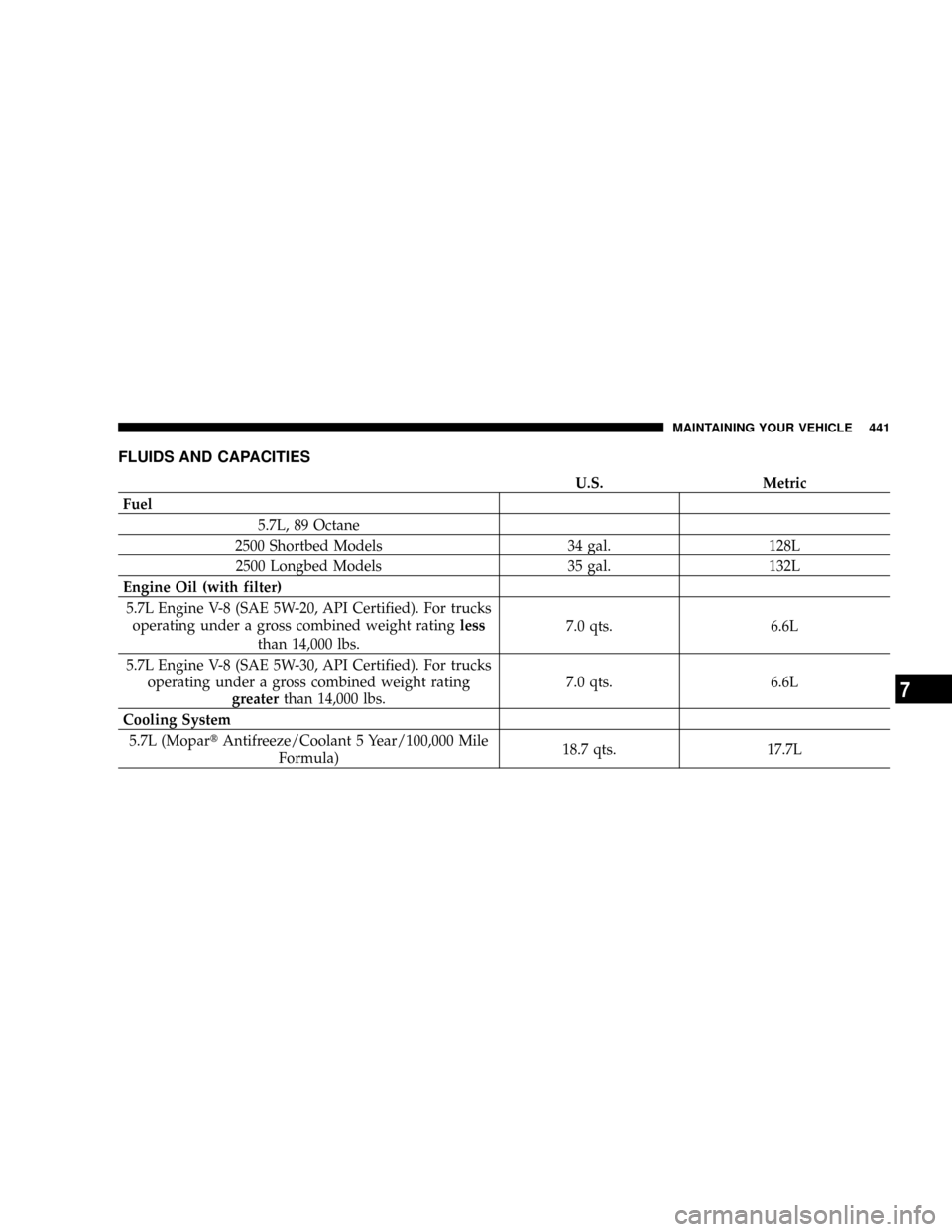
FLUIDS AND CAPACITIES
U.S. Metric
Fuel
5.7L, 89 Octane
2500 Shortbed Models 34 gal. 128L
2500 Longbed Models 35 gal. 132L
Engine Oil (with filter)
5.7L Engine V-8 (SAE 5W-20, API Certified). For trucks
operating under a gross combined weight ratingless
than 14,000 lbs.7.0 qts. 6.6L
5.7L Engine V-8 (SAE 5W-30, API Certified). For trucks
operating under a gross combined weight rating
greaterthan 14,000 lbs.7.0 qts. 6.6L
Cooling System
5.7L (MopartAntifreeze/Coolant 5 Year/100,000 Mile
Formula)18.7 qts. 17.7L
MAINTAINING YOUR VEHICLE 441
7
Page 443 of 492
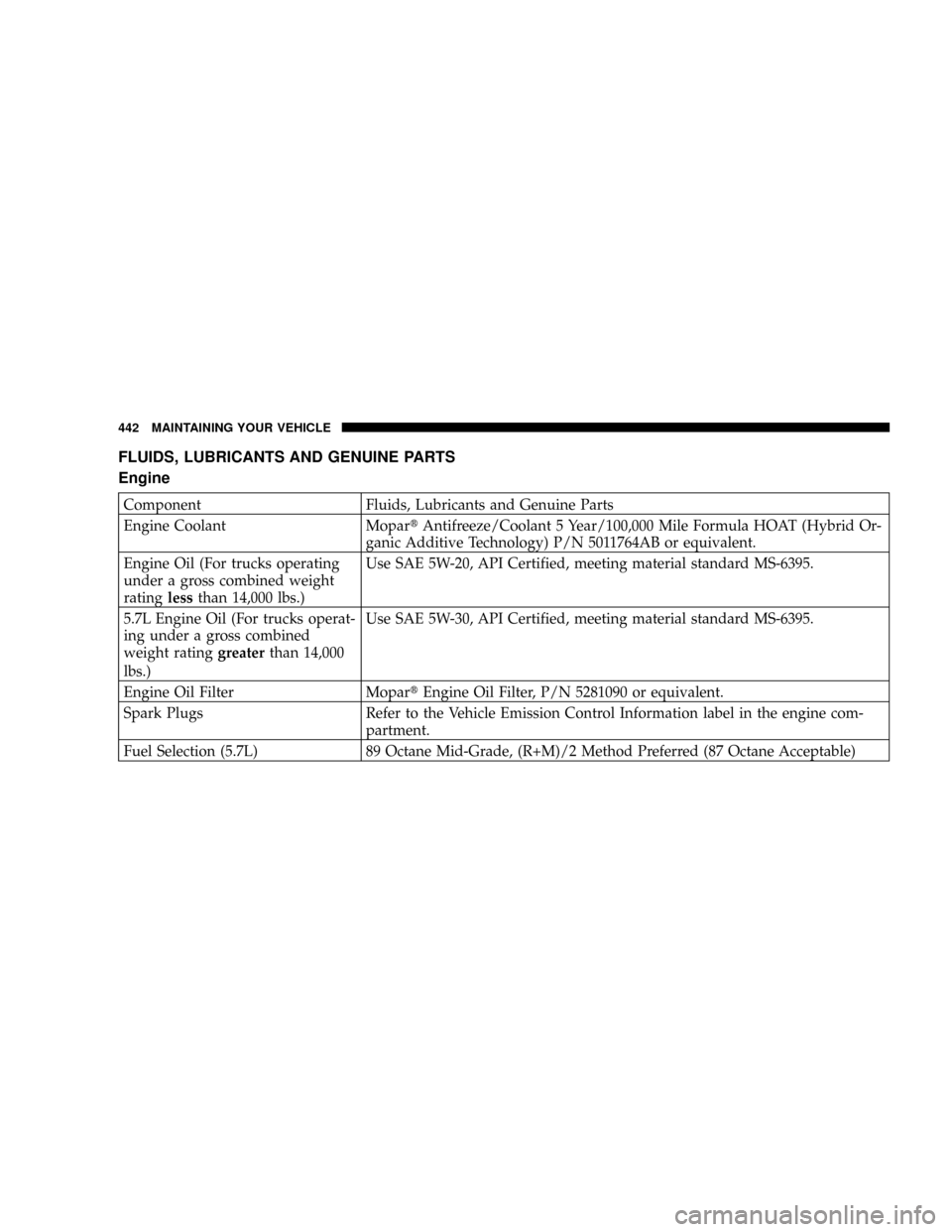
FLUIDS, LUBRICANTS AND GENUINE PARTS
Engine
Component Fluids, Lubricants and Genuine Parts
Engine Coolant MopartAntifreeze/Coolant 5 Year/100,000 Mile Formula HOAT (Hybrid Or-
ganic Additive Technology) P/N 5011764AB or equivalent.
Engine Oil (For trucks operating
under a gross combined weight
ratinglessthan 14,000 lbs.)Use SAE 5W-20, API Certified, meeting material standard MS-6395.
5.7L Engine Oil (For trucks operat-
ing under a gross combined
weight ratinggreaterthan 14,000
lbs.)Use SAE 5W-30, API Certified, meeting material standard MS-6395.
Engine Oil Filter MopartEngine Oil Filter, P/N 5281090 or equivalent.
Spark Plugs Refer to the Vehicle Emission Control Information label in the engine com-
partment.
Fuel Selection (5.7L) 89 Octane Mid-Grade, (R+M)/2 Method Preferred (87 Octane Acceptable)
442 MAINTAINING YOUR VEHICLE
Page 448 of 492
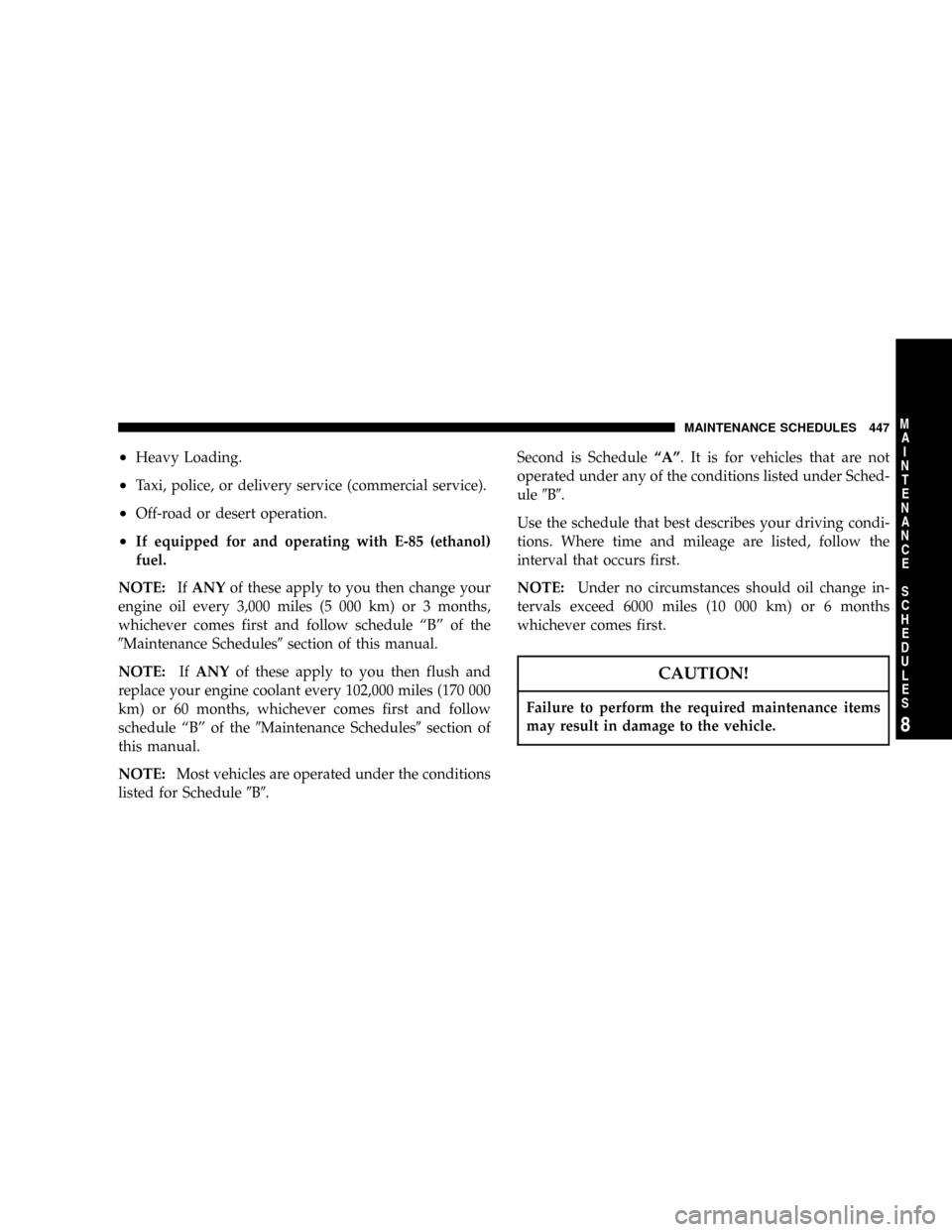
²Heavy Loading.
²Taxi, police, or delivery service (commercial service).
²Off-road or desert operation.
²If equipped for and operating with E-85 (ethanol)
fuel.
NOTE:IfANYof these apply to you then change your
engine oil every 3,000 miles (5 000 km) or 3 months,
whichever comes first and follow schedule ªBº of the
9Maintenance Schedules9section of this manual.
NOTE:IfANYof these apply to you then flush and
replace your engine coolant every 102,000 miles (170 000
km) or 60 months, whichever comes first and follow
schedule ªBº of the9Maintenance Schedules9section of
this manual.
NOTE:Most vehicles are operated under the conditions
listed for Schedule9B9.Second is ScheduleªAº. It is for vehicles that are not
operated under any of the conditions listed under Sched-
ule9B9.
Use the schedule that best describes your driving condi-
tions. Where time and mileage are listed, follow the
interval that occurs first.
NOTE:Under no circumstances should oil change in-
tervals exceed 6000 miles (10 000 km) or 6 months
whichever comes first.
CAUTION!
Failure to perform the required maintenance items
may result in damage to the vehicle.
MAINTENANCE SCHEDULES 447
8
M
A
I
N
T
E
N
A
N
C
E
S
C
H
E
D
U
L
E
S