steering wheel DODGE POWER WAGON 2007 2.G Owner's Manual
[x] Cancel search | Manufacturer: DODGE, Model Year: 2007, Model line: POWER WAGON, Model: DODGE POWER WAGON 2007 2.GPages: 492, PDF Size: 8.25 MB
Page 273 of 492
water 30 inches deep at a maximum speed of 5 mph, both
with an entrance ramp angle of 1.3 degrees.
CAUTION!
The door sill height is 25 inches. Water may intrude
into the interior of the vehicle at greater depths.
Simultaneous Brake And Throttle Operation
Many off-road driving conditions require the simulta-
neous use of the brake and throttle (two footed driving).
When climbing rocks, logs, or other stepped objects,
using light brake pressure with light throttle will keep the
vehicle from jerking or lurching. This technique is also
used when you need to stop and restart a vehicle on a
steep incline.
The Basics Of Off-Road Driving
You will encounter many types of terrain driving off-
road. You should be familiar with the terrain and area
before proceeding. There are many types of surface
conditions: hard packed dirt, gravel, rocks, grass, sand,
mud, snow and ice. Every surface has a different effect on
your vehicle's steering, handling and traction. Control-
ling your vehicle is one of the keys to successful off-road
driving, so always keep a firm grip on the steering wheel
and maintain a good driving posture. Avoid sudden
accelerations, turns or braking. In most cases there are no
road signs, posted speed limits or signal lights. Therefore
you will need to use your own good judgment on what is
safe and what isn't. When on a trail you should always be
looking ahead for surface obstacles and changes in
terrain. The key is to plan your future driving route while
remembering what you are currently driving over.
272 STARTING AND OPERATING
Page 274 of 492
CAUTION!
Never park your vehicle over dry grass or other
combustible materials. The heat from your vehicle
exhaust system could cause a fire.
WARNING!
Always wear your seat belt and firmly tie down
cargo. Unsecured cargo can become projectiles in an
off-road situation.
When To Use Low Range
When driving off-road, shift into 4L (Low range) for
additional traction or to improve handling and control on
slippery or difficult terrain. Due to the lower gearing, low
range will allow the engine to operate in a higher power
range. This will allow you to idle over obstacles anddown hills, with improved control and less effort. Also,
use 4L (Low range) in rain, ice, snow, mud, sand, to get
heavy loads rolling, improve traction, or whenever 4H
(High range) traction will not do the job.
Driving in Snow, Mud and Sand
There is a drastic reduction in traction when driving in
snow, mud or sand. The vehicle will be less responsive to
steering, acceleration and braking inputs. Therefore you
should accelerate slowly, leave greater stopping distances
and avoid abrupt vehicle maneuvers. You want to keep a
slow constant steady pace. The key is to maintain the
vehicle's momentum.
²Snow± In heavy snow or for additional control and
traction at slower speeds, shift the transmission to a
low gear and shift the transfer case to 4L (Low) if
necessary. Don't shift to a lower gear than necessary to
maintain headway. Over-revving the engine can spin
the wheels and traction will be lost. If you start to slow
STARTING AND OPERATING 273
5
Page 275 of 492
to a stop, try turning your steering wheel no more than
a1¤4turn quickly back and forth, while still applying
throttle. This will allow the tires to get a fresh9bite9
and help maintain your momentum.
CAUTION!
On icy or slippery roads, do not downshift at high
engine rpm's or vehicle speeds because engine brak-
ing may cause skidding and loss of control.
²Mud± Deep mud creates a great deal of suction
around the tires and is very difficult to get through.
You should use 4L (low range) with a gear low enough
to maintain your momentum without shifting. If you
start to slow to a stop, try turning your steering wheel
no more than a
1¤4turn quickly back and forth for
additional traction. Mud holes pose an increased
threat of vehicle damage and getting stuck. They arenormally full of debris from previous vehicles getting
stuck. As a good practice before entering any mud
hole, get out and determine how deep it is, if there are
any hidden obstacles and if the vehicle can be safely
recovered if stuck.
²Sand± Soft sand is very difficult to travel through
with full tire pressure. When crossing soft sandy spots
in a trail maintain your vehicle's momentum and do
not stop. The key to driving in soft sand is to use the
appropriate tire pressure, accelerating slowly, avoid-
ing abrupt maneuvers and maintaining the vehicle's
momentum. If you are going to be driving on large soft
sandy areas or dunes, reduce your tire pressure to a
minimum of 15 psi (103 kPa) to allow for a greater tire
surface area. Reduced tire pressure will drastically
improve your traction and handling, while driving on
the soft sand, but you must return the tires to normal
274 STARTING AND OPERATING
Page 276 of 492
air pressure before driving on pavement or other hard
surfaces. Be sure you have a way to air the tires back
up prior to reducing the pressure.
CAUTION!
Reduced tire pressures may cause tire unseating and
total loss of air pressure. To reduce the risk of tire
unseating, while at a reduced tire pressure, reduce
your speed and avoid sharp turns or abrupt maneu-
vers.
Crossing Obstacles (Rocks And Other High
Points)
While driving off road, you will encounter many types of
terrain. These varying types of terrain bring different
types of obstacles. Before proceeding review the path
ahead to determine the correct approach and your ability
to safely recover the vehicle if something goes wrong.Keeping a firm grip on the steering wheel, bring the
vehicle to a complete stop and then inch the vehicle
forward until it makes contact with the object. Apply the
throttle lightly while holding a light brake pressure and
ease the vehicle up and over the object.
WARNING!
Crossing obstacles can cause abrupt steering system
loading which could cause you to loose control of
your vehicle.
Using A Spotter
There are many times where it is hard to see the obstacle
or determine the correct path. Determining the correct
path can be extremely difficult when you are confronting
many obstacles. In these cases have someone guide you
over, through, or around the obstacle. Have the person
STARTING AND OPERATING 275
5
Page 279 of 492
CAUTION!
Winching or rocking the vehicle off hard objects
increases the risk of underbody damage.
Hill Climbing
Hill climbing requires good judgment and a good under-
standing of your abilities and your vehicle's limitations.
Hills can cause serious problems. Some are just too steep
to climb and should not be attempted. You should always
feel confident with the vehicle and your abilities. You
should always climb hills straight up and down. Never
attempt to climb a hill on an angle.
²Before Climbing A Steep Hill± As you approach a
hill consider its grade or steepness. Determine if it is
too steep. Look to see what the traction is on the hill
side trail. Is the trail straight up and down? What is on
top and the other side? Are there ruts, rocks, branchesor other obstacles on the path? Can you safely recover
the vehicle if something goes wrong? If everything
looks good and you feel confident, then change trans-
mission into a lower gear, shift the transfer case into 4L
(Low) and proceed with caution. You should use first
gear and 4L (Low) for very steep hills.
²Driving Up Hill± Once you have determined your
ability to proceed and have shifted into the appropri-
ate gear, line your vehicle up for the straightest
possible run. Accelerate with an easy constant throttle
and apply more power as you start up the hill. Do not
race forward into a steep grade, the abrupt change of
grade could cause you to lose control. If the front end
begins to bounce, ease off the throttle slightly to bring
all four tires back on the ground. As you approach the
crest of the hill ease off the throttle and slowly proceed
over the top. If the wheels start to slip as you approach
the crest of a hill, ease off the accelerator and maintain
headway by turning the steering wheel no more than
278 STARTING AND OPERATING
Page 286 of 492
CAUTION!
Pulling the vehicle off an obstacle, without first
clearing the object, may result in additional under-
body damage.
²Rock Cycling Your Vehicle± Rock cycling your ve-
hicle is one of the easiest, fastest and most commonly
used methods. This simply involves shifting your
vehicle from drive to reverse, while applying throttle
after each shift. During this process, for additional
traction, try turning your steering wheel quickly back
and forth no more than a
1¤4turn. If you are stuck in
mud, sand, or snow try spinning your tires during this
process to clean the debris from the tread and improve
the traction. You want to create a rocking motion with
the vehicle. This helps build vehicle momentum,
which hopefully gets you out. Remember to ease off
and on the accelerator before and after the shift. If aftera few rock cycles your vehicle is not free, stop and try
another method of recovery. Continuous rock cycling
will only cause unnecessary damage to your vehicle
and the environment.
CAUTION!
Damage can occur when spinning your tires at an
excessive high speed. Do not spin your tires faster
than an indicated 35 mph
²Using The Tow Hooks With A Tow Strap±Tow
straps are a quick and easy way to recover your
vehicle from minor situations if you have a secondary
vehicle which is not stuck. The tow hooks on your
vehicle are designed to take the abusive force gener-
ated during vehicle recovery. Do not use the bumper
or any other vehicle component as an attachment
point. Using tow straps requires coordination between
STARTING AND OPERATING 285
5
Page 289 of 492
WARNING!
Winch cables are under high tension when in use
and can become a projectile if they fail. Never stand
over or straddle the winch cable. Never jerk or
overload the winch cable. Never stand in front of the
vehicle while winching. Failure to follow these in-
structions can result in serious or fatal injury.
After Driving Off-Road
Off-road operation puts more stress on your vehicle than
does most on-road driving. After driving off-road, it is
always a good idea to check for damage.
²Completely inspect the underbody of your vehicle.
Check tires, body structure, steering, suspension, and
exhaust system for damage.
²Check threaded fasteners for looseness, particularly on
the chassis, drivetrain components, steering, and sus-
pension. Retighten them, if required, and torque to the
values specified in the Service Manual.
²Check for accumulations of plants or brush. These
things could be a fire hazard, or they might hide
damage to fuel lines, brake hoses, axle pinion seals,
and propeller shafts.
²After extended operation in mud, sand, water, or
similar dirty conditions, have brake drums and rotors,
brake linings, and axle yokes inspected and cleaned as
soon as possible.
²If you experience unusual vibration after driving in
mud, slush or similar conditions, check the wheels for
packed material. Packed foreign material can cause a
wheel imbalance and cleaning the wheels will correct
the situation.
288 STARTING AND OPERATING
Page 313 of 492
POWER STEERING
The standard power steering system will give you good
vehicle response and increased ease of maneuverability
in tight spaces. The system will provide mechanical
steering capability if power assist is lost.
If for some reason, the power assist is interrupted, it will
still be possible to steer your vehicle. Under these condi-
tions you will observe a substantial increase in steering
effort, especially at very low vehicle speeds and during
parking maneuvers.
NOTE:Increased noise levels at the end of the steering
wheel travel are considered normal and does not indicate
that there is a problem with the power steering system.
Upon initial start-up in cold weather, the power steering
pump may make noise for a short period of time. This is
due to the cold, thick fluid in the steering system. This
noise should be considered normal, and does not in any
way damage the steering system.WARNING!
Continued operation with reduced power steering
assist could pose a safety risk to yourself and others.
Service should be obtained as soon as possible.
CAUTION!
Prolong operation of the steering system at the end
of the steering wheel travel will increase the steering
fluid temperature and should be avoided when
possible. Damage to the power steering pump may
occur.
312 STARTING AND OPERATING
Page 332 of 492
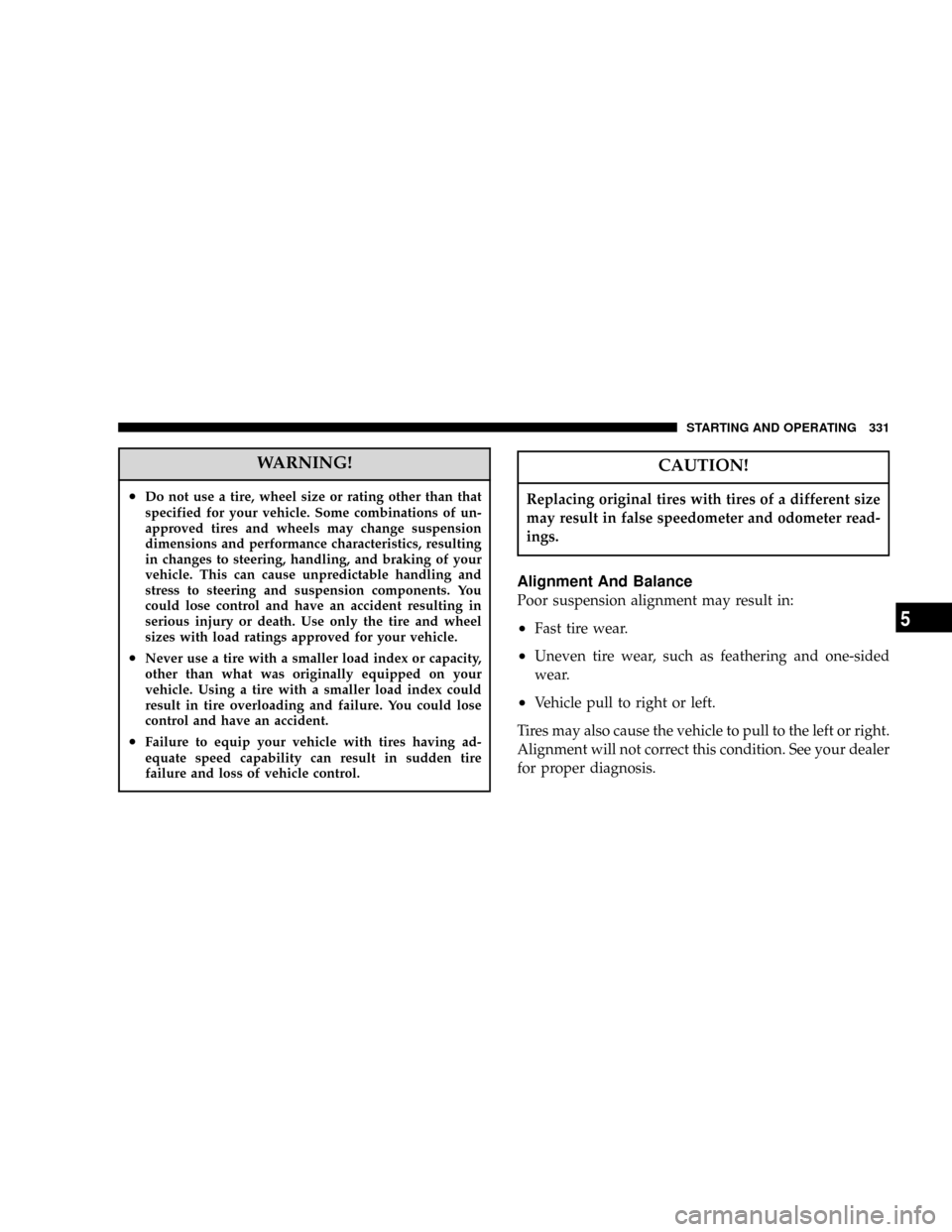
WARNING!
²Do not use a tire, wheel size or rating other than that
specified for your vehicle. Some combinations of un-
approved tires and wheels may change suspension
dimensions and performance characteristics, resulting
in changes to steering, handling, and braking of your
vehicle. This can cause unpredictable handling and
stress to steering and suspension components. You
could lose control and have an accident resulting in
serious injury or death. Use only the tire and wheel
sizes with load ratings approved for your vehicle.
²Never use a tire with a smaller load index or capacity,
other than what was originally equipped on your
vehicle. Using a tire with a smaller load index could
result in tire overloading and failure. You could lose
control and have an accident.
²Failure to equip your vehicle with tires having ad-
equate speed capability can result in sudden tire
failure and loss of vehicle control.
CAUTION!
Replacing original tires with tires of a different size
may result in false speedometer and odometer read-
ings.
Alignment And Balance
Poor suspension alignment may result in:
²Fast tire wear.
²Uneven tire wear, such as feathering and one-sided
wear.
²Vehicle pull to right or left.
Tires may also cause the vehicle to pull to the left or right.
Alignment will not correct this condition. See your dealer
for proper diagnosis.
STARTING AND OPERATING 331
5
Page 383 of 492
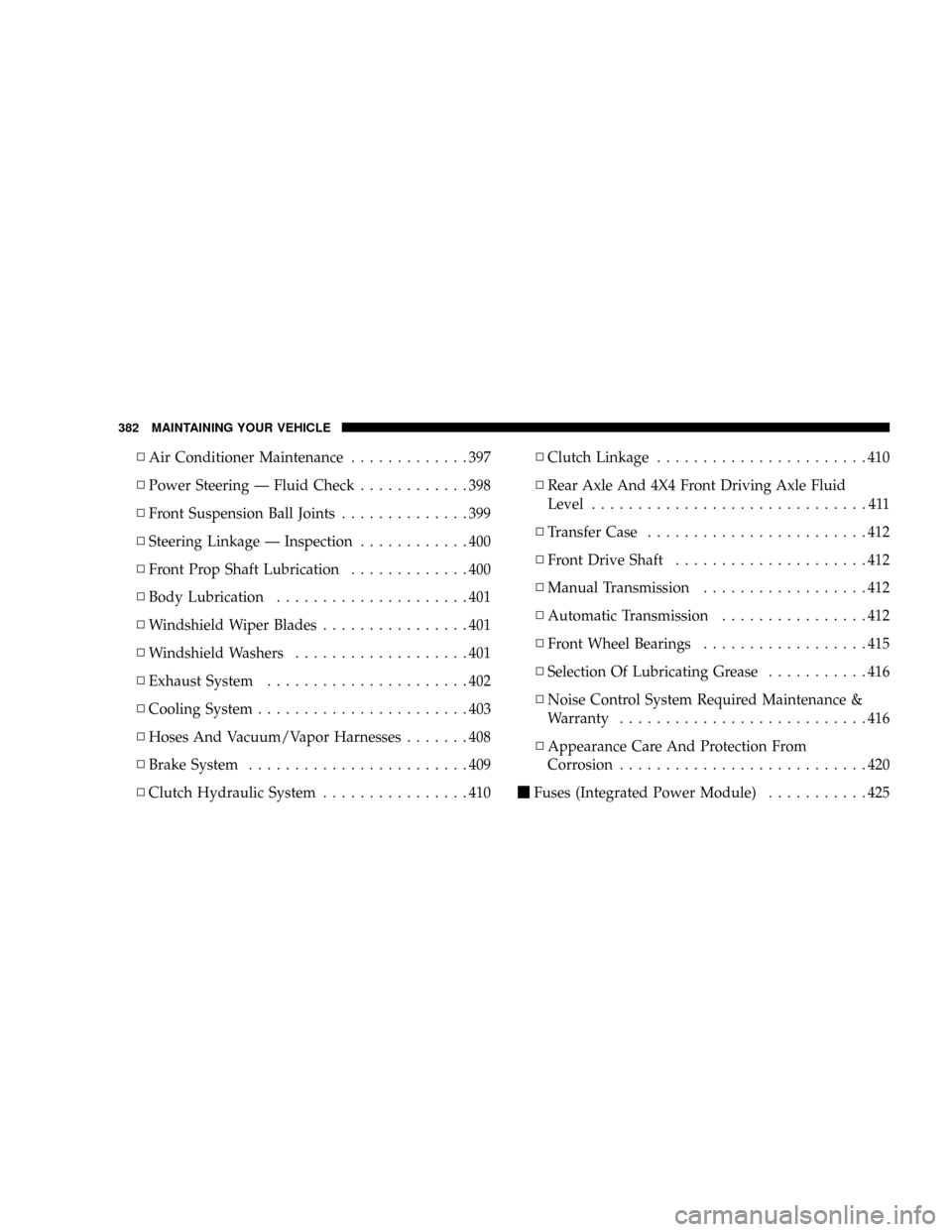
NAir Conditioner Maintenance.............397
NPower Steering Ð Fluid Check............398
NFront Suspension Ball Joints..............399
NSteering Linkage Ð Inspection............400
NFront Prop Shaft Lubrication.............400
NBody Lubrication.....................401
NWindshield Wiper Blades................401
NWindshield Washers...................401
NExhaust System......................402
NCooling System.......................403
NHoses And Vacuum/Vapor Harnesses.......408
NBrake System........................409
NClutch Hydraulic System................410NClutch Linkage.......................410
NRear Axle And 4X4 Front Driving Axle Fluid
Level..............................411
NTransfer Case........................412
NFront Drive Shaft.....................412
NManual Transmission..................412
NAutomatic Transmission................412
NFront Wheel Bearings..................415
NSelection Of Lubricating Grease...........416
NNoise Control System Required Maintenance &
Warranty...........................416
NAppearance Care And Protection From
Corrosion...........................420
mFuses (Integrated Power Module)...........425
382 MAINTAINING YOUR VEHICLE