warning DODGE POWER WAGON 2007 2.G Owner's Manual
[x] Cancel search | Manufacturer: DODGE, Model Year: 2007, Model line: POWER WAGON, Model: DODGE POWER WAGON 2007 2.GPages: 492, PDF Size: 8.25 MB
Page 47 of 492
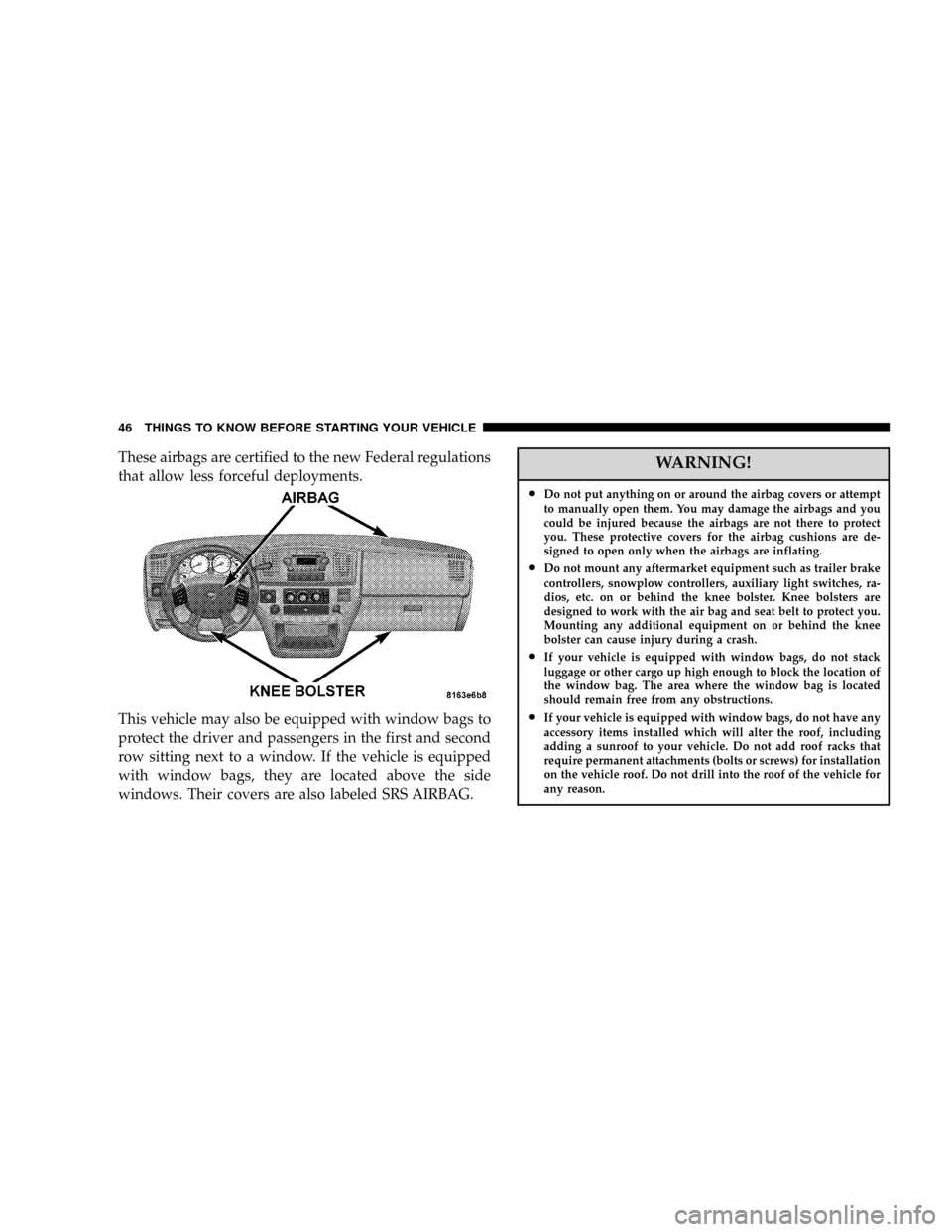
These airbags are certified to the new Federal regulations
that allow less forceful deployments.
This vehicle may also be equipped with window bags to
protect the driver and passengers in the first and second
row sitting next to a window. If the vehicle is equipped
with window bags, they are located above the side
windows. Their covers are also labeled SRS AIRBAG.WARNING!
²Do not put anything on or around the airbag covers or attempt
to manually open them. You may damage the airbags and you
could be injured because the airbags are not there to protect
you. These protective covers for the airbag cushions are de-
signed to open only when the airbags are inflating.
²Do not mount any aftermarket equipment such as trailer brake
controllers, snowplow controllers, auxiliary light switches, ra-
dios, etc. on or behind the knee bolster. Knee bolsters are
designed to work with the air bag and seat belt to protect you.
Mounting any additional equipment on or behind the knee
bolster can cause injury during a crash.
²If your vehicle is equipped with window bags, do not stack
luggage or other cargo up high enough to block the location of
the window bag. The area where the window bag is located
should remain free from any obstructions.
²If your vehicle is equipped with window bags, do not have any
accessory items installed which will alter the roof, including
adding a sunroof to your vehicle. Do not add roof racks that
require permanent attachments (bolts or screws) for installation
on the vehicle roof. Do not drill into the roof of the vehicle for
any reason.
46 THINGS TO KNOW BEFORE STARTING YOUR VEHICLE
Page 49 of 492
seats should ride properly buckled up in the rear seat.
Never allow children to slide the shoulder belt behind
them or under their arm.
²All occupants should use their seat belts properly.
²The driver and front passenger seats should be moved
back as far as practical to allow the airbag room to
inflate.
WARNING!
²Relying on the airbags alone could lead to more
severe injuries in a collision. The airbags work
with your seat belt to restrain you properly. In
some collisions the airbags won't deploy at all.
Always wear your seat belts even though you
have airbags.
²Being too close to the steering wheel or instru-
ment panel during airbag deployment could cause
serious injury. Airbags need room to inflate. Sit
back, comfortably extending your arms to reach
the steering wheel or instrument panel.
²If the vehicle has window airbags, they also need
room to inflate. Do not lean against the door or
window. Sit upright in the center of the seat.
48 THINGS TO KNOW BEFORE STARTING YOUR VEHICLE
Page 51 of 492
²The airbag control module also monitors the readiness
of the electronic parts of the system whenever the
ignition switch is in the START or RUN positions.
These include all of the items listed above except the
knee bolsters, the instrument panel, and the steering
wheel and column. If the key is in the9Off9position, in
the ACC position or not in the ignition, the airbags are
not on and will not inflate
²The airbag control module also turns on the AIR BAG
light in the instrument panel for 6 to 8 seconds when
the ignition is first turned on, then turns the light off.
²If it detects a malfunction in any part of the
system, it turns on the light either momen-
tarily or continuously. The instrument clus-
ter will flash the seat belt indicator if it
detects a fault with the airbag indicator.
WARNING!
Ignoring the AIR BAG light in your instrument
panel could mean you won't have the airbags to
protect you in a collision. If the light does not come
on, stays on after you start the vehicle, or if it comes
on as you drive, have the airbag system checked
right away.
²When the airbag control module detects a collision
requiring the airbags, it signals the inflator units. A
large quantity of nontoxic gas is generated to inflate
the airbags. The airbag covers separate and fold out of
the way as the airbags inflate to their full size. The
airbags fully inflate in milliseconds. This is less time
than it takes you to blink your eyes. The airbags then
quickly deflate while helping to restrain the driver and
front passenger. The driver's front airbag deflates
through vents towards the instrument panel. The
50 THINGS TO KNOW BEFORE STARTING YOUR VEHICLE
Page 53 of 492
because the infant has a medical condition which
makes it necessary for the driver to be able to see the
infant,
²is a child, age 1 to 12 who must ride in the front seat
because there is no rear seat, because there is no rear
seat position available, or because the child has a
medical condition which makes it necessary for the
driver to be able to see the child,
²has a medical condition which makes passenger airbag
inflation (deployment) a greater risk for the passenger
than the risk of hitting the dashboard (instrument
panel) or windshield in a crash.
WARNING!
Whenever an airbag is turned off, even a lap/
shoulder belted passenger may hit their head, neck,
or chest on the dashboard (instrument panel) or
windshield in a crash. This may result in serious
injury or death.
To Shut Off the Passenger Airbag (Standard Cab Ve-
hicles Only)
Place the ignition key in the Passenger Airbag On/Off
Switch, push the key in and turn clockwise, and remove
the key from the switch. This will shut off the passenger
side airbag. The ªOffº light near the switch will illumi-
nate when the ignition switch is turned to the ON
position.
52 THINGS TO KNOW BEFORE STARTING YOUR VEHICLE
Page 55 of 492
irritation, move to fresh air. If the irritation continues,
see your doctor. If these particles settle on your
clothing, follow the garment manufacturer's instruc-
tions for cleaning.
²It is not advisable to drive your vehicle after the
airbags have deployed. If you are involved in another
collision, the airbags will not be in place to protect you.
WARNING!
Deployed airbags can't protect you in another colli-
sion. Have the airbags replaced by an authorized
dealer as soon as possible.
Window Airbags Supplemental Restraint System
(SRS)ÐIf Equipped
The window airbag control module determines if a side
collision is severe enough to require the side airbags to
inflate. The window airbag control module will not
detect roll over, front or rear collisions.
The airbag control module monitors the readiness of the
electronic parts of the system whenever the ignition
switch is in the9START9or9RUN9positions. These
include all of the items listed above. The airbag control
module also turns on the AIRBAG light in the instrument
panel for 6 to 8 seconds when the ignition is first turned
on as a diagnostic or system check, then turns the light
off. If it detects a malfunction in any part of the system,
it turns on the light either momentarily or continuously.
The side (window) impact SRS Airbags are designed to
activate only in certain side collisions. When the airbag
control module detects a collision requiring the window
54 THINGS TO KNOW BEFORE STARTING YOUR VEHICLE
Page 56 of 492
bags to inflate, it signals the inflators on the crash side of
the vehicle. A quantity of nontoxic gas is generated to
inflate the window bag. The inflating window bag
pushes the side pillar molding out of the way and covers
the window. The airbag inflates in about 30 milliseconds
(about one-quarter of the time it takes to blink your eyes)
with enough force to injure you if you are not belted and
seated properly, or if items are positioned in the area
where the window bag inflates. This especially applies to
children. The window bag is only about 3
1¤2inches (8.9
cm) thick when it is inflated.
Enhanced Accident Response System
If the airbags deploy after an impact and the electrical
system remains functional, vehicles equipped with
power door locks will unlock automatically. In addition,
approximately 10 seconds after the vehicle has stopped
moving, the interior lights will light until the ignition
switch is turned off.
Maintaining Your Airbag Systems
WARNING!
²Modifications to any part of the airbag system
could cause it to fail when you need it. You could
be injured because the airbags are not there to
protect you. Do not modify the components or
wiring, including adding any kind of badges or
stickers to the steering wheel hub trim cover or
the upper right side of the instrument panel. Do
not modify the front bumper, vehicle body struc-
ture, or frame.
²You need proper knee impact protection in a
collision. Do not mount or locate any aftermarket
equipment on or behind the knee bolster.
²It is dangerous to try to repair any part of the
airbag system yourself. Be sure to tell anyone who
works on your vehicle that it has airbags.
THINGS TO KNOW BEFORE STARTING YOUR VEHICLE 55
2
Page 58 of 492
crash investigations initiated by DaimlerChrysler Corpo-
ration, such investigations may be requested by custom-
ers, insurance carriers, government officials, and profes-
sional crash researchers, such as those associated with
universities, and with hospital and insurance organiza-
tions.
In the event that an investigation is undertaken by
DaimlerChrysler Corporation (regardless of initiative),
the company or its designated representative will first
obtain permission of the appropriate custodial entity for
the vehicle (usually the vehicle owner or lessee) before
accessing the electronic data stored, unless ordered to
download data by a court with legal jurisdiction (i.e.,
pursuant to a warrant). A copy of the data will be
provided to the custodial entity upon request. General
data that does not identify particular vehicles or crashes
may be released for incorporation in aggregate crash
databases, such as those maintained by the US govern-
ment and various states. Data of a potentially sensitivenature, such as would identify a particular driver, ve-
hicle, or crash, will be treated confidentially. Confidential
data will not be disclosed by DaimlerChrysler Corpora-
tion to any third party except when:
1. Used for research purposes, such as to match data
with a particular crash record in an aggregate database,
provided confidentiality of personal data is thereafter
preserved
2. Used in defense of litigation involving a
DaimlerChrysler Corporation product
3. Requested by police under a legal warrant
4. Otherwise required by law
Data Parameters that May Be Recorded:
²Diagnostic trouble code(s) and warning lamp status
for electronically-controlled safety systems, including
the airbag system
THINGS TO KNOW BEFORE STARTING YOUR VEHICLE 57
2
Page 59 of 492
²Airbag disable lamp status (if equipped)
²9Time9of airbag deployment (in terms of ignition
cycles and vehicle mileage)
²Airbag deployment level (if applicable)
²Seatbelt status
²Brake status (service and parking brakes)
²Accelerator status (including vehicle speed)
²Engine control status (including engine speed)
²Cruise control status
Child Restraint
Everyone in your vehicle needs to be buckled up all the
time Ð babies and children, too. Every state in the United
States and all Canadian provinces require that small
children ride in proper restraint systems. This is the law,
and you can be prosecuted for ignoring it.Children 12 years and under should ride properly buck-
led up in a rear seat, if available. According to crash
statistics, children are safer when properly restrained in
the rear seats rather than in the front.
WARNING!
In a collision, an unrestrained child, even a tiny
baby, can become a missile inside the vehicle. The
force required to hold even an infant on your lap can
become so great that you could not hold the child, no
matter how strong you are. The child and others
could be badly injured. Any child riding in your
vehicle should be in a proper restraint for the child's
size.
58 THINGS TO KNOW BEFORE STARTING YOUR VEHICLE
Page 61 of 492
cannot sit with knees bent over the vehicle's seat
cushion while the child's back is against the seat back,
they should use a belt-positioning-booster seat. The
child and booster seat are held in the vehicle by the
lap/shoulder belt. (Some booster seats are equipped
with a front shield and are held in the vehicle by the
lap portion.) For further information refer to
www.seatcheck.org.WARNING!
²Improper installation can lead to failure of an
infant or child restraint. It could come loose in a
collision. The child could be badly injured or
killed. Follow the manufacturer's directions ex-
actly when installing an infant or child restraint.
²A rearward facing child restraint should only be
used in a rear seat, or in the front seat if the
passenger's front airbag is Off. If the airbag is left
On, a rearward facing child restraint in the front
seat may be struck by a deploying passenger
airbag which may cause severe or fatal injury to
the infant.
60 THINGS TO KNOW BEFORE STARTING YOUR VEHICLE
Page 63 of 492
around, and insert the latch plate into the buckle
again. If you still can't make the child restraint secure,
try a different seating position.
²Buckle the child into the seat according to the child
restraint manufacturer's directions.
²When your child restraint is not in use, secure it in the
vehicle with the seat belt or remove it from the vehicle.
Do not leave it loose in the vehicle. In a sudden stop or
collision, it could strike the occupants or seat backs
and cause serious personal injury.
WARNING!
Improper installation can lead to failure of an infant
or child restraint. It could come loose in a collision.
The child could be badly injured or killed. Follow
the manufacturer's directions exactly when install-
ing an infant or child restraint.
Lower Anchors and Tether for CHildren (LATCH)
Each vehicle is equipped with the child restraint anchor-
age system called LATCH, which stands for Lower
Anchors and Tether for CHildren. LATCH child restraint
anchorage systems are installed in the Standard Cab
passenger seat position and the Quad Cab rear seat
outboard positions. LATCH equipped seating positions
feature both lower anchor bars, located at the back of the
seat cushion, and tether strap anchorages, located behind
the seatback (refer to Child Restraint Tether Anchor later
in this section).
62 THINGS TO KNOW BEFORE STARTING YOUR VEHICLE