air condition DODGE POWER WAGON 2007 2.G Owner's Guide
[x] Cancel search | Manufacturer: DODGE, Model Year: 2007, Model line: POWER WAGON, Model: DODGE POWER WAGON 2007 2.GPages: 492, PDF Size: 8.25 MB
Page 409 of 492
²Check coolant freeze point in the radiator and in the
coolant recovery bottle. If antifreeze needs to be
added, contents of coolant recovery bottle must also be
protected against freezing.
²If frequent coolant additions are required, or if the
level in the coolant recovery bottle does not drop when
the engine cools, the cooling system should be pres-
sure tested for leaks.
²Maintain coolant concentration at 50% HOAT engine
coolant (minimum) and distilled water for proper
corrosion protection of your engine which contains
aluminum components.
²Make sure that the radiator and coolant recovery
bottle overflow hoses are not kinked or obstructed.
²Keep the front of the radiator clean. If your vehicle is
equipped with air conditioning, keep the front of the
condenser clean, also.
²Do not change the thermostat for summer or winter
operation. If replacement is ever necessary, install
ONLY the correct type thermostat. Other designs may
result in unsatisfactory coolant performance, poor gas
mileage, and increased emissions.
Hoses And Vacuum/Vapor Harnesses
Inspect surfaces of hoses and nylon tubing for evidence
of heat and mechanical damage. Hard or soft spots,
brittle rubber, cracking, tears, cuts, abrasions, and exces-
sive swelling indicate deterioration of the rubber.
Pay particular attention to those hoses nearest to high
heat sources such as the exhaust manifold. Inspect hose
routing to be sure hoses do not come in contact with any
heat source or moving component which may cause heat
damage or mechanical wear.
Insure nylon tubing in these areas has not melted or
collapsed.
408 MAINTAINING YOUR VEHICLE
Page 418 of 492
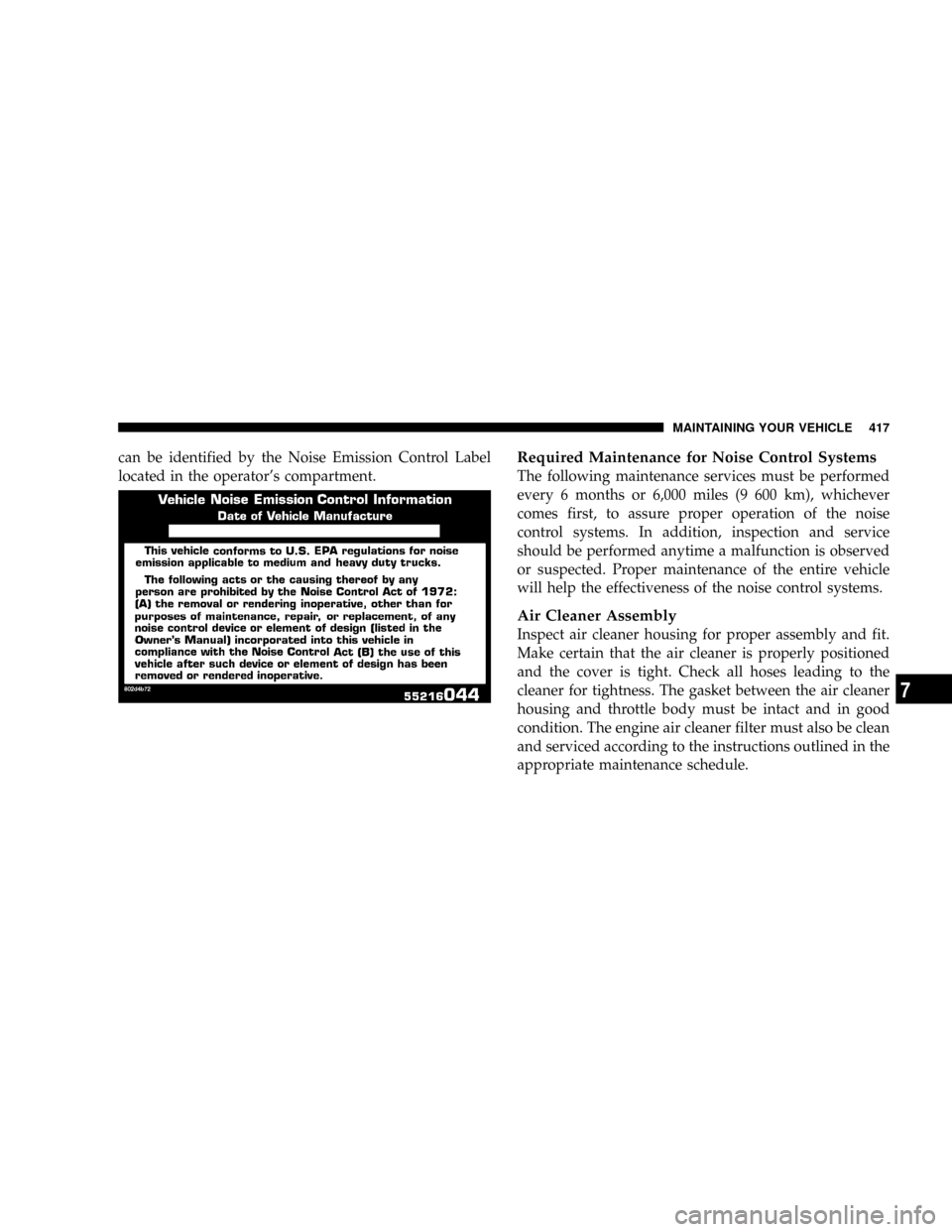
can be identified by the Noise Emission Control Label
located in the operator's compartment.Required Maintenance for Noise Control Systems
The following maintenance services must be performed
every 6 months or 6,000 miles (9 600 km), whichever
comes first, to assure proper operation of the noise
control systems. In addition, inspection and service
should be performed anytime a malfunction is observed
or suspected. Proper maintenance of the entire vehicle
will help the effectiveness of the noise control systems.
Air Cleaner Assembly
Inspect air cleaner housing for proper assembly and fit.
Make certain that the air cleaner is properly positioned
and the cover is tight. Check all hoses leading to the
cleaner for tightness. The gasket between the air cleaner
housing and throttle body must be intact and in good
condition. The engine air cleaner filter must also be clean
and serviced according to the instructions outlined in the
appropriate maintenance schedule.
MAINTAINING YOUR VEHICLE 417
7
Page 421 of 492
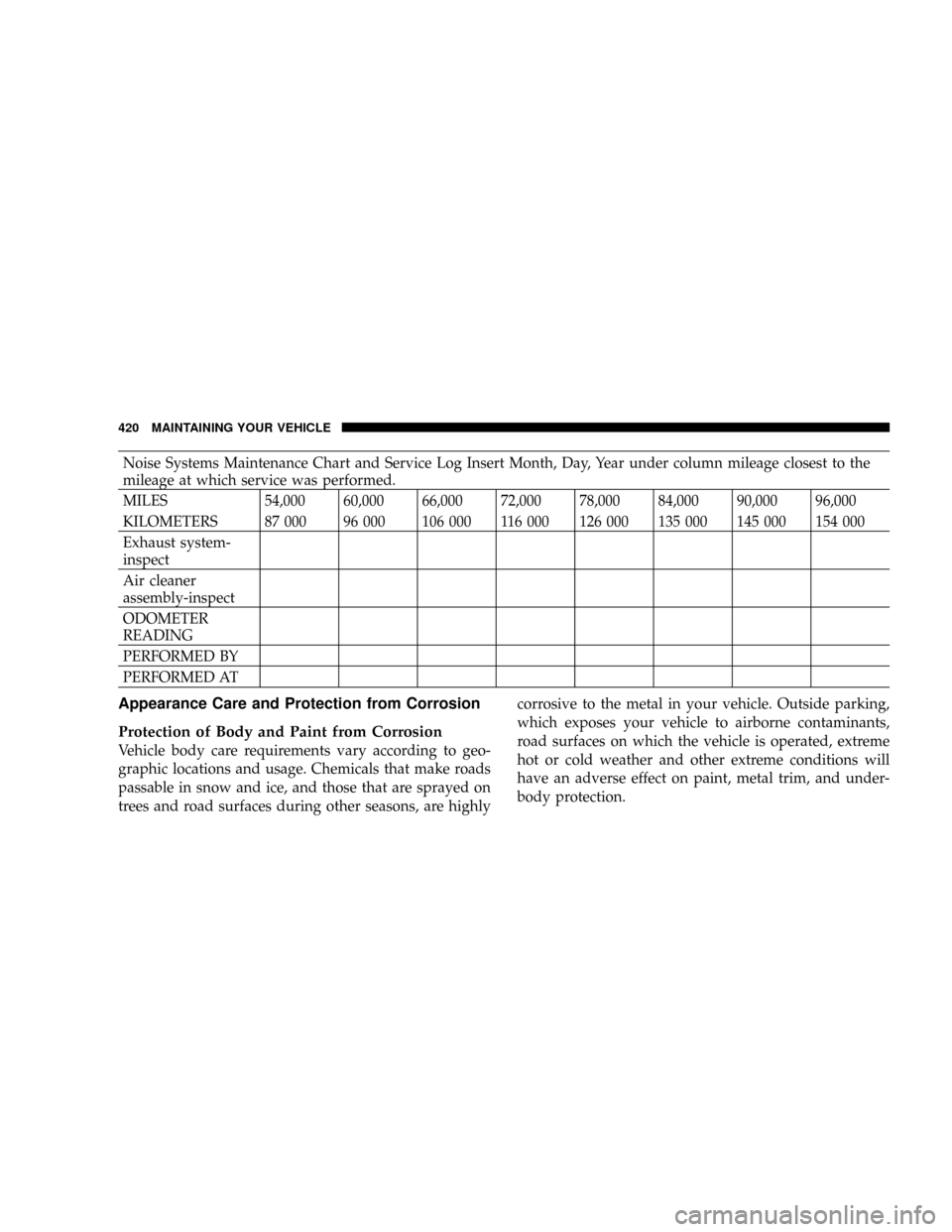
Noise Systems Maintenance Chart and Service Log Insert Month, Day, Year under column mileage closest to the
mileage at which service was performed.
MILES 54,000 60,000 66,000 72,000 78,000 84,000 90,000 96,000
KILOMETERS 87 000 96 000 106 000 116 000 126 000 135 000 145 000 154 000
Exhaust system-
inspect
Air cleaner
assembly-inspect
ODOMETER
READING
PERFORMED BY
PERFORMED AT
Appearance Care and Protection from Corrosion
Protection of Body and Paint from Corrosion
Vehicle body care requirements vary according to geo-
graphic locations and usage. Chemicals that make roads
passable in snow and ice, and those that are sprayed on
trees and road surfaces during other seasons, are highlycorrosive to the metal in your vehicle. Outside parking,
which exposes your vehicle to airborne contaminants,
road surfaces on which the vehicle is operated, extreme
hot or cold weather and other extreme conditions will
have an adverse effect on paint, metal trim, and under-
body protection.
420 MAINTAINING YOUR VEHICLE
Page 431 of 492
VEHICLE STORAGE
If you are storing your vehicle for more than 21 days, we
recommend that you take the following steps to mini-
mize the drain on your vehicle's battery:
²Disconnect the Ignition-Off Draw fuse (I.O.D.) fuse
located in the Integrated Power Module, located in the
engine compartment. The I.O.D. cavity includes a
snap-in retainer that allows the fuse to be discon-
nected, without removing it from the fuse block.
²The electronic shift transfer case should be placed in
the 4HI mode and kept in this position to minimize the
battery drain.
²As an alternative to the above steps you may, discon-
nect the negative cables from both batteries.
²Anytime you store your vehicle, or keep it out of
service (i.e. vacation) for two weeks or more, run the
air conditioning system at idle for about five minutesin the fresh air and high blower setting. This will
insure adequate system lubrication to minimize the
possibility of compressor damage when the system is
started again.
NOTE:When reinstalling the IOD fuse push firmly until
fully seated, the gages in the Instrument Cluster will do
a full sweep, when the ignition key is cycled to RUN. This
is a normal condition.
REPLACEMENT LIGHT BULBS
LIGHT BULBS Ð Inside Bulb No.
Overhead Console Lights............... TS212-2
Dome Light............................7679
All of the inside bulbs are brass or glass wedge base.
Aluminum base bulbs are not approved.
430 MAINTAINING YOUR VEHICLE
Page 447 of 492
EMISSION CONTROL SYSTEM MAINTENANCE
The ªScheduledº maintenance services, listed inbold
typein this section (Section 8) must be done at the times
or mileages specified to assure the continued proper
functioning of the emission control system. These, and all
other maintenance services included in this manual,
should be done to provide best vehicle performance and
reliability. More frequent maintenance may be needed for
vehicles in severe operating conditions such as dusty
areas and very short trip driving.
Inspection and service also should be done any time a
malfunction is suspected.
NOTE:Maintenance, replacement, or repair of the emis-
sion control devices and systems on your vehicle may be
performed by any automotive repair establishment or
individual using any automotive part which has been
certified pursuant to U.S. EPA or, in the State of Califor-
nia, California Air Resources Board regulations.
MAINTENANCE SCHEDULES
There are two maintenance schedules that show the
requiredservice for your vehicle.
First is ScheduleªBº. It is for vehicles that are operated
under the conditions that are listed below and at the
beginning of the schedule.
²Day or night temperatures are below 32É F (0É C).
²Stop and go driving.
²Extensive engine idling.
²Driving in dusty conditions.
²Short trips of less than 10 miles (16 km).
²More than 50% of your driving is at sustained high
speeds during hot weather, above 90É F C (32É).
²Trailer towing.
²Snowplowing.
446 MAINTENANCE SCHEDULES
8
M
A
I
N
T
E
N
A
N
C
E
S
C
H
E
D
U
L
E
S
Page 475 of 492
Adding Fuel........................... 339
Air Cleaner, Engine (Engine Air Cleaner Filter) . 393,417
Air Conditioner Maintenance............... 397
Air Conditioning Refrigerant.............397,398
Air Conditioning System................230,397
Air Conditioning System, Zone Control........ 233
Air Pressure, Tires....................323,332
Airbag..............................45,51
Airbag Light........................164,174
Airbag On/Off Switch..................... 51
Airbag, Side............................ 54
Alarm (Security Alarm).................18,176
Alarm System (Security Alarm)............... 18
Alignment and Balance................... 331
Alterations/Modifications, Vehicle............. 7
Antenna, Satellite Radio................... 223
Antifreeze (Engine Coolant)...........404,405,441
Disposal............................ 406
Anti-Lock Warning Light...............178,310Anti-Theft Security Alarm (Theft Alarm)........ 18
Anti-Theft System.....................18,176
Appearance Care........................ 420
Ashtray............................... 150
Automatic Dimming Mirror................. 84
Automatic Transaxle...................... 13
Interlock System........................ 16
Automatic Transmission
Adding Fluid......................... 413
Fluid and Filter Changes................. 415
Fluid Level Check...................412,413
Fluid Type........................414,443
Shift Indicator........................ 176
Shifting............................. 250
Special Additives...................... 415
Axle Fluid.......................... 411,443
Axle Lubrication (Axle Fluid)............... 411
Ball Joints............................. 399
474 INDEX