Transmission cooler radiator DODGE RAM 1500 1998 2.G Owner's Manual
[x] Cancel search | Manufacturer: DODGE, Model Year: 1998, Model line: RAM 1500, Model: DODGE RAM 1500 1998 2.GPages: 2627
Page 1495 of 2627
(6) Remove the wooden dowel rods and rubber
bands from the tappets.
(7) Lubricate the push rods with engine oil and
install in their original location.Verify that they
are seated in the tappets.
(8) Lubricate the valve tips with engine oil and
install the crossheads in their original locations.
(9) Lubricate the crossheads and push rod sockets
with engine oil and install the rocker arms and ped-
estals in their original locations. Tighten bolts to 36
N´m (27 ft. lbs.) torque.
(10)Verify valve lash adjustment (Refer to 9 -
ENGINE/CYLINDER HEAD/INTAKE/EXHAUST
VALVES & SEATS - STANDARD PROCEDURE).
(11) Install the cylinder head cover and reusable
gasket (Refer to 9 - ENGINE/CYLINDER HEAD/
CYLINDER HEAD COVER(S) - INSTALLATION).
(12) Install gear housing cover (Refer to 9 -
ENGINE/VALVE TIMING/GEAR HOUSING COVER
- INSTALLATION). Install front crankshaft dust
seal.
(13) Install the crankshaft damper with the speed
indicator ring (Refer to 9 - ENGINE/ENGINE
BLOCK/VIBRATION DAMPER - INSTALLATION).
(14) Install the fan support/hub assembly Refer to
(Refer to 7 - COOLING/ENGINE/RADIATOR FAN -
INSTALLATION).
(15) Install the power steering pump.
(16) Install accessory drive belt tensioner. Torque
bolt to 43 Nm (32 ft. lbs.).
(17) Install the accessory drive belt (Refer to 7 -
COOLING/ACCESSORY DRIVE/DRIVE BELTS -
INSTALLATION).
(18) Install the charge air cooler (with a/c con-
denser and auxiliary transmission oil cooler, if
equipped) and tighten the mounting bolts to 2 N´m
(17 in. lbs.) torque.
(19) Connect charge air cooler inlet and outlet
pipes. Tighten clamps to 11 N´m (95 in. lbs.) torque.
(20) Install the radiator upper support panel.
(21) Close radiator petcock and lower the radiator
into the engine compartment. Tighten the mounting
bolts to 11 N´m (95 in. lbs.) torque.
(22) Raise vehicle on hoist.
(23) Connect radiator lower hose and install
clamp.
(24) Connect transmission auxiliary oil cooler lines
(if equipped).
(25) Lower vehicle.
(26) Install the fan shroud and tighten the mount-
ing screws to 6 N´m (50 in. lbs.) torque.
(27) Install the electronically controlled viscous
fan/drive assembly. Connect harness connector.(Refer
to 7 - COOLING/ENGINE/RADIATOR FAN -
INSTALLATION).(28) Install the coolant recovery and windshield
washer fluid reservoirs to the fan shroud.
(29) Connect the coolant recovery hose to the radi-
ator filler neck.
(30) Add engine coolant (Refer to 7 - COOLING -
STANDARD PROCEDURE).
(31) Charge A/C system with refrigerant (if A/C
equipped) (Refer to 24 - HEATING & AIR CONDI-
TIONING/PLUMBING - STANDARD PROCEDURE).
(32) Connect the battery negative cables.
(33) Start engine and check for engine oil and cool-
ant leaks.
CONNECTING ROD BEARINGS
STANDARD PROCEDURE - CONNECTING ROD
BEARING AND CRANKSHAFT JOURNAL
CLEARANCE
(1) Measure the connecting rod bore with bearings
removedand the bolts tightened to 100 N´m (73 ft.
lbs.) torque..
(2) Measure the connecting rod bore with the bear-
ingsinstalledand the bolts tightened to 100 N´m
(73 ft. lbs.) torque.
Measure within 20É arc from each side of the part-
ing line. Also measure 90É from parting line.
Record the smallest and largest diameter.
Measure the diameter of the rod journal at the
location shown (Fig. 63). Calculate the average diam-
eter for each side of the journal.
Determine minimum bearing clearance by calculat-
ing the differance between the smallest connecting
rod bore diameter with the bearing installed and the
average diameter for each side of the crankshaft jour-
nal.
Determine the maximum bearing clearance by cal-
culating the difference between the largest connect-
ing rod bore diameter and the average diameter with
the bearing installed for each side of the crankshaft
journal.
DESCRIPTION MEASUREMENT
CONNECTING ROD
BORE, BEARINGS
REMOVEDMIN. 72.99 mm (2.874
in.)
MAX. 73.01 mm (2.875
in.)
CONNECTING ROD
BORE, BEARINGS
INSTALLEDMIN. 69.05 mm (2.719
in.)
MAX. 69.10 mm (2.720
in.)
9 - 272 ENGINE 5.9L DIESELDR
CAMSHAFT & BEARINGS (IN BLOCK) (Continued)
Page 1698 of 2627
FLUID
DESCRIPTION
The recommended fluid for the power steering sys-
tem is MopartATF +4.
MopartATF+4, when new is red in color. The
ATF+4 is dyed red so it can be identified from other
fluids used in the vehicle such as engine oil or anti-
freeze. The red color is not permanent and is not an
indicator of fluid condition, As the vehicle is driven,
the ATF+4 will begin to look darker in color and may
eventually become brown.THIS IS NORMAL.
ATF+4 also has a unique odor that may change with
age. Consequently, odor and color cannot be used to
indicate the fluid condition or the need for a fluid
change.
STANDARD PROCEDURE - POWER STEERING
FLUID LEVEL CHECKING
WARNING: FLUID LEVEL SHOULD BE CHECKED
WITH THE ENGINE OFF TO PREVENT PERSONAL
INJURY FROM MOVING PARTS.
CAUTION: MOPARTATF+4 is to be used in the
power steering system. No other power steering or
automatic transmission fluid is to be used in the
system. Damage may result to the power steering
pump and system if any other fluid is used, and do
not overfill.
The power steering fluid level can be viewed on the
dipstick attached to the filler cap. There are two
ranges listed on the dipstick, COLD and HOT. Before
opening power steering system, wipe the reservoir
filler cap free of dirt and debris. Remove the cap and
check the fluid level on its dipstick. When the fluid is
at normal ambient temperature, approximately 21ÉC
to 27ÉC (70ÉF to 80ÉF), the fluid level should read
between the minimum and maximum area of the cold
range. When the fluid is hot, fluid level is allowed to
read up to the highest end of the HOT range. Only
add fluid when the vehicle is cold.
Use only MopartATF+4Do not overfill the
power steering system.
FLUID COOLER
REMOVAL
(1) Drain and siphon the power steering fluid.
(2) Disconnect the return and supply hoses con-
nected to the power steering fluid cooler.
(3) Remove the mounting bracket bolts securing
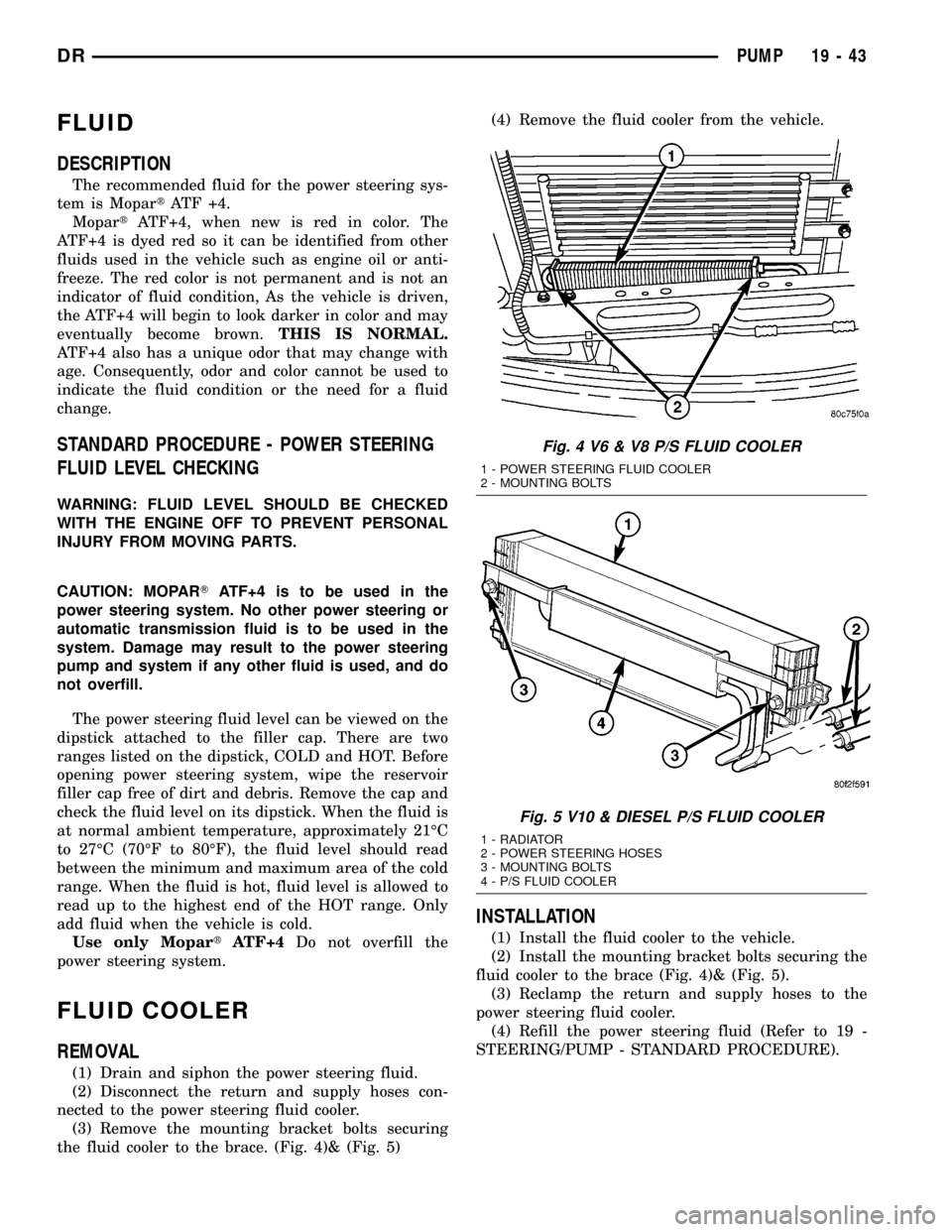
the fluid cooler to the brace. (Fig. 4)& (Fig. 5)(4) Remove the fluid cooler from the vehicle.
INSTALLATION
(1) Install the fluid cooler to the vehicle.
(2) Install the mounting bracket bolts securing the
fluid cooler to the brace (Fig. 4)& (Fig. 5).
(3) Reclamp the return and supply hoses to the
power steering fluid cooler.
(4) Refill the power steering fluid (Refer to 19 -
STEERING/PUMP - STANDARD PROCEDURE).
Fig. 4 V6 & V8 P/S FLUID COOLER
1 - POWER STEERING FLUID COOLER
2 - MOUNTING BOLTS
Fig. 5 V10 & DIESEL P/S FLUID COOLER
1 - RADIATOR
2 - POWER STEERING HOSES
3 - MOUNTING BOLTS
4 - P/S FLUID COOLER
DRPUMP 19 - 43
Page 1878 of 2627
(13) Install bolts attaching converter housing to
engine.
(14) Install rear support.
(15) Install the rear transmission crossmember.
(16) Lower transmission onto crossmember and
install bolts attaching transmission mount to cross-
member.
(17) Remove engine support fixture.
(18) Install the transfer case, if equipped.
(19) Install crankshaft position sensor. (Refer to 14
- FUEL SYSTEM/FUEL INJECTION/CRANKSHAFT
POSITION SENSOR - INSTALLATION)
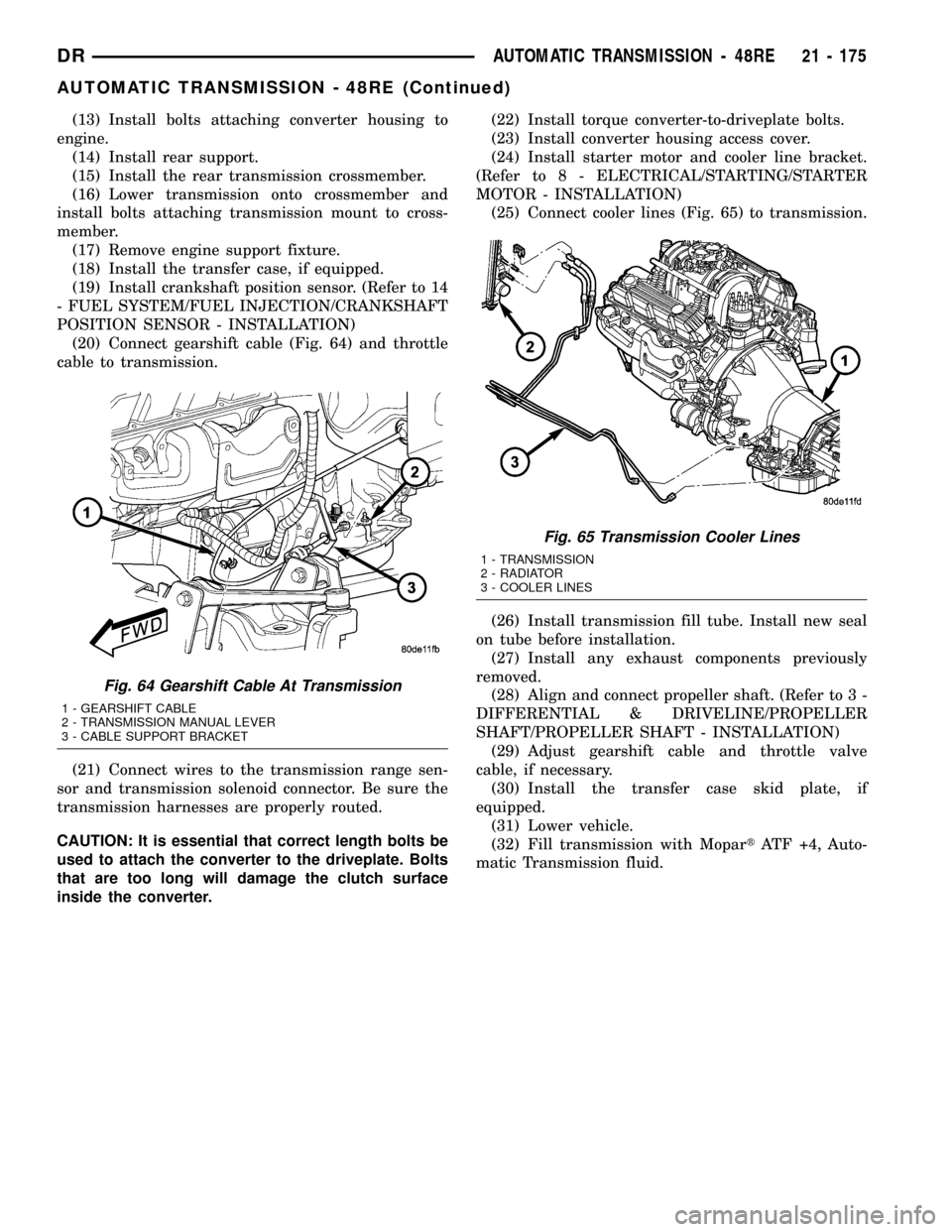
(20) Connect gearshift cable (Fig. 64) and throttle
cable to transmission.
(21) Connect wires to the transmission range sen-
sor and transmission solenoid connector. Be sure the
transmission harnesses are properly routed.
CAUTION: It is essential that correct length bolts be
used to attach the converter to the driveplate. Bolts
that are too long will damage the clutch surface
inside the converter.(22) Install torque converter-to-driveplate bolts.
(23) Install converter housing access cover.
(24) Install starter motor and cooler line bracket.
(Refer to 8 - ELECTRICAL/STARTING/STARTER
MOTOR - INSTALLATION)
(25) Connect cooler lines (Fig. 65) to transmission.
(26) Install transmission fill tube. Install new seal
on tube before installation.
(27) Install any exhaust components previously
removed.
(28) Align and connect propeller shaft. (Refer to 3 -
DIFFERENTIAL & DRIVELINE/PROPELLER
SHAFT/PROPELLER SHAFT - INSTALLATION)
(29) Adjust gearshift cable and throttle valve
cable, if necessary.
(30) Install the transfer case skid plate, if
equipped.
(31) Lower vehicle.
(32) Fill transmission with MopartATF +4, Auto-
matic Transmission fluid.
Fig. 64 Gearshift Cable At Transmission
1 - GEARSHIFT CABLE
2 - TRANSMISSION MANUAL LEVER
3 - CABLE SUPPORT BRACKET
Fig. 65 Transmission Cooler Lines
1 - TRANSMISSION
2 - RADIATOR
3 - COOLER LINES
DRAUTOMATIC TRANSMISSION - 48RE 21 - 175
AUTOMATIC TRANSMISSION - 48RE (Continued)
Page 1905 of 2627

(2) Heavy duty operation with a vehicle not prop-
erly equipped for this type of operation. Trailer tow-
ing or similar high load operation will overheat the
transmission fluid if the vehicle is improperly
equipped. Such vehicles should have an auxiliary
transmission fluid cooler, a heavy duty cooling sys-
tem, and the engine/axle ratio combination needed to
handle heavy loads.
DIAGNOSIS AND TESTING - FLUID
CONTAMINATION
Transmission fluid contamination is generally a
result of:
²adding incorrect fluid
²failure to clean dipstick and fill tube when
checking level
²engine coolant entering the fluid
²internal failure that generates debris
²overheat that generates sludge (fluid break-
down)
²failure to replace contaminated converter after
repair
The use of non-recommended fluids can result in
transmission failure. The usual results are erratic
shifts, slippage, abnormal wear and eventual failure
due to fluid breakdown and sludge formation. Avoid
this condition by using recommended fluids only.
The dipstick cap and fill tube should be wiped
clean before checking fluid level. Dirt, grease and
other foreign material on the cap and tube could fall
into the tube if not removed beforehand. Take the
time to wipe the cap and tube clean before withdraw-
ing the dipstick.
Engine coolant in the transmission fluid is gener-
ally caused by a cooler malfunction. The only remedy
is to replace the radiator as the cooler in the radiator
is not a serviceable part. If coolant has circulated
through the transmission, an overhaul is necessary.
The torque converter should also be replaced when-
ever a failure generates sludge and debris. This is
necessary because normal converter flushing proce-
dures will not remove all contaminants.
STANDARD PROCEDURE
STANDARD PROCEDURE - FLUID LEVEL
CHECK
Low fluid level can cause a variety of conditions
because it allows the pump to take in air along with
the fluid. As in any hydraulic system, air bubbles
make the fluid spongy, therefore, pressures will be
low and build up slowly.
Improper filling can also raise the fluid level too
high. When the transmssion has too much fluid, thegeartrain churns up foam and cause the same condi-
tions which occur with a low fluid level.
In either case, air bubbles can cause overheating
and/or fluid oxidation, and varnishing. This can
interfere with normal valve, clutch, and accumulator
operation. Foaming can also result in fluid escaping
from the transmission vent where it may be mis-
taken for a leak.
After the fluid has been checked, seat the dipstick
fully to seal out water and dirt.
The transmission has a dipstick to check oil level.
It is located on the right side of the engine. Be sure
to wipe all dirt from dipstick handle before removing.
Fluid level is checked with the engine running at
curb idle speed, the transmission in NEUTRAL and
the transmission fluid at normal operating tempera-
ture.The engine should be running at idle
speed for at least one minute, with the vehicle
on level ground.
The transmission fluid level can be checked two
ways.
PROCEDURE ONE
(1) Transmission fluid must be at normal operat-
ing temperature for accurate fluid level check. Drive
vehicle if necessary to bring fluid temperature up to
normal hot operating temperature of 82ÉC (180ÉF).
(2) Position vehicle on level surface.
(3) Start and run engine at curb idle speed.
(4) Apply parking brakes.
(5) Shift transmission momentarily into all gear
ranges. Then shift transmission back to NEUTRAL.
(6) Clean top of filler tube and dipstick to keep
dirt from entering tube.
(7) Remove dipstick (Fig. 87) and check fluid level
as follows:
(a) Correct acceptable level is in crosshatch area.
(b) Correct maximum level is to MAX arrow
mark.
(c) Incorrect level is at or below MIN line.
(d) If fluid is low, add only enough MopartAT F
+4 to restore correct level. Do not overfill.
Fig. 87 Dipstick Fluid Level Marks - Typical
1 - DIPSTICK
2 - MAXIMUM CORRECT FLUID LEVEL
3 - ACCEPTABLE FLUID LEVEL
21 - 202 AUTOMATIC TRANSMISSION - 48REDR
FLUID AND FILTER (Continued)
Page 1964 of 2627

(6) Check converter seating with a scale and
straightedge (Fig. 235). Surface of converter lugs
should be 19mm (0.75 in.) to the rear of the straight-
edge when converter is fully seated.
(7) If necessary, temporarily secure converter with
C-clamp attached to the converter housing.
(8) Install the transmission in the vehicle.
(9) Fill the transmission with the recommended
fluid.
TORQUE CONVERTER
DRAINBACK VALVE
DESCRIPTION
The drainback valve is located in the transmission
cooler outlet (pressure) line.
OPERATION
The valve prevents fluid from draining from the
converter into the cooler and lines when the vehicle
is shut down for lengthy periods. Production valves
have a hose nipple at one end, while the opposite end
is threaded for a flare fitting. All valves have an
arrow (or similar mark) to indicate direction of flow
through the valve.
STANDARD PROCEDURE - TORQUE
CONVERTER DRAINBACK VALVE
The converter drainback check valve is located in
the cooler outlet (pressure) line near the radiator
tank. The valve prevents fluid drainback when the
vehicle is parked for lengthy periods. The valve check
ball is spring loaded and has an opening pressure of
approximately 2 psi.
The valve is serviced as an assembly; it is not
repairable. Do not clean the valve if restricted, or
contaminated by sludge, or debris. If the valve fails,
or if a transmission malfunction occurs that gener-
ates significant amounts of sludge and/or clutch par-
ticles and metal shavings, the valve must be
replaced.
If the valve is restricted, installed backwards, or in
the wrong line, it will cause an overheating condition
and possible transmission failure.
CAUTION: The drainback valve is a one-way flow
device. It must be properly oriented in terms of flow
direction for the cooler to function properly. The
valve must be installed in the pressure line. Other-
wise flow will be blocked and would cause an over-
heating condition and eventual transmission failure.
TOW/HAUL OVERDRIVE
SWITCH
DESCRIPTION
The tow/haul overdrive OFF (control) switch is
located in the shift lever arm (Fig. 236). The switch
is a momentary contact device that signals the PCM
to toggle current status of the overdrive function.
Fig. 235 Typical Method Of Checking Converter
Seating
1 - SCALE
2 - STRAIGHTEDGE
Fig. 236 Tow/Haul Overdrive Off Switch
DRAUTOMATIC TRANSMISSION - 48RE 21 - 261
TORQUE CONVERTER (Continued)
Page 2069 of 2627

FLUID AND FILTER
DIAGNOSIS AND TESTING
DIAGNOSIS AND TESTING - EFFECTS OF
INCORRECT FLUID LEVEL
A low fluid level allows the pump to take in air
along with the fluid. Air in the fluid will cause fluid
pressures to be low and develop slower than normal.
If the transmission is overfilled, the gears churn the
fluid into foam. This aerates the fluid and causing
the same conditions occurring with a low level. In
either case, air bubbles cause fluid overheating, oxi-
dation and varnish buildup which interferes with
valve and clutch operation. Foaming also causes fluid
expansion which can result in fluid overflow from the
transmission vent or fill tube. Fluid overflow can eas-
ily be mistaken for a leak if inspection is not careful.
DIAGNOSIS AND TESTING - CAUSES OF
BURNT FLUID
Burnt, discolored fluid is a result of overheating
which has three primary causes.
(1) Internal clutch slippage, usually caused by low
line pressure, inadequate clutch apply pressure, or
clutch seal failure.
(2) A result of restricted fluid flow through the
main and/or auxiliary cooler. This condition is usu-
ally the result of a faulty or improperly installed
drainback valve, a damaged main cooler, or severe
restrictions in the coolers and lines caused by debris
or kinked lines.
(3) Heavy duty operation with a vehicle not prop-
erly equipped for this type of operation. Trailer tow-
ing or similar high load operation will overheat the
transmission fluid if the vehicle is improperly
equipped. Such vehicles should have an auxiliary
transmission fluid cooler, a heavy duty cooling sys-
tem, and the engine/axle ratio combination needed to
handle heavy loads.
DIAGNOSIS AND TESTING - FLUID
CONTAMINATION
Transmission fluid contamination is generally a
result of:
²adding incorrect fluid
²failure to clean dipstick and fill tube when
checking level
²engine coolant entering the fluid
²internal failure that generates debris
²overheat that generates sludge (fluid break-
down)
²failure to replace contaminated converter after
repairThe use of non-recommended fluids can result in
transmission failure. The usual results are erratic
shifts, slippage, abnormal wear and eventual failure
due to fluid breakdown and sludge formation. Avoid
this condition by using recommended fluids only.
The dipstick cap and fill tube should be wiped
clean before checking fluid level. Dirt, grease and
other foreign material on the cap and tube could fall
into the tube if not removed beforehand. Take the
time to wipe the cap and tube clean before withdraw-
ing the dipstick.
Engine coolant in the transmission fluid is gener-
ally caused by a cooler malfunction. The only remedy
is to replace the radiator as the cooler in the radiator
is not a serviceable part. If coolant has circulated
through the transmission, an overhaul is necessary.
The torque converter should also be replaced when-
ever a failure generates sludge and debris. This is
necessary because normal converter flushing proce-
dures will not remove all contaminants.
STANDARD PROCEDURE
STANDARD PROCEDURE - FLUID LEVEL
CHECK
Low fluid level can cause a variety of conditions
because it allows the pump to take in air along with
the fluid. As in any hydraulic system, air bubbles
make the fluid spongy, therefore, pressures will be
low and build up slowly.
Improper filling can also raise the fluid level too
high. When the transmssion has too much fluid, the
geartrain churns up foam and cause the same condi-
tions which occur with a low fluid level.
In either case, air bubbles can cause overheating
and/or fluid oxidation, and varnishing. This can
interfere with normal valve, clutch, and accumulator
operation. Foaming can also result in fluid escaping
from the transmission vent where it may be mis-
taken for a leak.
After the fluid has been checked, seat the dipstick
fully to seal out water and dirt.
The transmission has a dipstick to check oil level.
It is located on the right side of the engine. Be sure
to wipe all dirt from dipstick handle before removing.
The torque converter fills in both the P (PARK)
and N (NEUTRAL) positions. Place the selector lever
in P (PARK) to be sure that the fluid level check is
accurate.The engine should be running at idle
speed for at least one minute, with the vehicle
on level ground.At normal operating temperature
(approximately 82 C. or 180 F.), the fluid level is cor-
rect if it is in the HOT region (cross-hatched area) on
the oil level indicator. The fluid level will be approx-
21 - 366 AUTOMATIC TRANSMISSION - 45RFE/545RFEDR
Page 2595 of 2627

CONTROL MODULE - DESCRIPTION,
AIRBAG............................8O-11
CONTROL MODULE - DESCRIPTION,
FRONT...........................8W-97-5
CONTROL MODULE - DESCRIPTION,
FRONT..............................8E-5
CONTROL MODULE - DESCRIPTION,
TRANSFER CASE.....................8E-16
CONTROL MODULE - DESCRIPTION,
TRANSMISSION......................8E-20
CONTROL MODULE - DIAGNOSIS AND
TESTING, FRONT...................8W-97-5
CONTROL MODULE - DIAGNOSIS AND
TESTING, FRONT......................8E-5
CONTROL MODULE - INSTALLATION,
AIRBAG............................8O-13
CONTROL MODULE - INSTALLATION,
ENGINE.............................8E-4
CONTROL MODULE - INSTALLATION,
FRONT...........................8W-97-6
CONTROL MODULE - INSTALLATION,
FRONT..............................8E-5
CONTROL MODULE - OPERATION,
AIRBAG............................8O-11
CONTROL MODULE - OPERATION,
FRONT...........................8W-97-5
CONTROL MODULE - OPERATION,
FRONT..............................8E-5
CONTROL MODULE - OPERATION,
TRANSFER CASE.....................8E-16
CONTROL MODULE - OPERATION,
TRANSMISSION......................8E-20
CONTROL MODULE - REMOVAL, AIRBAG . 8O-12
CONTROL MODULE - REMOVAL, ENGINE . . . 8E-4
CONTROL MODULE - REMOVAL, FRONT . 8W-97-6
CONTROL MODULE - REMOVAL, FRONT . . . 8E-5
CONTROL MOTOR - DESCRIPTION, IDLE
AIR ...............................14-28
CONTROL MOTOR - INSTALLATION, IDLE
AIR ...............................14-29
CONTROL MOTOR - OPERATION, IDLE
AIR ...............................14-28
CONTROL MOTOR - REMOVAL, IDLE AIR . . 14-29
CONTROL RELAY - DESCRIPTION,
TRANSMISSION.....................21-405
CONTROL RELAY - OPERATION,
TRANSMISSION.....................21-405
CONTROL SWITCH - DESCRIPTION,
LUMBAR...........................8N-17
CONTROL SWITCH - OPERATION,
LUMBAR...........................8N-18
CONTROL SWITCH - REMOVAL,
LUMBAR...........................8N-18
CONTROLLED VISCOUS FAN DRIVE -
DIAGNOSIS AND TESTING,
ELECTRONICALLY.....................7-52
CONTROLLER ANTILOCK BRAKE -
DESCRIPTION........................8E-3
CONTROLLER ANTILOCK BRAKE -
INSTALLATION........................8E-3
CONTROLLER ANTILOCK BRAKE -
OPERATION..........................8E-3
CONTROLLER ANTILOCK BRAKE -
REMOVAL...........................8E-3
CONTROLS - DIAGNOSIS AND TESTING,
OVERDRIVE ELECTRICAL.............21-262
CONVERTER - DESCRIPTION, CATALYTIC
. . . 11-6
CONVERTER - DESCRIPTION, TORQUE
. . 21-255,
21-399
CONVERTER - INSTALLATION, TORQUE
. . 21-260,
21-404
CONVERTER - OPERATION, CATALYTIC
....11-6
CONVERTER - OPERATION, TORQUE
....21-259,
21-403
CONVERTER - REMOVAL, TORQUE
.....21-260,
21-404
CONVERTER DRAINBACK VALVE -
DESCRIPTION, TORQUE
..............21-261
CONVERTER DRAINBACK VALVE -
OPERATION, TORQUE
................21-261
CONVERTER DRAINBACK VALVE -
STANDARD PROCEDURE, TORQUE
......21-261
CONVERTER HOUSING FLUID LEAK -
DIAGNOSIS AND TESTING
......21-144,21-318
COOLANT - DESCRIPTION, ENGINE
.......7-31
COOLANT - DESCRIPTION, ENGINE
........0-3
COOLANT - DESCRIPTION, HOAT
.........7-32COOLANT - STANDARD PROCEDURE,
ADDING ADDITIONAL..................7-19
COOLANT FLOW - DIAGNOSIS AND
TESTING, RADIATOR...............7-54,7-56
COOLANT LEVEL CHECK - STANDARD
PROCEDURE.........................7-17
COOLANT RECOVERY CONTAINER- GAS
ENGINES - DESCRIPTION...............7-33
COOLANT RECOVERY CONTAINER- GAS
ENGINES - INSTALLATION...............7-33
COOLANT RECOVERY CONTAINER- GAS
ENGINES - OPERATION.................7-33
COOLANT RECOVERY CONTAINER- GAS
ENGINES - REMOVAL..................7-33
COOLANT TEMPERATURE SENSOR -
DESCRIPTION, ENGINE.................7-38
COOLANT TEMPERATURE SENSOR -
INSTALLATION, ENGINE................7-41
COOLANT TEMPERATURE SENSOR -
OPERATION, ENGINE...................7-38
COOLANT TEMPERATURE SENSOR -
REMOVAL, ENGINE....................7-39
COOLANT THERMOSTAT - 3.7L/4.7L -
DESCRIPTION, ENGINE.................7-44
COOLANT THERMOSTAT - 3.7L/4.7L -
INSTALLATION, ENGINE................7-45
COOLANT THERMOSTAT - 3.7L/4.7L -
OPERATION, ENGINE...................7-44
COOLANT THERMOSTAT - 3.7L/4.7L -
REMOVAL, ENGINE....................7-45
COOLANT THERMOSTAT - 5.9L DIESEL -
DESCRIPTION, ENGINE.................7-46
COOLANT THERMOSTAT - 5.9L DIESEL -
INSTALLATION, ENGINE..................7-47
COOLANT THERMOSTAT - 5.9L DIESEL -
OPERATION, ENGINE...................7-46
COOLANT THERMOSTAT - 5.9L DIESEL -
REMOVAL, ENGINE....................7-47
COOLANT THERMOSTAT - 8.0L -
DESCRIPTION, ENGINE.................7-48
COOLANT THERMOSTAT - 8.0L -
INSTALLATION, ENGINE................7-49
COOLANT THERMOSTAT - 8.0L -
OPERATION, ENGINE...................7-48
COOLANT THERMOSTAT - 8.0L -
REMOVAL, ENGINE....................7-49
COOLANT THERMOSTAT-5.7L -
DESCRIPTION, ENGINE.................7-41
COOLANT THERMOSTAT-5.7L -
INSTALLATION, ENGINE................7-43
COOLANT THERMOSTAT-5.7L -
OPERATION, ENGINE...................7-41
COOLANT THERMOSTAT-5.7L -
REMOVAL, ENGINE....................7-42
COOLER - 5.9L DIESEL - DESCRIPTION,
TRANS..............................7-68
COOLER - 5.9L DIESEL - OPERATION,
TRANS..............................7-69
COOLER - DESCRIPTION, TRANS.........7-67
COOLER - INSTALLATION, AIR TO OIL.....7-70
COOLER - INSTALLATION, FLUID........19-43
COOLER - INSTALLATION, RETURN
HOSE - GEAR TO................19-44,19-45
COOLER - INSTALLATION, RETURN
HOSE - RESERVOIR TO...........19-44,19-45
COOLER - INSTALLATION, TRANS........7-68
COOLER - INSTALLATION, WATER-TO-
AIR
................................7-70
COOLER - OPERATION, TRANS
...........7-67
COOLER - REMOVAL, AIR TO OIL
.........7-69
COOLER - REMOVAL, FLUID
............19-43
COOLER - REMOVAL, RETURN HOSE -
GEAR TO
......................19-44,19-45
COOLER - REMOVAL, RETURN HOSE -
RESERVOIR TO
.................19-44,19-45
COOLER - REMOVAL, TRANS
............7-68
COOLER - REMOVAL, WATER TO OIL
......7-69
COOLER AND PLUMBING - CLEANING,
CHARGE AIR
........................11-17
COOLER AND PLUMBING -
DESCRIPTION, CHARGE AIR
............11-16
COOLER AND PLUMBING - INSPECTION,
CHARGE AIR
........................11-17
COOLER AND PLUMBING -
INSTALLATION, CHARGE AIR
...........11-17
COOLER AND PLUMBING - OPERATION,
CHARGE AIR
........................11-16COOLER AND PLUMBING - REMOVAL,
CHARGE AIR........................11-17
COOLER SYSTEM - LEAKS - DIAGNOSIS
AND TESTING, CHARGE AIR............11-16
COOLING, SPECIAL TOOLS..............7-20
COOLING SYSTEM - ALL GAS ENGINES -
STANDARD PROCEDURE, DRAINING......7-17
COOLING SYSTEM - ALL GAS ENGINES -
STANDARD PROCEDURE, REFILLING......7-18
COOLING SYSTEM - OPERATION..........7-5
COOLING SYSTEM - TESTING FOR
LEAKS - DIAGNOSIS AND TESTING........7-5
COOLING SYSTEM 5.9L DIESEL ENGINE
- STANDARD PROCEDURE, DRAINING.....7-18
COOLING SYSTEM 5.9L DIESEL ENGINE
- STANDARD PROCEDURE, REFILLING.....7-19
COOLING SYSTEM CLEANING/REVERSE
FLUSHING - STANDARD PROCEDURE.....7-17
COOLING SYSTEM DIESEL ENGINE -
DIAGNOSIS AND TESTING...............7-7
COOLING SYSTEM FLOW - 5.9L DIESEL
- DESCRIPTION........................7-3
COOLING SYSTEM FLOW 3.7L/4.7L/5.7L
ENGINE - DESCRIPTION.................7-1
COOLING SYSTEM REQUIREMENTS -
DESCRIPTION, ENGINE.................24-1
COOLING SYSTEM, WARNING - ENGINE . . 24-42
CORE - DESCRIPTION, HEATER.........24-63
CORE - DESCRIPTION, SERVICE PORT
VALVE .............................24-70
CORE - INSTALLATION, HEATER.........24-63
CORE - INSTALLATION, SERVICE PORT
VALVE .............................24-70
CORE - OPERATION, HEATER...........24-63
CORE - REMOVAL, HEATER............24-63
CORE HOLE PLUG - INSTALLATION,
CAMSHAFT.........................9-206
CORE HOLE PLUG - REMOVAL,
CAMSHAFT.........................9-205
CORE PLUGS - INSTALLATION..........9-131
CORE PLUGS - REMOVAL..............9-131
CORES - REMOVAL, SERVICE PORT
VALVE .............................24-70
COUPLER - DESCRIPTION,
REFRIGERANT LINE...................24-67
COUPLER - INSTALLATION,
REFRIGERANT LINE...................24-68
COUPLER - OPERATION, REFRIGERANT
LINE...............................24-67
COUPLER - REMOVAL, REFRIGERANT
LINE...............................24-68
COUPLING - INSTALLATION, UPPER
STEERING..........................19-13
COUPLING - REMOVAL, UPPER
STEERING..........................19-13
COVER - DESCRIPTION, STRUCTURAL . . . 9-145,
9-216,9-57
COVER - FRONT - INSTALLATION, SEAT
BACK CUSHION......................23-82
COVER - FRONT - INSTALLATION, SEAT
CUSHION...........................23-83
COVER - FRONT - REMOVAL, SEAT BACK
CUSHION...........................23-82
COVER - FRONT - REMOVAL, SEAT
CUSHION...........................23-83
COVER - INSTALLATION...............23-16
COVER - INSTALLATION, ACM
..........8O-10
COVER - INSTALLATION, CENTER SEAT
BACK INERTIA HINGE
.................23-77
COVER - INSTALLATION, CENTER SEAT
CUSHION
...........................23-79
COVER - INSTALLATION, CYLINDER
HEAD
..............................9-255
COVER - INSTALLATION, DIFFERENTIAL
....3-97
COVER - INSTALLATION, GEAR HOUSING
. 9-301
COVER - INSTALLATION, INSTRUMENT
PANEL TOP
.........................23-59
COVER - INSTALLATION, REAR DOOR
SILL TRIM
..........................23-71
COVER - INSTALLATION, SHIFT
. . . 21-129,21-87
COVER - INSTALLATION, STEERING
COLUMN OPENING
...................23-60
COVER - INSTALLATION, STRUCTURAL
. . . 9-145,
9-216,9-57
COVER - INSTALLATION, TIMING/CHAIN
. . 9-227
COVER - OPERATION, STRUCTURAL
.....9-145,
9-216,9-57
8 INDEXDR
Description Group-Page Description Group-Page Description Group-Page
Page 2600 of 2627

FIRING ORDER / CABLE ROUTING, 5.7L
V-8 ENGINE..........................8I-4
FIRING ORDER, 3.7L V-6 - ENGINE........8I-4
FIRING ORDER, 4.7L V-8 - ENGINE........8I-4
FIRING ORDER, DIESEL - FUEL
INJECTOR..........................14-48
FITTING - DESCRIPTION, QUICK
CONNECT............................14-8
FITTING - STANDARD PROCEDURE,
CONNECTING ROD BEARING...........9-129
FITTING - STANDARD PROCEDURE,
CRANKSHAFT MAIN BEARING.....9-134,9-207
FITTING - STANDARD PROCEDURE,
PISTON...................9-139,9-211,9-51
FITTING - STANDARD PROCEDURE,
PISTON RING.........9-142,9-213,9-284,9-53
FITTING, STANDARD PROCEDURE -
CONNECTING ROD BEARING............9-49
FITTING, STANDARD PROCEDURE -
MAIN BEARING.......................9-44
FITTINGS - STANDARD PROCEDURE,
HANDLING TUBING...................24-45
FITTINGS - STANDARD PROCEDURE,
QUICK-CONNECT......................14-8
FLAG - INSTALLATION, SIDE VIEW
MIRROR...........................23-27
FLAG - REMOVAL, SIDE VIEW MIRROR . . . 23-27
FLARING - STANDARD PROCEDURE,
DOUBLE INVERTED....................5-10
FLARING - STANDARD PROCEDURE, ISO . . . 5-11
FLEX PLATE - INSTALLATION . . 9-138,9-210,9-48
FLEX PLATE - REMOVAL.......9-138,9-210,9-48
FLOOR - INSTALLATION, LOAD..........23-72
FLOOR - REMOVAL, LOAD.............23-71
FLOOR CONSOLE - INSTALLATION.......23-67
FLOOR CONSOLE - REMOVAL...........23-67
FLOOR DISTRIBUTION DUCT -
INSTALLATION.......................24-34
FLOOR DISTRIBUTION DUCT - REMOVAL . 24-33
FLOOR MATS - INSTALLATION, CARPETS . 23-65
FLOOR MATS - REMOVAL, CARPETS.....23-65
FLOOR SHIFT BOOT - INSTALLATION,
4WD ..............................23-62
FLOOR SHIFT BOOT - REMOVAL, 4WD....23-62
FLOOR SUPPORT CYLINDER -
INSTALLATION, LOAD.................23-72
FLOOR SUPPORT CYLINDER -
REMOVAL, LOAD.....................23-72
FLOW - 5.9L DIESEL - DESCRIPTION,
COOLING SYSTEM.....................7-3
FLOW - DIAGNOSIS AND TESTING,
RADIATOR COOLANT..............7-54,7-56
FLOW 3.7L/4.7L/5.7L ENGINE -
DESCRIPTION, COOLING SYSTEM.........7-1
FLOW AND PRESSURE - DIAGNOSIS
AND TESTING, POWER STEERING........19-4
FLUID - DESCRIPTION................19-43
FLUID - DESCRIPTION, AUTOMATIC
TRANSMISSION.......................0-4
FLUID - DESCRIPTION, POWER
STEERING............................0-3
FLUID - DIAGNOSIS AND TESTING,
CAUSES OF BURNT............21-201,21-366
FLUID - OPERATION, AUTOMATIC
TRANSMISSION.......................0-5
FLUID AND FILTER REPLACEMENT -
STANDARD PROCEDURE........21-203,21-367
FLUID CAPACITIES, SPECIFICATIONS.......0-5
FLUID CONTAMINATION - DIAGNOSIS
AND TESTING................21-202,21-366
FLUID CONTAMINATION - DIAGNOSIS
AND TESTING, BRAKE..................5-23
FLUID COOLER - INSTALLATION.........19-43
FLUID COOLER - REMOVAL............19-43
FLUID DRAIN AND REFILL - STANDARD
PROCEDURE.....21-441,21-476,21-507,21-537,
21-571
FLUID INDICATOR - DESCRIPTION,
WASHER
...........................8J-44
FLUID INDICATOR - OPERATION,
WASHER
...........................8J-44
FLUID LEAK - DIAGNOSIS AND TESTING,
CONVERTER HOUSING
.........21-144,21-318
FLUID LEVEL - DIAGNOSIS AND
TESTING, EFFECTS OF INCORRECT
.....21-201,
21-366
FLUID LEVEL - STANDARD PROCEDURE,
BRAKE
..............................5-23FLUID LEVEL CHECK - STANDARD
PROCEDURE.................21-202,21-366
FLUID LEVEL CHECKING - STANDARD
PROCEDURE, POWER STEERING........19-43
FLUID LEVEL SWITCH - DESCRIPTION,
WASHER............................8R-9
FLUID LEVEL SWITCH - INSTALLATION,
WASHER...........................8R-11
FLUID LEVEL SWITCH - OPERATION,
WASHER............................8R-9
FLUID LEVEL SWITCH - REMOVAL,
WASHER...........................8R-10
FLUID RESERVOIR - INSTALLATION.......5-24
FLUID RESERVOIR - REMOVAL..........5-23
FLUID, SPECIFICATIONS - BRAKE.........5-23
FLUSH - SPECIFICATIONS, GAP.........23-95
FLUSHING - STANDARD PROCEDURE,
COOLING SYSTEM CLEANING/
REVERSE............................7-17
FLUSHING POWER STEERING SYSTEM -
STANDARD PROCEDURE...............19-40
FLYWHEEL - ASSEMBLY................6-11
FLYWHEEL - DIAGNOSIS AND TESTING....6-10
FLYWHEEL - DISASSEMBLY.............6-11
FLYWHEEL - INSTALLATION.............6-11
FLYWHEEL - REMOVAL.................6-11
FOG LAMP - INSTALLATION............8L-12
FOG LAMP - REMOVAL................8L-12
FOG LAMP RELAY - DESCRIPTION.......8L-12
FOG LAMP RELAY - INSTALLATION........8L-13
FOG LAMP RELAY - OPERATION.........8L-13
FOG LAMP RELAY - REMOVAL..........8L-13
FOOTMANS LOOP BRACKETS -
INSTALLATION, SEAT BACK REAR.......23-85
FOOTMANS LOOP BRACKETS -
REMOVAL, SEAT BACK REAR...........23-85
FORM-IN-PLACE GASKETS AND
SEALERS - STANDARD PROCEDURE . . 9-239,9-9,
9-94
FRAME - INSTALLATION, GRILLE........23-40
FRAME - REAR - INSTALLATION, SEAT
CUSHION...........................23-85
FRAME - REAR - REMOVAL, SEAT
CUSHION...........................23-85
FRAME - REMOVAL, GRILLE............23-40
FRAME DIMENSIONS - SPECIFICATIONS . . 13-16
FRAME H-SECTION REPLACEMENT -
STANDARD PROCEDURE, REAR.........13-13
FRAME RAIL TIP REPLACEMENT -
STANDARD PROCEDURE, LIGHT DUTY
FRONT..............................13-4
FREE MODULE - INSTALLATION, HANDS . . . 8T-2
FREE MODULE - REMOVAL, HANDS.......8T-2
FRONT - INSTALLATION....5-16,5-21,5-22,5-34
FRONT - INSTALLATION...............22-14
FRONT - INSTALLATION, CRANKSHAFT
OIL SEAL.............9-136,9-208,9-275,9-46
FRONT - INSTALLATION, PROPELLER
SHAFT - HD...........................3-7
FRONT - INSTALLATION, PROPELLER
SHAFT- LD............................3-7
FRONT - INSTALLATION, SEAT..........23-81
FRONT - INSTALLATION, SEAT BACK
CUSHION / COVER...................23-82
FRONT - INSTALLATION, SEAT CUSHION
/ COVER............................23-83
FRONT - REMOVAL........5-13,5-17,5-21,5-33
FRONT - REMOVAL, CRANKSHAFT OIL
SEAL................9-135,9-208,9-275,9-46
FRONT - REMOVAL, PROPELLER SHAFT
- HD ................................3-7
FRONT - REMOVAL, PROPELLER SHAFT-
LD ..................................3-6
FRONT - REMOVAL, SEAT..............23-81
FRONT - REMOVAL, SEAT BACK
CUSHION / COVER...................23-82
FRONT - REMOVAL, SEAT CUSHION /
COVER.............................23-83
FRONT AIR DAM - INSTALLATION........13-2
FRONT AIR DAM - REMOVAL............13-2
FRONT AXLE - 9 1/4 AA -
ADJUSTMENTS
.......................3-59
FRONT AXLE - 9 1/4 AA - DIAGNOSIS
AND TESTING
........................3-54
FRONT AXLE - 9 1/4 AA - INSTALLATION
. . . 3-58
FRONT AXLE - 9 1/4 AA - REMOVAL
......3-57
FRONT AXLE - 9 1/4 AA - SPECIAL
TOOLS
..............................3-64FRONT AXLE - 9 1/4 AA -
SPECIFICATIONS......................3-63
FRONT AXLE - C205F - ADJUSTMENTS....3-32
FRONT AXLE - C205F - DIAGNOSIS AND
TESTING............................3-27
FRONT AXLE - C205F - INSTALLATION.....3-31
FRONT AXLE - C205F - REMOVAL........3-31
FRONT AXLE - C205F - SPECIAL TOOLS . . . 3-40
FRONT AXLE - C205F - SPECIFICATIONS . . . 3-39
FRONT BEARING - INSTALLATION,
OUTPUT SHAFT.....................21-216
FRONT BEARING - REMOVAL, OUTPUT
SHAFT............................21-216
FRONT BRAKE HOSE - INSTALLATION.....5-13
FRONT BUMPER - INSTALLATION.........13-2
FRONT BUMPER - REMOVAL............13-2
FRONT CENTER SEAT BELT -
INSTALLATION......................8O-31
FRONT CENTER SEAT BELT - REMOVAL . . 8O-30
FRONT CENTER SEAT BELT &
RETRACTOR - INSTALLATION...........8O-29
FRONT CENTER SEAT BELT &
RETRACTOR - REMOVAL..............8O-29
FRONT CLUTCH - ASSEMBLY..........21-207
FRONT CLUTCH - DESCRIPTION........21-205
FRONT CLUTCH - DISASSEMBLY.......21-205
FRONT CLUTCH - INSPECTION.........21-206
FRONT CLUTCH - OPERATION.........21-205
FRONT CONTROL MODULE -
DESCRIPTION.....................8W-97-5
FRONT CONTROL MODULE -
DESCRIPTION........................8E-5
FRONT CONTROL MODULE - DIAGNOSIS
AND TESTING.....................8W-97-5
FRONT CONTROL MODULE - DIAGNOSIS
AND TESTING........................8E-5
FRONT CONTROL MODULE -
INSTALLATION....................8W-97-6
FRONT CONTROL MODULE -
INSTALLATION........................8E-5
FRONT CONTROL MODULE - OPERATION . 8W-97-5
FRONT CONTROL MODULE - OPERATION . . 8E-5
FRONT CONTROL MODULE - REMOVAL . 8W-97-6
FRONT CONTROL MODULE - REMOVAL....8E-5
FRONT CROSSMEMBER - INSTALLATION . . 13-22
FRONT CROSSMEMBER - REMOVAL.....13-22
FRONT DOOR GLASS RUN
WEATHERSTRIP - INSTALLATION........23-92
FRONT DOOR GLASS RUN
WEATHERSTRIP - REMOVAL............23-92
FRONT DOOR INNER BELT MOLDING -
INSTALLATION.......................23-93
FRONT DOOR INNER BELT MOLDING -
REMOVAL..........................23-93
FRONT DOOR OUTER BELT MOLDING -
INSTALLATION.......................23-93
FRONT DOOR OUTER BELT MOLDING -
REMOVAL..........................23-92
FRONT FASCIA - INSTALLATION..........13-3
FRONT FASCIA - REMOVAL..............13-2
FRONT FENDER - INSTALLATION........23-39
FRONT FENDER - REMOVAL............23-39
FRONT FRAME RAIL TIP REPLACEMENT
- STANDARD PROCEDURE, LIGHT
DUTY...............................13-4
FRONT HOSE - REMOVAL...............5-12
FRONT MOUNT - INSTALLATION . . . 9-147,9-218,
9-287,9-59
FRONT MOUNT - REMOVAL . . 9-146,9-217,9-286,
9-58
FRONT OUTBOARD SEAT BELT BUCKLE -
INSTALLATION......................8O-38
FRONT OUTBOARD SEAT BELT BUCKLE -
REMOVAL..........................8O-37
FRONT OUTPUT SHAFT SEAL -
INSTALLATION . . . 21-442,21-477,21-508,21-538,
21-572
FRONT OUTPUT SHAFT SEAL -
REMOVAL . 21-441,21-477,21-507,21-537,21-572
FRONT PARKING BRAKE CABLE -
INSTALLATION........................5-38
FRONT PARKING BRAKE CABLE -
REMOVAL
...........................5-36
FRONT SEAL - INSTALLATION, OIL
PUMP
............................21-391
FRONT SEAL - REMOVAL, OIL PUMP
....21-391
FRONT SERVO - ASSEMBLY
...........21-209
FRONT SERVO - CLEANING
...........21-209
DRINDEX 13
Description Group-Page Description Group-Page Description Group-Page