Hood DODGE RAM 1500 1998 2.G Repair Manual
[x] Cancel search | Manufacturer: DODGE, Model Year: 1998, Model line: RAM 1500, Model: DODGE RAM 1500 1998 2.GPages: 2627
Page 2342 of 2627

(4) Remove the grille. (Refer to 23 - BODY/EXTE-
RIOR/GRILLE - REMOVAL)
(5) Remove the hood lamp and ambient tempera-
ture sensor.
INSTALLATION
(1) Install the hood lamp and ambient temperature
sensor.
(2) Install the grille. (Refer to 23 - BODY/EXTERI-
OR/GRILLE - INSTALLATION)
(3) Install the hood and install the nuts.
(4) Line up the marks made previously and
tighten the nuts to 23 N´m (17 ft. lbs.).
(5) Check the hood fit and adjust if required.
(Refer to 23 - BODY/BODY STRUCTURE/GAP AND
FLUSH - SPECIFICATIONS)
LATCH
REMOVAL
(1) Open the hood.
(2) Using a grease pencil or equivalent, mark the
position of the latch on the radiator crossmember.
(3) Remove the bolts. (Fig. 3)
(4) Disconnect the hood latch cable and remove the
latch.
INSTALLATION
(1) Connect the hood latch cable.
(2) Install the latch lining up the marks made pre-
viously and install the bolts.
(3) Tighten the bolts to 11 N´m (8 ft. lbs.).
(4) Check hood fit and adjust if required. (Refer to
23 - BODY/BODY STRUCTURE/GAP AND FLUSH -
SPECIFICATIONS)
LATCH RELEASE CABLE/
HANDLE ASSEMBLY
REMOVAL
(1) Remove the hood latch. (Refer to 23 - BODY/
HOOD/LATCH - REMOVAL)
(2) Remove the batter tray. (Refer to 8 - ELECTRI-
CAL/BATTERY SYSTEM/TRAY - REMOVAL)
(3) Disconnect the three cable push pin fasteners.
(4) From inside the cab loosen the two handle
screws and disconnect the handle from the instru-
ment panel bracket.
(5) Separate the grommet at the cowl panel and
remove cable through the cab.
INSTALLATION
(1) Route the cable/handle assembly through the
cowl panel and install the grommet.
(2) Position the handle onto the instrument panel
bracket and tighten the screws.
(3) Route the cable along the fender rails and
install the three push pin fasteners.
(4) Install the latch. (Refer to 23 - BODY/HOOD/
LATCH - INSTALLATION)
(5) Install the battery tray. (Refer to 8 - ELECTRI-
CAL/BATTERY SYSTEM/TRAY - INSTALLATION)
LATCH STRIKER /
SECONDARY CATCH
REMOVAL
(1) Disconnect and remove the secondary release
handle. (Fig. 4)
(2) Remove the two bolts and remove the striker/
catch assembly.
Fig. 2 HINGE
1 - A-PILLAR
2 - HINGE
3 - BOLTS (2)
Fig. 3 LATCH
1 - HOOD LATCH
2 - HOOD LATCH CABLE
3 - BOLTS (2)
DRHOOD 23 - 47
HOOD (Continued)
Page 2343 of 2627

INSTALLATION
(1) Install the latch striker/secondary catch and
install the bolts.
(2) Tighten the bolts to 11 N´m (8 ft. lbs.).
(3) Install the release handle and connect to the
secondary catch.
(4) Check the hood fit and adjust if required.
(Refer to 23 - BODY/BODY STRUCTURE/GAP AND
FLUSH - SPECIFICATIONS)
SUPPORT CYLINDER
REMOVAL
NOTE: The support cylinders can be replaced one
at a time.
(1) Open the hood and support.
NOTE: Lift the clips only enough to release the ball
studs. (Fig. 6)
(2) Using a small flat bladed tool, or equivalent,
release the upper retaining clips while pulling the
ball socket away from the ball stud. (Fig. 5)
CAUTION: Do not pull the supports from the middle
while removing.
(3) Pulling at the ends only, remove the support
cylinder.
INSTALLATION
(1) Make sure the retaining clips are seated into
the ball socket fully.
CAUTION: Do not install the support cylinders by
pressing at the center of the cylinder. Press the
ends only.
(2) Install the support cylinder over the ball studs
with the thin end connected to the body side of the
hinge and the retaining clips snapping into place.
Fig. 4 HOOD LATCH STRIKER/SECONDARY CATCH
1 - GRILLE
2 - LATCH STRIKER/SECONDARY CATCH
3 - BOLTS (2)
4 - SECONDARY CATCH RELEASE HANDLE
5 - GRILLE FRAME
Fig. 5 UPPER SUPPORT CYLINDER REMOVAL -
TYPICAL
1 - BALL SOCKET
2 - RETAINING CLIP
3 - FLAT BLADED TOOL
4 - BALL STUD
Fig. 6 UPPER SUPPORT CYLINDER RETAINING
CLIP
1 - RETAINING CLIP
2 - BALL SOCKET
3 - BALL STUD
23 - 48 HOODDR
LATCH STRIKER / SECONDARY CATCH (Continued)
Page 2348 of 2627

(1) Remove the left a-pillar trim. (Refer to 23 -
BODY/INTERIOR/A-PILLAR TRIM/GRAB HANDLE
- REMOVAL)
(2) Remove the top cover. (Refer to 23 - BODY/IN-
STRUMENT PANEL/INSTRUMENT PANEL TOP
COVER - REMOVAL)
(3) Disconnect the headliner harness electrical con-
nector at the a-pillar.
(4) Using a trim stick C-4755 or equivalent, from
the notch on the bottom, remove the left side cover.
(Fig. 20)
(5) Remove the steering column. (Refer to 19 -
STEERING/COLUMN - REMOVAL)
(6) Remove the two bolts at the column support
bracket. (Fig. 7)
(7) Remove the left cowl trim panel. (Refer to 23 -
BODY/INTERIOR/COWL TRIM - REMOVAL)
(8) Remove the instrument panel drivers side
bezel. (Refer to 23 - BODY/INSTRUMENT PANEL/
INSTRUMENT PANEL DRIVERS SIDE BEZEL -
REMOVAL)
(9) Remove the left side mounting bolts. (Fig. 8)
(10) Disconnect the wire harness electrical connec-
tors above the brake pedal. (Fig. 9)
(11) Loosen the screws and remove the hood
release handle from the bracket.
(12) Disconnect the park brake release handle
actuator rod.(13) Remove the air bag control module trim cover,
if equipped. (Fig. 20)
Fig. 7 COLUMN SUPPORT
1 - INSTRUMENT PANEL CLUSTER BEZEL
2 - STEERING COLUMN SUPPORT BRACKET
3 - BOLTS
Fig. 8 LEFT SIDE MOUNTING
1 - A-PILLAR
2 - INSTRUMENT PANEL
3 - MOUNTING BOLTS (3)
Fig. 9 WIRE HARNESS CONNECTORS
1 - BULKHEAD CONNECTORS
2 - INSTRUMENT PANEL HARNESS CONNECTORS
DRINSTRUMENT PANEL 23 - 53
INSTRUMENT PANEL ASSEMBLY (Continued)
Page 2351 of 2627

(8) Install the left a-pillar trim. (Refer to 23 -
BODY/INTERIOR/A-PILLAR TRIM - INSTALLA-
TION)
(9) Position the left end cap and seat the attach-
ment clips fully.
(10) Install the right side mounting bolts on the
a-pillar and one right mounting bolt on the cowl side
panel and tighten to 12 N´m (9 ft. lbs.).
(11) Install the right a-pillar trim panel. (Refer to
23 - BODY/INTERIOR/A-PILLAR TRIM - INSTAL-
LATION)
(12) Position the right end cap and seat the
attachment clips fully.
(13) Install the one HVAC mounting screw.
(14) Connect the radio antenna.
(15) Connect the two electrical connectors at the
right cowl panel.
(16) Install the right cowl trim cover. (Refer to 23 -
BODY/INTERIOR/COWL TRIM - INSTALLATION)
(17) Connect the air bag control module electrical
connector.
(18) Install the center bracket bolts and tighten to
12 N´m (9 ft. lbs.).
(19) Install the floor console, if equipped. (Refer to
23 - BODY/INTERIOR/FLOOR CONSOLE - INSTAL-
LATION)
(20) Install the air bag control module cover, if
equipped.
(21) Connect the park brake release handle actua-
tor rod.
(22) Install the hood release handle and tighten
the screws.
(23) Install the two bolts at the column support
bracket and tighten to 14 N´m (10 ft. lbs.).
(24) Install the steering column. (Refer to 19 -
STEERING/COLUMN - INSTALLATION)
(25) Connect the wire harness electrical connectors
above the brake pedal.
(26) Install the two top instrument panel bolts and
tighten to 12 N´m (9 ft. lbs.).
(27) Install the four top instrument panel screws.
(28) Install the instrument panel top cover. (Refer
to 23 - BODY/INSTRUMENT PANEL/INSTRUMENT
PANEL TOP COVER - INSTALLATION)
INSTRUMENT PANEL
HEADLAMP SWITCH BEZEL
REMOVAL
WARNING: ON VEHICLES EQUIPPED WITH AIR-
BAGS, DISABLE THE AIRBAG SYSTEM BEFORE
ATTEMPTING ANY STEERING WHEEL, STEERING
COLUMN, SEAT BELT TENSIONER, OR INSTRU-
MENT PANEL COMPONENT DIAGNOSIS OR SER-VICE. DISCONNECT AND ISOLATE THE BATTERY
NEGATIVE (GROUND) CABLE, THEN WAIT TWO
MINUTES FOR THE AIRBAG SYSTEM CAPACITOR
TO DISCHARGE BEFORE PERFORMING FURTHER
DIAGNOSIS OR SERVICE. THIS IS THE ONLY SURE
WAY TO DISABLE THE AIRBAG SYSTEM. FAILURE
TO TAKE THE PROPER PRECAUTIONS COULD
RESULT IN ACCIDENTAL AIRBAG DEPLOYMENT
AND POSSIBLE PERSONAL INJURY.
(1) Using a trim stick C-4755 or equivalent,
release the top clips on the steering column opening
cover and the lower drivers side bezel.
(2) Using a trim stick C-4755 or equivalent,
release the switch bezel. (Fig. 17)
(3) Disconnect the electrical connector and remove
the bezel.
INSTALLATION
WARNING: ON VEHICLES EQUIPPED WITH AIR-
BAGS, DISABLE THE AIRBAG SYSTEM BEFORE
ATTEMPTING ANY STEERING WHEEL, STEERING
COLUMN, SEAT BELT TENSIONER, OR INSTRU-
MENT PANEL COMPONENT DIAGNOSIS OR SER-
VICE. DISCONNECT AND ISOLATE THE BATTERY
NEGATIVE (GROUND) CABLE, THEN WAIT TWO
MINUTES FOR THE AIRBAG SYSTEM CAPACITOR
TO DISCHARGE BEFORE PERFORMING FURTHER
DIAGNOSIS OR SERVICE. THIS IS THE ONLY SURE
WAY TO DISABLE THE AIRBAG SYSTEM. FAILURE
TO TAKE THE PROPER PRECAUTIONS COULD
RESULT IN ACCIDENTAL AIRBAG DEPLOYMENT
AND POSSIBLE PERSONAL INJURY.
(1) Connect the electrical connector.
Fig. 17 HEADLIGHT SWITCH BEZEL
1 - SWITCH BEZEL
2 - INSTRUMENT PANEL
3 - ELECTRICAL CONNECTOR
4 - HEADLIGHT SWITCH
23 - 56 INSTRUMENT PANELDR
INSTRUMENT PANEL ASSEMBLY (Continued)
Page 2355 of 2627

(3) Install the storage bin, if equipped. (Refer to 23
- BODY/INSTRUMENT PANEL/STORAGE BIN -
INSTALLATION)
(4) Install the cup holder, if equipped. (Refer to 23
- BODY/INSTRUMENT PANEL/CUP HOLDER -
INSTALLATION)
(5) Install the glove box. (Refer to 23 - BODY/IN-
STRUMENT PANEL/GLOVE BOX - INSTALLA-
TION)
(6) Install the ash receiver. (Refer to 23 - BODY/
INSTRUMENT PANEL/ASH RECEIVER - INSTAL-
LATION)
(7) Install the passenger side cowl trim panel.
(Refer to 23 - BODY/INTERIOR/COWL TRIM -
INSTALLATION)
(8) Position the passenger side end cap and seat
fully.
STEERING COLUMN OPENING
COVER
REMOVAL
WARNING: ON VEHICLES EQUIPPED WITH AIR-
BAGS, DISABLE THE AIRBAG SYSTEM BEFORE
ATTEMPTING ANY STEERING WHEEL, STEERING
COLUMN, SEAT BELT TENSIONER, OR INSTRU-
MENT PANEL COMPONENT DIAGNOSIS OR SER-
VICE. DISCONNECT AND ISOLATE THE BATTERY
NEGATIVE (GROUND) CABLE, THEN WAIT TWO
MINUTES FOR THE AIRBAG SYSTEM CAPACITOR
TO DISCHARGE BEFORE PERFORMING FURTHER
DIAGNOSIS OR SERVICE. THIS IS THE ONLY SURE
WAY TO DISABLE THE AIRBAG SYSTEM. FAILURE
TO TAKE THE PROPER PRECAUTIONS COULD
RESULT IN ACCIDENTAL AIRBAG DEPLOYMENT
AND POSSIBLE PERSONAL INJURY.
(1) Remove the two lower screws. (Fig. 21)
(2) Using a trim stick C-4755 or equivalent,
release the upper clips and remove the cover.
INSTALLATION
WARNING: ON VEHICLES EQUIPPED WITH AIR-
BAGS, DISABLE THE AIRBAG SYSTEM BEFORE
ATTEMPTING ANY STEERING WHEEL, STEERING
COLUMN, SEAT BELT TENSIONER, OR INSTRU-
MENT PANEL COMPONENT DIAGNOSIS OR SER-
VICE. DISCONNECT AND ISOLATE THE BATTERY
NEGATIVE (GROUND) CABLE, THEN WAIT TWO
MINUTES FOR THE AIRBAG SYSTEM CAPACITOR
TO DISCHARGE BEFORE PERFORMING FURTHER
DIAGNOSIS OR SERVICE. THIS IS THE ONLY SURE
WAY TO DISABLE THE AIRBAG SYSTEM. FAILURETO TAKE THE PROPER PRECAUTIONS COULD
RESULT IN ACCIDENTAL AIRBAG DEPLOYMENT
AND POSSIBLE PERSONAL INJURY.
(1) Position the cover and seat the upper clips
fully.
(2) Install the two lower screws.
STEERING COLUMN OPENING
SUPPORT BRACKET
REMOVAL
(1) Remove the steering column opening cover.
(Refer to 23 - BODY/INSTRUMENT PANEL/STEER-
ING COLUMN OPENING COVER - REMOVAL)
(2) Remove the two screws and remove the diag-
nostic connector.
(3) Loosen the screws and remove the hood release
handle from the bracket.
(4) Remove the two bracket screws and slide
upward off the locating tabs to remove. (Fig. 22)
INSTALLATION
(1) Position the bracket onto the locating tabs and
slide down.
(2) Install the two screws.
(3) Install the diagnostic connector and install the
two screws.
(4) Install the hood release handle and tighten the
screws.
Fig. 21 STEERING COLUMN OPENING COVER
1 - SCREWS (2)
2 - COVER
23 - 60 INSTRUMENT PANELDR
INSTRUMENT PANEL LOWER SURROUND (Continued)
Page 2391 of 2627

NOTE:
All measurements are in mm.
O/F = Over Flush
U/F = Under Flush
DIMENSION DESCRIPTION GAP FLUSH
*1 Bumper to grille 19.0 3.0 Ð
*2 Hood to grille 1.5 1.0
Parallel within 2.0U/F 0.75 1.75
*3 Fender to hood 6.0 2.0
Parallel within 1.0U/F 3.2 1.5
(Underflush from front of
hood to start of hockey
stick area only)
*4 Fender to hood
(Up/Down surface only)6.0 1.5
Parallel within 1.00.0 1.5
*5 Front door to windshield Ð O/F 20.5 1.5
(Base of windshield)
O/F 9.0 1.5
(Top of windshield)
*6 Roof to front door Ð U/F 6.0 1.5
Parallel within 1.5
7 Quarter to front door 5.0 1.5
Parallel within 1.00.0 1.5
8 Front door to quarter character line
alignmentÐ Up/Down 0.0 1.5
*9 Front door to fender character line
alignmentÐ Up/Down 0.0 1.5
*10 Front door to fender 5.0 1.5
Parallel within 1.00.0 1.5
*11 Bumper to fender 19.0 3.0
Parallel within 3.0O/F 5.0 5.0 (SLT)
O/F 14.0 5.0 (SPORT)
*12 Bumper to headlamp 19.0 4.0 Ð
* ALL MODELS
Fig. 1 GAP & FLUSH - STANDARD CAB
23 - 96 BODY STRUCTUREDR
GAP AND FLUSH (Continued)
Page 2494 of 2627
²Faulty A/C-heater control.
²Faulty related wiring harness or connectors.
²Improper engine coolant temperature.
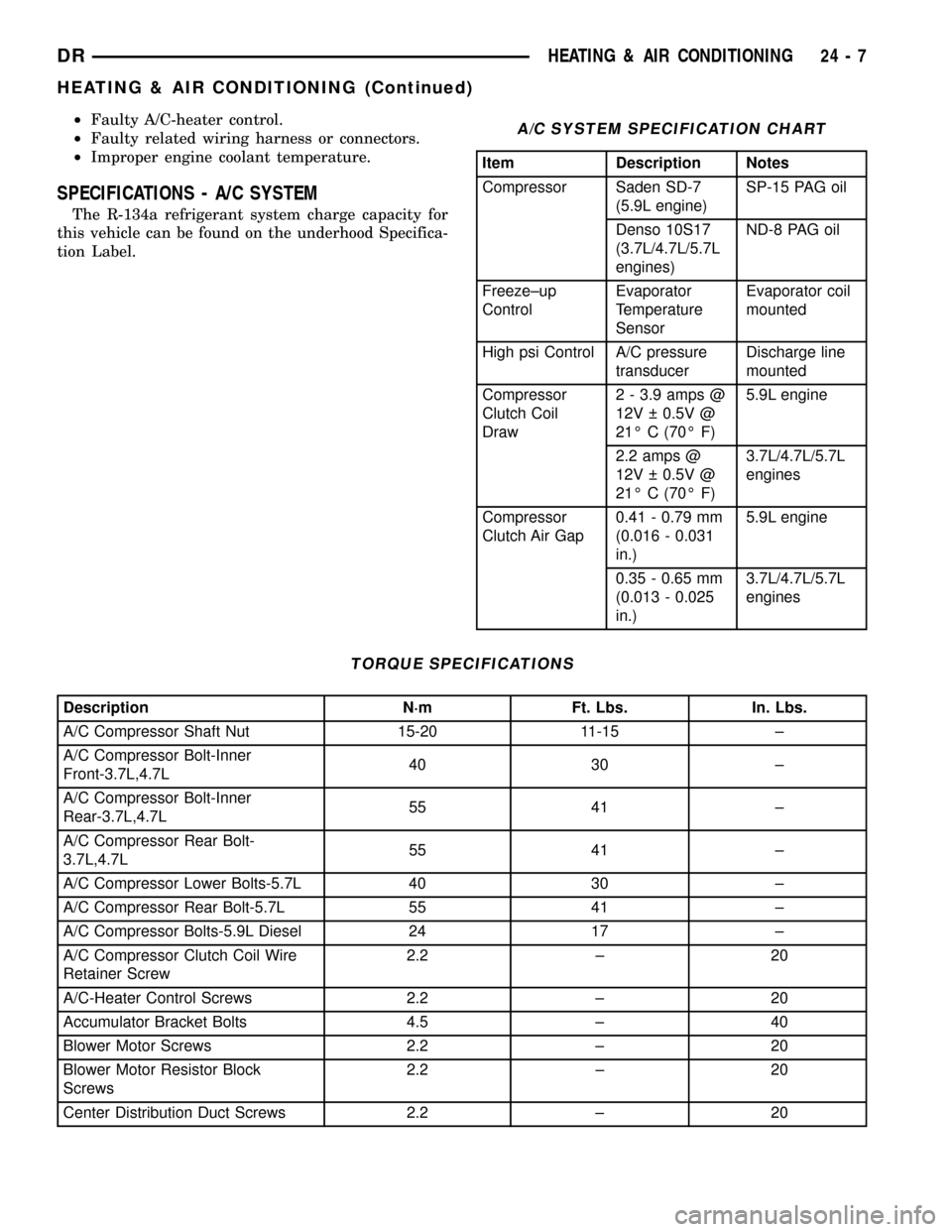
SPECIFICATIONS - A/C SYSTEM
The R-134a refrigerant system charge capacity for
this vehicle can be found on the underhood Specifica-
tion Label.
A/C SYSTEM SPECIFICATION CHART
Item Description Notes
Compressor Saden SD-7
(5.9L engine)SP-15 PAG oil
Denso 10S17
(3.7L/4.7L/5.7L
engines)ND-8 PAG oil
Freeze±up
ControlEvaporator
Temperature
SensorEvaporator coil
mounted
High psi Control A/C pressure
transducerDischarge line
mounted
Compressor
Clutch Coil
Draw2 - 3.9 amps @
12V 0.5V @
21É C (70É F)5.9L engine
2.2 amps @
12V 0.5V @
21É C (70É F)3.7L/4.7L/5.7L
engines
Compressor
Clutch Air Gap0.41 - 0.79 mm
(0.016 - 0.031
in.)5.9L engine
0.35 - 0.65 mm
(0.013 - 0.025
in.)3.7L/4.7L/5.7L
engines
TORQUE SPECIFICATIONS
Description N´m Ft. Lbs. In. Lbs.
A/C Compressor Shaft Nut 15-20 11-15 ±
A/C Compressor Bolt-Inner
Front-3.7L,4.7L40 30 ±
A/C Compressor Bolt-Inner
Rear-3.7L,4.7L55 41 ±
A/C Compressor Rear Bolt-
3.7L,4.7L55 41 ±
A/C Compressor Lower Bolts-5.7L 40 30 ±
A/C Compressor Rear Bolt-5.7L 55 41 ±
A/C Compressor Bolts-5.9L Diesel 24 17 ±
A/C Compressor Clutch Coil Wire
Retainer Screw2.2 ± 20
A/C-Heater Control Screws 2.2 ± 20
Accumulator Bracket Bolts 4.5 ± 40
Blower Motor Screws 2.2 ± 20
Blower Motor Resistor Block
Screws2.2 ± 20
Center Distribution Duct Screws 2.2 ± 20
DRHEATING & AIR CONDITIONING 24 - 7
HEATING & AIR CONDITIONING (Continued)
Page 2535 of 2627

After the system has been tested for leaks and
evacuated, a refrigerant (R-134a) charge can be
injected into the system.
NOTE: When connecting the service equipment
coupling to the line fitting, verify that the valve of
the coupling is fully closed. This will reduce the
amount of effort required to make the connection.
(1) If using a separate vacuum pump close all
valves before disconnecting pump. Connect manifold
gauge set to the A/C service ports.
NOTE: Always refer to the underhood HVAC Speci-
fication label for the refrigerant fill level of the vehi-
cle being serviced.
(2) Measure refrigerant (refer to capacities). Refer
to the instructions provided with the equipment
being used.
(3) Verify engine is shut off. Open the suction and
discharge valves. Open the charge valve to allow the
refrigerant to flow into the system. When the trans-
fer of refrigerant has stopped, close the suction and
discharge valve.
(4) If all of the charge did not transfer from the
dispensing device, put vehicle controls into the fol-
lowing mode:
²Automatic transmission in park or manual
transmission in neutral
²Engine at idle
²A/C mode control set to outside air
²A/C mode control set to panel mode
²A/C temperature control set to full cool
²Blower motor control set on highest speed
²Vehicle windows closed
If the A/C compressor does not engage, test the
compressor clutch control circuit and correct any fail-
ure (Refer to 8 - ELECTRICAL/WIRING DIAGRAM
INFORMATION - DIAGNOSIS AND TESTING).
(5) Open the suction valve to allow the remaining
refrigerant to transfer to the system.
WARNING: TAKE CARE NOT TO OPEN THE DIS-
CHARGE (HIGH-PRESSURE) VALVE AT THIS TIME.
(6) Close all valves and test the A/C system perfor-
mance.
(7) Disconnect the charging station or manifold
gauge set. Install the service port caps.
REFRIGERANT CHARGE CAPACITY
The R-134a refrigerant system charge capacity for
this vehicle can be found on the underhood HVAC
specfication tag.
A/C COMPRESSOR
DESCRIPTION
DESCRIPTION - A/C COMPRESSOR
The A/C system on models equipped with the 5.9L
engine use a Sanden SD-7 reciprocating swash plate-
type compressor. This compressor has a fixed dis-
placement of 165 cubic centimeter (10.068 cubic
inches) and has both the suction and discharge ports
located on the cylinder head.
The A/C system on models equipped with the 3.7L,
4.7L and 5.7L engines use a Denso 10S17 reciprocat-
ing swash plate-type compressor. This compressor
has a fixed displacement of 170 cubic centimeter and
has both the suction and discharge ports located on
the cylinder head.
A label identifying the use of R-134a refrigerant is
located on both A/C compressors.
DESCRIPTION - HIGH PRESSURE RELIEF
VALVE
A high pressure relief valve is located on the com-
pressor cylinder head, which is on the rear of the
compressor. This mechanical valve is designed to
vent refrigerant from the system to protect against
damage to the compressor and other system compo-
nents, caused by condenser air flow restriction or an
overcharge of refrigerant.
OPERATION
OPERATION - A/C COMPRESSOR
The A/C compressor is driven by the engine
through an electric clutch, drive pulley and belt
arrangement. The compressor is lubricated by refrig-
erant oil that is circulated throughout the refrigerant
system with the refrigerant.
The compressor draws in low-pressure refrigerant
vapor from the evaporator through its suction port. It
then compresses the refrigerant into a high-pressure,
high-temperature refrigerant vapor, which is then
pumped to the condenser through the compressor dis-
charge port.
The compressor cannot be repaired. If faulty or
damaged, the entire compressor assembly must be
replaced. The compressor clutch, pulley and clutch
coil are available for service.
OPERATION - HIGH PRESSURE RELIEF VALVE
The high pressure relief valve vents the system
when a discharge pressure of 3445 to 4135 kPa (500
to 600 psi) or above is reached. The valve closes
24 - 48 PLUMBINGDR
PLUMBING (Continued)
Page 2556 of 2627
designs. Useonlyrefrigerant oil of the same type as
recommended to service the refrigerant system
(always refer to the specification tagincluded
with the replacement A/C compressor or the under-
hood A/C system specification tag).
OPERATION
After performing any refrigerant recovery or recy-
cling operation, always replenish the refrigerant sys-
tem with the same amount of the recommended
refrigerant oil as was removed. Too little refrigerant
oil can cause compressor damage, and too much can
reduce air conditioning system performance.
PAG refrigerant oil is much more hygroscopic than
mineral oil, and will absorb any moisture it comes
into contact with, even moisture in the air. The PAG
oil container should always be kept tightly capped
until it is ready to be used. After use, recap the oil
container immediately to prevent moisture contami-
nation.
STANDARD PROCEDURE - REFRIGERANT OIL
LEVEL
WARNING: REFER TO THE APPLICABLE WARN-
INGS AND CAUTIONS FOR THIS SYSTEM BEFORE
PERFORMING THE FOLLOWING OPERATION (Refer
to 24 - HEATING & AIR CONDITIONING/PLUMBING -
WARNING) and (Refer to 24 - HEATING & AIR CON-
DITIONING/PLUMBING - CAUTION).
CAUTION: The refrigerant oil in the R-134a A/C sys-
tem is unique depending on the A/C compressor
used. Use only PAG oils that are designed to work
with R-134a refrigerant and the A/C compressor in
the vehicle. Always refer to the underhood A/C Sys-
tem Specification Label for the correct oil designa-
tion.
It is important to have the correct amount of lubri-
cant in the A/C refrigerant system to ensure proper
lubrication of the A/C compressor. Too little lubricant
will result in damage to the compressor. Too much
lubricant will reduce the cooling capacity of the A/C
system and consequently result in higher discharge
air temperatures.
The lubricant used in the compressor is polyalka-
lene glycol PAG lubricant. Only the refrigerant lubri-
cant approved for use with this vehicle should be
used to service the system. Do not use any other
lubricant. The lubricant container should be kept
tightly capped until it is ready for use. Refrigerant
lubricant will quickly absorb any moisture it comes
in contact with.
It will not be necessary to check the oil level in the
A/C compressor or to add oil, unless there has beenan oil loss. An oil loss may occur due to component
replacement, or a rupture or leak from a refrigerant
line, connector fitting, component or component seal.
If a leak occurs, add 30 milliliters (1 fluid ounce) of
the recommended refrigerant oil to the refrigerant
system after the repair has been made. Refrigerant
oil loss will be evident at the leak point by the pres-
ence of a wet, shiny surface around the leak.
COMPONENT REFRIGERANT OIL LEVEL CHECK
When an air conditioning system is first assembled
at the factory, all components (except the A/C com-
pressor) are refrigerant oil free. After the refrigerant
system has been charged with (R-134a) refrigerant
and operated, the oil in the A/C compressor is dis-
persed through the lines and components. The A/C
evaporator, A/C condenser, and accumulator will
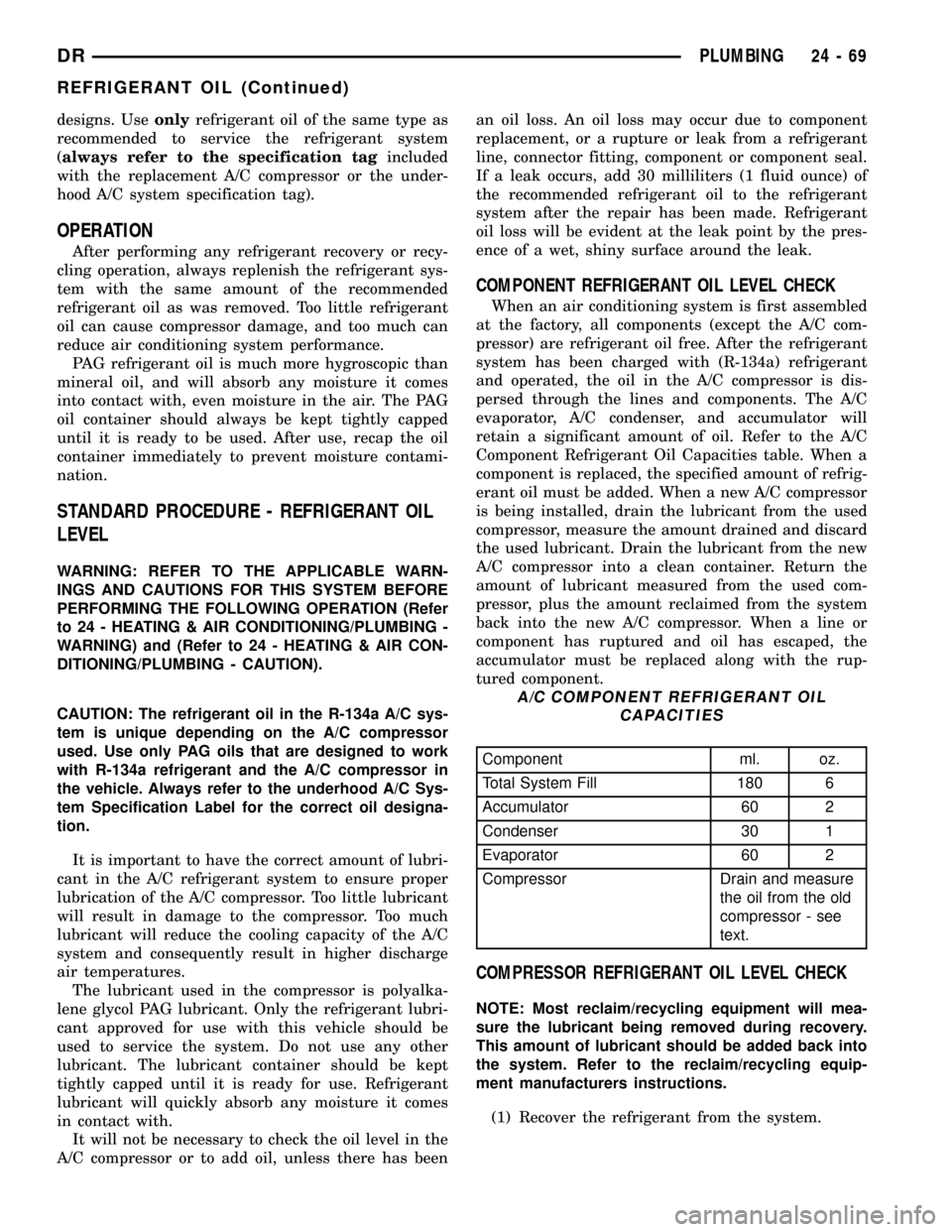
retain a significant amount of oil. Refer to the A/C
Component Refrigerant Oil Capacities table. When a
component is replaced, the specified amount of refrig-
erant oil must be added. When a new A/C compressor
is being installed, drain the lubricant from the used
compressor, measure the amount drained and discard
the used lubricant. Drain the lubricant from the new
A/C compressor into a clean container. Return the
amount of lubricant measured from the used com-
pressor, plus the amount reclaimed from the system
back into the new A/C compressor. When a line or
component has ruptured and oil has escaped, the
accumulator must be replaced along with the rup-
tured component.
A/C COMPONENT REFRIGERANT OIL
CAPACITIES
Component ml. oz.
Total System Fill 180 6
Accumulator 60 2
Condenser 30 1
Evaporator 60 2
Compressor Drain and measure
the oil from the old
compressor - see
text.
COMPRESSOR REFRIGERANT OIL LEVEL CHECK
NOTE: Most reclaim/recycling equipment will mea-
sure the lubricant being removed during recovery.
This amount of lubricant should be added back into
the system. Refer to the reclaim/recycling equip-
ment manufacturers instructions.
(1) Recover the refrigerant from the system.
DRPLUMBING 24 - 69
REFRIGERANT OIL (Continued)
Page 2603 of 2627

HEATED SEAT MODULE - INSTALLATION . . . 8E-7
HEATED SEAT MODULE - INSTALLATION . . 8G-15
HEATED SEAT MODULE - OPERATION.....8E-6
HEATED SEAT MODULE - OPERATION....8G-14
HEATED SEAT MODULE - REMOVAL.......8E-7
HEATED SEAT MODULE - REMOVAL.....8G-15
HEATED SEAT SENSOR - DESCRIPTION . . . 8G-11
HEATED SEAT SENSOR - DIAGNOSIS
AND TESTING.......................8G-11
HEATED SEAT SENSOR - OPERATION....8G-11
HEATED SEAT SENSOR - REMOVAL......8G-11
HEATED SEAT SWITCH - DESCRIPTION . . . 8G-11
HEATED SEAT SWITCH - DIAGNOSIS
AND TESTING.......................8G-12
HEATED SEAT SWITCH - INSTALLATION . . 8G-13
HEATED SEAT SWITCH - OPERATION.....8G-12
HEATED SEAT SWITCH - REMOVAL......8G-13
HEATED SEAT SYSTEM - DESCRIPTION....8G-7
HEATED SEAT SYSTEM - DIAGNOSIS
AND TESTING........................8G-8
HEATED SEAT SYSTEM - OPERATION.....8G-8
HEATER - 5.9L DIESEL - DESCRIPTION,
ENGINE BLOCK.......................7-37
HEATER - 5.9L DIESEL - INSTALLATION,
ENGINE BLOCK.......................7-38
HEATER - 5.9L DIESEL - OPERATION,
ENGINE BLOCK.......................7-38
HEATER - 5.9L DIESEL - REMOVAL,
ENGINE BLOCK.........................7-38
HEATER - DESCRIPTION, ENGINE BLOCK . . . 7-36
HEATER - DESCRIPTION, FUEL..........14-51
HEATER - DESCRIPTION, INTAKE AIR.....14-80
HEATER - DIAGNOSIS AND TESTING,
ENGINE BLOCK.......................7-36
HEATER - DIAGNOSIS AND TESTING,
FUEL..............................14-52
HEATER - INSTALLATION, ENGINE
BLOCK..............................7-37
HEATER - INSTALLATION, INTAKE AIR....14-80
HEATER - OPERATION, ENGINE BLOCK....7-36
HEATER - OPERATION, FUEL............14-51
HEATER - OPERATION, INTAKE AIR......14-80
HEATER - REMOVAL, ENGINE BLOCK......7-37
HEATER - REMOVAL, INTAKE AIR........14-80
HEATER AND AIR CONDITIONER -
DESCRIPTION........................24-1
HEATER AND AIR CONDITIONER -
OPERATION..........................24-1
HEATER CONTROL - DESCRIPTION, A/C . . . 24-14
HEATER CONTROL - INSTALLATION, A/C . . 24-15
HEATER CONTROL - REMOVAL, A/C......24-15
HEATER CORE - DESCRIPTION..........24-63
HEATER CORE - INSTALLATION.........24-63
HEATER CORE - OPERATION............24-63
HEATER CORE - REMOVAL.............24-63
HEATER INLET HOSE - INSTALLATION....24-64
HEATER INLET HOSE - REMOVAL........24-64
HEATER PERFORMANCE TEST -
DIAGNOSIS AND TESTING..............24-6
HEATER RELAY - DESCRIPTION, FUEL....14-52
HEATER RELAY - DESCRIPTION, INTAKE
AIR ...............................14-82
HEATER RELAY - INSTALLATION, FUEL . . . 14-53
HEATER RELAY - INSTALLATION, INTAKE
AIR ...............................14-82
HEATER RELAY - OPERATION, FUEL......14-52
HEATER RELAY - OPERATION, INTAKE
AIR ...............................14-82
HEATER RELAY - REMOVAL, FUEL.......14-52
HEATER RELAY - REMOVAL, INTAKE AIR . . 14-82
HEATER RETURN HOSE - INSTALLATION . . 24-65
HEATER RETURN HOSE - REMOVAL......24-64
HEIGHT ADJUSTMENT - 4WD (LD) -
STANDARD PROCEDURE.................2-3
HEIGHT MEASUREMENT - 4WD (LD) -
STANDARD PROCEDURE.................2-3
HEMI ENGINE - INSTALLATION, 3.7L/4.7L
AND 5.7L......................24-59,24-73
HEMI ENGINE - REMOVAL, 3.7L/4.7L
AND 5.7L......................24-57,24-71
HIGH BEAM INDICATOR - DESCRIPTION
. . 8J-28
HIGH BEAM INDICATOR - OPERATION
....8J-28
HIGH MOUNTED STOP LAMP -
INSTALLATION, CENTER
...............8L-11
HIGH MOUNTED STOP LAMP -
REMOVAL, CENTER
...................8L-11
HIGH MOUNTED STOP LAMP UNIT -
INSTALLATION, CENTER
...............8L-11HIGH MOUNTED STOP LAMP UNIT -
REMOVAL, CENTER...................8L-11
HIGH PRESSURE RELIEF VALVE -
DESCRIPTION.......................24-48
HIGH PRESSURE RELIEF VALVE -
OPERATION.........................24-48
HIGH SPEEDS - DESCRIPTION, TIRE
PRESSURE..........................22-7
HIGH/LOW RELAY - DESCRIPTION,
WIPER.............................8R-20
HIGH/LOW RELAY - DIAGNOSIS AND
TESTING, WIPER.....................8R-21
HIGH/LOW RELAY - INSTALLATION,
WIPER.............................8R-22
HIGH/LOW RELAY - OPERATION, WIPER . . 8R-20
HIGH/LOW RELAY - REMOVAL, WIPER . . . 8R-21
HIGH-PRESSURE FUEL LINE LEAKS -
DIAGNOSIS AND TESTING.............14-58
HINGE - INSTALLATION.....23-16,23-22,23-31,
23-46
HINGE - INSTALLATION, CENTER SEAT
BACK..............................23-79
HINGE - REMOVAL....23-16,23-22,23-31,23-46
HINGE - REMOVAL, CENTER SEAT BACK . . 23-78
HINGE COVER - INSTALLATION, CENTER
SEAT BACK INERTIA..................23-77
HINGE COVER - REMOVAL, CENTER
SEAT BACK INERTIA..................23-77
HITCH - INSTALLATION, TRAILER........13-25
HITCH - REMOVAL, TRAILER...........13-25
HOAT COOLANT - DESCRIPTION..........7-32
HOISTING - STANDARD PROCEDURE......0-20
HOLDDOWN - DESCRIPTION, BATTERY . . . 8F-14
HOLDDOWN - INSTALLATION, BATTERY . . . 8F-14
HOLDDOWN - OPERATION, BATTERY.....8F-14
HOLDDOWN - REMOVAL, BATTERY......8F-14
HOLDER - INSTALLATION, CUP.........23-51
HOLDER - REMOVAL, CUP.............23-51
HOLDING CLUTCHES - DESCRIPTION....21-371
HOLDING CLUTCHES - OPERATION.....21-372
HOLE PLUG - INSTALLATION, CAMSHAFT
CORE..............................9-206
HOLE PLUG - REMOVAL, CAMSHAFT
CORE..............................9-205
HOLE REPAIR - DESCRIPTION,
THREADED........................Intro.-8
HONING - STANDARD PROCEDURE,
CYLINDER BORE.................9-128,9-38
HOOD - INSTALLATION................23-47
HOOD - REMOVAL....................23-46
HOOK - INSTALLATION, COAT...........23-66
HOOK - REMOVAL, COAT..............23-66
HOOK ASSEMBLY - INSTALLATION,
FRONT TOW........................13-23
HOOK ASSEMBLY - REMOVAL, FRONT
TOW ..............................13-23
HORN - DIAGNOSIS AND TESTING.......8H-1
HORN - INSTALLATION.................8H-2
HORN - REMOVAL....................8H-2
HORN SWITCH - DESCRIPTION..........8H-2
HORN SWITCH - DIAGNOSIS AND
TESTING............................8H-2
HORN SYSTEM - DESCRIPTION..........8H-1
HORN SYSTEM - DIAGNOSIS AND
TESTING............................8H-1
HORN SYSTEM - OPERATION............8H-1
HOSE - GEAR TO COOLER -
INSTALLATION, RETURN..........19-44,19-45
HOSE - GEAR TO COOLER - REMOVAL,
RETURN......................19-44,19-45
HOSE - INSTALLATION, FRONT BRAKE.....5-13
HOSE - INSTALLATION, HEATER INLET....24-64
HOSE - INSTALLATION, HEATER RETURN . 24-65
HOSE - INSTALLATION, PRESSURE . 19-44,19-45
HOSE - INSTALLATION, REAR BRAKE......5-12
HOSE - REMOVAL, FRONT..............5-12
HOSE - REMOVAL, HEATER INLET.......24-64
HOSE - REMOVAL, HEATER RETURN.....24-64
HOSE - REMOVAL, PRESSURE.....19-44,19-45
HOSE - REMOVAL, REAR BRAKE
.........5-11
HOSE - RESERVOIR TO COOLER -
INSTALLATION, RETURN
..........19-44,19-45
HOSE - RESERVOIR TO COOLER -
REMOVAL, RETURN
.............19-44,19-45
HOSE ASSEMBLY - INSTALLATION, REAR
TUBE
...............................5-13
HOSE ASSEMBLY - REMOVAL, REAR
TUBE
...............................5-12HOSE CLAMPS - DESCRIPTION...........7-3
HOSE CLAMPS - OPERATION.............7-5
HOSES/TUBES - DESCRIPTION, WASHER . 8R-11
HOSES/TUBES - OPERATION, WASHER . . . 8R-11
HOUSING - ASSEMBLY, HVAC...........24-35
HOUSING - DIAGNOSIS AND TESTING,
CLUTCH..............................6-7
HOUSING - DISASSEMBLY, HVAC........24-35
HOUSING - INSTALLATION, CLUTCH.......6-9
HOUSING - INSTALLATION, GEAR........9-300
HOUSING - INSTALLATION, HVAC........24-36
HOUSING - INSTALLATION, ROCKER.....9-255
HOUSING - REMOVAL, CLUTCH...........6-9
HOUSING - REMOVAL, GEAR...........9-299
HOUSING - REMOVAL, HVAC...........24-34
HOUSING - REMOVAL, ROCKER.........9-255
HOUSING BUSHING AND SEAL -
INSTALLATION, EXTENSION...........21-440
HOUSING BUSHING AND SEAL -
REMOVAL, EXTENSION...............21-440
HOUSING COVER - INSTALLATION, GEAR . 9-301
HOUSING COVER - REMOVAL, GEAR.....9-301
HOUSING FLUID LEAK - DIAGNOSIS AND
TESTING, CONVERTER.........21-144,21-318
HOUSING SEAL - INSTALLATION,
ADAPTER...............21-128,21-364,21-85
HOUSING SEAL - INSTALLATION,
EXTENSION . 21-128,21-201,21-507,21-536,21-85
HOUSING SEAL - REMOVAL, ADAPTER . . 21-128,
21-364,21-85
HOUSING SEAL - REMOVAL,
EXTENSION . 21-128,21-201,21-507,21-536,21-85
HOUSING SEAL AND DUST BOOT -
INSTALLATION, EXTENSION.....21-476,21-571
HOUSING SEAL AND DUST BOOT -
REMOVAL, EXTENSION.........21-476,21-571
HOW TO USE WIRING DIAGRAMS -
DESCRIPTION.....................8W-01-1
H-SECTION REPLACEMENT - STANDARD
PROCEDURE, REAR FRAME............13-13
HUB / BEARING - INSTALLATION.........2-32
HUB / BEARING - REMOVAL.............2-31
HVAC HOUSING - ASSEMBLY...........24-35
HVAC HOUSING - DISASSEMBLY........24-35
HVAC HOUSING - INSTALLATION........24-36
HVAC HOUSING - REMOVAL............24-34
HYDRAULIC BOOSTER - DIAGNOSIS
AND TESTING........................5-30
HYDRAULIC LASH ADJUSTER -
DIAGNOSIS AND TESTING.........9-125,9-32
HYDRAULIC PRESSURE TEST -
DIAGNOSIS AND TESTING......21-141,21-316
HYDRAULIC SCHEMATICS, SCHEMATICS
AND DIAGRAMS..............21-176,21-337
HYDRAULIC TAPPETS - DIAGNOSIS AND
TESTING...........................9-210
HYDRAULIC TAPPETS - INSTALLATION . . . 9-211
HYDRAULIC TAPPETS - REMOVAL.......9-211
HYDROBOOST - INSTALLATION..........5-27
HYDROBOOST - INSTALLATION, ALL
EXCEPT.............................5-27
HYDROBOOST - REMOVAL..............5-26
HYDROBOOST - REMOVAL, ALL EXCEPT . . . 5-26
HYDRO-BOOST BRAKE BOOSTER -
INSTALLATION........................5-32
HYDRO-BOOST BRAKE BOOSTER -
REMOVAL
...........................5-31
HYDROFORM FENDER RAIL REPAIR -
STANDARD PROCEDURE
...............13-11
HYDROSTATIC LOCK - STANDARD
PROCEDURE
...................9-190,9-240
IDENTIFICATION - DESCRIPTION,
FASTENER
.........................Intro.-5
IDENTIFICATION AND INFORMATION -
DESCRIPTION, SECTION
.............8W-01-6
IDENTIFICATION NUMBER -
DESCRIPTION, VEHICLE
..............Intro.-1
IDLE AIR CONTROL MOTOR -
DESCRIPTION
.......................14-28
IDLE AIR CONTROL MOTOR -
INSTALLATION
.......................14-29
IDLE AIR CONTROL MOTOR -
OPERATION
.........................14-28
IDLE AIR CONTROL MOTOR - REMOVAL
. . 14-29
IDLER SHAFT - INSTALLATION
......9-179,9-81
IDLER SHAFT - REMOVAL
..........9-179,9-81
IGNITION - SPECIFICATIONS, TORQUE
.....8I-3
16 INDEXDR
Description Group-Page Description Group-Page Description Group-Page