Fuel rail DODGE RAM 1500 1998 2.G Repair Manual
[x] Cancel search | Manufacturer: DODGE, Model Year: 1998, Model line: RAM 1500, Model: DODGE RAM 1500 1998 2.GPages: 2627
Page 1643 of 2627

FUEL CONTROL ACTUATOR
DESCRIPTION
The Fuel Control Actuator (FCA) is located at the
rear of the high-pressure, fuel injection pump (Fig.
13).
OPERATION
The Fuel Control Actuator (FCA) is an electroni-
cally controlled solenoid valve. The ECM controls the
amount of fuel that enters the high-pressure pump-
ing chambers by opening and closing the FCA based
on a demanded fuel pressure. When the FCA is
opened, the maximum amount of fuel is being sup-
plied to the fuel injection pump. Any fuel that does
not enter the injection pump is directed to the cas-
cade overflow valve. The cascade overflow valve reg-
ulates how much excess fuel is used for lubrication of
the pump and how much is returned to the fuel tank
through the drain manifold.
An audible click from the FCA is normal when
operating the key from the ON to the OFF position.
REMOVAL
The Fuel Control Actuator (FCA) is a non-servi-
cable part.
FUEL INJECTOR
DESCRIPTION
Six individual, solenoid actuated high-pressure fuel
injectors are used (Fig. 14). The injectors are verti-
cally mounted into a bored hole in the top of the cyl-
inder head. This bored hole is located between the
intake/exhaust valves. High-pressure connectors (Fig.
15), mounted into the side of the cylinder head, con-
nect each fuel injector to each high-pressure fuel line.
OPERATION
High-pressure fuel is supplied from the injection
pump, through a high-pressure fuel line, into a fuel
rail, through high-pressure lines, through steel con-
nectors and into the solenoid actuated fuel injector.
The ECM actuates the solenoid causing the needle
valve to rise and fuel flows through the spray holes
in the nozzle tip into the combustion chamber.
Each fuel injector is connected to the fuel rail by a
high-pressure fuel line and a steel connector. This
steel connector is positioned into the cylinder head
and sealed with an o-ring. The connector is retained
in the cylinder head by a nut (fitting) that is
threaded into the cylinder head.
Fig. 13 FUEL CONTROL ACTUATOR
1 - ACTUATOR MOUNTING BOLTS
2 - FCA (FUEL CONTROL ACTUATOR)
3 - ACTUATOR ELECTRICAL CONNECTOR
Fig. 14 FUEL INJECTOR - DIESEL
1 - SOLENOID ELECTRICAL CONNECTOR STUDS
2 - MOUNTING BOLTS
3 - MOUNTING PLATES
4- COPPER SEALING WASHER
5 - INJECTOR TIP
6 - INJECTOR O-RING
7 - INJECTOR ELECTRICAL SOLENOID
14 - 74 FUEL INJECTION - DIESELDR
Page 1644 of 2627

The torquing force of this threaded nut (fitting)
provides a sealing pressure between the fuel line con-
nector and the fuel injector.Retaining nut torque
is very critical.If the nut (fitting) is under torqued,
the mating surfaces will not seal and a high-pressure
fuel leak will result. If the fitting is over torqued, the
connector and injector will deform and also cause a
high-pressure fuel leak. This leak will be inside the
cylinder head and will not be visible. The result will
be a possible fuel injector miss-fire and low power, or
a no-start condition.
The fuel injectors use hole type nozzles. High-pres-
sure flows into the side of the injector, the ECM acti-
vates the solenoid causing the injector needle to lift
and fuel to be injected. The clearances in the nozzle
bore are extremely small and any dirt or contami-
nants will cause the injector to stick. Because of this,
it is very important to do a thorough cleaning of any
lines before opening up any fuel system component.
Always cover or cap any open fuel connections before
a fuel system repair is performed.
Each fuel injector connector tube contains an edge
filter that is designed to beak up small contaminants
before entering the fuel injector.The edge filters
are not a substitute for proper cleaning andcovering of all fuel system components during
repair.
The bottom of each fuel injector is sealed to the
cylinder head with a1.5mmthick copper shim (gas-
ket). The correct thickness shim must always be re-
installed after removing an injector.
Fuel pressure in the injector circuit decreases after
injection. The injector needle valve is immediately
closed and fuel flow into the combustion chamber is
stopped. Exhaust gases are prevented from entering
the injector nozzle by the needle valve.
REMOVAL
CAUTION: Refer to Cleaning Fuel System Parts.
Six individual, solenoid actuated high-pressure fuel
injectors are used (Fig. 14). The injectors are verti-
cally mounted into a bored hole in the top of the cyl-
inder head. This bored hole is located between the
intake/exhaust valves. High-pressure connectors (Fig.
15), mounted into the side of the cylinder head, con-
nect each fuel injector to each high-pressure fuel line.
(1) Disconnect both negative battery cables from
both batteries. Cover and isolate ends of cables.
(2) Remove breather assembly.
Fig. 15 HIGH-PRESSURE CONNECTOR
1 - HIGH-PRESSURE CONNECTOR (TO FUEL INJECTOR)
2 - O-RING
3 - CONNECTOR RETAINER4 - FUEL RAIL
5 - HIGH-PRESSURE FUEL LINES
6 - LOCATING PINS
DRFUEL INJECTION - DIESEL 14 - 75
FUEL INJECTOR (Continued)
Page 1645 of 2627

(3) Remove valve cover. Refer to Engines for proce-
dures.
(4) Remove necessary high pressure fuel line con-
necting necessary fuel injector rail to high pressure
connector. Refer to Fuel Line Removal for procedures.
(5) A connector retainer (nut) (Fig. 15) is used on
each connector tube. Remove this nut(s) by unthread-
ing from cylinder head.
(6) Using special high-pressure connector removal
tool #9015 (Fig. 16), or (Fig. 17) remove necessary
high-pressure connector(s) from cylinder head. Tool
#9015 threads onto connector tube. Use tool to pry
connector tube(s) from cylinder head.
(7) Remove necessary exhaust rocker arm assem-
bly(s).
(8) Disconnect injector solenoid wire nuts at top of
injectors (Fig. 18).
(9) Remove 2 fuel injector hold-down clamp bolts
at each injector being removed.
(10)USING TOOL #9010:
(a) Special Tool #9010 (Fig. 19) is equipped with
2 clamshell clamps, a sliding retainer sleeve to
retain the clamshell clamps, a 2±piece mounting
stud, and a pivoting handle.Do not attempt to
remove the fuel injector with any other
device. Damage to injector will occur.
(b) The rocker housing (Fig. 18) is bolted to the
top of cylinder head. The mounting stud from tool
#9010 was meant to temporarily replace a rocker
housing mounting bolt. Remove the necessary
rocker housing mounting bolt. These mounting
bolts are located at the center of each of the 3
rocker housing support bridges.
(c) Install and tighten 2±piece mounting stud to
rocker housing. If removing the #6 fuel injector,
separate the 2±piece mounting stud. Install lower
half of mounting stud to center of rocker housing
bridge. Install upper half of mounting stud to lower
half.
(d) Position tool handle to mounting stud and
install handle nut. Leave handle nut loose to allow
a pivoting action.
(e) Position lower part of clamshell halves to
sides of fuel injector (wider shoulder to bottom).
The upper part of clamshell halves should also be
positioned into machined shoulder on the handles
pivoting head.
(f) Slide the retainer sleeve over pivoting handle
head to lock clamshell halves together.
(g) Be sure handle pivot nut is loose.
(h) Depress handle downward to remove fuel
injector straight up from cylinder head bore.
(11) Remove and discard injector sealing washer.
This should be located on tip of injector (Fig. 20) or
(Fig. 21).
Fig. 16 CONNECTOR TUBE REMOVAL
1 - CONNECTOR TUBE
2 - TOOL #9015
3 - CYLINDER HEAD (LEFT SIDE)
Fig. 17 TOOL #9015 AND CONNECTOR TUBE
1 - CONNECTOR TUBE
2 - LOCATING PINS
3 - RUBBER O-RING
4 - TOOL #9015
14 - 76 FUEL INJECTION - DIESELDR
FUEL INJECTOR (Continued)
Page 1647 of 2627

(6) Install injector into cylinder head with male
connector port facing the intake manifold. Push down
on fuel injector mounting flange to engage o-ring and
seat injector.
(7) Tightening Sequence:
(a) Install fuel injector holdown clamp (mount-
ing flange) bolts.Do a preliminary tightening
of these bolts to 5 N´m (44 in. lbs.) torque.
This preliminary tightening insures the fuel
injector is seated and centered.
(b) After tightening, relieve bolt torque, but
leave both bolts threaded in place.
(c) Install high-pressure connector and retaining
nut. Do a preliminary tightening to 15 N´m (11 ft.
lbs.) torque.
(d) Alternately tighten injector holdown bolts to
10 N´m (89 in. lbs.) torque.
(e) Do a final tightening of the high-pressure
connector and retaining nut. Tighten to 50 N´m (37
ft. lbs.) torque.
(8) Connect injector solenoid wires and nuts to top
of injectors (Fig. 18). Tighten connector nuts to 1.25
N´m (11 in. lbs.) torque.Be very careful not to
overtighten these nuts as damage to fuel injec-
tor will occur.
(9) Install exhaust rocker arm assembly. Refer to
Engine.
(10) Set exhaust valve lash. Refer to Engine.
(11) Install high pressure fuel line. Refer to Torque
Specifications.Be sure to use a secondary
back-up wrench on the connector nut (fitting)
while torquing fuel line fitting.Refer to Fuel Line
Installation for additional information.
(12) Install valve cover. Refer to Engine.
(13) Install breather assembly.
(14) Connect negative battery cables to both bat-
teries.
FUEL INJECTOR RAIL
DESCRIPTION
The fuel injector rail is bolted to the top of the
intake manifold.
OPERATION
The fuel rail is used as a distribution device to
supply high-pressure fuel to the high-pressure fuel
lines.
REMOVAL
CAUTION: Cleanliness cannot be overemphasized
when handling or replacing diesel fuel system com-
ponents. This especially includes the fuel injectors,
high-pressure fuel lines and fuel injection pump.Very tight tolerances are used with these parts. Dirt
contamination could cause rapid part wear and pos-
sible plugging of fuel injector nozzle tip holes. This
in turn could lead to possible engine misfire.
Always wash/clean any fuel system component
thoroughly before disassembly and then air dry.
Cap or cover any open part after disassembly.
Before assembly, examine each part for dirt, grease
or other contaminants and clean if necessary. When
installing new parts, lubricate them with clean
engine oil or clean diesel fuel only.
(1) Disconnect both negative battery cables at both
batteries. Isolate ends of both cables.
(2) Disconnect electrical connector at fuel pressure
sensor.
(3) Remove banjo bolt at fuel limiting valve.
(4) Disconnect necessary wiring harness retention
clips from intake manifold.
(5) Lift 2 rubber covers to gain access to positive
(+), intake heater cable nuts. Remove 2 nuts and
remove 2 cables from studs.
(6) Carefully remove 4 high-pressure fuel lines
from top of injector rail engine. Note position of each
line while removing.Do not bend lines while
removing.
CAUTION: WHEN LOOSENING OR TIGHTENING
HIGH-PRESSURE LINES ATTACHED TO A SEPA-
RATE FITTING, USE A BACK-UP WRENCH ON FIT-
TING. DO NOT ALLOW FITTING TO ROTATE.
DAMAGE TO BOTH FUEL LINE AND FITTING WILL
RESULT.
(7) Carefully remove 2 high-pressure fuel lines at
each end of injector rail. Note position of each line
while removing.Do not bend lines while remov-
ing.
(8) Remove fuel line connecting injector pump to
fuel rail.
(9) Remove 3 injector rail mounting bolts (Fig. 22).
(10) Remove rail from top of intake manifold.
INSTALLATION
(1) Clean any dirt/debris from top of intake mani-
fold and bottom of fuel rail.
(2) Position fuel rail to top of manifold and install
3 mounting bolts. Refer to Torque Specifications.
(3) Install all high-pressure lines to rail. Refer to
Fuel Lines for procedures.
(4) Reposition wiring harness to intake manifold
and install new tie wraps.
(5) Install and tighten fuel limiting valve banjo
bolt. Refer to Torque Specifications.
(6) Connect electrical connector to fuel pressure
sensor.
(7) Position 2 positive (+) cables to intake heater
studs. Install 2 nuts.
14 - 78 FUEL INJECTION - DIESELDR
FUEL INJECTOR (Continued)
Page 1648 of 2627

(8) Connect battery cables to both batteries.
(9) Start engine and check for leaks.
INLET AIR TEMPERATURE
SENSOR/PRESSURE SENSOR
DESCRIPTION
The combination, dual function Inlet Air Tempera-
ture/Pressure Sensor is located on the air cleaner (fil-
ter) cover.
OPERATION
The Inlet Air Temperature/Pressure Sensor is a
combination dual-function sensor. The sensor element
extends into the intake air stream at the top of the
air filter housing. Ambient air temperature as well as
barometric pressure is monitored by this sensor. The
Engine Control Module (ECM) monitors signals from
this sensor.
REMOVAL
The Inlet Air Temperature/Pressure Sensor is
located on the air cleaner cover (Fig. 23).
(1) Disconnect electrical connector at sensor (Fig.
24).
(2) Remove two Torx-type mounting screws.
(3) Remove sensor from air cleaner cover.
(4) Check condition of sensor o-ring (Fig. 25).
INSTALLATION
(1) Check condition of sensor o-ring.
(2) Position sensor into top of air cleaner cover
with a slight twisting action.
(3) Install 2 mounting screws.
(4) Install electrical connector.
Fig. 22 FUEL INJECTOR RAIL
1 - FUEL RAIL MOUNTING BOLTS (3)
2 - INSULATED CLAMPS
3 - FUEL INJECTOR RAIL
Fig. 23 IAT/PRESSURE SENSOR LOCATION - 5.9L
DIESEL
1 - CLIPS
2 - FILTER COVER
3 - FILTER MINDERŸ
4 - INLET AIR TEMPERATURE/ PRESSURE SENSOR
5 - FILTER HOUSING
DRFUEL INJECTION - DIESEL 14 - 79
FUEL INJECTOR RAIL (Continued)
Page 1861 of 2627

STANDARD PROCEDURE - ALUMINUM
THREAD REPAIR
Damaged or worn threads in the aluminum trans-
mission case and valve body can be repaired by the
use of Heli-CoilsŸ, or equivalent. This repair con-
sists of drilling out the worn-out damaged threads.
Then tap the hole with a special Heli-CoilŸ tap, or
equivalent, and installing a Heli-CoilŸ insert, or
equivalent, into the hole. This brings the hole back to
its original thread size.
Heli-CoilŸ, or equivalent, tools and inserts are
readily available from most automotive parts suppli-
ers.
REMOVAL
NOTE: The overdrive unit can be removed and ser-
viced separately. It is not necessary to remove the
entire transmission assembly to perform overdrive
unit repairs.
(1) Disconnect battery negative cable.
(2) Raise vehicle.
(3) Remove the transfer case skid plate (Fig. 12), if
equipped.(4) Disconnect and lower or remove necessary
exhaust components.
(5) Remove engine-to-transmission struts.
(6) Remove starter motor. (Refer to 8 - ELECTRI-
CAL/STARTING/STARTER MOTOR - REMOVAL)
(7) Disconnect and remove the crankshaft position
sensor. (Refer to 14 - FUEL SYSTEM/FUEL INJEC-
TION/CRANKSHAFT POSITION SENSOR -
REMOVAL) Retain the sensor attaching bolts.
(8) If transmission is being removed for overhaul,
remove transmission oil pan, drain fluid and reinstall
pan.
(9) Remove torque converter access cover.
(10) Rotate crankshaft in clockwise direction until
converter bolts are accessible. Then remove bolts one
at a time. Rotate crankshaft with socket wrench on
dampener bolt.
(11) Mark propeller shaft and axle yokes for
assembly alignment. Then disconnect and remove
propeller shaft. On4x4models, remove both propel-
ler shafts. (Refer to 3 - DIFFERENTIAL & DRIV-
ELINE/PROPELLER SHAFT/PROPELLER SHAFT -
REMOVAL)
(12) Disconnect wires from the transmission range
sensor and transmission solenoid connector.
(13) Disconnect gearshift cable (Fig. 13) from the
transmission.
Fig. 12 Transfer Case Skid Plate
1 - FRAME RAIL
2 - SKID PLATE
3 - BOLTS (6)
Fig. 13 Gearshift Cable At Transmission
1 - GEARSHIFT CABLE
2 - TRANSMISSION MANUAL LEVER
3 - CABLE SUPPORT BRACKET
21 - 158 AUTOMATIC TRANSMISSION - 48REDR
AUTOMATIC TRANSMISSION - 48RE (Continued)
Page 2307 of 2627
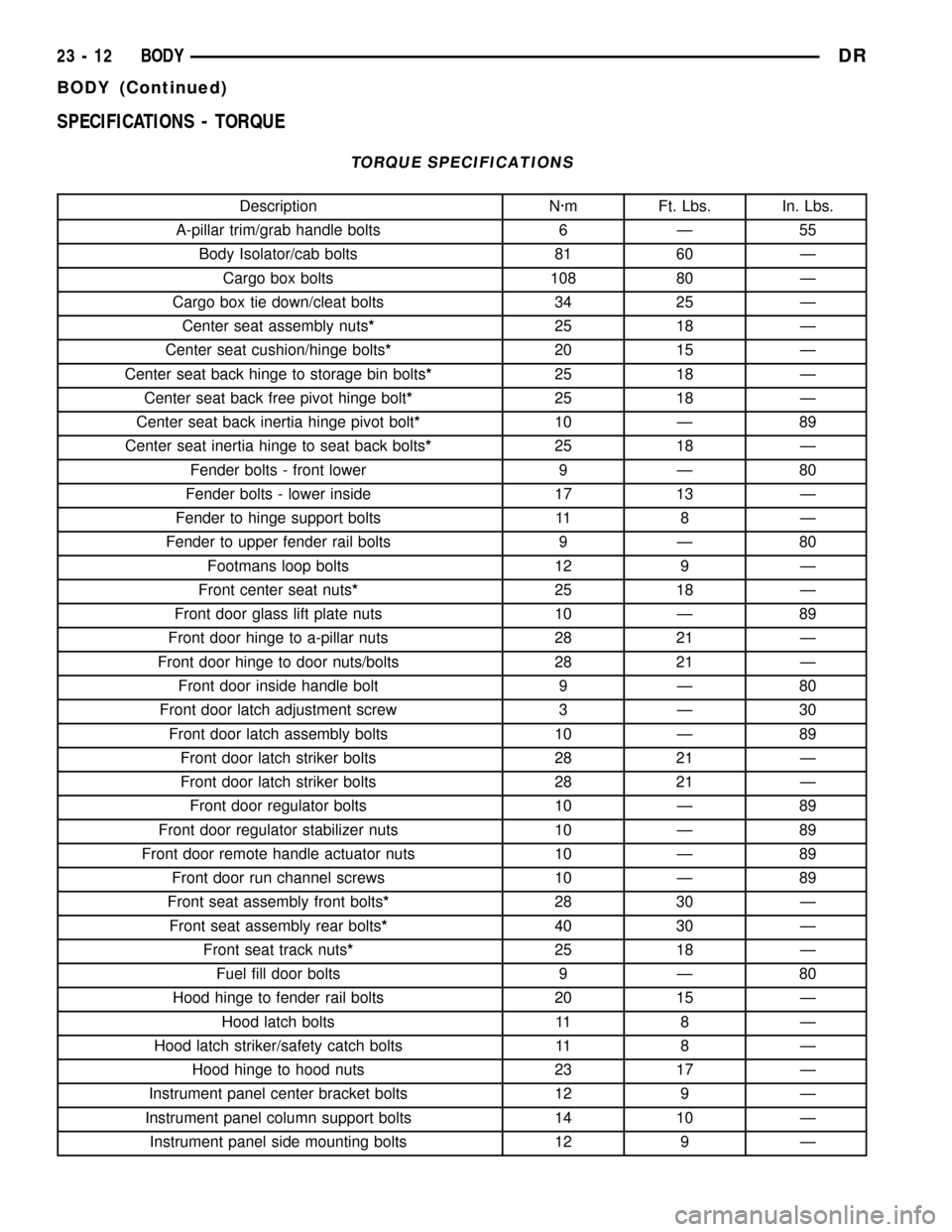
SPECIFICATIONS - TORQUE
TORQUE SPECIFICATIONS
Description N´m Ft. Lbs. In. Lbs.
A-pillar trim/grab handle bolts 6 Ð 55
Body Isolator/cab bolts 81 60 Ð
Cargo box bolts 108 80 Ð
Cargo box tie down/cleat bolts 34 25 Ð
Center seat assembly nuts*25 18 Ð
Center seat cushion/hinge bolts*20 15 Ð
Center seat back hinge to storage bin bolts*25 18 Ð
Center seat back free pivot hinge bolt*25 18 Ð
Center seat back inertia hinge pivot bolt*10 Ð 89
Center seat inertia hinge to seat back bolts*25 18 Ð
Fender bolts - front lower 9 Ð 80
Fender bolts - lower inside 17 13 Ð
Fender to hinge support bolts 11 8 Ð
Fender to upper fender rail bolts 9 Ð 80
Footmans loop bolts 12 9 Ð
Front center seat nuts*25 18 Ð
Front door glass lift plate nuts 10 Ð 89
Front door hinge to a-pillar nuts 28 21 Ð
Front door hinge to door nuts/bolts 28 21 Ð
Front door inside handle bolt 9 Ð 80
Front door latch adjustment screw 3 Ð 30
Front door latch assembly bolts 10 Ð 89
Front door latch striker bolts 28 21 Ð
Front door latch striker bolts 28 21 Ð
Front door regulator bolts 10 Ð 89
Front door regulator stabilizer nuts 10 Ð 89
Front door remote handle actuator nuts 10 Ð 89
Front door run channel screws 10 Ð 89
Front seat assembly front bolts*28 30 Ð
Front seat assembly rear bolts*40 30 Ð
Front seat track nuts*25 18 Ð
Fuel fill door bolts 9 Ð 80
Hood hinge to fender rail bolts 20 15 Ð
Hood latch bolts 11 8 Ð
Hood latch striker/safety catch bolts 11 8 Ð
Hood hinge to hood nuts 23 17 Ð
Instrument panel center bracket bolts 12 9 Ð
Instrument panel column support bolts 14 10 Ð
Instrument panel side mounting bolts 12 9 Ð
23 - 12 BODYDR
BODY (Continued)
Page 2334 of 2627

FRONT FENDER
REMOVAL
(1) Remove the antenna, if equipped. (Refer to 8 -
ELECTRICAL/AUDIO/ANTENNA BODY & CABLE -
REMOVAL)
(2) Remove the battery tray, if required. (Refer to 8
- ELECTRICAL/BATTERY SYSTEM/TRAY -
REMOVAL)
(3) Remove the cowl grille. (Refer to 23 - BODY/
EXTERIOR/COWL GRILLE - REMOVAL)
(4) Remove the headlamp unit. (Refer to 8 - ELEC-
TRICAL/LAMPS/LIGHTING - EXTERIOR/HEAD-
LAMP UNIT - REMOVAL)
(5) Remove the wheelhouse splash shield. (Refer to
23 - BODY/EXTERIOR/FRONT WHEELHOUSE
SPLASH SHIELD - REMOVAL)
(6) Remove the inside and lower bolts. (Fig. 6)
(7) Remove the two bolts below the headlamp.
(8) Remove the hinge support bolt at the cowl.
(9) Remove the three bolts along the fender rail.
INSTALLATION
(1) Install the three bolts along the upper fender
rail and tighten to 9 N´m (80 in. lbs.).
(2) Install the upper hinge support bolt at the cowl
and tighten to 17 N´m (13 ft. lbs.).
(3) Install the two bolts below the headlamp and
tighten to 9 N´m (80 in. lbs.).(4) Install the inside and lower bolts and tighten
to 17 N´m (13 ft. lbs.).
(5) Check the fender positioning and adjust as
required by adding shims. (Refer to 23 - BODY/
BODY STRUCTURE/GAP AND FLUSH - SPECIFI-
CATIONS)
(6) Install the wheelhouse splash shield. (Refer to
23 - BODY/EXTERIOR/FRONT WHEELHOUSE
SPLASH SHIELD - INSTALLATION)
(7) Install the headlamp unit. (Refer to 8 - ELEC-
TRICAL/LAMPS/LIGHTING - EXTERIOR/HEAD-
LAMP UNIT - INSTALLATION)
(8) Install the cowl grille. (Refer to 23 - BODY/EX-
TERIOR/COWL GRILLE - INSTALLATION)
(9) Install the battery tray, if required. (Refer to 8
- ELECTRICAL/BATTERY SYSTEM/TRAY -
INSTALLATION)
(10) Install the antenna, if required. (Refer to 8 -
ELECTRICAL/AUDIO/ANTENNA BODY & CABLE -
INSTALLATION)
FUEL FILL DOOR
REMOVAL
(1) Open fill door and remove the bolts. (Fig. 7)
(2) Remove the door.
INSTALLATION
(1) Install the fuel fill door.
(2) Install the bolts and tighten to 9 N´m (80 in.
lbs.).
Fig. 6 FRONT FENDER
1 - HOOD HINGE SUPPORT BOLT (1)
2 - HOOD HINGE
3 - INNER BOLT (1)
4 - FRONT BOLTS (2)
5 - LOWER BOLT INSERT
6 - FENDER
7 - UPPER BOLTS (3)
Fig. 7 FUEL FILL DOOR
1 - FUEL FILL DOOR
2 - BOLTS (2)
DREXTERIOR 23 - 39
Page 2598 of 2627

DOOR GLASS RUN WEATHERSTRIP -
REMOVAL, FRONT....................23-92
DOOR GLASS RUN WEATHERSTRIP -
REMOVAL, REAR.....................23-93
DOOR INNER BELT MOLDING -
INSTALLATION, FRONT................23-93
DOOR INNER BELT MOLDING -
INSTALLATION, REAR.................23-94
DOOR INNER BELT MOLDING -
REMOVAL, FRONT....................23-93
DOOR INNER BELT MOLDING -
REMOVAL, REAR.....................23-94
DOOR LOCK MOTOR - DESCRIPTION......8N-4
DOOR LOCK MOTOR - DIAGNOSIS AND
TESTING............................8N-4
DOOR LOCK MOTOR - OPERATION.......8N-4
DOOR MODULE - DESCRIPTION, DRIVER . . 8N-5
DOOR MODULE - DIAGNOSIS AND
TESTING, DRIVER.....................8N-6
DOOR MODULE - INSTALLATION,
DRIVER.............................8N-7
DOOR MODULE - OPERATION, DRIVER....8N-5
DOOR MODULE - REMOVAL, DRIVER.....8N-7
DOOR OPENING SEAL - INSTALLATION . . . 23-92
DOOR OPENING SEAL - REMOVAL.......23-92
DOOR OUTER BELT MOLDING -
INSTALLATION, FRONT................23-93
DOOR OUTER BELT MOLDING -
INSTALLATION, REAR.................23-94
DOOR OUTER BELT MOLDING -
REMOVAL, FRONT....................23-92
DOOR OUTER BELT MOLDING -
REMOVAL, REAR.....................23-93
DOOR SILL TRIM COVER -
INSTALLATION, REAR.................23-71
DOOR SILL TRIM COVER - REMOVAL,
REAR..............................23-71
DOUBLE CARDAN UNIVERSAL JOINTS -
ASSEMBLY..........................3-17
DOUBLE CARDAN UNIVERSAL JOINTS -
DISASSEMBLY........................3-16
DOUBLE INVERTED FLARING -
STANDARD PROCEDURE................5-10
DRAG LINK - INSTALLATION............19-36
DRAG LINK - REMOVAL...............19-36
DRAIN AND REFILL - STANDARD
PROCEDURE, FLUID.....21-441,21-476,21-507,
21-537,21-571
DRAIN CIRCUIT - OPERATION, FUEL.....14-67
DRAINBACK VALVE - DESCRIPTION,
TORQUE CONVERTER................21-261
DRAINBACK VALVE - OPERATION,
TORQUE CONVERTER................21-261
DRAINBACK VALVE - STANDARD
PROCEDURE, TORQUE CONVERTER.....21-261
DRAINING AT FUEL FILTER - STANDARD
PROCEDURES, WATER................14-47
DRAW TEST - STANDARD PROCEDURE,
IGNITION-OFF.......................8F-11
DRIP RAIL WEATHERSTRIP -
INSTALLATION.......................23-91
DRIP RAIL WEATHERSTRIP - REMOVAL . . 23-91
DRIP RAIL WEATHERSTRIP RETAINER -
INSTALLATION.......................23-92
DRIP RAIL WEATHERSTRIP RETAINER -
REMOVAL..........................23-92
DRIVE - DIAGNOSIS AND TESTING,
ELECTRONICALLY CONTROLLED
VISCOUS FAN........................7-52
DRIVE - DIAGNOSIS AND TESTING,
VISCOUS FAN........................7-50
DRIVE BELT - 3.7L / 4.7L -
INSTALLATION........................7-26
DRIVE BELT - 3.7L / 4.7L - REMOVAL.....7-26
DRIVE BELT - 5.9L DIESEL -
INSTALLATION........................7-29
DRIVE BELT - 5.9L DIESEL - REMOVAL....7-29
DRIVE BELT - DIAGNOSIS AND TESTING,
ACCESSORY.....................7-24,7-27
DRIVE LEARN - STANDARD PROCEDURE . . 8E-23
DRIVE SYSTEM - DESCRIPTION, TIMING
. . 9-166
DRIVE SYSTEM - OPERATION, TIMING
....9-166
DRIVE VISCOUS CLUTCH - 5.9L DIESEL
- DESCRIPTION, FAN
...................7-52
DRIVE VISCOUS CLUTCH - 5.9L DIESEL
- OPERATION, FAN
....................7-52
DRIVE VISCOUS CLUTCH-GAS ENGINES
- DESCRIPTION, FAN
...................7-50DRIVE VISCOUS CLUTCH-GAS ENGINES
- OPERATION, FAN....................7-50
DRIVER AIRBAG - ASSEMBLY..........8O-26
DRIVER AIRBAG - DESCRIPTION........8O-23
DRIVER AIRBAG - DISASSEMBLY........8O-25
DRIVER AIRBAG - INSTALLATION.......8O-28
DRIVER AIRBAG - OPERATION..........8O-23
DRIVER AIRBAG - REMOVAL...........8O-24
DRIVER DOOR MODULE - DESCRIPTION . . . 8N-5
DRIVER DOOR MODULE - DIAGNOSIS
AND TESTING........................8N-6
DRIVER DOOR MODULE - INSTALLATION . . 8N-7
DRIVER DOOR MODULE - OPERATION....8N-5
DRIVER DOOR MODULE - REMOVAL......8N-7
DRIVER SEAT SWITCH - DESCRIPTION . . . 8N-14
DRIVER SEAT SWITCH - DIAGNOSIS
AND TESTING.......................8N-14
DRIVER SEAT SWITCH - INSTALLATION . . 8N-15
DRIVER SEAT SWITCH - OPERATION.....8N-14
DRIVER SEAT SWITCH - REMOVAL......8N-15
DRIVER SIDE BEZEL - INSTALLATION,
INSTRUMENT PANEL..................23-58
DRIVER SIDE BEZEL - REMOVAL,
INSTRUMENT PANEL..................23-58
DROP - STANDARD PROCEDURE,
TESTING FOR A VOLTAGE...........8W-01-10
DRUM IN HAT BRAKE - CLEANING,
REAR...............................5-39
DRUM IN HAT BRAKE - INSPECTION,
REAR...............................5-39
DUAL REAR WHEEL INSTALLATION -
STANDARD PROCEDURE...............22-12
DUAL WHEELS - INSTALLATION, REAR....5-35
DUAL WHEELS - REMOVAL, REAR........5-34
DUCT - INSTALLATION, DEFROSTER.....24-32
DUCT - INSTALLATION, FLOOR
DISTRIBUTION.......................24-34
DUCT - REMOVAL, DEFROSTER.........24-32
DUCT - REMOVAL, FLOOR
DISTRIBUTION.......................24-33
DUCTS - INSTALLATION, INSTRUMENT
PANEL.............................24-37
DUCTS - INSTALLATION, INSTRUMENT
PANEL DEMISTER....................24-37
DUCTS - REMOVAL, INSTRUMENT
PANEL.............................24-37
DUCTS - REMOVAL, INSTRUMENT
PANEL DEMISTER....................24-36
DUST BOOT - INSTALLATION,
EXTENSION HOUSING SEAL.....21-476,21-571
DUST BOOT - REMOVAL, EXTENSION
HOUSING SEAL...............21-476,21-571
ECM - DESCRIPTION...................8E-3
ECM - OPERATION....................8E-3
EFFECTS OF INCORRECT FLUID LEVEL -
DIAGNOSIS AND TESTING......21-201,21-366
ELECTRICAL CONTROLS - DIAGNOSIS
AND TESTING, OVERDRIVE............21-262
ELECTRONIC GOVERNOR -
DESCRIPTION......................21-197
ELECTRONIC GOVERNOR -
INSTALLATION......................21-200
ELECTRONIC GOVERNOR - OPERATION . . 21-198
ELECTRONIC GOVERNOR - REMOVAL . . . 21-199
ELECTRONIC VARIABLE BRAKE
PROPORTIONING - DESCRIPTION........5-49
ELECTRONIC VARIABLE BRAKE
PROPORTIONING - OPERATION..........5-49
ELECTRONIC VEHICLE INFO CENTER -
DESCRIPTION........................8M-7
ELECTRONIC VEHICLE INFO CENTER -
INSTALLATION.......................8M-9
ELECTRONIC VEHICLE INFO CENTER -
OPERATION.........................8M-7
ELECTRONIC VEHICLE INFO CENTER -
REMOVAL...........................8M-9
ELECTRONIC VEHICLE INFORMATION
CENTER - DIAGNOSIS AND TESTING
......8M-8
ELECTRONIC VEHICLE INFORMATION
CENTER PROGRAMMING - STANDARD
PROCEDURE
.........................8M-8
ELECTRONICALLY CONTROLLED
VISCOUS FAN DRIVE - DIAGNOSIS
AND TESTING
........................7-52
ELECTROSTATIC DISCHARGE (ESD)
SENSITIVE DEVICES - STANDARD
PROCEDURE
......................8W-01-8
ELEMENT - DESCRIPTION, HEATED SEAT
. . 8G-9ELEMENT - DIAGNOSIS AND TESTING,
HEATED SEAT .......................8G-10
ELEMENT - INSTALLATION, AIR
CLEANER..................9-107,9-21,9-249
ELEMENT - INSTALLATION, HEATED
SEAT ..............................8G-10
ELEMENT - OPERATION, HEATED SEAT . . . 8G-10
ELEMENT - REMOVAL, AIR CLEANER....9-107,
9-21,9-248
ELEMENT - REMOVAL, HEATED SEAT....8G-10
EMISSION CONTROL INFORMATION
(VECI) - DESCRIPTION, VEHICLE.......Intro.-2
END - DIAGNOSIS AND TESTING, OUTER
TIE ROD............................19-32
END - INSTALLATION, OUTER TIE ROD . . . 19-33
END - INSTALLATION, TIE ROD.........19-37
END - REMOVAL, OUTER TIE ROD.......19-32
END - REMOVAL, TIE ROD.............19-37
ENGINE - 3.7L - DESCRIPTION............9-3
ENGINE - 5.7L - DESCRIPTION..........9-182
ENGINE - DESCRIPTION, COOLING
SYSTEM FLOW 3.7L/4.7L/5.7L............7-1
ENGINE - DESCRIPTION, FUEL
REQUIREMENTS - DIESEL...............0-1
ENGINE - DIAGNOSIS AND TESTING,
COOLING SYSTEM DIESEL...............7-7
ENGINE - DIAGNOSIS AND TESTING,
DIESEL.............................11-5
ENGINE - DIAGNOSIS AND TESTING,
GAS................................11-4
ENGINE - FIRING ORDER / CABLE
ROUTING, 5.7L V-8....................8I-4
ENGINE - INSTALLATION...............9-242
ENGINE - INSTALLATION, 3.7L/4.7L AND
5.7L HEMI.....................24-59,24-73
ENGINE - INSTALLATION, 5.9L DIESEL . . . 24-54,
24-58,24-72
ENGINE - INSTALLATION, DIESEL........8R-17
ENGINE - INSTALLATION, EXCEPT
DIESEL............................8R-17
ENGINE - INSTALLATION, GAS..........19-26
ENGINE - REMOVAL..................9-241
ENGINE - REMOVAL, 3.7L/4.7L AND 5.7L
HEMI.........................24-57,24-71
ENGINE - REMOVAL, 5.9L DIESEL . . 24-53,24-56,
24-70
ENGINE - REMOVAL, DIESEL...........8R-16
ENGINE - REMOVAL, EXCEPT DIESEL....8R-15
ENGINE - REMOVAL, GAS..............19-25
ENGINE - SPECIFICATIONS, 3.7L.........9-12
ENGINE - SPECIFICATIONS, 4.7L.........9-99
ENGINE - STANDARD PROCEDURE,
DRAINING COOLING SYSTEM 5.9L
DIESEL.............................7-18
ENGINE - STANDARD PROCEDURE,
REFILLING COOLING SYSTEM 5.9L
DIESEL.............................7-19
ENGINE - TORQUE, FUEL SYSTEM -
DIESEL............................14-48
ENGINE 5.9L DIESEL - DESCRIPTION.....9-232
ENGINE BLOCK - CLEANING . . . 9-128,9-205,9-39
ENGINE BLOCK - DESCRIPTION.....9-128,9-38
ENGINE BLOCK - INSPECTION . 9-128,9-205,9-39
ENGINE BLOCK HEATER - 5.9L DIESEL -
DESCRIPTION........................7-37
ENGINE BLOCK HEATER - 5.9L DIESEL -
INSTALLATION........................7-38
ENGINE BLOCK HEATER - 5.9L DIESEL -
OPERATION..........................7-38
ENGINE BLOCK HEATER - 5.9L DIESEL -
REMOVAL...........................7-38
ENGINE BLOCK HEATER - DESCRIPTION . . . 7-36
ENGINE BLOCK HEATER - DIAGNOSIS
AND TESTING........................7-36
ENGINE BLOCK HEATER - INSTALLATION . . . 7-37
ENGINE BLOCK HEATER - OPERATION.....7-36
ENGINE BLOCK HEATER - REMOVAL......7-37
ENGINE CONTROL MODULE -
INSTALLATION........................8E-4
ENGINE CONTROL MODULE - REMOVAL . . . 8E-4
ENGINE COOLANT - DESCRIPTION
........7-31
ENGINE COOLANT - DESCRIPTION
.........0-3
ENGINE COOLANT TEMPERATURE
SENSOR - DESCRIPTION
...............7-38
ENGINE COOLANT TEMPERATURE
SENSOR - INSTALLATION
...............7-41
ENGINE COOLANT TEMPERATURE
SENSOR - OPERATION
.................7-38
DRINDEX 11
Description Group-Page Description Group-Page Description Group-Page
Page 2599 of 2627

ENGINE COOLANT TEMPERATURE
SENSOR - REMOVAL...................7-39
ENGINE COOLANT THERMOSTAT -
3.7L/4.7L - DESCRIPTION...............7-44
ENGINE COOLANT THERMOSTAT -
3.7L/4.7L - INSTALLATION..............7-45
ENGINE COOLANT THERMOSTAT -
3.7L/4.7L - OPERATION.................7-44
ENGINE COOLANT THERMOSTAT -
3.7L/4.7L - REMOVAL..................7-45
ENGINE COOLANT THERMOSTAT - 5.9L
DIESEL - DESCRIPTION................7-46
ENGINE COOLANT THERMOSTAT - 5.9L
DIESEL - INSTALLATION................7-47
ENGINE COOLANT THERMOSTAT - 5.9L
DIESEL - OPERATION..................7-46
ENGINE COOLANT THERMOSTAT - 5.9L
DIESEL - REMOVAL....................7-47
ENGINE COOLANT THERMOSTAT - 8.0L -
DESCRIPTION........................7-48
ENGINE COOLANT THERMOSTAT - 8.0L -
INSTALLATION........................7-49
ENGINE COOLANT THERMOSTAT - 8.0L -
OPERATION..........................7-48
ENGINE COOLANT THERMOSTAT - 8.0L -
REMOVAL...........................7-49
ENGINE COOLANT THERMOSTAT-5.7L -
DESCRIPTION........................7-41
ENGINE COOLANT THERMOSTAT-5.7L -
INSTALLATION........................7-43
ENGINE COOLANT THERMOSTAT-5.7L -
OPERATION..........................7-41
ENGINE COOLANT THERMOSTAT-5.7L -
REMOVAL.............................7-42
ENGINE COOLING SYSTEM
REQUIREMENTS - DESCRIPTION.........24-1
ENGINE COOLING SYSTEM, WARNING....24-42
ENGINE DATA PLATE - DESCRIPTION.....9-248
ENGINE DIAGNOSIS - INTRODUCTION -
DIAGNOSIS AND TESTING......9-183,9-4,9-94
ENGINE DIAGNOSIS - LUBRICATION -
DIAGNOSIS AND TESTING..........9-187,9-7
ENGINE DIAGNOSIS - MECHANICAL -
DIAGNOSIS AND TESTING . . . 9-185,9-188,9-233,
9-6,9-92
ENGINE DIAGNOSIS - PERFORMANCE -
DIAGNOSIS AND TESTING......9-183,9-4,9-90
ENGINE FIRING ORDER, 3.7L V-6.........8I-4
ENGINE FIRING ORDER, 4.7L V-8.........8I-4
ENGINE GASKET SURFACE
PREPARATION - STANDARD
PROCEDURE.........................9-10
ENGINE OIL - DIESEL ENGINES -
DESCRIPTION.........................0-2
ENGINE OIL AND LUBRICANTS -
DESCRIPTION.........................0-1
ENGINE OIL LEAK - DIAGNOSIS AND
TESTING..................9-152,9-220,9-64
ENGINE OIL LEVEL - STANDARD
PROCEDURE........................9-292
ENGINE OIL PRESSURE - DIAGNOSIS
AND TESTING.......................9-289
ENGINE OIL PRESSURE - DIAGNOSIS
AND TESTING, CHECKING.....9-152,9-220,9-65
ENGINE OIL SERVICE - STANDARD
PROCEDURE..........9-153,9-222,9-292,9-71
ENGINE, SPECIAL TOOLS - 4.7L.........9-103
ENGINE, SPECIAL TOOLS - 5.7L.........9-196
ENGINE, SPECIAL TOOLS - 5.9L DIESEL . . 9-246
ENGINE, SPECIFICATIONS - 5.7L........9-192
ENGINE TEMPERATURE GAUGE -
DESCRIPTION.......................8J-24
ENGINE TEMPERATURE GAUGE -
OPERATION.........................8J-24
ENGINE TIMING - VERIFICATION -
STANDARD PROCEDURE...............9-167
ENGINES - CLEANING, RADIATOR FAN -
GAS................................7-34
ENGINES - DESCRIPTION, COOLANT
RECOVERY CONTAINER- GAS
............7-33
ENGINES - DESCRIPTION, ENGINE OIL -
DIESEL
..............................0-2
ENGINES - DESCRIPTION, FAN DRIVE
VISCOUS CLUTCH-GAS
.................7-50
ENGINES - INSPECTION, RADIATOR FAN
- GAS
...............................7-34
ENGINES - INSTALLATION, 3.7, 4.7 AND
5.7L
..........................24-53,24-55ENGINES - INSTALLATION, COOLANT
RECOVERY CONTAINER- GAS............7-33
ENGINES - INSTALLATION, RADIATOR
FAN - GAS...........................7-34
ENGINES - OPERATION, COOLANT
RECOVERY CONTAINER- GAS............7-33
ENGINES - OPERATION, FAN DRIVE
VISCOUS CLUTCH-GAS.................7-50
ENGINES - REMOVAL, 3.7, 4.7 AND 5.7L . 24-52,
24-55
ENGINES - REMOVAL, COOLANT
RECOVERY CONTAINER- GAS............7-33
ENGINES - REMOVAL, RADIATOR FAN -
GAS................................7-33
ENGINES - STANDARD PROCEDURE,
DRAINING COOLING SYSTEM - ALL
GAS................................7-17
ENGINES - STANDARD PROCEDURE,
REFILLING COOLING SYSTEM - ALL
GAS................................7-18
ENHANCED SEATBELT REMINDER
PROGRAMMING - STANDARD
PROCEDURE........................8J-35
ENTRY MODULE - DESCRIPTION,
REMOTE KEYLESS....................8N-7
ENTRY MODULE - DIAGNOSIS AND
TESTING, REMOTE KEYLESS............8N-7
ENTRY MODULE - INSTALLATION,
REMOTE KEYLESS....................8N-8
ENTRY MODULE - OPERATION, REMOTE
KEYLESS............................8N-7
ENTRY MODULE - REMOVAL, REMOTE
KEYLESS............................8N-7
ENTRY TRANSMITTER - DIAGNOSIS AND
TESTING, REMOTE KEYLESS..............8N-8
ENTRY TRANSMITTER -
SPECIFICATIONS, REMOTE KEYLESS......8N-9
EQUIPMENT - STANDARD PROCEDURE,
REFRIGERANT SYSTEM SERVICE........24-46
ERASING TRANSMITTER CODES -
STANDARD PROCEDURE..............8M-12
ETC INDICATOR - DESCRIPTION.........8J-25
ETC INDICATOR - OPERATION..........8J-25
EVACUATE - STANDARD PROCEDURE,
REFRIGERANT SYSTEM...............24-47
EVAP SYSTEM - DESCRIPTION..........25-10
EVAP SYSTEM - TORQUE..............25-11
EVAPORATOR - DESCRIPTION, A/C.......24-59
EVAPORATOR - INSTALLATION, A/C......24-60
EVAPORATOR - OPERATION, A/C........24-59
EVAPORATOR - REMOVAL, A/C..........24-60
EVAPORATOR TEMPERATURE SENSOR -
DESCRIPTION.......................24-22
EVAPORATOR TEMPERATURE SENSOR -
INSTALLATION.......................24-22
EVAPORATOR TEMPERATURE SENSOR -
OPERATION.........................24-22
EVAPORATOR TEMPERATURE SENSOR -
REMOVAL..........................24-22
EVAP/PURGE SOLENOID - DESCRIPTION . . 25-12
EVAP/PURGE SOLENOID - INSTALLATION . 25-12
EVAP/PURGE SOLENOID - OPERATION....25-12
EVAP/PURGE SOLENOID - REMOVAL.....25-12
EXHAUST MANIFOLD - CLEANING . . 9-163,9-226,
9-298
EXHAUST MANIFOLD - DESCRIPTION....9-161,
9-226,9-74
EXHAUST MANIFOLD - INSPECTION.....9-163,
9-227,9-298
EXHAUST MANIFOLD - INSTALLATION . . . 9-164,
9-227,9-298,9-74
EXHAUST MANIFOLD - OPERATION......9-226
EXHAUST MANIFOLD - REMOVAL . . 9-161,9-226,
9-298,9-74
EXHAUST PIPE - INSPECTION.......11-7,11-8
EXTENSION HOUSING BUSHING AND
SEAL - INSTALLATION................21-440
EXTENSION HOUSING BUSHING AND
SEAL - REMOVAL
...................21-440
EXTENSION HOUSING SEAL -
INSTALLATION
. . . 21-128,21-201,21-507,21-536,
21-85
EXTENSION HOUSING SEAL - REMOVAL
. 21-128,
21-201,21-507,21-536,21-85
EXTENSION HOUSING SEAL AND DUST
BOOT - INSTALLATION
.........21-476,21-571
EXTENSION HOUSING SEAL AND DUST
BOOT - REMOVAL
.............21-476,21-571EXTERIOR - DESCRIPTION, LAMPS/
LIGHTING...........................8L-2
EXTERIOR - DIAGNOSIS AND TESTING,
LAMPS/LIGHTING.....................8L-3
EXTERIOR - OPERATION, LAMPS/
LIGHTING...........................8L-2
EXTERIOR HANDLE - INSTALLATION.....23-21,
23-30
EXTERIOR HANDLE - REMOVAL....23-20,23-30
EXTERIOR LAMPS, SPECIFICATIONS......8L-7
EXTERIOR NAME PLATES -
INSTALLATION.......................23-38
EXTERIOR NAME PLATES - REMOVAL....23-38
FAILURE - DIAGNOSIS AND TESTING,
CYLINDER HEAD GASKET..............9-199
FAN - 5.9L DIESEL - CLEANING,
RADIATOR...........................7-35
FAN - 5.9L DIESEL - INSPECTION,
RADIATOR...........................7-35
FAN - 5.9L DIESEL - INSTALLATION,
RADIATOR...........................7-36
FAN - 5.9L DIESEL - REMOVAL,
RADIATOR...........................7-35
FAN - GAS ENGINES - CLEANING,
RADIATOR...........................7-34
FAN - GAS ENGINES - INSPECTION,
RADIATOR...........................7-34
FAN - GAS ENGINES - INSTALLATION,
RADIATOR...........................7-34
FAN - GAS ENGINES - REMOVAL,
RADIATOR...........................7-33
FAN DRIVE - DIAGNOSIS AND TESTING,
ELECTRONICALLY CONTROLLED
VISCOUS............................7-52
FAN DRIVE - DIAGNOSIS AND TESTING,
VISCOUS............................7-50
FAN DRIVE VISCOUS CLUTCH - 5.9L
DIESEL - DESCRIPTION................7-52
FAN DRIVE VISCOUS CLUTCH - 5.9L
DIESEL - OPERATION..................7-52
FAN DRIVE VISCOUS CLUTCH-GAS
ENGINES - DESCRIPTION...............7-50
FAN DRIVE VISCOUS CLUTCH-GAS
ENGINES - OPERATION.................7-50
FASCIA - INSTALLATION, FRONT.........13-3
FASCIA - REMOVAL, FRONT.............13-2
FASTENER IDENTIFICATION -
DESCRIPTION......................Intro.-5
FASTENER USAGE - DESCRIPTION......Intro.-8
FENDER - INSTALLATION, FRONT........23-39
FENDER - INSTALLATION, REAR.........23-44
FENDER - REMOVAL, FRONT...........23-39
FENDER - REMOVAL, REAR............23-44
FENDER MARKER LAMP - INSTALLATION . 8L-18
FENDER MARKER LAMP - REMOVAL.....8L-17
FENDER RAIL REPAIR - STANDARD
PROCEDURE, HYDROFORM............13-11
FILL - STANDARD PROCEDURE,
TRANSMISSION...............21-204,21-368
FILL DOOR - INSTALLATION, FUEL.......23-39
FILL DOOR - REMOVAL, FUEL..........23-39
FILLER CAP - DESCRIPTION, FUEL.......25-13
FILLER CAP - OPERATION, FUEL........25-13
FILTER - INSTALLATION, INLET..........14-20
FILTER - INSTALLATION, OIL . 9-155,9-223,9-293,
9-70
FILTER - REMOVAL, INLET.............14-20
FILTER - REMOVAL, OIL . 9-154,9-223,9-293,9-70
FILTER - STANDARD PROCEDURES,
WATER DRAINING AT FUEL............14-47
FILTER / WATER SEPARATOR -
DESCRIPTION, FUEL..................14-50
FILTER / WATER SEPARATOR -
INSTALLATION, FUEL.................14-50
FILTER / WATER SEPARATOR -
OPERATION, FUEL....................14-50
FILTER / WATER SEPARATOR -
REMOVAL, FUEL.....................14-50
FILTER REPLACEMENT - STANDARD
PROCEDURE, FLUID
...........21-203,21-367
FILTER/PRESSURE REGULATOR -
DESCRIPTION, FUEL
...................14-5
FILTER/PRESSURE REGULATOR -
OPERATION, FUEL
.....................14-6
FINESSE SANDING/BUFFING &
POLISHING - DESCRIPTION
............23-74
FINISH - DESCRIPTION, BASECOAT/
CLEARCOAT
.........................23-73
12 INDEXDR
Description Group-Page Description Group-Page Description Group-Page