Mirror wiring DODGE RAM 1500 1998 2.G Workshop Manual
[x] Cancel search | Manufacturer: DODGE, Model Year: 1998, Model line: RAM 1500, Model: DODGE RAM 1500 1998 2.GPages: 2627
Page 471 of 2627

DIAGNOSIS AND TESTING - REAR WINDOW
DEFOGGER SYSTEM
For circuit descriptions and diagrams, refer to Rear
Window Defogger in Wiring Diagrams. The operation
of the electrically heated rear window defogger sys-
tem can be confirmed in one of the following man-
ners:
1. Turn the ignition switch to the On position.
While monitoring the instrument panel voltmeter, set
the defogger switch in the On position. When the
defogger switch is turned On, a distinct voltmeter
needle deflection should be noted.
2. Turn the ignition switch to the On position. Set
the defogger switch in the On position. The rear win-
dow defogger operation can be checked by feeling the
rear window or outside rear view mirror glass. A dis-
tinct difference in temperature between the grid lines
and the adjacent clear glass or the mirror glass can
be detected within three to four minutes of operation.
3. Using a 12-volt DC voltmeter, contact the rear
glass heating grid terminal A (right side) with the
negative lead, and terminal B (left side) with the pos-
itive lead (Fig. 1). The voltmeter should read battery
voltage.
The above checks will confirm system operation.
Illumination of the defogger switch indicator lamp
means that there is electrical current available at the
output of the rear window defogger logic and timer
circuitry, but does not confirm that the electrical cur-
rent is reaching the rear glass heating grid lines.
If the defogger system does not operate, the prob-
lem should be isolated in the following manner:(1) Confirm that the ignition switch is in the On
position.
(2) Make sure that the rear glass heating grid feed
and ground wires are connected to the glass. Confirm
that the ground wire has continuity to ground.
(3) Check the fuses in the power distribution cen-
ter (PDC) and in the junction block. The fuses must
be tight in their receptacles and all electrical connec-
tions must be secure.
When the above steps have been completed and the
rear glass heating grid is still inoperative, one or
more of the following could be faulty:
²Rear window switch in the A/C-heater control..
²Rear window grid lines (all grid lines would
have to be broken or one of the feed wires discon-
nected for the entire system to be inoperative).
If setting the defogger switch to the On position
produces a severe voltmeter deflection, check for a
short circuit between the rear window switch defog-
ger relay output and the rear glass heating grid.
REAR WINDOW DEFOGGER
RELAY
DESCRIPTION
The rear window defogger relay (Fig. 2) is a Inter-
national Standards Organization (ISO) micro-relay.
Relays conforming to the ISO specifications have
common physical dimensions, current capacities, ter-
minal patterns, and terminal functions. The ISO
micro-relay terminal functions are the same as a con-
ventional ISO relay. However, the ISO micro-relay
terminal pattern (or footprint) is different, the cur-
rent capacity is lower, and the physical dimensions
are smaller than those of the conventional ISO relay.
The rear window defogger relay is located in the
power distribution center (PDC) in the engine com-
partment. Refer to the PDC label for rear window
defogger relay identification and location.
The black, molded plastic case is the most visible
component of the rear window defogger relay. Five
male spade-type terminals extend from the bottom of
the base to connect the relay to the vehicle electrical
system, and the ISO designation for each terminal is
molded into the base adjacent to each terminal. The
ISO terminal designations are as follows:
²30 (Common Feed)- This terminal is con-
nected to the movable contact point of the relay.
²85 (Coil Ground)- This terminal is connected
to the ground feed side of the relay control coil.
²86 (Coil Battery)- This terminal is connected
to the battery feed side of the relay control coil.
²87 (Normally Open)- This terminal is con-
nected to the normally open fixed contact point of the
relay.
Fig. 1 Grid Line Test - Typical
1 - VIEW FROM INSIDE VEHICLE
2 - REAR WINDOW DEFOGGER
3 - BUS BARS
4 - VOLTAGE FEED (A)
5 - VOLTMETER
6 - MID-POINT (C)
7 - PICK-UP LEADS
8 - GROUND (B)
8G - 2 HEATED GLASSDR
HEATED GLASS (Continued)
Page 472 of 2627

²87A (Normally Closed)- This terminal is con-
nected to the normally closed fixed contact point of
the relay.
The rear window defogger relay cannot be adjusted
or repaired. If the relay is damaged or faulty, it must
be replaced.
OPERATION
The rear window defogger relay is an electrome-
chanical switch that uses a low current input from
the integrated power module (IPM) to control the
high current output to the rear window defogger
grid. The movable common feed contact point is held
against the fixed normally closed contact point by
spring pressure. When the relay coil is energized, an
electromagnetic field is produced by the coil wind-
ings. This electromagnetic field draws the movable
relay contact point away from the fixed normally
closed contact point, and holds it against the fixed
normally open contact point. When the relay coil is
de-energized, spring pressure returns the movable
contact point back against the fixed normally closed
contact point. The resistor or diode is connected in
parallel with the relay coil in the relay, and helps to
dissipate voltage spikes and electromagnetic interfer-
ence that can be generated as the electromagnetic
field of the relay coil collapses.
The rear window defogger relay terminals are con-
nected to the vehicle electrical system through a
receptacle in the IPM. The inputs and outputs of the
rear window defogger relay include:
²The common feed terminal (30) receives a bat-
tery current input from fuse 27 (15 amp) in the IPM
through a fused B(+) circuit at all times.²The coil ground terminal (87) receives a ground
input from the A/C-heater control when the A/C-
heater control electronically pulls the control circuit
to ground.
²The coil battery terminal (85) receives a battery
current input from fuse 36 (10 amp) in the IPM
through a fused B(+) circuit only when the ignition
switch is in the Run position.
²The normally open terminal (86) provides a bat-
tery current output to the rear window defogger and
heated power mirrors (when equipped) through the
relay output circuit only when the rear window
defogger relay coil is energized.
²The normally closed terminal (87A) is not con-
nected to any circuit in this application, but provides
a battery current output only when the rear window
defogger relay coil is de-energized.
The rear window defogger relay cannot be repaired
and, if faulty or damaged, it must be replaced. Refer
to the appropriate wiring information for diagnosis
and testing of the micro-relay and for complete rear
window defogger system wiring diagrams.
REMOVAL
(1)Disconnect and isolate the negative battery cable.
(2) Remove the cover from the integrated power
module (IPM) (Fig. 3).
(3) Refer to the fuse and relay layout map on the
inner surface of the IPM cover for rear window defog-
ger relay identification and location.
(4) Remove the rear window defogger relay from
the IPM.
Fig. 2 Rear Window Defogger Relay
1 - RELAY TERMINALS
2 - RELAY CAVITIES
Fig. 3 Integrated Power Module (IPM)
1 - BATTERY
2 - INTEGRATED POWER MODULE (IPM)
DRHEATED GLASS 8G - 3
REAR WINDOW DEFOGGER RELAY (Continued)
Page 607 of 2627

POWER MIRRORS
TABLE OF CONTENTS
page page
POWER MIRRORS
DESCRIPTION.........................10
OPERATION...........................10
DIAGNOSIS AND TESTING - POWER
MIRRORS...........................10
AUTOMATIC DAY / NIGHT MIRROR
DESCRIPTION.........................11
OPERATION...........................11
DIAGNOSIS AND TESTING - AUTOMATIC DAY
/ NIGHT MIRROR......................11REMOVAL.............................12
POWER MIRROR SWITCH
DIAGNOSIS AND TESTING - POWER MIRROR
SWITCH............................12
REMOVAL.............................12
SIDEVIEW MIRROR
REMOVAL.............................12
POWER MIRRORS
DESCRIPTION
AUTOMATIC DAY/NIGHT MIRROR
The automatic day/night mirror system is able to
automatically change the reflectance of the inside
rear view mirror in order to reduce the glare of head-
lamps approaching the vehicle from the rear. The
automatic day/night rear view mirror receives bat-
tery current through a fuse in the Integrated Power
Module (IPM) only when the ignition switch is in the
On position.
OUTSIDE REAR VIEW MIRROR
The power operated outside rear view mirrors
allow the driver to adjust both outside mirrors elec-
trically from the driver side front seat position by
operating a switch on the driver side front door trim
panel. The power mirrors receive a non-switched bat-
tery feed through a fuse in the Integrated Power
Module (IPM) so that the system will remain opera-
tional, regardless of the ignition switch position.
OPERATION
AUTOMATIC DAY/NIGHT MIRROR
A switch located on the bottom of the automatic
day/night mirror housing allows the vehicle operator
to select whether the automatic dimming feature is
operational. When the automatic day/night mirror is
turned on, the mirror switch is lighted by an integral
Light-Emitting Diode (LED). The mirror will auto-
matically disable its self-dimming feature whenever
the vehicle is being driven in reverse.
OUTSIDE REAR VIEW MIRROR
The heated mirrors include an electric heating grid
behind the mirror glass in each outside mirror, which
can clear the mirror glass of ice, snow, or fog. (Refer
to 8 - ELECTRICAL/HEATED MIRRORS -
DESCRIPTION) for more information.
DIAGNOSIS AND TESTING - POWER MIRRORS
WIRING VOLTAGE TEST
The following wiring test determines whether or
not voltage is continuous through the body harness
to switch.
(1) Remove the power mirror switch (Refer to 8 -
ELECTRICAL/POWER LOCKS/DOOR MODULE -
REMOVAL).
(2) Disconnect wire harness connector from back of
power mirror switch.
(3) Connect the clip end of a 12 volt test light to
Pin 5 in the mirror switch harness connector. Touch
the test light probe to Pin 3.
If the test light illuminates, the wiring circuit
between the battery and switch is OK.
If the lamp does not illuminate, first check fuse in
the Integrated Power Module (IPM). If fuse is OK,
then check for a broken wire.
Refer to the appropriate wiring information.
POWER MIRROR MOTOR TEST
If the power mirror switch is receiving proper cur-
rent and ground and mirrors do not operate, proceed
with power mirror motor test. Refer to the appropri-
ate wiring information.
(1) Remove the power mirror switch (Refer to 8 -
ELECTRICAL/POWER LOCKS/DOOR MODULE -
REMOVAL).
8N - 10 POWER MIRRORSDR
Page 608 of 2627
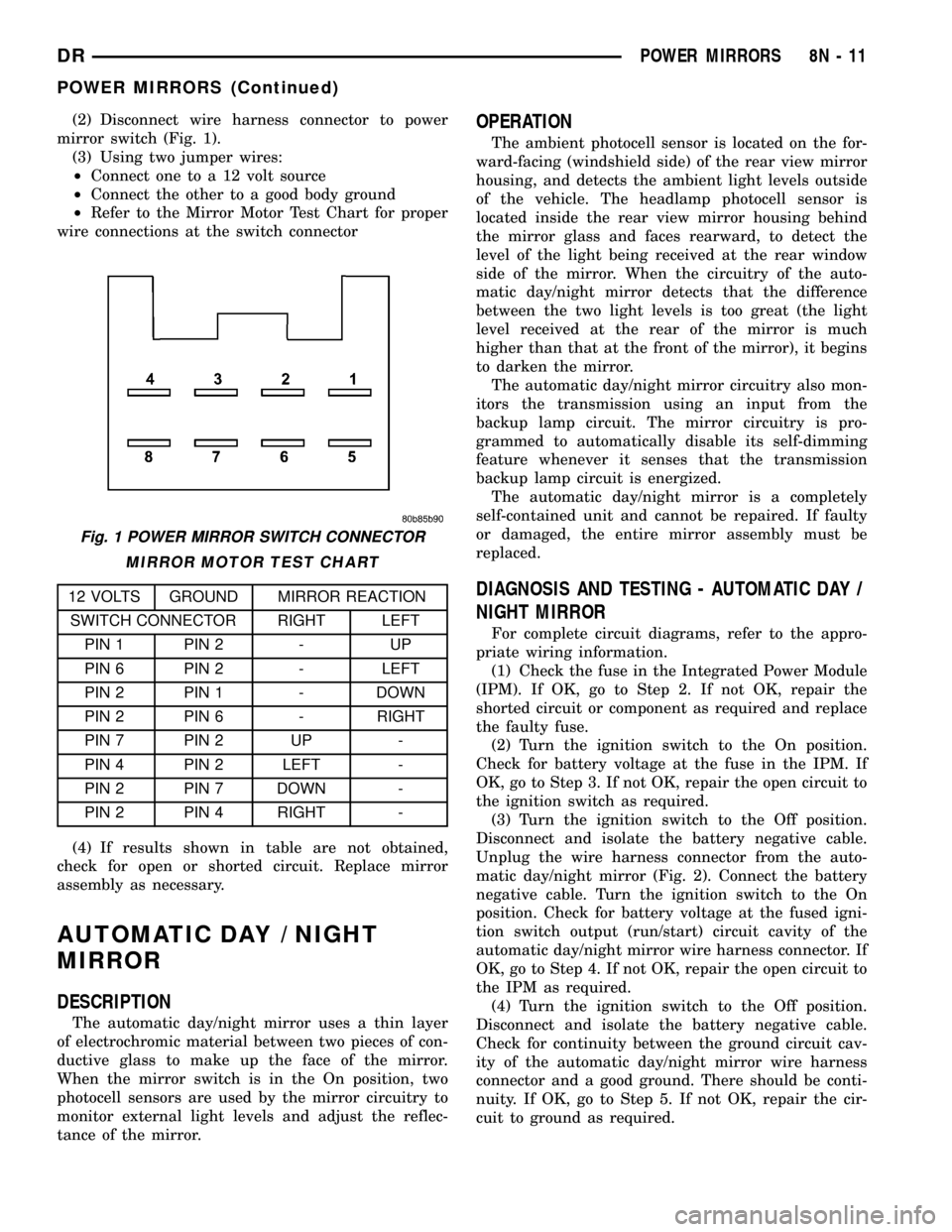
(2) Disconnect wire harness connector to power
mirror switch (Fig. 1).
(3) Using two jumper wires:
²Connect one to a 12 volt source
²Connect the other to a good body ground
²Refer to the Mirror Motor Test Chart for proper
wire connections at the switch connector
MIRROR MOTOR TEST CHART
12 VOLTS GROUND MIRROR REACTION
SWITCH CONNECTOR RIGHT LEFT
PIN 1 PIN 2 - UP
PIN 6 PIN 2 - LEFT
PIN 2 PIN 1 - DOWN
PIN 2 PIN 6 - RIGHT
PIN 7 PIN 2 UP -
PIN 4 PIN 2 LEFT -
PIN 2 PIN 7 DOWN -
PIN 2 PIN 4 RIGHT -
(4) If results shown in table are not obtained,
check for open or shorted circuit. Replace mirror
assembly as necessary.
AUTOMATIC DAY / NIGHT
MIRROR
DESCRIPTION
The automatic day/night mirror uses a thin layer
of electrochromic material between two pieces of con-
ductive glass to make up the face of the mirror.
When the mirror switch is in the On position, two
photocell sensors are used by the mirror circuitry to
monitor external light levels and adjust the reflec-
tance of the mirror.
OPERATION
The ambient photocell sensor is located on the for-
ward-facing (windshield side) of the rear view mirror
housing, and detects the ambient light levels outside
of the vehicle. The headlamp photocell sensor is
located inside the rear view mirror housing behind
the mirror glass and faces rearward, to detect the
level of the light being received at the rear window
side of the mirror. When the circuitry of the auto-
matic day/night mirror detects that the difference
between the two light levels is too great (the light
level received at the rear of the mirror is much
higher than that at the front of the mirror), it begins
to darken the mirror.
The automatic day/night mirror circuitry also mon-
itors the transmission using an input from the
backup lamp circuit. The mirror circuitry is pro-
grammed to automatically disable its self-dimming
feature whenever it senses that the transmission
backup lamp circuit is energized.
The automatic day/night mirror is a completely
self-contained unit and cannot be repaired. If faulty
or damaged, the entire mirror assembly must be
replaced.
DIAGNOSIS AND TESTING - AUTOMATIC DAY /
NIGHT MIRROR
For complete circuit diagrams, refer to the appro-
priate wiring information.
(1) Check the fuse in the Integrated Power Module
(IPM). If OK, go to Step 2. If not OK, repair the
shorted circuit or component as required and replace
the faulty fuse.
(2) Turn the ignition switch to the On position.
Check for battery voltage at the fuse in the IPM. If
OK, go to Step 3. If not OK, repair the open circuit to
the ignition switch as required.
(3) Turn the ignition switch to the Off position.
Disconnect and isolate the battery negative cable.
Unplug the wire harness connector from the auto-
matic day/night mirror (Fig. 2). Connect the battery
negative cable. Turn the ignition switch to the On
position. Check for battery voltage at the fused igni-
tion switch output (run/start) circuit cavity of the
automatic day/night mirror wire harness connector. If
OK, go to Step 4. If not OK, repair the open circuit to
the IPM as required.
(4) Turn the ignition switch to the Off position.
Disconnect and isolate the battery negative cable.
Check for continuity between the ground circuit cav-
ity of the automatic day/night mirror wire harness
connector and a good ground. There should be conti-
nuity. If OK, go to Step 5. If not OK, repair the cir-
cuit to ground as required.
Fig. 1 POWER MIRROR SWITCH CONNECTOR
DRPOWER MIRRORS 8N - 11
POWER MIRRORS (Continued)
Page 718 of 2627

The wiper high/low relay can be diagnosed using
conventional diagnostic tools and methods. However,
conventional diagnostic methods may not prove con-
clusive in the diagnosis of the instrument cluster, the
Front Control Module (FCM), or the electronic mes-
sage inputs to or outputs from the instrument cluster
and the FCM that control the operation of the wiper
high/low relay. The most reliable, efficient, and accu-
rate means to diagnose the wiper high/low relay, the
instrument cluster, the FCM, or the electronic mes-
sage inputs and outputs related to the wiper high/low
relay operation requires the use of a DRBIIItscan
tool. Refer to the appropriate diagnostic information.
DIAGNOSIS AND TESTING - WIPER HIGH/LOW
RELAY
The wiper high/low relay (Fig. 23) is located in the
Integrated Power Module (IPM) in the engine com-
partment near the battery. Refer to the appropriate
wiring information. The wiring information includes
wiring diagrams, proper wire and connector repair
procedures, details of wire harness routing and
retention, connector pin-out information and location
views for the various wire harness connectors, splices
and grounds.
(1) Remove the wiper high/low relay from the IPM.
(Refer to 8 - ELECTRICAL/WIPERS/WASHERS/
WIPER HIGH/LOW RELAY - REMOVAL).
(2) A relay in the de-energized position should
have continuity between terminals 87A and 30, and
no continuity between terminals 87 and 30. If OK, go
to Step 3. If not OK, replace the faulty relay.
(3) Resistance between terminals 85 and 86 (elec-
tromagnet) should be 75 8 ohms. If OK, go to Step
4. If not OK, replace the faulty relay.(4) Connect a battery to terminals 85 and 86.
There should now be continuity between terminals
30 and 87, and no continuity between terminals 87A
and 30. If OK, reinstall the relay and use a DRBIIIt
scan tool to perform further testing. Refer to the
appropriate diagnostic information.
REMOVAL
(1) Disconnect and isolate the battery negative
cable.
(2) Remove the cover from the Integrated Power
Module (IPM) (Fig. 24).
(3) Remove the wiper high/low relay by grasping it
firmly and pulling it straight out from the receptacle
in the IPM.
Fig. 23 ISO Micro Relay
30 - COMMON FEED
85 - COIL GROUND
86 - COIL BATTERY
87 - NORMALLY OPEN
87A - NORMALLY CLOSED
Fig. 24 Integrated Power Module
1 - 15 - CARTRIDGE FUSE
16 - 53 - BLADE FUSE
54 - HEATED MIRROR RELAY
55 - WIPER ON/OFF RELAY
56 - A/C CONDENSER FAN RELAY
57 - ENGINE CONTROL RELAY
58 - FUEL PUMP RELAY
59 - TRANSMISSION RELAY
60 - WIPER HIGH/LOW RELAY
61 - SPARE
62 - FOG LAMP RELAY
63 - ADJUSTABLE PEDAL RELAY
64 - A/C CLUTCH RELAY
65 - SPARE
66 - O2 RELAY
67 - SPARE
68 - SPARE
69 - SPARE
70 - SPARE
71 - SPARE
72 - STARTER RELAY
73 - PARK LAMP RELAY
DRWIPERS/WASHERS 8R - 21
WIPER HIGH/LOW RELAY (Continued)
Page 726 of 2627

WIRING
TABLE OF CONTENTS
page page
WIRING DIAGRAM INFORMATION....... 8W-01-1
COMPONENT INDEX.................. 8W-02-1
POWER DISTRIBUTION............... 8W-10-1
GROUND DISTRIBUTION.............. 8W-15-1
BUS COMMUNICATIONS.............. 8W-18-1
CHARGING SYSTEM.................. 8W-20-1
STARTING SYSTEM.................. 8W-21-1
FUEL/IGNITION SYSTEM.............. 8W-30-1
TRANSMISSION CONTROL SYSTEM..... 8W-31-1
VEHICLE SPEED CONTROL............ 8W-33-1
REAR WHEEL ANTILOCK BRAKES....... 8W-34-1
ALL WHEEL ANTILOCK BRAKES........ 8W-35-1
VEHICLE THEFT SECURITY SYSTEM..... 8W-39-1
INSTRUMENT CLUSTER............... 8W-40-1
HORN/CIGAR LIGHTER/POWER OUTLET . . 8W-41-1
AIR CONDITIONING.................. 8W-42-1
AIRBAG SYSTEM.................... 8W-43-1
INTERIOR LIGHTING.................. 8W-44-1AUDIO SYSTEM..................... 8W-47-1
REAR WINDOW DEFOGGER............ 8W-48-1
OVERHEAD CONSOLE................. 8W-49-1
FRONT LIGHTING.................... 8W-50-1
REAR LIGHTING..................... 8W-51-1
TURN SIGNALS...................... 8W-52-1
WIPERS............................ 8W-53-1
TRAILER TOW....................... 8W-54-1
NAVIGATION/TELECOMMUNICATION..... 8W-55-1
POWER WINDOWS................... 8W-60-1
POWER DOOR LOCKS................ 8W-61-1
POWER MIRRORS................... 8W-62-1
POWER SEATS...................... 8W-63-1
SPLICE INFORMATION................ 8W-70-1
CONNECTOR PIN-OUTS............... 8W-80-1
CONNECTOR/GROUND/SPLICE
LOCATION........................ 8W-91-1
POWER DISTRIBUTION............... 8W-97-1 DRWIRING 8W - 1
Page 1154 of 2627

8W-91 CONNECTOR/GROUND/SPLICE LOCATION
TABLE OF CONTENTS
page
CONNECTOR/GROUND/SPLICE LOCATION
DESCRIPTION..........................1
CONNECTOR/GROUND/SPLICE
LOCATION
DESCRIPTION
This section provides illustrations identifying con-
nector, ground, and splice locations in the vehicle.
Connector, ground, and splice indexes are provided.Use the wiring diagrams in each section for connec-
tor, ground, and splice identification. Refer to the
index for the proper figure number. For items that
are not shown in this section N/S is placed in the
Fig. column.
CONNECTORS
CONNECTOR NAME/NUMBER COLOR LOCATION FIG.
4WD Switch (Manual Transfer
Case)BK Near T/O for Backup Lamp Switch 16, 17, 19
A/C Compressor Clutch BK At A/C Compressor 3, 6, 7, 10
A/C Pressure Transducer BK Left Side of A/C Compressor 6, 7, 10
A/C-Heater Control C1 BK Center of Instrument Panel 34, 35, 36
A/C-Heater Control C2 BK Center of Instrument Panel 34, 35
Accelerator Pedal Position Sensor Under Battery Tray 22, 27
Adjustable Pedal Motor WT Left of Instrument Panel 31
Adjustable Pedal Switch BL Left of Instrument Panel 35, 38
Airbag Control Module C1 YL Lower Center of Instrument Panel 35, 36
Airbag Control Module C2 YL Lower Center of Instrument Panel 44, 46
Airbag Control Module-Left Side
ImpactYL Left B-Pillar 44, 46
Airbag Control Module-Right Side
ImpactYL Right B-Pillar 45, 47
Airbag-Driver Squib 1 YL On Steering Wheel N/S
Airbag-Left Curtain YL Top Left B-Pillar 44, 46
Airbag-Passenger YL Right Front of Instrument Panel 35, 39
Airbag-Right Curtain YL Top Right B-Pillar 45, 47
Ambient Temperature Sensor BK Left Rear of Hood 23, 29
Amplifier Audio C1 GY Top Center of Instrument Panel 35, 39
Amplifier Audio C2 GY Top Center of Instrument Panel 35, 39
Ashtray Lamp Center Stack 35
Automatic Day/Night Mirror (Except
Base)BK Top Center of Windshield N/S
Backup Lamp Switch BK Left Rear of Transmission 12, 13, 17, 19
DR8W-91 CONNECTOR/GROUND/SPLICE LOCATION 8W - 91 - 1
Page 2501 of 2627

spikes and electromagnetic interference that can be
generated as the electromagnetic field of the relay
coil collapses.
The A/C compressor clutch relay terminals are con-
nected to the vehicle electrical system through a
receptacle in the integrated power module (IPM). The
inputs and outputs of the A/C compressor clutch
relay include:
²The common feed terminal (30) receives a bat-
tery current input from a fuse in the IPM through a
fused B(+) circuit at all times.
²The coil ground terminal (86) receives a ground
input from the PCM/ECM through the A/C compres-
sor clutch relay control circuit only when the PCM/
ECM electronically pulls the control circuit to
ground.
²The coil battery terminal (85) receives a battery
current input from PTC 1 in the IPM through a
fused ignition switch output (run) circuit only when
the ignition switch is in the On position.
²The normally open terminal (87) provides a bat-
tery current output to the compressor clutch coil
through the A/C compressor clutch relay output cir-
cuit only when the A/C compressor clutch relay coil is
energized.
²The normally closed terminal (87A) is not con-
nected to any circuit in this application, but provides
a battery current output only when the A/C compres-
sor clutch relay coil is de-energized.
Refer to the appropriate wiring information for
diagnosis and testing of the micro-relay and for com-
plete HVAC wiring diagrams.
REMOVAL
(1) Disconnect and isolate the negative battery
cable.
(2) Remove the cover from the integrated power
module (IPM) (Fig. 11).
(3) Refer to the fuse and relay layout label on the
IPM cover for compressor clutch relay identification
and location.
(4) Remove the A/C compressor clutch relay from
the IPM.
INSTALLATION
(1) See the fuse and relay layout label affixed to
the underside of the IPM cover for A/C compressor
clutch relay location.
(2) Position the A/C compressor clutch relay in the
proper receptacle in the IPM.
(3) Align the A/C compressor clutch relay termi-
nals with the terminal cavities in the IPM receptacle.
(4) Push down firmly on the A/C compressor clutch
relay until the terminals are fully seated in the ter-
minal cavities in the IPM receptacle.
(5) Install the cover onto the IPM.(6) Reconnect the negative battery cable.
A/C HEATER CONTROL
DESCRIPTION
The heater and air conditioning systems use elec-
trical controls. These controls provide the vehicle
operator with a number of setting options to help
control the climate and comfort within the vehicle.
The A/C-heater control for the Single Zone system
(Fig. 12) or Dual Zone system (Fig. 13) is located to
the right of the instrument cluster on the instrument
panel.
The Single Zone control panel contains a rotary-
type temperature control switch, a rotary-type mode
control switch and a rotary-type blower motor speed
switch. The A/C-heater control also has a push but-
ton to activate the optional heated side view mirror
defroster elements and to turn the A/C on.
The Dual Zone control panel contains a pair of slid-
er-type temperature control switches, a rotary-type
mode control switch and a rotary-type blower motor
speed switch. The control also has buttons to activate
the optional heated sideview mirror defroster ele-
ments, turn the A/C on and set the system to Max
A/C.
The A/C-heater control panel cannot be repaired. If
faulty or damaged, the entire unit must be replaced.
Fig. 11 Integrated Power Module (IPM)
1 - BATTERY
2 - INTEGRATED POWER MODULE (IPM)
24 - 14 CONTROLSDR
A/C COMPRESSOR CLUTCH RELAY (Continued)
Page 2507 of 2627

BLOWER MOTOR SWITCH
DESCRIPTION
The blower motor is controlled by a rotary-type
blower motor switch, mounted in the A/C-heater con-
trol. The switch allows the selection of one of four
different blower motor speeds and includes an Off
position.
OPERATION
The blower motor switch provides a blower motor
ground path through the A/C-heater mode control
switch. The blower motor switch directs this ground
path through or around the blower motor resistor
wires, as required to achieve the selected blower
motor speed.
The blower motor switch cannot be repaired and, if
faulty or damaged, the entire A/C-heater control
must be replaced.
DIAGNOSIS AND TESTING - BLOWER MOTOR
SWITCH
For circuit descriptions and diagrams, refer to the
appropriate wiring information. The wiring informa-
tion includes wiring diagrams, proper wire and con-
nector repair procedures, further details on wire
harness routing and retention, as well as pin-out and
location views for the various wire harness connec-
tors, splices and grounds.
WARNING: ON VEHICLES EQUIPPED WITH AIR-
BAGS, DISABLE THE AIRBAG SYSTEM BEFORE
ATTEMPTING ANY STEERING WHEEL, STEERING
COLUMN, OR INSTRUMENT PANEL COMPONENT
DIAGNOSIS OR SERVICE. DISCONNECT AND ISO-LATE THE BATTERY NEGATIVE (GROUND) CABLE,
THEN WAIT TWO MINUTES FOR THE AIRBAG SYS-
TEM CAPACITOR TO DISCHARGE BEFORE PER-
FORMING FURTHER DIAGNOSIS OR SERVICE. THIS
IS THE ONLY SURE WAY TO DISABLE THE AIRBAG
SYSTEM. FAILURE TO TAKE THE PROPER PRE-
CAUTIONS COULD RESULT IN AN ACCIDENTAL
AIRBAG DEPLOYMENT AND POSSIBLE PERSONAL
INJURY.
(1) Check for battery voltage at the fuse in the
Power Distribution Center (PDC). If OK, go to Step
2. If not OK, repair the shorted circuit or component
as required and replace the faulty fuse.
(2) Turn the ignition switch to the Off position.
Disconnect and isolate the battery negative cable.
Remove the A/C-heater control from the instrument
panel (Refer to 24 - HEATING & AIR CONDITION-
ING/CONTROLS/A/C HEATER CONTROL -
REMOVAL). Check for continuity between the
ground circuit cavity of the A/C-heater control wire
harness connector and a good ground. There should
be continuity. If OK, go to Step 3. If not OK, repair
the open circuit to ground as required.
(3) With the A/C-heater control wire harness con-
nector disconnected, place the A/C-heater mode con-
trol switch in any position except the Off position.
Check for continuity between the ground circuit ter-
minal and each of the blower motor driver circuit ter-
minals of the A/C-heater control as you move the
blower motor switch to each of the four speed posi-
tions. There should be continuity at each driver cir-
cuit terminal in only one blower motor switch speed
position. If OK, test and repair the blower driver cir-
cuits between the A/C-heater control connector and
the blower motor resistor as required. If not OK,
replace the faulty A/C-heater control.
DEFROST DOOR ACTUATOR
DESCRIPTION
The defrost door actuator is a reversible, 12-volt
Direct Current (DC), servo motor. The defrost door
actuator is located on the driver side end of the
HVAC housing, underneath the instrument panel
and is mechanically connected to the defroster door.
The defrost door actuator is interchangeable with
the actuators for the mode door, blend door(s) and
the recirculation door. Each actuator is contained
within an identical black molded plastic housing with
an integral wire connector receptacle. Integral
mounting tabs allow the actuator to be secured with
three screws to the HVAC housing. Each actuator
also has an identical output shaft with splines that
connects it to the linkage that drives the proper door.
The defrost door actuator does not require mechani-
Fig. 18 A/C-Heater Control - Single Zone Shown,
Dual Zone Typical
1 - MOUNTING TAB (4)
2 - A/C BUTTON
3 - SIDEVIEW MIRROR DEFROSTER BUTTON (IF EQUIPED)
4 - MODE CONTROL SWITCH
5 - TEMPERATURE CONTROL SWITCH
6 - BLOWER MOTOR SWITCH
24 - 20 CONTROLSDR
Page 2602 of 2627

GEAR/RING GEAR/TONE RING -
INSTALLATION, PINION......3-108,3-137,3-164
GEAR/RING GEAR/TONE RING -
REMOVAL, PINION.........3-106,3-134,3-162
GEARSHIFT CABLE - DIAGNOSIS AND
TESTING....................21-210,21-368
GEARSHIFT CABLE - INSTALLATION....21-211,
21-370
GEARSHIFT CABLE - REMOVAL . . 21-210,21-369
GEARSHIFT CABLE, ADJUSTMENTS.....21-212,
21-370
GEAR/TONE RING - INSTALLATION,
PINION GEAR/RING.........3-108,3-137,3-164
GEAR/TONE RING - REMOVAL, PINION
GEAR/RING...............3-106,3-134,3-162
GEARTRAIN - ASSEMBLY, PLANETARY . . . 21-397
GEARTRAIN - CLEANING, PLANETARY . . . 21-396
GEARTRAIN - DESCRIPTION,
PLANETARY........................21-395
GEARTRAIN - DISASSEMBLY,
PLANETARY........................21-396
GEARTRAIN - INSPECTION, PLANETARY . 21-397
GEARTRAIN - OPERATION, PLANETARY . . 21-396
GEARTRAIN/OUTPUT SHAFT -
ASSEMBLY, PLANETARY..............21-244
GEARTRAIN/OUTPUT SHAFT -
DESCRIPTION, PLANETARY............21-241
GEARTRAIN/OUTPUT SHAFT -
DISASSEMBLY, PLANETARY...........21-242
GEARTRAIN/OUTPUT SHAFT -
INSPECTION, PLANETARY.............21-243
GEARTRAIN/OUTPUT SHAFT -
OPERATION, PLANETARY.............21-241
GENERAL - WARNINGS.............8W-01-7
GENERATOR / CHARGING SYSTEM -
SPECIFICATIONS, TORQUE.............8F-20
GENERATOR - DESCRIPTION...........8F-21
GENERATOR - INSTALLATION...........8F-24
GENERATOR - OPERATION.............8F-21
GENERATOR - REMOVAL...............8F-22
GENERATOR RATINGS, SPECIFICATIONS . . 8F-20
GENII - ASSEMBLY, TRANSFER CASE -
NV241............................21-428
GENII - ASSEMBLY, TRANSFER CASE -
NV244............................21-525
GENII - CLEANING, TRANSFER CASE -
NV241............................21-426
GENII - CLEANING, TRANSFER CASE -
NV244............................21-523
GENII - DESCRIPTION, TRANSFER CASE
- NV241...........................21-415
GENII - DESCRIPTION, TRANSFER CASE
- NV244...........................21-512
GENII - DIAGNOSIS AND TESTING,
TRANSFER CASE - NV241.............21-416
GENII - DISASSEMBLY, TRANSFER CASE
- NV241...........................21-417
GENII - DISASSEMBLY, TRANSFER CASE
- NV244...........................21-514
GENII - INSPECTION, TRANSFER CASE -
NV241............................21-426
GENII - INSPECTION, TRANSFER CASE -
NV244............................21-523
GENII - INSTALLATION, TRANSFER CASE
- NV241...........................21-438
GENII - INSTALLATION, TRANSFER CASE
- NV244...........................21-534
GENII - OPERATION, TRANSFER CASE -
NV241............................21-415
GENII - OPERATION, TRANSFER CASE -
NV244............................21-513
GENII - REMOVAL, TRANSFER CASE -
NV241............................21-417
GENII - REMOVAL, TRANSFER CASE -
NV244............................21-514
GENII - TRANSFER CASE, NV241.......21-438
GENII - TRANSFER CASE, NV244.......21-535
GLASS - DESCRIPTION, HEATED.........8G-1
GLASS - INSTALLATION, BACKLITE VENT . 23-87
GLASS - INSTALLATION, DOOR....23-20,23-30
GLASS - INSTALLATION, SIDE VIEW
MIRROR...........................23-43
GLASS - OPERATION, HEATED
...........8G-1
GLASS - REMOVAL, BACKLITE VENT
.....23-87
GLASS - REMOVAL, DOOR
........23-20,23-30
GLASS - REMOVAL, SIDE VIEW MIRROR
. . 23-42
GLASS RUN CHANNEL - INSTALLATION
. . 23-22,
23-31GLASS RUN CHANNEL - REMOVAL . 23-21,23-30
GLASS RUN WEATHERSTRIP -
INSTALLATION, FRONT DOOR...........23-92
GLASS RUN WEATHERSTRIP -
INSTALLATION, REAR DOOR............23-93
GLASS RUN WEATHERSTRIP -
REMOVAL, FRONT DOOR..............23-92
GLASS RUN WEATHERSTRIP -
REMOVAL, REAR DOOR...............23-93
GLOVE BOX - INSTALLATION...........23-52
GLOVE BOX - REMOVAL...............23-52
GLOVE BOX LAMP/SWITCH -
INSTALLATION.......................8L-28
GLOVE BOX LAMP/SWITCH - REMOVAL . . . 8L-27
GLOVE BOX LATCH - INSTALLATION.....23-52
GLOVE BOX LATCH - REMOVAL.........23-52
GOVERNOR - DESCRIPTION,
ELECTRONIC.......................21-197
GOVERNOR - INSTALLATION,
ELECTRONIC.......................21-200
GOVERNOR - OPERATION, ELECTRONIC . 21-198
GOVERNOR - REMOVAL, ELECTRONIC . . . 21-199
GRAB HANDLE - INSTALLATION,
B-PILLAR...........................23-68
GRAB HANDLE - REMOVAL, B-PILLAR....23-68
GRID LINE AND TERMINAL REPAIR -
STANDARD PROCEDURE...............8G-4
GRILLE - INSTALLATION...............23-40
GRILLE - INSTALLATION, COWL.........23-38
GRILLE - REMOVAL....................23-40
GRILLE - REMOVAL, COWL............23-38
GRILLE FRAME - INSTALLATION.........23-40
GRILLE FRAME - REMOVAL............23-40
GROUND - STANDARD PROCEDURE,
TESTING FOR A SHORT TO..........8W-01-9
GROUND AND SPLICE INFORMATION -
DESCRIPTION, CONNECTOR..........8W-01-7
GROUND ON FUSES POWERING
SEVERAL LOADS - STANDARD
PROCEDURE, TESTING FOR A SHORT
TO.............................8W-01-10
GROUND STRAP - DESCRIPTION, RADIO
NOISE SUPPRESSION..................8A-9
GROUND STRAP - INSTALLATION,
RADIO NOISE SUPPRESSION...........8A-10
GROUND STRAP - OPERATION, RADIO
NOISE SUPPRESSION..................8A-9
GROUND STRAP - REMOVAL, RADIO
NOISE SUPPRESSION..................8A-9
GROUNDS - DESCRIPTION, POWER......8E-10
GUIDE SEALS - DESCRIPTION, VALVE . 9-32,9-38
GUIDES - DESCRIPTION, VALVE....9-107,9-202
GUIDES AND SPRINGS - STANDARD
PROCEDURE, VALVES.................9-256
HALF SHAFT - CAUTION................3-20
HALF SHAFT - DIAGNOSIS AND TESTING . . 3-20
HALF SHAFT - INSTALLATION............3-21
HALF SHAFT - REMOVAL...............3-20
HALF SHAFT - SPECIAL TOOLS..........3-21
HALF SHAFT - SPECIFICATIONS..........3-21
HANDLE - INSTALLATION, A-PILLAR
TRIM/GRAB.........................23-63
HANDLE - INSTALLATION, B-PILLAR
GRAB..............................23-68
HANDLE - INSTALLATION, EXTERIOR
....23-21,
23-30
HANDLE - INSTALLATION, RELEASE
.......5-44
HANDLE - REMOVAL, A-PILLAR
TRIM/GRAB
.........................23-63
HANDLE - REMOVAL, B-PILLAR GRAB
....23-68
HANDLE - REMOVAL, EXTERIOR
. . . 23-20,23-30
HANDLE - REMOVAL, RELEASE
..........5-44
HANDLE ACTUATOR - INSTALLATION,
INSIDE
........................23-22,23-32
HANDLE ACTUATOR - REMOVAL, INSIDE
. 23-22,
23-31
HANDLE/BEZEL - INSTALLATION,
LUMBAR SUPPORT
...................23-82
HANDLE/BEZEL - REMOVAL, LUMBAR
SUPPORT
..........................23-82
HANDLE/LATCH REMOTE -
INSTALLATION, RELEASE
..............23-17
HANDLE/LATCH REMOTE - REMOVAL,
RELEASE
...........................23-17
HANDLING NON-DEPLOYED
SUPPLEMENTAL RESTRAINTS -
STANDARD PROCEDURE
...............8O-6HANDLING TUBING AND FITTINGS -
STANDARD PROCEDURE...............24-45
HANDS FREE MODULE - INSTALLATION....8T-2
HANDS FREE MODULE - REMOVAL.......8T-2
HARNESS - DIAGNOSIS AND TESTING,
WIRING..........................8W-01-7
HAZARD SWITCH - DESCRIPTION.......8L-14
HAZARD SWITCH - OPERATION.........8L-14
HCU (HYDRAULIC CONTROL UNIT) -
DESCRIPTION........................5-49
HCU (HYDRAULIC CONTROL UNIT) -
INSTALLATION........................5-50
HCU (HYDRAULIC CONTROL UNIT) -
OPERATION..........................5-49
HCU (HYDRAULIC CONTROL UNIT) -
REMOVAL...........................5-50
HEAD - CLEANING, CYLINDER.....9-200,9-251
HEAD - DESCRIPTION, CYLINDER . . 9-107,9-249
HEAD - INSPECTION, CYLINDER....9-200,9-252
HEAD - INSTALLATION, CYLINDER.......9-200
HEAD - INSTALLATION, LEFT CYLINDER . . 9-112
HEAD - INSTALLATION, RIGHT
CYLINDER..........................9-113
HEAD - LEFT - INSTALLATION,
CYLINDER...........................9-24
HEAD - LEFT - REMOVAL, CYLINDER......9-22
HEAD - OPERATION, CYLINDER.........9-199
HEAD - REMOVAL, CYLINDER.....9-200,9-249
HEAD - REMOVAL, LEFT CYLINDER......9-108
HEAD - REMOVAL, RIGHT CYLINDER.....9-110
HEAD - RIGHT - INSTALLATION,
CYLINDER...........................9-34
HEAD - RIGHT - REMOVAL, CYLINDER....9-33
HEAD COVER - INSTALLATION,
CYLINDER..........................9-255
HEAD COVER - REMOVAL, CYLINDER....9-255
HEAD COVER(S) - DESCRIPTION,
CYLINDER......................9-122,9-27
HEAD COVER(S) - INSTALLATION,
CYLINDER..................9-201,9-28,9-37
HEAD COVER(S) - REMOVAL, CYLINDER . 9-201,
9-28,9-37
HEAD GASKET - DIAGNOSIS AND
TESTING, CYLINDER...................9-21
HEAD GASKET FAILURE - DIAGNOSIS
AND TESTING, CYLINDER..............9-199
HEAD GASKET SELECTION - STANDARD
PROCEDURE........................9-281
HEADLAMP - INSTALLATION............8L-14
HEADLAMP - REMOVAL...............8L-14
HEADLAMP SWITCH - DESCRIPTION.....8L-14
HEADLAMP SWITCH - INSTALLATION....8L-15
HEADLAMP SWITCH - OPERATION.......8L-14
HEADLAMP SWITCH - REMOVAL........8L-14
HEADLAMP SWITCH BEZEL -
INSTALLATION, INSTRUMENT PANEL.....23-56
HEADLAMP SWITCH BEZEL - REMOVAL,
INSTRUMENT PANEL..................23-56
HEADLAMP UNIT - ADJUSTMENTS......8L-16
HEADLAMP UNIT - INSTALLATION.......8L-15
HEADLAMP UNIT - REMOVAL...........8L-15
HEADLINER - INSTALLATION...........23-68
HEADLINER - REMOVAL...............23-68
HEADREST - INSTALLATION............23-80
HEADREST - REMOVAL................23-80
HEADREST SLEEVE - INSTALLATION.....23-81
HEADREST SLEEVE - REMOVAL.........23-81
HEAT SHIELDS - DESCRIPTION..........11-8
HEAT SHIELDS - INSTALLATION..........11-8
HEAT SHIELDS - REMOVAL.............11-8
HEAT STAKING - STANDARD
PROCEDURE.........................23-3
HEATED GLASS - DESCRIPTION..........8G-1
HEATED GLASS - OPERATION...........8G-1
HEATED MIRRORS - DESCRIPTION.......8G-6
HEATED MIRRORS - OPERATION.........8G-6
HEATED SEAT ELEMENT - DESCRIPTION . . . 8G-9
HEATED SEAT ELEMENT - DIAGNOSIS
AND TESTING.......................8G-10
HEATED SEAT ELEMENT - INSTALLATION . 8G-10
HEATED SEAT ELEMENT - OPERATION....8G-10
HEATED SEAT ELEMENT - REMOVAL
.....8G-10
HEATED SEAT MODULE - DESCRIPTION
....8E-6
HEATED SEAT MODULE - DESCRIPTION
. . 8G-13
HEATED SEAT MODULE - DIAGNOSIS
AND TESTING
........................8E-6
HEATED SEAT MODULE - DIAGNOSIS
AND TESTING
.......................8G-14
DRINDEX 15
Description Group-Page Description Group-Page Description Group-Page