schedule b DODGE RAM 1500 GAS 2004 3.G User Guide
[x] Cancel search | Manufacturer: DODGE, Model Year: 2004, Model line: RAM 1500 GAS, Model: DODGE RAM 1500 GAS 2004 3.GPages: 429, PDF Size: 7.52 MB
Page 344 of 429

Cooling System
Cooling System Maintenance
At the intervals shown in the Maintenance Schedules
Section of the manual, the system should be drained,
flushed and filled.
Inspection
Coolant protection checks should be made every 12
months (prior to the onset of freezing weather, where
applicable). If coolant is dirty or rusty in appearance, the
system should be drained, flushed and refilled with fresh
coolant as specified.
Inspect the entire cooling system for leaks. Check the face
of the radiator for any accumulation of bugs, leaves, or
other foreign matter. If dirty, clean the radiator core with
a garden hose. With the engine OFF, gently spray water
from the back of the radiator core.For 3.7L, 4.7L, and 5.7L engines, check the coolant bottle
hoses for condition and tightness of the connections at
both the coolant bottle and radiator.
For 3.7L, 4.7L, 5.7L engines, check the coolant pressure
cap and coolant reserve system for proper vacuum
sealing. With the engine at normal operating tempera-
ture, note the level of the coolant in the coolant bottle.
Without removing the pressure cap (with the engine off),
drain a small amount of coolant from the radiator drain-
cock. If the coolant level in the coolant bottle drops, the
system is sealing properly.
Coolant Level ( 3.7L, 4.7L, 5.7L Engines)
The coolant reserve system provides a quick visual
method of determining that the coolant level is adequate.
With the engine idling, and warmed to the normal
operating temperature, the level of the coolant in the
coolant bottle should be between the fluid level marks.
Check the coolant level whenever the hood is raised.
344 MAINTAINING YOUR VEHICLE
Page 345 of 429
The radiator normally remains completely full, so there is
no longer a need to remove the coolant pressure cap
except for checking coolant freeze point or replacement
with new antifreeze coolant.
WARNING!
Never add coolant to the radiator when the engine is
overheated. Do not loosen or remove pressure cap to
cool an overheated engine! The coolant is under
pressure and severe scalding could result.
Drain, Flush And Refill
At intervals shown on the Maintenance Schedules, the
system should be drained, flushed and refilled. Refer to
your dealer or consult a service manual for proper
procedures.
Adding Coolant
When adding coolant or refilling system, a 50% solution
of ethylene glycol antifreeze coolant in water should be
used. Higher concentrations (not to exceed 65%) are
required if temperatures below -34 FÉ (-37 CÉ) are antici-
pated. Use only high purity water such as distilled or
deionized water when mixing the water/antifreeze solu-
tion. The use of lower quality water will reduce the
amount of corrosion protection in the engine cooling
system. Please note that it is the owner's responsibility to
maintain the proper level of protection against freezing
according to the temperatures occurring in the area
where the vehicle is operated.
NOTE:Mixing coolant types will decrease the life of the
engine coolant and will require more frequent coolant
changes.
MAINTAINING YOUR VEHICLE 345
7
Page 350 of 429

Clutch Linkage
If the clutch pedal linkage begins to squeak or grunt, the
clutch pedal pivot bushings should be lubricated. Refer
to Recommended Fluids, Lubricants and Genuine Parts
for the correct lubricant type.
Propeller Shaft Universal Joints
Cross Type (No fittings) ÐRelubrication of this type of
universal joint is not required. The seals should be
inspected for external leaks or damage. If external leaks
or damage is evident, the universal joint should be
replaced.
Rear Axle And 4x4 Front Driving Axle Fluid Level
Refer to Recommended Fluids, Lubricants and Genuine
Parts for the correct Fluid type. For normal service,
periodic fluid level checks are not required. When the
vehicle is serviced for other reasons the exterior surfaces
of the axle assembly should be inspected. If gear oil
leakage is suspected inspect the fluid level.This inspection should be made with the vehicle in a level
position. The fluid level should be even with the bottom
of the fill hole for the Manufacturer's C205F HD Front
Axles. The fluid level should be 5/8º (16 mm) below on
9 1/4º Manufacturer's Rear Axles.
For all 2500/3500 Model axles, the fluid level should be
1/4º 1/4º (6.4 mm 6.4 mm) below the fill hole on the
9.25º Front and 3/4º 1/4º (19 mm 6.4 mm) on 10.5º
Rear axles. The 11.5º Rear Axle level should be 1/4º
1/4º (6.4 mm 6.4 mm) below the fill hole.
Drain and Refill
Vehicles operated in normal service do not have regularly
scheduled oil changes. If fluid has become contaminated
with water or to provide the correct viscosity grade, drain
and refill.
Lubricant Selection
Refer to Recommended Fluids, Lubricants and Genuine
Parts for correct fluid type.
350 MAINTAINING YOUR VEHICLE
Page 355 of 429
Automatic Transmission Fluid and Filter Change
To obtain best performance and long life for automatic
transmissions, the manufacturer recommends that they
be given regular maintenance service by an Authorized
Dodge Dealer or Service Center.
It is important that proper lubricant is used in the
transmission. Refer to Recommended Fluids, Lubricants
and Genuine Parts for correct fluid type.
The fluid and filter(s) should be changed as specified in
the Maintenance Schedule (Section 8).
NOTE:If the transmission is disassembled for any
reason, the fluid and filter(s) should be changed.
Special Additives
The manufacturer strongly recommends against the ad-
dition of any additives to the transmission. Exception to
this policy is the use of special dyes to aid in detectingfluid leaks. The use of transmission sealers should be
avoided, since they may adversely affect seals.
Front Wheel Bearings
Front wheel bearings for all Dodge Ram Trucks are
sealed-for-life. They do not require greasing or seal
replacement. In some instances, these bearings will
ªpurgeº excess grease and the bearing will look slightly
wet. This is normal. Periodic inspection for excess play is
recommended.
Rear Wheel Bearings Ð Manufacturer's Axles
These bearings are normally considered permanently
lubricated. Cleaning and repacking is required only
when axle shafts are removed or in case of extreme water
or dust contamination.
MAINTAINING YOUR VEHICLE 355
7
Page 357 of 429
Required Maintenance for Noise Control Systems
The following maintenance services must be performed
every 6 months or 6,000 miles (9 600 km), whichever
comes first, to assure proper operation of the noise
control systems. In addition, inspection and service
should be performed anytime a malfunction is observedor suspected. Proper maintenance of the entire vehicle
will help the effectiveness of the noise control systems.
Air Cleaner Assembly
Inspect air cleaner housing for proper assembly and fit.
Make certain that the air cleaner is properly positioned
and the cover is tight. Check all hoses leading to the
cleaner for tightness. The gasket between the air cleaner
housing and throttle body must be intact and in good
condition. The engine air cleaner filter must also be clean
and serviced according to the instructions outlined in the
appropriate maintenance schedule.
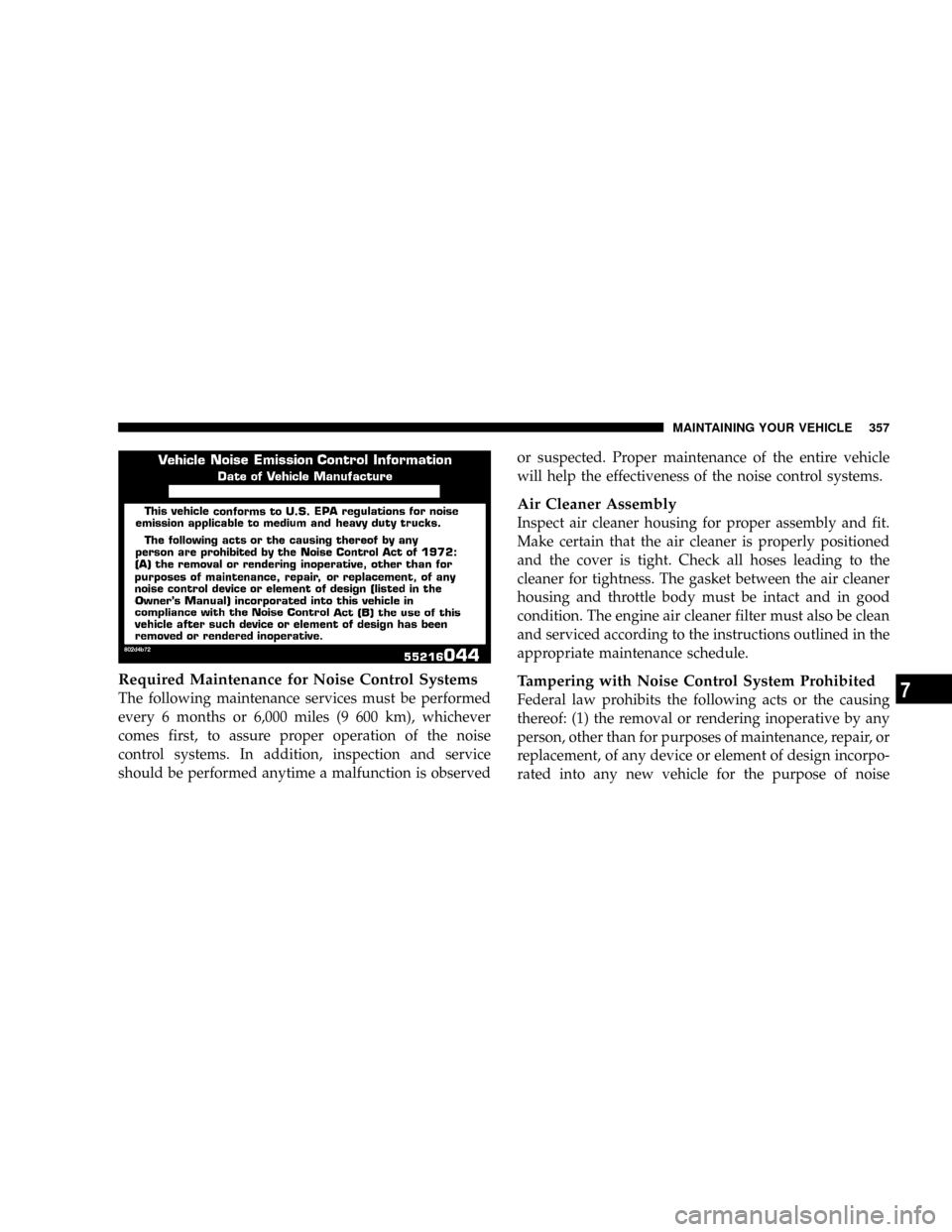
Tampering with Noise Control System Prohibited
Federal law prohibits the following acts or the causing
thereof: (1) the removal or rendering inoperative by any
person, other than for purposes of maintenance, repair, or
replacement, of any device or element of design incorpo-
rated into any new vehicle for the purpose of noise
MAINTAINING YOUR VEHICLE 357
7
Page 383 of 429
MAINTENANCE SCHEDULES
CONTENTS
mEmission Control System Maintenance........384
mMaintenance Schedules...................384NSchedule ªBº........................387
NSchedule ªAº........................397
8
M
A
I
N
T
E
N
A
N
C
E
S
C
H
E
D
U
L
E
S
Page 384 of 429
EMISSION CONTROL SYSTEM MAINTENANCE
The ªScheduledº maintenance services, listed inbold
typein this section (Section 8) must be done at the times
or mileages specified to assure the continued proper
functioning of the emission control system. These, and all
other maintenance services included in this manual,
should be done to provide best vehicle performance and
reliability. More frequent maintenance may be needed for
vehicles in severe operating conditions such as dusty
areas and very short trip driving.
Inspection and service also should be done any time a
malfunction is suspected.
NOTE:Maintenance, replacement, or repair of the emis-
sion control devices and systems on your vehicle may be
performed by any automotive repair establishment or
individual using any automotive part which has been
certified pursuant to U.S. EPA or, in the State of Califor-
nia, California Air Resources Board regulations.
MAINTENANCE SCHEDULES
There are two maintenance schedules that show the
requiredservice for your vehicle.
First is ScheduleªBº. It is for vehicles that are operated
under the conditions that are listed below and at the
beginning of the schedule.
²Day or night temperatures are below 32É F (0É C).
²Stop and go driving.
²Extensive engine idling.
²Driving in dusty conditions.
²Short trips of less than 10 miles (16 km).
²More than 50% of your driving is at sustained high
speeds during hot weather, above 90É F C (32É).
²Trailer towing.
²Snowplowing.
384 MAINTENANCE SCHEDULES
8
M
A
I
N
T
E
N
A
N
C
E
S
C
H
E
D
U
L
E
S
Page 385 of 429
²Heavy Loading.
²Taxi, police, or delivery service (commercial service).
²Off-road or desert operation.
²If equipped for and operating with E-85 (ethanol)
fuel.
NOTE:IfANYof these apply to you then change your
engine oil every 3,000 miles (5 000 km) or 3 months,
whichever comes first and follow schedule ªBº of the
9Maintenance Schedules9section of this manual.
NOTE:Most vehicles are operated under the conditions
listed for Schedule9B9.
Second is ScheduleªAº. It is for vehicles that are not
operated under any of the conditions listed under Sched-
ule9B9.Use the schedule that best describes your driving condi-
tions. Where time and mileage are listed, follow the
interval that occurs first.
NOTE:Under no circumstances should oil change in-
tervals exceed 6000 miles (10 000 km) or 6 months
whichever comes first.
CAUTION!
Failure to perform the required maintenance items
may result in damage to the vehicle.
MAINTENANCE SCHEDULES 385
8
M
A
I
N
T
E
N
A
N
C
E
S
C
H
E
D
U
L
E
S
Page 386 of 429
At Each Stop for Fuel
²Check the engine oil level about 5 minutes after a fully
warmed engine is shut off. Checking the oil level while
the vehicle is on level ground will improve the accu-
racy of the oil level reading. Add oil only when the
level is at or below the ADD or MIN mark.
²Check the windshield washer solvent and add if
required.
Once a Month
²Check tire pressure and look for unusual wear or
damage.
²Inspect the battery and clean and tighten the terminals
as required.
²Check the fluid levels of coolant bottle, brake master
cylinder, and transmission and add as needed.
²Check all lights and all other electrical items for correct
operation.
At Each Oil Change
²Change the engine oil filter.
²Inspect the exhaust system.
²Inspect the brake hoses.
²Inspect the CV joints (if equipped) and front suspen-
sion components.
²Check the automatic transmission fluid level.
²Check the manual transmission fluid level.
²Check the coolant level, hoses, and clamps.
Tire Rotation
²Rotate the tires at 6,000 miles (10 000 km).
386 MAINTENANCE SCHEDULES
8
M
A
I
N
T
E
N
A
N
C
E
S
C
H
E
D
U
L
E
S
Page 387 of 429
Schedule ªBº
Follow schedule ªBº if you usually operate your vehicle
under one or more of the following conditions.
²Day or night temperatures are below 32É F (0É C).
²Stop and go driving.
²Extensive engine idling.
²Driving in dusty conditions.
²Short trips of less than 10 miles (16 km).
²More than 50% of your driving is at sustained high
speeds during hot weather, above 90É F C (32É).
²Trailer towing.
²Snowplowing.
²Heavy Loading.
²Taxi, police, or delivery service (commercial service).
²Off-road or desert operation.
²If equipped for and operating with E-85 (ethanol)
fuel.
NOTE:IfANYof these apply to you then change your
engine oil every 3,000 miles (5 000 km) or 3 months,
whichever comes first and follow schedule ªBº of the
9Maintenance Schedules9section of this manual.
If none of these apply to you, then change your engine oil
at every interval shown on schedule9A9of the9Mainte-
nance Schedules9section of this manual.
SCHEDULE ªBº 387
8
M
A
I
N
T
E
N
A
N
C
E
S
C
H
E
D
U
L
E
S