torque DODGE RAM 1999 Service Repair Manual
[x] Cancel search | Manufacturer: DODGE, Model Year: 1999, Model line: RAM, Model: DODGE RAM 1999Pages: 1691, PDF Size: 40.34 MB
Page 967 of 1691
block. Install distributor so distributor shaft engages with slot in
oil pump drive gear. It may be necessary to slightly rotate
distributor during installation.
6) When distributor is fully seated, the distributor rotor
should be at 3 o'clock position and center of hold-down bolt area on
distributor housing should align with distributor hold-down bolt area
on cylinder block.
7) Install hold-down clamp and distributor hold-down bolt.
Tighten distributor hold-down bolt to specification. See TORQUE
SPECIFICATIONS.
8) If installing a factory replacement distributor, remove
plastic alignment pin from distributor housing. If installing original
or used distributor, remove drift from distributor housing and
reinstall camshaft position sensor. On all applications, install
distributor cap and remaining components. Base ignition timing is
nonadjustable, as ignition timing and timing advance are controlled by
the Powertrain Control Module (PCM).
Removal (Dakota 3.9L, 5.2L & 5.9L, Durango, Ram Pickup 3.9L,
5.2L & 5.9L, Ram Van & Ram Wagon)
1) Disconnect negative battery cable. On Ram Van and Ram
Wagon, remove engine cover. On all models, remove air cleaner
assembly. Remove distributor cap. Disconnect electrical connector for
distributor.
2) Rotate crankshaft clockwise (viewed from front of engine)\
until cylinder No. 1 is at Top Dead Center (TDC) on compression stroke\
and timing mark on vibration damper aligns with TDC timing mark on
timing chain cover. Cylinder No. 1 is the front cylinder on driver's
side of engine.
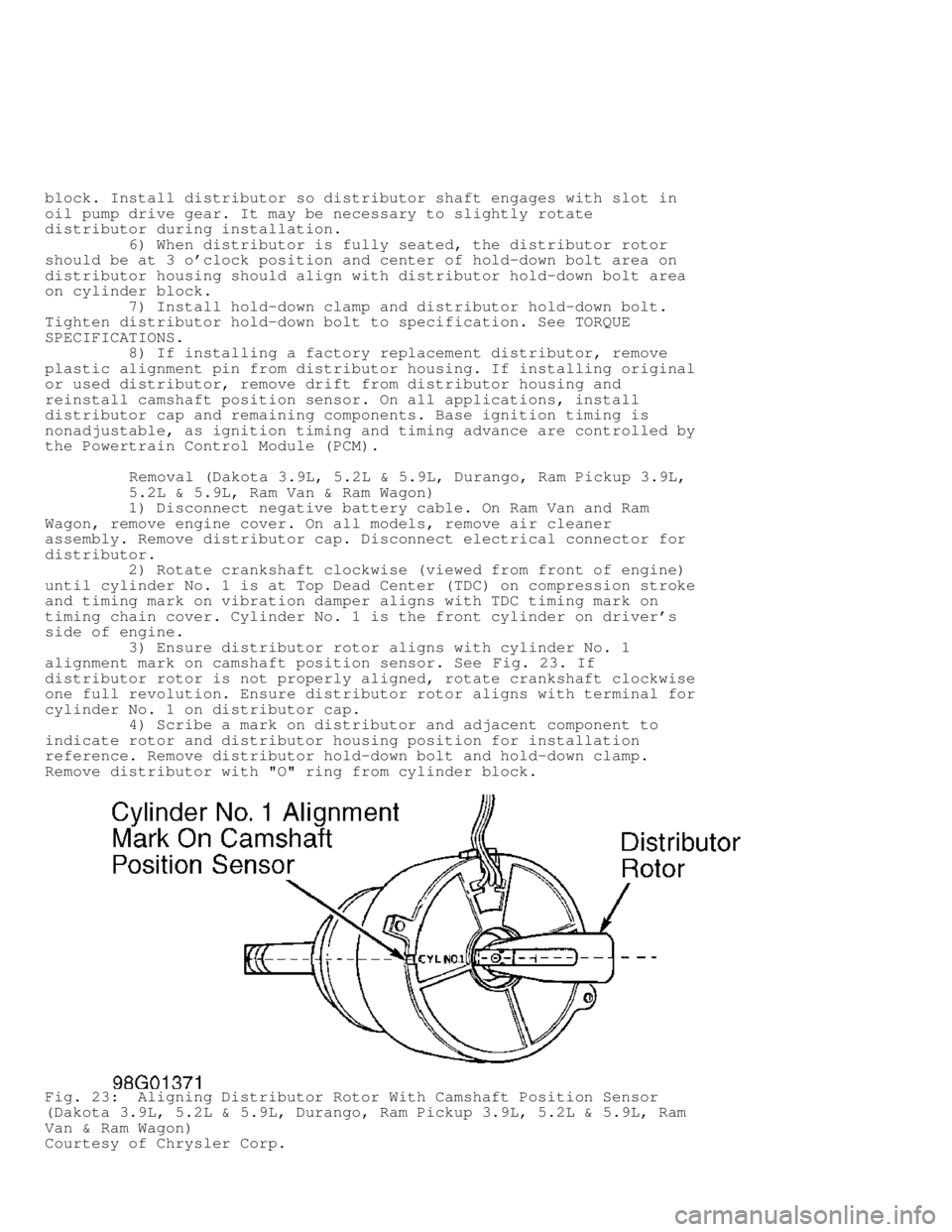
3) Ensure distributor rotor aligns with cylinder No. 1
alignment mark on camshaft position sensor. See Fig. 23. If
distributor rotor is not properly aligned, rotate crankshaft clockwise
one full revolution. Ensure distributor rotor aligns with terminal for
cylinder No. 1 on distributor cap.
4) Scribe a mark on distributor and adjacent component to
indicate rotor and distributor housing position for installation
reference. Remove distributor hold-down bolt and hold-down clamp.
Remove distributor with "O" ring from cylinder block.
Fig. 23: Aligning Distributor Rotor With Camshaft Position Sensor
(Dakota 3.9L, 5.2L & 5.9L, Durango, Ram Pickup 3.9L, 5.2L & 5.9L, Ram
Van & Ram Wagon)
Courtesy of Chrysler Corp.
Page 968 of 1691

Installation
1) If engine has not been rotated after removing distributor,
go to next step. If engine was rotated after removing distributor,
rotate crankshaft clockwise (viewed from front of engine) until
cylinder No. 1 is at Top Dead Center (TDC) on compression stroke and
timing mark on vibration damper aligns with TDC timing mark on timing
chain cover. Go to next step.
2) Ensure distributor mounting area on cylinder block is
clean. Install NEW "O" ring on distributor if necessary. Apply light
coat of engine oil on "O" ring.
3) Position distributor rotor so it aligns with terminal for
cylinder No. 1 on distributor cap. Install distributor. Ensure
distributor engages with slot in oil pump drive gear. Install hold-
down clamp and distributor hold-down bolt. DO NOT tighten distributor
hold-down bolt at this time.
4) Rotate distributor until distributor rotor aligns with
cylinder No. 1 alignment mark on camshaft position sensor. See Fig. 23
. Tighten distributor hold-down bolt to specification. See TORQUE
SPECIFICATIONS. To install remaining components, reverse removal
procedure.
5) Base ignition timing is nonadjustable. Base ignition
timing and timing advance are controlled by the Powertrain Control
Module (PCM). Distributor position is used to determine the fuel
system synchronization. To check for correct distributor position and
fuel system synchronization, see FUEL SYSTEM SYNCHRONIZATION under
FUEL SYSTEM in ON-VEHICLE ADJUSTMENTS article.
IGNITION COIL
Removal & Installation (Dakota 2.5L)
Ignition coil is located on side of engine, near distributor.
Service procedure is primarily an unbolt and bolt-on procedure.
Tighten ignition coil retaining bolts or nuts to specification. See
TORQUE SPECIFICATIONS.
Removal & Installation (Dakota 3.9L, 5.2L & 5.9L, Durango &
Ram Van/Wagon)
1) Ignition coil is located on front of passenger's side
cylinder head. Disconnect spark plug wires and electrical connector
from ignition coil.
CAUTION: Ignition coil-to-cylinder head mounting bracket bolts hold
the idler pulley for the accessory drive belt, as these bolts
are under tension. If necessary to remove these bolts,
accessory drive belt must be removed first.
2) Remove ignition coil retaining bolts or nuts with ignition
coil from the ignition coil mounting bracket. DO NOT remove ignition
coil-to-cylinder head mounting bracket bolts, as these bolts are under
tension.
3) To install, reverse removal procedure. Tighten ignition
coil retaining bolts or nuts to specification. See TORQUE
SPECIFICATIONS.
Removal & Installation (Ram Pickup 3.9L, 5.2L & 5.9L)
1) On 3.9L, 5.2L and 5.9L with light-duty emissions, ignition
coil is located on front of passenger's side cylinder head. On 5.9L
with heavy-duty emissions, ignition coil is located on top of air
injection pump. On all models, disconnect spark plug wires and
electrical connector from ignition coil.
CAUTION: On 3.9L, 5.2L and 5.9L with light-duty emissions, ignition
coil-to-cylinder head mounting bracket bolts hold the idler
Page 969 of 1691

pulley for the accessory drive belt, as these bolts are under
tension. If necessary to remove these bolts, accessory drive
belt must be removed first.
2) Remove ignition coil retaining bolts or nuts with ignition
coil from the ignition coil mounting bracket. On 3.9L, 5.2L and 5.9L
with light-duty emissions, DO NOT remove ignition coil-to-cylinder
head mounting bracket bolts, as these bolts are under tension. On all
applications, to install, reverse removal procedure. Tighten ignition
coil retaining bolts or nuts to specification. See TORQUE
SPECIFICATIONS.
Removal & Installation (Ram Pickup 8.0L)
1) Two separate ignition coils are located above passenger's
side valve cover. Each ignition coil can be serviced separately. On
all ignition coil applications, disconnect spark plug wires and
electrical connector from ignition coil.
2) Remove ignition coil retaining bolts and ignition coil
from ignition coil mounting bracket. To install, reverse removal
procedure. Ensure ignition coil is mounted on ignition coil mounting
bracket with electrical connector facing downward. Tighten ignition
coil retaining bolts to specification. See TORQUE SPECIFICATIONS.
FUEL SYSTEM
FUEL SYSTEM PRESSURE RELEASE
WARNING: Always release fuel pressure before disconnecting any fuel
injection-related component. DO NOT allow fuel to contact
engine or electrical components.
1) Remove fuel cap from fuel tank. Note location of spring
loaded flapper valve inside fuel tank filler tube assembly. Flapper
valve is located just below the fuel cap area on fuel tank filler tube
assembly. Flapper valve is used as a secondary way of sealing the fuel
tank if fuel cap was not properly tightened.
WARNING: When opening flapper valve inside fuel tank filler tube
assembly, ensure a non-metallic object is used to prevent any
sparks.
2) Using a non-metallic object, push flapper valve inside
filler tube assembly downward to release any pressure from the fuel
tank. Ensure all pressure is released from fuel tank.
3) Remove fuel pump relay from Power Distribution Center
(PDC). Fuel pump relay may be identified by label on inside of PDC
cover. See POWER DISTRIBUTION CENTER (PDC) LOCATION table.
4) On all models, start engine and allow engine to idle until
engine stalls. Attempt to restart engine until engine will no longer
run. Turn ignition off.
CAUTION: Ensure steps 1) through 4) are performed before proceeding.
Steps 3) and 4) must be performed to ensure most of the fuel
pressure is released from fuel rails to prevent an excessive
amount of fuel being delivered into the cylinders.
5) Remaining fuel pressure is released by energizing a fuel
injector. Disconnect electrical connector at any fuel injector.
6) Connect jumper wire between one electrical terminal on
fuel injector and positive battery terminal. Connect another jumper
wire on remaining electrical terminal on fuel injector.
Page 978 of 1691

Removal & Installation
Fuel pressure regulator is incorporated with the fuel filter.
For servicing for fuel filter/fuel pressure regulator, see FUEL
FILTER/FUEL PRESSURE REGULATOR.
FUEL PUMP
Removal & Installation
Fuel pump is incorporated into the fuel pump module. See FUEL
PUMP MODULE.
FUEL PUMP INLET STRAINER
Removal & Installation
1) Fuel pump inlet strainer is mounted on fuel pump module.
See Fig. 31 . Remove fuel pump module. See FUEL PUMP MODULE.
2) Spread locking tabs on bottom of fuel pump module and
remove fuel pump inlet strainer from fuel pump module. See Fig. 31.
Remove "O" ring from end of fuel pump module if "O" ring was not
removed with fuel pump inlet strainer.
3) To install, reverse removal procedure. Ensure "O" ring is
properly seated when installing fuel pump inlet strainer. Reinstall
fuel pump module using proper procedure.
FUEL PUMP MODULE
Removal (Dakota)
1) Fuel pump module is located on top of fuel tank. See
Fig. 27 . Fuel tank must be removed for servicing of fuel pump module.
Remove fuel tank. See FUEL TANK.
2) Ensure area around fuel pump module is clean. Using Fuel
Pump Module Lock Nut Spanner Wrench (6856), remove fuel pump module
lock nut. See Fig. 32. Remove fuel pump module with rubber gasket from
fuel tank.
CAUTION: When fuel pump module is removed from fuel tank, rubber
gasket must be replaced. DO NOT reuse rubber gasket.
Installation
1) Ensure sealing area on fuel tank is clean. Using NEW
rubber gasket, install fuel pump module on fuel tank. DO NOT reuse
rubber gasket. Ensure rubber gasket remains in place.
NOTE: Fuel pump module must be properly positioned in fuel tank to
prevent float from contacting the fuel tank.
2) Rotate fuel pump module so alignment arrow on fuel pump
module is at 7 o'clock position and aligns with reference mark on fuel
tank. See Fig. 33. Install and hand tighten fuel pump module lock nut.
3) Note location of fuel pressure regulator on fuel pump
module. See Fig. 27. Ensure fuel filter/pressure regulator is
positioned on fuel pump module so fuel line fitting on side fuel
filter/fuel pressure regulator points toward driver's side of vehicle.
4) Hold fuel pump module in place while tightening fuel pump
module lock nut to specification. See TORQUE SPECIFICATIONS. Reinstall
fuel tank using proper procedure.
Page 981 of 1691

1) Fuel pump module is located on top of fuel tank. See
Fig. 29. Fuel tank must be removed for servicing of fuel pump module.
Remove fuel tank. See FUEL TANK under FUEL SYSTEM.
2) Ensure area around fuel pump module is clean. Note
position of fuel pump module installation in fuel tank for
installation reference. Using Fuel Pump Module Lock Nut Spanner Wrench
(6856), remove fuel pump module lock nut. See Fig. 32. Remove fuel
pump module with rubber gasket from fuel tank.
CAUTION: When fuel pump module is removed from fuel tank, rubber
gasket must be replaced. DO NOT reuse rubber gasket.
Installation
1) Ensure sealing area on fuel tank is clean. Using NEW
rubber gasket, install fuel pump module on fuel tank. DO NOT reuse
rubber gasket. Ensure rubber gasket remains in place.
NOTE: Fuel pump module must be properly positioned in fuel tank to
prevent float from contacting the fuel tank.
2) Loosely install fuel pump module lock nut. Rotate fuel
pump module so electrical connector is pointing toward driver's side
of fuel tank. See Fig. 29.
3) Note location of fuel pressure regulator on fuel pump
module. See Fig. 29. Ensure fuel filter/pressure regulator is
positioned on fuel pump module so fuel line fitting on side fuel
filter/fuel pressure regulator points toward driver's side of fuel
tank.
4) Hold fuel pump module in place while tightening fuel pump
module lock nut to specification. See TORQUE SPECIFICATIONS. Reinstall
fuel tank using proper procedure.
Removal (Ram Van & Ram Wagon)
1) Fuel pump module is located on top of fuel tank. See
Fig. 30 . Fuel tank must be removed for servicing of fuel pump module.
Remove fuel tank. See FUEL TANK.
2) Ensure area around fuel pump module is clean. Using Fuel
Pump Module Lock Nut Spanner Wrench (6856), remove fuel pump module
lock nut. See Fig. 32. Remove fuel pump module with rubber gasket from
fuel tank.
CAUTION: When fuel pump module is removed from fuel tank, rubber
gasket must be replaced. DO NOT reuse rubber gasket.
Installation
1) Ensure sealing area on fuel tank is clean. Using NEW
rubber gasket, install fuel pump module on fuel tank. DO NOT reuse
rubber gasket. Ensure rubber gasket remains in place.
NOTE: Fuel pump module must be properly positioned in fuel tank to
prevent float from contacting the fuel tank.
2) Rotate fuel pump module so alignment mark on fuel pump
module aligns with reference mark on fuel tank. See Fig. 35. Install
and hand tighten fuel pump module lock nut.
3) Note location of fuel pressure regulator on fuel pump
module. See Fig. 35. Ensure fuel filter/pressure regulator is
positioned on fuel pump module so fuel line fitting on side fuel
filter/fuel pressure regulator points toward driver's side of vehicle.
4) Hold fuel pump module in place while tightening fuel pump
module lock nut to specification. See TORQUE SPECIFICATIONS. Reinstall
fuel tank using proper procedure.
Page 985 of 1691

1) To install, reverse removal procedure. If installing small
vent tube and large fill tube on fuel tank, ensure fuel tank fittings
are clean.
2) Install disconnect fitting on fuel tank fitting until
disconnect fitting snaps onto fuel tank fitting. Pull on small vent
tube or and large fill tube to ensure disconnect fitting is locked on
fuel tank fitting. To verify proper installation of disconnect
fitting, ensure the distance between release sleeve and top of fuel
tank fitting is .50" (12.7 mm) on small vent tube or .25" (6.4 mm) o\
n
large fill tube. See Fig. 37.
3) Install fuel lines on fuel filter/fuel pressure regulator
on fuel pump module using proper procedure. See FUEL LINE DISCONNECT
FITTINGS under FUEL SYSTEM.
CAUTION: DO NOT overtighten fuel tank strap retaining nuts during
installation.
4) Tighten fuel tank strap retaining nuts to specification.
See TORQUE SPECIFICATIONS. To install remaining components, reverse
removal procedure. Start engine and check for fuel leaks.
Removal (Durango)
1) Fuel tank may be drained by removing vent hose from rear
of fuel tank, or by pumping fuel from fuel tank using the fuel pump if
fuel pump is operating. If removing vent hose from fuel tank to drain
the fuel, go to step 4). If using fuel pump to drain the fuel tank, go
to next step.
2) Disconnect fuel line from fuel rail. See FUEL LINE AT FUEL
RAIL under FUEL SYSTEM. Connect Fuel Hose (6541, 6539, 6631 or 6923)
for proper engine application at fuel line fitting on fuel rail. Place
remaining end of fuel hose in an approved gasoline container.
3) Connect scan tool to Data Link Connector (DLC). DLC is a
16-pin connector attached to bottom of driver's side of the instrument
panel, just to the right of the brake pedal. Using scan tool
manufacturer's instructions, activate the fuel pump and pump fuel from
fuel tank. Once fuel tank is empty, remove scan tool. Reinstall fuel
line on fuel rail using proper procedure. Go to step 5).
4) Release fuel pressure from fuel system. See FUEL SYSTEM
PRESSURE RELEASE. Ensure negative battery cable is disconnected.
Remove fuel tank cap to release any residual fuel tank pressure.
5) Raise and support vehicle. Remove necessary skid plates
for access to fuel tank. Disconnect vent and filler hose from rear of
fuel tank. If fuel tank was not previously drained, place drain hose
in vent hose fitting at rear of fuel tank. Drain fuel from fuel tank
into an approved gasoline container.
6) Support fuel tank with transmission jack. Remove fuel tank
strap retaining nuts. Position fuel tank straps toward outside of
vehicle. Slightly lower fuel tank. Ensure rear of fuel tank is higher
than front of fuel tank to prevent any spilling any remaining fuel in
fuel tank.
7) Disconnect fuel line from fuel filter/fuel pressure
regulator on fuel pump module using proper procedure for fuel line
disconnect fitting. See FUEL LINE DISCONNECT FITTINGS. Fuel pump
module is located on top of fuel tank. See Fig. 28. Disconnect
electrical connector at fuel pump module. Disconnect vapor line from
rollover valves on top of fuel tank and EVAP line from fuel pump
module. Lower fuel tank from vehicle.
CAUTION: DO NOT overtighten fuel tank strap retaining nuts during
installation.
Installation
1) To install, reverse removal procedure. Install fuel lines
Page 986 of 1691

on fuel filter/fuel pressure regulator on fuel pump module using
proper procedure. See FUEL LINE DISCONNECT FITTINGS.
2) Tighten fuel tank strap retaining nuts to specification.
See TORQUE SPECIFICATIONS. Start engine and check for fuel leaks.
Removal (Ram Pickup)
1) Fuel tank may be drained by lowering fuel tank, or by
pumping fuel from fuel tank using the fuel pump if fuel pump is
operating. If lowering fuel tank to drain the fuel, go to step 4). If
using fuel pump to drain the fuel tank, go to next step.
2) Disconnect fuel line from fuel rail. See FUEL LINE AT FUEL
RAIL. Connect Fuel Hose (6541, 6539, 6631 or 6923) for proper engine
application at fuel line fitting on fuel rail. Place remaining end of
fuel hose in an approved gasoline container.
3) Connect scan tool to Data Link Connector (DLC). DLC is a
16-pin connector attached to bottom of driver's side of the instrument
panel, just straight above the accelerator pedal. Using scan tool
manufacturer's instructions, activate the fuel pump and pump fuel from
fuel tank. Once fuel tank is empty, remove scan tool. Reinstall fuel
line on fuel rail using proper procedure. Go to step 5).
4) Release fuel pressure from fuel system. See FUEL SYSTEM
PRESSURE RELEASE. Ensure negative battery cable is disconnected.
Remove fuel tank cap to release any residual fuel tank pressure.
5) Raise and support vehicle. Open fuel tank filler door.
Remove fuel tank filler tube assembly-to-body screws. Support fuel
tank with transmission jack. Remove fuel tank strap retaining nuts.
6) Slightly lower fuel tank. If fuel tank was not previously
drained, slightly rotate fuel tank so vent hose and filler hose on
fuel tank are above the fuel level in the fuel tank to prevent fuel
leakage when hoses are disconnected. Vent hose and filler hose attach
to fitting on the fuel tank. See Fig. 29.
7) Disconnect vent hose from vent hose fitting on fuel tank.
If fuel tank was previously drained, go to next step. If fuel tank was
not previously drained, place drain hose in vent hose fitting on fuel
tank. Drain fuel from fuel tank into an approved gasoline container.
Go to next step.
8) Disconnect filler hose from filler hose fitting on fuel
tank. Disconnect electrical connector at fuel pump module. Fuel pump
module is located on top of fuel tank. See Fig. 29.
9) Disconnect fuel line from fuel filter/fuel pressure
regulator on fuel pump module using proper procedure for fuel line
disconnect fitting. See FUEL LINE DISCONNECT FITTINGS under FUEL
SYSTEM.
10) Disconnect necessary vapor hoses from rollover valves on
top of fuel tank or fuel pump module. See Fig. 29. Lower fuel tank
from vehicle.
CAUTION: DO NOT overtighten fuel tank strap retaining nuts during
installation.
Installation
1) To install, reverse removal procedure. Install fuel lines
on fuel filter/fuel pressure regulator on fuel pump module using
proper procedure. See FUEL LINE DISCONNECT FITTINGS.
2) Tighten fuel tank strap retaining nuts to specification.
See TORQUE SPECIFICATIONS. Start engine and check for fuel leaks.
Removal (Ram Van & Ram Wagon)
1) Fuel tank may be drained by siphoning fuel out through
small vent hose on fuel and vent hose fitting assembly on fuel tank,
or by pumping fuel from fuel tank using the fuel pump if fuel pump is
operating. If siphoning fuel out through small vent hose on fuel and
vent hose fitting assembly on fuel tank, go to step 4). If using fuel
Page 988 of 1691

fitting assembly out of the plastic shield. Use care not to damage
fill and vent fitting assembly. Disconnect fuel line from fuel
filter/fuel pressure regulator on fuel pump module using proper
procedure for fuel line disconnect fitting. See FUEL LINE DISCONNECT
FITTINGS. Fuel pump module is located on top of fuel tank. See Fig. 30
.
11) Disconnect electrical connector at fuel pump module.
Disconnect vapor hoses from rollover valves on top of fuel tank. See
Fig. 30 . Lower fuel tank from vehicle. Use care not to damage fill and
vent hose fitting assembly.
Installation
1) To install, reverse removal procedure. Install fuel lines
on fuel filter/fuel pressure regulator on fuel pump module using
proper procedure. See FUEL LINE DISCONNECT FITTINGS.
2) Ensure retaining tabs on fill and vent hose fitting
assembly fully engage the plastic shield. Tighten fuel tank strap
retaining nuts to specification. See TORQUE SPECIFICATIONS. Start
engine and check for fuel leaks.
FUEL RAIL & INJECTORS
Removal (Dakota 2.5L)
1) Release fuel pressure from fuel system. See FUEL SYSTEM
PRESSURE RELEASE. Ensure negative battery cable is disconnected.
2) Disconnect air inlet duct at throttle body for access to
fuel rail. Disconnect vent line from fuel damper at end of fuel rail
(if equipped).
3) Note electrical connector location on injectors for
installation reference. Disconnect electrical connectors at injectors.
Disconnect fuel line from fuel rail. See FUEL LINE AT FUEL RAIL.
Disconnect control cables at throttle body. Remove control cable
mounting bracket from intake manifold for access to fuel rail.
4) Remove fuel rail bolts. Ensure area around injectors and
intake manifold is clean. Using rocking motion, remove fuel rail with
injectors from intake manifold.
5) If removing injector from fuel rail, remove retaining clip
from fuel rail and injector. Retaining clip is located at top of
injector and fuel rail. Remove injector with "O" ring from fuel rail.
Installation
1) If installing injector on fuel rail, install NEW "O" ring
on injector. Coat "O" ring on injector with engine oil. Install
injector on fuel rail. Install retaining clip on injector and fuel
rail.
2) To install remaining components, reverse removal procedure
using NEW "O" ring at bottom of each injector. Coat "O" ring on
injector with engine oil before installing injectors and fuel rail.
3) Tighten fuel rail bolts to specification. See TORQUE
SPECIFICATIONS. Install fuel line on fuel rail using proper procedure.
See FUEL LINE AT FUEL RAIL. Start engine and check for leaks.
Removal (Dakota 3.9L, 5.2L & 5.9L, Durango, Ram Pickup 3.9L,
5.2L & 5.9L, Ram Van & Ram Wagon)
1) Release fuel pressure from fuel system. See FUEL SYSTEM
PRESSURE RELEASE. Ensure negative battery cable is disconnected.
2) On Ram Van and Ram Wagon, remove engine cover. On all
models, remove air cleaner. Remove throttle body from intake manifold.
See THROTTLE BODY. On A/C equipped models, remove A/C compressor-to-
intake manifold support brace at rear of A/C compressor.
3) On all models, note electrical connector location on
injectors for installation reference. Disconnect electrical connectors
at injectors. Disconnect any necessary wiring electrical connectors
Page 989 of 1691

for access to fuel rails and injectors.
CAUTION: Both fuel rails are serviced as an assembly. DO NOT attempt
to separate fuel rail from connecting fuel hose at rear of
each fuel rail. Connecting fuel hose does not use any form of
clamps on the hose. DO NOT use any clamps on connecting fuel
hose. When removing fuel rails with injectors, use care not
to bend connecting fuel hose.
4) Disconnect fuel line from fuel rail. See FUEL LINE AT FUEL
RAIL. Remove fuel rail bolts. Ensure area around injectors and intake
manifold is clean.
5) Using rocking motion, pull driver's side fuel rail with
injectors upward from intake manifold until injectors just clear
intake manifold. Repeat procedure on passenger's side fuel rail.
Remove fuel rails with injectors from intake manifold.
6) If removing injector from fuel rail, remove retaining clip
from fuel rail and injector. Retaining clip is located at top of
injector and fuel rail. Remove injector with "O" ring from fuel rail.
Installation
1) If installing injector on fuel rail, install NEW "O" ring
on injector. Coat "O" ring on injector with engine oil. Install
injector on fuel rail. Install retaining clip on injector and fuel
rail.
2) To install remaining components, reverse removal procedure
using NEW "O" ring at bottom of each injector. Coat "O" ring on
injector with engine oil before installing injectors and fuel rails.
3) Push passenger's side fuel rail and then driver's side
fuel rail downward until shoulder on each injector contacts the intake
manifold. Ensure all injectors are fully seated.
4) Tighten fuel rail bolts and throttle body bolts to
specification. See TORQUE SPECIFICATIONS. Install fuel line on fuel
rail using proper procedure. See FUEL LINE AT FUEL RAIL under FUEL
SYSTEM. Start engine and check for leaks.
Removal (Ram Pickup 8.0L)
1) Release fuel pressure from fuel system. See FUEL SYSTEM
PRESSURE RELEASE. Ensure negative battery cable is disconnected.
2) Remove throttle body from upper intake manifold. See
THROTTLE BODY. Remove ignition coils with mounting bracket for access
to fuel rails.
3) Upper intake manifold must be removed for servicing of
fuel rails and injectors. Remove generator-to-upper intake manifold
brace and A/C compressor-to-upper intake manifold brace. Remove
generator and A/C compressor if necessary for removal of upper intake
manifold.
4) Disconnect necessary vacuum lines and hoses for removal of
upper intake manifold. Remove bolts, upper intake manifold and gasket
from lower intake manifold.
5) Note electrical connector location on injectors for
installation reference. Disconnect electrical connectors at injectors.
Disconnect fuel line from fuel rail. See FUEL LINE AT FUEL RAIL.
6) Remove fuel rail bolts. Ensure area around injectors and
lower intake manifold is clean. Using rocking motion, pull driver's
side fuel rail with injectors upward from intake manifold until
injectors just clear intake manifold. Repeat procedure on passenger's
side fuel rail. Remove fuel rails with injectors from lower intake
manifold.
7) If removing injector from fuel rail, remove retaining clip
from fuel rail and injector. Retaining clip is located at top of
injector and fuel rail. Remove injector with "O" ring from fuel rail.
Page 990 of 1691
Installation
1) If installing injector on fuel rail, install NEW "O" ring
on injector. Coat "O" ring on injector with engine oil. Install
injector on fuel rail. Position injectors on fuel rails so electrical
connector on injector is facing toward passenger's side of the
vehicle. Install retaining clip on injector and fuel rail.
2) To install remaining components, reverse removal procedure
using NEW "O" ring at bottom of each injector. Coat "O" ring on
injector with engine oil before installing injectors and fuel rails.
3) Push passenger's side fuel rail and then driver's side
fuel rail downward until shoulder on each injector contacts the intake
manifold. Ensure all injectors are fully seated.
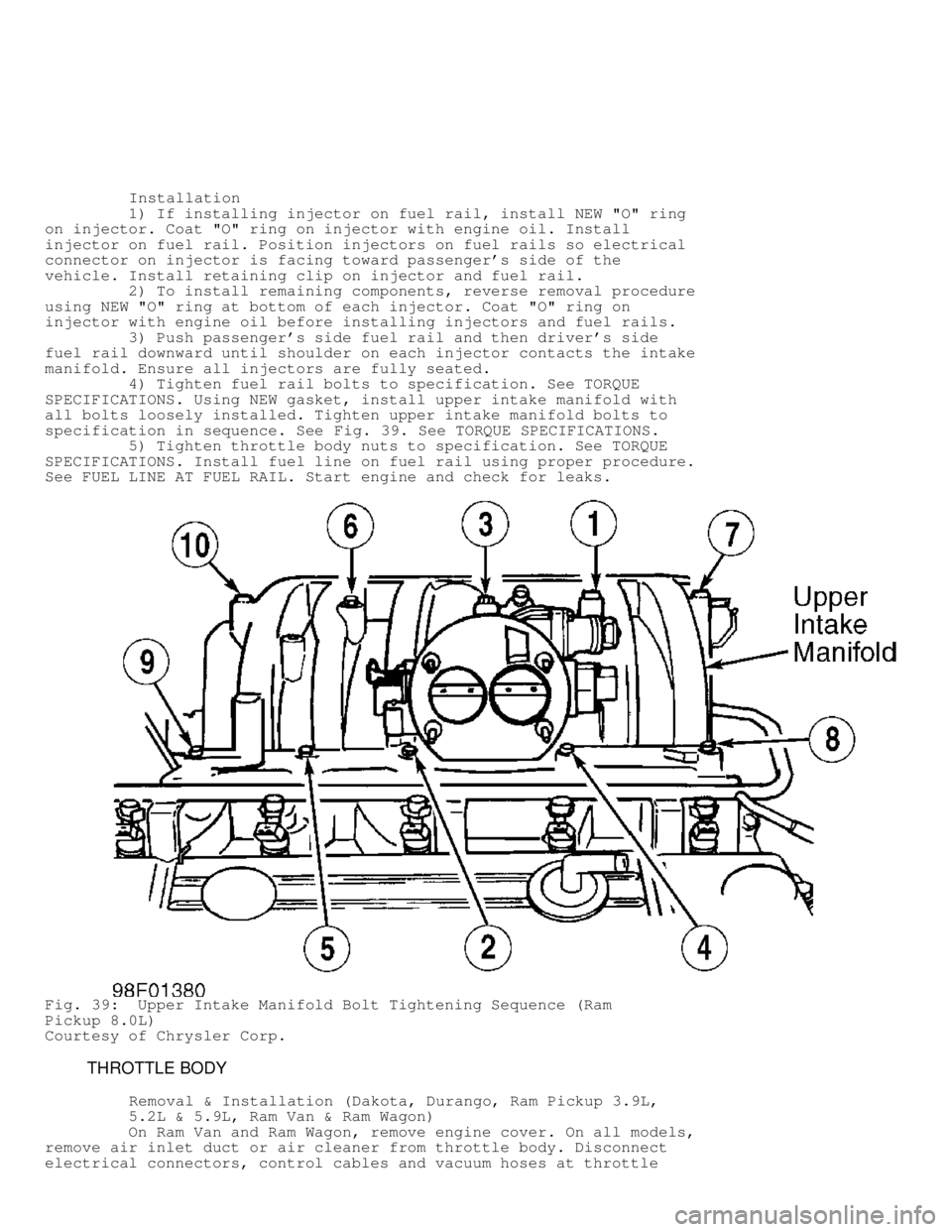
4) Tighten fuel rail bolts to specification. See TORQUE
SPECIFICATIONS. Using NEW gasket, install upper intake manifold with
all bolts loosely installed. Tighten upper intake manifold bolts to
specification in sequence. See Fig. 39. See TORQUE SPECIFICATIONS.
5) Tighten throttle body nuts to specification. See TORQUE
SPECIFICATIONS. Install fuel line on fuel rail using proper procedure.
See FUEL LINE AT FUEL RAIL. Start engine and check for leaks.
Fig. 39: Upper Intake Manifold Bolt Tightening Sequence (Ram
Pickup 8.0L)
Courtesy of Chrysler Corp.
THROTTLE BODY
Removal & Installation (Dakota, Durango, Ram Pickup 3.9L,
5.2L & 5.9L, Ram Van & Ram Wagon)
On Ram Van and Ram Wagon, remove engine cover. On all models,
remove air inlet duct or air cleaner from throttle body. Disconnect
electrical connectors, control cables and vacuum hoses at throttle