ad blue DODGE RAM 1999 Service User Guide
[x] Cancel search | Manufacturer: DODGE, Model Year: 1999, Model line: RAM, Model: DODGE RAM 1999Pages: 1691, PDF Size: 40.34 MB
Page 198 of 1691

more than 5 ohms on either circuit, repair short to ground in Dark
Green/Light Blue wire or Black/Light Blue wire. If resistance is less
than 5 ohms on either circuit, go to next step.
4) If there are no potential causes for this DTC remaining,
ACM is assumed to be defective. Replace ACM. See
AIR BAG CONTROL MODULE (ACM) under REMOVAL & INSTALLATION.
LOSS OF IGNITION RUN ONLY
NOTE: Perform AIR BAG VERIFICATION TEST after
all repairs. Each time a connector is disconnected, inspect
it to ensure it is in good condition. Always focus on circuit
being tested. Dirt, water and corrosion, are most common
problems in connectors. Due to manufacturer changes in wire
colors, use terminal identification whenever possible.
1) Remove and inspect fuse No. 18 located in junction block.
If fuse is blown, go to step 5). If fuse is good, go to next step.
2) Using a voltmeter, check voltage between ground and
ignition switch output RUN circuit at fuse No. 18. If voltage is less
than 10 volts, repair open ignition switch output RUN circuit. If
voltage is more than 10 volts, go to next step.
3) Reinstall fuse No. 18. Disconnect battery and wait 2
minutes before proceeding. Disconnect ACM connector. Turn ignition on,
then reconnect battery. Using a voltmeter, check voltage between
ground and ACM connector terminal No. 15 (Dark Blue/Yellow wire). If
voltage is more than 10 volts, go to next step. If voltage is less
than 10 volts, repair open in Dark Blue/Yellow wire.
4) If there are no potential causes for this DTC remaining,
ACM is assumed to be defective. Replace ACM. See
AIR BAG CONTROL MODULE (ACM) under REMOVAL & INSTALLATION.
5) Turn ignition off. Using an ohmmeter, check resistance
between ground and fused ignition switch output RUN circuit at fuse
No. 18. If resistance is more than 5 ohms, replace fuse No. 18 located
in junction block. If resistance is less than 5 ohms, go to next step.
6) Disconnect battery and wait 2 minutes before proceeding.
Disconnect ACM connector. Using an ohmmeter, check resistance between
ground and ACM connector terminal No. 15 (Dark Blue/Yellow wire). If
resistance is less than 5 ohms, repair fused ignition switch output
RUN circuit for a short to ground and replace fuse. If resistance is
more than 5 ohms, go to next step.
7) If there are no potential causes for this DTC remaining,
ACM is assumed to be defective. Replace ACM and fuse No. 18. See
AIR BAG CONTROL MODULE (ACM) under REMOVAL & INSTALLATION.
LOSS OF IGNITION RUN/START
NOTE: Perform AIR BAG VERIFICATION TEST after
all repairs. Each time a connector is disconnected, inspect
it to ensure it is in good condition. Always focus on circuit
being tested. Dirt, water and corrosion, are most common
problems in connectors. Due to manufacturer changes in wire
colors, use terminal identification whenever possible.
1) Remove and inspect fuse No. 19. If fuse is blown, go to
step 5). If fuse is good, go to next step.
2) Using a voltmeter, measure ignition switch output
RUN/START circuit between fuse No. 19 and ground. If voltage is less
than 10 volts, repair open ignition switch output RUN/START circuit.
If voltage is more than 10 volts, reinstall fuse No. 19. Disconnect
battery and wait 2 minutes before proceeding. Go to next step.
3) Disconnect ACM connector. Turn ignition on. Reconnect
battery. Using a voltmeter, check voltage between ground and ACM
Page 201 of 1691
 and No. 3 (Black/Yellow wire). If resistance is more than 5 ohm\
s
on either circuit, replace PAD switch. If resistance is less than 5
ohms on either circuit, go to next step.
5) Using")
wire) and No. 3 (Black/Yellow wire). If resistance is more than 5 ohm\
s
on either circuit, replace PAD switch. If resistance is less than 5
ohms on either circuit, go to next step.
5) Using an ohmmeter, check resistance between ACM connector
terminal No. 7 (Brown/Yellow wire) and PAD switch 4-pin connector
(harness side) terminal No. 4 (Dark Green/Yellow wire). If resistanc\
e
is more than 5 ohms, repair open or high resistance in Brown/Yellow
wire. If resistance is less than 5 ohms, go to next step.
6) Using an ohmmeter, check resistance between ACM connector
terminal No. 8 (Violet/Yellow wire) and PAD switch 4-pin connector
(harness side) terminal No. 3 (Black/Yellow wire). If resistance is
more than 5 ohms, repair open or high resistance in Violet/Yellow
wire. If resistance is less than 5 ohms, go to next step.
7) If there are no potential causes for this DTC remaining,
ACM is assumed to be defective. Replace ACM. See
AIR BAG CONTROL MODULE (ACM) under REMOVAL & INSTALLATION.
PASSENGER SQUIB CIRCUIT SHORTED
NOTE: Perform AIR BAG VERIFICATION TEST after
all repairs. Each time a connector is disconnected, inspect
it to ensure it is in good condition. Always focus on circuit
being tested. Dirt, water and corrosion, are most common
problems in connectors. Due to manufacturer changes in wire
colors, use terminal identification whenever possible.
1) Turn ignition off. Turn PAD switch to the ON position.
Turn ignition on (engine off). Using DRB, read active codes. If DRB
displays PASSENGER SIDE SQUIB SHORTED DTC, go to next step. If DRB
does not display PASSENGER SIDE SQUIB SHORTED DTC, go to appropriate
diagnostic test.
2) Turn ignition off. Disconnect battery and wait 2 minutes
before proceeding. Disconnect passenger-side air bag module connector.
Disconnect clockspring connector. Go to next step.
3) Using an ohmmeter, check resistance between Passenger-side
air bag 2-pin connector terminal "B" (Dark Green/Yellow wire) and
clockspring 2-pin connector terminal No. 1 (Black/Light Blue wire). If\
resistance is less than 5 ohms, repair short between Dark Green/Yellow
wire and Black/Light Blue wire. If resistance is more than 5 ohms, go
to next step.
4) Using an ohmmeter, check resistance between passenger-side
air bag module 2-pin connector terminal "A" (Black/Yellow wire) and
clockspring 2-pin connector terminal No. 2 (Dark Green/Light Blue
wire). If resistance is less than 5 ohms, repair short between
Black/Yellow wire and Dark Green/Light Blue wire. If resistance is
more than 5 ohms, go to next step.
5) Using an ohmmeter, check resistance between passenger-side
air bag clockspring 2-pin connector terminals. If resistance is less
than 5 ohms, go to next step. If resistance is more than 5 ohms,
replace passenger-side air bag module.
6) Disconnect PAD switch 4-pin connector. Using an ohmmeter,
check resistance between passenger-side air bag module 4-pin connector
(harness side) terminals "A" (Black/Yellow wire) and "B" (Dark
Green/Yellow wire). If resistance is less than 5 ohms, repair short
between Dark Green/Yellow wire Black/Yellow wire. If resistance is
more than 5 ohms, go to next step.
7) Using an ohmmeter, check resistance between PAD switch 4-
pin connector (harness side) terminals No. 1 (Brown/Yellow wire) and\
No. 2 (Violet/Yellow wire). If resistance is less than 5 ohms in
either circuit, repair short between Brown/Yellow wire and
Violet/Yellow wire. If resistance is more than 5 ohms, go to next
step.
8) If there are no potential causes for this DTC remaining,
Page 203 of 1691

Reconnect battery. Using a voltmeter, check voltage between ground and
passenger-side air bag module 2-pin connector terminals "A" and "B".
If voltage is more than 0.5 volt on either circuit, go to next step.
If voltage is less than 0.5 volt on either circuit, replace ACM.
4) Disconnect PAD switch 4-pin connector. Using a voltmeter,
check voltage between ground and passenger-side air bag module 2-pin
connector terminals "A" (Black/Yellow wire) and "B" (Dark Green/Yello\
w
wire). If voltage is more than 0.5 volt in either circuit, repair
short in Black/Yellow wire or Dark Green/Yellow wire. If voltage is
less than 0.5 volt in either circuit, go to next step.
5) Using a voltmeter, check voltage between ground and PAD
switch 4-pin connector (harness side) terminals No. 1 (Brown/Yellow
wire) and No. 2 (Violet/Yellow wire). If voltage is more than 0.5 vol\
t
on either circuit, repair short in Brown/Yellow wire or Violet/Yellow
wire. If voltage is less than 0.5 volt on either circuit, replace PAD
switch.
REPAIRING SEAT BELT CONTROL TIMER MODULE (SCTM)
NOTE: Perform AIR BAG VERIFICATION TEST after
all repairs. Each time a connector is disconnected, inspect
it to ensure it is in good condition. Always focus on circuit
being tested. Dirt, water and corrosion, are most common
problems in connectors. Due to manufacturer changes in wire
colors, use terminal identification whenever possible.
1) Using a voltmeter, backprobe (do not disconnect connector)\
main seat connector terminal No. 10 (Light Green/Black wire) to
ground. See WIRING DIAGRAMS for terminal identification. If voltage is
between 1-3 volts, replace ACM. If voltage is less than one volt,
repair open in Light Green/Black wire. If voltage is between 9-10
volts, perform Seat Belt Control Timer Module (SCTM) diagnostics.
Repair as required. If voltage is not between 9-10 volts, go to next
step.
2) Disconnect SCTM connector. Using a voltmeter, check
voltage between ground and SCTM connector terminal No. 11 (Light
Green/Black wire). If voltage is between 9-10 volts, replace SCTM. If
voltage is not between 9-10 volts, go to next step.
3) Turn ignition off. Using an ohmmeter, check resistance
between ground and SCTM connector terminal No. 11 (Light Green/Black
wire). If resistance is less than 5 ohms, repair short in Light
Green/Black wire. If resistance is more than 5 ohms, go to next step.
4) Using an ohmmeter, check resistance between ground and
SCTM connector terminals No. 6 (Black/Light Green wire) and No. 13
(Black/Pink wire). If resistance is more than 5 ohms on either
circuit, repair open in Black/Light Green wire or Black/Pink wire. If
resistance is less than 5 ohms on either circuit, go to next step.
5) Turn ignition off. Using a voltmeter, check voltage
between ground and SCTM connector terminal No. 4 (Dark Blue wire). If
voltage is less than 10 volts, repair open in Dark Blue wire. If
voltage is more than 10 volts, go to next step.
6) Using a voltmeter, check voltage between ground and SCTM
connector terminal No. 5 (Pink wire). If voltage is less than 10
volts, repair open in Pink wire. If voltage is more than 10 volts,
replace SCTM.
REPAIRING SCTM MESSAGE MISMATCH
NOTE: Perform AIR BAG VERIFICATION TEST after
all repairs. Each time a connector is disconnected, inspect
it to ensure it is in good condition. Always focus on circuit
being tested. Dirt, water and corrosion, are most common
problems in connectors. Due to manufacturer changes in wire
Page 207 of 1691

6) Using DRB in voltmeter mode, check voltage at ACM
connector terminal No. 22 (White/Black wire). If voltage is 1.8-2.6
volts, replace ACM. If voltage is not 1.8-2.6 volts, repair open in
White/Black wire.
OPEN FUSED IGNITION SWITCH OUTPUT (RUN/START) CKT
NOTE: Perform COMPONENT VERIFICATION TEST under DIAGNOSTIC TESTS
after all repairs. Each time a connector is disconnected,
inspect it to ensure it is in good condition. Always focus on
circuit being tested. Dirt, water and corrosion, are most
common problems in connectors. Due to manufacturer changes in
wire colors, use terminal identification whenever possible.
1) Turn ignition on (engine off). Using DRB in voltmeter
mode, probe output side (Dark Blue wire) of fuse No. 19 located in
junction block. If voltage is less than 10 volts, repair open in Dark
Blue wire. If voltage is more than 10 volts, go to next step.
2) Turn ignition off and wait 2 minutes before proceeding.
Using DRB in ohmmeter mode, probe fused side (Light Green/Yellow wire)\
of fuse No. 19 located in junction block. If resistance is less than 5
ohms, go to next step. If resistance is more than 5 ohms, go to step
4).
3) Disconnect ACM connector. Using DRB in ohmmeter mode,
probe fused side (Light Green/Yellow wire) of fuse No. 19 located in
junction block. If resistance is less than 5 ohms, repair short to
ground in Light Green/Yellow wire an replace fuse No. 19. If
resistance is more than 5 ohms, replace ACM and fuse No. 19.
4) Turn ignition off and wait 2 minutes before proceeding.
Disconnect ACM. Using an ohmmeter, check resistance between ACM
connector terminal No. 14 (Light Green/Yellow wire) and fused side
(Light Green/Yellow wire) of fuse No. 19 located in junction block. If\
resistance is more than 5 ohms, repair open in Light Green/Yellow wire
and replace fuse No. 19. If resistance is less than 5 ohms, go to next
step.
5) Reconnect ACM connector. Turn ignition on (engine off).
replace fuse No. 19. Perform appropriate diagnostic test under
DIAGNOSTIC TESTS.
NO RESPONSE FROM POWERTRAIN CONTROL MODULE
NOTE: Perform COMPONENT VERIFICATION TEST under DIAGNOSTIC TESTS
after all repairs. Each time a connector is disconnected,
inspect it to ensure it is in good condition. Always focus on
circuit being tested. Dirt, water and corrosion, are most
common problems in connectors. Due to manufacturer changes in
wire colors, use terminal identification whenever possible.
1) If engine does not run, repair as required. If engine
runs, disconnect Powertrain Control Module (PCM) connectors. Connect a\
jumper wire between ground and PCM Gray connector terminal C30
(Violet/Brown wire). Using DRB, perform CCD bus test. If DRB does not
display SHORT TO GROUND, repair open Violet/Brown wire. If DRB
displays SHORT TO GROUND, go to next step.
2) Connect a jumper wire between ground and PCM Gray
connector terminal C28 (White/Black wire). Using DRB, perform CCD bus
test. If DRB does not display SHORT TO GROUND, repair open White/Black
wire. If DRB displays SHORT TO GROUND, replace PCM.
REPAIRING SHORT TO BATTERY
NOTE: Perform COMPONENT VERIFICATION TEST under DIAGNOSTIC TESTS
after all repairs. Each time a connector is disconnected,
Page 288 of 1691

13) On A/T models, ensure all electrical connectors are clean
and properly connected to electrical plugs on transmission case. On
all models, check for loose or defective electrical connections on
starter and starter solenoid.
MECHANICAL INSPECTION
Compression
Manufacturer does not provide information for checking
compression.
FUEL SYSTEM
AIR IN FUEL SYSTEM
NOTE: Air in the fuel system may cause hard starting, rough
running, excessive smoke, poor engine performance, engine
misfire, poor fuel economy and fuel knock. Air may enter fuel
system whenever fuel supply lines, fuel filter/water
separator, fuel injection pump, fuel injectors or high
-pressure fuel lines are removed or disconnected.
1) Inspect all low-pressure fuel lines from fuel tank to fuel
transfer pump, fuel heater and fuel filter/water separator for signs
of leakage. Inspect all high-pressure fuel lines for signs of leakage.
See FUEL INJECTOR & HIGH-PRESSURE FUEL LINES under FUEL SYSTEM.
2) After repairing fuel leak, bleed air from fuel system. See
FUEL LINE BLEEDING under FUEL SYSTEM in REMOVAL, OVERHAUL &
INSTALLATION - TRUCKS - DIESEL article.
FUEL HEATER
1) Fuel heater is located in fuel filter/water separator. See
Fig. 1 . Fuel heater uses a fuel heater temperature sensor for
controlling operation of the fuel heater.
2) A defective fuel heater may cause excessive wax build-up
in the fuel filter/water separator during cold ambient temperatures.
Wax build-up may cause hard starting, prevent engine from
accelerating, low power, Blue smoke or White smoke. For testing of
fuel heater and fuel heater temperature sensor, see SYSTEM & COMPONENT
TESTING - TRUCKS - DIESEL article.
FUEL HEATER RELAY
Ensure fuel heater relay, located in power distribution
center is installed correctly and that terminals are not corroded. For
fuel heater relay testing, see SYSTEM & COMPONENT TESTING - TRUCKS -
DIESEL article.
FUEL FILTER/WATER SEPARATOR
NOTE: A blocked or restricted fuel filter/water separator may cause
starting problems, prevent engine from accelerating, low
power or White smoke. If an excessive amount of water
collects in filter/separator in a short period of time, it
may be necessary to drain and clean fuel tank.
1) When ignition switch is first turned to ON position,
WATER-IN-FUEL (WIF) warning light should come on for 2 seconds to
perform bulb and wiring circuit test and then go off. WATER-IN-FUEL
(WIF) warning light is located on instrument panel, just below the
Page 299 of 1691
Connect a jumper wire between OPS connector terminals. Start engine
and allow to idle for 20 seconds. Increase engine speed to 1600 RPM.
If chime sounds, system is currently functioning properly. If chime
does not sound, go to next step.
4) Remove instrument cluster. See appropriate INSTRUMENT
PANELS article. Disconnect Instrument cluster 10-pin Gray connector
"B". Connect a jumper wire between ground and Dark Blue/Red wire of
instrument cluster 10-pin Gray connector terminal No. 7. Turn ignition
on. If chime sounds, replace instrument cluster. If chime does not
sound, repair open Dark Blue/Red wire.
CHIME INOPERATIVE - KEY IN IGNITION & LF DOOR OPEN
NOTE: For connector terminal identification and wiring diagrams,
see BODY CONTROL COMPUTER - INTRODUCTION article. Perform
VERIFICATION TEST VER-1A after each repair.
CAUTION: Always turn ignition switch to OFF position prior to
disconnecting any module connector.
1) Turn ignition off. Open driver's door. If chime does not
sound, go to next step. If chime sounds, system is currently
functioning correctly.
2) Using scan tool, read driver's door ajar switch status. If
scan tool displays LFDOOR AJAR SWITCH: CLOSED, go to next step. If
scan tool does not display LFDOOR AJAR SWITCH: CLOSED, go to OPEN LEFT
DOOR AJAR CIRCUIT.
3) Using scan tool, read key-in ignition chime state. If scan
tool does not display KEY-IN IGNITION CHIME STATE: ON, go to next
step. If scan tool displays KEY-IN IGNITION CHIME STATE: ON, replace
Central Timer Module (CTM). CTM is located under left side of
instrument panel.
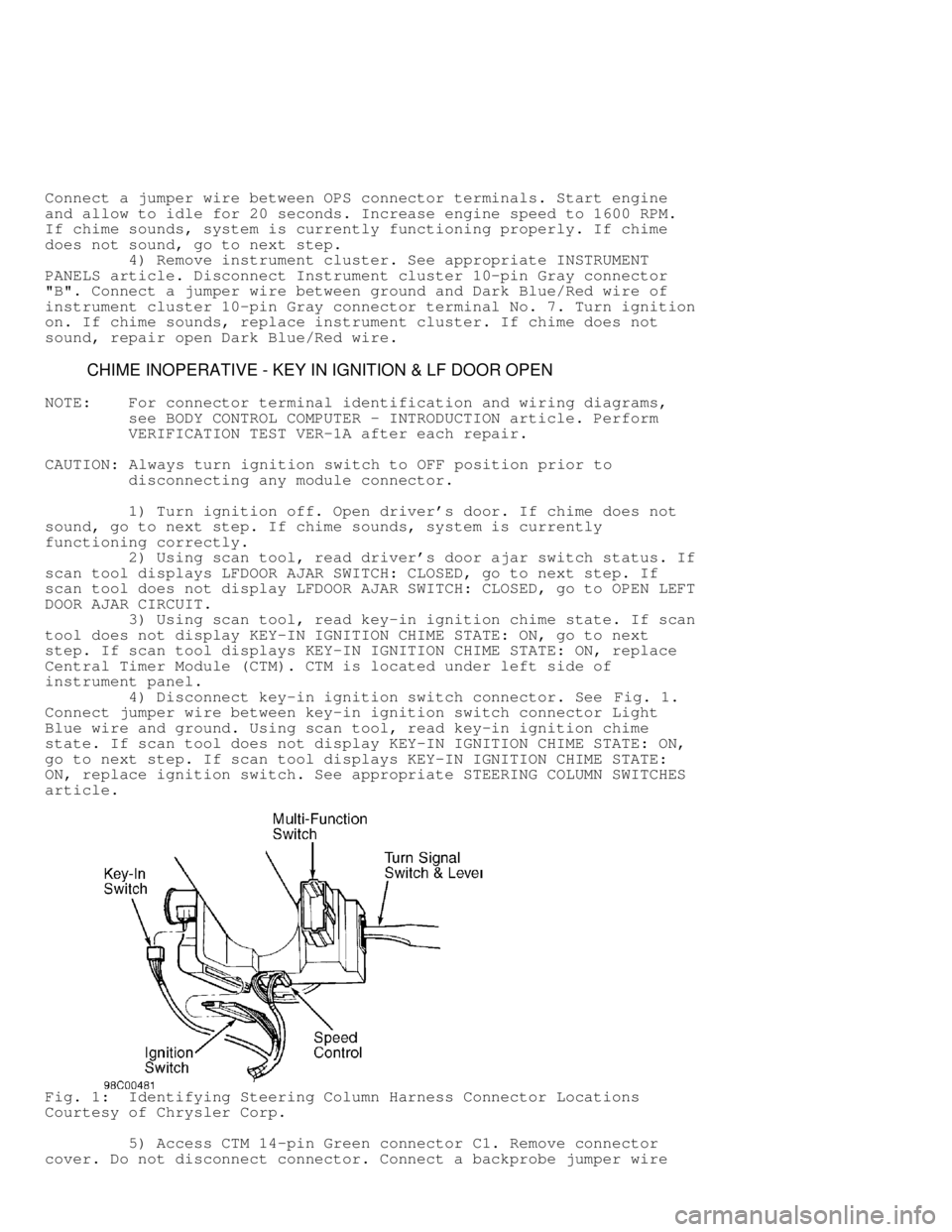
4) Disconnect key-in ignition switch connector. See Fig. 1.
Connect jumper wire between key-in ignition switch connector Light
Blue wire and ground. Using scan tool, read key-in ignition chime
state. If scan tool does not display KEY-IN IGNITION CHIME STATE: ON,
go to next step. If scan tool displays KEY-IN IGNITION CHIME STATE:
ON, replace ignition switch. See appropriate STEERING COLUMN SWITCHES
article.
Fig. 1: Identifying Steering Column Harness Connector Locations
Courtesy of Chrysler Corp.
5) Access CTM 14-pin Green connector C1. Remove connector
cover. Do not disconnect connector. Connect a backprobe jumper wire
Page 300 of 1691

between terminal No. 9 (Light Blue wire) and chassis ground. Using
scan tool, read key-in ignition switch status. If scan tool does not
display KEY-IN IGNITION CHIME STATE: ON, replace CTM. If scan tool
displays KEY-IN IGNITION CHIME STATE: ON, repair open Light Blue wire
between CTM and ignition switch.
CHIME INOPERATIVE AT ALL TIMES
NOTE: Perform VERIFICATION TEST VER-1A after each repair.
Turn ignition on. Using scan tool, select BODY SYSTEM, BODY
COMPUTER then ACTUATORS. Actuate chime. If chime sounds, system is
currently functioning correctly. If chime does not sound, replace
Central Timer Module (CTM). CTM is located under left side of
instrument panel.
CHIME INOPERATIVE WITH EXTERIOR LIGHTS ON
NOTE: For connector terminal identification and wiring diagrams,
see BODY CONTROL COMPUTER - INTRODUCTION article. Perform
VERIFICATION TEST VER-1A after each repair.
CAUTION: Always turn ignition switch to OFF position prior to
disconnecting any module connector.
1) Remove ignition key. Using scan tool, read key-in ignition
chime state. If scan tool does not display KEY-IN IGNITION CHIME
STATE:
OFF, go to step 4). If scan tool displays KEY-IN IGNITION CHIME STATE:
OFF, go to next step.
2) Open driver's door. Using scan tool, read door ajar
status. If scan tool displays LFDOOR AJAR SWITCH: CLOSED, go to next
step. If scan tool does not display LFDOOR AJAR SWITCH: CLOSED, go to
OPEN LEFT DOOR AJAR CIRCUIT.
3) Turn on headlights. If chime does not sound, repair open
headlight sense circuit (Light Blue wire) between CTM and headlight
switch. See appropriate wiring diagram in BODY CONTROL COMPUTER -
INTRODUCTION article. If chime sounds, system is currently functioning
correctly.
4) Open driver's door. Using scan tool, read door ajar
status. If scan tool displays LFDOOR AJAR SWITCH: CLOSED, go to next
step. If scan tool does not display LFDOOR AJAR SWITCH: CLOSED, go to
OPEN LEFT DOOR AJAR CIRCUIT.
5) Disconnect key-in ignition switch connector. See Fig. 1.
Using scan tool, read key-in ignition chime state. If scan tool
displays KEY-IN IGNITION CHIME STATE: ON, go to next step. If scan
tool does not display KEY-IN IGNITION CHIME STATE: ON, replace
ignition switch. See appropriate STEERING COLUMN SWITCHES article.
6) Turn ignition off. Disconnect Central Timer Module (CTM).\
CTM is located under left side of instrument panel. Remove ignition
key. Ensure all lights and accessories are off. Close all doors. Using
external ohmmeter, measure resistance between ground and terminal No.
9 (Light Blue wire) on CTM Green connector "A". If resistance is less
than 10 ohms, repair Light Blue wire between CTM and ignition switch
for short to ground. If resistance is 10 ohms or more, replace CTM.
CHIME INOPERATIVE WITH LOW OIL PRESSURE
NOTE: For connector terminal identification and wiring diagrams,
see BODY CONTROL COMPUTER - INTRODUCTION article. Perform
VERIFICATION TEST VER-1A after each repair.
CAUTION: Always turn ignition switch to OFF position prior to
Page 301 of 1691
 Disconnect Oil Pressure Switch (OPS). OPS is located near\
bottom of distributor. Connect a jumper wire between OPS connector
terminals. Start")
disconnecting any module connector.
1) Disconnect Oil Pressure Switch (OPS). OPS is located near\
bottom of distributor. Connect a jumper wire between OPS connector
terminals. Start engine and allow to idle for 20 seconds. Increase
engine speed to 1600 RPM. If chime sounds, go to next step. If chime
does not sound, go to step 3).
2) Turn ignition on. Using scan tool, actuate chime. If chime
does not sound, replace Central Timer Module (CTM). CTM is located
under left side of instrument panel. If chime sounds, system is
currently functioning properly.
3) Using scan tool, access CLUSTER MONITOR. With engine
running, read CCD oil pressure. If scan tool reading does not match
instrument cluster reading, replace instrument cluster. If scan tool
reading matches instrument cluster reading, go to next step.
4) Remove jumper wire. Connect a jumper wire between ground
and OPS connector Gray wire. Start engine and allow to idle for 20
seconds. Increase engine speed to 1600 RPM. If chime sounds, repair
open ground circuit between OPS connector and ground. If chime does
not sound, go to next step.
5) Turn ignition on. Using scan tool, actuate chime. If chime
does not sound, replace Central Timer Module (CTM). CTM is located
under left side of instrument panel. If chime sounds, go to next step.
6) Remove instrument cluster. See appropriate INSTRUMENT
PANELS article. Disconnect CTM 14-pin Green connector C1. Using an
external ohmmeter, measure resistance of Dark Blue/Red wire between
CTM 14-pin Green connector C1 terminal No. 2 and instrument cluster
10-pin connector C2 terminal No. 7. If resistance is less than 5 ohms,
replace CTM. If resistance is 5 ohms or more, repair open Dark
Blue/Red wire.
CHIME SOUNDS WITH DRIVER DOOR OPEN
NOTE: For connector terminal identification and wiring diagrams,
see BODY CONTROL COMPUTER - INTRODUCTION article. Perform
VERIFICATION TEST VER-1A after each repair.
CAUTION: Always turn ignition switch to OFF position prior to
disconnecting any module connector.
1) Ensure all interior and exterior lights are off. Remove
ignition key and open driver's door. If chime does not sound, system
is currently functioning correctly. If chime sounds, go to next step.
2) Using scan tool, read key-in ignition chime state. If scan
tool displays KEY-IN IGNITION CHIME STATE: "ON/OFF", go to next step.
If scan tool does not display KEY-IN IGNITION CHIME STATE: "ON/OFF",
replace Central Timer Module (CTM). CTM is located under left side of
instrument panel.
3) Disconnect key-in ignition switch connector. See Fig. 1.
Using scan tool, read key-in ignition chime state. If scan tool
displays KEY-IN IGNITION CHIME STATE: ON, go to next step. If scan
tool does not display KEY-IN IGNITION CHIME STATE: ON, replace
ignition switch. See appropriate STEERING COLUMN SWITCHES article.
4) Turn ignition off. Disconnect Central Timer Module (CTM).\
CTM is located under left side of instrument panel. Remove ignition
key. Ensure all lights and accessories are off. Close all doors. Using
external ohmmeter, measure resistance between ground and terminal No.
9 (Light Blue wire) on CTM Green connector "A". If resistance is less
than 10 ohms, repair Light Blue wire between CTM and ignition switch
for short to ground. If resistance is 10 ohms or more, replace CTM.
DOOR AJAR SYSTEM
Page 302 of 1691

OPEN LEFT DOOR AJAR CIRCUIT
NOTE: For connector terminal identification and wiring diagrams,
see BODY CONTROL COMPUTER - INTRODUCTION article. Perform
VERIFICATION TEST VER-1A after each repair.
CAUTION: Always turn ignition switch to OFF position prior to
disconnecting any module connector.
1) Remove driver's door panel. Disconnect driver's door ajar
switch and ensure connector is clean and not damaged. Connect a jumper
wire between left front door ajar switch connector Tan wire and
Black/Light Green wire. Using scan tool, read left front door ajar
switch status. If scan tool displays DRDOOR AJAR SW: CLOSED, replace
left front door ajar switch. If scan tool does not display DRDOOR AJAR
SW:
CLOSED, go to next step.
2) Disconnect jumper wire from Black/Light Green wire. Take
jumper wire end removed from Black/Light Green wire and connect to
ground. If scan tool displays DRDOOR AJAR SW: CLOSED, repair open
ground circuit (Black/Light Green wire). If scan tool does not display\
DRDOOR AJAR SW: CLOSED, go to next step.
3) Disconnect jumper wire. Locate Central Timer Module (CTM)\
.
CTM is located under left side of instrument panel. Access CTM 14-pin
Green connector C1. Remove connector cover. Do not disconnect
connector. Connect a backprobe jumper wire between chassis ground and
terminal No. 1 (Tan wire). Using scan tool, read left front door ajar
switch status. If scan tool displays DRDOOR AJAR SW: CLOSED, repair
open in Tan wire between left front door ajar switch and CTM. If scan
tool does not display DRDOOR AJAR SW: CLOSED, replace CTM.
OPEN RIGHT DOOR AJAR CIRCUIT
NOTE: For connector terminal identification and wiring diagrams,
see BODY CONTROL COMPUTER - INTRODUCTION article. Perform
VERIFICATION TEST VER-1A after each repair.
CAUTION: Always turn ignition switch to OFF position prior to
disconnecting any module connector.
1) Remove passenger's door panel. Disconnect right front door
ajar switch and ensure connector is clean and not damaged. Connect a
jumper wire between right front door ajar switch connector Black/Light
Blue wire and Black/Light Green wire. Using scan tool, read right
front door ajar switch status. If scan tool displays PASSDOOR AJAR SW:
CLOSED, replace right front door ajar switch. If scan tool does not
display PASSDOOR AJAR SW: CLOSED, go to next step.
2) Disconnect jumper from Black/Light Green wire. Take jumper
wire end removed from Black/Light Green wire and connect to ground. If
scan tool displays PASSDOOR AJAR SWITCH: CLOSED, repair open ground
circuit (Black/Light Green wire). If scan tool does not display
PASSDOOR AJAR SW: CLOSED, go to next step.
3) Disconnect jumper wire. Locate Central Timer Module (CTM)\
.
CTM is located under left side of instrument panel. Access CTM 14-pin
Green connector C1. Remove connector cover. Do not disconnect
connector. Connect a backprobe jumper wire between chassis ground and
terminal No. 5 (Black/Light Blue wire). If scan tool displays PASS
DOOR AJAR SW: CLOSED, repair open Black/Light Blue wire between CTM
and right front door ajar switch. If scan tool does not display PASS
DOOR AJAR SW: CLOSED, replace CTM.
SHORTED LEFT DOOR AJAR CIRCUIT
Page 303 of 1691

NOTE: For connector terminal identification and wiring diagrams,
see BODY CONTROL COMPUTER - INTRODUCTION article. Perform
VERIFICATION TEST VER-1A after each repair.
CAUTION: Always turn ignition switch to OFF position prior to
disconnecting any module connector.
1) Remove driver's door panel. Disconnect driver's door ajar
switch. Using scan tool, read left front door ajar switch status. If
scan tool displays DRDOOR AJAR SW: CLOSED, go to next step. If scan
tool does not display DRDOOR AJAR SW: CLOSED, replace left front door
ajar switch.
2) Disconnect Central Timer Module (CTM) 14-pin Green
connector C1. CTM is located under left side of instrument panel.
Using an external ohmmeter, measure resistance between ground and CTM
14-pin Green connector C1 terminal No. 1 (Tan wire). If resistance is
less than 5 ohms, repair short to ground in Tan wire between CTM 14-
pin connector C1 and left front door ajar switch. If resistance is 5
ohms or more, replace CTM.
SHORTED RIGHT DOOR AJAR CIRCUIT
NOTE: For connector terminal identification and wiring diagrams,
see BODY CONTROL COMPUTER - INTRODUCTION article. Perform
VERIFICATION TEST VER-1A after each repair.
CAUTION: Always turn ignition switch to OFF position prior to
disconnecting any module connector.
1) Ensure all doors are closed. Open right front door and
remove door panel. Disconnect right front door ajar switch. Using scan
tool, read right front door ajar switch status. If scan tool displays
PASSDOOR AJAR SW: CLOSED, go to next step. If scan tool does not
display PASSDOOR AJAR SW: CLOSED, replace right front door ajar
switch.
2) Disconnect Central Timer Module (CTM) 14-pin Green
connector C1. CTM is located under left side of instrument panel.
Using an external ohmmeter, measure resistance between ground and CTM
14-pin Green connector C1 terminal No. 5 (Black/Light Blue wire). If
resistance is less than 5 ohms, repair short to ground in Black/Light
Blue wire. If resistance is 5 ohms or more, replace CTM.
INSTRUMENT CLUSTER
ALL GAUGES DO NOT OPERATE
NOTE: For connector terminal identification and wiring diagrams,
see BODY CONTROL COMPUTER - INTRODUCTION article. Perform
VERIFICATION TEST VER-1A after each repair.
CAUTION: Always turn ignition switch to OFF position prior to
disconnecting or connecting any module connector.
1) Turn ignition on. Using scan tool, select ELECTRO/MECH
CLUSTER. If scan tool displays BUS OPERATIONAL, go to next step. If
scan tool does not display BUS OPERATIONAL, go to appropriate VEHICLE
COMMUNICATIONS article and follow appropriate symptom diagnostics.
2) If scan tool displays NO RESPONSE, go to appropriate
VEHICLE COMMUNICATIONS article. If scan tool does not display NO
RESPONSE, go to next step.
3) Using scan tool, select SYSTEM TEST. If scan tool displays