wheel DODGE RAM 1999 Service Repair Manual
[x] Cancel search | Manufacturer: DODGE, Model Year: 1999, Model line: RAM, Model: DODGE RAM 1999Pages: 1691, PDF Size: 40.34 MB
Page 1384 of 1691
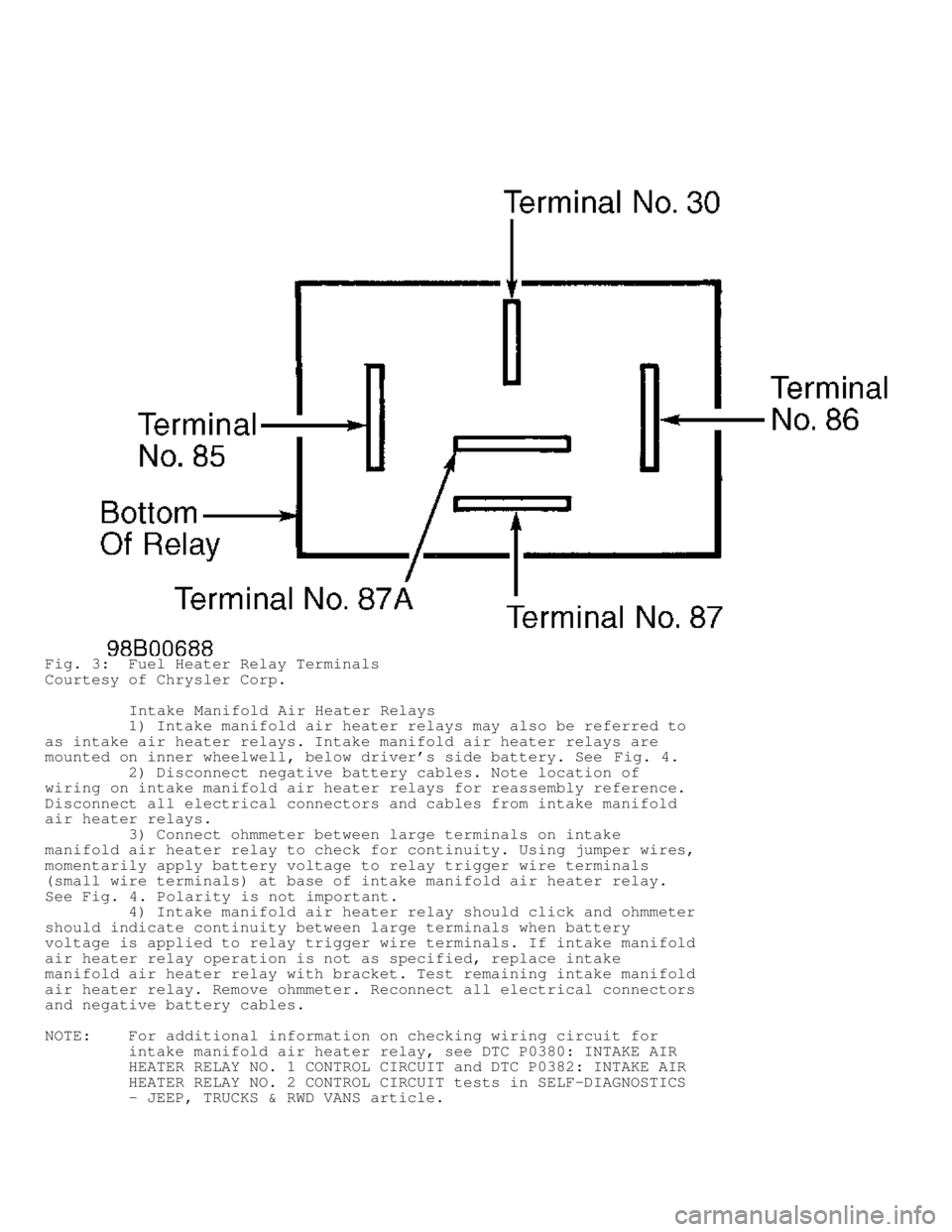
Fig. 3: Fuel Heater Relay Terminals
Courtesy of Chrysler Corp.
Intake Manifold Air Heater Relays
1) Intake manifold air heater relays may also be referred to
as intake air heater relays. Intake manifold air heater relays are
mounted on inner wheelwell, below driver's side battery. See Fig. 4.
2) Disconnect negative battery cables. Note location of
wiring on intake manifold air heater relays for reassembly reference.
Disconnect all electrical connectors and cables from intake manifold
air heater relays.
3) Connect ohmmeter between large terminals on intake
manifold air heater relay to check for continuity. Using jumper wires,
momentarily apply battery voltage to relay trigger wire terminals
(small wire terminals) at base of intake manifold air heater relay.
See Fig. 4 . Polarity is not important.
4) Intake manifold air heater relay should click and ohmmeter
should indicate continuity between large terminals when battery
voltage is applied to relay trigger wire terminals. If intake manifold
air heater relay operation is not as specified, replace intake
manifold air heater relay with bracket. Test remaining intake manifold
air heater relay. Remove ohmmeter. Reconnect all electrical connectors
and negative battery cables.
NOTE: For additional information on checking wiring circuit for
intake manifold air heater relay, see DTC P0380: INTAKE AIR
HEATER RELAY NO. 1 CONTROL CIRCUIT and DTC P0382: INTAKE AIR
HEATER RELAY NO. 2 CONTROL CIRCUIT tests in SELF-DIAGNOSTICS
- JEEP, TRUCKS & RWD VANS article.
Page 1460 of 1691
NOTE: Turbocharger is not serviceable and must be replaced as a
complete assembly. Turbocharger overhaul procedures should
only be performed by an authorized facility.
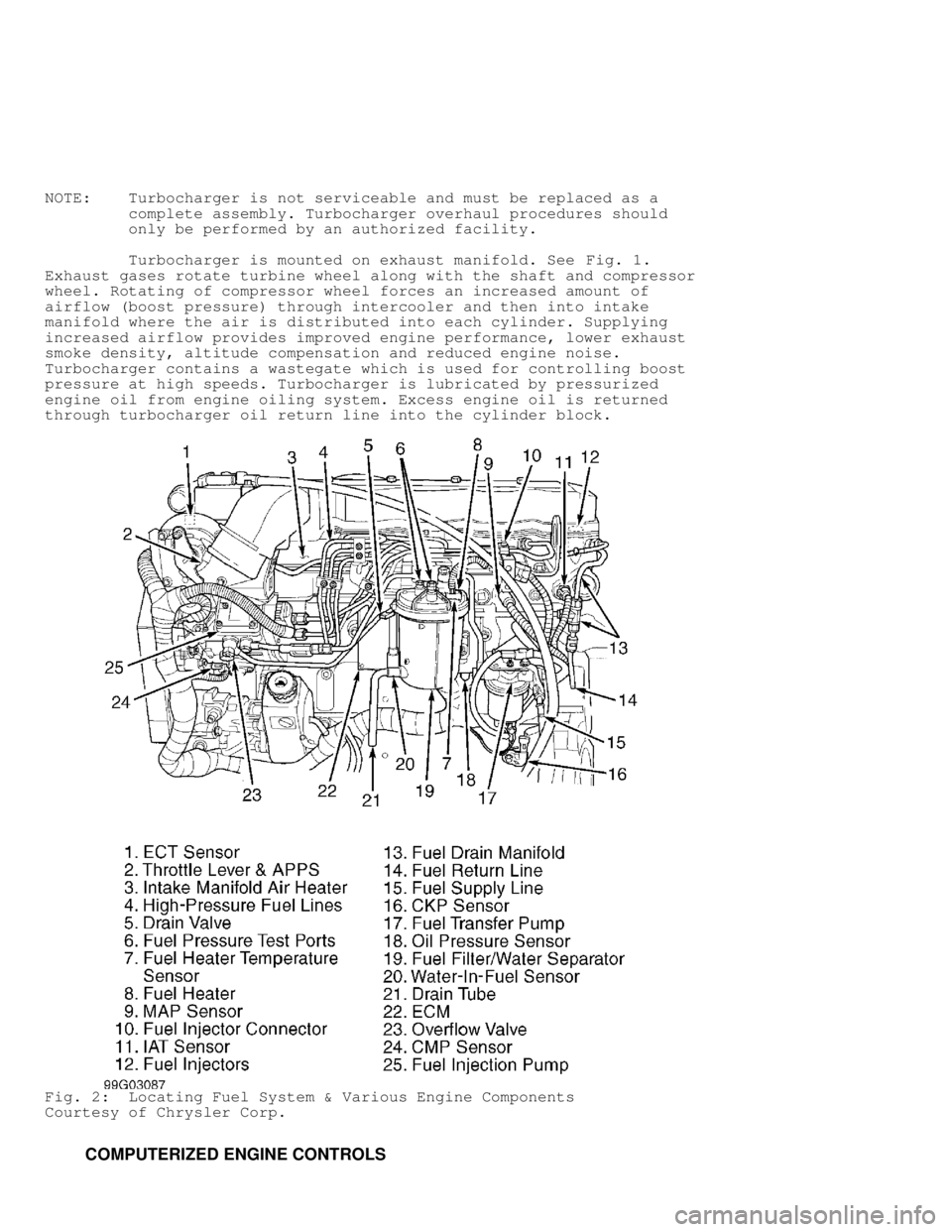
Turbocharger is mounted on exhaust manifold. See Fig. 1.
Exhaust gases rotate turbine wheel along with the shaft and compressor
wheel. Rotating of compressor wheel forces an increased amount of
airflow (boost pressure) through intercooler and then into intake
manifold where the air is distributed into each cylinder. Supplying
increased airflow provides improved engine performance, lower exhaust
smoke density, altitude compensation and reduced engine noise.
Turbocharger contains a wastegate which is used for controlling boost
pressure at high speeds. Turbocharger is lubricated by pressurized
engine oil from engine oiling system. Excess engine oil is returned
through turbocharger oil return line into the cylinder block.
Fig. 2: Locating Fuel System & Various Engine Components
Courtesy of Chrysler Corp.
COMPUTERIZED ENGINE CONTROLS
Page 1462 of 1691

* Charging System
* Cruise Control System
* Intake Manifold Air Heater
* Tachometer
* Torque Convertor Clutch Engagement (A/T Only)
* Transmission Overdrive Solenoid (A/T Only) Components are
grouped into 2 categories. The first category covers INPUT
DEVICES, which control or produce voltage signals monitored
by the PCM. The second category covers OUTPUT SIGNALS, which
are components controlled by the PCM. See PCM INPUT SIGNALS
and ECM/PCM OUTPUT SIGNALS.
ECM INPUT SIGNALS
Accelerator Pedal Position Sensor (APPS)
APPS sensor is mounted on top left of engine. See Fig. 2.
Sensor provides DC voltage input signal to Engine Control Module (ECM)\
to indicate throttle position. On previous engines, there were
linkages between accelerator pedal, throttle position sensor and
injection pump. On this engine, no linkage exists between accelerator
pedal and injection pump. ECM uses input signals from APPS sensor to
determine proper fuel delivery. ECM also outputs this signal to PCM.
Battery Voltage
Battery voltage input signal provides operating voltage to
Engine Control Module (ECM). This input signal keeps ECM memory alive
and informs ECM what generator output voltage is when engine is
running. ECM memory is used to store Diagnostic Trouble Codes (DTCs),
store APPS sensor voltages from previous key cycles and provide a
speed control adaptive memory.
Camshaft Position Sensor (CMP)
Camshaft Position (CMP) sensor is a hall effect sensor (0-5
volts switched), located below injection pump in rear face of timing
gear cover. Sensor is not used for fuel control. Sensor is used only
for diagnostic purposes.
CCD Bus Circuits
These circuits are connected between Engine Control Module
(ECM) and Powertrain Control Module (PCM) to allow communication
between modules.
Crankshaft Position Sensor (CKP)
Crankshaft Position (CKP) sensor delivers input signal (35
tooth wheel with gap) to Engine Control Module (ECM) to indicate
engine speed and crankshaft position. ECM uses CKP signal along with
other input signals for controlling injector firing sequence and
timing. Sensor is located below fuel transfer pump, on side of engine
block. See Fig. 2.
Data Link Connector (DLC)
Data Link Connector (DLC) provides an input signal to Engine
Control Module (ECM) when using scan tool to retrieve Diagnostic
Trouble Codes (DTCs) from ECM. Input signal may also be used when
performing various tests on the ECM and electronic control system.
Data link connector is a 16-pin connector located at lower edge of
driver's side of instrument panel, just above accelerator pedal.
Engine Coolant Temperature (ECT) Sensor
Engine coolant temperature sensor delivers input signal to
Engine Control Module (ECM) to indicate engine coolant temperature.
ECM uses input signal for controlling fuel control and timing. Engine
coolant temperature sensor is located on front of head, near
Page 1465 of 1691

located in power distribution center at driver's side front corner of
engine compartment, near the battery. Automatic Shutdown (ASD) relay
may also be referred to as Auto Shutdown (ASD) relay.
Battery Temperature Sensor
Battery temperature sensor delivers input signal to
Powertrain Control Module (PCM) to indicate the battery temperature.
PCM uses battery temperature input to modify rate of output from the
charging system. Battery temperature sensor is snapped into battery
tray below driver's side battery.
Battery Voltage
Battery voltage input signal provides operating voltage to
Powertrain Control Module (PCM). This input signal keeps PCM memory
alive and informs PCM what generator output voltage is when engine is
running. PCM memory is used to store Diagnostic Trouble Codes (DTCs),
store APPS sensor voltages from previous key cycles and provide a
speed control adaptive memory.
Brake Switch
Brake switch delivers input signal to Powertrain Control
Module (PCM) to indicate when brakes are applied. PCM uses input
signal for controlling cruise control system and transmission torque
converter clutch operation on A/T models. Brake switch is located near
top of brake pedal and may also be referred to as brakelight switch.
CKP Sensor
Crankshaft Position (CKP) sensor delivers input signal (35
tooth wheel with gap) to Engine Control Module (ECM) to indicate
engine speed and crankshaft position. ECM uses CKP signal along with
other input signals for controlling injector firing sequence and
timing. Sensor is located below fuel transfer pump, on side of engine
block. See Fig. 2.
Cruise Control System Switches
Cruise control system functions, controlled by momentary
contact switches, are monitored through multiplexed input signal to
Powertrain Control Module (PCM). Resistance monitored at this input
signal, in conjunction with the length of time the PCM measures the
resistance, determines which switch feature has been selected.
Data Link Connector (DLC)
Data Link Connector (DLC) provides an input signal to
Powertrain Control Module (PCM) when using scan tool to retrieve
Diagnostic Trouble Codes (DTCs) from PCM. Input signal may also be
used when performing various tests on the PCM and electronic control
system. DLC is a 16-pin connector located at lower edge of driver's
side of instrument panel, just above accelerator pedal.
Fuel Level Sensor
The Powertrain Control Module (PCM) sends a 5-volt signal to
the fuel level sensor. The fuel level sensor will return a signal to
PCM. This signal is used for fuel gauge operation and to prevent
setting a false misfire or fuel system trouble codes. If fuel level is
less than 15 percent, PCM will not set code.
Ignition Sense
Ignition switch position input to Powertrain Control Module
(PCM). PCM uses input to determine proper output functions, including
cruise control, generator output, sensor supply and transmission
functions.
Transmission Speed Sensor (A/T Models)
Page 1466 of 1691

Transmission speed sensor may also be referred to as
transmission output shaft speed sensor. Transmission speed sensor is
located on overdrive case at rear of transmission. Transmission speed
sensor delivers input signal to Powertrain Control Module (PCM) to
indicate transmission output shaft speed.
Overdrive Switch (A/T Models)
Transmission overdrive switch may be referred to as
overdrive/override switch, OD switch or overdrive off switch.
Transmission overdrive switch is located on end of gearshift lever.
When vehicle operator depresses transmission overdrive switch, an
input signal is delivered to the Powertrain Control Module (PCM). The
PCM uses input signal for controlling transmission overdrive shifts by
use of transmission overdrive solenoid on transmission valve body.
Transmission overdrive switch is normally in the ON position, allowing
transmission overdrive operation. If transmission overdrive switch is
depressed once, switch is in OFF position, allowing no transmission
overdrive upshift. If transmission overdrive switch is depressed
again, switch returns to the ON position, allowing transmission
overdrive operation.
Park/Neutral Switch (A/T Models)
Park/neutral switch delivers input signal to Powertrain
Control Module (PCM) to indicate if transmission is in Park, Neutral
or Drive. PCM uses input signal for controlling cruise control system,
transmission torque converter clutch operation and transmission
overdrive solenoid. When park/neutral switch is in Park or Neutral,
switch also provides a ground circuit for the engine starting system.
Park/neutral switch is located on the driver's side of transmission,
near shift linkage.
Transmission Governor Pressure Sensor (A/T Models)
Transmission governor pressure sensor delivers input signal
to Powertrain Control Module (PCM) to indicate transmission governor
pressure. PCM uses input signal for controlling governor pressure by
use of governor pressure solenoid on transmission valve body.
Transmission Temperature Sensor (A/T Models)
Transmission temperature sensor monitors transmission fluid
temperature and delivers input signal to Powertrain Control Module
(PCM). PCM uses input signal for controlling transmission torque
converter clutch operation, transmission overdrive shifts and governor
pressure. Transmission temperature sensor is located on transmission
valve body, incorporated into governor pressure sensor.
PCM prevents torque converter clutch engagement and
transmission overdrive operation when transmission fluid temperature
is less than 50
F (10C). If transmission fluid temperature is more
than 260F (126C), PCM forces a 4-3 downshift and engages torque
converter clutch until transmission fluid cools down. Once
transmission fluid cools to less than 230
F (110C), PCM allows a 3-4
shift again.
Vehicle Speed & Distance
Vehicle speed sensor is no longer used. The vehicle speed and
distance traveled are determined by rear wheel speed sensor. Rear
wheel speed sensor is mounted on top of rear axle housing, above the
ring gear. Rear wheel speed sensor delivers an input signal to
Controller Anti-Lock Brake (CAB) to indicate vehicle speed and
distance traveled. The CAB then delivers input signal to Powertrain
Control Module (PCM) to indicate vehicle speed and distance traveled.
PCM uses input signal for controlling control cruise control system
and fuel system. The CAB is mounted on top of the hydraulic control
unit. Hydraulic control unit contains the pump assembly that
Page 1467 of 1691

brakelines are attached to and is mounted in the engine compartment.
ECM OUTPUT SIGNALS
APPS & CKP Output To PCM
See ACCELERATOR PEDAL POSITION SENSOR (APPS) OUTPUT FROM ECM
under PCM INPUT SIGNALS.
CCD Bus
These circuits are connected between Engine Control Module
(ECM) and Powertrain Control Module (PCM) to allow communication
between modules.
DLC Output
Data Link Connector (DLC) is connected to Engine Control
Module (ECM). Using a scan tool, data can be retrieved (output) from\
ECM.
5-Volt Sensor Supply Output
Engine Control Module (ECM) supplies a 5-volt reference
signal to the following sensors:
* Crankshaft Position (CKP) Sensor
* Camshaft Position (CMP) Sensor
* Intake Air Temperature (IAT) Sensor
* Engine Oil Pressure Sensor
* Manifold Absolute Pressure (MAP) Sensor
Engine Control Module (ECM) also supplies voltage to the
following sensors:
* Accelerator Pedal Position Sensor (APPS)
* Intake Air Temperature (IAT) Sensor
* Engine Oil Pressure Sensor
* Engine Coolant Temperature (ECT) Sensor
* Manifold Absolute Pressure (MAP) Sensor
* Water-In-Fuel (WIF) Sensor
Fuel Injection Pump Relay
The Engine Control Module (ECM) energizes the fuel injection
pump and integral Fuel Pump Control Module (FPCM) through the relay.
When ignition is turned on, ECM supplies 12 volts to fuel injection
pump relay, located in Power Distribution Center.
Fuel Pump Control Module (FPCM)
Fuel Pump Control Module (FPCM) controls fuel pump using
inputs from Engine Control Module (ECM). FPCM is integral to top of
fuel pump. ECM and FPCM are interconnected together for fuel injection
control.
Fuel Transfer Pump
Engine Control Module (ECM) supplies power to fuel transfer
pump. Transfer fuel pump supplies fuel under low pressure (14 psi)
while engine is running to fuel injection pump. Fuel transfer pump
supplies an excess of fuel to cool fuel injection pump. Excess fuel is
returned to fuel tank by fuel injection pump.
Intake Manifold Air Heater Relays
Intake manifold air heater relays provide voltage to intake
manifold air heater for warming of intake. See Fig. 5. Warming of
intake air aids in engine starting and improved driveability during
cold ambient temperatures. Intake manifold air heater relays are
mounted on inner wheelwell, below driver's side battery. See Fig. 6.
Page 1473 of 1691

Module (FPCM). Because of electronic control, pump timing is not
adjustable. See ON-VEHICLE ADJUSTMENTS - TRUCKS - DIESEL article.
FUEL FILTER/WATER SEPARATOR
Fuel filter/water separator is located on left side of engine
and contains fuel heater, Water-In-Fuel (WIF) sensor and drain valve.
See Fig. 2 . The WIF sensor delivers an input signal to Engine Control
Module (ECM) when water exists in fuel filter/water separator. ECM
will then turn on WATER-IN-FUEL warning light. WATER-IN-FUEL warning
light is located on instrument panel, just below tachometer. The
WATER-IN-FUEL warning light informs the operator to drain water from
fuel filter/water separator to prevent damage to fuel system
components. Water may be drained from fuel filter/water separator by
using drain valve on fuel filter/water separator.
FUEL HEATER
Fuel heater is used to prevent diesel fuel from waxing during
cold temperatures. Fuel heater is located in fuel filter/water
separator. See Fig. 2. Fuel flows from fuel tank to fuel transfer pump
and then to fuel filter/water separator. Fuel heater contains a fuel
heater temperature sensor that senses the fuel temperature. When
temperature is less than 37-53
F (3-12C), fuel heater temperature
sensor allows current to flow to the fuel heater to warm the fuel.
When temperature is more than 67-83
F (19-28C), fuel heater
temperature sensor turns off the current flow to the fuel heater.
Voltage to operate fuel heater is provided from ignition switch,
through fuel heater relay and to fuel heater. Fuel heater and fuel
heater relay are not controlled by Engine Control Module (ECM).
EMISSION SYSTEMS
INTAKE MANIFOLD AIR HEATER SYSTEM
Intake manifold air heater is used to warm intake air during
cold starting conditions. Heater system consists of 2 relays and 2
grid heaters installed on top of intake manifold. See Fig. 5.
Engine Control Module (ECM) energizes intake manifold air
heater relays to provide voltage to intake manifold air heater before
and after starting depending on input signals from intake manifold air
temperature sensor, engine speed sensor and vehicle speed. Intake
manifold air heater relays are not energized when intake manifold air
temperature is greater than 59
F (15C) or during engine cranking.
Intake manifold air heater relays are mounted on left inner wheelwell,
below left side battery. See Fig. 6.
Intake manifold air temperature sensor monitors intake
manifold air temperature and delivers an input signal to ECM for
controlling intake manifold air heater. Intake manifold air
temperature sensor is located in intake manifold. See Figs. 2 and 4.
SELF-DIAGNOSTIC SYSTEM
DATA LINK CONNECTOR
The Data Link Connector (DLC) is a 16-pin connector located
at lower edge of driver's side of instrument panel, just above the
accelerator pedal. The Engine Control Module (ECM) contains a self-
diagnostic system which stores a Diagnostic Trouble Code (FTC) if an
incorrect signal or no signal is received from certain sensors or
components. FTC may be retrieved from ECM for system diagnosis by
Page 1476 of 1691
(IAC) motor.
Battery Temperature Sensor
PCM uses sensor to determine battery temperature and to
control battery charging rate. Temperature data along with battery
voltage data, is used by PCM to vary charging rate. System voltage is
higher at colder temperatures and is gradually reduced at warmer
temperatures.
Battery Voltage
PCM monitors battery voltage to determine fuel injector pulse
width and generator field control. This is done to compensate for
reduced current flow through injector caused by lowered voltage.
Brake Switch
This switch may also be referred to as a brakelight switch.
PCM uses this switch input to maintain idle speed at a preprogrammed
RPM when brakes are applied. If PCM receives an input signal from
brake switch when speed control system is on, PCM will turn speed
control system off.
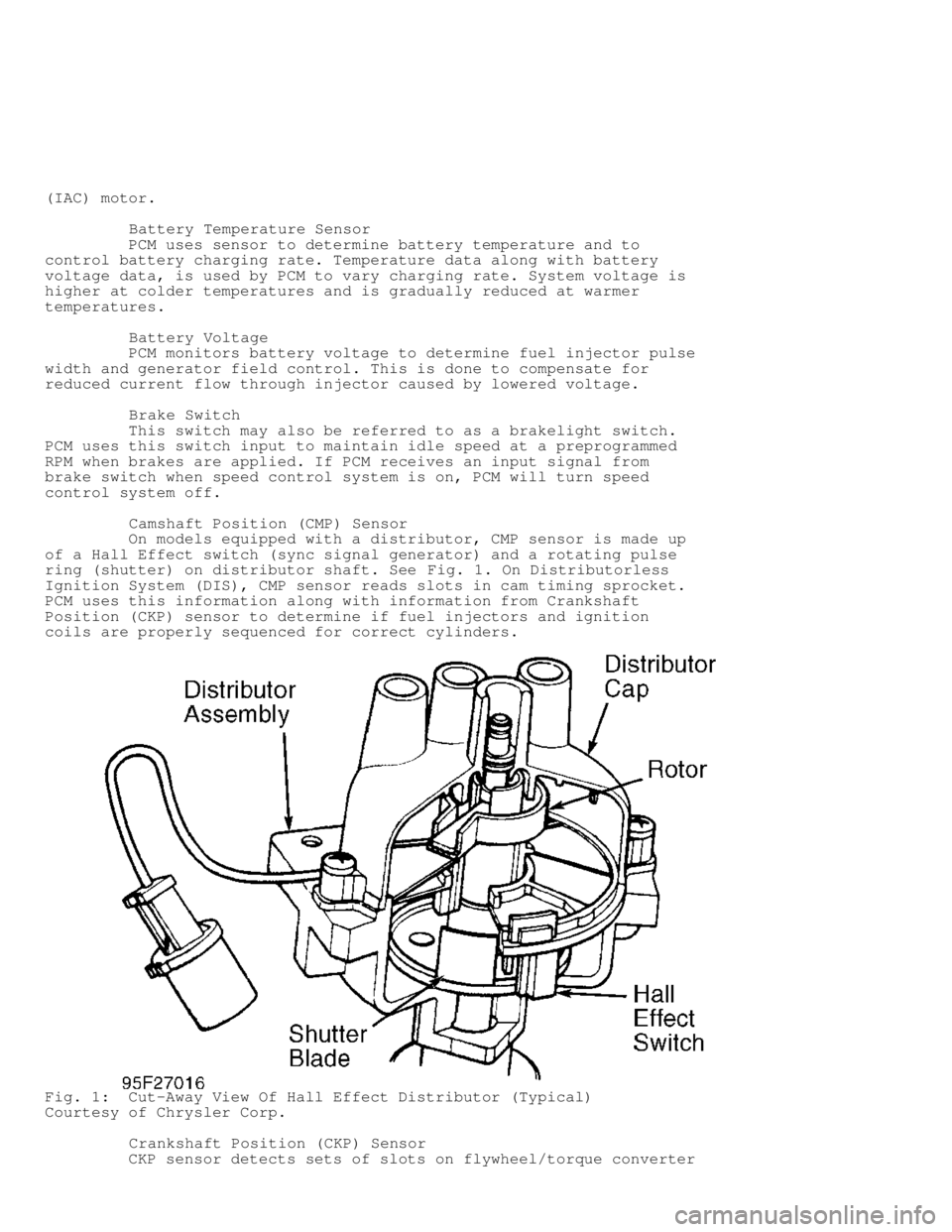
Camshaft Position (CMP) Sensor
On models equipped with a distributor, CMP sensor is made up
of a Hall Effect switch (sync signal generator) and a rotating pulse
ring (shutter) on distributor shaft. See Fig. 1. On Distributorless
Ignition System (DIS), CMP sensor reads slots in cam timing sprocket.
PCM uses this information along with information from Crankshaft
Position (CKP) sensor to determine if fuel injectors and ignition
coils are properly sequenced for correct cylinders.
Fig. 1: Cut-Away View Of Hall Effect Distributor (Typical)
Courtesy of Chrysler Corp.
Crankshaft Position (CKP) Sensor
CKP sensor detects sets of slots on flywheel/torque converter
Page 1487 of 1691

PCM controls operation of electric cooling fan. PCM operates fan
through radiator fan relay by grounding or ungrounding relay control
circuit. PCM regulates engine idle speed through IAC motor when fan is
on.
SHIFT INDICATOR LIGHT
PCM provides ground for shift indicator light on models
equipped with manual transmission. Based on engine speed, throttle
position, and vehicle speed, PCM turns shift indicator light on to
advise driver to shift to a higher gear for optimum fuel economy.
SPEED CONTROL SERVO
System is electrically actuated and vacuum operated. Controls
are located on steering wheel. Controls consist of 3 buttons: OFF/ON,
RESUME/ACCEL and SET/DECEL. Speed control servo is controlled by PCM.
System will operate at 35-85 MPH.
TACHOMETER
PCM provides signal to drive tachometer.
TORQUE CONVERTER CLUTCH (TCC) SOLENOID
PCM controls torque converter lock-up through TCC solenoid.
PCM controls lock-up according to various operating conditions.
TRANSMISSION GOVERNOR SOLENOID
PCM controls solenoid to regulate line pressure for shift
control.
TRANSMISSION OVERDRIVE/OVERRIDE (OD/OR) SWITCH INDICATOR
LIGHT
PCM controls indicator light on OD/OR switch on models
equipped with overdrive automatic transmission.
TRANSMISSION OVERDRIVE (OD) SOLENOID
On models equipped with OD transmission, PCM controls 3-4 OD
upshift and downshift through OD solenoid. PCM determines optimum OD
shift scheduling for all operating conditions.
Page 1504 of 1691
simultaneously when throttle is depressed. If both levers to do not
move simultaneously, readjust throttle valve cable.
TRANSFER CASE SHIFT LINKAGE
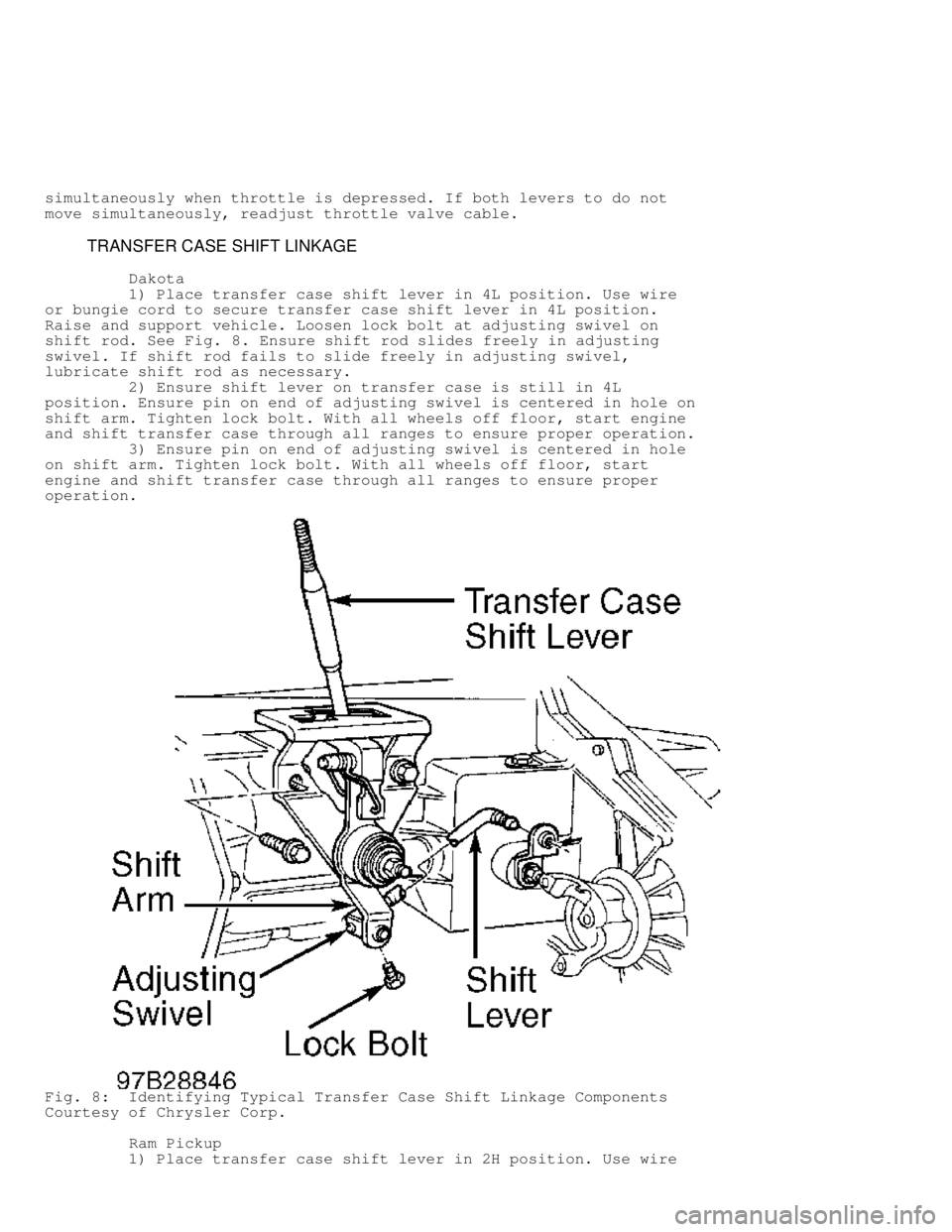
Dakota
1) Place transfer case shift lever in 4L position. Use wire
or bungie cord to secure transfer case shift lever in 4L position.
Raise and support vehicle. Loosen lock bolt at adjusting swivel on
shift rod. See Fig. 8. Ensure shift rod slides freely in adjusting
swivel. If shift rod fails to slide freely in adjusting swivel,
lubricate shift rod as necessary.
2) Ensure shift lever on transfer case is still in 4L
position. Ensure pin on end of adjusting swivel is centered in hole on
shift arm. Tighten lock bolt. With all wheels off floor, start engine
and shift transfer case through all ranges to ensure proper operation.
3) Ensure pin on end of adjusting swivel is centered in hole
on shift arm. Tighten lock bolt. With all wheels off floor, start
engine and shift transfer case through all ranges to ensure proper
operation.
Fig. 8: Identifying Typical Transfer Case Shift Linkage Components
Courtesy of Chrysler Corp.
Ram Pickup
1) Place transfer case shift lever in 2H position. Use wire