Fuel lines DODGE RAM 1999 Service Owner's Manual
[x] Cancel search | Manufacturer: DODGE, Model Year: 1999, Model line: RAM, Model: DODGE RAM 1999Pages: 1691, PDF Size: 40.34 MB
Page 931 of 1691

2) Disconnect drain tube from drain valve. Disconnect
electrical connector for Water-In-Fuel (WIF) sensor at bottom of fuel
filter/water separator. See Fig. 3.
3) Support canister for fuel filter/water separator and
remove canister nut from top of filter mounting head. See Fig. 3.
Remove canister with fuel filter/water separator and seal ring from
filter mounting head. Remove fuel filter/water separator from
canister.
4) Remove "O" ring from top of shaft inside the canister.
Remove bolts and drain valve from canister (if necessary).
5) Check the 2 probes inside the canister on end of WIF
sensor for contamination. Clean probes if contaminated. If
contamination cannot be removed from the probes, replace WIF sensor.
If replacing WIF sensor, remove WIF sensor and "O" ring from canister.
6) Fuel heater is located inside fuel filter housing. Heater
mounting plate, heating element, temperature sensor, and wiring
harness are serviced as an assembly. Disconnect heater electrical
connector from engine wiring harness near upper rear part of filter.
7) Disconnect electrical connector at end of 2-wire harness
before attempting to pass harness through filter header. Remove clip
retaining wires to connector. Remove wires from connector. Remove 3
fuel heater screws. Press on heater sealing grommet to remove heater
from filter canister header. Pass wire through hole in filter header.
Remove fuel heater.
Installation
1) Ensure inside of canister is clean. Using NEW "O" ring,
install WIF sensor on canister (if removed). Tighten WIF sensor to
specification. See TORQUE SPECIFICATIONS.
2) Install drain valve on canister (if removed). Tighten
drain valve-to-canister bolts to specification. See TORQUE
SPECIFICATIONS.
3) Install NEW "O" ring on shaft inside canister. Coat "O"
ring with diesel fuel. Install NEW fuel filter/water separator and NEW
seal ring in canister. Coat seal ring with diesel fuel.
NOTE: Canister for fuel filter/water separator should be filled
with diesel fuel before installing. If canister cannot be
filled with diesel fuel, low-pressure fuel lines must be bled
after installation.
CAUTION: When installing canister on filter mounting head, ensure tab
areas on outside of canister align with tabs on filter
mounting head. This must be done to prevent damage to
canister and filter mounting head.
4) Fill canister for fuel filter/water separator with diesel
fuel. Install canister with fuel filter/water separator on filter
mounting head. Ensure canister fully engages with filter mounting head
and tab areas on outside of canister align with tabs on filter
mounting head.
5) Install and tighten canister nut to specification. See
TORQUE SPECIFICATIONS.
6) To install remaining components, reverse removal
procedure. If canister was not filled with diesel fuel, bleed low-
pressure fuel lines before starting engine. See FUEL LINE BLEEDING
under FUEL SYSTEM. Start engine and check for fuel leaks.
FUEL TANK MODULE & IN-TANK FUEL FILTER
NOTE: In-tank fuel filter is located on bottom of fuel tank module
which also contains the fuel gauge sending unit. Fuel tank
module is mounted on top of fuel tank.
Page 932 of 1691
Removal
1) Raise and support vehicle. Disconnect negative battery
cables. Drain fuel tank. Remove fuel tank filler tube bolts from body.
Support fuel tank with transmission jack. Remove fuel tank straps and
heat shields (if equipped).
2) Slightly lower fuel tank for access to fuel lines and
electrical connector at fuel tank module. Disconnect electrical
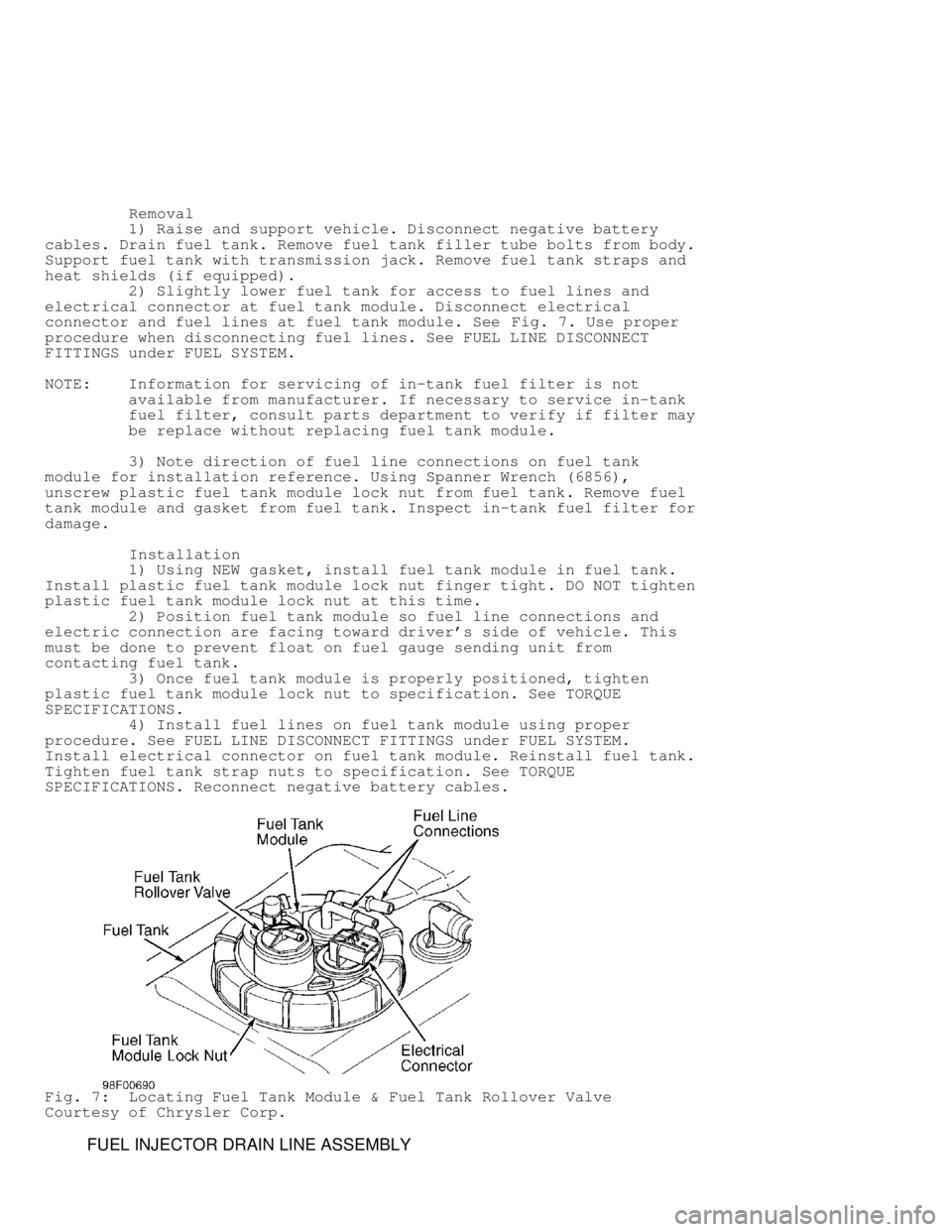
connector and fuel lines at fuel tank module. See Fig. 7. Use proper
procedure when disconnecting fuel lines. See FUEL LINE DISCONNECT
FITTINGS under FUEL SYSTEM.
NOTE: Information for servicing of in-tank fuel filter is not
available from manufacturer. If necessary to service in-tank
fuel filter, consult parts department to verify if filter may
be replace without replacing fuel tank module.
3) Note direction of fuel line connections on fuel tank
module for installation reference. Using Spanner Wrench (6856),
unscrew plastic fuel tank module lock nut from fuel tank. Remove fuel
tank module and gasket from fuel tank. Inspect in-tank fuel filter for
damage.
Installation
1) Using NEW gasket, install fuel tank module in fuel tank.
Install plastic fuel tank module lock nut finger tight. DO NOT tighten
plastic fuel tank module lock nut at this time.
2) Position fuel tank module so fuel line connections and
electric connection are facing toward driver's side of vehicle. This
must be done to prevent float on fuel gauge sending unit from
contacting fuel tank.
3) Once fuel tank module is properly positioned, tighten
plastic fuel tank module lock nut to specification. See TORQUE
SPECIFICATIONS.
4) Install fuel lines on fuel tank module using proper
procedure. See FUEL LINE DISCONNECT FITTINGS under FUEL SYSTEM.
Install electrical connector on fuel tank module. Reinstall fuel tank.
Tighten fuel tank strap nuts to specification. See TORQUE
SPECIFICATIONS. Reconnect negative battery cables.
Fig. 7: Locating Fuel Tank Module & Fuel Tank Rollover Valve
Courtesy of Chrysler Corp.
FUEL INJECTOR DRAIN LINE ASSEMBLY
Page 933 of 1691
Removal
1) Remove nameplate located above rocker lever covers. Remove
fuel injector drain line-to-fuel injector banjo bolt and seal washer
from each fuel injector. Plug all fuel openings.
2) Remove fuel injector drain line assembly retaining clamp
at rear of intake manifold. Remove fuel injector drain line bolt with
seal washers at filter mounting head. See Fig. 3. Remove fuel injector
drain line assembly.
Installation
To install, reverse removal procedure using NEW seal washers.
Tighten bolts to specification. See TORQUE SPECIFICATIONS.
FUEL HEATER
Removal & Installation
Fuel heater is located in FUEL FILTER/WATER SEPARATOR &
WATER-IN-FUEL SENSOR. See FUEL FILTER/WATER SEPARATOR & WATER-IN-FUEL
SENSOR.
FUEL INJECTOR
Removal
1) Disconnect negative battery cables. Each fuel injector is
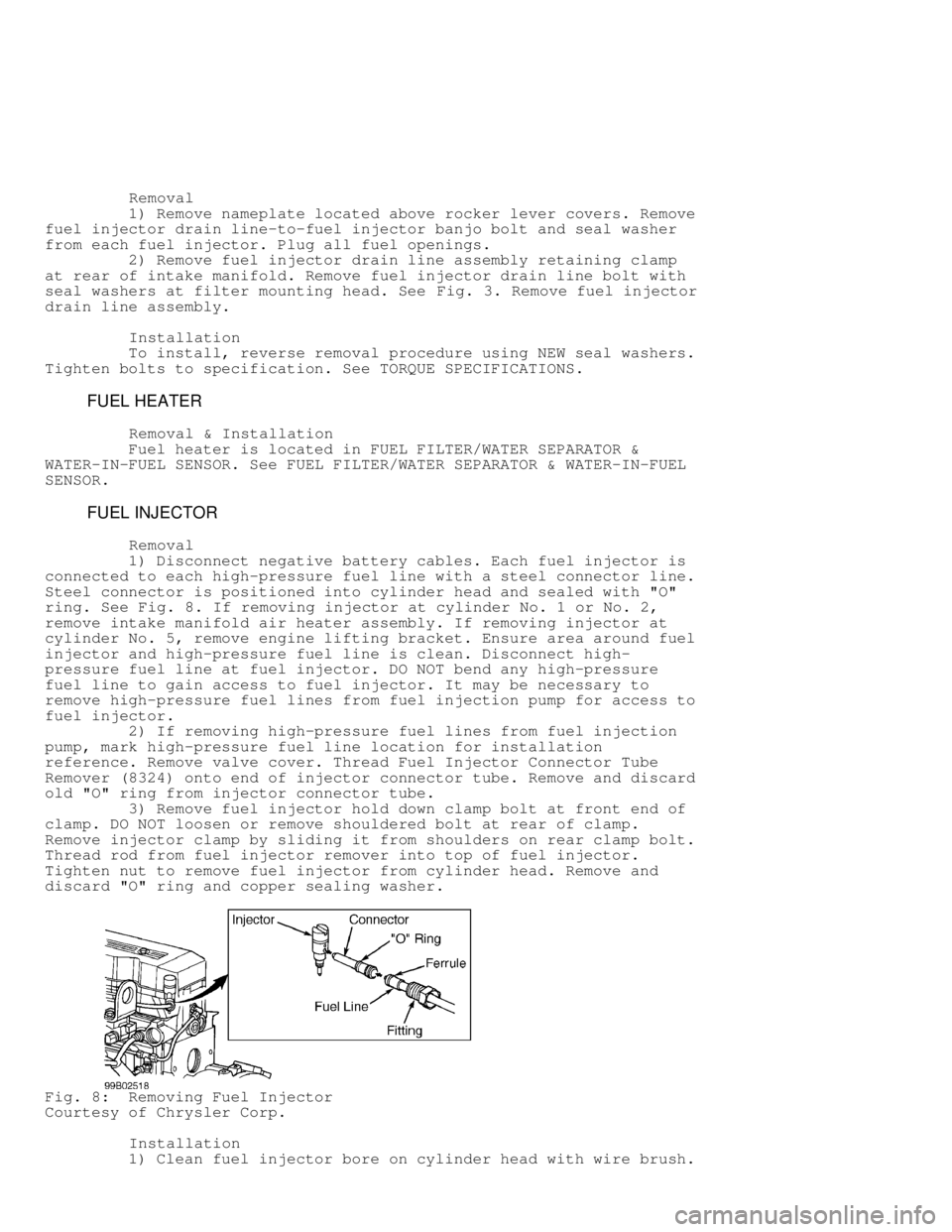
connected to each high-pressure fuel line with a steel connector line.
Steel connector is positioned into cylinder head and sealed with "O"
ring. See Fig. 8. If removing injector at cylinder No. 1 or No. 2,
remove intake manifold air heater assembly. If removing injector at
cylinder No. 5, remove engine lifting bracket. Ensure area around fuel
injector and high-pressure fuel line is clean. Disconnect high-
pressure fuel line at fuel injector. DO NOT bend any high-pressure
fuel line to gain access to fuel injector. It may be necessary to
remove high-pressure fuel lines from fuel injection pump for access to
fuel injector.
2) If removing high-pressure fuel lines from fuel injection
pump, mark high-pressure fuel line location for installation
reference. Remove valve cover. Thread Fuel Injector Connector Tube
Remover (8324) onto end of injector connector tube. Remove and discard\
old "O" ring from injector connector tube.
3) Remove fuel injector hold down clamp bolt at front end of
clamp. DO NOT loosen or remove shouldered bolt at rear of clamp.
Remove injector clamp by sliding it from shoulders on rear clamp bolt.
Thread rod from fuel injector remover into top of fuel injector.
Tighten nut to remove fuel injector from cylinder head. Remove and
discard "O" ring and copper sealing washer.
Fig. 8: Removing Fuel Injector
Courtesy of Chrysler Corp.
Installation
1) Clean fuel injector bore on cylinder head with wire brush.
Page 934 of 1691

Apply light coat of engine oil on NEW .060" (1.5 mm) thick Copper
sealing washer. Install NEW Copper sealing washer on spray tip of fuel
injector. Engine oil is used to aid holding sealing washer in place.
Install new "O" ring on fuel injector. Apply small amount of engine
oil to "O" ring.
2) Ensure fuel inlet hole on side of fuel injector is
positioned toward injector connector tube. Install injector into
cylinder head bore using care not to allow injector tip to touch sides
of bore. Press fuel injector into cylinder head with finger pressure
only. Install fuel injector hold down clamp into shouldered bolt while
aligning slot in top of injector into groove in bottom of clamp.
Tighten opposite clamp bolt to specification. See TORQUE
SPECIFICATIONS.
3) Apply small amount of clean engine oil to NEW "O" ring.
Install "O" ring to fuel injector connector tube. Using finger
pressure only, press injector connector tube into cylinder head.
Connect and tighten high pressure fuel lines to specification. See
TORQUE SPECIFICATIONS.
NOTE: Fuel line fitting torque is important. Mating surfaces will
not seal if fuel line fitting is under or over-torqued.
4) To install remaining components, reverse removal
procedure. Tighten bolts to specification. See TORQUE SPECIFICATIONS.
Bleed high-pressure fuel lines. See FUEL LINE BLEEDING under FUEL
SYSTEM.
FUEL INJECTION PUMP
CAUTION: High-pressure fuel lines must be clamped securely and routed
so they do not contact each other or any other components. DO
NOT weld or substitute high-pressure fuel lines. High
-pressure lines are same length and proper high-pressure fuel
line must be installed in specified area for proper engine
operation.
Removal
1) Disconnect negative battery cables. Clean fuel lines at
cylinder head and injection pump. Clean fuel injection pump and fuel
lines at side of pump. Disconnect 9-pin electrical connector at Fuel
Pump Control Module (FPCM). Place a rag around overflow valve to catch\
excess fuel. Remove overflow valve and disconnect fuel return line.
Remove banjo bolts and fuel supply line at side of injection pump and
top of fuel filter housing.
2) Remove all high pressure fuel lines, intake air tube,
accelerator pedal position sensor, air intake housing, engine oil
dipstick tube, wiring clips, electrical connectors at intake heaters,
and engine lifting bracket. Unscrew plastic access cap at front gear
cover. Remove injection pump gear-to-injection pump shaft nut and
washer.
3) Engine may be rotated by removing dust plug from
transmission adapter plate and installing Engine Barring Tool (Snap-On
SP371) in transmission adapter plate. See Fig. 9. Rotate engine until
keyway is at 12 o'clock position.
Page 938 of 1691

gear. When installing pump, ensure dowel on mounting flange must align
with hole in front of pump. Ensure fuel injection pump is flat against
gear housing. Install 4 fuel injection pump-to-gear housing nuts
finger tight. DO NOT tighten nuts at this time.
CAUTION: DO NOT tighten pump to gear cover using mounting nuts. Damage
to pump or gear cover may result. Pump must be positioned
flat to mounting flange before attempting to tighten mounting
nuts.
4) Install fuel injection pump shaft washer and nut to pump
shaft finger tight. Position lower pump bracket and install 3 bolts
finger tight. Tighten fuel injection pump drive gear nut to
preliminary torque of 22 ft. lbs. (30 N.m). Tighten 4 fuel injection
pump nuts and 3 lower pump bracket-to-pump bolts to specification.
Tighten 2 engine bracket-to-engine bolts to specification. See TORQUE
SPECIFICATIONS Final tighten injection pump shaft nut. Use barring
tool to prevent engine from rotating.
5) Install plastic access cap to front gear cover. Using new
gaskets, install fuel return line and overflow valve to side of
injection pump. Tighten overflow valve to specification. See TORQUE
SPECIFICATIONS Using new gaskets, install fuel supply line to side of
injection pump and top of fuel filter housing. Tighten banjo bolts to
specification. TORQUE SPECIFICATIONS.
6) To complete installation, reverse removal procedure. Bleed
air from fuel system. See FUEL LINE BLEEDING.
FUEL TANK ROLLOVER VALVE
Removal
1) Fuel tank rollover valve is pressed into rubber grommet on
top of fuel tank module. See Fig. 7. Manufacturer recommends removing
fuel tank for access to fuel tank rollover valve.
NOTE: It may be necessary to disconnect fuel lines and electrical
connector from fuel tank module so fuel tank may be lowered
for access to fuel tank rollover valve.
2) Raise and support vehicle. Disconnect negative battery
cables. Drain fuel tank. Remove fuel tank filler tube bolts from body.
Support fuel tank with transmission jack. Remove fuel tank straps and
heat shields (if equipped).
NOTE: Manufacturer recommends replacing rubber grommet on fuel tank
module when servicing fuel tank rollover valve.
3) Slightly lower fuel tank for access to fuel tank rollover
valve. Disconnect electrical connector and fuel lines from fuel tank
module if necessary to gain access to fuel tank rollover valve. Use
proper procedure when disconnecting fuel lines. See FUEL LINE
DISCONNECT FITTINGS under FUEL SYSTEM.
4) Disconnect hose from fuel tank rollover valve. Pry one
side of fuel tank rollover valve from rubber grommet. Remove fuel tank
rollover valve. Remove rubber grommet.
Installation
1) To install, reverse removal procedure using NEW rubber
grommet. If fuel lines were disconnected, install fuel lines on fuel
tank module using proper procedure. See FUEL LINE DISCONNECT FITTINGS
under FUEL SYSTEM.
2) Reinstall fuel tank. Tighten fuel tank strap nuts to
specification. See TORQUE SPECIFICATIONS. Reconnect negative battery
cables.
Page 939 of 1691

FUEL TRANSFER PUMP
Removal
1) Disconnect negative battery cables. Clean area around
transfer pump and fuel lines. Remove starter. Place a drain pan below
pump. Disconnect fuel line fitting at fuel supply line. Remove support
bracket bolt at top of pump. Remove banjo bolts at front and rear of
pump.
2) Disconnect pigtail harness electrical connector from main
engine wiring harness. Remove 3 pump bracket nuts. Remove fuel
transfer pump.
Installation
1) Install new gaskets to fuel supply line, support bracket,
and banjo bolt at rear of pump. Install banjo bolt finger tight.
Install new gaskets to fuel line and banjo bolt at front of pump.
Position 3 pump studs into pump mounting bracket and install 3 nuts
finger tight. Install support bracket bolt finger tight.
2) Tighten bolts and nuts evenly to specification. See TORQUE
SPECIFICATIONS. Reconnect electrical connectors. Tighten fuel lines to
specification. Install starter and negative battery cables. Bleed low-
pressure fuel lines. See FUEL LINE BLEEDING under FUEL SYSTEM.
HIGH-PRESSURE FUEL LINES
CAUTION: High-pressure fuel lines must be clamped securely and routed
so they do not contact each other or any other components. DO
NOT weld or substitute high-pressure fuel lines. High
-pressure lines are same length and proper high-pressure fuel
line must be installed in specified area for proper engine
operation.
Removal
1) Disconnect negative battery cables. Remove nameplate
located above rocker lever covers. Disconnect necessary clamps from
high-pressure fuel lines.
2) Ensure area around each high-pressure fuel line nut is
clean. Mark high-pressure fuel line location for installation
reference. Remove high-pressure fuel line from fuel injector.
3) Remove high-pressure fuel lines from fuel injection pump.
Remove high-pressure fuel lines from engine, using care not to bend
the fuel line.
Installation
To install, reverse removal procedure. Ensure all high-
pressure fuel line nuts are tightened to specification at fuel
injector and fuel injection pump before tightening clamp bolts to
specification. Bleed high-pressure fuel lines. See FUEL LINE BLEEDING
under FUEL SYSTEM.
OVERFLOW VALVE
Removal & Installation
1) Disconnect negative battery cables. Ensure area around
overflow valve is clean. Remove valve from pump and banjo fitting.
Discard gaskets.
2) To install, reverse removal procedure using NEW gaskets.
Tighten overflow valve to specification. See TORQUE SPECIFICATIONS.
EMISSION SYSTEMS & SUB-SYSTEMS
Page 970 of 1691
CAUTION: DO NOT apply battery voltage to fuel injector for extended
periods, or fuel injector may be damaged.
7) Momentarily touch remaining end of jumper wire to negative
battery terminal in short intervals to energize fuel injector and
release remaining fuel pressure.
8) Remove jumper wires. Reinstall electrical connector and
fuel pump relay. Fuel system components may now be serviced. Cover
fuel lines with shop towel before disconnecting, as some residual fuel
pressure may exist.
9) Diagnostic Trouble Code (DTCs) may have been stored in
Powertrain Control Module (PCM) due to the removal of fuel pump relay.\
Using scan tool, clear DTCs from PCM. See appropriate SELF-DIAGNOSTICS
article for clearing of DTCs.
FUEL LINE DISCONNECT FITTINGS
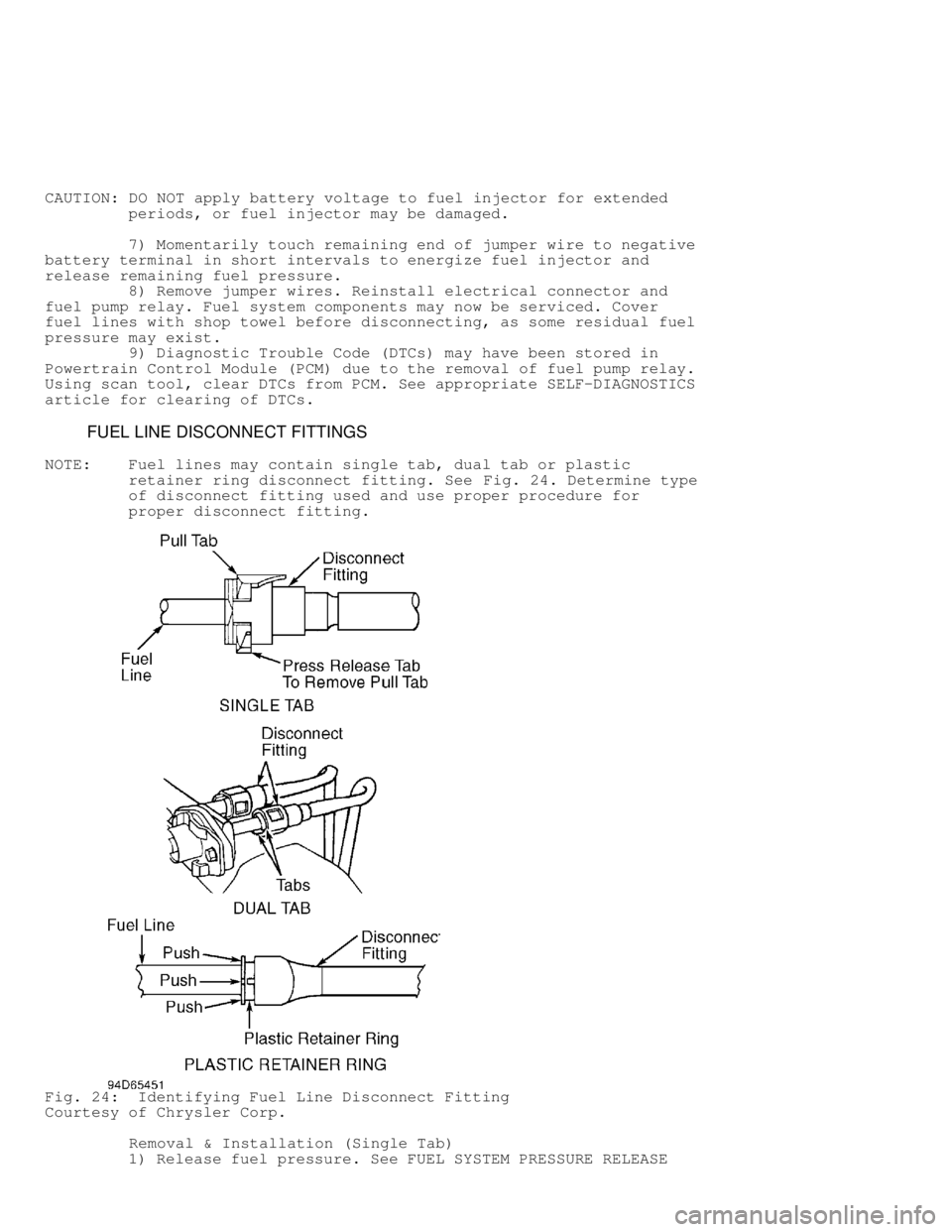
NOTE: Fuel lines may contain single tab, dual tab or plastic
retainer ring disconnect fitting. See Fig. 24. Determine type
of disconnect fitting used and use proper procedure for
proper disconnect fitting.
Fig. 24: Identifying Fuel Line Disconnect Fitting
Courtesy of Chrysler Corp.
Removal & Installation (Single Tab)
1) Release fuel pressure. See FUEL SYSTEM PRESSURE RELEASE
Page 971 of 1691

N - R EM OVE /IN STA LL/O VER HAU L
under FUEL SYSTEM. Disconnect negative battery cable. Ensure disconnect fitting and fuel lines are clean. Note location of releasetab and pull tab on disconnect fitting. See Fig. 24.
CAUTION: Release tab must be pressed downward before removing pull
tab, or pull tab will be damaged. 2) Press release tab downward. Use screwdriver to pry pull tab upward until pull tab separates from disconnect fitting. Removedisconnect fitting from fuel line. Inspect components for damage. Ifdisconnect fitting is damaged, entire assembly must be replaced, asonly pull tab may be replaced. 3) To install, ensure fuel line and disconnect fitting areclean. Lubricate fuel line and disconnect fitting with engine oil.Install disconnect fitting on fuel line until disconnect fittingbottoms on fuel line. 4) Install NEW pull tab until pull tab locks in disconnectfitting. DO NOT reuse old pull tab. Pull on fuel line and disconnectfitting to ensure components are properly locked together. Reconnectnegative battery cable. Start engine and check for leaks. Removal & Installation (Dual Tab)
1) Release fuel pressure. See FUEL SYSTEM PRESSURE RELEASE under FUEL SYSTEM. Disconnect negative battery cable. Ensuredisconnect fitting and fuel lines are clean. Note location of tabs ondisconnect fitting. See Fig. 24.
2) Squeeze both tabs against disconnect fitting. Pulldisconnect fitting from fuel line. The plastic retainer will remain onthe fuel system component being serviced. The "O" rings and spacerwill remain in the disconnect fitting. 3) Inspect components for damage. If disconnect fitting isdamaged, entire assembly must be replaced. The only component that maybe replaced is the plastic retainer. If plastic retainer must beremoved from fuel system component, carefully release the plasticretainer from the fuel system component using 2 screwdrivers. Inspectplastic retainer for cracks or damage. Replace plastic retainer ifdefective. 4) To install, ensure fuel line and disconnect fitting areclean. Lubricate fuel line and disconnect fitting with engine oil.Install disconnect fitting on fuel line until click sound is heard. 5) Pull on fuel line and disconnect fitting to ensurecomponents are properly locked together. Reconnect negative batterycable. Start engine and check for leaks. Removal & Installation (Plastic Retainer Ring)
1) Release fuel pressure. See FUEL SYSTEM PRESSURE RELEASE under FUEL SYSTEM. Disconnect negative battery cable. Ensuredisconnect fitting and fuel lines are clean. Note location of plasticretainer ring on disconnect fitting. See Fig. 24.
NOTE: Plastic retainer ring must be pressed evenly into disconnect fitting. If plastic retainer is not even, it will be difficult to remove disconnect fitting from fuel line. 2) Firmly push disconnect fitting toward the fuel line while pushing plastic retainer ring evenly into disconnect fitting. Withplastic retainer ring fully depressed, pull disconnect fitting fromfuel line. 3) Inspect components for damage. If disconnect fitting isdamaged, entire assembly must be replaced. 4) To install, ensure fuel line and disconnect fitting areclean. Lubricate fuel line and disconnect fitting with engine oil.Install disconnect fitting on fuel line until click sound is heard.
Page 985 of 1691

1) To install, reverse removal procedure. If installing small
vent tube and large fill tube on fuel tank, ensure fuel tank fittings
are clean.
2) Install disconnect fitting on fuel tank fitting until
disconnect fitting snaps onto fuel tank fitting. Pull on small vent
tube or and large fill tube to ensure disconnect fitting is locked on
fuel tank fitting. To verify proper installation of disconnect
fitting, ensure the distance between release sleeve and top of fuel
tank fitting is .50" (12.7 mm) on small vent tube or .25" (6.4 mm) o\
n
large fill tube. See Fig. 37.
3) Install fuel lines on fuel filter/fuel pressure regulator
on fuel pump module using proper procedure. See FUEL LINE DISCONNECT
FITTINGS under FUEL SYSTEM.
CAUTION: DO NOT overtighten fuel tank strap retaining nuts during
installation.
4) Tighten fuel tank strap retaining nuts to specification.
See TORQUE SPECIFICATIONS. To install remaining components, reverse
removal procedure. Start engine and check for fuel leaks.
Removal (Durango)
1) Fuel tank may be drained by removing vent hose from rear
of fuel tank, or by pumping fuel from fuel tank using the fuel pump if
fuel pump is operating. If removing vent hose from fuel tank to drain
the fuel, go to step 4). If using fuel pump to drain the fuel tank, go
to next step.
2) Disconnect fuel line from fuel rail. See FUEL LINE AT FUEL
RAIL under FUEL SYSTEM. Connect Fuel Hose (6541, 6539, 6631 or 6923)
for proper engine application at fuel line fitting on fuel rail. Place
remaining end of fuel hose in an approved gasoline container.
3) Connect scan tool to Data Link Connector (DLC). DLC is a
16-pin connector attached to bottom of driver's side of the instrument
panel, just to the right of the brake pedal. Using scan tool
manufacturer's instructions, activate the fuel pump and pump fuel from
fuel tank. Once fuel tank is empty, remove scan tool. Reinstall fuel
line on fuel rail using proper procedure. Go to step 5).
4) Release fuel pressure from fuel system. See FUEL SYSTEM
PRESSURE RELEASE. Ensure negative battery cable is disconnected.
Remove fuel tank cap to release any residual fuel tank pressure.
5) Raise and support vehicle. Remove necessary skid plates
for access to fuel tank. Disconnect vent and filler hose from rear of
fuel tank. If fuel tank was not previously drained, place drain hose
in vent hose fitting at rear of fuel tank. Drain fuel from fuel tank
into an approved gasoline container.
6) Support fuel tank with transmission jack. Remove fuel tank
strap retaining nuts. Position fuel tank straps toward outside of
vehicle. Slightly lower fuel tank. Ensure rear of fuel tank is higher
than front of fuel tank to prevent any spilling any remaining fuel in
fuel tank.
7) Disconnect fuel line from fuel filter/fuel pressure
regulator on fuel pump module using proper procedure for fuel line
disconnect fitting. See FUEL LINE DISCONNECT FITTINGS. Fuel pump
module is located on top of fuel tank. See Fig. 28. Disconnect
electrical connector at fuel pump module. Disconnect vapor line from
rollover valves on top of fuel tank and EVAP line from fuel pump
module. Lower fuel tank from vehicle.
CAUTION: DO NOT overtighten fuel tank strap retaining nuts during
installation.
Installation
1) To install, reverse removal procedure. Install fuel lines
Page 986 of 1691

on fuel filter/fuel pressure regulator on fuel pump module using
proper procedure. See FUEL LINE DISCONNECT FITTINGS.
2) Tighten fuel tank strap retaining nuts to specification.
See TORQUE SPECIFICATIONS. Start engine and check for fuel leaks.
Removal (Ram Pickup)
1) Fuel tank may be drained by lowering fuel tank, or by
pumping fuel from fuel tank using the fuel pump if fuel pump is
operating. If lowering fuel tank to drain the fuel, go to step 4). If
using fuel pump to drain the fuel tank, go to next step.
2) Disconnect fuel line from fuel rail. See FUEL LINE AT FUEL
RAIL. Connect Fuel Hose (6541, 6539, 6631 or 6923) for proper engine
application at fuel line fitting on fuel rail. Place remaining end of
fuel hose in an approved gasoline container.
3) Connect scan tool to Data Link Connector (DLC). DLC is a
16-pin connector attached to bottom of driver's side of the instrument
panel, just straight above the accelerator pedal. Using scan tool
manufacturer's instructions, activate the fuel pump and pump fuel from
fuel tank. Once fuel tank is empty, remove scan tool. Reinstall fuel
line on fuel rail using proper procedure. Go to step 5).
4) Release fuel pressure from fuel system. See FUEL SYSTEM
PRESSURE RELEASE. Ensure negative battery cable is disconnected.
Remove fuel tank cap to release any residual fuel tank pressure.
5) Raise and support vehicle. Open fuel tank filler door.
Remove fuel tank filler tube assembly-to-body screws. Support fuel
tank with transmission jack. Remove fuel tank strap retaining nuts.
6) Slightly lower fuel tank. If fuel tank was not previously
drained, slightly rotate fuel tank so vent hose and filler hose on
fuel tank are above the fuel level in the fuel tank to prevent fuel
leakage when hoses are disconnected. Vent hose and filler hose attach
to fitting on the fuel tank. See Fig. 29.
7) Disconnect vent hose from vent hose fitting on fuel tank.
If fuel tank was previously drained, go to next step. If fuel tank was
not previously drained, place drain hose in vent hose fitting on fuel
tank. Drain fuel from fuel tank into an approved gasoline container.
Go to next step.
8) Disconnect filler hose from filler hose fitting on fuel
tank. Disconnect electrical connector at fuel pump module. Fuel pump
module is located on top of fuel tank. See Fig. 29.
9) Disconnect fuel line from fuel filter/fuel pressure
regulator on fuel pump module using proper procedure for fuel line
disconnect fitting. See FUEL LINE DISCONNECT FITTINGS under FUEL
SYSTEM.
10) Disconnect necessary vapor hoses from rollover valves on
top of fuel tank or fuel pump module. See Fig. 29. Lower fuel tank
from vehicle.
CAUTION: DO NOT overtighten fuel tank strap retaining nuts during
installation.
Installation
1) To install, reverse removal procedure. Install fuel lines
on fuel filter/fuel pressure regulator on fuel pump module using
proper procedure. See FUEL LINE DISCONNECT FITTINGS.
2) Tighten fuel tank strap retaining nuts to specification.
See TORQUE SPECIFICATIONS. Start engine and check for fuel leaks.
Removal (Ram Van & Ram Wagon)
1) Fuel tank may be drained by siphoning fuel out through
small vent hose on fuel and vent hose fitting assembly on fuel tank,
or by pumping fuel from fuel tank using the fuel pump if fuel pump is
operating. If siphoning fuel out through small vent hose on fuel and
vent hose fitting assembly on fuel tank, go to step 4). If using fuel