Obd DODGE RAM 1999 Service Repair Manual
[x] Cancel search | Manufacturer: DODGE, Model Year: 1999, Model line: RAM, Model: DODGE RAM 1999Pages: 1691, PDF Size: 40.34 MB
Page 174 of 1691
protective cover is fitted to front of air bag module bearing the SRS
air bag logo. Air bag module contains air bag cushion, inflator and
supporting components. Air bag module is a sealed unit and is not
serviceable. The module inflator assembly produces nitrogen gas to
fill air bag cushion when a small amount of current from ACM is
applied to the ignitor assembly. Gas pressure builds and discharges
from inflator through a diffuser and screen assembly, forcing steering
wheel cover to burst along its seams until air bag is fully inflated.
Once air bag cushion is fully inflated, gas escapes from bag through
vents, away from driver.
Passenger-Side
Air bag module is mounted to instrument panel mounting
bracket. Module is covered by a protective door bearing the SRS air
bag logo. When supplied an electrical signal, inflator will discharge
argon gas directly into air bag. When air bag inflates, protective
door will pivot aside allowing air bag to deploy.
AIR BAG CONTROL MODULE (ACM)
ACM is located under instrument panel, on transmission
tunnel. Impact sensor, energy reserve capacitor and On-Board
Diagnostics (OBD) are an integral part of ACM. ACM monitors critical
input and output circuits within air bag system, ensuring they are
operating correctly. Some circuits are tested continuously; others are
checked only under certain conditions. ACM provides information about
air bag system through AIR BAG warning light and Data Link Connector
(DLC). When diagnostic trouble code (fault message) is stored, AIR B\
AG
warning light will be activated for 12 seconds or more.
DATA LINK CONNECTOR (DLC)
DLC is located under left side of instrument panel, left of
steering column. DLC is used to access SRS on-board diagnostics.
CLOCKSPRING
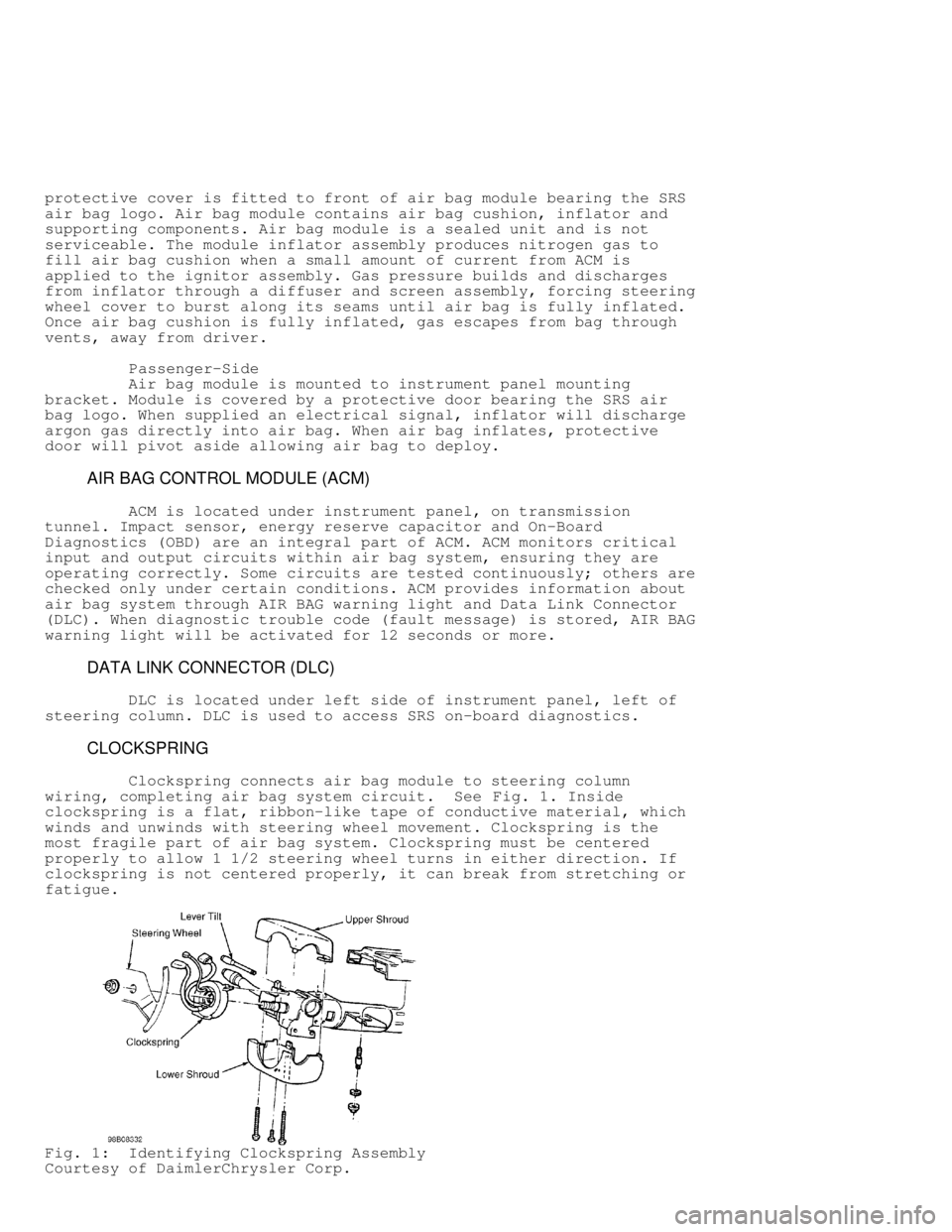
Clockspring connects air bag module to steering column
wiring, completing air bag system circuit. See Fig. 1. Inside
clockspring is a flat, ribbon-like tape of conductive material, which
winds and unwinds with steering wheel movement. Clockspring is the
most fragile part of air bag system. Clockspring must be centered
properly to allow 1 1/2 steering wheel turns in either direction. If
clockspring is not centered properly, it can break from stretching or
fatigue.
Fig. 1: Identifying Clockspring Assembly
Courtesy of DaimlerChrysler Corp.
Page 267 of 1691

6) Disconnect PNP switch harness connector. Measure
resistance of PNP switch sense circuit between Black PCM harness
connector C1 and PNP switch harness connector. If resistance is less
than 5 ohms, replace PNP switch. If resistance is not as specified,
repair open in PNP switch sense circuit.
7) Conditions required to set DTC P1899 are not present at
this time. Using scan tool, check and record FREEZE FRAME data. Ensure
"CAUSED BY DTC" "P" code matches code on DTC screen. Using wiring
diagram as a guide, inspect wiring and connectors. Repair wiring
harness as necessary. If wiring and connectors are okay, does not
reset, see INACTIVE DTC CONDITION under SELF-DIAGNOSTIC SYSTEM.
Testing is complete.
TEST VER-2A (EXCEPT DIESEL)
NOTE: If Powertrain Control Module (PCM) is replaced, correct
vehicle mileage and Vehicle Identification Number (VIN) must
be programmed into PCM to prevent Diagnostic Trouble Codes
(DTCs) from being set in Anti-Lock Brake System (ABS) modul\
e
and Supplemental Restraint System (SRS) module. To program
PCM and clear DTCs from ABS and SRS modules, proceed to
appropriate procedure listed below. On models equipped with a
Smart Key Immobilizer Module (SKIM), if replacing Powertrain
Control Module (PCM), secret key data must also be updated to\
enable engine starting. To update secret key data, proceed to
appropriate procedure listed below.
Procedure For Programming PCM & Clearing DTCs From ABS & SRS
Modules
Connect scan tool to Data Link Connector (DLC). Using scan
tool, enter correct VIN and mileage into PCM. Using scan tool
manufacturer's instructions, clear DTCs from ABS and SRS modules. Go
to step 1)).
Procedure For Updating Secret Key Data
Connect scan tool to Data Link Connector (DLC). Go to ENGINE
and then MISC menus on scan tool. Place SKIM in SECURED ACCESS MODE by
using appropriate Personal Identification Number (PIN) for this
vehicle. PIN may be obtained from owner, vehicle's invoice, or from
manufacturer. Select UPDATE THE SECRET KEY DATA. Data will be
transferred from Smart Key Immobilizer Module (SKIM) to PCM. Go to
step 1)).
1) Inspect vehicle to ensure all engine components are
connected. Reassemble and reconnect components as necessary. If test
is being performed after performing a NO TROUBLE CODE (NTC) test, go
to next step. If test is being performed after performing an OBD-II
TROUBLE CODE test, perform TEST VER-5A. If test is being performed
after any other TROUBLE CODE test, go to step 3).
2) Check if initial symptom still exists. If initial or
another symptom exists, repair is not complete. Check for Technical
Service Bulletins (TSBs) that apply to symptom and see appropriate
TEST NTC-1A: NO TROUBLE CODE TEST MENU in ENGINE PERFORMANCE, or
appropriate TROUBLE SHOOTING - NO CODES article in ENGINE PERFORMANCE
for diagnosis by symptom. If initial symptom no longer exists, test is
complete. Go to step 8).
3) If any DTCs have not been diagnosed, perform appropriate
test(s) see appropriate SELF-DIAGNOSTIC TESTS in ENGINE PERFORMANCE.
If all DTCs have been diagnosed and repaired, go to next step.
4) If Powertrain Control Module (PCM) has not been replaced,\
use scan tool to clear DTCs from PCM. Using scan tool, reset all
values in adaptive memory. To ensure no other DTCs remain, go to next
step.
Page 389 of 1691

made.
* When using a jumper wire, ensure either jumper wire or
circuit is fuse-protected.
* Before disconnecting connector from any control module,
ensure ignition is off before removing connector.
* When checking voltage or continuity at any control module,
probe connector for control module from pin side. DO NOT
backprobe connector or probe wires through insulation.
* DO NOT cause short circuits when performing electrical tests.
This will set additional Diagnostic Trouble Codes (DTCs),
making diagnosis of original problem more difficult.
* Use specified test equipment when performing electrical
tests.
RETRIEVING DIAGNOSTIC TROUBLE CODES
NOTE: Self-diagnostic tests are written specifically for Chrysler's
Diagnostic Readout Box (DRB). If using a generic scan tool,
ensure it is OBD-II certified. A generic scan tool may not be
capable of performing all necessary test functions.
Ensure battery is fully charged. Turn ignition off. Connect
scan tool to Data Link Connector (DLC). DLC is located under left side\
of instrument panel. Turn ignition on. Using scan tool manufacturer's
instructions, record all DTCs displayed on scan tool. If ant DTCs are
retrieved, perform appropriate test under DIAGNOSTIC TESTS. Once all
repairs are made, clear DTCs. See CLEARING DIAGNOSTIC TROUBLE CODES.
If no DTCs are retrieved and fault still exists, go to CHECKING SPEED
CONTROL OPERATION under SYSTEM TESTS.
CLEARING DIAGNOSTIC TROUBLE CODES
Ensure ignition is off. Connect scan tool to DLC. Turn
ignition on. Using screen prompts on scan tool, erase DTCs from PCM.
DIAGNOSTIC TESTS
FTC P0720: LOW OUTPUT SPEED SENSOR (OSS) RPM MORE THAN 15 MPH
FTC P0720 will set if output shaft speed is less than 60 RPM
for 2.6 seconds when vehicle speed is more than 15 MPH.
Possible Causes:
* Defective Output Speed Sensor (OSS).
* OSS signal circuit open or shorted.
* OSS ground circuit open or shorted.
* Park/Neutral Position (PNP) switch FTC present.
* Defective PNP switch.
* Defective PCM.
1) Turn ignition on. Using scan tool, read DTCs. If FTC
specific good trip is displayed and equal to zero, go to next step. If
FTC specific good trip is equal to more than zero, go to step 13).
2) If there are any Park/Neutral Position (PNP) switch DTCs,\
repair PNP switch FTC first. Perform TEST VER-5A under VERIFICATION
TESTS. If there are no PNP switch DTCs, go to next step.
3) Using scan tool, read PNP switch state. While observing
scan tool, shift transmission through all positions. If scan tool did
not display P/N and D/R in correct positions, repair PNP switch or
circuit as necessary. Perform TEST VER-5A under VERIFICATION TESTS. If
Page 953 of 1691

Removal & Installation (Ram Pickup)
PTO switch is used on models only with after market PTO
units. PTO switch delivers an input signal to Powertrain Control
Module (PCM) to indicate when PTO is engaged. The PCM will disable
certain OBD-II systems when PTO is engaged. No other service
information is available from manufacturer.
THROTTLE POSITION (TP) SENSOR
Removal (Dakota, Durango, Ram Pickup 3.9L, 5.2L & 5.9L, Ram
Van & Ram Wagon)
The TP sensor is located on side of throttle body. On Ram Van
and Ram Wagon, remove engine cover. On all models, remove air inlet
duct at throttle body for access to TP sensor. Disconnect electrical
connector at TP sensor. Remove retaining bolts and TP sensor.
Installation
1) Throttle shaft on throttle body slides into socket on TP
sensor. Throttle shaft rests against tabs in socket on TP sensor. See
Fig. 12 .
2) Install TP sensor on throttle body. When properly
installed, TP sensor should rotate a few degrees so retaining bolts
may be installed. Slight tension should exist on TP sensor when
rotating TP sensor.
3) If difficult to rotate TP sensor into position when
aligning retaining bolts, remove TP sensor. Reinstall TP sensor so
throttle shaft is on the other side of tabs in socket on TP sensor.
Tighten retaining bolts for TP sensor to specification. See TORQUE
SPECIFICATIONS.
4) Operate throttle lever on throttle body to ensure no
binding exists in TP sensor. Install electrical connector and air
inlet duct or air cleaner assembly.
Removal (Ram Pickup 8.0L)
The TP sensor is located on side of throttle body. Remove air
inlet duct at air cleaner assembly. Remove cover from air cleaner
assembly. Remove air cleaner housing-to-throttle body nuts and air
cleaner housing from throttle body. Disconnect electrical connector at
TP sensor. Remove retaining bolts and TP sensor.
Installation
1) Throttle shaft on throttle body slides into socket on TP
sensor. Throttle shaft rests against tabs in socket on TP sensor. See
Fig. 12 .
2) Install TP sensor on throttle body. When properly
installed, TP sensor should rotate a few degrees so retaining bolts
may be installed. Slight tension should exist on TP sensor when
rotating TP sensor.
3) If difficult to rotate TP sensor into position when
aligning retaining bolts, remove TP sensor. Reinstall TP sensor so
throttle shaft is on the other side of tabs in socket on TP sensor.
Tighten retaining bolts for TP sensor to specification. See TORQUE
SPECIFICATIONS.
4) Operate throttle lever on throttle body to ensure no
binding exists in TP sensor. To install remaining components, reverse
removal procedure. Tighten air cleaner housing-to-throttle body nuts
to specification. See TORQUE SPECIFICATIONS.
Page 1464 of 1691

manifold, sends input signal to Engine Control Module (ECM). ECM uses
input signal for controlling fuel control, timing and engine
protection. ECM will lower engine power if boost is too high.
Oil Pressure Sensor
Oil pressure sensor signal is input to Engine Control Module
(ECM). ECM converts signal to pressure value. Value is sent on CCD Bus\
to instrument panel gauge/light. Oil pressure sensor is located on
side of engine block, below ECM. See Fig. 2.
Power Take Off (PTO)
This input is used on vehicles equipped with a Power Take Off
(PTO) unit. When PTO is engaged, Engine Control Module (ECM) will
disable some OBD-II functions.
Water-In-Fuel (WIF) Sensor
WIF sensor is located in bottom of fuel filter/water
separator. See Fig. 2. WIF sensor delivers input signal to Engine
Control Module (ECM) when water exists in the fuel filter/water
separator. As water level increases, resistance across WIF sensor
decreases. ECM compares decrease in resistance to a high water
standard value. When resistance is 30,000-40,000 ohms, ECM will turn
on WATER-IN-FUEL warning light. WATER-IN-FUEL warning light is located
on instrument panel, just below tachometer. ECM monitors input signal
when ignition switch is in the ON position and continues to monitor
input signal until intake manifold air heater post-heat cycle is
complete.
PCM INPUT SIGNALS
A/C Switch
When A/C switch is in ON position, an input signal is
delivered from A/C switch to Engine Control Module (ECM) to indicate
that A/C operation has been requested. Once A/C operation has been
requested, an A/C request signal is delivered to ECM from A/C high-
pressure switch and A/C low-pressure switch. The A/C request signal
indicates evaporator pressure is within proper range for A/C
operation. ECM uses A/C request signal to cycle A/C compressor clutch
by using an A/C clutch relay. A/C clutch relay may also be referred to
as A/C compressor clutch relay. If A/C high-pressure switch or A/C
low-pressure switch opens, A/C request signal will not be delivered to
the ECM. ECM will then open ground circuit for A/C clutch relay and
A/C compressor clutch will be disengaged.
The A/C clutch relay is located in power distribution center
at driver's side front corner of engine compartment, near the battery.
The A/C high-pressure switch is located on discharge line, near A/C
compressor. The A/C low-pressure switch is located on top of
accumulator.
Accelerator Pedal Position Sensor (APPS) Output From ECM
Accelerator Pedal Position Sensor (APPS) is mounted on top
left of engine. See Fig. 2. Sensor provides DC voltage input signal to
Engine Control Module (ECM) to indicate throttle position. On previous\
engines, there were linkages between accelerator pedal, throttle
position sensor and injection pump. On this engine, no linkage exists
between accelerator pedal and injection pump. APPS signal is sent on
CCD Bus circuit from ECM to PCM.
Automatic Shutdown (ASD) Relay
A 12-volt input signal is delivered from ASD relay to Engine
Control Module (ECM) when ASD relay is energized. If ECM does not
receive a 12-volt input signal when ASD relay is energized, a
Diagnostic Trouble Code (FTC) will be stored in ECM. ASD relay is