Temperature DODGE RAM 2001 Service Repair Manual
[x] Cancel search | Manufacturer: DODGE, Model Year: 2001, Model line: RAM, Model: DODGE RAM 2001Pages: 2889, PDF Size: 68.07 MB
Page 2404 of 2889
No upshift to fourth gear will occur if any of the fol-
lowing are true:
²The transmission fluid temperature is below 10É
C (50É F) or above 121É C (250É F).
²The shift to third is not yet complete.
²Vehicle speed is too low for the 3-4 shift to occur.
²Battery temperature is below -5É C (23É F).
ADJUSTMENT
Check linkage adjustment by starting engine in
PARK and NEUTRAL. Adjustment is acceptable if
the engine starts in only these two positions. Adjust-
ment is incorrect if the engine starts in one position
but not both positions
If the engine starts in any other position, or if the
engine will not start in any position, the park/neutral
switch is probably faulty.
LINKAGE ADJUSTMENT
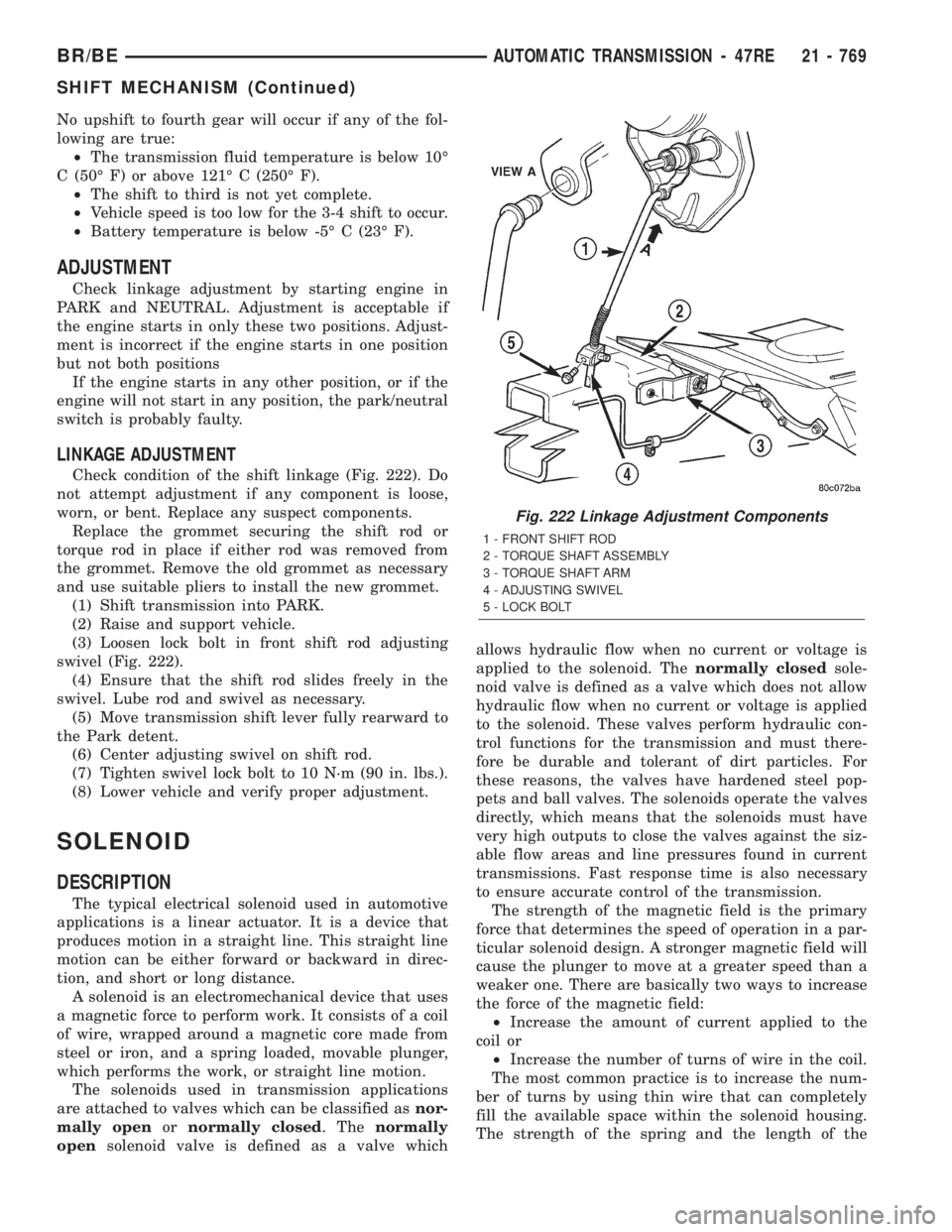
Check condition of the shift linkage (Fig. 222). Do
not attempt adjustment if any component is loose,
worn, or bent. Replace any suspect components.
Replace the grommet securing the shift rod or
torque rod in place if either rod was removed from
the grommet. Remove the old grommet as necessary
and use suitable pliers to install the new grommet.
(1) Shift transmission into PARK.
(2) Raise and support vehicle.
(3) Loosen lock bolt in front shift rod adjusting
swivel (Fig. 222).
(4) Ensure that the shift rod slides freely in the
swivel. Lube rod and swivel as necessary.
(5) Move transmission shift lever fully rearward to
the Park detent.
(6) Center adjusting swivel on shift rod.
(7) Tighten swivel lock bolt to 10 N´m (90 in. lbs.).
(8) Lower vehicle and verify proper adjustment.
SOLENOID
DESCRIPTION
The typical electrical solenoid used in automotive
applications is a linear actuator. It is a device that
produces motion in a straight line. This straight line
motion can be either forward or backward in direc-
tion, and short or long distance.
A solenoid is an electromechanical device that uses
a magnetic force to perform work. It consists of a coil
of wire, wrapped around a magnetic core made from
steel or iron, and a spring loaded, movable plunger,
which performs the work, or straight line motion.
The solenoids used in transmission applications
are attached to valves which can be classified asnor-
mally openornormally closed. Thenormally
opensolenoid valve is defined as a valve whichallows hydraulic flow when no current or voltage is
applied to the solenoid. Thenormally closedsole-
noid valve is defined as a valve which does not allow
hydraulic flow when no current or voltage is applied
to the solenoid. These valves perform hydraulic con-
trol functions for the transmission and must there-
fore be durable and tolerant of dirt particles. For
these reasons, the valves have hardened steel pop-
pets and ball valves. The solenoids operate the valves
directly, which means that the solenoids must have
very high outputs to close the valves against the siz-
able flow areas and line pressures found in current
transmissions. Fast response time is also necessary
to ensure accurate control of the transmission.
The strength of the magnetic field is the primary
force that determines the speed of operation in a par-
ticular solenoid design. A stronger magnetic field will
cause the plunger to move at a greater speed than a
weaker one. There are basically two ways to increase
the force of the magnetic field:
²Increase the amount of current applied to the
coil or
²Increase the number of turns of wire in the coil.
The most common practice is to increase the num-
ber of turns by using thin wire that can completely
fill the available space within the solenoid housing.
The strength of the spring and the length of the
Fig. 222 Linkage Adjustment Components
1 - FRONT SHIFT ROD
2 - TORQUE SHAFT ASSEMBLY
3 - TORQUE SHAFT ARM
4 - ADJUSTING SWIVEL
5 - LOCK BOLT
BR/BEAUTOMATIC TRANSMISSION - 47RE 21 - 769
SHIFT MECHANISM (Continued)
Page 2408 of 2889
TORQUE CONVERTER
DESCRIPTION
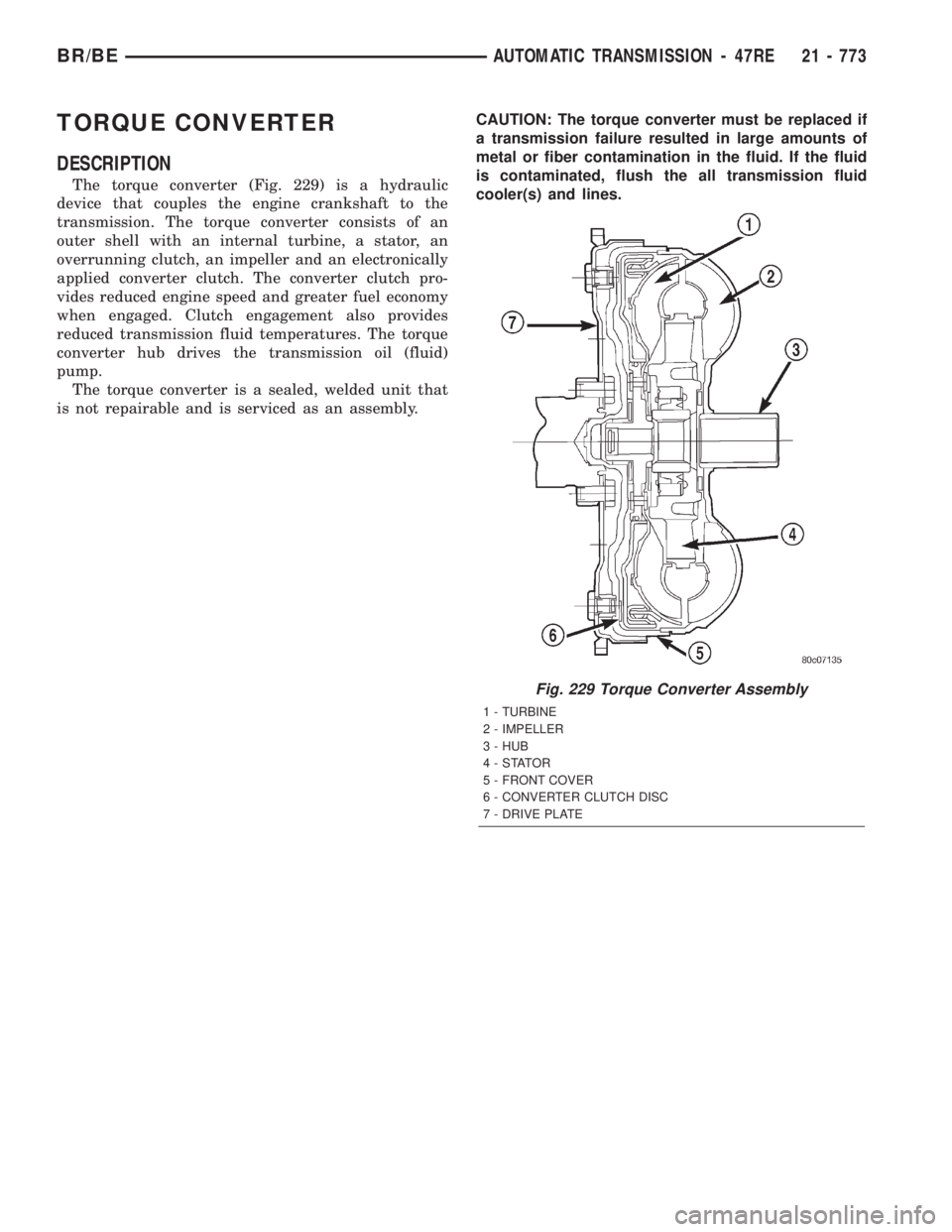
The torque converter (Fig. 229) is a hydraulic
device that couples the engine crankshaft to the
transmission. The torque converter consists of an
outer shell with an internal turbine, a stator, an
overrunning clutch, an impeller and an electronically
applied converter clutch. The converter clutch pro-
vides reduced engine speed and greater fuel economy
when engaged. Clutch engagement also provides
reduced transmission fluid temperatures. The torque
converter hub drives the transmission oil (fluid)
pump.
The torque converter is a sealed, welded unit that
is not repairable and is serviced as an assembly.CAUTION: The torque converter must be replaced if
a transmission failure resulted in large amounts of
metal or fiber contamination in the fluid. If the fluid
is contaminated, flush the all transmission fluid
cooler(s) and lines.
Fig. 229 Torque Converter Assembly
1 - TURBINE
2 - IMPELLER
3 - HUB
4-STATOR
5 - FRONT COVER
6 - CONVERTER CLUTCH DISC
7 - DRIVE PLATE
BR/BEAUTOMATIC TRANSMISSION - 47RE 21 - 773
Page 2414 of 2889
vehicle is parked for lengthy periods. The valve check
ball is spring loaded and has an opening pressure of
approximately 2 psi.
The valve is serviced as an assembly; it is not
repairable. Do not clean the valve if restricted, or
contaminated by sludge, or debris. If the valve fails,
or if a transmission malfunction occurs that gener-
ates significant amounts of sludge and/or clutch par-
ticles and metal shavings, the valve must be
replaced.
The valve must be removed whenever the cooler
and lines are reverse flushed. The valve can be flow
tested when necessary. The procedure is exactly the
same as for flow testing a cooler.
If the valve is restricted, installed backwards, or in
the wrong line, it will cause an overheating condition
and possible transmission failure.
CAUTION: The drainback valve is a one-way flow
device. It must be properly oriented in terms of flow
direction for the cooler to function properly. The
valve must be installed in the pressure line. Other-
wise flow will be blocked and would cause an over-
heating condition and eventual transmission failure.
TRANSMISSION
TEMPERATURE SENSOR
DESCRIPTION
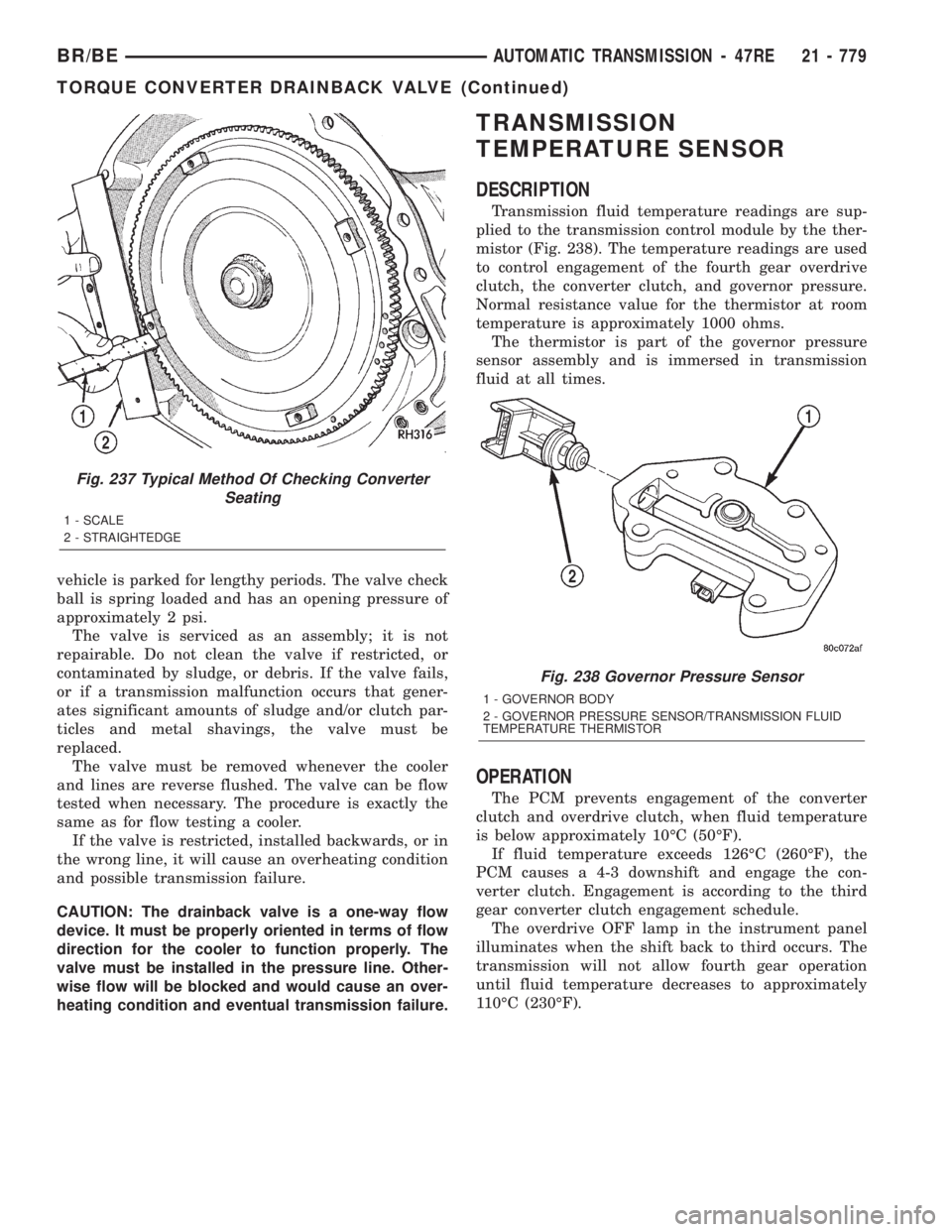
Transmission fluid temperature readings are sup-
plied to the transmission control module by the ther-
mistor (Fig. 238). The temperature readings are used
to control engagement of the fourth gear overdrive
clutch, the converter clutch, and governor pressure.
Normal resistance value for the thermistor at room
temperature is approximately 1000 ohms.
The thermistor is part of the governor pressure
sensor assembly and is immersed in transmission
fluid at all times.
OPERATION
The PCM prevents engagement of the converter
clutch and overdrive clutch, when fluid temperature
is below approximately 10ÉC (50ÉF).
If fluid temperature exceeds 126ÉC (260ÉF), the
PCM causes a 4-3 downshift and engage the con-
verter clutch. Engagement is according to the third
gear converter clutch engagement schedule.
The overdrive OFF lamp in the instrument panel
illuminates when the shift back to third occurs. The
transmission will not allow fourth gear operation
until fluid temperature decreases to approximately
110ÉC (230ÉF).
Fig. 237 Typical Method Of Checking Converter
Seating
1 - SCALE
2 - STRAIGHTEDGE
Fig. 238 Governor Pressure Sensor
1 - GOVERNOR BODY
2 - GOVERNOR PRESSURE SENSOR/TRANSMISSION FLUID
TEMPERATURE THERMISTOR
BR/BEAUTOMATIC TRANSMISSION - 47RE 21 - 779
TORQUE CONVERTER DRAINBACK VALVE (Continued)
Page 2433 of 2889
REMOVAL
The valve body can be removed for service without
having to remove the transmission assembly.
The valve body can be disassembled for cleaning
and inspection of the individual components.
The only replaceable valve body components are:
²Manual lever.
²Manual lever washer, seal, E-clip, and shaft
seal.
²Manual lever detent ball.
²Throttle lever.
²Fluid filter.
²Pressure adjusting screw bracket.
²Governor pressure solenoid.
²Governor pressure sensor (includes transmission
temperature thermistor).
²Converter clutch/overdrive solenoid assembly
and harness .
²Governor housing gasket.
²Solenoid case connector O-rings.
(1) Shift transmission into NEUTRAL.
(2) Raise vehicle.
(3) Remove gearshift and throttle levers from shaft
of valve body manual lever.
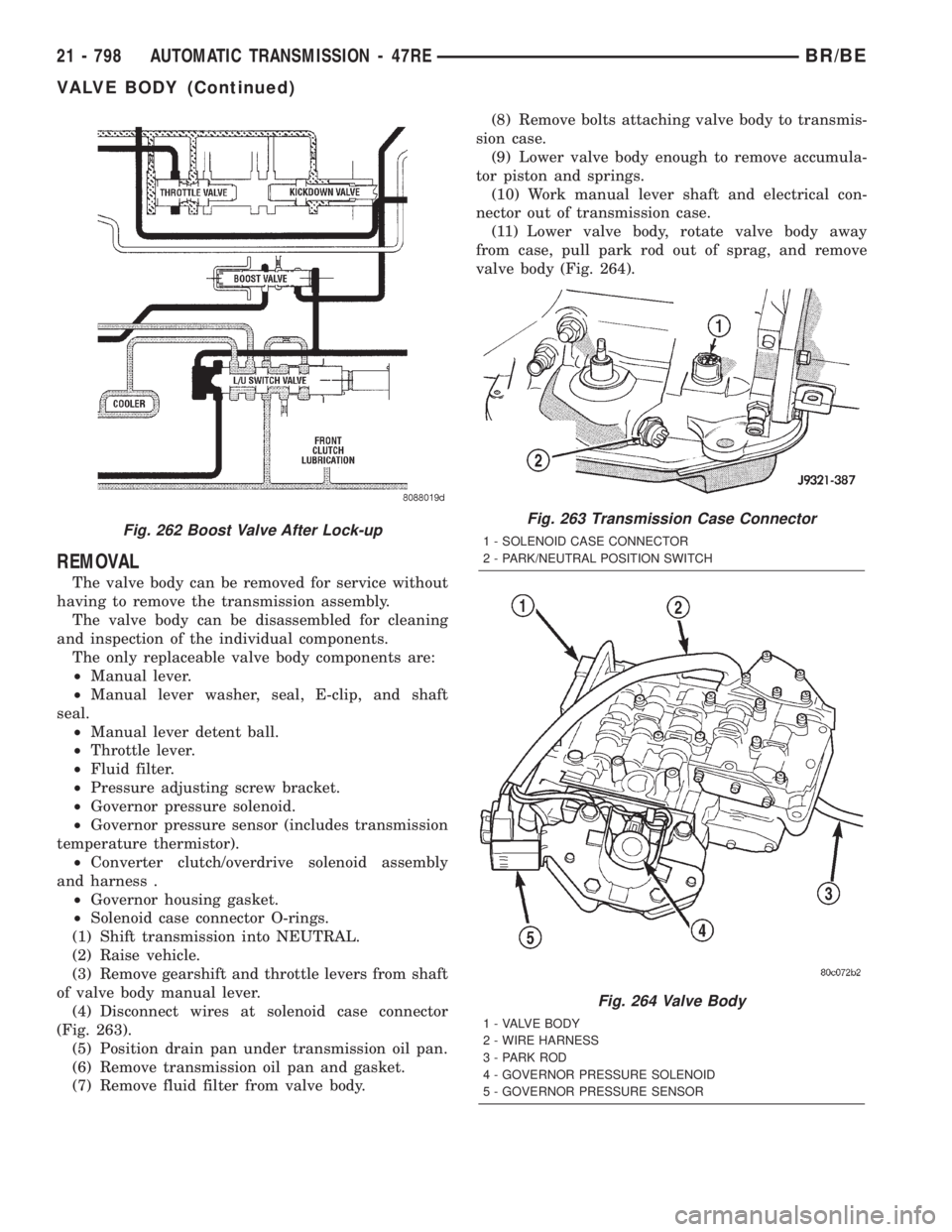
(4) Disconnect wires at solenoid case connector
(Fig. 263).
(5) Position drain pan under transmission oil pan.
(6) Remove transmission oil pan and gasket.
(7) Remove fluid filter from valve body.(8) Remove bolts attaching valve body to transmis-
sion case.
(9) Lower valve body enough to remove accumula-
tor piston and springs.
(10) Work manual lever shaft and electrical con-
nector out of transmission case.
(11) Lower valve body, rotate valve body away
from case, pull park rod out of sprag, and remove
valve body (Fig. 264).
Fig. 262 Boost Valve After Lock-upFig. 263 Transmission Case Connector
1 - SOLENOID CASE CONNECTOR
2 - PARK/NEUTRAL POSITION SWITCH
Fig. 264 Valve Body
1 - VALVE BODY
2 - WIRE HARNESS
3 - PARK ROD
4 - GOVERNOR PRESSURE SOLENOID
5 - GOVERNOR PRESSURE SENSOR
21 - 798 AUTOMATIC TRANSMISSION - 47REBR/BE
VALVE BODY (Continued)
Page 2568 of 2889
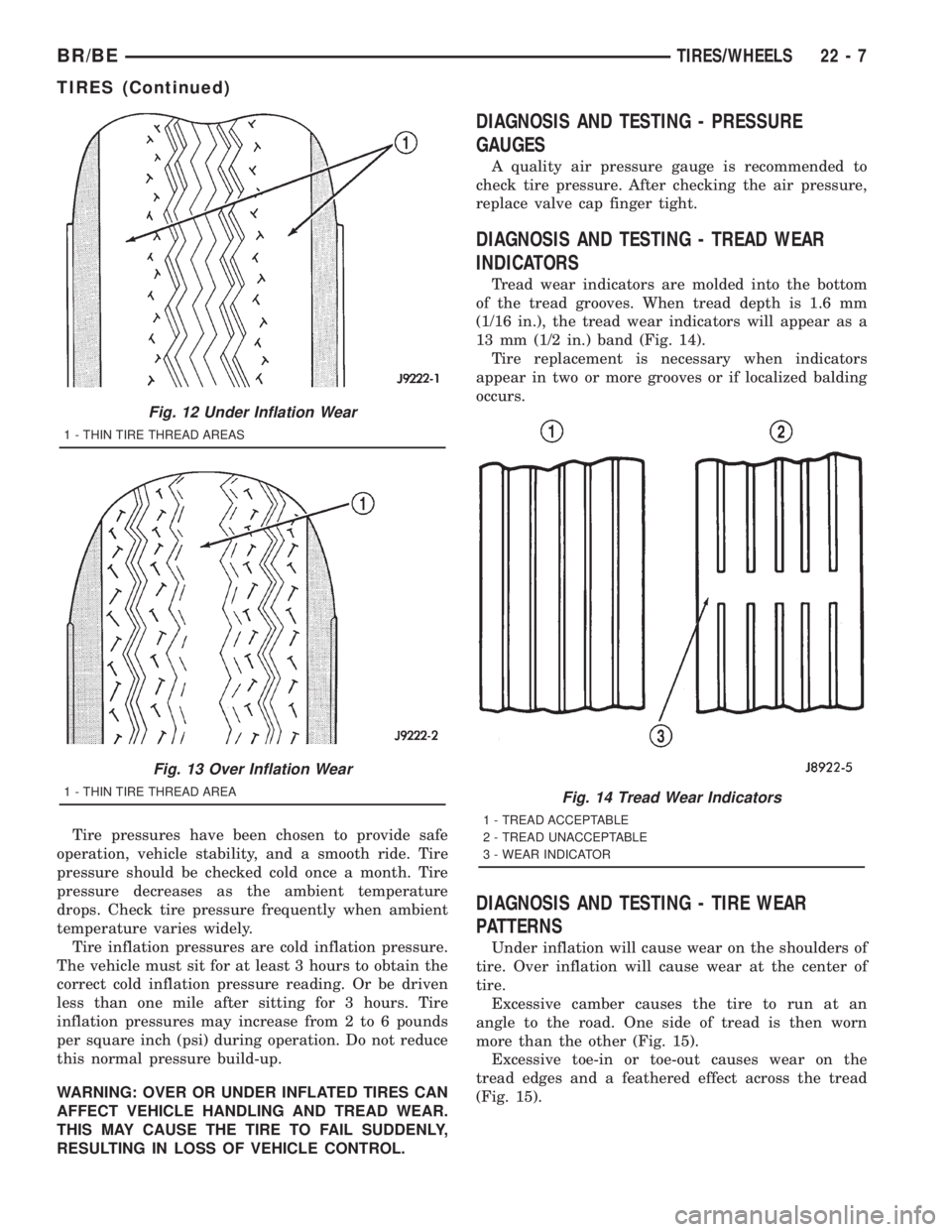
Tire pressures have been chosen to provide safe
operation, vehicle stability, and a smooth ride. Tire
pressure should be checked cold once a month. Tire
pressure decreases as the ambient temperature
drops. Check tire pressure frequently when ambient
temperature varies widely.
Tire inflation pressures are cold inflation pressure.
The vehicle must sit for at least 3 hours to obtain the
correct cold inflation pressure reading. Or be driven
less than one mile after sitting for 3 hours. Tire
inflation pressures may increase from 2 to 6 pounds
per square inch (psi) during operation. Do not reduce
this normal pressure build-up.
WARNING: OVER OR UNDER INFLATED TIRES CAN
AFFECT VEHICLE HANDLING AND TREAD WEAR.
THIS MAY CAUSE THE TIRE TO FAIL SUDDENLY,
RESULTING IN LOSS OF VEHICLE CONTROL.
DIAGNOSIS AND TESTING - PRESSURE
GAUGES
A quality air pressure gauge is recommended to
check tire pressure. After checking the air pressure,
replace valve cap finger tight.
DIAGNOSIS AND TESTING - TREAD WEAR
INDICATORS
Tread wear indicators are molded into the bottom
of the tread grooves. When tread depth is 1.6 mm
(1/16 in.), the tread wear indicators will appear as a
13 mm (1/2 in.) band (Fig. 14).
Tire replacement is necessary when indicators
appear in two or more grooves or if localized balding
occurs.
DIAGNOSIS AND TESTING - TIRE WEAR
PATTERNS
Under inflation will cause wear on the shoulders of
tire. Over inflation will cause wear at the center of
tire.
Excessive camber causes the tire to run at an
angle to the road. One side of tread is then worn
more than the other (Fig. 15).
Excessive toe-in or toe-out causes wear on the
tread edges and a feathered effect across the tread
(Fig. 15).
Fig. 12 Under Inflation Wear
1 - THIN TIRE THREAD AREAS
Fig. 13 Over Inflation Wear
1 - THIN TIRE THREAD AREAFig. 14 Tread Wear Indicators
1 - TREAD ACCEPTABLE
2 - TREAD UNACCEPTABLE
3 - WEAR INDICATOR
BR/BETIRES/WHEELS 22 - 7
TIRES (Continued)
Page 2636 of 2889
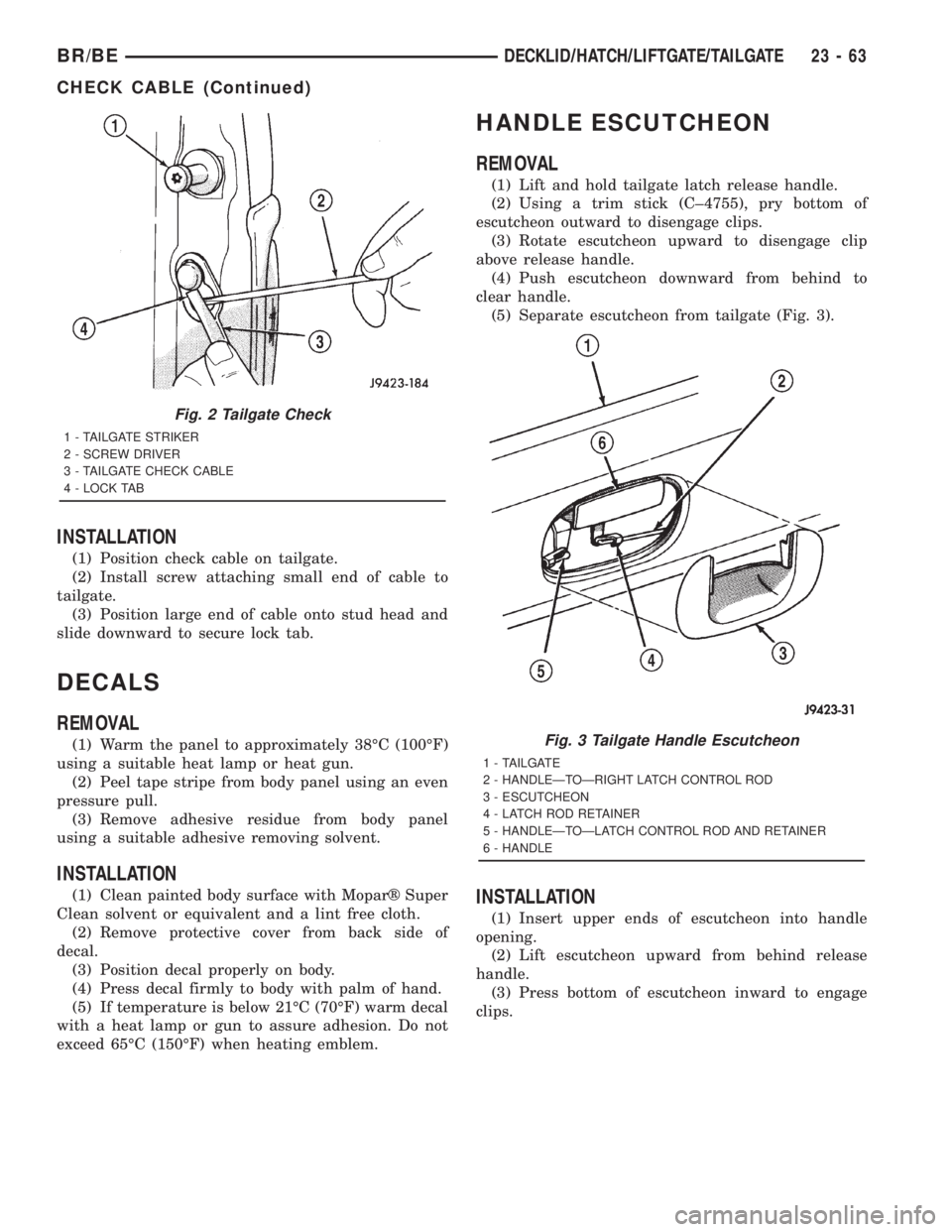
INSTALLATION
(1) Position check cable on tailgate.
(2) Install screw attaching small end of cable to
tailgate.
(3) Position large end of cable onto stud head and
slide downward to secure lock tab.
DECALS
REMOVAL
(1) Warm the panel to approximately 38ÉC (100ÉF)
using a suitable heat lamp or heat gun.
(2) Peel tape stripe from body panel using an even
pressure pull.
(3) Remove adhesive residue from body panel
using a suitable adhesive removing solvent.
INSTALLATION
(1) Clean painted body surface with Moparž Super
Clean solvent or equivalent and a lint free cloth.
(2) Remove protective cover from back side of
decal.
(3) Position decal properly on body.
(4) Press decal firmly to body with palm of hand.
(5) If temperature is below 21ÉC (70ÉF) warm decal
with a heat lamp or gun to assure adhesion. Do not
exceed 65ÉC (150ÉF) when heating emblem.
HANDLE ESCUTCHEON
REMOVAL
(1) Lift and hold tailgate latch release handle.
(2) Using a trim stick (C±4755), pry bottom of
escutcheon outward to disengage clips.
(3) Rotate escutcheon upward to disengage clip
above release handle.
(4) Push escutcheon downward from behind to
clear handle.
(5) Separate escutcheon from tailgate (Fig. 3).
INSTALLATION
(1) Insert upper ends of escutcheon into handle
opening.
(2) Lift escutcheon upward from behind release
handle.
(3) Press bottom of escutcheon inward to engage
clips.
Fig. 2 Tailgate Check
1 - TAILGATE STRIKER
2 - SCREW DRIVER
3 - TAILGATE CHECK CABLE
4 - LOCK TAB
Fig. 3 Tailgate Handle Escutcheon
1 - TAILGATE
2 - HANDLEÐTOÐRIGHT LATCH CONTROL ROD
3 - ESCUTCHEON
4 - LATCH ROD RETAINER
5 - HANDLEÐTOÐLATCH CONTROL ROD AND RETAINER
6 - HANDLE
BR/BEDECKLID/HATCH/LIFTGATE/TAILGATE 23 - 63
CHECK CABLE (Continued)
Page 2662 of 2889
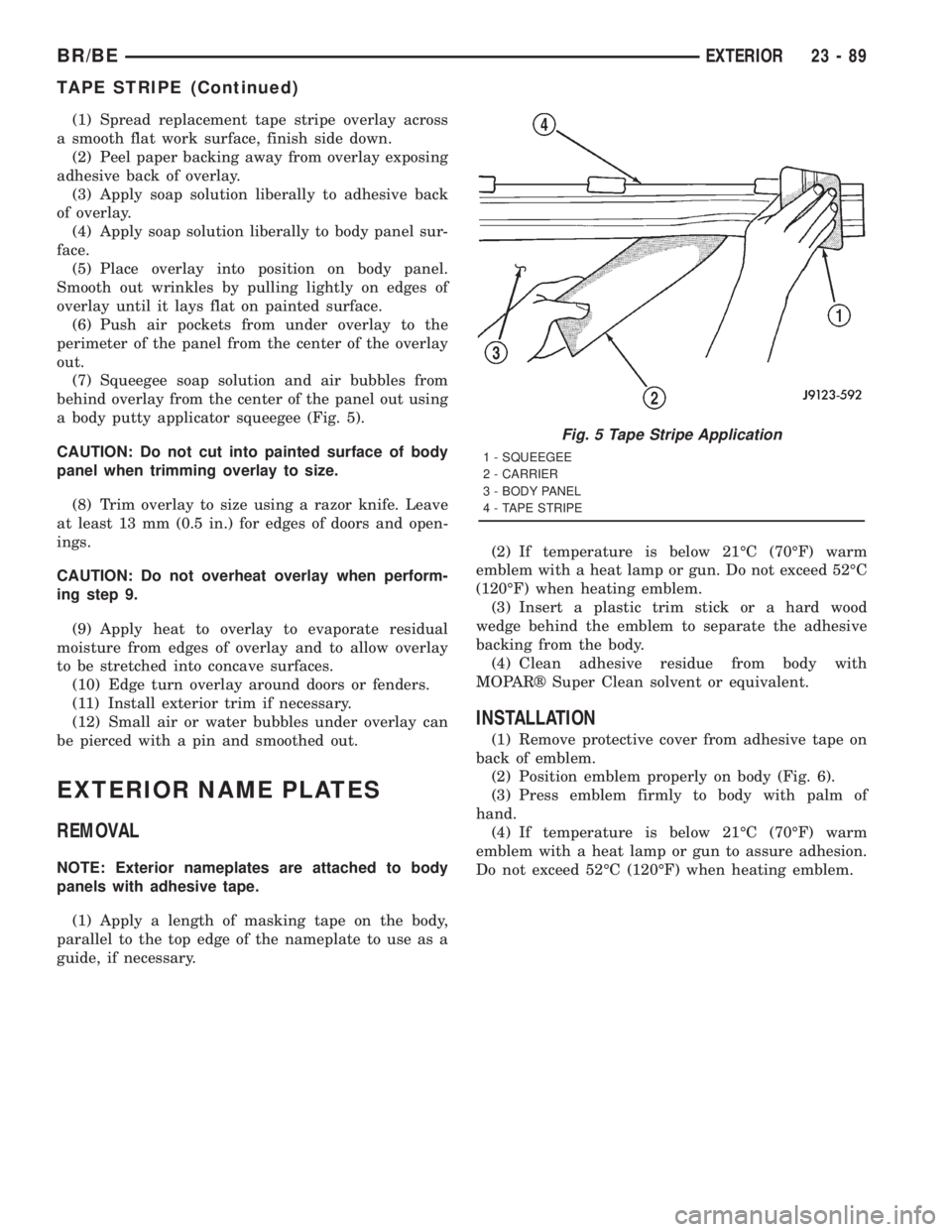
(1) Spread replacement tape stripe overlay across
a smooth flat work surface, finish side down.
(2) Peel paper backing away from overlay exposing
adhesive back of overlay.
(3) Apply soap solution liberally to adhesive back
of overlay.
(4) Apply soap solution liberally to body panel sur-
face.
(5) Place overlay into position on body panel.
Smooth out wrinkles by pulling lightly on edges of
overlay until it lays flat on painted surface.
(6) Push air pockets from under overlay to the
perimeter of the panel from the center of the overlay
out.
(7) Squeegee soap solution and air bubbles from
behind overlay from the center of the panel out using
a body putty applicator squeegee (Fig. 5).
CAUTION: Do not cut into painted surface of body
panel when trimming overlay to size.
(8) Trim overlay to size using a razor knife. Leave
at least 13 mm (0.5 in.) for edges of doors and open-
ings.
CAUTION: Do not overheat overlay when perform-
ing step 9.
(9) Apply heat to overlay to evaporate residual
moisture from edges of overlay and to allow overlay
to be stretched into concave surfaces.
(10) Edge turn overlay around doors or fenders.
(11) Install exterior trim if necessary.
(12) Small air or water bubbles under overlay can
be pierced with a pin and smoothed out.
EXTERIOR NAME PLATES
REMOVAL
NOTE: Exterior nameplates are attached to body
panels with adhesive tape.
(1) Apply a length of masking tape on the body,
parallel to the top edge of the nameplate to use as a
guide, if necessary.(2) If temperature is below 21ÉC (70ÉF) warm
emblem with a heat lamp or gun. Do not exceed 52ÉC
(120ÉF) when heating emblem.
(3) Insert a plastic trim stick or a hard wood
wedge behind the emblem to separate the adhesive
backing from the body.
(4) Clean adhesive residue from body with
MOPARž Super Clean solvent or equivalent.
INSTALLATION
(1) Remove protective cover from adhesive tape on
back of emblem.
(2) Position emblem properly on body (Fig. 6).
(3) Press emblem firmly to body with palm of
hand.
(4) If temperature is below 21ÉC (70ÉF) warm
emblem with a heat lamp or gun to assure adhesion.
Do not exceed 52ÉC (120ÉF) when heating emblem.
Fig. 5 Tape Stripe Application
1 - SQUEEGEE
2 - CARRIER
3 - BODY PANEL
4 - TAPE STRIPE
BR/BEEXTERIOR 23 - 89
TAPE STRIPE (Continued)
Page 2673 of 2889
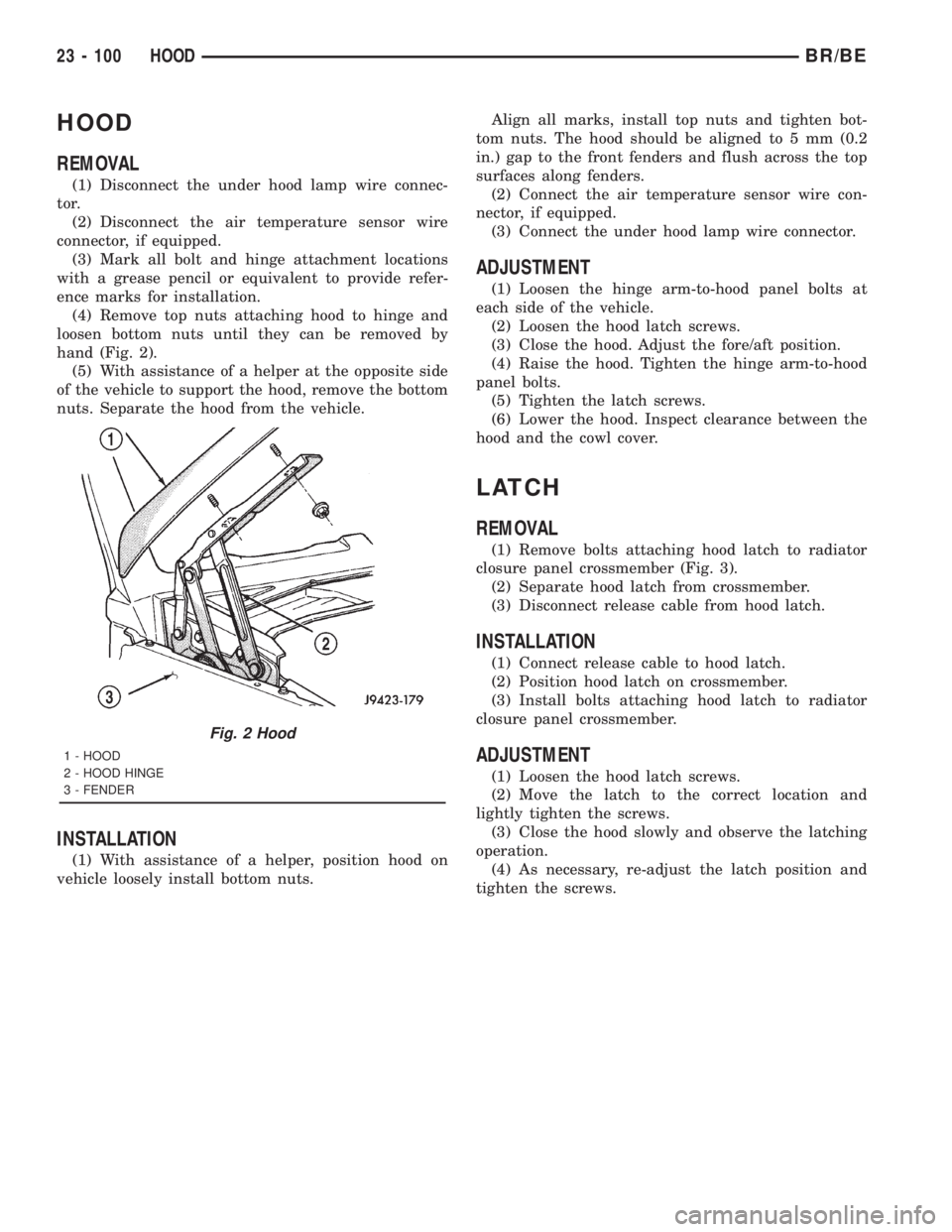
HOOD
REMOVAL
(1) Disconnect the under hood lamp wire connec-
tor.
(2) Disconnect the air temperature sensor wire
connector, if equipped.
(3) Mark all bolt and hinge attachment locations
with a grease pencil or equivalent to provide refer-
ence marks for installation.
(4) Remove top nuts attaching hood to hinge and
loosen bottom nuts until they can be removed by
hand (Fig. 2).
(5) With assistance of a helper at the opposite side
of the vehicle to support the hood, remove the bottom
nuts. Separate the hood from the vehicle.
INSTALLATION
(1) With assistance of a helper, position hood on
vehicle loosely install bottom nuts.Align all marks, install top nuts and tighten bot-
tom nuts. The hood should be aligned to 5 mm (0.2
in.) gap to the front fenders and flush across the top
surfaces along fenders.
(2) Connect the air temperature sensor wire con-
nector, if equipped.
(3) Connect the under hood lamp wire connector.
ADJUSTMENT
(1) Loosen the hinge arm-to-hood panel bolts at
each side of the vehicle.
(2) Loosen the hood latch screws.
(3) Close the hood. Adjust the fore/aft position.
(4) Raise the hood. Tighten the hinge arm-to-hood
panel bolts.
(5) Tighten the latch screws.
(6) Lower the hood. Inspect clearance between the
hood and the cowl cover.
LATCH
REMOVAL
(1) Remove bolts attaching hood latch to radiator
closure panel crossmember (Fig. 3).
(2) Separate hood latch from crossmember.
(3) Disconnect release cable from hood latch.
INSTALLATION
(1) Connect release cable to hood latch.
(2) Position hood latch on crossmember.
(3) Install bolts attaching hood latch to radiator
closure panel crossmember.
ADJUSTMENT
(1) Loosen the hood latch screws.
(2) Move the latch to the correct location and
lightly tighten the screws.
(3) Close the hood slowly and observe the latching
operation.
(4) As necessary, re-adjust the latch position and
tighten the screws.
Fig. 2 Hood
1 - HOOD
2 - HOOD HINGE
3 - FENDER
23 - 100 HOODBR/BE
Page 2676 of 2889
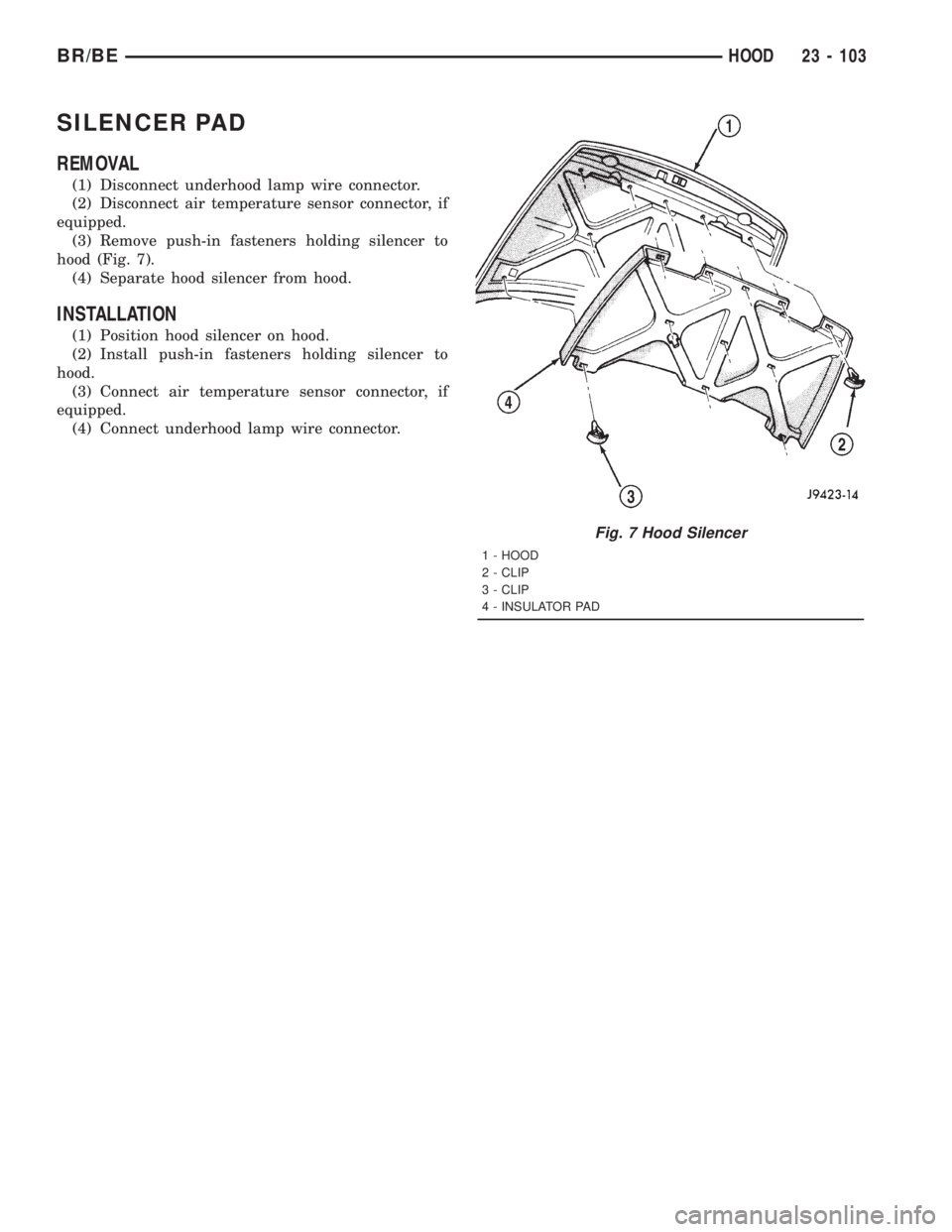
SILENCER PAD
REMOVAL
(1) Disconnect underhood lamp wire connector.
(2) Disconnect air temperature sensor connector, if
equipped.
(3) Remove push-in fasteners holding silencer to
hood (Fig. 7).
(4) Separate hood silencer from hood.
INSTALLATION
(1) Position hood silencer on hood.
(2) Install push-in fasteners holding silencer to
hood.
(3) Connect air temperature sensor connector, if
equipped.
(4) Connect underhood lamp wire connector.
Fig. 7 Hood Silencer
1 - HOOD
2 - CLIP
3 - CLIP
4 - INSULATOR PAD
BR/BEHOOD 23 - 103
Page 2730 of 2889
HEATING & AIR CONDITIONING
TABLE OF CONTENTS
page page
HEATING & AIR CONDITIONING
DESCRIPTION............................1
OPERATION.............................1
DIAGNOSIS AND TESTING..................2
A/C PERFORMANCE.....................2
HEATER PERFORMANCE.................6STANDARD PROCEDURE...................7
DIODE REPLACEMENT...................7
SPECIFICATIONS.........................8
CONTROLS..............................9
DISTRIBUTION..........................31
PLUMBING.............................40
HEATING & AIR
CONDITIONING
DESCRIPTION - HEATER AND AIR
CONDITIONER
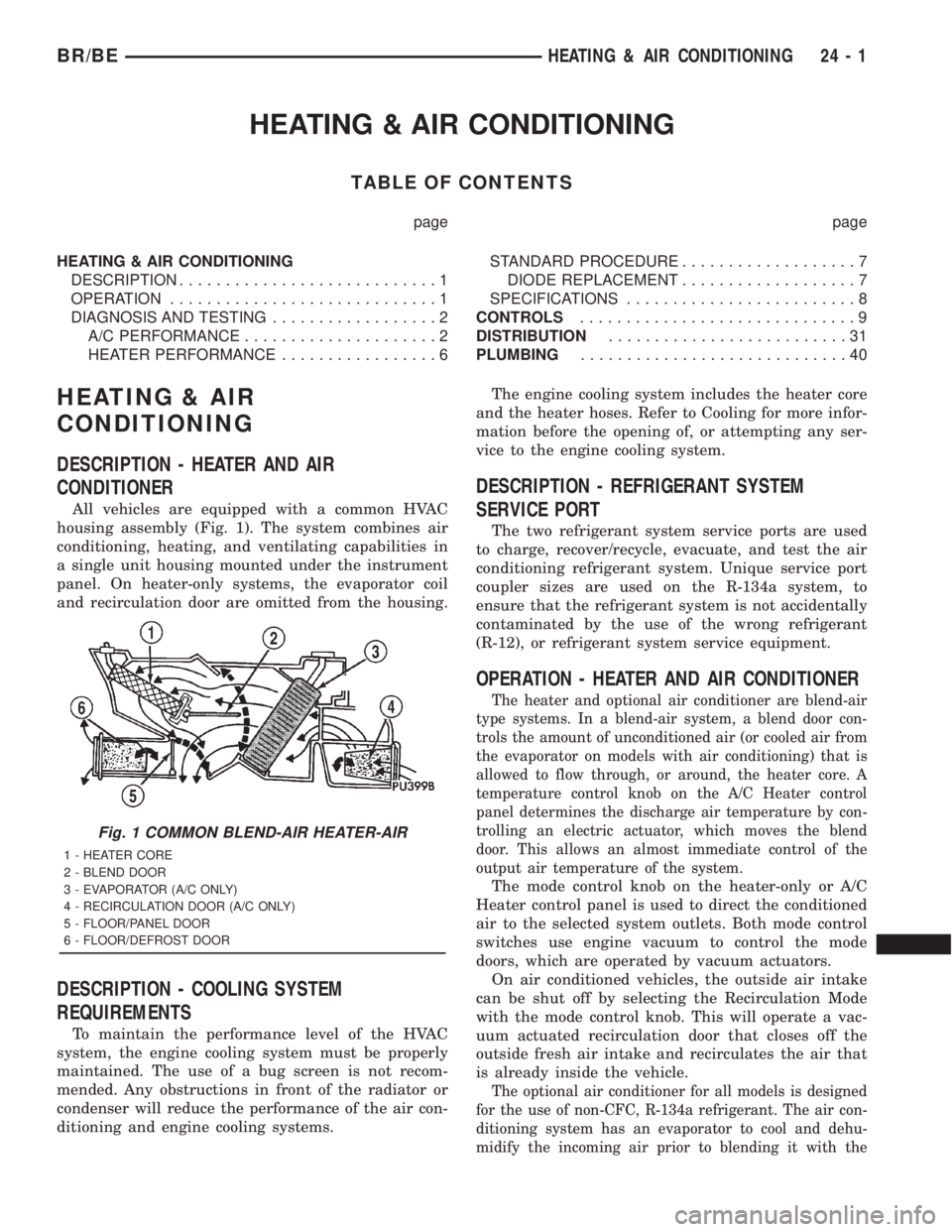
All vehicles are equipped with a common HVAC
housing assembly (Fig. 1). The system combines air
conditioning, heating, and ventilating capabilities in
a single unit housing mounted under the instrument
panel. On heater-only systems, the evaporator coil
and recirculation door are omitted from the housing.
DESCRIPTION - COOLING SYSTEM
REQUIREMENTS
To maintain the performance level of the HVAC
system, the engine cooling system must be properly
maintained. The use of a bug screen is not recom-
mended. Any obstructions in front of the radiator or
condenser will reduce the performance of the air con-
ditioning and engine cooling systems.The engine cooling system includes the heater core
and the heater hoses. Refer to Cooling for more infor-
mation before the opening of, or attempting any ser-
vice to the engine cooling system.
DESCRIPTION - REFRIGERANT SYSTEM
SERVICE PORT
The two refrigerant system service ports are used
to charge, recover/recycle, evacuate, and test the air
conditioning refrigerant system. Unique service port
coupler sizes are used on the R-134a system, to
ensure that the refrigerant system is not accidentally
contaminated by the use of the wrong refrigerant
(R-12), or refrigerant system service equipment.
OPERATION - HEATER AND AIR CONDITIONER
The heater and optional air conditioner are blend-air
type systems. In a blend-air system, a blend door con-
trols the amount of unconditioned air (or cooled air from
the evaporator on models with air conditioning) that is
allowed to flow through, or around, the heater core. A
temperature control knob on the A/C Heater control
panel determines the discharge air temperature by con-
trolling an electric actuator, which moves the blend
door. This allows an almost immediate control of the
output air temperature of the system.
The mode control knob on the heater-only or A/C
Heater control panel is used to direct the conditioned
air to the selected system outlets. Both mode control
switches use engine vacuum to control the mode
doors, which are operated by vacuum actuators.
On air conditioned vehicles, the outside air intake
can be shut off by selecting the Recirculation Mode
with the mode control knob. This will operate a vac-
uum actuated recirculation door that closes off the
outside fresh air intake and recirculates the air that
is already inside the vehicle.
The optional air conditioner for all models is designed
for the use of non-CFC, R-134a refrigerant. The air con-
ditioning system has an evaporator to cool and dehu-
midify the incoming air prior to blending it with the
Fig. 1 COMMON BLEND-AIR HEATER-AIR
1 - HEATER CORE
2 - BLEND DOOR
3 - EVAPORATOR (A/C ONLY)
4 - RECIRCULATION DOOR (A/C ONLY)
5 - FLOOR/PANEL DOOR
6 - FLOOR/DEFROST DOOR
BR/BEHEATING & AIR CONDITIONING 24 - 1