42re DODGE RAM 2001 Service Repair Manual
[x] Cancel search | Manufacturer: DODGE, Model Year: 2001, Model line: RAM, Model: DODGE RAM 2001Pages: 2889, PDF Size: 68.07 MB
Page 2 of 2889
INTRODUCTION
TABLE OF CONTENTS
page page
BODY CODE PLATE
DESCRIPTION............................1
FASTENER IDENTIFICATION
DESCRIPTION............................3
FASTENER USAGE
DESCRIPTION............................6
INTERNATIONAL VEHICLE CONTROL &
DISPLAY SYMBOLS
DESCRIPTION............................6
METRIC SYSTEM
DESCRIPTION............................6TORQUE REFERENCES
DESCRIPTION............................9
VECI LABEL
DESCRIPTION...........................10
OPERATION.............................10
VEHICLE IDENTIFICATION NUMBER
DESCRIPTION...........................10
VEHICLE SAFETY CERTIFICATION LABEL
DESCRIPTION...........................12
EQUIPMENT IDENTIFICATION PLATE
DESCRIPTION...........................12
BODY CODE PLATE
DESCRIPTION
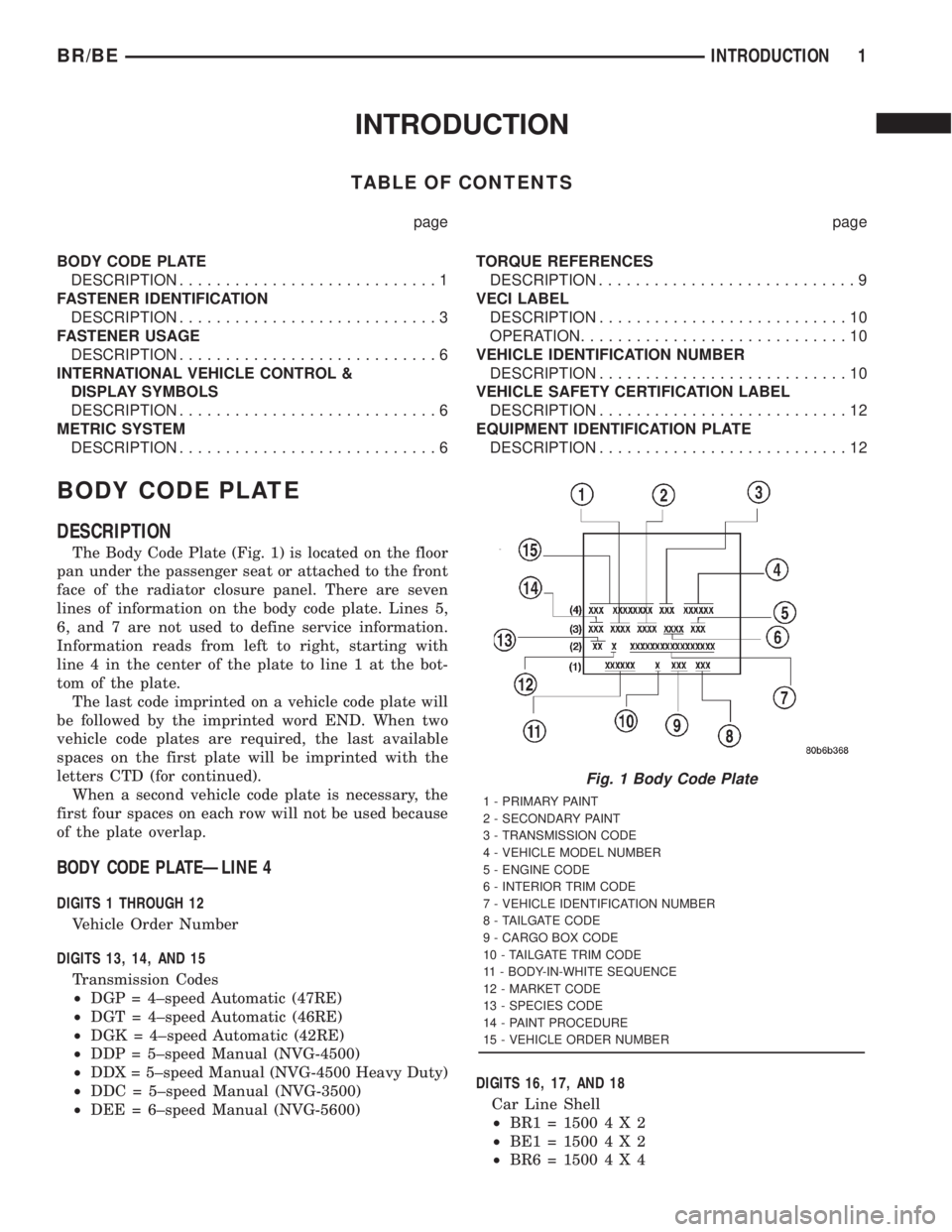
The Body Code Plate (Fig. 1) is located on the floor
pan under the passenger seat or attached to the front
face of the radiator closure panel. There are seven
lines of information on the body code plate. Lines 5,
6, and 7 are not used to define service information.
Information reads from left to right, starting with
line 4 in the center of the plate to line 1 at the bot-
tom of the plate.
The last code imprinted on a vehicle code plate will
be followed by the imprinted word END. When two
vehicle code plates are required, the last available
spaces on the first plate will be imprinted with the
letters CTD (for continued).
When a second vehicle code plate is necessary, the
first four spaces on each row will not be used because
of the plate overlap.
BODY CODE PLATEÐLINE 4
DIGITS 1 THROUGH 12
Vehicle Order Number
DIGITS 13, 14, AND 15
Transmission Codes
²DGP = 4±speed Automatic (47RE)
²DGT = 4±speed Automatic (46RE)
²DGK = 4±speed Automatic (42RE)
²DDP = 5±speed Manual (NVG-4500)
²DDX = 5±speed Manual (NVG-4500 Heavy Duty)
²DDC = 5±speed Manual (NVG-3500)
²DEE = 6±speed Manual (NVG-5600)DIGITS 16, 17, AND 18
Car Line Shell
²BR1=15004X2
²BE1=15004X2
²BR6=15004X4
Fig. 1 Body Code Plate
1 - PRIMARY PAINT
2 - SECONDARY PAINT
3 - TRANSMISSION CODE
4 - VEHICLE MODEL NUMBER
5 - ENGINE CODE
6 - INTERIOR TRIM CODE
7 - VEHICLE IDENTIFICATION NUMBER
8 - TAILGATE CODE
9 - CARGO BOX CODE
10 - TAILGATE TRIM CODE
11 - BODY-IN-WHITE SEQUENCE
12 - MARKET CODE
13 - SPECIES CODE
14 - PAINT PROCEDURE
15 - VEHICLE ORDER NUMBER
BR/BEINTRODUCTION 1
Page 19 of 2889
FLUID CAPACITIES
SPECIFICATIONS
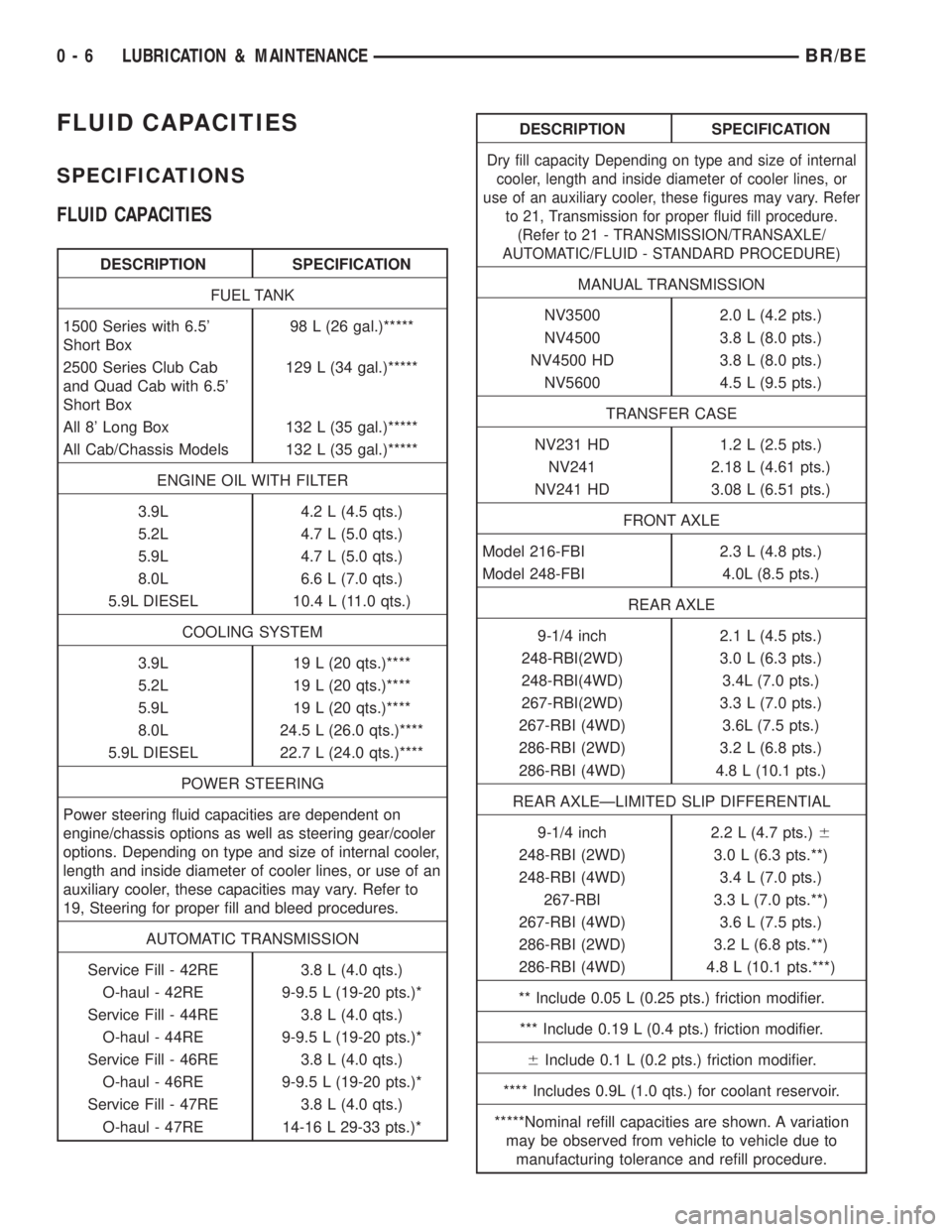
FLUID CAPACITIES
DESCRIPTION SPECIFICATION
FUEL TANK
1500 Series with 6.5'
Short Box98 L (26 gal.)*****
2500 Series Club Cab
and Quad Cab with 6.5'
Short Box129 L (34 gal.)*****
All 8' Long Box 132 L (35 gal.)*****
All Cab/Chassis Models 132 L (35 gal.)*****
ENGINE OIL WITH FILTER
3.9L 4.2 L (4.5 qts.)
5.2L 4.7 L (5.0 qts.)
5.9L 4.7 L (5.0 qts.)
8.0L 6.6 L (7.0 qts.)
5.9L DIESEL 10.4 L (11.0 qts.)
COOLING SYSTEM
3.9L 19 L (20 qts.)****
5.2L 19 L (20 qts.)****
5.9L 19 L (20 qts.)****
8.0L 24.5 L (26.0 qts.)****
5.9L DIESEL 22.7 L (24.0 qts.)****
POWER STEERING
Power steering fluid capacities are dependent on
engine/chassis options as well as steering gear/cooler
options. Depending on type and size of internal cooler,
length and inside diameter of cooler lines, or use of an
auxiliary cooler, these capacities may vary. Refer to
19, Steering for proper fill and bleed procedures.
AUTOMATIC TRANSMISSION
Service Fill - 42RE 3.8 L (4.0 qts.)
O-haul - 42RE 9-9.5 L (19-20 pts.)*
Service Fill - 44RE 3.8 L (4.0 qts.)
O-haul - 44RE 9-9.5 L (19-20 pts.)*
Service Fill - 46RE 3.8 L (4.0 qts.)
O-haul - 46RE 9-9.5 L (19-20 pts.)*
Service Fill - 47RE 3.8 L (4.0 qts.)
O-haul - 47RE 14-16 L 29-33 pts.)*
DESCRIPTION SPECIFICATION
Dry fill capacity Depending on type and size of internal
cooler, length and inside diameter of cooler lines, or
use of an auxiliary cooler, these figures may vary. Refer
to 21, Transmission for proper fluid fill procedure.
(Refer to 21 - TRANSMISSION/TRANSAXLE/
AUTOMATIC/FLUID - STANDARD PROCEDURE)
MANUAL TRANSMISSION
NV3500 2.0 L (4.2 pts.)
NV4500 3.8 L (8.0 pts.)
NV4500 HD 3.8 L (8.0 pts.)
NV5600 4.5 L (9.5 pts.)
TRANSFER CASE
NV231 HD 1.2 L (2.5 pts.)
NV241 2.18 L (4.61 pts.)
NV241 HD 3.08 L (6.51 pts.)
FRONT AXLE
Model 216-FBI 2.3 L (4.8 pts.)
Model 248-FBI 4.0L (8.5 pts.)
REAR AXLE
9-1/4 inch 2.1 L (4.5 pts.)
248-RBI(2WD) 3.0 L (6.3 pts.)
248-RBI(4WD) 3.4L (7.0 pts.)
267-RBI(2WD) 3.3 L (7.0 pts.)
267-RBI (4WD) 3.6L (7.5 pts.)
286-RBI (2WD) 3.2 L (6.8 pts.)
286-RBI (4WD) 4.8 L (10.1 pts.)
REAR AXLEÐLIMITED SLIP DIFFERENTIAL
9-1/4 inch 2.2 L (4.7 pts.)6
248-RBI (2WD) 3.0 L (6.3 pts.**)
248-RBI (4WD) 3.4 L (7.0 pts.)
267-RBI 3.3 L (7.0 pts.**)
267-RBI (4WD) 3.6 L (7.5 pts.)
286-RBI (2WD) 3.2 L (6.8 pts.**)
286-RBI (4WD) 4.8 L (10.1 pts.***)
** Include 0.05 L (0.25 pts.) friction modifier.
*** Include 0.19 L (0.4 pts.) friction modifier.
6Include 0.1 L (0.2 pts.) friction modifier.
**** Includes 0.9L (1.0 qts.) for coolant reservoir.
*****Nominal refill capacities are shown. A variation
may be observed from vehicle to vehicle due to
manufacturing tolerance and refill procedure.
0 - 6 LUBRICATION & MAINTENANCEBR/BE
Page 417 of 2889
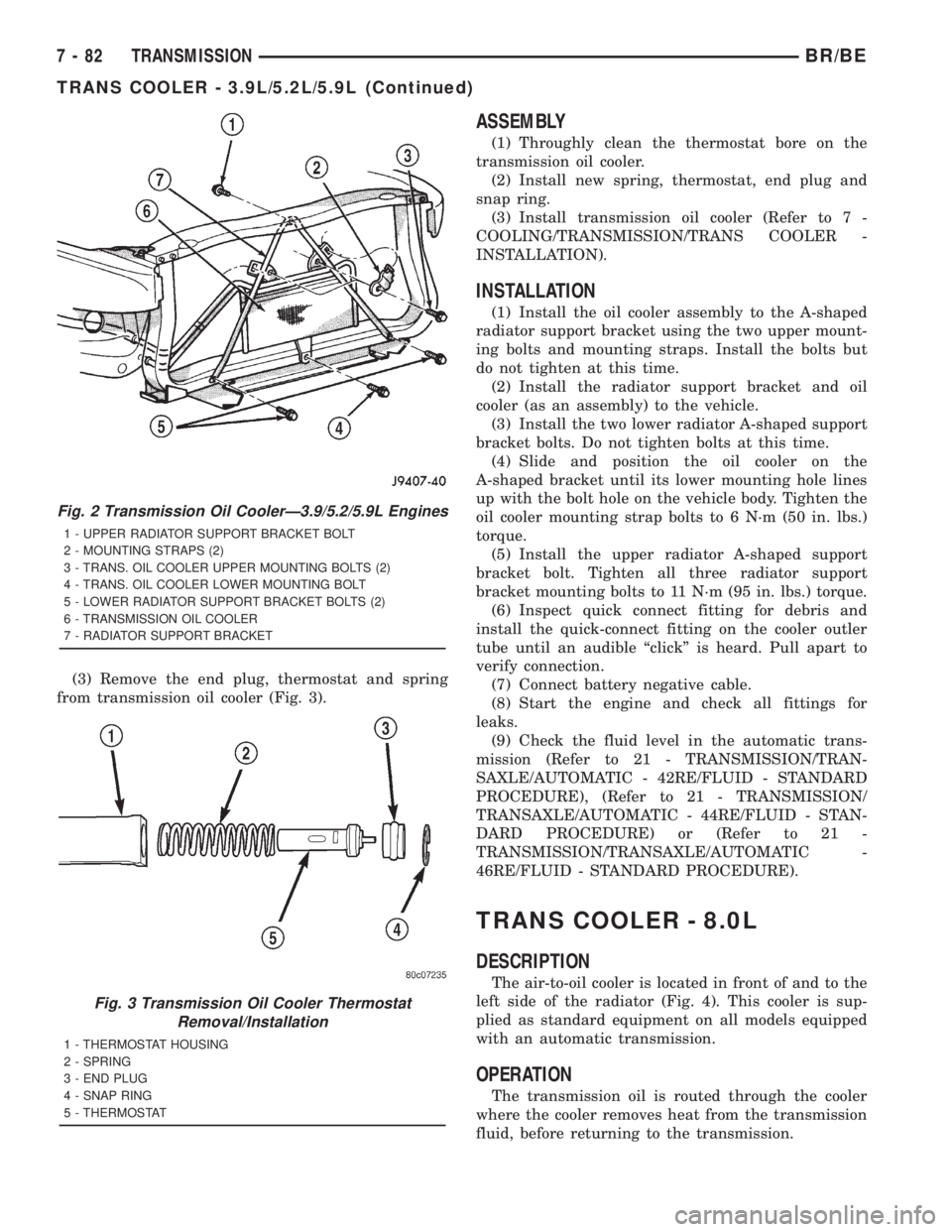
(3) Remove the end plug, thermostat and spring
from transmission oil cooler (Fig. 3).
ASSEMBLY
(1) Throughly clean the thermostat bore on the
transmission oil cooler.
(2) Install new spring, thermostat, end plug and
snap ring.
(3) Install transmission oil cooler (Refer to 7 -
COOLING/TRANSMISSION/TRANS COOLER -
INSTALLATION).
INSTALLATION
(1) Install the oil cooler assembly to the A-shaped
radiator support bracket using the two upper mount-
ing bolts and mounting straps. Install the bolts but
do not tighten at this time.
(2) Install the radiator support bracket and oil
cooler (as an assembly) to the vehicle.
(3) Install the two lower radiator A-shaped support
bracket bolts. Do not tighten bolts at this time.
(4) Slide and position the oil cooler on the
A-shaped bracket until its lower mounting hole lines
up with the bolt hole on the vehicle body. Tighten the
oil cooler mounting strap bolts to 6 N´m (50 in. lbs.)
torque.
(5) Install the upper radiator A-shaped support
bracket bolt. Tighten all three radiator support
bracket mounting bolts to 11 N´m (95 in. lbs.) torque.
(6) Inspect quick connect fitting for debris and
install the quick-connect fitting on the cooler outler
tube until an audible ªclickº is heard. Pull apart to
verify connection.
(7) Connect battery negative cable.
(8) Start the engine and check all fittings for
leaks.
(9) Check the fluid level in the automatic trans-
mission (Refer to 21 - TRANSMISSION/TRAN-
SAXLE/AUTOMATIC - 42RE/FLUID - STANDARD
PROCEDURE), (Refer to 21 - TRANSMISSION/
TRANSAXLE/AUTOMATIC - 44RE/FLUID - STAN-
DARD PROCEDURE) or (Refer to 21 -
TRANSMISSION/TRANSAXLE/AUTOMATIC -
46RE/FLUID - STANDARD PROCEDURE).
TRANS COOLER - 8.0L
DESCRIPTION
The air-to-oil cooler is located in front of and to the
left side of the radiator (Fig. 4). This cooler is sup-
plied as standard equipment on all models equipped
with an automatic transmission.
OPERATION
The transmission oil is routed through the cooler
where the cooler removes heat from the transmission
fluid, before returning to the transmission.
Fig. 2 Transmission Oil CoolerÐ3.9/5.2/5.9L Engines
1 - UPPER RADIATOR SUPPORT BRACKET BOLT
2 - MOUNTING STRAPS (2)
3 - TRANS. OIL COOLER UPPER MOUNTING BOLTS (2)
4 - TRANS. OIL COOLER LOWER MOUNTING BOLT
5 - LOWER RADIATOR SUPPORT BRACKET BOLTS (2)
6 - TRANSMISSION OIL COOLER
7 - RADIATOR SUPPORT BRACKET
Fig. 3 Transmission Oil Cooler Thermostat
Removal/Installation
1 - THERMOSTAT HOUSING
2 - SPRING
3 - END PLUG
4 - SNAP RING
5 - THERMOSTAT
7 - 82 TRANSMISSIONBR/BE
TRANS COOLER - 3.9L/5.2L/5.9L (Continued)
Page 1604 of 2889
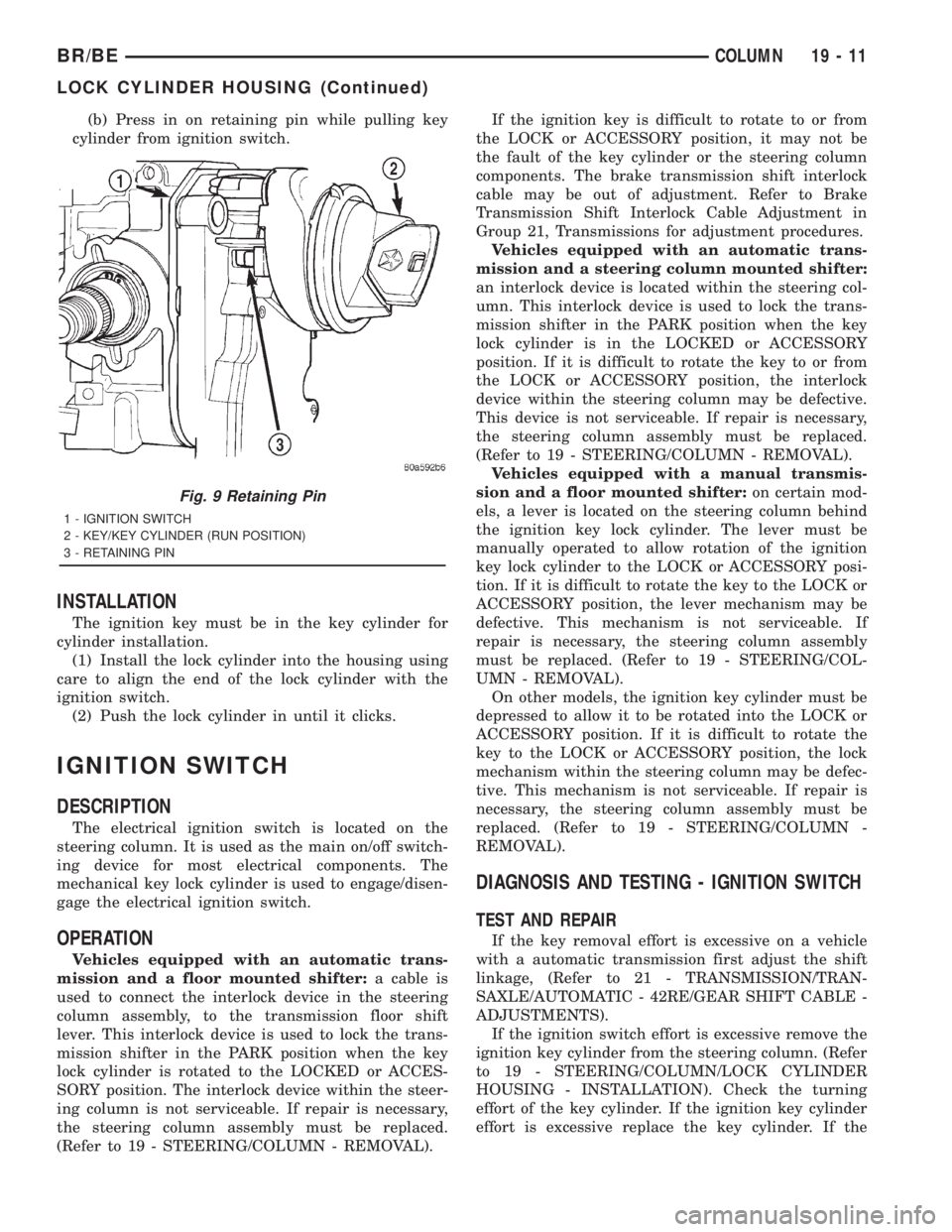
(b) Press in on retaining pin while pulling key
cylinder from ignition switch.
INSTALLATION
The ignition key must be in the key cylinder for
cylinder installation.
(1) Install the lock cylinder into the housing using
care to align the end of the lock cylinder with the
ignition switch.
(2) Push the lock cylinder in until it clicks.
IGNITION SWITCH
DESCRIPTION
The electrical ignition switch is located on the
steering column. It is used as the main on/off switch-
ing device for most electrical components. The
mechanical key lock cylinder is used to engage/disen-
gage the electrical ignition switch.
OPERATION
Vehicles equipped with an automatic trans-
mission and a floor mounted shifter:a cable is
used to connect the interlock device in the steering
column assembly, to the transmission floor shift
lever. This interlock device is used to lock the trans-
mission shifter in the PARK position when the key
lock cylinder is rotated to the LOCKED or ACCES-
SORY position. The interlock device within the steer-
ing column is not serviceable. If repair is necessary,
the steering column assembly must be replaced.
(Refer to 19 - STEERING/COLUMN - REMOVAL).If the ignition key is difficult to rotate to or from
the LOCK or ACCESSORY position, it may not be
the fault of the key cylinder or the steering column
components. The brake transmission shift interlock
cable may be out of adjustment. Refer to Brake
Transmission Shift Interlock Cable Adjustment in
Group 21, Transmissions for adjustment procedures.
Vehicles equipped with an automatic trans-
mission and a steering column mounted shifter:
an interlock device is located within the steering col-
umn. This interlock device is used to lock the trans-
mission shifter in the PARK position when the key
lock cylinder is in the LOCKED or ACCESSORY
position. If it is difficult to rotate the key to or from
the LOCK or ACCESSORY position, the interlock
device within the steering column may be defective.
This device is not serviceable. If repair is necessary,
the steering column assembly must be replaced.
(Refer to 19 - STEERING/COLUMN - REMOVAL).
Vehicles equipped with a manual transmis-
sion and a floor mounted shifter:on certain mod-
els, a lever is located on the steering column behind
the ignition key lock cylinder. The lever must be
manually operated to allow rotation of the ignition
key lock cylinder to the LOCK or ACCESSORY posi-
tion. If it is difficult to rotate the key to the LOCK or
ACCESSORY position, the lever mechanism may be
defective. This mechanism is not serviceable. If
repair is necessary, the steering column assembly
must be replaced. (Refer to 19 - STEERING/COL-
UMN - REMOVAL).
On other models, the ignition key cylinder must be
depressed to allow it to be rotated into the LOCK or
ACCESSORY position. If it is difficult to rotate the
key to the LOCK or ACCESSORY position, the lock
mechanism within the steering column may be defec-
tive. This mechanism is not serviceable. If repair is
necessary, the steering column assembly must be
replaced. (Refer to 19 - STEERING/COLUMN -
REMOVAL).
DIAGNOSIS AND TESTING - IGNITION SWITCH
TEST AND REPAIR
If the key removal effort is excessive on a vehicle
with a automatic transmission first adjust the shift
linkage, (Refer to 21 - TRANSMISSION/TRAN-
SAXLE/AUTOMATIC - 42RE/GEAR SHIFT CABLE -
ADJUSTMENTS).
If the ignition switch effort is excessive remove the
ignition key cylinder from the steering column. (Refer
to 19 - STEERING/COLUMN/LOCK CYLINDER
HOUSING - INSTALLATION). Check the turning
effort of the key cylinder. If the ignition key cylinder
effort is excessive replace the key cylinder. If the
Fig. 9 Retaining Pin
1 - IGNITION SWITCH
2 - KEY/KEY CYLINDER (RUN POSITION)
3 - RETAINING PIN
BR/BECOLUMN 19 - 11
LOCK CYLINDER HOUSING (Continued)
Page 1636 of 2889
TRANSMISSION AND TRANSFER CASE
TABLE OF CONTENTS
page page
MANUAL - NV3500........................1
MANUAL - NV4500.......................44
MANUAL - NV5600.......................91
AUTOMATIC TRANSMISSION - 42RE........134
AUTOMATIC TRANSMISSION - 44RE........305AUTOMATIC TRANSMISSION - 46RE........477
AUTOMATIC TRANSMISSION - 47RE........648
TRANSFER CASE - NV231HD..............820
TRANSFER CASE - NV241LD..............855
TRANSFER CASE - NV241HD..............890
MANUAL - NV3500
TABLE OF CONTENTS
page page
MANUAL - NV3500
DESCRIPTION............................1
OPERATION.............................1
DIAGNOSIS AND TESTING..................3
MANUAL TRANSMISSION.................3
REMOVAL...............................3
DISASSEMBLY............................5CLEANING..............................15
INSPECTION............................15
ASSEMBLY.............................17
INSTALLATION...........................40
SPECIFICATIONS........................41
SPECIAL TOOLS.........................41
MANUAL - NV3500
DESCRIPTION
The NV3500 is a medium-duty 5-speed, constant
mesh fully synchronized manual transmission. Fifth
gear is an overdrive range with a ratio of 0.73:1. The
NV3500 is available in two and four-wheel drive con-
figurations.
The transmission gear case consists of two alumi-
num housings (Fig. 1). The clutch housing is not a
removable component. It is an integral part of the
transmission front housing.
A combination of roller and ball bearings are used
to support the transmission shafts in the two hous-
ings. The transmission gears all rotate on caged type
needle bearings. A roller bearing is used between the
input and output shaft.
The transmission has a single shaft shift mecha-
nism with three shift forks all mounted on the shaft.
The shaft is supported in the front and rear housings
by bushings and one linear ball bearing. Internal
shift components consist of the forks, shaft, shift
lever socket, and detent components
GEAR RATIOS
Gear ratios is as follows:
GEAR RATIO
FIRST 4.02:1
SECOND 2.32:1
THIRD 1.40:1
FOURTH 1:1
FIFTH 0.73:1
REVERSE 3.55:1
OPERATION
The manual transmission receives power through
the clutch assembly from the engine. The clutch disc
is splined to the transmission input shaft and is
turned at engine speed at all times that the clutch is
engaged. The input shaft is connected to the trans-
mission countershaft through the mesh of fourth
speed gear on the input shaft and the fourth counter-
shaft gear. At this point, all the transmission gears
are spinning.
BR/BETRANSMISSION AND TRANSFER CASE 21 - 1
Page 1769 of 2889
AUTOMATIC TRANSMISSION - 42RE
TABLE OF CONTENTS
page page
AUTOMATIC TRANSMISSION - 42RE
DESCRIPTION..........................135
OPERATION............................137
DIAGNOSIS AND TESTING................143
AUTOMATIC TRANSMISSION.............143
PRELIMINARY........................143
ROAD TESTING.......................143
HYDRAULIC PRESSURE TEST...........144
AIR CHECKING TRANSMISSION CLUTCH
AND BAND OPERATION.................147
CONVERTER HOUSING FLUID LEAK......148
DIAGNOSIS CHARTS...................149
STANDARD PROCEDURE.................159
ALUMINUM THREAD REPAIR.............159
REMOVAL.............................159
DISASSEMBLY..........................160
CLEANING.............................165
INSPECTION...........................165
ASSEMBLY............................166
INSTALLATION..........................173
SCHEMATICS AND DIAGRAMS.............174
SPECIFICATIONS........................186
SPECIAL TOOLS........................188
ACCUMULATOR
DESCRIPTION..........................191
OPERATION............................191
INSPECTION...........................192
BANDS
DESCRIPTION..........................192
OPERATION............................192
ADJUSTMENTS.........................193
ELECTRONIC GOVERNOR
DESCRIPTION..........................194
OPERATION............................194
REMOVAL.............................196
INSTALLATION..........................197
EXTENSION HOUSING BUSHING
REMOVAL.............................198
INSTALLATION..........................198
EXTENSION HOUSING SEAL
REMOVAL.............................198
INSTALLATION..........................198
FLUID AND FILTER
DIAGNOSIS AND TESTING................199
EFFECTS OF INCORRECT FLUID LEVEL . . . 199
CAUSES OF BURNT FLUID..............199
FLUID CONTAMINATION................199
STANDARD PROCEDURE.................199
FLUID LEVEL CHECK...................199FLUID AND FILTER REPLACEMENT.......201
TRANSMISSION FILL...................201
FRONT CLUTCH
DESCRIPTION..........................202
OPERATION............................202
DISASSEMBLY..........................202
INSPECTION...........................205
ASSEMBLY............................206
FRONT SERVO
DESCRIPTION..........................206
OPERATION............................207
DISASSEMBLY..........................207
CLEANING.............................207
INSPECTION...........................207
ASSEMBLY............................208
OIL PUMP
DESCRIPTION..........................208
OPERATION............................208
STANDARD PROCEDURE.................209
OIL PUMP VOLUME CHECK..............209
DISASSEMBLY..........................209
CLEANING.............................211
INSPECTION...........................211
ASSEMBLY............................212
OUTPUT SHAFT FRONT BEARING
REMOVAL.............................213
INSTALLATION..........................213
OUTPUT SHAFT REAR BEARING
REMOVAL.............................213
INSTALLATION..........................213
OVERDRIVE CLUTCH
DESCRIPTION..........................214
OPERATION............................214
OVERDRIVE OFF SWITCH
DESCRIPTION..........................215
OPERATION............................215
DIAGNOSIS AND TESTING................215
OVERDRIVE ELECTRICAL CONTROLS.....215
REMOVAL.............................215
INSTALLATION..........................215
OVERDRIVE UNIT
REMOVAL.............................216
DISASSEMBLY..........................217
CLEANING.............................224
INSPECTION...........................224
ASSEMBLY............................225
INSTALLATION..........................234
21 - 134 AUTOMATIC TRANSMISSION - 42REBR/BE
Page 1770 of 2889
OVERRUNNING CLUTCH CAM/OVERDRIVE
PISTON RETAINER
DESCRIPTION..........................235
OPERATION............................235
DISASSEMBLY..........................235
CLEANING.............................236
INSPECTION...........................236
ASSEMBLY............................236
PARK/NEUTRAL POSITION SWITCH
DIAGNOSIS AND TESTING................237
PARK/NEUTRAL POSITION SWITCH.......237
REMOVAL.............................238
INSTALLATION..........................238
PISTONS
DESCRIPTION..........................238
OPERATION............................238
PLANETARY GEARTRAIN/OUTPUT SHAFT
DESCRIPTION..........................240
OPERATION............................240
DISASSEMBLY..........................240
INSPECTION...........................241
ASSEMBLY............................241
REAR CLUTCH
DESCRIPTION..........................246
OPERATION............................246
DISASSEMBLY..........................247
CLEANING.............................247
INSPECTION...........................248
ASSEMBLY............................248
REAR SERVO
DESCRIPTION..........................250
OPERATION............................250
DISASSEMBLY..........................251
CLEANING.............................251
ASSEMBLY............................251
SHIFT MECHANISM
DESCRIPTION..........................251OPERATION............................251
ADJUSTMENTS.........................252
SOLENOID
DESCRIPTION..........................252
OPERATION............................253
SPEED SENSOR
DESCRIPTION..........................253
OPERATION............................253
THROTTLE VALVE CABLE
DESCRIPTION..........................253
ADJUSTMENTS.........................254
TORQUE CONVERTER
DESCRIPTION..........................256
OPERATION............................260
REMOVAL.............................261
INSTALLATION..........................261
TORQUE CONVERTER DRAINBACK VALVE
DESCRIPTION..........................262
OPERATION............................262
STANDARD PROCEDURE.................262
TORQUE CONVERTER DRAINBACK VALVE . 262
TRANSMISSION TEMPERATURE SENSOR
DESCRIPTION..........................262
OPERATION............................262
VALVE BODY
DESCRIPTION..........................263
OPERATION............................267
REMOVAL.............................281
DISASSEMBLY..........................282
CLEANING.............................293
INSPECTION...........................293
ASSEMBLY............................294
INSTALLATION..........................303
ADJUSTMENTS.........................304
AUTOMATIC TRANSMISSION -
42RE
DESCRIPTION
The 42RE is a four speed fully automatic transmis-
sion (Fig. 1) with an electronic governor. The 42RE is
equipped with a lock-up clutch in the torque con-
verter. First through third gear ranges are provided
by the clutches, bands, overrunning clutch, and plan-
etary gear sets in the transmission. Fourth gear
range is provided by the overdrive unit that contains
an overdrive clutch, direct clutch, planetary gear set,
and overrunning clutch.
The transmission contains a front, rear, and direct
clutch which function as the input driving compo-
nents. It also contains the kickdown (front) and thelow/reverse (rear) bands which, along with the over-
running clutch and overdrive clutch, serve as the
holding components. The driving and holding compo-
nents combine to select the necessary planetary gear
components, in the front, rear, or overdrive planetary
gear set, transfer the engine power from the input
shaft through to the output shaft.
The valve body is mounted to the lower side of the
transmission and contains the valves to control pres-
sure regulation, fluid flow control, and clutch/band
application. The oil pump is mounted at the front of
the transmission and is driven by the torque con-
verter hub. The pump supplies the oil pressure nec-
essary for clutch/band actuation and transmission
lubrication.
BR/BEAUTOMATIC TRANSMISSION - 42RE 21 - 135
Page 1771 of 2889
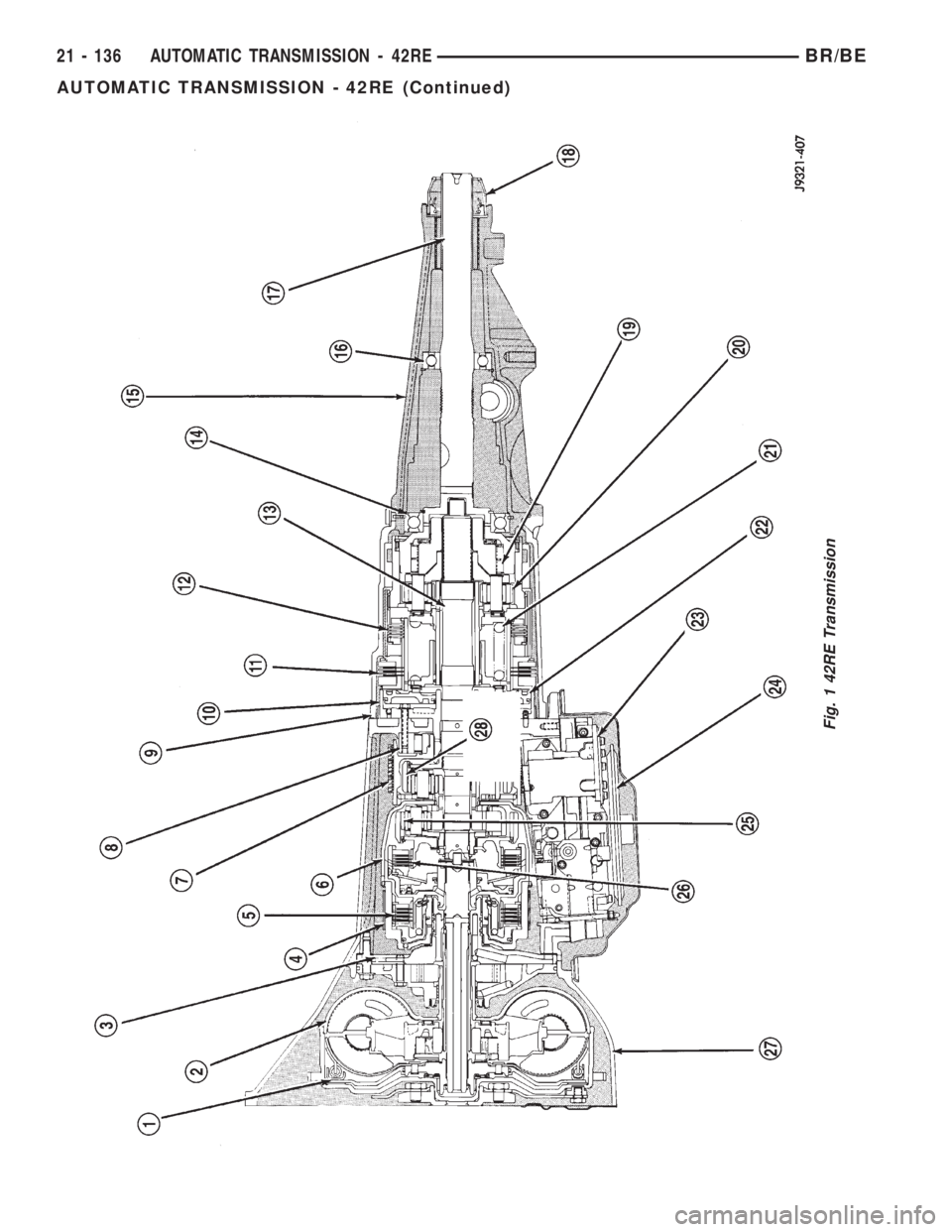
Fig. 1 42RE Transmission
21 - 136 AUTOMATIC TRANSMISSION - 42REBR/BE
AUTOMATIC TRANSMISSION - 42RE (Continued)
Page 1772 of 2889
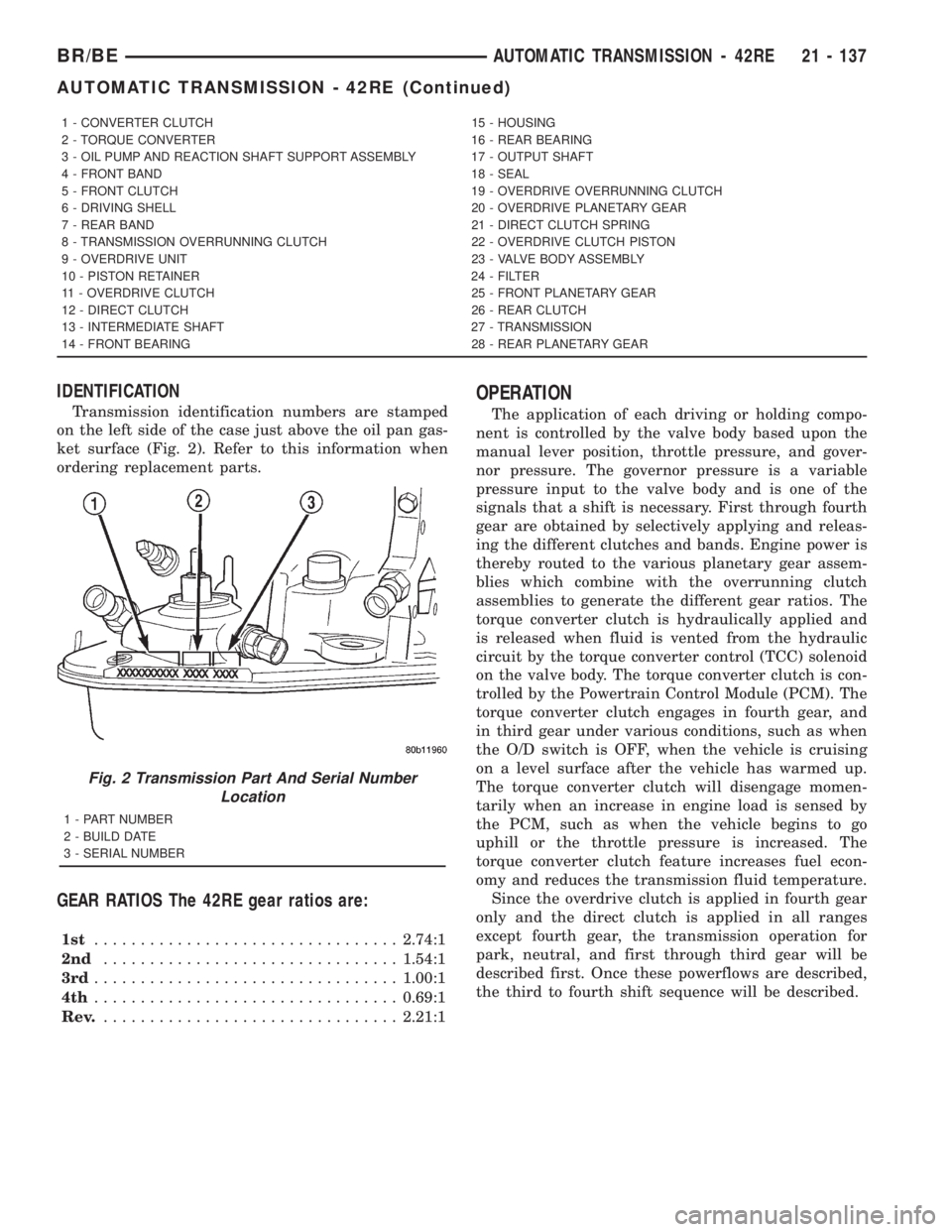
IDENTIFICATION
Transmission identification numbers are stamped
on the left side of the case just above the oil pan gas-
ket surface (Fig. 2). Refer to this information when
ordering replacement parts.
GEAR RATIOS The 42RE gear ratios are:
1st.................................2.74:1
2nd................................1.54:1
3rd.................................1.00:1
4th.................................0.69:1
Rev.................................2.21:1
OPERATION
The application of each driving or holding compo-
nent is controlled by the valve body based upon the
manual lever position, throttle pressure, and gover-
nor pressure. The governor pressure is a variable
pressure input to the valve body and is one of the
signals that a shift is necessary. First through fourth
gear are obtained by selectively applying and releas-
ing the different clutches and bands. Engine power is
thereby routed to the various planetary gear assem-
blies which combine with the overrunning clutch
assemblies to generate the different gear ratios. The
torque converter clutch is hydraulically applied and
is released when fluid is vented from the hydraulic
circuit by the torque converter control (TCC) solenoid
on the valve body. The torque converter clutch is con-
trolled by the Powertrain Control Module (PCM). The
torque converter clutch engages in fourth gear, and
in third gear under various conditions, such as when
the O/D switch is OFF, when the vehicle is cruising
on a level surface after the vehicle has warmed up.
The torque converter clutch will disengage momen-
tarily when an increase in engine load is sensed by
the PCM, such as when the vehicle begins to go
uphill or the throttle pressure is increased. The
torque converter clutch feature increases fuel econ-
omy and reduces the transmission fluid temperature.
Since the overdrive clutch is applied in fourth gear
only and the direct clutch is applied in all ranges
except fourth gear, the transmission operation for
park, neutral, and first through third gear will be
described first. Once these powerflows are described,
the third to fourth shift sequence will be described.
1 - CONVERTER CLUTCH 15 - HOUSING
2 - TORQUE CONVERTER 16 - REAR BEARING
3 - OIL PUMP AND REACTION SHAFT SUPPORT ASSEMBLY 17 - OUTPUT SHAFT
4 - FRONT BAND 18 - SEAL
5 - FRONT CLUTCH 19 - OVERDRIVE OVERRUNNING CLUTCH
6 - DRIVING SHELL 20 - OVERDRIVE PLANETARY GEAR
7 - REAR BAND 21 - DIRECT CLUTCH SPRING
8 - TRANSMISSION OVERRUNNING CLUTCH 22 - OVERDRIVE CLUTCH PISTON
9 - OVERDRIVE UNIT 23 - VALVE BODY ASSEMBLY
10 - PISTON RETAINER 24 - FILTER
11 - OVERDRIVE CLUTCH 25 - FRONT PLANETARY GEAR
12 - DIRECT CLUTCH 26 - REAR CLUTCH
13 - INTERMEDIATE SHAFT 27 - TRANSMISSION
14 - FRONT BEARING 28 - REAR PLANETARY GEAR
Fig. 2 Transmission Part And Serial Number
Location
1 - PART NUMBER
2 - BUILD DATE
3 - SERIAL NUMBER
BR/BEAUTOMATIC TRANSMISSION - 42RE 21 - 137
AUTOMATIC TRANSMISSION - 42RE (Continued)
Page 1773 of 2889
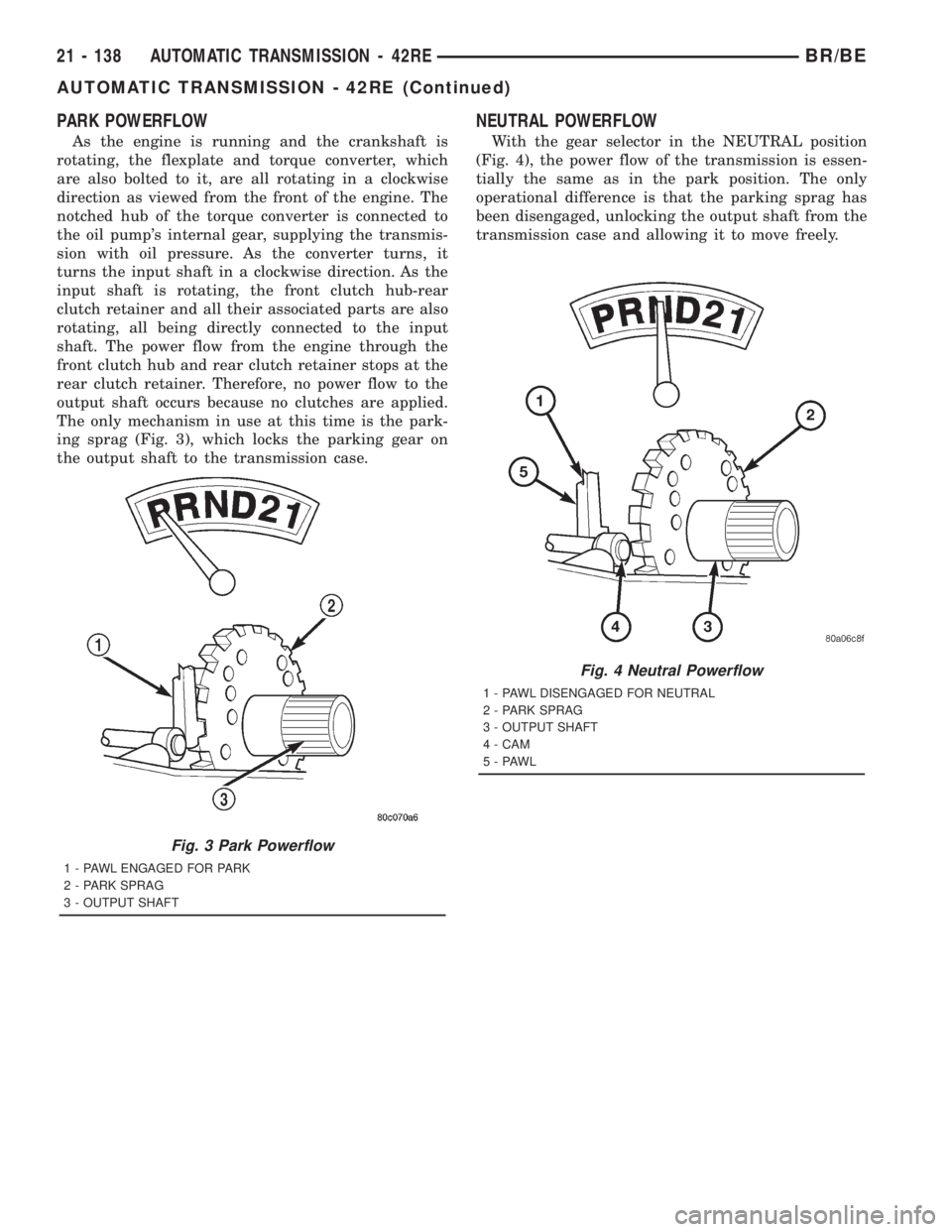
PARK POWERFLOW
As the engine is running and the crankshaft is
rotating, the flexplate and torque converter, which
are also bolted to it, are all rotating in a clockwise
direction as viewed from the front of the engine. The
notched hub of the torque converter is connected to
the oil pump's internal gear, supplying the transmis-
sion with oil pressure. As the converter turns, it
turns the input shaft in a clockwise direction. As the
input shaft is rotating, the front clutch hub-rear
clutch retainer and all their associated parts are also
rotating, all being directly connected to the input
shaft. The power flow from the engine through the
front clutch hub and rear clutch retainer stops at the
rear clutch retainer. Therefore, no power flow to the
output shaft occurs because no clutches are applied.
The only mechanism in use at this time is the park-
ing sprag (Fig. 3), which locks the parking gear on
the output shaft to the transmission case.
NEUTRAL POWERFLOW
With the gear selector in the NEUTRAL position
(Fig. 4), the power flow of the transmission is essen-
tially the same as in the park position. The only
operational difference is that the parking sprag has
been disengaged, unlocking the output shaft from the
transmission case and allowing it to move freely.
Fig. 3 Park Powerflow
1 - PAWL ENGAGED FOR PARK
2 - PARK SPRAG
3 - OUTPUT SHAFT
Fig. 4 Neutral Powerflow
1 - PAWL DISENGAGED FOR NEUTRAL
2 - PARK SPRAG
3 - OUTPUT SHAFT
4 - CAM
5-PAWL
21 - 138 AUTOMATIC TRANSMISSION - 42REBR/BE
AUTOMATIC TRANSMISSION - 42RE (Continued)