child lock DODGE RAM 2001 Service Repair Manual
[x] Cancel search | Manufacturer: DODGE, Model Year: 2001, Model line: RAM, Model: DODGE RAM 2001Pages: 2889, PDF Size: 68.07 MB
Page 492 of 2889
rosion or foreign material, then reassembled.
Following reassembly, check the voltage drop for the
battery cable connection and the battery cable again
to confirm repair.
When performing the voltage drop test, it is impor-
tant to remember that the voltage drop is giving an
indication of the resistance between the two points at
which the voltmeter probes are attached.EXAM-
PLE:When testing the resistance of the battery pos-
itive cable, touch the voltmeter leads to the battery
positive cable terminal clamp and to the battery pos-
itive cable eyelet terminal at the starter solenoid
B(+) terminal stud. If you probe the battery positive
terminal post and the battery positive cable eyelet
terminal at the starter solenoid B(+) terminal stud,
you are reading the combined voltage drop in the
battery positive cable terminal clamp-to-terminal
post connection and the battery positive cable.
VOLTAGE DROP TEST
WARNING: IF THE BATTERY SHOWS SIGNS OF
FREEZING, LEAKING, LOOSE POSTS, OR LOW
ELECTROLYTE LEVEL, DO NOT TEST, ASSIST-
BOOST, OR CHARGE. THE BATTERY MAY ARC
INTERNALLY AND EXPLODE. PERSONAL INJURY
AND/OR VEHICLE DAMAGE MAY RESULT.
WARNING: EXPLOSIVE HYDROGEN GAS FORMS IN
AND AROUND THE BATTERY. DO NOT SMOKE,
USE FLAME, OR CREATE SPARKS NEAR THE BAT-
TERY. PERSONAL INJURY AND/OR VEHICLE DAM-
AGE MAY RESULT.
WARNING: THE BATTERY CONTAINS SULFURIC
ACID, WHICH IS POISONOUS AND CAUSTIC. AVOID
CONTACT WITH THE SKIN, EYES, OR CLOTHING.
IN THE EVENT OF CONTACT, FLUSH WITH WATER
AND CALL A PHYSICIAN IMMEDIATELY. KEEP OUT
OF THE REACH OF CHILDREN.
WARNING: IF THE BATTERY IS EQUIPPED WITH
REMOVABLE CELL CAPS, BE CERTAIN THAT EACH
OF THE CELL CAPS IS IN PLACE AND TIGHT
BEFORE THE BATTERY IS RETURNED TO SER-
VICE. PERSONAL INJURY AND/OR VEHICLE DAM-
AGE MAY RESULT FROM LOOSE OR MISSING
CELL CAPS.
WARNING: MODELS EQUIPPED WITH THE DIESEL
ENGINE OPTION ALSO HAVE AN AUTOMATIC
SHUTDOWN (ASD) RELAY LOCATED IN THE
POWER DISTRIBUTION CENTER (PDC), IN THE
ENGINE COMPARTMENT. HOWEVER, REMOVAL OFTHE ASD RELAY MAY NOT PREVENT THE DIESEL
ENGINE FROM STARTING. BE CERTAIN TO ALSO
DISCONNECT THE FUEL SHUTDOWN SOLENOID
WIRE HARNESS CONNECTOR ON MODELS WITH A
DIESEL ENGINE. FAILURE TO DO SO MAY RESULT
IN PERSONAL INJURY.
The following operation will require a voltmeter
accurate to 1/10 (0.10) volt. Before performing this
test, be certain that the following procedures are
accomplished:
²The battery is fully-charged and load tested.
Refer toBattery Chargingin the index of this ser-
vice manual for the location of the proper battery
charging procedures. Refer toBatteryin the index of
this service manual for the location of the battery
diagnosis and testing procedures, including the
proper battery load test procedures.
²Fully engage the parking brake.
²If the vehicle is equipped with an automatic
transmission, place the gearshift selector lever in the
Park position. If the vehicle is equipped with a man-
ual transmission, place the gearshift selector lever in
the Neutral position and block the clutch pedal in the
fully depressed position.
²Verify that all lamps and accessories are turned
off.
²To prevent a gasoline engine from starting,
remove the Automatic ShutDown (ASD) relay. The
ASD relay is located in the Power Distribution Cen-
ter (PDC), in the engine compartment. See the fuse
and relay layout label affixed to the underside of the
PDC cover for ASD relay identification and location.
To prevent a diesel engine from starting, disconnect
the fuel shutdown solenoid wire harness connector
(Fig. 21).
(1) Connect the positive lead of the voltmeter to
the battery negative terminal post. Connect the neg-
ative lead of the voltmeter to the battery negative
cable terminal clamp (Fig. 22). Rotate and hold the
ignition switch in the Start position. Observe the
voltmeter. If voltage is detected, correct the poor con-
nection between the battery negative cable terminal
clamp and the battery negative terminal post.
NOTE: If the vehicle is equipped with a dual battery
system, Step 1 must be performed twice, once for
each battery.
(2) Connect the positive lead of the voltmeter to
the battery positive terminal post. Connect the nega-
tive lead of the voltmeter to the battery positive cable
terminal clamp (Fig. 23). Rotate and hold the ignition
switch in the Start position. Observe the voltmeter. If
voltage is detected, correct the poor connection
between the battery positive cable terminal clamp
and the battery positive terminal post.
BR/BEBATTERY SYSTEM 8F - 21
BATTERY CABLE (Continued)
Page 676 of 2889
RESTRAINTS
TABLE OF CONTENTS
page page
RESTRAINTS
DESCRIPTION............................1
OPERATION.............................2
WARNING...............................3
DIAGNOSIS AND TESTING..................4
AIRBAG SYSTEM........................4
STANDARD PROCEDURE...................4
HANDLING NON-DEPLOYED AIRBAGS.......4
SERVICE AFTER AN AIRBAG
DEPLOYMENT..........................4
VERIFICATION TEST.....................5
SPECIAL TOOLS..........................6
AIRBAG CONTROL MODULE
DESCRIPTION............................6
OPERATION.............................6
REMOVAL...............................7
INSTALLATION............................8
CHILD TETHER
REMOVAL...............................9
INSTALLATION............................9
CLOCKSPRING
DESCRIPTION...........................10
OPERATION.............................10
STANDARD PROCEDURE..................11
CLOCKSPRING CENTERING..............11
REMOVAL..............................11
INSTALLATION...........................13
DRIVER AIRBAG
DESCRIPTION...........................14
OPERATION.............................14
REMOVAL..............................14
DISASSEMBLY...........................15
ASSEMBLY.............................17
INSTALLATION...........................18FRONT SEAT BELT & RETRACTOR
REMOVAL..............................18
INSTALLATION...........................19
FRONT SEAT BELT BUCKLE
REMOVAL..............................20
INSTALLATION...........................20
PASSENGER AIRBAG
DESCRIPTION...........................21
OPERATION.............................21
REMOVAL..............................21
INSTALLATION...........................23
PASSENGER AIRBAG ON/OFF SWITCH
DESCRIPTION...........................23
OPERATION.............................24
REMOVAL..............................24
INSTALLATION...........................25
REAR SEAT BELT & RETRACTOR
REMOVAL..............................26
INSTALLATION...........................26
REAR SEAT BELT BUCKLE
REMOVAL..............................27
INSTALLATION...........................27
SEAT BELT SWITCH
DESCRIPTION...........................28
OPERATION.............................28
DIAGNOSIS AND TESTING.................28
SEAT BELT SWITCH....................28
SEAT BELT TURNING LOOP ADJUSTER
REMOVAL..............................29
INSTALLATION...........................29
TURNING LOOP HEIGHT ADJUSTER KNOB
REMOVAL..............................30
INSTALLATION...........................30
RESTRAINTS
DESCRIPTION
A dual front airbag system is standard factory-in-
stalled safety equipment on this model. The airbag
system is a passive, inflatable, Supplemental
Restraint System (SRS) and vehicles with this equip-
ment can be readily identified by the ªSRS - AIR-
BAGº logo molded into the driver airbag trim cover
in the center of the steering wheel and also into the
passenger airbag door on the instrument panel above
the glove box (Fig. 1). Vehicles with the airbag sys-
tem can also be identified by the airbag indicator,which will illuminate in the instrument cluster for
about seven seconds as a bulb test each time the
ignition switch is turned to the On position.
The dual front airbag system consists of the follow-
ing major components, which are described in further
detail elsewhere in this service manual:
²Airbag Control Module- The Airbag Control
Module (ACM) is located on a mount on the floor
panel transmission tunnel, below the center of the
instrument panel.
²Airbag Indicator- The airbag indicator is inte-
gral to the ElectroMechanical Instrument Cluster
(EMIC), which is located on the instrument panel in
front of the driver.
BR/BERESTRAINTS 8O - 1
Page 677 of 2889
²Clockspring- The clockspring is located near
the top of the steering column, directly beneath the
steering wheel.
²Driver Airbag- The driver airbag is located in
the center of the steering wheel, beneath the driver
airbag trim cover.
²Driver Knee Blocker- The driver knee blocker
is a molded plastic structural unit secured to the
back side of and integral to the instrument panel
steering column opening cover.
²Passenger Airbag- The passenger airbag is
located on the instrument panel, beneath the passen-
ger airbag door on the instrument panel above the
glove box on the passenger side of the vehicle.
²Passenger Airbag On/Off Switch- The pas-
senger airbag on/off switch is located in a dedicated
opening in the upper right corner of the instrument
panel cluster bezel, to the right of the center panel
outlets of the climate control system.
²Passenger Knee Blocker- The passenger knee
blocker is a structural reinforcement that is integral
to and concealed within the glove box door.
The ACM and the EMIC each contain a central
processing unit and programming that allow them to
communicate with each other using the Chrysler Col-
lision Detection (CCD) data bus network. This
method of communication is used for control of the
airbag indicator on all models. (Refer to 8 - ELEC-
TRICAL/ELECTRONIC CONTROL MODULES/
COMMUNICATION - DESCRIPTION).
Hard wired circuitry connects the airbag system
components to each other through the electrical sys-
tem of the vehicle. These hard wired circuits are
integral to several wire harnesses, which are routed
throughout the vehicle and retained by many differ-
ent methods. These circuits may be connected to each
other, to the vehicle electrical system, and to the air-
bag system components through the use of a combi-
nation of soldered splices, splice block connectors,and many different types of wire harness terminal
connectors and insulators. Refer to the appropriate
wiring information. The wiring information includes
wiring diagrams, proper wire and connector repair
procedures, further details on wire harness routing
and retention, as well as pin-out and location views
for the various wire harness connectors, splices and
grounds.
OPERATION
The airbag system is referred to as a supplemental
restraint system because it was designed and is
intended to enhance the protection for the front seat
occupants of the vehicleonlywhen used in conjunc-
tion with the seat belts. It is referred to as a passive
system because the vehicle occupants are not
required to do anything to make it work. The pri-
mary passenger restraints in this or any other vehi-
cle are the standard equipment factory-installed seat
belts. Seat belts are referred to as an active restraint
because the vehicle occupants are required to physi-
cally fasten and properly adjust these restraints in
order to benefit from them. The vehicle occupants
must be wearing their seat belts in order to obtain
the maximum safety benefit from the factory-in-
stalled airbag system.
The airbag system electrical circuits are continu-
ously monitored and controlled by a microprocessor
and software contained within the Airbag Control
Module (ACM). An airbag indicator in the ElectroMe-
chanical Instrument Cluster (EMIC) lights for about
seven seconds as a bulb test each time the ignition
switch is turned to the On or Start positions. Follow-
ing the bulb test, the airbag indicator is turned on or
off by the ACM to indicate the status of the airbag
system. If the airbag indicator comes on at any time
other than during the bulb test, it indicates that
there is a problem in the airbag system electrical cir-
cuits. Such a problem may cause the airbags not to
deploy when required, or to deploy when not
required.
The clockspring on the top of the steering column
allows a continuous electrical circuit to be main-
tained between the stationary steering column and
the driver airbag inflator, which rotates with the
steering wheel. The passenger airbag on/off switch
allows the passenger side airbag to be disabled when
circumstances necessitate that a child, or an adult
with certain medical conditions be placed in the front
passenger seating position. Refer to the owner's man-
ual in the vehicle glove box for specific recommenda-
tions concerning the specific circumstances where the
passenger airbag on/off switch should be used to dis-
able the passenger airbag.
Fig. 1 SRS Logo
8O - 2 RESTRAINTSBR/BE
RESTRAINTS (Continued)
Page 685 of 2889
(1) Position the child tether anchor (standard cab)
or child tether (club/quad cab) onto the cab back
panel (Fig. 7).
(2) Install and tighten the screw that secures the
child tether anchor (standard cab) or child tether
(club/quad cab) onto the cab back panel. Tighten the
screw to 13.5 N´m (120 in. lbs.).
(3) Reinstall the trim onto the inside of the cab
back panel. (Refer to 23 - BODY/INTERIOR/REAR
CLOSURE PANEL TRIM - INSTALLATION).
CLOCKSPRING
DESCRIPTION
The clockspring assembly is secured with two inte-
gral plastic latches onto the steering column lock
housing near the top of the steering column, behind
the steering wheel. The clockspring consists of a flat,
round molded plastic case with a stubby tail that
hangs below the steering column and contains a con-
nector receptacle and a long pigtail wire with connec-
tor that face toward the instrument panel. Within
the plastic housing is a spool-like molded plastic
rotor with a large exposed hub. The upper surface of
the rotor hub has a large center hole, two large flats,
two auto-locking tabs, and three short pigtail wires
with connectors that face toward the steering wheel.
The lower surface of the rotor hub has two integral
turn signal cancelling cam lobes. Within the plastic
case and wound around the rotor spool is a long rib-
bon-like tape that consists of several thin copper wire
leads sandwiched between two thin plastic mem-
branes. The outer end of the tape terminates at the
connector receptacle and pigtail wire that face the
instrument panel, while the inner end of the tape
terminates at the pigtail wires on the hub of the
clockspring rotor that face the steering wheel.
Service replacement clocksprings are shipped pre-
centered and with a piece of tape covering the
engaged auto-locking tabs. The auto-locking tabs
secure the centered clockspring rotor to the clock-
spring case during shipment, but these tabs are auto-
matically disengaged once the clockspring is installed
on the steering column. (Refer to 8 - ELECTRICAL/
RESTRAINTS/CLOCKSPRING - STANDARD PRO-
CEDURE - CLOCKSPRING CENTERING).
The clockspring cannot be repaired. If the clock-
spring is faulty, damaged, or if the driver airbag has
been deployed, the clockspring must be replaced.
OPERATION
The clockspring is a mechanical electrical circuit
component that is used to provide continuous electri-
cal continuity between the fixed instrument panel
wire harness and the electrical components mountedon or in the rotating steering wheel. On this model
the rotating electrical components include the driver
airbag, the horn switch, the speed control switches,
and the remote radio switches if the vehicle is so
equipped. The clockspring case is positioned and
secured to the upper steering column lock housing by
two integral plastic latches. The connector receptacle
on the tail of the fixed clockspring housing connect
the clockspring to the vehicle electrical system
through a take out with connector from the instru-
ment panel wire harness. The lower clockspring pig-
tail on the tail of the clockspring housing connect the
clockspring driver airbag circuits to a separate take
out and connector of the instrument panel wire har-
ness located near the lower instrument panel rein-
forcement, below the steering column. The
clockspring rotor is movable and is keyed to the hub
of the steering wheel by two large flats that are
molded into the rotor hub. The two lobes on the
lower surface of the clockspring rotor hub contact a
turn signal cancel actuator of the multi-function
switch to provide automatic turn signal cancellation.
The pigtail wires on the upper surface of the clock-
spring connect the clockspring to the horn switch, the
two speed control switches, and the remote radio
switches on vehicles that are so equipped.
Like the clockspring in a timepiece, the clockspring
tape has travel limits and can be damaged by being
wound too tightly during full stop-to-stop steering
wheel rotation. To prevent this from occurring, the
clockspring must be centered when it is installed on
the steering column. Centering the clockspring
indexes the clockspring spool to the movable steering
components so that the tape can operate within its
designed travel limits. However, if the clockspring is
removed from the steering column or if the steering
shaft is disconnected from the steering gear, the
clockspring spool can change position relative to the
movable steering components and must be re-cen-
tered following completion of the service or the tape
may be damaged. Service replacement clocksprings
are shipped pre-centered and with the auto-locking
tabs engaged. A piece of tape covers the auto-locking
tabs to discourage tampering. These auto-locking
tabs should not be disengaged until the clockspring
has been installed on the steering column. If this
shipping tape is removed or damaged, or if the auto-
locking tabs are disengaged before the clockspring is
installed on a steering column, the clockspring cen-
tering procedure must be performed. (Refer to 8 -
ELECTRICAL/RESTRAINTS/CLOCKSPRING -
STANDARD PROCEDURE - CLOCKSPRING CEN-
TERING).
8O - 10 RESTRAINTSBR/BE
CHILD TETHER (Continued)
Page 2836 of 2889
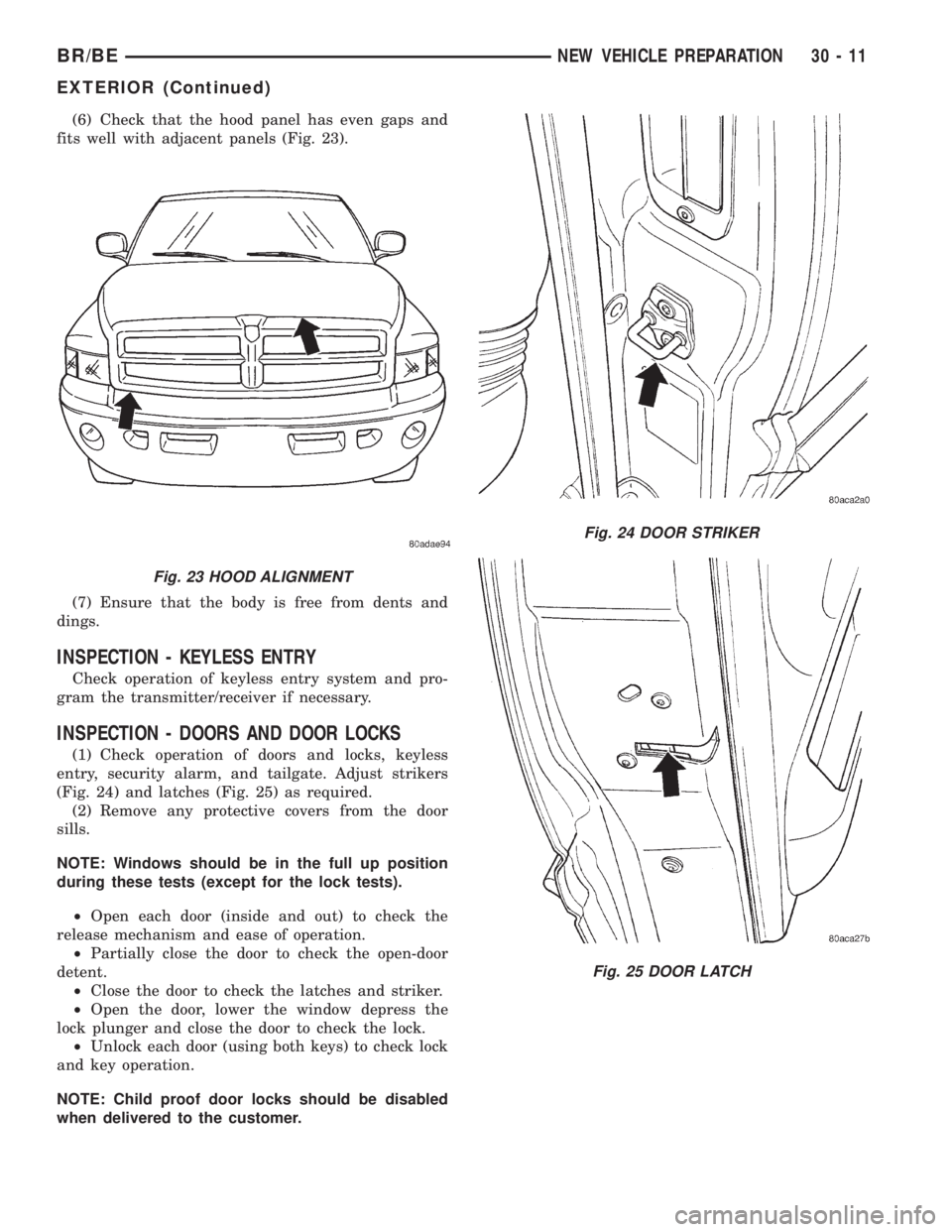
(6) Check that the hood panel has even gaps and
fits well with adjacent panels (Fig. 23).
(7) Ensure that the body is free from dents and
dings.
INSPECTION - KEYLESS ENTRY
Check operation of keyless entry system and pro-
gram the transmitter/receiver if necessary.
INSPECTION - DOORS AND DOOR LOCKS
(1) Check operation of doors and locks, keyless
entry, security alarm, and tailgate. Adjust strikers
(Fig. 24) and latches (Fig. 25) as required.
(2) Remove any protective covers from the door
sills.
NOTE: Windows should be in the full up position
during these tests (except for the lock tests).
²Open each door (inside and out) to check the
release mechanism and ease of operation.
²Partially close the door to check the open-door
detent.
²Close the door to check the latches and striker.
²Open the door, lower the window depress the
lock plunger and close the door to check the lock.
²Unlock each door (using both keys) to check lock
and key operation.
NOTE: Child proof door locks should be disabled
when delivered to the customer.
Fig. 23 HOOD ALIGNMENT
Fig. 24 DOOR STRIKER
Fig. 25 DOOR LATCH
BR/BENEW VEHICLE PREPARATION 30 - 11
EXTERIOR (Continued)
Page 2854 of 2889
CENTER HIGH MOUNTED STOP LAMP -
INSTALLATION........................8L-6
CENTER HIGH MOUNTED STOP LAMP -
REMOVAL...........................8L-6
CENTER HIGH MOUNTED STOP LAMP
UNIT - INSTALLATION..................8L-6
CENTER HIGH MOUNTED STOP LAMP
UNIT - REMOVAL.....................8L-6
CENTER SEAT ARMREST/CONSOLE -
INSTALLATION......................23-132
CENTER SEAT ARMREST/CONSOLE -
REMOVAL.........................23-132
CENTER SEAT ARMREST/LATCH COVER -
INSTALLATION......................23-132
CENTER SEAT ARMREST/LATCH COVER -
REMOVAL.........................23-132
CENTERING - STANDARD PROCEDURE,
CLOCKSPRING......................8O-11
CENTRAL TIMER MODULE - DIAGNOSIS
AND TESTING........................8E-4
CERTIFICATION LABEL - DESCRIPTION,
VEHICLE SAFETY..................Intro.-12
CHAIN COVER(S) - INSTALLATION,
TIMING BELT..........9-113,9-169,9-226,9-56
CHAIN COVER(S) - REMOVAL, TIMING
BELT ................9-113,9-169,9-225,9-56
CHAIN STRETCH - INSPECTION,
MEASURING TIMING....9-114,9-170,9-227,9-58
CHANNEL - INSTALLATION, GLASS RUN . . 23-70
CHANNEL - REMOVAL, GLASS RUN......23-70
CHARGE - STANDARD PROCEDURE,
REFRIGERANT SYSTEM...............24-46
CHARGE AIR COOLER AND PLUMBING -
CLEANING..........................11-18
CHARGE AIR COOLER AND PLUMBING -
DESCRIPTION.......................11-17
CHARGE AIR COOLER AND PLUMBING -
INSPECTION........................11-18
CHARGE AIR COOLER AND PLUMBING -
INSTALLATION.......................11-18
CHARGE AIR COOLER AND PLUMBING -
OPERATION.........................11-17
CHARGE AIR COOLER AND PLUMBING -
REMOVAL..........................11-17
CHARGING - DESCRIPTION.............8F-27
CHARGING - OPERATION..............8F-27
CHARGING - STANDARD PROCEDURE,
BATTERY............................8F-9
CHARGING SYSTEM - DIAGNOSIS AND
TESTING...........................8F-27
CHART, SPECIFICATIONS - TORQUE........5-3
CHART, SPECIFICATIONS -
TORQUE.............19-19,19-39,19-41,19-9
CHART, SPECIFICATIONS -
TORQUE.....................2-15,2-27,2-8
CHART, SPECIFICATIONS - TORQUE......22-11
CHARTS - DIAGNOSIS AND TESTING,
DIAGNOSIS......21-149,21-320,21-492,21-663
CHARTS - DIAGNOSIS AND TESTING,
SMOKE DIAGNOSIS...................9-234
CHASSIS ADAPTER BRACKET -
INSTALLATION, CAB...................13-9
CHASSIS ADAPTER BRACKET -
REMOVAL, CAB.......................13-9
CHECK - INSTALLATION...............23-78
CHECK - REMOVAL...................23-78
CHECK - STANDARD PROCEDURE,
COOLANT LEVEL......................7-16
CHECK - STANDARD PROCEDURE, FLUID
LEVEL..........21-199,21-370,21-545,21-715
CHECK - STANDARD PROCEDURE, OIL
PUMP VOLUME . . . 21-209,21-379,21-554,21-724
CHECK CABLE - INSTALLATION.........23-63
CHECK CABLE - REMOVAL.............23-62
CHECK GAUGES INDICATOR -
DESCRIPTION.......................8J-17
CHECK GAUGES INDICATOR -
OPERATION.........................8J-17
CHECK OUT - STANDARD PROCEDURE,
OWNER............................30-22
CHECK VALVE - DESCRIPTION, ONE WAY . 25-30
CHECK VALVE - DESCRIPTION, VACUUM
. . 24-28
CHECK VALVE - DIAGNOSIS AND
TESTING, ONE-WAY
..................25-30
CHECK VALVE - INSTALLATION, ONE
WAY
...............................25-30
CHECK VALVE - INSTALLATION, VACUUM
. 24-29
CHECK VALVE - OPERATION, ONE WAY
. . . 25-30CHECK VALVE - OPERATION, VACUUM....24-28
CHECK VALVE - REMOVAL, ONE WAY....25-30
CHECK VALVE - REMOVAL, VACUUM.....24-29
CHECKING BATTERY ELECTROLYTE
LEVEL - STANDARD PROCEDURE.........8F-8
CHECKING TRANSMISSION CLUTCH AND
BAND OPERATION - DIAGNOSIS AND
TESTING, AIR................21-147,21-318
CHECKS - DIAGNOSIS AND TESTING,
PRELIMINARY.........................7-4
CHILD TETHER - INSTALLATION..........8O-9
CHILD TETHER - REMOVAL.............8O-9
CHIME WARNING SYSTEM -
DESCRIPTION........................8B-1
CHIME WARNING SYSTEM - DIAGNOSIS
AND TESTING........................8B-2
CHIME WARNING SYSTEM - OPERATION . . . 8B-1
CHOKE RELAY - DESCRIPTION, RADIO....8A-8
CHOKE RELAY - DIAGNOSIS AND
TESTING, RADIO......................8A-8
CHOKE RELAY - INSTALLATION, RADIO....8A-9
CHOKE RELAY - OPERATION, RADIO......8A-8
CHOKE RELAY - REMOVAL, RADIO.......8A-9
CIGAR LIGHTER - DIAGNOSIS &
TESTING.........................8W-97-2
CIGAR LIGHTER OUTLET - DESCRIPTION . 8W-97-2
CIGAR LIGHTER OUTLET -
INSTALLATION....................8W-97-3
CIGAR LIGHTER OUTLET - OPERATION . 8W-97-2
CIGAR LIGHTER OUTLET - REMOVAL....8W-97-3
CIRCUIT ACTUATION TEST MODE -
DESCRIPTION........................25-1
CIRCUIT BREAKER - DESCRIPTION....8W-97-4
CIRCUIT BREAKER - DIAGNOSIS &
TESTING.........................8W-97-4
CIRCUIT SENSE - DESCRIPTION,
IGNITION...........................8E-17
CIRCUIT SENSE - OPERATION, IGNITION . . 8E-19
CIRCUITS - DIESEL - OPERATION,
NON-MONITORED....................25-23
CIRCUITS - GAS ENGINES - OPERATION,
NON-MONITORED....................25-22
CLAMPS - DESCRIPTION, HOSE...........7-2
CLAMPS - OPERATION, HOSE.............7-2
CLASSIFICATION OF LUBRICANTS -
STANDARD PROCEDURE.................0-3
CLEANER ELEMENT - INSTALLATION,
AIR ...............................9-245
CLEANER ELEMENT - REMOVAL, AIR.....9-244
CLEANING AND INSPECTION, OIL
COOLER & LINES....................9-296
CLEANING, APPEARANCE TIPS..........30-21
CLEANING/REVERSE FLUSHING -
STANDARD PROCEDURE, COOLING
SYSTEM............................7-16
CLEARANCE - STANDARD PROCEDURE,
CONNECTING ROD BEARING AND
CRANKSHAFT JOURNAL...............9-274
CLEARANCE - STANDARD PROCEDURE,
MAIN BEARING......................9-275
CLEARANCE LAMP - INSTALLATION.......8L-6
CLEARANCE LAMP - REMOVAL..........8L-6
CLOCKSPRING - DESCRIPTION.........8O-10
CLOCKSPRING - INSTALLATION.........8O-13
CLOCKSPRING - OPERATION...........8O-10
CLOCKSPRING - REMOVAL............8O-11
CLOCKSPRING CENTERING - STANDARD
PROCEDURE........................8O-11
CLOSURE PANEL TRIM - INSTALLATION,
REAR.............................23-121
CLOSURE PANEL TRIM - REMOVAL,
REAR.............................23-120
CLUB/QUAD CAB - INSTALLATION.......8O-20
CLUB/QUAD CAB - REMOVAL...........8O-19
CLUSTER - ASSEMBLY, INSTRUMENT....8J-13
CLUSTER - DESCRIPTION, INSTRUMENT . . . 8J-2
CLUSTER - DIAGNOSIS AND TESTING,
INSTRUMENT........................8J-6
CLUSTER - DISASSEMBLY, INSTRUMENT . . 8J-11
CLUSTER - INSTALLATION, INSTRUMENT . 8J-14
CLUSTER - OPERATION, INSTRUMENT.....8J-3
CLUSTER - REMOVAL, INSTRUMENT
.....8J-10
CLUSTER BEZEL - INSTALLATION
.......23-110
CLUSTER BEZEL - REMOVAL
..........23-109
CLUTCH - 3.9L/5.2L/5.9L/8.0L -
DESCRIPTION, FAN DRIVE VISCOUS
......7-56
CLUTCH - 3.9L/5.2L/5.9L/8.0L -
OPERATION, FAN DRIVE VISCOUS
........7-56CLUTCH - 5.9L DIESEL - DESCRIPTION,
FAN DRIVE VISCOUS...................7-57
CLUTCH - 5.9L DIESEL - OPERATION,
FAN DRIVE VISCOUS...................7-57
CLUTCH - ASSEMBLY, FRONT . . . 21-206,21-376,
21-550,21-721
CLUTCH - ASSEMBLY, REAR....21-248,21-419,
21-593,21-766
CLUTCH - CLEANING, REAR....21-247,21-418,
21-593,21-765
CLUTCH - DESCRIPTION.................6-1
CLUTCH - DESCRIPTION, A/C
COMPRESSOR.......................24-13
CLUTCH - DESCRIPTION, FRONT . 21-202,21-373,
21-548,21-718
CLUTCH - DESCRIPTION, OVERDRIVE . . . 21-214,
21-385,21-560,21-731
CLUTCH - DESCRIPTION, REAR . . 21-246,21-417,
21-591,21-764
CLUTCH - DIAGNOSTIC AND TESTING......6-2
CLUTCH - DISASSEMBLY, FRONT......21-202,
21-373,21-549,21-719
CLUTCH - DISASSEMBLY, REAR . 21-247,21-418,
21-592,21-765
CLUTCH - INSPECTION, A/C
COMPRESSOR.......................24-16
CLUTCH - INSPECTION, FRONT . . 21-205,21-376,
21-550,21-721
CLUTCH - INSPECTION, REAR . . . 21-248,21-419,
21-593,21-765
CLUTCH - INSTALLATION, A/C
COMPRESSOR.......................24-16
CLUTCH - OPERATION....................6-1
CLUTCH - OPERATION, A/C
COMPRESSOR.......................24-13
CLUTCH - OPERATION, FRONT . . 21-202,21-373,
21-548,21-718
CLUTCH - OPERATION, OVERDRIVE....21-214,
21-385,21-560,21-731
CLUTCH - OPERATION, REAR . . . 21-246,21-417,
21-592,21-764
CLUTCH - REMOVAL, A/C COMPRESSOR . . 24-14
CLUTCH - SPECIFICATIONS...............6-7
CLUTCH - WARNING....................6-2
CLUTCH AND BAND OPERATION -
DIAGNOSIS AND TESTING, AIR
CHECKING TRANSMISSION......21-147,21-318
CLUTCH AND BAND OPERATION -
DIAGNOSIS AND TESTING, AIR
TESTING TRANSMISSION.......21-490,21-661
CLUTCH BREAK-IN - STANDARD
PROCEDURE, A/C COMPRESSOR........24-13
CLUTCH CAM/OVERDRIVE PISTON
RETAINER - ASSEMBLY,
OVERRUNNING . . . 21-236,21-406,21-581,21-752
CLUTCH CAM/OVERDRIVE PISTON
RETAINER - CLEANING, OVERRUNNING . 21-236,
21-406,21-580,21-752
CLUTCH CAM/OVERDRIVE PISTON
RETAINER - DESCRIPTION,
OVERRUNNING . . . 21-235,21-405,21-580,21-751
CLUTCH CAM/OVERDRIVE PISTON
RETAINER - DISASSEMBLY,
OVERRUNNING . . . 21-235,21-405,21-580,21-751
CLUTCH CAM/OVERDRIVE PISTON
RETAINER - INSPECTION,
OVERRUNNING . . . 21-236,21-406,21-580,21-752
CLUTCH CAM/OVERDRIVE PISTON
RETAINER - OPERATION,
OVERRUNNING . . . 21-235,21-405,21-580,21-751
CLUTCH COIL - DIAGNOSIS AND
TESTING, A/C COMPRESSOR...........24-13
CLUTCH DISC - DESCRIPTION............6-7
CLUTCH DISC - INSTALLATION............6-9
CLUTCH DISC - OPERATION..............6-8
CLUTCH DISC - REMOVAL...............6-8
CLUTCH HOUSING - DIAGNOSIS AND
TESTING............................6-11
CLUTCH HOUSING - INSTALLATION.......6-13
CLUTCH HOUSING - REMOVAL...........6-13
CLUTCH PEDAL - INSTALLATION
.........6-19
CLUTCH PEDAL - REMOVAL
.............6-18
CLUTCH PEDAL POSITION SWITCH -
DESCRIPTION
........................6-22
CLUTCH PEDAL POSITION SWITCH -
OPERATION
..........................6-22
CLUTCH RELAY - DESCRIPTION, A/C
COMPRESSOR
.......................24-17
BR/BEINDEX 7
Description Group-Page Description Group-Page Description Group-Page