ECO mode DODGE RAM 2002 Service Owners Manual
[x] Cancel search | Manufacturer: DODGE, Model Year: 2002, Model line: RAM, Model: DODGE RAM 2002Pages: 2255, PDF Size: 62.07 MB
Page 2167 of 2255
STANDARD PROCEDURE - REFRIGERANT
SYSTEM EVACUATE
WARNING: REVIEW THE WARNINGS AND CAU-
TIONS IN THE FRONT OF THIS SECTION BEFORE
PERFORMING THE FOLLOWING OPERATION.
(Refer to 24 - HEATING & AIR CONDITIONING/
PLUMBING - WARNING) (Refer to 24 - HEATING &
AIR CONDITIONING/PLUMBING - CAUTION)
If the refrigerant system has been open to the
atmosphere, it must be evacuated before the system
can be charged. If moisture and air enters the system
and becomes mixed with the refrigerant, the com-
pressor head pressure will rise above acceptable
operating levels. This will reduce the performance of
the air conditioner and damage the compressor.
Evacuating the refrigerant system will remove the
air and boil the moisture out of the system at near
room temperature. To evacuate the refrigerant sys-
tem, use the following procedure:
(1) Connect a R-134a refrigerant recovery/recy-
cling/charging station that meets SAE Standard
J2210 and a manifold gauge set to the refrigerant
system of the vehicle.
(2) Open the low and high side valves and start
the charging station vacuum pump. When the suc-
tion gauge reads 88 kPa (26 in. Hg.) vacuum or
greater, close all of the valves and turn off the vac-
uum pump.
(a) If the refrigerant system fails to reach the
specified vacuum, the system has a leak that must
be corrected. (Refer to 24 - HEATING & AIR CON-
DITIONING/PLUMBING - DIAGNOSIS AND
TESTING - REFRIGERANT SYSTEM LEAKS)
(b) If the refrigerant system maintains the spec-
ified vacuum for five minutes, restart the vacuum
pump, open the suction and discharge valves and
evacuate the system for an additional ten minutes.
(3) Close all of the valves, and turn off the charg-
ing station vacuum pump.
(4) The refrigerant system is now ready to be
charged with R-134a refrigerant. (Refer to 24 -
HEATING & AIR CONDITIONING/PLUMBING -
STANDARD PROCEDURE - REFRIGERANT SYS-
TEM CHARGE)
STANDARD PROCEDURE - REFRIGERANT
SYSTEM CHARGE
WARNING: REVIEW THE WARNINGS AND CAU-
TIONS IN THE FRONT OF THIS SECTION BEFORE
PERFORMING THE FOLLOWING OPERATION.
(Refer to 24 - HEATING & AIR CONDITIONING/
PLUMBING - WARNING) (Refer to 24 - HEATING &
AIR CONDITIONING/PLUMBING - CAUTION)After the refrigerant system has been tested for
leaks and evacuated, a refrigerant charge can be
injected into the system. (Refer to 24 - HEATING &
AIR CONDITIONING/PLUMBING - SPECIFICA-
TIONS - CHARGE CAPACITY)
A R-134a refrigerant recovery/recycling/charging
station that meets SAE Standard J2210 must be
used to charge the refrigerant system with R-134a
refrigerant. Refer to the operating instructions sup-
plied by the equipment manufacturer for proper care
and use of this equipment.
SPECIFICATIONS
SPECIFICATIONS
The R-134a refrigerant system charge capacity for
this vehicle is: 0.907 kilograms (32 ounces).
A/C COMPRESSOR
DESCRIPTION
The air conditioning system uses a Sanden
SD7H15 seven cylinder, reciprocating wobble plate-
type compressor on all models. This compressor has a
fixed displacement of 150 cubic centimeters (9.375
cubic inches), and has both the suction and discharge
ports located on the cylinder head. A label identifying
the use of R-134a refrigerant is located on the com-
pressor.
DESCRIPTION - HIGH PRESSURE RELIEF
VALVE
A high pressure relief valve is located on the com-
pressor cylinder head, which is at the rear of the
compressor. This mechanical valve is designed to
vent refrigerant from the system to protect against
damage to the compressor and other system compo-
nents, caused by condenser air flow restriction or an
overcharge of refrigerant.
OPERATION
The compressor is driven by the engine through an
electric clutch, drive pulley and belt arrangement.
The compressor is lubricated by refrigerant oil that is
circulated throughout the refrigerant system with the
refrigerant.
The compressor draws in low-pressure refrigerant
vapor from the evaporator through its suction port. It
then compresses the refrigerant into a high-pressure,
high-temperature refrigerant vapor, which is then
pumped to the condenser through the compressor dis-
charge port.
The compressor cannot be repaired. If faulty or
damaged, the entire compressor assembly must be
24 - 46 PLUMBINGBR/BE
PLUMBING (Continued)
Page 2170 of 2255
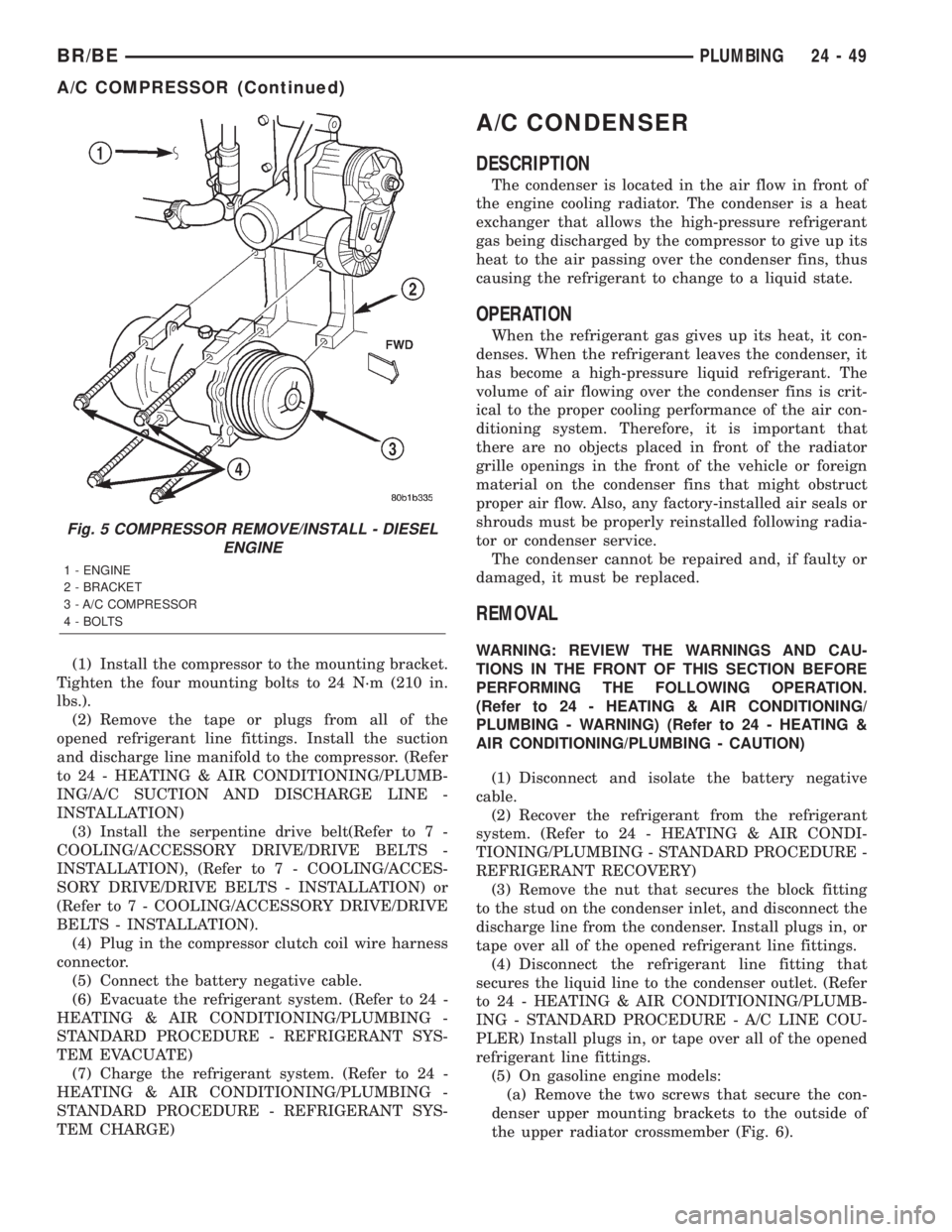
(1) Install the compressor to the mounting bracket.
Tighten the four mounting bolts to 24 N´m (210 in.
lbs.).
(2) Remove the tape or plugs from all of the
opened refrigerant line fittings. Install the suction
and discharge line manifold to the compressor. (Refer
to 24 - HEATING & AIR CONDITIONING/PLUMB-
ING/A/C SUCTION AND DISCHARGE LINE -
INSTALLATION)
(3) Install the serpentine drive belt(Refer to 7 -
COOLING/ACCESSORY DRIVE/DRIVE BELTS -
INSTALLATION), (Refer to 7 - COOLING/ACCES-
SORY DRIVE/DRIVE BELTS - INSTALLATION) or
(Refer to 7 - COOLING/ACCESSORY DRIVE/DRIVE
BELTS - INSTALLATION).
(4) Plug in the compressor clutch coil wire harness
connector.
(5) Connect the battery negative cable.
(6) Evacuate the refrigerant system. (Refer to 24 -
HEATING & AIR CONDITIONING/PLUMBING -
STANDARD PROCEDURE - REFRIGERANT SYS-
TEM EVACUATE)
(7) Charge the refrigerant system. (Refer to 24 -
HEATING & AIR CONDITIONING/PLUMBING -
STANDARD PROCEDURE - REFRIGERANT SYS-
TEM CHARGE)
A/C CONDENSER
DESCRIPTION
The condenser is located in the air flow in front of
the engine cooling radiator. The condenser is a heat
exchanger that allows the high-pressure refrigerant
gas being discharged by the compressor to give up its
heat to the air passing over the condenser fins, thus
causing the refrigerant to change to a liquid state.
OPERATION
When the refrigerant gas gives up its heat, it con-
denses. When the refrigerant leaves the condenser, it
has become a high-pressure liquid refrigerant. The
volume of air flowing over the condenser fins is crit-
ical to the proper cooling performance of the air con-
ditioning system. Therefore, it is important that
there are no objects placed in front of the radiator
grille openings in the front of the vehicle or foreign
material on the condenser fins that might obstruct
proper air flow. Also, any factory-installed air seals or
shrouds must be properly reinstalled following radia-
tor or condenser service.
The condenser cannot be repaired and, if faulty or
damaged, it must be replaced.
REMOVAL
WARNING: REVIEW THE WARNINGS AND CAU-
TIONS IN THE FRONT OF THIS SECTION BEFORE
PERFORMING THE FOLLOWING OPERATION.
(Refer to 24 - HEATING & AIR CONDITIONING/
PLUMBING - WARNING) (Refer to 24 - HEATING &
AIR CONDITIONING/PLUMBING - CAUTION)
(1) Disconnect and isolate the battery negative
cable.
(2) Recover the refrigerant from the refrigerant
system. (Refer to 24 - HEATING & AIR CONDI-
TIONING/PLUMBING - STANDARD PROCEDURE -
REFRIGERANT RECOVERY)
(3) Remove the nut that secures the block fitting
to the stud on the condenser inlet, and disconnect the
discharge line from the condenser. Install plugs in, or
tape over all of the opened refrigerant line fittings.
(4) Disconnect the refrigerant line fitting that
secures the liquid line to the condenser outlet. (Refer
to 24 - HEATING & AIR CONDITIONING/PLUMB-
ING - STANDARD PROCEDURE - A/C LINE COU-
PLER) Install plugs in, or tape over all of the opened
refrigerant line fittings.
(5) On gasoline engine models:
(a) Remove the two screws that secure the con-
denser upper mounting brackets to the outside of
the upper radiator crossmember (Fig. 6).
Fig. 5 COMPRESSOR REMOVE/INSTALL - DIESEL
ENGINE
1 - ENGINE
2 - BRACKET
3 - A/C COMPRESSOR
4 - BOLTS
BR/BEPLUMBING 24 - 49
A/C COMPRESSOR (Continued)
Page 2172 of 2255
(8) Charge the refrigerant system. (Refer to 24 -
HEATING & AIR CONDITIONING/PLUMBING -
STANDARD PROCEDURE - REFRIGERANT SYS-
TEM CHARGE)
NOTE: If the condenser is replaced, add 30 millili-
ters (1 fluid ounce) of refrigerant oil to the refriger-
ant system. Use only refrigerant oil of the type
recommended for the compressor in the vehicle.
(Refer to 24 - HEATING & AIR CONDITIONING/
PLUMBING/REFRIGERANT OIL - DESCRIPTION)
SUCTION AND DISCHARGE
LINE
REMOVAL
WARNING: REVIEW THE WARNINGS AND CAU-
TIONS IN THE FRONT OF THIS SECTION BEFORE
PERFORMING THE FOLLOWING OPERATION.
(Refer to 24 - HEATING & AIR CONDITIONING/
PLUMBING - WARNING) (Refer to 24 - HEATING &
AIR CONDITIONING/PLUMBING - CAUTION)(1) Disconnect and isolate the battery negative
cable.
(2) Recover the refrigerant from the refrigerant
system. (Refer to 24 - HEATING & AIR CONDI-
TIONING/PLUMBING - STANDARD PROCEDURE -
REFRIGERANT RECOVERY)
(3) Unplug the wire harness connector from the a/c
high pressure switch.
(4) Disconnect the suction line refrigerant line cou-
pler at the accumulator. (Refer to 24 - HEATING &
AIR CONDITIONING/PLUMBING - STANDARD
PROCEDURE - A/C LINE COUPLER) Install plugs
in, or tape over all of the opened refrigerant line fit-
tings.
(5) Remove the nut that secures the block fitting
to the stud on the condenser inlet and disconnect the
discharge line from the condenser. Install plugs in, or
tape over all of the opened refrigerant line fittings.
(6) On models with a gasoline engine, remove the
nut that secures the refrigerant line support bracket
to the stud on the compressor mounting bracket.
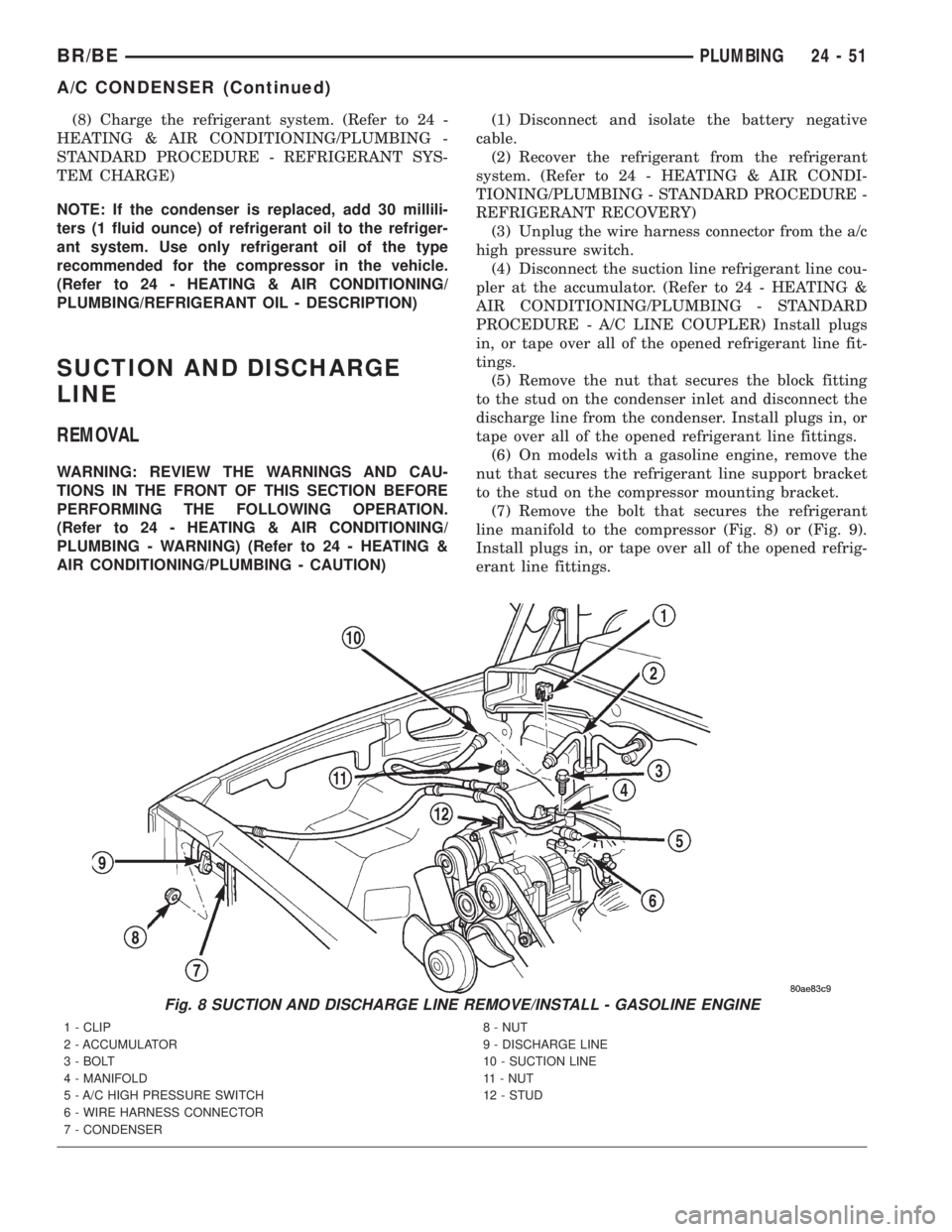
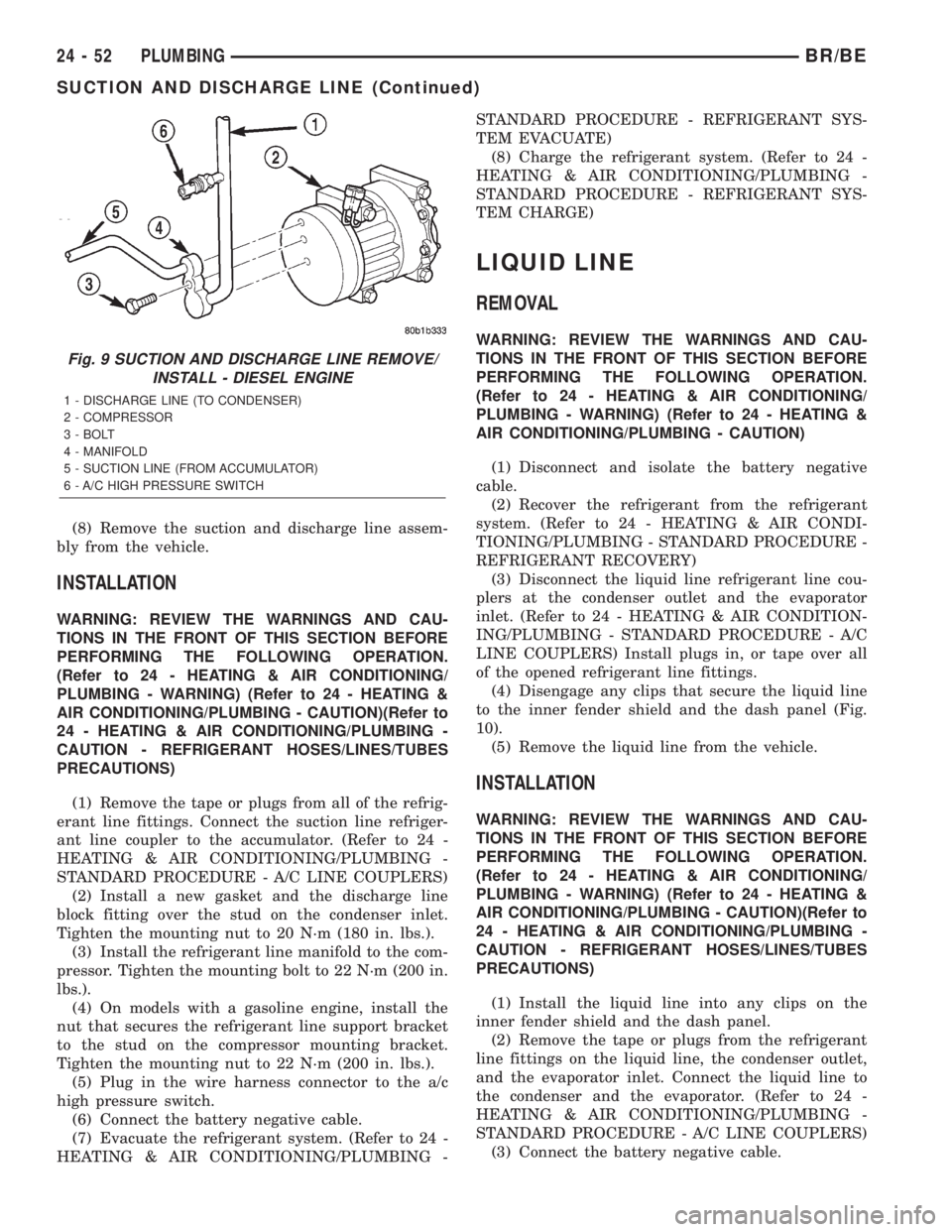
(7) Remove the bolt that secures the refrigerant
line manifold to the compressor (Fig. 8) or (Fig. 9).
Install plugs in, or tape over all of the opened refrig-
erant line fittings.
Fig. 8 SUCTION AND DISCHARGE LINE REMOVE/INSTALL - GASOLINE ENGINE
1 - CLIP
2 - ACCUMULATOR
3 - BOLT
4 - MANIFOLD
5 - A/C HIGH PRESSURE SWITCH
6 - WIRE HARNESS CONNECTOR
7 - CONDENSER8 - NUT
9 - DISCHARGE LINE
10 - SUCTION LINE
11 - NUT
12 - STUD
BR/BEPLUMBING 24 - 51
A/C CONDENSER (Continued)
Page 2173 of 2255
(8) Remove the suction and discharge line assem-
bly from the vehicle.
INSTALLATION
WARNING: REVIEW THE WARNINGS AND CAU-
TIONS IN THE FRONT OF THIS SECTION BEFORE
PERFORMING THE FOLLOWING OPERATION.
(Refer to 24 - HEATING & AIR CONDITIONING/
PLUMBING - WARNING) (Refer to 24 - HEATING &
AIR CONDITIONING/PLUMBING - CAUTION)(Refer to
24 - HEATING & AIR CONDITIONING/PLUMBING -
CAUTION - REFRIGERANT HOSES/LINES/TUBES
PRECAUTIONS)
(1) Remove the tape or plugs from all of the refrig-
erant line fittings. Connect the suction line refriger-
ant line coupler to the accumulator. (Refer to 24 -
HEATING & AIR CONDITIONING/PLUMBING -
STANDARD PROCEDURE - A/C LINE COUPLERS)
(2) Install a new gasket and the discharge line
block fitting over the stud on the condenser inlet.
Tighten the mounting nut to 20 N´m (180 in. lbs.).
(3) Install the refrigerant line manifold to the com-
pressor. Tighten the mounting bolt to 22 N´m (200 in.
lbs.).
(4) On models with a gasoline engine, install the
nut that secures the refrigerant line support bracket
to the stud on the compressor mounting bracket.
Tighten the mounting nut to 22 N´m (200 in. lbs.).
(5) Plug in the wire harness connector to the a/c
high pressure switch.
(6) Connect the battery negative cable.
(7) Evacuate the refrigerant system. (Refer to 24 -
HEATING & AIR CONDITIONING/PLUMBING -STANDARD PROCEDURE - REFRIGERANT SYS-
TEM EVACUATE)
(8) Charge the refrigerant system. (Refer to 24 -
HEATING & AIR CONDITIONING/PLUMBING -
STANDARD PROCEDURE - REFRIGERANT SYS-
TEM CHARGE)
LIQUID LINE
REMOVAL
WARNING: REVIEW THE WARNINGS AND CAU-
TIONS IN THE FRONT OF THIS SECTION BEFORE
PERFORMING THE FOLLOWING OPERATION.
(Refer to 24 - HEATING & AIR CONDITIONING/
PLUMBING - WARNING) (Refer to 24 - HEATING &
AIR CONDITIONING/PLUMBING - CAUTION)
(1) Disconnect and isolate the battery negative
cable.
(2) Recover the refrigerant from the refrigerant
system. (Refer to 24 - HEATING & AIR CONDI-
TIONING/PLUMBING - STANDARD PROCEDURE -
REFRIGERANT RECOVERY)
(3) Disconnect the liquid line refrigerant line cou-
plers at the condenser outlet and the evaporator
inlet. (Refer to 24 - HEATING & AIR CONDITION-
ING/PLUMBING - STANDARD PROCEDURE - A/C
LINE COUPLERS) Install plugs in, or tape over all
of the opened refrigerant line fittings.
(4) Disengage any clips that secure the liquid line
to the inner fender shield and the dash panel (Fig.
10).
(5) Remove the liquid line from the vehicle.
INSTALLATION
WARNING: REVIEW THE WARNINGS AND CAU-
TIONS IN THE FRONT OF THIS SECTION BEFORE
PERFORMING THE FOLLOWING OPERATION.
(Refer to 24 - HEATING & AIR CONDITIONING/
PLUMBING - WARNING) (Refer to 24 - HEATING &
AIR CONDITIONING/PLUMBING - CAUTION)(Refer to
24 - HEATING & AIR CONDITIONING/PLUMBING -
CAUTION - REFRIGERANT HOSES/LINES/TUBES
PRECAUTIONS)
(1) Install the liquid line into any clips on the
inner fender shield and the dash panel.
(2) Remove the tape or plugs from the refrigerant
line fittings on the liquid line, the condenser outlet,
and the evaporator inlet. Connect the liquid line to
the condenser and the evaporator. (Refer to 24 -
HEATING & AIR CONDITIONING/PLUMBING -
STANDARD PROCEDURE - A/C LINE COUPLERS)
(3) Connect the battery negative cable.
Fig. 9 SUCTION AND DISCHARGE LINE REMOVE/
INSTALL - DIESEL ENGINE
1 - DISCHARGE LINE (TO CONDENSER)
2 - COMPRESSOR
3 - BOLT
4 - MANIFOLD
5 - SUCTION LINE (FROM ACCUMULATOR)
6 - A/C HIGH PRESSURE SWITCH
24 - 52 PLUMBINGBR/BE
SUCTION AND DISCHARGE LINE (Continued)
Page 2180 of 2255
EMISSIONS CONTROL
TABLE OF CONTENTS
page page
EMISSIONS CONTROL
DESCRIPTION
DESCRIPTION - DIESEL.................1
DESCRIPTION - STATE DISPLAY TEST
MODE...............................1
DESCRIPTION - CIRCUIT ACTUATION TEST
MODE...............................2
DESCRIPTION - DIAGNOSTIC TROUBLE
CODES..............................2
DESCRIPTION - TASK MANAGER.........17
DESCRIPTION - MONITORED SYSTEMS . . . 17
DESCRIPTION - TRIP DEFINITION........19
DESCRIPTION - COMPONENT MONITORS -
GAS ENGINES.......................19DESCRIPTION - COMPONENT MONITORS -
DIESEL ENGINES.....................20
OPERATION
OPERATION - GAS ENGINES............20
OPERATION - DIESEL..................20
OPERATION - TASK MANAGER..........21
OPERATION - NON-MONITORED
CIRCUITS - GAS ENGINES..............24
OPERATION - NON-MONITORED
CIRCUITS - DIESEL....................24
AIR INJECTION.........................26
EVAPORATIVE EMISSIONS................32
EMISSIONS CONTROL
DESCRIPTION
DESCRIPTION - DIESEL
Two different modules are used for powertrain con-
trol with the diesel engine. The Powertrain Control
Module (PCM) is used primarily for charging system,
transmission, A/C compressor clutch operation and
speed control functions. The Engine Control Module
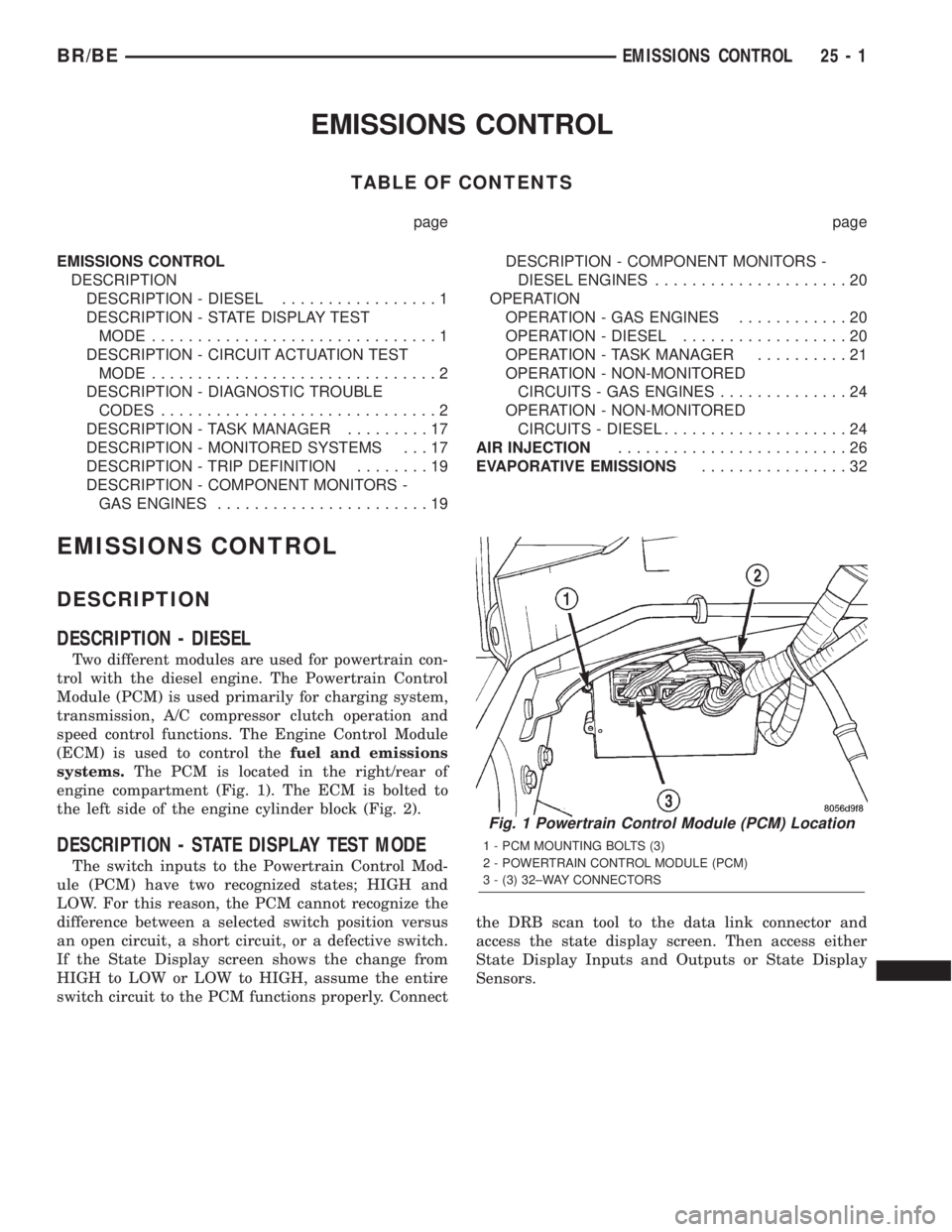
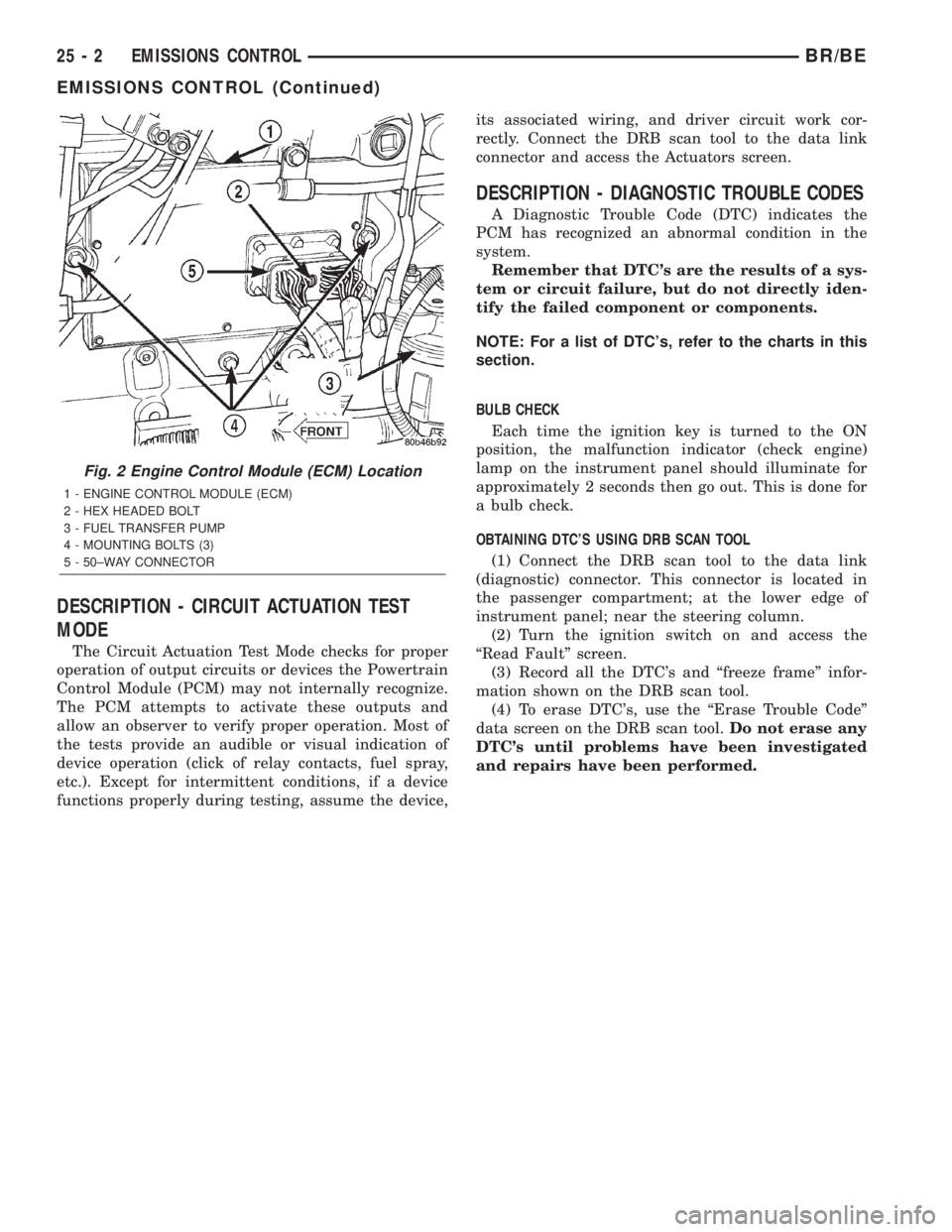
(ECM) is used to control thefuel and emissions
systems.The PCM is located in the right/rear of
engine compartment (Fig. 1). The ECM is bolted to
the left side of the engine cylinder block (Fig. 2).
DESCRIPTION - STATE DISPLAY TEST MODE
The switch inputs to the Powertrain Control Mod-
ule (PCM) have two recognized states; HIGH and
LOW. For this reason, the PCM cannot recognize the
difference between a selected switch position versus
an open circuit, a short circuit, or a defective switch.
If the State Display screen shows the change from
HIGH to LOW or LOW to HIGH, assume the entire
switch circuit to the PCM functions properly. Connectthe DRB scan tool to the data link connector and
access the state display screen. Then access either
State Display Inputs and Outputs or State Display
Sensors.
Fig. 1 Powertrain Control Module (PCM) Location
1 - PCM MOUNTING BOLTS (3)
2 - POWERTRAIN CONTROL MODULE (PCM)
3 - (3) 32±WAY CONNECTORS
BR/BEEMISSIONS CONTROL 25 - 1
Page 2181 of 2255
DESCRIPTION - CIRCUIT ACTUATION TEST
MODE
The Circuit Actuation Test Mode checks for proper
operation of output circuits or devices the Powertrain
Control Module (PCM) may not internally recognize.
The PCM attempts to activate these outputs and
allow an observer to verify proper operation. Most of
the tests provide an audible or visual indication of
device operation (click of relay contacts, fuel spray,
etc.). Except for intermittent conditions, if a device
functions properly during testing, assume the device,its associated wiring, and driver circuit work cor-
rectly. Connect the DRB scan tool to the data link
connector and access the Actuators screen.
DESCRIPTION - DIAGNOSTIC TROUBLE CODES
A Diagnostic Trouble Code (DTC) indicates the
PCM has recognized an abnormal condition in the
system.
Remember that DTC's are the results of a sys-
tem or circuit failure, but do not directly iden-
tify the failed component or components.
NOTE: For a list of DTC's, refer to the charts in this
section.
BULB CHECK
Each time the ignition key is turned to the ON
position, the malfunction indicator (check engine)
lamp on the instrument panel should illuminate for
approximately 2 seconds then go out. This is done for
a bulb check.
OBTAINING DTC'S USING DRB SCAN TOOL
(1) Connect the DRB scan tool to the data link
(diagnostic) connector. This connector is located in
the passenger compartment; at the lower edge of
instrument panel; near the steering column.
(2) Turn the ignition switch on and access the
ªRead Faultº screen.
(3) Record all the DTC's and ªfreeze frameº infor-
mation shown on the DRB scan tool.
(4) To erase DTC's, use the ªErase Trouble Codeº
data screen on the DRB scan tool.Do not erase any
DTC's until problems have been investigated
and repairs have been performed.
Fig. 2 Engine Control Module (ECM) Location
1 - ENGINE CONTROL MODULE (ECM)
2 - HEX HEADED BOLT
3 - FUEL TRANSFER PUMP
4 - MOUNTING BOLTS (3)
5 - 50±WAY CONNECTOR
25 - 2 EMISSIONS CONTROLBR/BE
EMISSIONS CONTROL (Continued)
Page 2197 of 2255
The primary components within the assembly are:
A three port solenoid that activates both of the func-
tions listed above; a pump which contains a switch,
two check valves and a spring/diaphragm, a canister
vent valve (CVV) seal which contains a spring loaded
vent seal valve.
Immediately after a cold start, between predeter-
mined temperature thresholds limits, the three port
solenoid is briefly energized. This initializes the
pump by drawing air into the pump cavity and also
closes the vent seal. During non test conditions the
vent seal is held open by the pump diaphragm
assembly which pushes it open at the full travel posi-
tion. The vent seal will remain closed while the
pump is cycling due to the reed switch triggering of
the three port solenoid that prevents the diaphragm
assembly from reaching full travel. After the brief
initialization period, the solenoid is de-energized
allowing atmospheric pressure to enter the pump
cavity, thus permitting the spring to drive the dia-
phragm which forces air out of the pump cavity and
into the vent system. When the solenoid is energized
and de energized, the cycle is repeated creating flow
in typical diaphragm pump fashion. The pump is con-
trolled in 2 modes:
Pump Mode: The pump is cycled at a fixed rate to
achieve a rapid pressure build in order to shorten the
overall test length.
Test Mode: The solenoid is energized with a fixed
duration pulse. Subsequent fixed pulses occur when
the diaphragm reaches the Switch closure point.
The spring in the pump is set so that the system
will achieve an equalized pressure of about 7.5º H20.
The cycle rate of pump strokes is quite rapid as the
system begins to pump up to this pressure. As the
pressure increases, the cycle rate starts to drop off. If
there is no leak in the system, the pump would even-
tually stop pumping at the equalized pressure. If
there is a leak, it will continue to pump at a rate rep-
resentative of the flow characteristic of the size of the
leak. From this information we can determine if the
leak is larger than the required detection limit (cur-
rently set at .040º orifice by CARB). If a leak is
revealed during the leak test portion of the test, the
test is terminated at the end of the test mode and no
further system checks will be performed.
After passing the leak detection phase of the test,
system pressure is maintained by turning on the
LDP's solenoid until the purge system is activated.
Purge activation in effect creates a leak. The cycle
rate is again interrogated and when it increases due
to the flow through the purge system, the leak check
portion of the diagnostic is complete.
The canister vent valve will unseal the system
after completion of the test sequence as the pump
diaphragm assembly moves to the full travel position.Evaporative system functionality will be verified by
using the stricter evap purge flow monitor. At an
appropriate warm idle the LDP will be energized to
seal the canister vent. The purge flow will be clocked
up from some small value in an attempt to see a
shift in the 02 control system. If fuel vapor, indicated
by a shift in the 02 control, is present the test is
passed. If not, it is assumed that the purge system is
not functioning in some respect. The LDP is again
turned off and the test is ended.
MISFIRE MONITOR
Excessive engine misfire results in increased cata-
lyst temperature and causes an increase in HC emis-
sions. Severe misfires could cause catalyst damage.
To prevent catalytic convertor damage, the PCM
monitors engine misfire.
The Powertrain Control Module (PCM) monitors
for misfire during most engine operating conditions
(positive torque) by looking at changes in the crank-
shaft speed. If a misfire occurs the speed of the
crankshaft will vary more than normal.
FUEL SYSTEM MONITOR
To comply with clean air regulations, vehicles are
equipped with catalytic converters. These converters
reduce the emission of hydrocarbons, oxides of nitro-
gen and carbon monoxide. The catalyst works best
when the Air Fuel (A/F) ratio is at or near the opti-
mum of 14.7 to 1.
The PCM is programmed to maintain the optimum
air/fuel ratio of 14.7 to 1. This is done by making
short term corrections in the fuel injector pulse width
based on the O2S sensor output. The programmed
memory acts as a self calibration tool that the engine
controller uses to compensate for variations in engine
specifications, sensor tolerances and engine fatigue
over the life span of the engine. By monitoring the
actual fuel-air ratio with the O2S sensor (short term)
and multiplying that with the program long-term
(adaptive) memory and comparing that to the limit,
it can be determined whether it will pass an emis-
sions test. If a malfunction occurs such that the PCM
cannot maintain the optimum A/F ratio, then the
MIL will be illuminated.
CATALYST MONITOR
To comply with clean air regulations, vehicles are
equipped with catalytic converters. These converters
reduce the emission of hydrocarbons, oxides of nitro-
gen and carbon monoxide.
Normal vehicle miles or engine misfire can cause a
catalyst to decay. This can increase vehicle emissions
and deteriorate engine performance, driveability and
fuel economy.
25 - 18 EMISSIONS CONTROLBR/BE
EMISSIONS CONTROL (Continued)
Page 2213 of 2255
INSTALLATION
(1) Install solenoid assembly to support bracket.
(2) Connect vacuum harness.
(3) Connect wiring connector.
FUEL FILLER CAP
DESCRIPTION
The plastic fuel tank filler tube cap is threaded
onto the end of the fuel fill tube. Certain models are
equipped with a 1/4 turn cap.
OPERATION
The loss of any fuel or vapor out of fuel filler tube
is prevented by the use of a pressure-vacuum fuel fill
cap. Relief valves inside the cap will release fuel tank
pressure at predetermined pressures. Fuel tank vac-
uum will also be released at predetermined values.
This cap must be replaced by a similar unit if
replacement is necessary. This is in order for the sys-
tem to remain effective.
CAUTION: Remove fill cap before servicing any fuel
system component to relieve tank pressure. If
equipped with a Leak Detection Pump (LDP), the
cap must be tightened securely. If cap is left loose,
a Diagnostic Trouble Code (DTC) may be set.
REMOVAL/INSTALLATION
If replacement of the 1/4 turn fuel tank filler tube
cap is necessary, it must be replaced with an identi-
cal cap to be sure of correct system operation.
CAUTION: Remove the fuel tank filler tube cap to
relieve fuel tank pressure. The cap must be
removed prior to disconnecting any fuel system
component or before draining the fuel tank.
LEAK DETECTION PUMP
DESCRIPTION
The Leak Detection Pump (LDP) is used only with
certain emission packages.
The LDP is a device used to detect a leak in the
evaporative system.
The pump contains a 3 port solenoid, a pump that
contains a switch, a spring loaded canister vent valve
seal, 2 check valves and a spring/diaphragm.
OPERATION
Immediately after a cold start, engine temperature
between 40ÉF and 86ÉF, the 3 port solenoid is briefly
energized. This initializes the pump by drawing airinto the pump cavity and also closes the vent seal.
During non-test test conditions, the vent seal is held
open by the pump diaphragm assembly which pushes
it open at the full travel position. The vent seal will
remain closed while the pump is cycling. This is due
to the operation of the 3 port solenoid which prevents
the diaphragm assembly from reaching full travel.
After the brief initialization period, the solenoid is
de-energized, allowing atmospheric pressure to enter
the pump cavity. This permits the spring to drive the
diaphragm which forces air out of the pump cavity
and into the vent system. When the solenoid is ener-
gized and de-energized, the cycle is repeated creating
flow in typical diaphragm pump fashion. The pump
is controlled in 2 modes:
PUMP MODE:The pump is cycled at a fixed rate
to achieve a rapid pressure build in order to shorten
the overall test time.
TEST MODE:The solenoid is energized with a
fixed duration pulse. Subsequent fixed pulses occur
when the diaphragm reaches the switch closure
point.
The spring in the pump is set so that the system
will achieve an equalized pressure of about 7.5 inches
of water.
When the pump starts, the cycle rate is quite high.
As the system becomes pressurized pump rate drops.
If there is no leak the pump will quit. If there is a
leak, the test is terminated at the end of the test
mode.
If there is no leak, the purge monitor is run. If the
cycle rate increases due to the flow through the
purge system, the test is passed and the diagnostic is
complete.
The canister vent valve will unseal the system
after completion of the test sequence as the pump
diaphragm assembly moves to the full travel position.
REMOVAL
The LDP and LDP filter are attached to a bracket
mounted to the right-inner fender (Fig. 2). The LDP
and LDP filter are replaced (serviced) as one unit.
(1) Carefully remove hose at LDP filter.
(2) Remove LDP filter mounting bolt and remove
from vehicle.
(3) Carefully remove vapor/vacuum lines at LDP.
(4) Disconnect electrical connector at LDP (Fig. 2).
(5) Remove LDP mounting screws and remove
LDP from vehicle.
INSTALLATION
The LDP and LDP filter are attached to a bracket
mounted to the right-inner fender (Fig. 2) . The LDP
and LDP filter are replaced (serviced) as one unit.
(1) Install LDP to mounting bracket. Tighten
screws to 1 N´m (11 in. lbs.) torque.
25 - 34 EVAPORATIVE EMISSIONSBR/BE
EVAP/PURGE SOLENOID (Continued)
Page 2227 of 2255
DIESEL - INSTALLATION, WATER PUMP -
5.9L................................7-72
DIESEL - OPERATION.................8E-18
DIESEL - OPERATION.................25-20
DIESEL - OPERATION..........14-106,14-108
DIESEL - OPERATION...................8I-6
DIESEL - OPERATION, BELT
TENSIONERS - 5.9L...................7-23
DIESEL - OPERATION, COOLANT
RECOVERY CONTAINER - 3.9L/5.2L/
5.9L/5.9L............................7-40
DIESEL - OPERATION, ENGINE BLOCK
HEATER - 5.9L........................7-46
DIESEL - OPERATION, ENGINE COOLANT
THERMOSTAT - 5.9L...................7-53
DIESEL - OPERATION, FAN DRIVE
VISCOUS CLUTCH - 5.9L...............7-56
DIESEL - OPERATION, NON-MONITORED
CIRCUITS...........................25-24
DIESEL - OPERATION, RADIATOR - 5.9L . . . 7-62
DIESEL - OPERATION, TRANS COOLER -
5.9L................................7-84
DIESEL - OPERATION, VACUUM PUMP -
5.9L................................7-34
DIESEL - OPERATION, WATER PUMP -
5.9L................................7-72
DIESEL - REMOVAL............14-107,14-108
DIESEL - REMOVAL....................8I-7
DIESEL - REMOVAL, BELT TENSIONERS -
5.9L................................7-23
DIESEL - REMOVAL, COOLANT
RECOVERY CONTAINER - 3.9L/5.2L/
5.9L/5.9L............................7-40
DIESEL - REMOVAL, DRIVE BELTS - 5.9L . . 7-32
DIESEL - REMOVAL, ENGINE BLOCK
HEATER - 5.9L........................7-46
DIESEL - REMOVAL, ENGINE COOLANT
THERMOSTAT - 5.9L...................7-54
DIESEL - REMOVAL, EXHAUST PIPE -
5.9L................................11-9
DIESEL - REMOVAL, MUFFLER - 5.9L.....11-11
DIESEL - REMOVAL, RADIATOR - 5.9L.....7-62
DIESEL - REMOVAL, RADIATOR FAN -
5.9L................................7-43
DIESEL - REMOVAL, TAILPIPE - 5.9L.....11-12
DIESEL - REMOVAL, VACUUM PUMP -
5.9L................................7-34
DIESEL - REMOVAL, WATER PUMP -
5.9L................................7-72
DIESEL ENGINE - DESCRIPTION, FUEL
REQUIREMENTS.......................0-3
DIESEL ENGINE - DIAGNOSIS AND
TESTING............................11-4
DIESEL ENGINE - DIAGNOSIS AND
TESTING, COOLING SYSTEM............7-13
DIESEL ENGINE - INSTALLATION........19-37
DIESEL ENGINE - REMOVAL............19-36
DIESEL ENGINE - STANDARD
PROCEDURE, DRAINING COOLING
SYSTEM 5.9L........................7-15
DIESEL ENGINE - STANDARD
PROCEDURE, REFILLING COOLING
SYSTEM 5.9L........................7-16
DIESEL ENGINE - TORQUE.............14-94
DIESEL ENGINE, SPECIAL TOOLS - 5.9L . . 9-128
DIESEL ENGINES - DESCRIPTION,
COMPONENT MONITORS
..............25-20
DIESEL ENGINES - FUEL SYSTEM
PRESSURES
........................14-62
DIESEL FUEL DELIVERY SYSTEM -
DESCRIPTION
.......................14-55
DIESEL FUEL INJECTION SYSTEM -
DESCRIPTION
.......................14-91
DIESEL FUEL SYSTEM, SPECIAL TOOLS
. . 14-63
DIESEL FUEL TANK - DESCRIPTION
......14-82
DIESEL, SPECIFICATIONS - 5.9L
.........9-127
DIESEL WITH AUTO. TRANS. -
INSTALLATION
..................8P-12,8P-6
DIESEL WITH AUTO. TRANS. -
REMOVAL
.......................8P-5,8P-9
DIFFERENTIAL - ASSEMBLY
....3-126,3-38,3-66,
3-97
DIFFERENTIAL - DISASSEMBLY
. 3-126,3-38,3-65,
3-97
DIFFERENTIAL - INSTALLATION
. 3-126,3-39,3-66,
3-97
DIFFERENTIAL - POWR-LOK - ASSEMBLY
. . 3-99DIFFERENTIAL - POWR-LOK -
DISASSEMBLY........................3-99
DIFFERENTIAL - REMOVAL . 3-125,3-37,3-64,3-96
DIFFERENTIAL - TRAC-LOK - ASSEMBLY . . 3-129,
3-70
DIFFERENTIAL - TRAC-LOK -
DISASSEMBLY...................3-128,3-68
DIFFERENTIAL CASE BEARINGS -
INSTALLATION.........3-102,3-129,3-41,3-72
DIFFERENTIAL CASE BEARINGS -
REMOVAL.............3-102,3-129,3-40,3-72
DIMENSION, SPECIFICATIONS - FRAME....13-8
DIMENSIONS, SPECIFICATIONS - BODY
OPENING...........................23-60
DIODE - INSTALLATION............8W-01-13
DIODE - REMOVAL................8W-01-13
DIODE REPLACEMENT - STANDARD
PROCEDURE.........................24-7
DISASSEMBLY - OVERHEAD CONSOLE
DISASSEMBLY.......................8M-7
DISASSEMBLY, AXLE VACUUM MOTOR....3-34
DISASSEMBLY, DIAGNOSIS AND
TESTING....................21-115,21-287
DISASSEMBLY, DIFFERENTIAL . . 3-126,3-38,3-65,
3-97
DISASSEMBLY, DIFFERENTIAL -
POWR-LOK..........................3-99
DISASSEMBLY, DIFFERENTIAL -
TRAC-LOK......................3-128,3-68
DISASSEMBLY, DISASSEMBLY -
OVERHEAD CONSOLE.................8M-7
DISASSEMBLY, DOUBLE CARDAN
UNIVERSAL JOINTS...................3-10
DISASSEMBLY, DRIVER AIRBAG.........8O-15
DISASSEMBLY, FLYWHEEL..............6-13
DISASSEMBLY, FRONT CLUTCH . . 21-161,21-331
DISASSEMBLY, FRONT SERVO . . . 21-164,21-334
DISASSEMBLY, GLOVE BOX...........23-110
DISASSEMBLY, HVAC HOUSING.........24-35
DISASSEMBLY, INSTRUMENT CLUSTER . . . 8J-10
DISASSEMBLY, MANUAL - NV4500........21-5
DISASSEMBLY, MANUAL - NV5600.......21-49
DISASSEMBLY, OIL PUMP...............9-47
DISASSEMBLY, OIL PUMP.......21-167,21-337
DISASSEMBLY, OVERDRIVE UNIT . 21-173,21-346
DISASSEMBLY, OVERRUNNING CLUTCH
CAM/OVERDRIVE PISTON RETAINER....21-192,
21-364
DISASSEMBLY, PLANETARY GEARTRAIN/
OUTPUT SHAFT...............21-198,21-369
DISASSEMBLY, REAR CLUTCH . . . 21-204,21-376
DISASSEMBLY, REAR SERVO....21-207,21-378
DISASSEMBLY, REMOVAL...............5-11
DISASSEMBLY, SINGLE CARDAN
UNIVERSAL JOINTS....................3-8
DISASSEMBLY, STANDARD PROCEDURE . . . 7-80
DISASSEMBLY, TRANSFER CASE -
NV241HD..........................21-469
DISASSEMBLY, TRANSFER CASE -
NV241LD..........................21-432
DISASSEMBLY, VALVE BODY.....21-237,21-409
DISC - INSTALLATION, CLUTCH...........6-8
DISC - REMOVAL, CLUTCH...............6-7
DISC BRAKE CALIPERS - DESCRIPTION....5-10
DISC BRAKE CALIPERS - OPERATION.....5-10
DISC BRAKE ROTOR, DIAGNOSIS AND
TESTING............................5-20
DISCHARGE (ESD) SENSITIVE DEVICES -
STANDARD PROCEDURE,
ELECTROSTATIC...................8W-01-8
DISCHARGE LINE - INSTALLATION,
SUCTION...........................24-52
DISCHARGE LINE - REMOVAL, SUCTION . . 24-51
DISPLAY TEST MODE - DESCRIPTION,
STATE ..............................25-1
DISTRIBUTION - DESCRIPTION, POWER . 8W-97-1
DISTRIBUTION - OPERATION, POWER . . 8W-97-1
DISTRIBUTION CENTER - DESCRIPTION,
POWER..........................8W-97-8
DISTRIBUTION CENTER - INSTALLATION,
POWER
.........................8W-97-10
DISTRIBUTION CENTER - OPERATION,
POWER
..........................8W-97-8
DISTRIBUTION CENTER - REMOVAL,
POWER
..........................8W-97-8
DISTRIBUTION SYSTEMS, SPECIAL
TOOLS - POWER
...................8W-97-2
DISTRIBUTOR - DESCRIPTION
..........8I-11DISTRIBUTOR - INSTALLATION..........8I-13
DISTRIBUTOR - OPERATION............8I-12
DISTRIBUTOR - REMOVAL..............8I-12
DISTRIBUTOR BUSHING - INSTALLATION . . 9-35
DISTRIBUTOR BUSHING - REMOVAL......9-35
DISTRIBUTOR CAP - DIAGNOSIS AND
TESTING............................8I-14
DISTRIBUTOR ROTOR - DIAGNOSIS AND
TESTING............................8I-14
DOME LAMP - INSTALLATION..........8L-34
DOME LAMP - REMOVAL..............8L-34
DOOR - ADJUSTMENT, CARGO..........23-78
DOOR - INSTALLATION...........23-69,23-78
DOOR - INSTALLATION, BLEND.........24-37
DOOR - INSTALLATION, FUEL FILL.......23-95
DOOR - INSTALLATION, HEAT/DEFROST . . . 24-38
DOOR - INSTALLATION, PANEL/DEFROST . . 24-38
DOOR - INSTALLATION, RECIRCULATION . . 24-39
DOOR - REMOVAL...............23-69,23-78
DOOR - REMOVAL, BLEND.............24-37
DOOR - REMOVAL, FUEL FILL..........23-95
DOOR - REMOVAL, HEAT/DEFROST......24-37
DOOR - REMOVAL, PANEL/DEFROST.....24-38
DOOR - REMOVAL, RECIRCULATION.....24-38
DOOR ACTUATOR - INSTALLATION,
BLEND.............................24-25
DOOR ACTUATOR - INSTALLATION,
HEAT/DEFROST......................24-27
DOOR ACTUATOR - INSTALLATION,
PANEL/DEFROST.....................24-27
DOOR ACTUATOR - INSTALLATION,
RECIRCULATION.....................24-28
DOOR ACTUATOR - REMOVAL, BLEND....24-25
DOOR ACTUATOR - REMOVAL,
HEAT/DEFROST......................24-26
DOOR ACTUATOR - REMOVAL,
PANEL/DEFROST.....................24-26
DOOR ACTUATOR - REMOVAL,
RECIRCULATION.....................24-27
DOOR AJAR SWITCH - DESCRIPTION....8L-34
DOOR AJAR SWITCH - DIAGNOSIS AND
TESTING...........................8L-34
DOOR AJAR SWITCH - INSTALLATION....8L-35
DOOR AJAR SWITCH - REMOVAL........8L-35
DOOR CYLINDER LOCK SWITCH -
DESCRIPTION........................8N-5
DOOR CYLINDER LOCK SWITCH -
DIAGNOSIS AND TESTING..............8N-6
DOOR CYLINDER LOCK SWITCH -
INSTALLATION.......................8N-6
DOOR CYLINDER LOCK SWITCH -
OPERATION..........................8N-5
DOOR CYLINDER LOCK SWITCH -
REMOVAL...........................8N-6
DOOR FORE/AFT - ADJUSTMENT, FRONT . . 23-69
DOOR GLASS - INSTALLATION..........23-70
DOOR GLASS - REMOVAL.............23-70
DOOR GLASS RUN WEATHERSTRIP -
INSTALLATION, FRONT...............23-153
DOOR GLASS RUN WEATHERSTRIP -
REMOVAL, FRONT...................23-152
DOOR INNER BELT WEATHERSTRIP -
INSTALLATION, FRONT...............23-153
DOOR INNER BELT WEATHERSTRIP -
REMOVAL, FRONT...................23-153
DOOR IN/OUT - ADJUSTMENT, FRONT....23-70
DOOR LATCH - ADJUSTMENT, FRONT....23-73
DOOR OPENING SEAL - INSTALLATION . . 23-152
DOOR OPENING SEAL - REMOVAL......23-152
DOOR OUTER BELT WEATHERSTRIP -
INSTALLATION, FRONT...............23-153
DOOR OUTER BELT WEATHERSTRIP -
REMOVAL, FRONT...................23-153
DOOR SEAL - INSTALLATION, B-PILLAR . 23-151
DOOR SEAL - REMOVAL, B-PILLAR.....23-151
DOOR SECOND WEATHERSTRIP -
INSTALLATION, FRONT...............23-154
DOOR SECOND WEATHERSTRIP -
REMOVAL, FRONT...................23-154
DOOR SILL TRIM - INSTALLATION......23-121
DOOR SILL TRIM - REMOVAL.........23-121
DOOR SPEAKER - INSTALLATION, FRONT . 8A-19
DOOR SPEAKER - INSTALLATION, REAR
. . 8A-21
DOOR SPEAKER - REMOVAL, FRONT
.....8A-19
DOOR SPEAKER - REMOVAL, REAR
......8A-20
DOOR UP/DOWN - ADJUSTMENT, FRONT
. 23-70
DOOR UPPER CORNER SEAL -
INSTALLATION, FRONT
...............23-154
10 INDEXBR/BE
Description Group-Page Description Group-Page Description Group-Page