air bleeding DODGE RAM 2002 Service User Guide
[x] Cancel search | Manufacturer: DODGE, Model Year: 2002, Model line: RAM, Model: DODGE RAM 2002Pages: 2255, PDF Size: 62.07 MB
Page 1364 of 2255
(c) Check condition of o-ring.
(d) Inspect the 2 WIF sensor probes. Carefully
clean contaminants from sensor probes with a cloth
if necessary. Replace sensor if probes are covered
with contaminants and will not clean up.
(7)Fuel Heater Element Replacement:The
heater element is located in the fuel filter housing
(Fig. 15).
(a) Remove fuel filter. See previous steps.
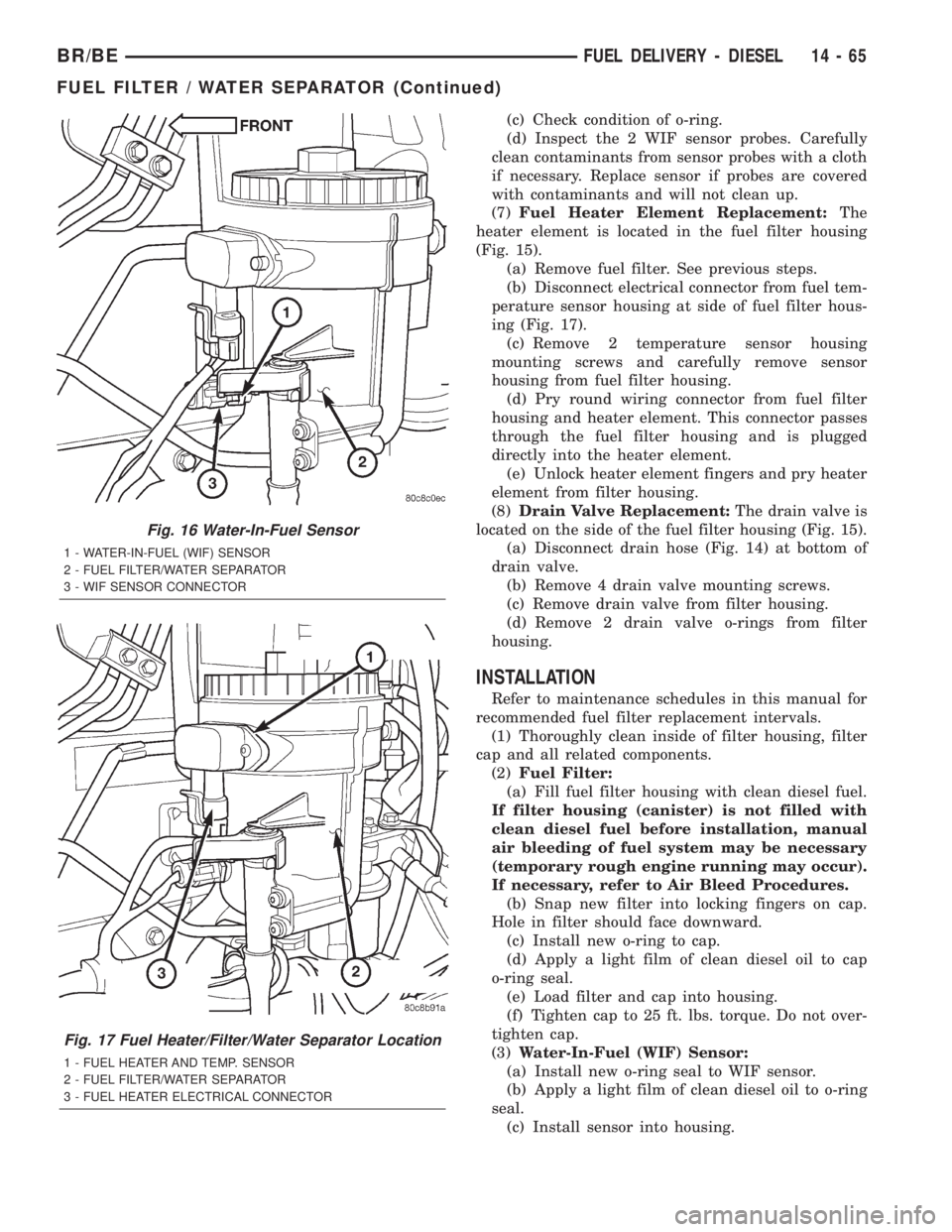
(b) Disconnect electrical connector from fuel tem-
perature sensor housing at side of fuel filter hous-
ing (Fig. 17).
(c) Remove 2 temperature sensor housing
mounting screws and carefully remove sensor
housing from fuel filter housing.
(d) Pry round wiring connector from fuel filter
housing and heater element. This connector passes
through the fuel filter housing and is plugged
directly into the heater element.
(e) Unlock heater element fingers and pry heater
element from filter housing.
(8)Drain Valve Replacement:The drain valve is
located on the side of the fuel filter housing (Fig. 15).
(a) Disconnect drain hose (Fig. 14) at bottom of
drain valve.
(b) Remove 4 drain valve mounting screws.
(c) Remove drain valve from filter housing.
(d) Remove 2 drain valve o-rings from filter
housing.
INSTALLATION
Refer to maintenance schedules in this manual for
recommended fuel filter replacement intervals.
(1) Thoroughly clean inside of filter housing, filter
cap and all related components.
(2)Fuel Filter:
(a) Fill fuel filter housing with clean diesel fuel.
If filter housing (canister) is not filled with
clean diesel fuel before installation, manual
air bleeding of fuel system may be necessary
(temporary rough engine running may occur).
If necessary, refer to Air Bleed Procedures.
(b) Snap new filter into locking fingers on cap.
Hole in filter should face downward.
(c) Install new o-ring to cap.
(d) Apply a light film of clean diesel oil to cap
o-ring seal.
(e) Load filter and cap into housing.
(f) Tighten cap to 25 ft. lbs. torque. Do not over-
tighten cap.
(3)Water-In-Fuel (WIF) Sensor:
(a) Install new o-ring seal to WIF sensor.
(b) Apply a light film of clean diesel oil to o-ring
seal.
(c) Install sensor into housing.
Fig. 16 Water-In-Fuel Sensor
1 - WATER-IN-FUEL (WIF) SENSOR
2 - FUEL FILTER/WATER SEPARATOR
3 - WIF SENSOR CONNECTOR
Fig. 17 Fuel Heater/Filter/Water Separator Location
1 - FUEL HEATER AND TEMP. SENSOR
2 - FUEL FILTER/WATER SEPARATOR
3 - FUEL HEATER ELECTRICAL CONNECTOR
BR/BEFUEL DELIVERY - DIESEL 14 - 65
FUEL FILTER / WATER SEPARATOR (Continued)
Page 1369 of 2255
OPERATION
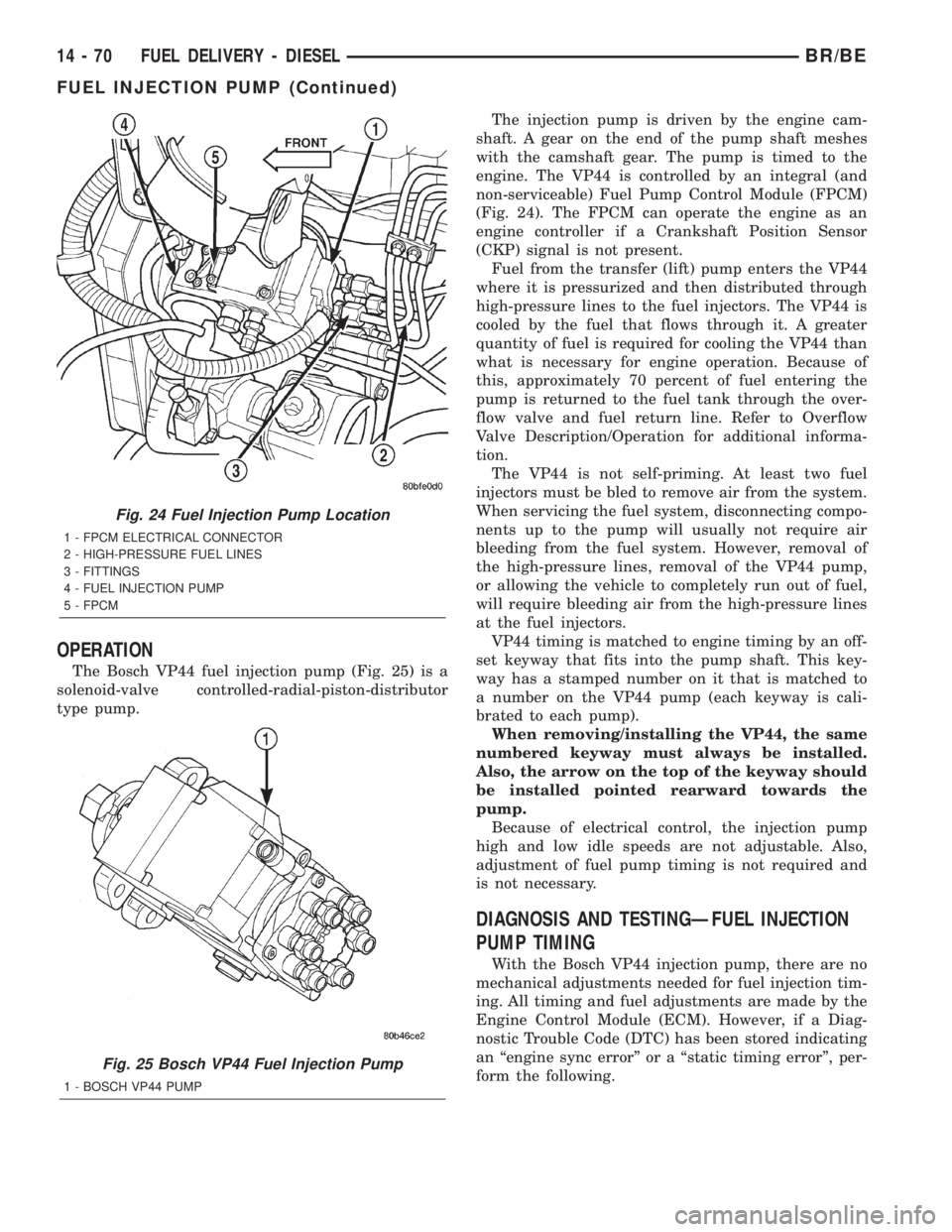
The Bosch VP44 fuel injection pump (Fig. 25) is a
solenoid-valve controlled-radial-piston-distributor
type pump.The injection pump is driven by the engine cam-
shaft. A gear on the end of the pump shaft meshes
with the camshaft gear. The pump is timed to the
engine. The VP44 is controlled by an integral (and
non-serviceable) Fuel Pump Control Module (FPCM)
(Fig. 24). The FPCM can operate the engine as an
engine controller if a Crankshaft Position Sensor
(CKP) signal is not present.
Fuel from the transfer (lift) pump enters the VP44
where it is pressurized and then distributed through
high-pressure lines to the fuel injectors. The VP44 is
cooled by the fuel that flows through it. A greater
quantity of fuel is required for cooling the VP44 than
what is necessary for engine operation. Because of
this, approximately 70 percent of fuel entering the
pump is returned to the fuel tank through the over-
flow valve and fuel return line. Refer to Overflow
Valve Description/Operation for additional informa-
tion.
The VP44 is not self-priming. At least two fuel
injectors must be bled to remove air from the system.
When servicing the fuel system, disconnecting compo-
nents up to the pump will usually not require air
bleeding from the fuel system. However, removal of
the high-pressure lines, removal of the VP44 pump,
or allowing the vehicle to completely run out of fuel,
will require bleeding air from the high-pressure lines
at the fuel injectors.
VP44 timing is matched to engine timing by an off-
set keyway that fits into the pump shaft. This key-
way has a stamped number on it that is matched to
a number on the VP44 pump (each keyway is cali-
brated to each pump).
When removing/installing the VP44, the same
numbered keyway must always be installed.
Also, the arrow on the top of the keyway should
be installed pointed rearward towards the
pump.
Because of electrical control, the injection pump
high and low idle speeds are not adjustable. Also,
adjustment of fuel pump timing is not required and
is not necessary.
DIAGNOSIS AND TESTINGÐFUEL INJECTION
PUMP TIMING
With the Bosch VP44 injection pump, there are no
mechanical adjustments needed for fuel injection tim-
ing. All timing and fuel adjustments are made by the
Engine Control Module (ECM). However, if a Diag-
nostic Trouble Code (DTC) has been stored indicating
an ªengine sync errorº or a ªstatic timing errorº, per-
form the following.
Fig. 24 Fuel Injection Pump Location
1 - FPCM ELECTRICAL CONNECTOR
2 - HIGH-PRESSURE FUEL LINES
3 - FITTINGS
4 - FUEL INJECTION PUMP
5 - FPCM
Fig. 25 Bosch VP44 Fuel Injection Pump
1 - BOSCH VP44 PUMP
14 - 70 FUEL DELIVERY - DIESELBR/BE
FUEL INJECTION PUMP (Continued)
Page 1381 of 2255
CAUTION: Be sure that the high-pressure fuel lines
are installed in the same order that they were
removed.
(1) Lubricate threads of injector line fittings with
clean engine oil.
(2) Loosen, but do not remove, all fuel line support
bracket bolts.
(3) Installrearinjection line bundle beginning
with cylinder head (fuel injector) connections, fol-
lowed by injection pump connections. Tighten all fit-
tings finger tight.
(4) Tighten fittings at fuel injector ends for cylin-
ders number 6 and 5 to 38 N´m (28 ft. lbs.) torque.
Do not tighten number 3 line at this time. It
will be tightened during bleeding procedure.
(5) Tighten 3 fittings at fuel injection pump ends
to 24 N´m (18 ft. lbs.) torque.
(6) Installfrontinjection line bundle beginning
with cylinder head (fuel injector) connections, fol-
lowed by injection pump connections. Tighten all fit-
tings finger tight.
(7) Tighten fitting at fuel injector end for cylinder
number 2 to 38 N´m (28 ft. lbs.) torque.Do not
tighten lines number 1 or 4 at this time. They
will be tightened during bleeding procedure.
(8) Tighten remaining 3 fittings at fuel injection
pump ends to 24 N´m (18 ft. lbs.) torque.
(9) Install fuel line support bracket bolts to intake
manifold and tighten to 24 N´m (18 ft. lbs.) torque.
CAUTION: Be sure fuel lines are not contacting
each other or any other component. Noise will
result.
(10) Install engine lifting bracket at rear of intake
manifold. Tighten 2 bolts to 77 N´m (57 ft. lbs.)
torque.
(11) Install cable bracket housing/cable assembly
and tighten 3 mounting bolts to 24 N´m (18 ft. lbs.)
torque.
(12) Clean any old gasket material below and
above intake manifold air heater element block. Also
clean mating areas at intake manifold and air intake
housing.
(13) Using new gaskets, position intake manifold
air heater element block to engine.
(14) Install air intake housing and position ground
cable. Install 4 mounting bolts and tighten to 24 N´m
(18 ft. lbs.) torque.
(15) Install air tube (intake manifold-to-charge air
cooler) (Fig. 49). Tighten clamps to 8 N´m (72 in. lbs.)
torque.
(16) Install engine oil dipstick tube support mount-
ing bolt and tighten to 24 N´m (18 ft. lbs.) torque.
(17) Install engine oil dipstick to engine.(18) Connect 2 electrical cables to cable mounting
studs.
(19) Connect electrical connector to bottom of
APPS by pushing connector upward until it snaps
into position.
(20) Connect wiring harness (clip) at bottom of
Accelerator Pedal Position Sensor (APPS) mounting
bracket (Fig. 48).
(21) Connect front wiring clip (Fig. 49) to cable
bracket housing.
(22) Install cable cover (Fig. 47).
(23) Connect both negative battery cables to both
batteries.
(24) Bleed air from fuel system. Do this at fuel
injector ends of lines. Use cylinders numbers 1, 3 and
4 for bleeding. (Refer to 14 - FUEL SYSTEM/FUEL
DELIVERY - STANDARD PROCEDURE). After
bleeding, tighten fittings to 38 N´m (28 ft. lbs.)
torque.
(25) Check lines/fittings for leaks.
FUEL TANK
DESCRIPTION - DIESEL FUEL TANK
The fuel tank is similar to the tank used with gas-
oline powered models. The tank is equipped with a
separate fuel return line and a different fuel tank
module for diesel powered models. A fuel tank
mounted, electric fuel pump is not used with diesel
powered models. Refer to Fuel Tank Module for addi-
tional information.
For removal and installation procedures, refer to
Fuel Tank - Gasoline Engines.
FUEL TANK MODULE
DESCRIPTION
An electric fuel pump isnot usedin the fuel tank
module for diesel powered engines. Fuel is supplied
by the engine mounted fuel transfer pump and the
fuel injection pump.
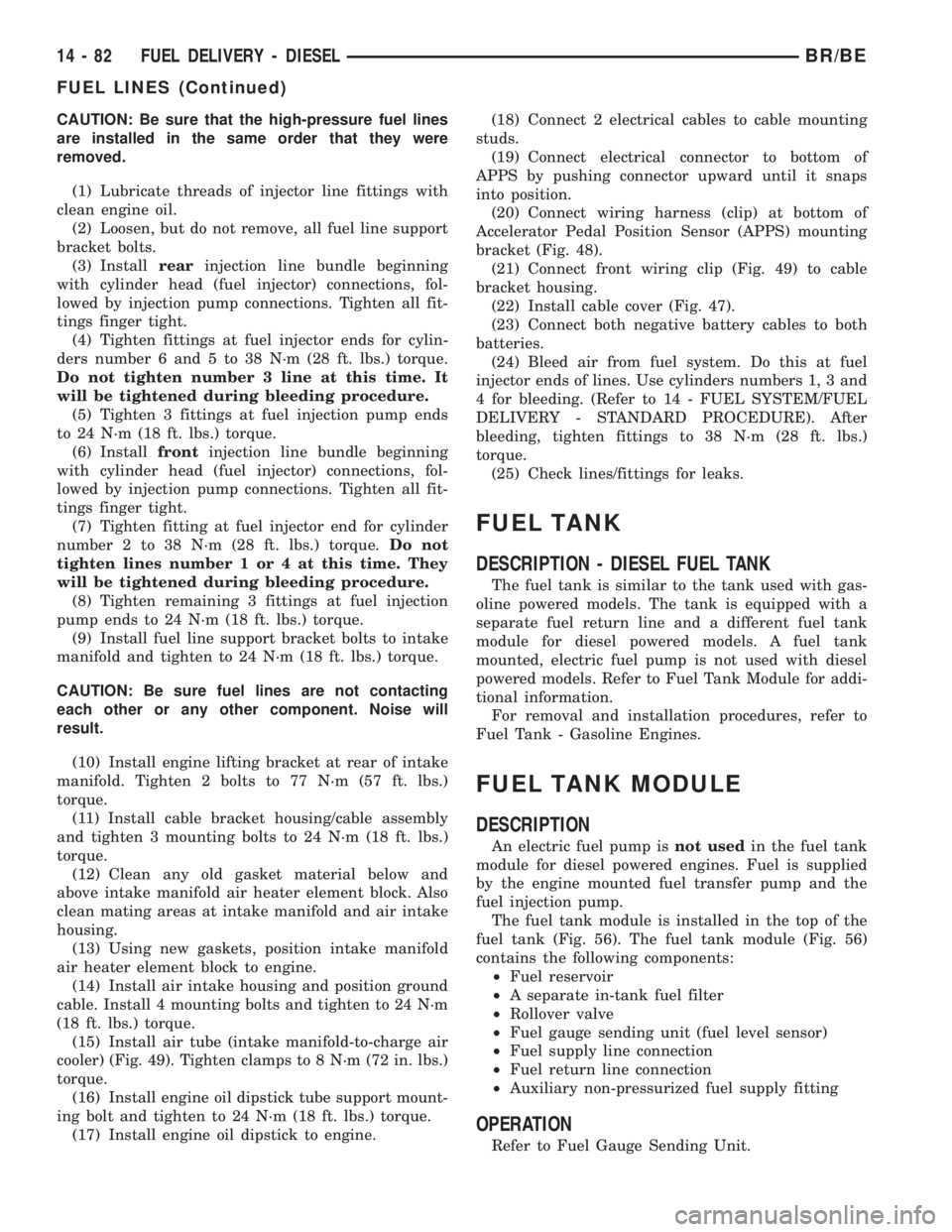
The fuel tank module is installed in the top of the
fuel tank (Fig. 56). The fuel tank module (Fig. 56)
contains the following components:
²Fuel reservoir
²A separate in-tank fuel filter
²Rollover valve
²Fuel gauge sending unit (fuel level sensor)
²Fuel supply line connection
²Fuel return line connection
²Auxiliary non-pressurized fuel supply fitting
OPERATION
Refer to Fuel Gauge Sending Unit.
14 - 82 FUEL DELIVERY - DIESELBR/BE
FUEL LINES (Continued)
Page 1389 of 2255
REMOVAL
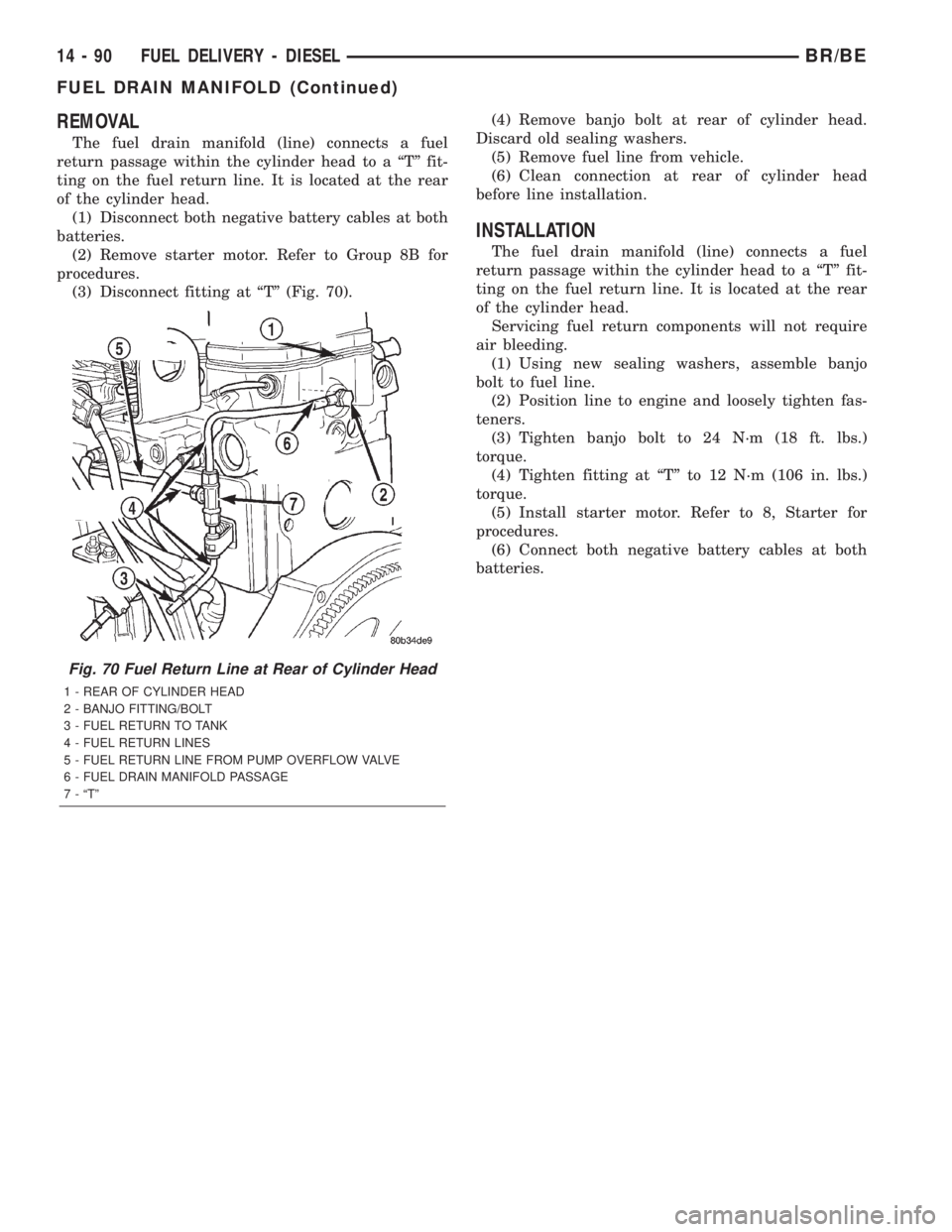
The fuel drain manifold (line) connects a fuel
return passage within the cylinder head to a ªTº fit-
ting on the fuel return line. It is located at the rear
of the cylinder head.
(1) Disconnect both negative battery cables at both
batteries.
(2) Remove starter motor. Refer to Group 8B for
procedures.
(3) Disconnect fitting at ªTº (Fig. 70).(4) Remove banjo bolt at rear of cylinder head.
Discard old sealing washers.
(5) Remove fuel line from vehicle.
(6) Clean connection at rear of cylinder head
before line installation.
INSTALLATION
The fuel drain manifold (line) connects a fuel
return passage within the cylinder head to a ªTº fit-
ting on the fuel return line. It is located at the rear
of the cylinder head.
Servicing fuel return components will not require
air bleeding.
(1) Using new sealing washers, assemble banjo
bolt to fuel line.
(2) Position line to engine and loosely tighten fas-
teners.
(3) Tighten banjo bolt to 24 N´m (18 ft. lbs.)
torque.
(4) Tighten fitting at ªTº to 12 N´m (106 in. lbs.)
torque.
(5) Install starter motor. Refer to 8, Starter for
procedures.
(6) Connect both negative battery cables at both
batteries.
Fig. 70 Fuel Return Line at Rear of Cylinder Head
1 - REAR OF CYLINDER HEAD
2 - BANJO FITTING/BOLT
3 - FUEL RETURN TO TANK
4 - FUEL RETURN LINES
5 - FUEL RETURN LINE FROM PUMP OVERFLOW VALVE
6 - FUEL DRAIN MANIFOLD PASSAGE
7 - ªTº
14 - 90 FUEL DELIVERY - DIESELBR/BE
FUEL DRAIN MANIFOLD (Continued)
Page 1398 of 2255
lines before opening up any fuel system component.
Always cover or cap any open fuel connections before
a fuel system repair is performed.
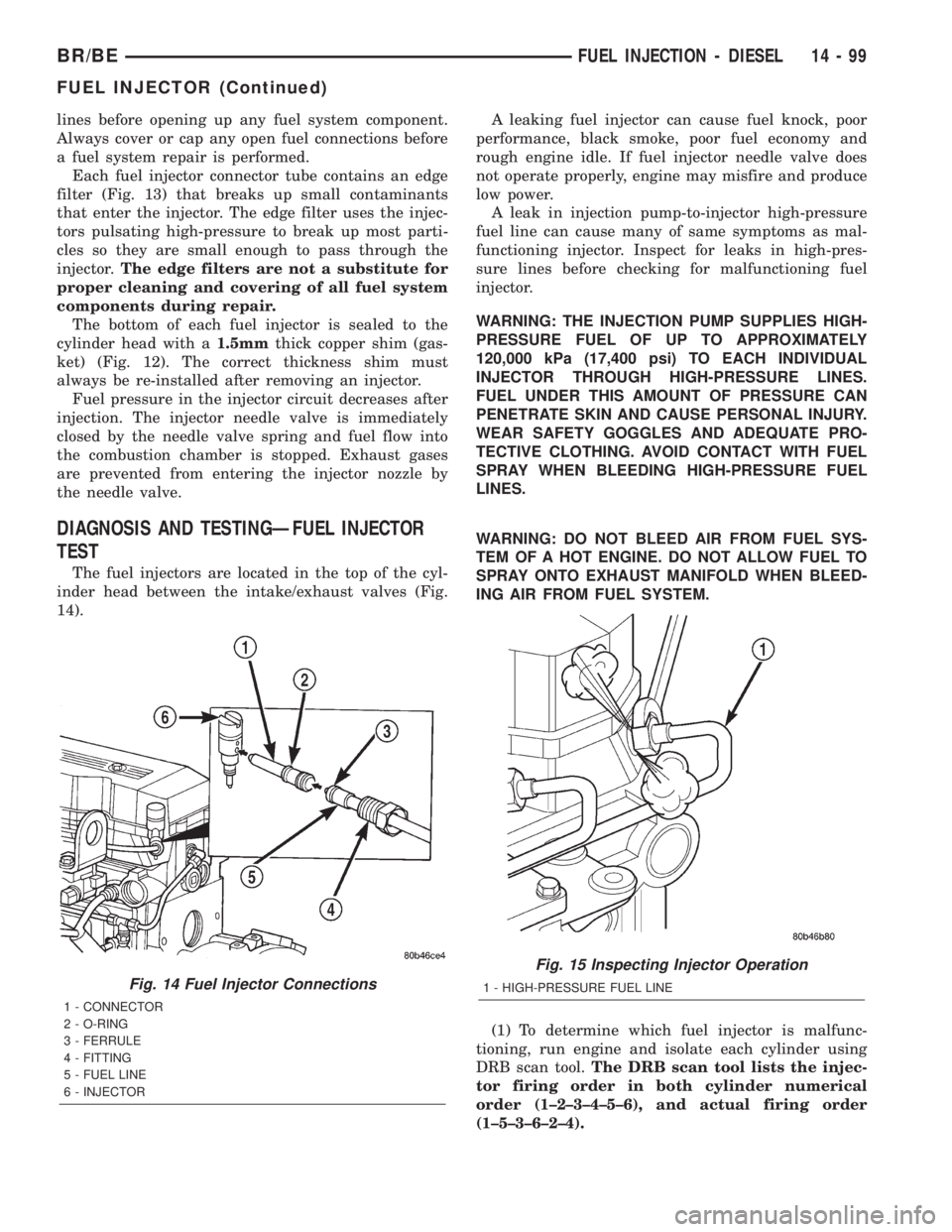
Each fuel injector connector tube contains an edge
filter (Fig. 13) that breaks up small contaminants
that enter the injector. The edge filter uses the injec-
tors pulsating high-pressure to break up most parti-
cles so they are small enough to pass through the
injector.The edge filters are not a substitute for
proper cleaning and covering of all fuel system
components during repair.
The bottom of each fuel injector is sealed to the
cylinder head with a1.5mmthick copper shim (gas-
ket) (Fig. 12). The correct thickness shim must
always be re-installed after removing an injector.
Fuel pressure in the injector circuit decreases after
injection. The injector needle valve is immediately
closed by the needle valve spring and fuel flow into
the combustion chamber is stopped. Exhaust gases
are prevented from entering the injector nozzle by
the needle valve.
DIAGNOSIS AND TESTINGÐFUEL INJECTOR
TEST
The fuel injectors are located in the top of the cyl-
inder head between the intake/exhaust valves (Fig.
14).A leaking fuel injector can cause fuel knock, poor
performance, black smoke, poor fuel economy and
rough engine idle. If fuel injector needle valve does
not operate properly, engine may misfire and produce
low power.
A leak in injection pump-to-injector high-pressure
fuel line can cause many of same symptoms as mal-
functioning injector. Inspect for leaks in high-pres-
sure lines before checking for malfunctioning fuel
injector.
WARNING: THE INJECTION PUMP SUPPLIES HIGH-
PRESSURE FUEL OF UP TO APPROXIMATELY
120,000 kPa (17,400 psi) TO EACH INDIVIDUAL
INJECTOR THROUGH HIGH-PRESSURE LINES.
FUEL UNDER THIS AMOUNT OF PRESSURE CAN
PENETRATE SKIN AND CAUSE PERSONAL INJURY.
WEAR SAFETY GOGGLES AND ADEQUATE PRO-
TECTIVE CLOTHING. AVOID CONTACT WITH FUEL
SPRAY WHEN BLEEDING HIGH-PRESSURE FUEL
LINES.
WARNING: DO NOT BLEED AIR FROM FUEL SYS-
TEM OF A HOT ENGINE. DO NOT ALLOW FUEL TO
SPRAY ONTO EXHAUST MANIFOLD WHEN BLEED-
ING AIR FROM FUEL SYSTEM.
(1) To determine which fuel injector is malfunc-
tioning, run engine and isolate each cylinder using
DRB scan tool.The DRB scan tool lists the injec-
tor firing order in both cylinder numerical
order (1±2±3±4±5±6), and actual firing order
(1±5±3±6±2±4).
Fig. 14 Fuel Injector Connections
1 - CONNECTOR
2 - O-RING
3 - FERRULE
4 - FITTING
5 - FUEL LINE
6 - INJECTOR
Fig. 15 Inspecting Injector Operation
1 - HIGH-PRESSURE FUEL LINE
BR/BEFUEL INJECTION - DIESEL 14 - 99
FUEL INJECTOR (Continued)
Page 1617 of 2255
FRONT SERVO
DESCRIPTION
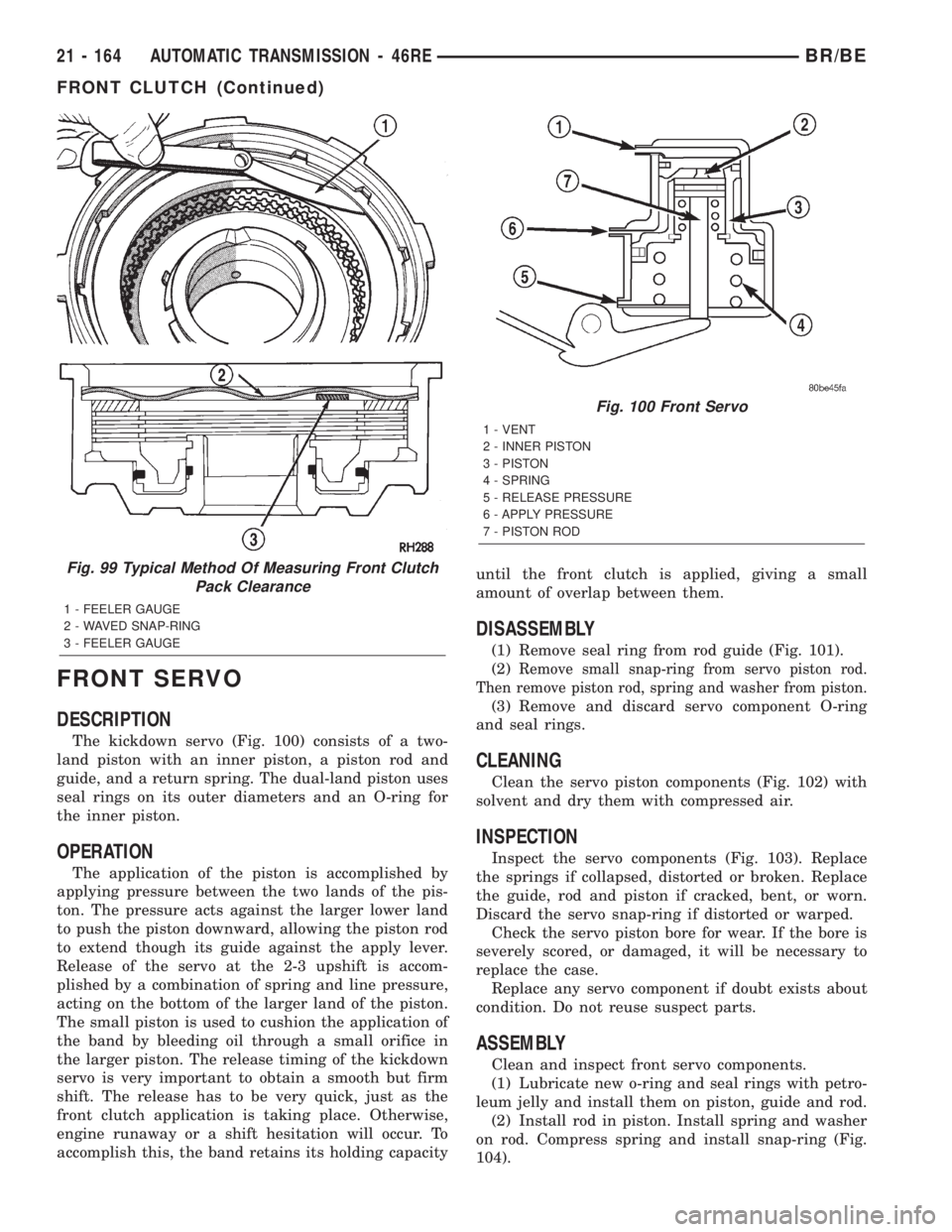
The kickdown servo (Fig. 100) consists of a two-
land piston with an inner piston, a piston rod and
guide, and a return spring. The dual-land piston uses
seal rings on its outer diameters and an O-ring for
the inner piston.
OPERATION
The application of the piston is accomplished by
applying pressure between the two lands of the pis-
ton. The pressure acts against the larger lower land
to push the piston downward, allowing the piston rod
to extend though its guide against the apply lever.
Release of the servo at the 2-3 upshift is accom-
plished by a combination of spring and line pressure,
acting on the bottom of the larger land of the piston.
The small piston is used to cushion the application of
the band by bleeding oil through a small orifice in
the larger piston. The release timing of the kickdown
servo is very important to obtain a smooth but firm
shift. The release has to be very quick, just as the
front clutch application is taking place. Otherwise,
engine runaway or a shift hesitation will occur. To
accomplish this, the band retains its holding capacityuntil the front clutch is applied, giving a small
amount of overlap between them.
DISASSEMBLY
(1) Remove seal ring from rod guide (Fig. 101).
(2)
Remove small snap-ring from servo piston rod.
Then remove piston rod, spring and washer from piston.
(3) Remove and discard servo component O-ring
and seal rings.
CLEANING
Clean the servo piston components (Fig. 102) with
solvent and dry them with compressed air.
INSPECTION
Inspect the servo components (Fig. 103). Replace
the springs if collapsed, distorted or broken. Replace
the guide, rod and piston if cracked, bent, or worn.
Discard the servo snap-ring if distorted or warped.
Check the servo piston bore for wear. If the bore is
severely scored, or damaged, it will be necessary to
replace the case.
Replace any servo component if doubt exists about
condition. Do not reuse suspect parts.
ASSEMBLY
Clean and inspect front servo components.
(1) Lubricate new o-ring and seal rings with petro-
leum jelly and install them on piston, guide and rod.
(2) Install rod in piston. Install spring and washer
on rod. Compress spring and install snap-ring (Fig.
104).
Fig. 99 Typical Method Of Measuring Front Clutch
Pack Clearance
1 - FEELER GAUGE
2 - WAVED SNAP-RING
3 - FEELER GAUGE
Fig. 100 Front Servo
1 - VENT
2 - INNER PISTON
3 - PISTON
4 - SPRING
5 - RELEASE PRESSURE
6 - APPLY PRESSURE
7 - PISTON ROD
21 - 164 AUTOMATIC TRANSMISSION - 46REBR/BE
FRONT CLUTCH (Continued)
Page 1787 of 2255
(11) Install spring retainer on top of piston
springs.
(12) Compress spring retainer and piston springs
with Tool C-3863-A.
(13) Install spring retainer snap-ring and remove
compressor tool.
(14) Install clutch plates and discs (Fig. 95). Four
clutch discs, four steel plates and one reaction plate
are required.
(15) Install reaction plate followed by waved snap-
ring.
(16) Check clutch pack clearance with feeler gauge
(Fig. 93). Clearance between waved spring and pres-
sure plate should 1.78-3.28 mm (0.070-0.129 in.). If
clearance is incorrect, clutch plates, clutch discs,
snap-ring, or pressure plate may have to be changed.
FRONT SERVO
DESCRIPTION
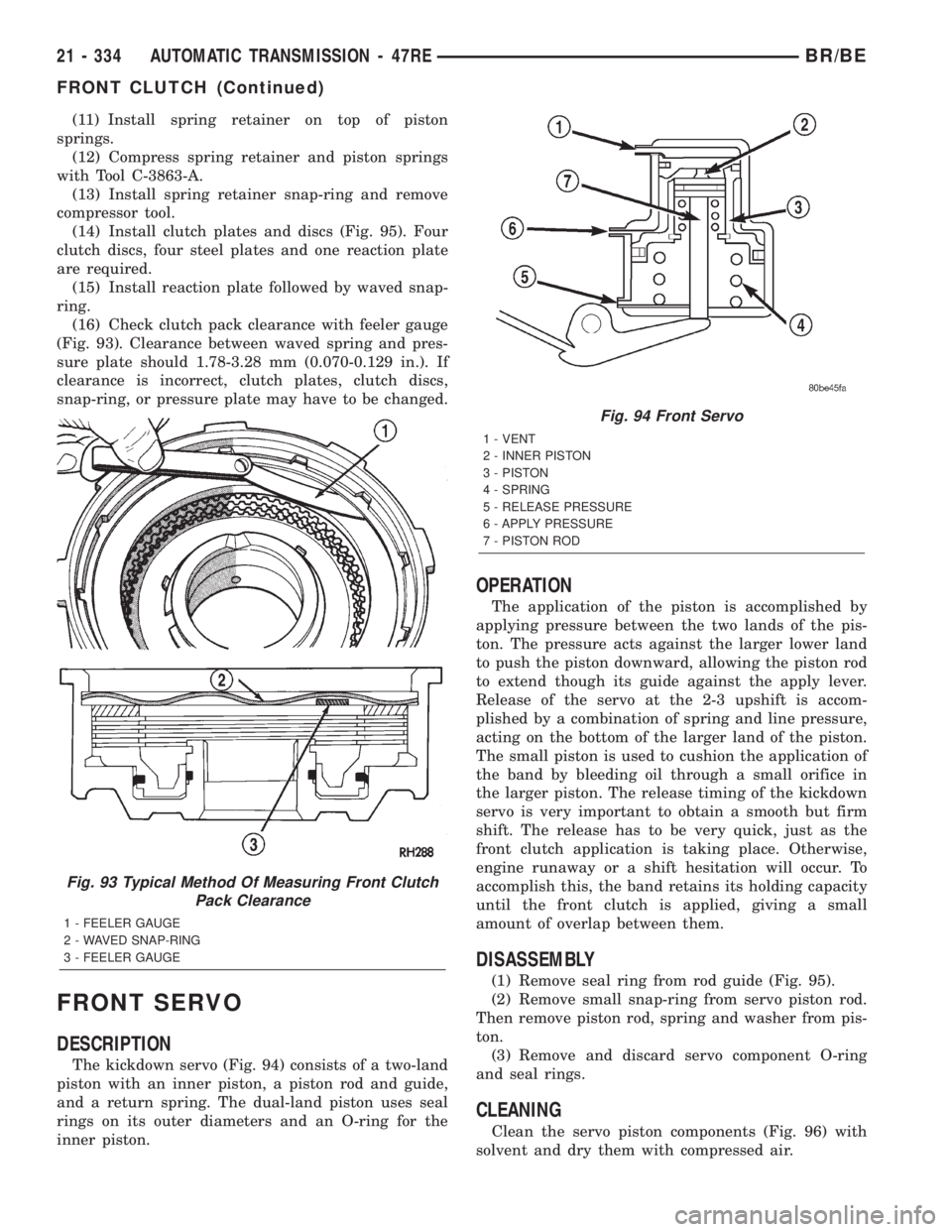
The kickdown servo (Fig. 94) consists of a two-land
piston with an inner piston, a piston rod and guide,
and a return spring. The dual-land piston uses seal
rings on its outer diameters and an O-ring for the
inner piston.
OPERATION
The application of the piston is accomplished by
applying pressure between the two lands of the pis-
ton. The pressure acts against the larger lower land
to push the piston downward, allowing the piston rod
to extend though its guide against the apply lever.
Release of the servo at the 2-3 upshift is accom-
plished by a combination of spring and line pressure,
acting on the bottom of the larger land of the piston.
The small piston is used to cushion the application of
the band by bleeding oil through a small orifice in
the larger piston. The release timing of the kickdown
servo is very important to obtain a smooth but firm
shift. The release has to be very quick, just as the
front clutch application is taking place. Otherwise,
engine runaway or a shift hesitation will occur. To
accomplish this, the band retains its holding capacity
until the front clutch is applied, giving a small
amount of overlap between them.
DISASSEMBLY
(1) Remove seal ring from rod guide (Fig. 95).
(2) Remove small snap-ring from servo piston rod.
Then remove piston rod, spring and washer from pis-
ton.
(3) Remove and discard servo component O-ring
and seal rings.
CLEANING
Clean the servo piston components (Fig. 96) with
solvent and dry them with compressed air.
Fig. 93 Typical Method Of Measuring Front Clutch
Pack Clearance
1 - FEELER GAUGE
2 - WAVED SNAP-RING
3 - FEELER GAUGE
Fig. 94 Front Servo
1 - VENT
2 - INNER PISTON
3 - PISTON
4 - SPRING
5 - RELEASE PRESSURE
6 - APPLY PRESSURE
7 - PISTON ROD
21 - 334 AUTOMATIC TRANSMISSION - 47REBR/BE
FRONT CLUTCH (Continued)
Page 2149 of 2255
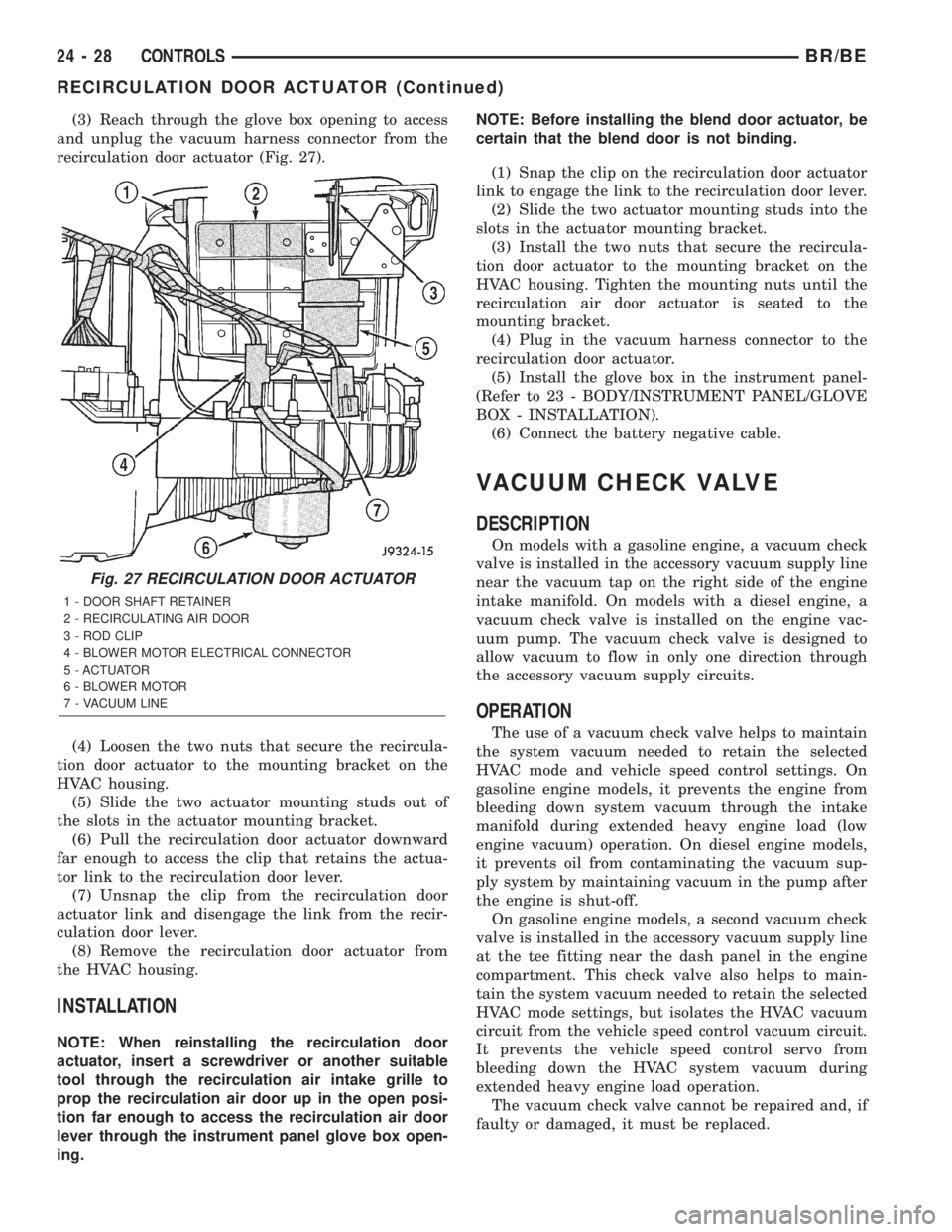
(3) Reach through the glove box opening to access
and unplug the vacuum harness connector from the
recirculation door actuator (Fig. 27).
(4) Loosen the two nuts that secure the recircula-
tion door actuator to the mounting bracket on the
HVAC housing.
(5) Slide the two actuator mounting studs out of
the slots in the actuator mounting bracket.
(6) Pull the recirculation door actuator downward
far enough to access the clip that retains the actua-
tor link to the recirculation door lever.
(7) Unsnap the clip from the recirculation door
actuator link and disengage the link from the recir-
culation door lever.
(8) Remove the recirculation door actuator from
the HVAC housing.
INSTALLATION
NOTE: When reinstalling the recirculation door
actuator, insert a screwdriver or another suitable
tool through the recirculation air intake grille to
prop the recirculation air door up in the open posi-
tion far enough to access the recirculation air door
lever through the instrument panel glove box open-
ing.NOTE: Before installing the blend door actuator, be
certain that the blend door is not binding.
(1) Snap the clip on the recirculation door actuator
link to engage the link to the recirculation door lever.
(2) Slide the two actuator mounting studs into the
slots in the actuator mounting bracket.
(3) Install the two nuts that secure the recircula-
tion door actuator to the mounting bracket on the
HVAC housing. Tighten the mounting nuts until the
recirculation air door actuator is seated to the
mounting bracket.
(4) Plug in the vacuum harness connector to the
recirculation door actuator.
(5) Install the glove box in the instrument panel-
(Refer to 23 - BODY/INSTRUMENT PANEL/GLOVE
BOX - INSTALLATION).
(6) Connect the battery negative cable.
VACUUM CHECK VALVE
DESCRIPTION
On models with a gasoline engine, a vacuum check
valve is installed in the accessory vacuum supply line
near the vacuum tap on the right side of the engine
intake manifold. On models with a diesel engine, a
vacuum check valve is installed on the engine vac-
uum pump. The vacuum check valve is designed to
allow vacuum to flow in only one direction through
the accessory vacuum supply circuits.
OPERATION
The use of a vacuum check valve helps to maintain
the system vacuum needed to retain the selected
HVAC mode and vehicle speed control settings. On
gasoline engine models, it prevents the engine from
bleeding down system vacuum through the intake
manifold during extended heavy engine load (low
engine vacuum) operation. On diesel engine models,
it prevents oil from contaminating the vacuum sup-
ply system by maintaining vacuum in the pump after
the engine is shut-off.
On gasoline engine models, a second vacuum check
valve is installed in the accessory vacuum supply line
at the tee fitting near the dash panel in the engine
compartment. This check valve also helps to main-
tain the system vacuum needed to retain the selected
HVAC mode settings, but isolates the HVAC vacuum
circuit from the vehicle speed control vacuum circuit.
It prevents the vehicle speed control servo from
bleeding down the HVAC system vacuum during
extended heavy engine load operation.
The vacuum check valve cannot be repaired and, if
faulty or damaged, it must be replaced.
Fig. 27 RECIRCULATION DOOR ACTUATOR
1 - DOOR SHAFT RETAINER
2 - RECIRCULATING AIR DOOR
3 - ROD CLIP
4 - BLOWER MOTOR ELECTRICAL CONNECTOR
5 - ACTUATOR
6 - BLOWER MOTOR
7 - VACUUM LINE
24 - 28 CONTROLSBR/BE
RECIRCULATION DOOR ACTUATOR (Continued)
Page 2218 of 2255
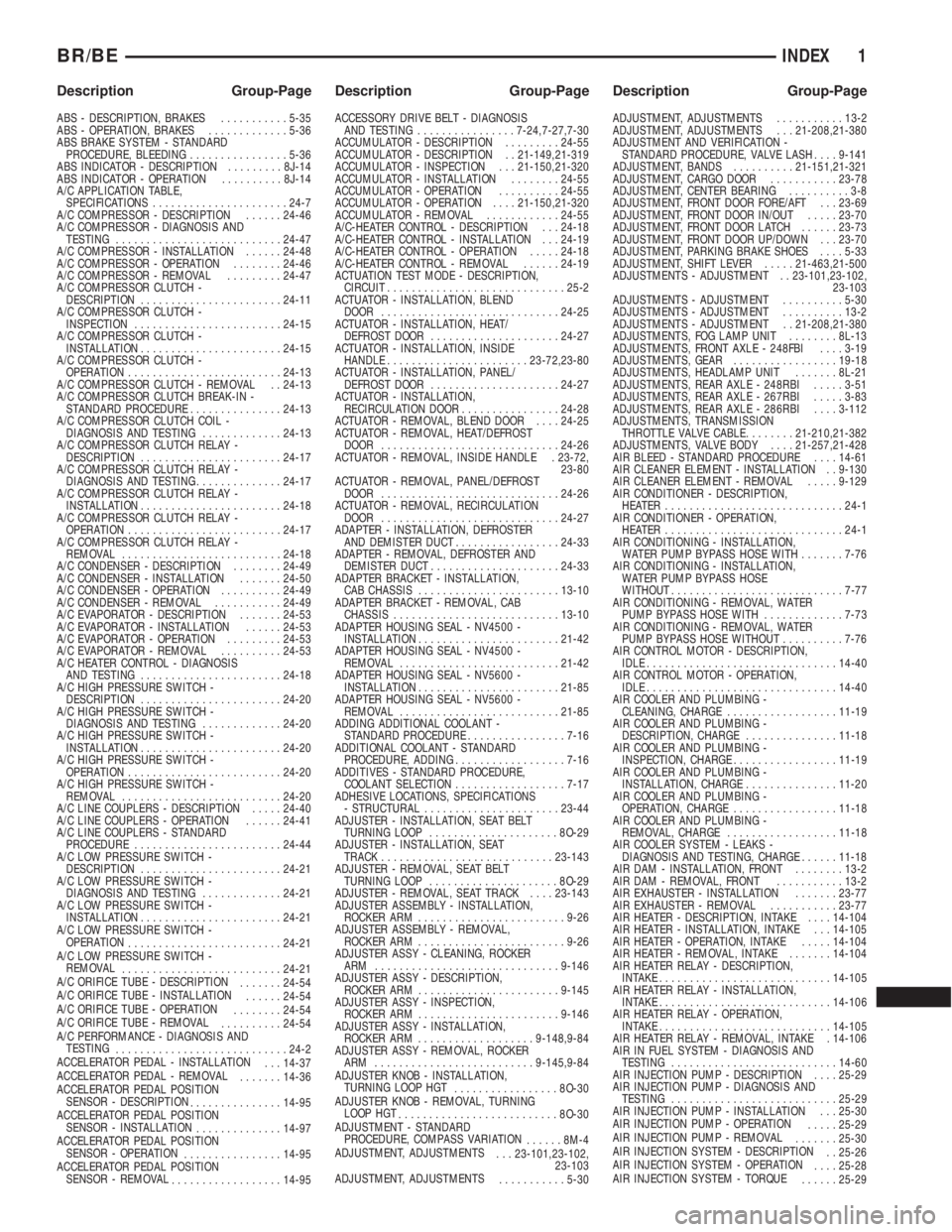
ABS - DESCRIPTION, BRAKES...........5-35
ABS - OPERATION, BRAKES.............5-36
ABS BRAKE SYSTEM - STANDARD
PROCEDURE, BLEEDING................5-36
ABS INDICATOR - DESCRIPTION.........8J-14
ABS INDICATOR - OPERATION..........8J-14
A/C APPLICATION TABLE,
SPECIFICATIONS......................24-7
A/C COMPRESSOR - DESCRIPTION......24-46
A/C COMPRESSOR - DIAGNOSIS AND
TESTING...........................24-47
A/C COMPRESSOR - INSTALLATION......24-48
A/C COMPRESSOR - OPERATION........24-46
A/C COMPRESSOR - REMOVAL.........24-47
A/C COMPRESSOR CLUTCH -
DESCRIPTION.......................24-11
A/C COMPRESSOR CLUTCH -
INSPECTION........................24-15
A/C COMPRESSOR CLUTCH -
INSTALLATION.......................24-15
A/C COMPRESSOR CLUTCH -
OPERATION.........................24-13
A/C COMPRESSOR CLUTCH - REMOVAL . . 24-13
A/C COMPRESSOR CLUTCH BREAK-IN -
STANDARD PROCEDURE...............24-13
A/C COMPRESSOR CLUTCH COIL -
DIAGNOSIS AND TESTING.............24-13
A/C COMPRESSOR CLUTCH RELAY -
DESCRIPTION.......................24-17
A/C COMPRESSOR CLUTCH RELAY -
DIAGNOSIS AND TESTING...............24-17
A/C COMPRESSOR CLUTCH RELAY -
INSTALLATION.......................24-18
A/C COMPRESSOR CLUTCH RELAY -
OPERATION.........................24-17
A/C COMPRESSOR CLUTCH RELAY -
REMOVAL..........................24-18
A/C CONDENSER - DESCRIPTION........24-49
A/C CONDENSER - INSTALLATION.......24-50
A/C CONDENSER - OPERATION..........24-49
A/C CONDENSER - REMOVAL...........24-49
A/C EVAPORATOR - DESCRIPTION.......24-53
A/C EVAPORATOR - INSTALLATION......24-53
A/C EVAPORATOR - OPERATION.........24-53
A/C EVAPORATOR - REMOVAL..........24-53
A/C HEATER CONTROL - DIAGNOSIS
AND TESTING.......................24-18
A/C HIGH PRESSURE SWITCH -
DESCRIPTION.......................24-20
A/C HIGH PRESSURE SWITCH -
DIAGNOSIS AND TESTING.............24-20
A/C HIGH PRESSURE SWITCH -
INSTALLATION.......................24-20
A/C HIGH PRESSURE SWITCH -
OPERATION.........................24-20
A/C HIGH PRESSURE SWITCH -
REMOVAL..........................24-20
A/C LINE COUPLERS - DESCRIPTION.....24-40
A/C LINE COUPLERS - OPERATION......24-41
A/C LINE COUPLERS - STANDARD
PROCEDURE........................24-44
A/C LOW PRESSURE SWITCH -
DESCRIPTION.......................24-21
A/C LOW PRESSURE SWITCH -
DIAGNOSIS AND TESTING.............24-21
A/C LOW PRESSURE SWITCH -
INSTALLATION.......................24-21
A/C LOW PRESSURE SWITCH -
OPERATION
.........................24-21
A/C LOW PRESSURE SWITCH -
REMOVAL
..........................24-21
A/C ORIFICE TUBE - DESCRIPTION
.......24-54
A/C ORIFICE TUBE - INSTALLATION
......24-54
A/C ORIFICE TUBE - OPERATION
........24-54
A/C ORIFICE TUBE - REMOVAL
..........24-54
A/C PERFORMANCE - DIAGNOSIS AND
TESTING
............................24-2
ACCELERATOR PEDAL - INSTALLATION
. . . 14-37
ACCELERATOR PEDAL - REMOVAL
.......14-36
ACCELERATOR PEDAL POSITION
SENSOR - DESCRIPTION
...............14-95
ACCELERATOR PEDAL POSITION
SENSOR - INSTALLATION
..............14-97
ACCELERATOR PEDAL POSITION
SENSOR - OPERATION
................14-95
ACCELERATOR PEDAL POSITION
SENSOR - REMOVAL
..................14-95ACCESSORY DRIVE BELT - DIAGNOSIS
AND TESTING................7-24,7-27,7-30
ACCUMULATOR - DESCRIPTION.........24-55
ACCUMULATOR - DESCRIPTION . . 21-149,21-319
ACCUMULATOR - INSPECTION . . . 21-150,21-320
ACCUMULATOR - INSTALLATION........24-55
ACCUMULATOR - OPERATION..........24-55
ACCUMULATOR - OPERATION....21-150,21-320
ACCUMULATOR - REMOVAL............24-55
A/C-HEATER CONTROL - DESCRIPTION . . . 24-18
A/C-HEATER CONTROL - INSTALLATION . . . 24-19
A/C-HEATER CONTROL - OPERATION.....24-18
A/C-HEATER CONTROL - REMOVAL......24-19
ACTUATION TEST MODE - DESCRIPTION,
CIRCUIT.............................25-2
ACTUATOR - INSTALLATION, BLEND
DOOR.............................24-25
ACTUATOR - INSTALLATION, HEAT/
DEFROST DOOR.....................24-27
ACTUATOR - INSTALLATION, INSIDE
HANDLE.......................23-72,23-80
ACTUATOR - INSTALLATION, PANEL/
DEFROST DOOR.....................24-27
ACTUATOR - INSTALLATION,
RECIRCULATION DOOR................24-28
ACTUATOR - REMOVAL, BLEND DOOR....24-25
ACTUATOR - REMOVAL, HEAT/DEFROST
DOOR.............................24-26
ACTUATOR - REMOVAL, INSIDE HANDLE . 23-72,
23-80
ACTUATOR - REMOVAL, PANEL/DEFROST
DOOR.............................24-26
ACTUATOR - REMOVAL, RECIRCULATION
DOOR.............................24-27
ADAPTER - INSTALLATION, DEFROSTER
AND DEMISTER DUCT.................24-33
ADAPTER - REMOVAL, DEFROSTER AND
DEMISTER DUCT.....................24-33
ADAPTER BRACKET - INSTALLATION,
CAB CHASSIS.......................13-10
ADAPTER BRACKET - REMOVAL, CAB
CHASSIS...........................13-10
ADAPTER HOUSING SEAL - NV4500 -
INSTALLATION.......................21-42
ADAPTER HOUSING SEAL - NV4500 -
REMOVAL..........................21-42
ADAPTER HOUSING SEAL - NV5600 -
INSTALLATION.......................21-85
ADAPTER HOUSING SEAL - NV5600 -
REMOVAL..........................21-85
ADDING ADDITIONAL COOLANT -
STANDARD PROCEDURE................7-16
ADDITIONAL COOLANT - STANDARD
PROCEDURE, ADDING..................7-16
ADDITIVES - STANDARD PROCEDURE,
COOLANT SELECTION..................7-17
ADHESIVE LOCATIONS, SPECIFICATIONS
- STRUCTURAL......................23-44
ADJUSTER - INSTALLATION, SEAT BELT
TURNING LOOP.....................8O-29
ADJUSTER - INSTALLATION, SEAT
TRACK............................23-143
ADJUSTER - REMOVAL, SEAT BELT
TURNING LOOP.....................8O-29
ADJUSTER - REMOVAL, SEAT TRACK....23-143
ADJUSTER ASSEMBLY - INSTALLATION,
ROCKER ARM........................9-26
ADJUSTER ASSEMBLY - REMOVAL,
ROCKER ARM........................9-26
ADJUSTER ASSY - CLEANING, ROCKER
ARM ..............................9-146
ADJUSTER ASSY - DESCRIPTION,
ROCKER ARM.......................9-145
ADJUSTER ASSY - INSPECTION,
ROCKER ARM.......................9-146
ADJUSTER ASSY - INSTALLATION,
ROCKER ARM...................9-148,9-84
ADJUSTER ASSY - REMOVAL, ROCKER
ARM ..........................9-145,9-84
ADJUSTER KNOB - INSTALLATION,
TURNING LOOP HGT
.................8O-30
ADJUSTER KNOB - REMOVAL, TURNING
LOOP HGT
..........................8O-30
ADJUSTMENT - STANDARD
PROCEDURE, COMPASS VARIATION
......8M-4
ADJUSTMENT, ADJUSTMENTS
. . . 23-101,23-102,
23-103
ADJUSTMENT, ADJUSTMENTS
...........5-30ADJUSTMENT, ADJUSTMENTS...........13-2
ADJUSTMENT, ADJUSTMENTS . . . 21-208,21-380
ADJUSTMENT AND VERIFICATION -
STANDARD PROCEDURE, VALVE LASH....9-141
ADJUSTMENT, BANDS..........21-151,21-321
ADJUSTMENT, CARGO DOOR...........23-78
ADJUSTMENT, CENTER BEARING..........3-8
ADJUSTMENT, FRONT DOOR FORE/AFT . . . 23-69
ADJUSTMENT, FRONT DOOR IN/OUT.....23-70
ADJUSTMENT, FRONT DOOR LATCH......23-73
ADJUSTMENT, FRONT DOOR UP/DOWN . . . 23-70
ADJUSTMENT, PARKING BRAKE SHOES....5-33
ADJUSTMENT, SHIFT LEVER.....21-463,21-500
ADJUSTMENTS - ADJUSTMENT . . 23-101,23-102,
23-103
ADJUSTMENTS - ADJUSTMENT..........5-30
ADJUSTMENTS - ADJUSTMENT..........13-2
ADJUSTMENTS - ADJUSTMENT . . 21-208,21-380
ADJUSTMENTS, FOG LAMP UNIT........8L-13
ADJUSTMENTS, FRONT AXLE - 248FBI....3-19
ADJUSTMENTS, GEAR.................19-18
ADJUSTMENTS, HEADLAMP UNIT.......8L-21
ADJUSTMENTS, REAR AXLE - 248RBI.....3-51
ADJUSTMENTS, REAR AXLE - 267RBI.....3-83
ADJUSTMENTS, REAR AXLE - 286RBI....3-112
ADJUSTMENTS, TRANSMISSION
THROTTLE VALVE CABLE.........21-210,21-382
ADJUSTMENTS, VALVE BODY....21-257,21-428
AIR BLEED - STANDARD PROCEDURE....14-61
AIR CLEANER ELEMENT - INSTALLATION . . 9-130
AIR CLEANER ELEMENT - REMOVAL.....9-129
AIR CONDITIONER - DESCRIPTION,
HEATER .............................24-1
AIR CONDITIONER - OPERATION,
HEATER .............................24-1
AIR CONDITIONING - INSTALLATION,
WATER PUMP BYPASS HOSE WITH.......7-76
AIR CONDITIONING - INSTALLATION,
WATER PUMP BYPASS HOSE
WITHOUT............................7-77
AIR CONDITIONING - REMOVAL, WATER
PUMP BYPASS HOSE WITH.............7-73
AIR CONDITIONING - REMOVAL, WATER
PUMP BYPASS HOSE WITHOUT..........7-76
AIR CONTROL MOTOR - DESCRIPTION,
IDLE...............................14-40
AIR CONTROL MOTOR - OPERATION,
IDLE...............................14-40
AIR COOLER AND PLUMBING -
CLEANING, CHARGE..................11-19
AIR COOLER AND PLUMBING -
DESCRIPTION, CHARGE...............11-18
AIR COOLER AND PLUMBING -
INSPECTION, CHARGE.................11-19
AIR COOLER AND PLUMBING -
INSTALLATION, CHARGE...............11-20
AIR COOLER AND PLUMBING -
OPERATION, CHARGE.................11-18
AIR COOLER AND PLUMBING -
REMOVAL, CHARGE..................11-18
AIR COOLER SYSTEM - LEAKS -
DIAGNOSIS AND TESTING, CHARGE......11-18
AIR DAM - INSTALLATION, FRONT........13-2
AIR DAM - REMOVAL, FRONT...........13-2
AIR EXHAUSTER - INSTALLATION.......23-77
AIR EXHAUSTER - REMOVAL...........23-77
AIR HEATER - DESCRIPTION, INTAKE....14-104
AIR HEATER - INSTALLATION, INTAKE . . . 14-105
AIR HEATER - OPERATION, INTAKE.....14-104
AIR HEATER - REMOVAL, INTAKE.......14-104
AIR HEATER RELAY - DESCRIPTION,
INTAKE............................14-105
AIR HEATER RELAY - INSTALLATION,
INTAKE............................14-106
AIR HEATER RELAY - OPERATION,
INTAKE............................14-105
AIR HEATER RELAY - REMOVAL, INTAKE . 14-106
AIR IN FUEL SYSTEM - DIAGNOSIS AND
TESTING...........................14-60
AIR INJECTION PUMP - DESCRIPTION....25-29
AIR INJECTION PUMP - DIAGNOSIS AND
TESTING...........................25-29
AIR INJECTION PUMP - INSTALLATION . . . 25-30
AIR INJECTION PUMP - OPERATION
.....25-29
AIR INJECTION PUMP - REMOVAL
.......25-30
AIR INJECTION SYSTEM - DESCRIPTION
. . 25-26
AIR INJECTION SYSTEM - OPERATION
....25-28
AIR INJECTION SYSTEM - TORQUE
......25-29
BR/BEINDEX 1
Description Group-Page Description Group-Page Description Group-Page
Page 2220 of 2255
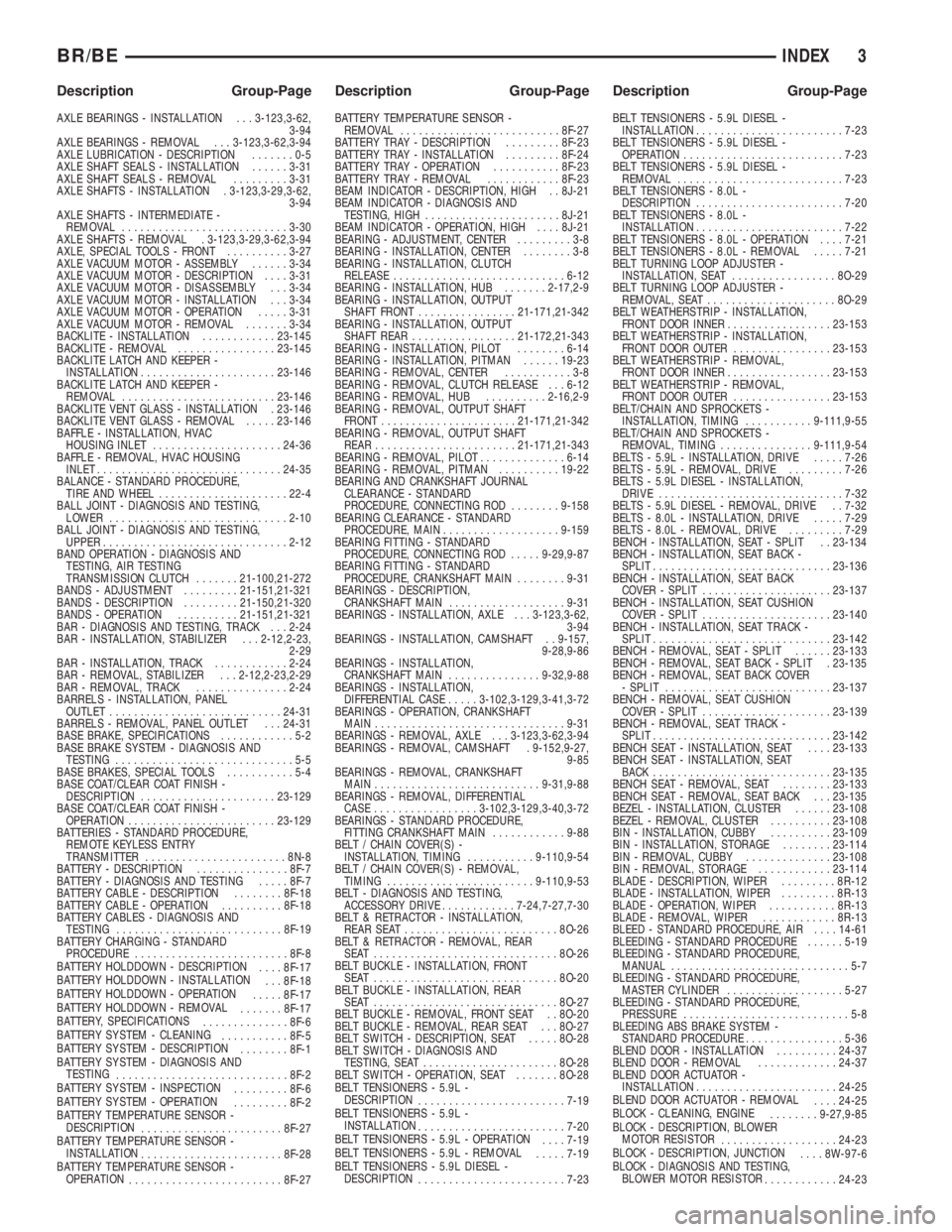
AXLE BEARINGS - INSTALLATION . . . 3-123,3-62,
3-94
AXLE BEARINGS - REMOVAL . . . 3-123,3-62,3-94
AXLE LUBRICATION - DESCRIPTION.......0-5
AXLE SHAFT SEALS - INSTALLATION......3-31
AXLE SHAFT SEALS - REMOVAL.........3-31
AXLE SHAFTS - INSTALLATION . 3-123,3-29,3-62,
3-94
AXLE SHAFTS - INTERMEDIATE -
REMOVAL...........................3-30
AXLE SHAFTS - REMOVAL . 3-123,3-29,3-62,3-94
AXLE, SPECIAL TOOLS - FRONT..........3-27
AXLE VACUUM MOTOR - ASSEMBLY......3-34
AXLE VACUUM MOTOR - DESCRIPTION....3-31
AXLE VACUUM MOTOR - DISASSEMBLY . . . 3-34
AXLE VACUUM MOTOR - INSTALLATION . . . 3-34
AXLE VACUUM MOTOR - OPERATION.....3-31
AXLE VACUUM MOTOR - REMOVAL.......3-34
BACKLITE - INSTALLATION............23-145
BACKLITE - REMOVAL................23-145
BACKLITE LATCH AND KEEPER -
INSTALLATION......................23-146
BACKLITE LATCH AND KEEPER -
REMOVAL.........................23-146
BACKLITE VENT GLASS - INSTALLATION . 23-146
BACKLITE VENT GLASS - REMOVAL.....23-146
BAFFLE - INSTALLATION, HVAC
HOUSING INLET.....................24-36
BAFFLE - REMOVAL, HVAC HOUSING
INLET..............................24-35
BALANCE - STANDARD PROCEDURE,
TIRE AND WHEEL.....................22-4
BALL JOINT - DIAGNOSIS AND TESTING,
LOWER.............................2-10
BALL JOINT - DIAGNOSIS AND TESTING,
UPPER..............................2-12
BAND OPERATION - DIAGNOSIS AND
TESTING, AIR TESTING
TRANSMISSION CLUTCH.......21-100,21-272
BANDS - ADJUSTMENT.........21-151,21-321
BANDS - DESCRIPTION.........21-150,21-320
BANDS - OPERATION..........21-151,21-321
BAR - DIAGNOSIS AND TESTING, TRACK . . . 2-24
BAR - INSTALLATION, STABILIZER . . . 2-12,2-23,
2-29
BAR - INSTALLATION, TRACK............2-24
BAR - REMOVAL, STABILIZER . . . 2-12,2-23,2-29
BAR - REMOVAL, TRACK...............2-24
BARRELS - INSTALLATION, PANEL
OUTLET............................24-31
BARRELS - REMOVAL, PANEL OUTLET . . . 24-31
BASE BRAKE, SPECIFICATIONS............5-2
BASE BRAKE SYSTEM - DIAGNOSIS AND
TESTING.............................5-5
BASE BRAKES, SPECIAL TOOLS...........5-4
BASE COAT/CLEAR COAT FINISH -
DESCRIPTION......................23-129
BASE COAT/CLEAR COAT FINISH -
OPERATION........................23-129
BATTERIES - STANDARD PROCEDURE,
REMOTE KEYLESS ENTRY
TRANSMITTER.......................8N-8
BATTERY - DESCRIPTION...............8F-7
BATTERY - DIAGNOSIS AND TESTING.....8F-7
BATTERY CABLE - DESCRIPTION........8F-18
BATTERY CABLE - OPERATION..........8F-18
BATTERY CABLES - DIAGNOSIS AND
TESTING...........................8F-19
BATTERY CHARGING - STANDARD
PROCEDURE.........................8F-8
BATTERY HOLDDOWN - DESCRIPTION
....8F-17
BATTERY HOLDDOWN - INSTALLATION
. . . 8F-18
BATTERY HOLDDOWN - OPERATION
.....8F-17
BATTERY HOLDDOWN - REMOVAL
.......8F-17
BATTERY, SPECIFICATIONS
..............8F-6
BATTERY SYSTEM - CLEANING
...........8F-5
BATTERY SYSTEM - DESCRIPTION
........8F-1
BATTERY SYSTEM - DIAGNOSIS AND
TESTING
............................8F-2
BATTERY SYSTEM - INSPECTION
.........8F-6
BATTERY SYSTEM - OPERATION
.........8F-2
BATTERY TEMPERATURE SENSOR -
DESCRIPTION
.......................8F-27
BATTERY TEMPERATURE SENSOR -
INSTALLATION
.......................8F-28
BATTERY TEMPERATURE SENSOR -
OPERATION
.........................8F-27BATTERY TEMPERATURE SENSOR -
REMOVAL..........................8F-27
BATTERY TRAY - DESCRIPTION.........8F-23
BATTERY TRAY - INSTALLATION.........8F-24
BATTERY TRAY - OPERATION...........8F-23
BATTERY TRAY - REMOVAL............8F-23
BEAM INDICATOR - DESCRIPTION, HIGH . . 8J-21
BEAM INDICATOR - DIAGNOSIS AND
TESTING, HIGH......................8J-21
BEAM INDICATOR - OPERATION, HIGH....8J-21
BEARING - ADJUSTMENT, CENTER.........3-8
BEARING - INSTALLATION, CENTER........3-8
BEARING - INSTALLATION, CLUTCH
RELEASE............................6-12
BEARING - INSTALLATION, HUB.......2-17,2-9
BEARING - INSTALLATION, OUTPUT
SHAFT FRONT................21-171,21-342
BEARING - INSTALLATION, OUTPUT
SHAFT REAR.................21-172,21-343
BEARING - INSTALLATION, PILOT........6-14
BEARING - INSTALLATION, PITMAN......19-23
BEARING - REMOVAL, CENTER...........3-8
BEARING - REMOVAL, CLUTCH RELEASE . . . 6-12
BEARING - REMOVAL, HUB..........2-16,2-9
BEARING - REMOVAL, OUTPUT SHAFT
FRONT......................21-171,21-342
BEARING - REMOVAL, OUTPUT SHAFT
REAR.......................21-171,21-343
BEARING - REMOVAL, PILOT..............6-14
BEARING - REMOVAL, PITMAN..........19-22
BEARING AND CRANKSHAFT JOURNAL
CLEARANCE - STANDARD
PROCEDURE, CONNECTING ROD........9-158
BEARING CLEARANCE - STANDARD
PROCEDURE, MAIN...................9-159
BEARING FITTING - STANDARD
PROCEDURE, CONNECTING ROD.....9-29,9-87
BEARING FITTING - STANDARD
PROCEDURE, CRANKSHAFT MAIN........9-31
BEARINGS - DESCRIPTION,
CRANKSHAFT MAIN...................9-31
BEARINGS - INSTALLATION, AXLE . . . 3-123,3-62,
3-94
BEARINGS - INSTALLATION, CAMSHAFT . . 9-157,
9-28,9-86
BEARINGS - INSTALLATION,
CRANKSHAFT MAIN...............9-32,9-88
BEARINGS - INSTALLATION,
DIFFERENTIAL CASE.....3-102,3-129,3-41,3-72
BEARINGS - OPERATION, CRANKSHAFT
MAIN...............................9-31
BEARINGS - REMOVAL, AXLE . . . 3-123,3-62,3-94
BEARINGS - REMOVAL, CAMSHAFT . 9-152,9-27,
9-85
BEARINGS - REMOVAL, CRANKSHAFT
MAIN...........................9-31,9-88
BEARINGS - REMOVAL, DIFFERENTIAL
CASE.................3-102,3-129,3-40,3-72
BEARINGS - STANDARD PROCEDURE,
FITTING CRANKSHAFT MAIN............9-88
BELT / CHAIN COVER(S) -
INSTALLATION, TIMING...........9-110,9-54
BELT / CHAIN COVER(S) - REMOVAL,
TIMING........................9-110,9-53
BELT - DIAGNOSIS AND TESTING,
ACCESSORY DRIVE............7-24,7-27,7-30
BELT & RETRACTOR - INSTALLATION,
REAR SEAT.........................8O-26
BELT & RETRACTOR - REMOVAL, REAR
SEAT ..............................8O-26
BELT BUCKLE - INSTALLATION, FRONT
SEAT ..............................8O-20
BELT BUCKLE - INSTALLATION, REAR
SEAT ..............................8O-27
BELT BUCKLE - REMOVAL, FRONT SEAT . . 8O-20
BELT BUCKLE - REMOVAL, REAR SEAT . . . 8O-27
BELT SWITCH - DESCRIPTION, SEAT.....8O-28
BELT SWITCH - DIAGNOSIS AND
TESTING, SEAT......................8O-28
BELT SWITCH - OPERATION, SEAT.......8O-28
BELT TENSIONERS - 5.9L -
DESCRIPTION
........................7-19
BELT TENSIONERS - 5.9L -
INSTALLATION
........................7-20
BELT TENSIONERS - 5.9L - OPERATION
....7-19
BELT TENSIONERS - 5.9L - REMOVAL
.....7-19
BELT TENSIONERS - 5.9L DIESEL -
DESCRIPTION
........................7-23BELT TENSIONERS - 5.9L DIESEL -
INSTALLATION........................7-23
BELT TENSIONERS - 5.9L DIESEL -
OPERATION..........................7-23
BELT TENSIONERS - 5.9L DIESEL -
REMOVAL...........................7-23
BELT TENSIONERS - 8.0L -
DESCRIPTION........................7-20
BELT TENSIONERS - 8.0L -
INSTALLATION........................7-22
BELT TENSIONERS - 8.0L - OPERATION....7-21
BELT TENSIONERS - 8.0L - REMOVAL.....7-21
BELT TURNING LOOP ADJUSTER -
INSTALLATION, SEAT.................8O-29
BELT TURNING LOOP ADJUSTER -
REMOVAL, SEAT.....................8O-29
BELT WEATHERSTRIP - INSTALLATION,
FRONT DOOR INNER.................23-153
BELT WEATHERSTRIP - INSTALLATION,
FRONT DOOR OUTER................23-153
BELT WEATHERSTRIP - REMOVAL,
FRONT DOOR INNER.................23-153
BELT WEATHERSTRIP - REMOVAL,
FRONT DOOR OUTER................23-153
BELT/CHAIN AND SPROCKETS -
INSTALLATION, TIMING...........9-111,9-55
BELT/CHAIN AND SPROCKETS -
REMOVAL, TIMING...............9-111,9-54
BELTS - 5.9L - INSTALLATION, DRIVE.....7-26
BELTS - 5.9L - REMOVAL, DRIVE.........7-26
BELTS - 5.9L DIESEL - INSTALLATION,
DRIVE..............................7-32
BELTS - 5.9L DIESEL - REMOVAL, DRIVE . . 7-32
BELTS - 8.0L - INSTALLATION, DRIVE.....7-29
BELTS - 8.0L - REMOVAL, DRIVE.........7-29
BENCH - INSTALLATION, SEAT - SPLIT . . 23-134
BENCH - INSTALLATION, SEAT BACK -
SPLIT.............................23-136
BENCH - INSTALLATION, SEAT BACK
COVER - SPLIT.....................23-137
BENCH - INSTALLATION, SEAT CUSHION
COVER - SPLIT.....................23-140
BENCH - INSTALLATION, SEAT TRACK -
SPLIT.............................23-142
BENCH - REMOVAL, SEAT - SPLIT......23-133
BENCH - REMOVAL, SEAT BACK - SPLIT . 23-135
BENCH - REMOVAL, SEAT BACK COVER
- SPLIT...........................23-137
BENCH - REMOVAL, SEAT CUSHION
COVER - SPLIT.....................23-139
BENCH - REMOVAL, SEAT TRACK -
SPLIT.............................23-142
BENCH SEAT - INSTALLATION, SEAT....23-133
BENCH SEAT - INSTALLATION, SEAT
BACK.............................23-135
BENCH SEAT - REMOVAL, SEAT........23-133
BENCH SEAT - REMOVAL, SEAT BACK . . . 23-135
BEZEL - INSTALLATION, CLUSTER......23-108
BEZEL - REMOVAL, CLUSTER..........23-108
BIN - INSTALLATION, CUBBY..........23-109
BIN - INSTALLATION, STORAGE........23-114
BIN - REMOVAL, CUBBY..............23-108
BIN - REMOVAL, STORAGE............23-114
BLADE - DESCRIPTION, WIPER.........8R-12
BLADE - INSTALLATION, WIPER.........8R-13
BLADE - OPERATION, WIPER...........8R-13
BLADE - REMOVAL, WIPER............8R-13
BLEED - STANDARD PROCEDURE, AIR....14-61
BLEEDING - STANDARD PROCEDURE......5-19
BLEEDING - STANDARD PROCEDURE,
MANUAL.............................5-7
BLEEDING - STANDARD PROCEDURE,
MASTER CYLINDER...................5-27
BLEEDING - STANDARD PROCEDURE,
PRESSURE...........................5-8
BLEEDING ABS BRAKE SYSTEM -
STANDARD PROCEDURE................5-36
BLEND DOOR - INSTALLATION..........24-37
BLEND DOOR - REMOVAL.............24-37
BLEND DOOR ACTUATOR -
INSTALLATION.......................24-25
BLEND DOOR ACTUATOR - REMOVAL
....24-25
BLOCK - CLEANING, ENGINE
........9-27,9-85
BLOCK - DESCRIPTION, BLOWER
MOTOR RESISTOR
...................24-23
BLOCK - DESCRIPTION, JUNCTION
....8W-97-6
BLOCK - DIAGNOSIS AND TESTING,
BLOWER MOTOR RESISTOR
............24-23
BR/BEINDEX 3
Description Group-Page Description Group-Page Description Group-Page