clock DODGE RAM 2003 Service Repair Manual
[x] Cancel search | Manufacturer: DODGE, Model Year: 2003, Model line: RAM, Model: DODGE RAM 2003Pages: 2895, PDF Size: 83.15 MB
Page 2326 of 2895
(15) Check and adjust front and rear bands if nec-
essary.
(16) Connect solenoid case connector wires.
(17) Install the transmission range sensor.
(18) Install oil pan and new gasket. Tighten pan
bolts to 17 N´m (13 ft. lbs.) torque.
(19) Lower vehicle and fill transmission with
MopartATF +4, Automatic Transmission fluid.
(20) Check and adjust gearshift and throttle valve
cables, if necessary.
ADJUSTMENTS - VALVE BODY
CONTROL PRESSURE ADJUSTMENTS
There are two control pressure adjustments on the
valve body;
²Line Pressure
²Throttle Pressure
Line and throttle pressures are interdependent
because each affects shift quality and timing. As a
result, both adjustments must be performed properly
and in the correct sequence. Adjust line pressure first
and throttle pressure last.
LINE PRESSURE ADJUSTMENT
Measure distance from the valve body to the inner
edge of the adjusting screw with an accurate steel
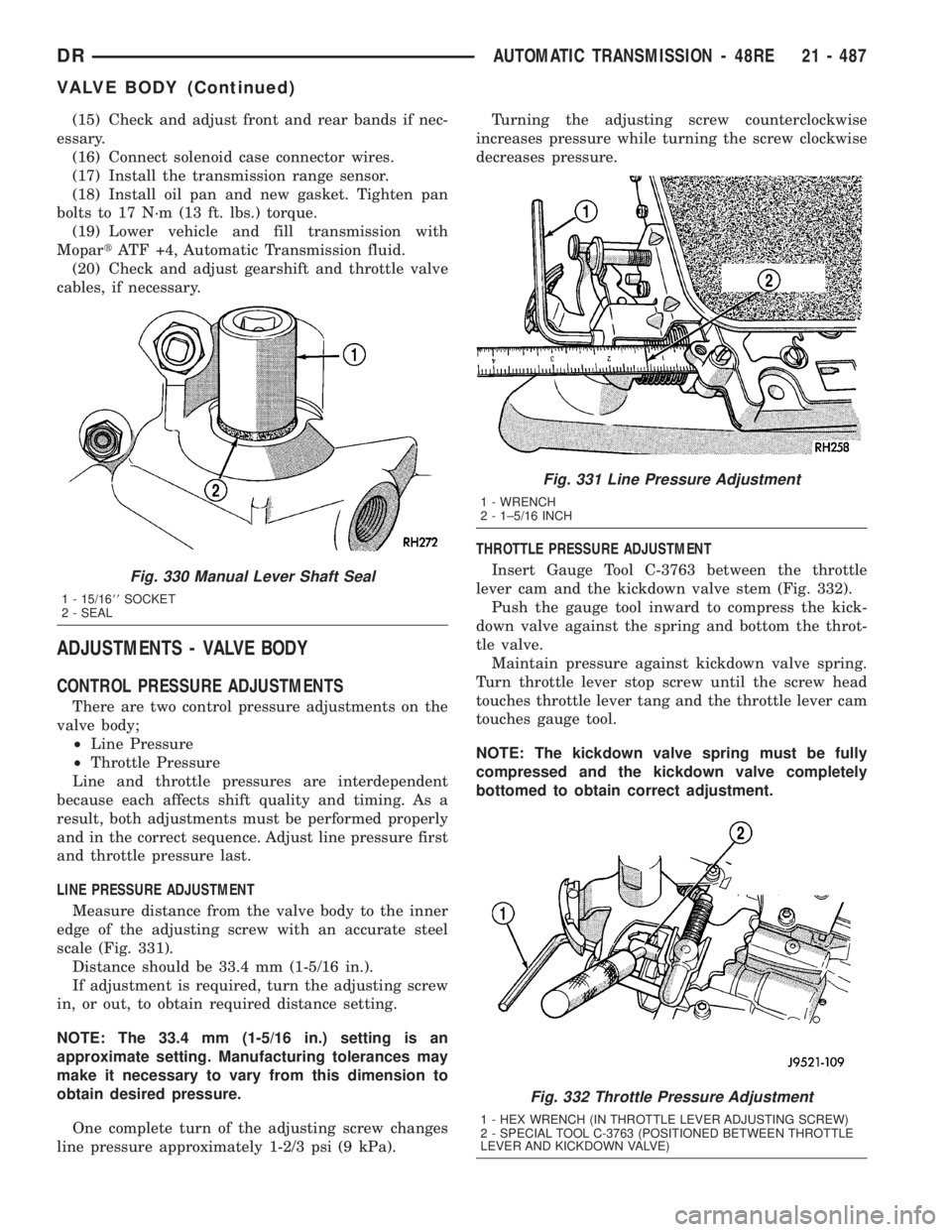
scale (Fig. 331).
Distance should be 33.4 mm (1-5/16 in.).
If adjustment is required, turn the adjusting screw
in, or out, to obtain required distance setting.
NOTE: The 33.4 mm (1-5/16 in.) setting is an
approximate setting. Manufacturing tolerances may
make it necessary to vary from this dimension to
obtain desired pressure.
One complete turn of the adjusting screw changes
line pressure approximately 1-2/3 psi (9 kPa).Turning the adjusting screw counterclockwise
increases pressure while turning the screw clockwise
decreases pressure.
THROTTLE PRESSURE ADJUSTMENT
Insert Gauge Tool C-3763 between the throttle
lever cam and the kickdown valve stem (Fig. 332).
Push the gauge tool inward to compress the kick-
down valve against the spring and bottom the throt-
tle valve.
Maintain pressure against kickdown valve spring.
Turn throttle lever stop screw until the screw head
touches throttle lever tang and the throttle lever cam
touches gauge tool.
NOTE: The kickdown valve spring must be fully
compressed and the kickdown valve completely
bottomed to obtain correct adjustment.
Fig. 330 Manual Lever Shaft Seal
1 - 15/1688SOCKET
2 - SEAL
Fig. 331 Line Pressure Adjustment
1 - WRENCH
2 - 1±5/16 INCH
Fig. 332 Throttle Pressure Adjustment
1 - HEX WRENCH (IN THROTTLE LEVER ADJUSTING SCREW)
2 - SPECIAL TOOL C-3763 (POSITIONED BETWEEN THROTTLE
LEVER AND KICKDOWN VALVE)
DRAUTOMATIC TRANSMISSION - 48RE 21 - 487
VALVE BODY (Continued)
Page 2335 of 2895
(9) Disconnect and lower or remove any necessary
exhaust components.
(10) Remove the starter motor.
(11) Rotate crankshaft in clockwise direction until
converter bolts are accessible. Then remove bolts one
at a time. Rotate crankshaft with socket wrench on
dampener bolt.
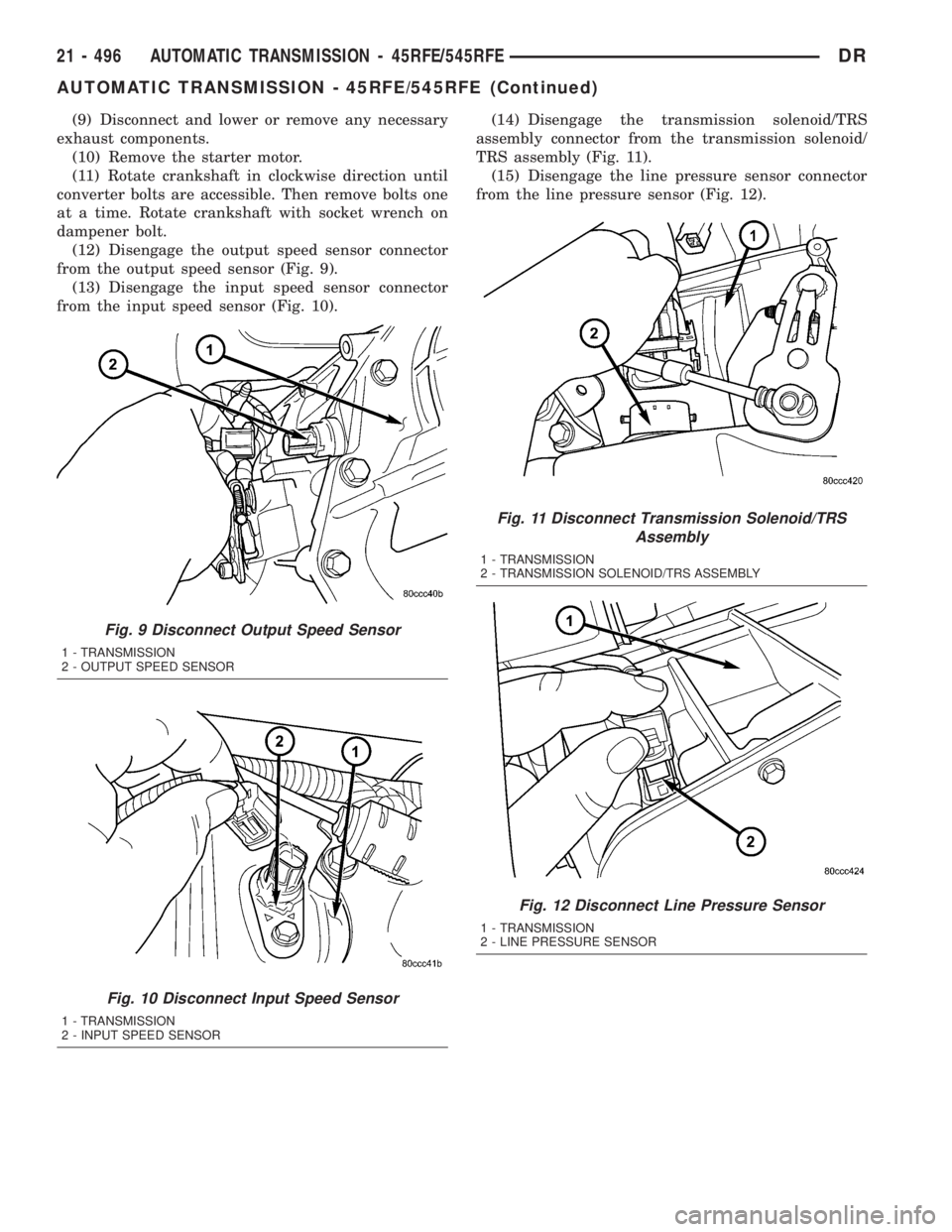
(12) Disengage the output speed sensor connector
from the output speed sensor (Fig. 9).
(13) Disengage the input speed sensor connector
from the input speed sensor (Fig. 10).(14) Disengage the transmission solenoid/TRS
assembly connector from the transmission solenoid/
TRS assembly (Fig. 11).
(15) Disengage the line pressure sensor connector
from the line pressure sensor (Fig. 12).
Fig. 9 Disconnect Output Speed Sensor
1 - TRANSMISSION
2 - OUTPUT SPEED SENSOR
Fig. 10 Disconnect Input Speed Sensor
1 - TRANSMISSION
2 - INPUT SPEED SENSOR
Fig. 11 Disconnect Transmission Solenoid/TRS
Assembly
1 - TRANSMISSION
2 - TRANSMISSION SOLENOID/TRS ASSEMBLY
Fig. 12 Disconnect Line Pressure Sensor
1 - TRANSMISSION
2 - LINE PRESSURE SENSOR
21 - 496 AUTOMATIC TRANSMISSION - 45RFE/545RFEDR
AUTOMATIC TRANSMISSION - 45RFE/545RFE (Continued)
Page 2417 of 2895
STATOR
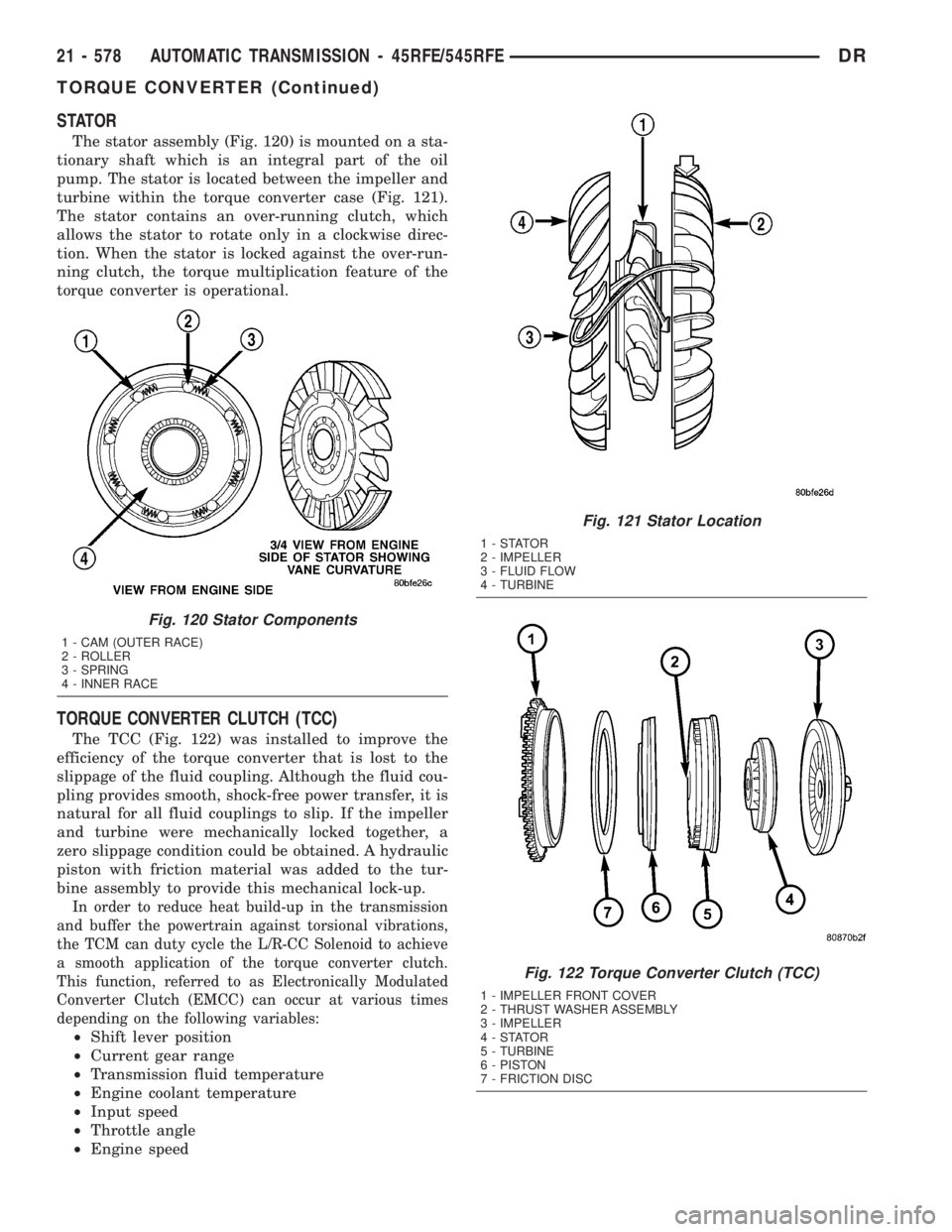
The stator assembly (Fig. 120) is mounted on a sta-
tionary shaft which is an integral part of the oil
pump. The stator is located between the impeller and
turbine within the torque converter case (Fig. 121).
The stator contains an over-running clutch, which
allows the stator to rotate only in a clockwise direc-
tion. When the stator is locked against the over-run-
ning clutch, the torque multiplication feature of the
torque converter is operational.
TORQUE CONVERTER CLUTCH (TCC)
The TCC (Fig. 122) was installed to improve the
efficiency of the torque converter that is lost to the
slippage of the fluid coupling. Although the fluid cou-
pling provides smooth, shock-free power transfer, it is
natural for all fluid couplings to slip. If the impeller
and turbine were mechanically locked together, a
zero slippage condition could be obtained. A hydraulic
piston with friction material was added to the tur-
bine assembly to provide this mechanical lock-up.
In order to reduce heat build-up in the transmission
and buffer the powertrain against torsional vibrations,
the TCM can duty cycle the L/R-CC Solenoid to achieve
a smooth application of the torque converter clutch.
This function, referred to as Electronically Modulated
Converter Clutch (EMCC) can occur at various times
depending on the following variables:
²Shift lever position
²Current gear range
²Transmission fluid temperature
²Engine coolant temperature
²Input speed
²Throttle angle
²Engine speed
Fig. 120 Stator Components
1 - CAM (OUTER RACE)
2 - ROLLER
3 - SPRING
4 - INNER RACE
Fig. 121 Stator Location
1-STATOR
2 - IMPELLER
3 - FLUID FLOW
4 - TURBINE
Fig. 122 Torque Converter Clutch (TCC)
1 - IMPELLER FRONT COVER
2 - THRUST WASHER ASSEMBLY
3 - IMPELLER
4-STATOR
5 - TURBINE
6 - PISTON
7 - FRICTION DISC
21 - 578 AUTOMATIC TRANSMISSION - 45RFE/545RFEDR
TORQUE CONVERTER (Continued)
Page 2418 of 2895
OPERATION
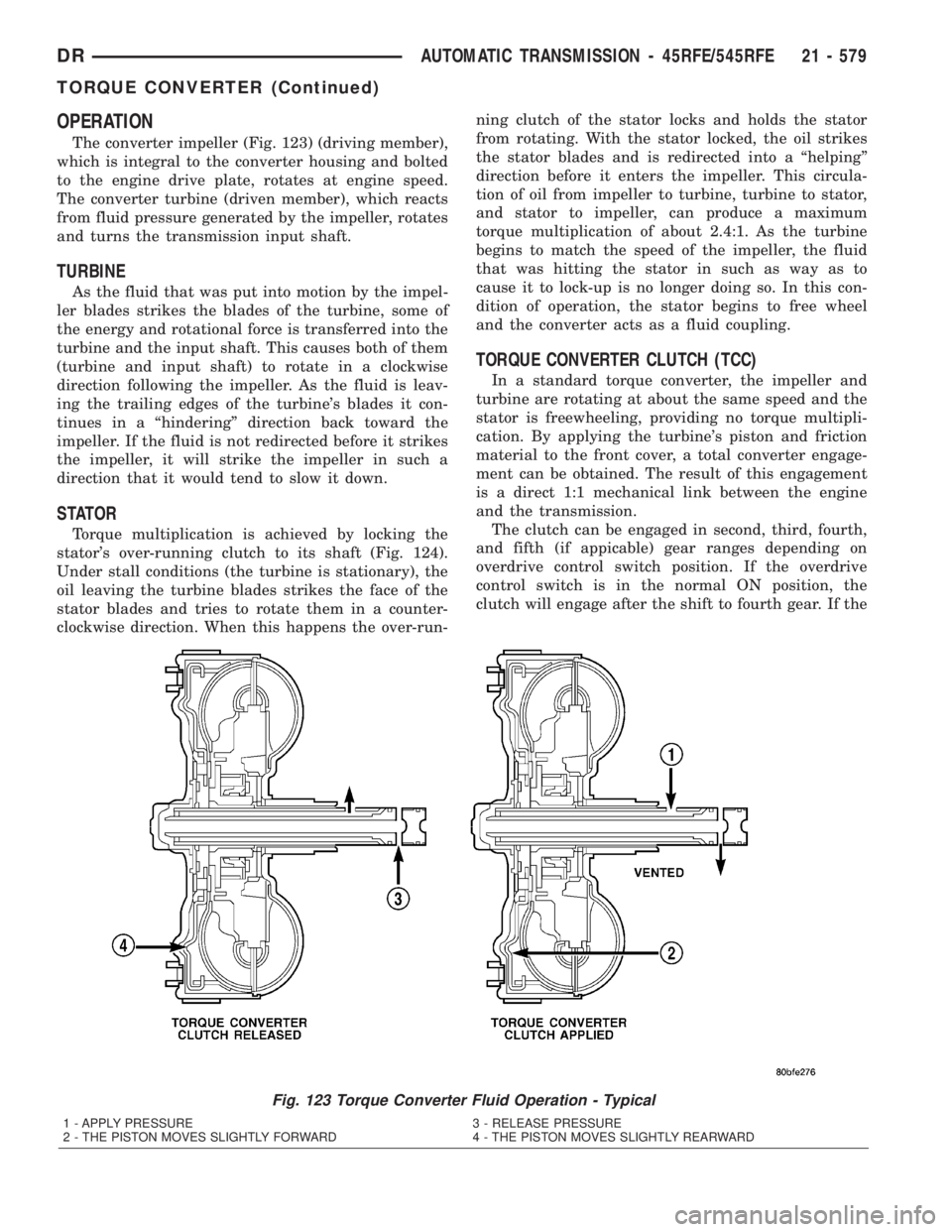
The converter impeller (Fig. 123) (driving member),
which is integral to the converter housing and bolted
to the engine drive plate, rotates at engine speed.
The converter turbine (driven member), which reacts
from fluid pressure generated by the impeller, rotates
and turns the transmission input shaft.
TURBINE
As the fluid that was put into motion by the impel-
ler blades strikes the blades of the turbine, some of
the energy and rotational force is transferred into the
turbine and the input shaft. This causes both of them
(turbine and input shaft) to rotate in a clockwise
direction following the impeller. As the fluid is leav-
ing the trailing edges of the turbine's blades it con-
tinues in a ªhinderingº direction back toward the
impeller. If the fluid is not redirected before it strikes
the impeller, it will strike the impeller in such a
direction that it would tend to slow it down.
STATOR
Torque multiplication is achieved by locking the
stator's over-running clutch to its shaft (Fig. 124).
Under stall conditions (the turbine is stationary), the
oil leaving the turbine blades strikes the face of the
stator blades and tries to rotate them in a counter-
clockwise direction. When this happens the over-run-ning clutch of the stator locks and holds the stator
from rotating. With the stator locked, the oil strikes
the stator blades and is redirected into a ªhelpingº
direction before it enters the impeller. This circula-
tion of oil from impeller to turbine, turbine to stator,
and stator to impeller, can produce a maximum
torque multiplication of about 2.4:1. As the turbine
begins to match the speed of the impeller, the fluid
that was hitting the stator in such as way as to
cause it to lock-up is no longer doing so. In this con-
dition of operation, the stator begins to free wheel
and the converter acts as a fluid coupling.
TORQUE CONVERTER CLUTCH (TCC)
In a standard torque converter, the impeller and
turbine are rotating at about the same speed and the
stator is freewheeling, providing no torque multipli-
cation. By applying the turbine's piston and friction
material to the front cover, a total converter engage-
ment can be obtained. The result of this engagement
is a direct 1:1 mechanical link between the engine
and the transmission.
The clutch can be engaged in second, third, fourth,
and fifth (if appicable) gear ranges depending on
overdrive control switch position. If the overdrive
control switch is in the normal ON position, the
clutch will engage after the shift to fourth gear. If the
Fig. 123 Torque Converter Fluid Operation - Typical
1 - APPLY PRESSURE 3 - RELEASE PRESSURE
2 - THE PISTON MOVES SLIGHTLY FORWARD 4 - THE PISTON MOVES SLIGHTLY REARWARD
DRAUTOMATIC TRANSMISSION - 45RFE/545RFE 21 - 579
TORQUE CONVERTER (Continued)
Page 2786 of 2895
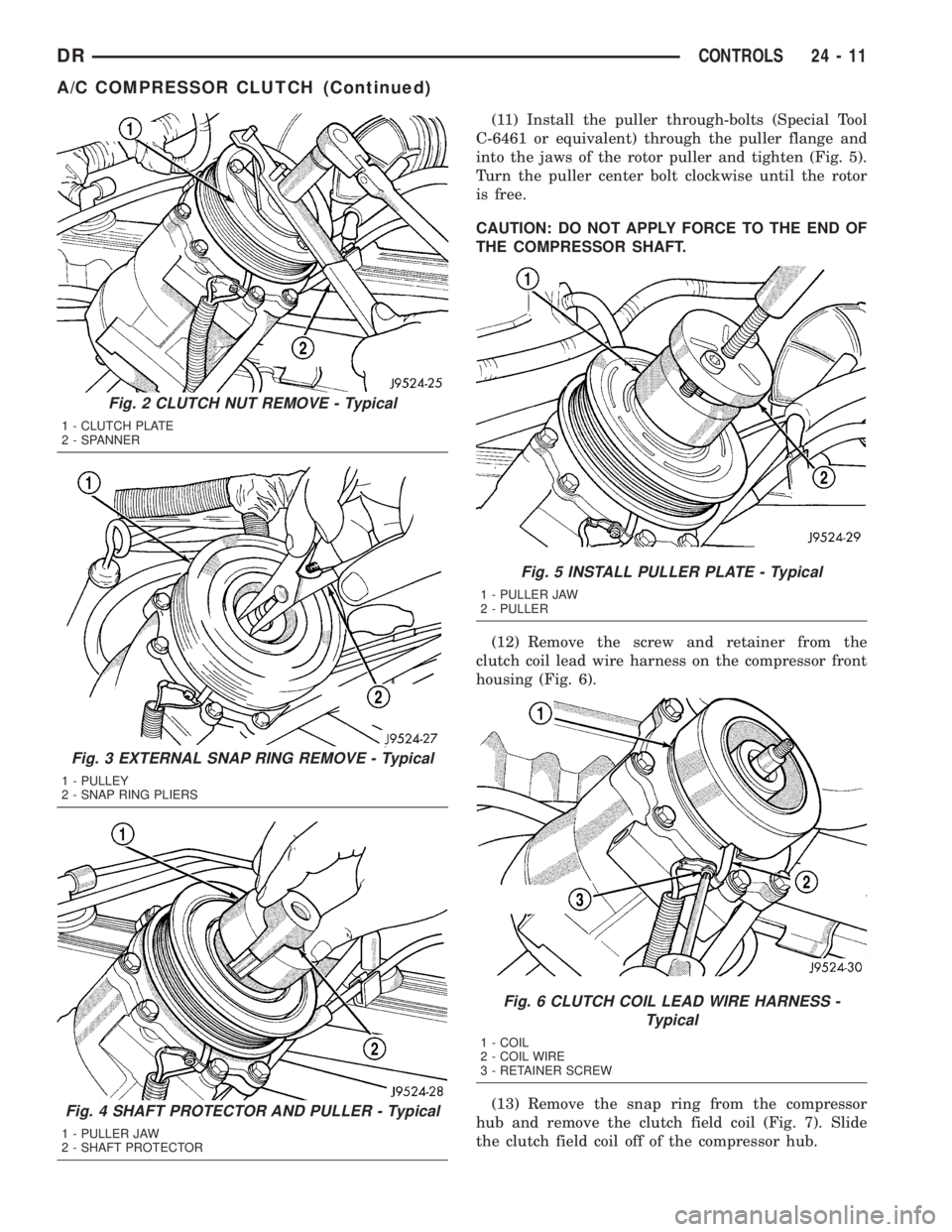
(11) Install the puller through-bolts (Special Tool
C-6461 or equivalent) through the puller flange and
into the jaws of the rotor puller and tighten (Fig. 5).
Turn the puller center bolt clockwise until the rotor
is free.
CAUTION: DO NOT APPLY FORCE TO THE END OF
THE COMPRESSOR SHAFT.
(12) Remove the screw and retainer from the
clutch coil lead wire harness on the compressor front
housing (Fig. 6).
(13) Remove the snap ring from the compressor
hub and remove the clutch field coil (Fig. 7). Slide
the clutch field coil off of the compressor hub.
Fig. 2 CLUTCH NUT REMOVE - Typical
1 - CLUTCH PLATE
2 - SPANNER
Fig. 3 EXTERNAL SNAP RING REMOVE - Typical
1 - PULLEY
2 - SNAP RING PLIERS
Fig. 4 SHAFT PROTECTOR AND PULLER - Typical
1 - PULLER JAW
2 - SHAFT PROTECTOR
Fig. 5 INSTALL PULLER PLATE - Typical
1 - PULLER JAW
2 - PULLER
Fig. 6 CLUTCH COIL LEAD WIRE HARNESS -
Typical
1 - COIL
2 - COIL WIRE
3 - RETAINER SCREW
DRCONTROLS 24 - 11
A/C COMPRESSOR CLUTCH (Continued)
Page 2832 of 2895
pump by drawing air into the pump cavity and also
closes the vent seal. During non test conditions the
vent seal is held open by the pump diaphragm
assembly which pushes it open at the full travel posi-
tion. The vent seal will remain closed while the
pump is cycling due to the reed switch triggering of
the three port solenoid that prevents the diaphragm
assembly from reaching full travel. After the brief
initialization period, the solenoid is de-energized
allowing atmospheric pressure to enter the pump
cavity, thus permitting the spring to drive the dia-
phragm which forces air out of the pump cavity and
into the vent system. When the solenoid is energized
and de energized, the cycle is repeated creating flow
in typical diaphragm pump fashion. The pump is con-
trolled in 2 modes:
Pump Mode: The pump is cycled at a fixed rate to
achieve a rapid pressure build in order to shorten the
overall test length.
Test Mode: The solenoid is energized with a fixed
duration pulse. Subsequent fixed pulses occur when
the diaphragm reaches the Switch closure point.
The spring in the pump is set so that the system
will achieve an equalized pressure of about 7.5º H20.
The cycle rate of pump strokes is quite rapid as the
system begins to pump up to this pressure. As the
pressure increases, the cycle rate starts to drop off. If
there is no leak in the system, the pump would even-
tually stop pumping at the equalized pressure. If
there is a leak, it will continue to pump at a rate rep-
resentative of the flow characteristic of the size of the
leak. From this information we can determine if the
leak is larger than the required detection limit (cur-
rently set at .040º orifice by CARB). If a leak is
revealed during the leak test portion of the test, the
test is terminated at the end of the test mode and no
further system checks will be performed.
After passing the leak detection phase of the test,
system pressure is maintained by turning on the
LDP's solenoid until the purge system is activated.
Purge activation in effect creates a leak. The cycle
rate is again interrogated and when it increases due
to the flow through the purge system, the leak check
portion of the diagnostic is complete.
The canister vent valve will unseal the system
after completion of the test sequence as the pump
diaphragm assembly moves to the full travel position.
Evaporative system functionality will be verified by
using the stricter evap purge flow monitor. At an
appropriate warm idle the LDP will be energized to
seal the canister vent. The purge flow will be clocked
up from some small value in an attempt to see a
shift in the 02 control system. If fuel vapor, indicated
by a shift in the 02 control, is present the test is
passed. If not, it is assumed that the purge system isnot functioning in some respect. The LDP is again
turned off and the test is ended.
MISFIRE MONITOR
Excessive engine misfire results in increased cata-
lyst temperature and causes an increase in HC emis-
sions. Severe misfires could cause catalyst damage.
To prevent catalytic convertor damage, the PCM
monitors engine misfire.
The Powertrain Control Module (PCM) monitors
for misfire during most engine operating conditions
(positive torque) by looking at changes in the crank-
shaft speed. If a misfire occurs the speed of the
crankshaft will vary more than normal.
FUEL SYSTEM MONITOR
To comply with clean air regulations, vehicles are
equipped with catalytic converters. These converters
reduce the emission of hydrocarbons, oxides of nitro-
gen and carbon monoxide. The catalyst works best
when the Air Fuel (A/F) ratio is at or near the opti-
mum of 14.7 to 1.
The PCM is programmed to maintain the optimum
air/fuel ratio of 14.7 to 1. This is done by making
short term corrections in the fuel injector pulse width
based on the O2S sensor output. The programmed
memory acts as a self calibration tool that the engine
controller uses to compensate for variations in engine
specifications, sensor tolerances and engine fatigue
over the life span of the engine. By monitoring the
actual fuel-air ratio with the O2S sensor (short term)
and multiplying that with the program long-term
(adaptive) memory and comparing that to the limit,
it can be determined whether it will pass an emis-
sions test. If a malfunction occurs such that the PCM
cannot maintain the optimum A/F ratio, then the
MIL will be illuminated.
CATALYST MONITOR
To comply with clean air regulations, vehicles are
equipped with catalytic converters. These converters
reduce the emission of hydrocarbons, oxides of nitro-
gen and carbon monoxide.
Normal vehicle miles or engine misfire can cause a
catalyst to decay. This can increase vehicle emissions
and deteriorate engine performance, driveability and
fuel economy.
The catalyst monitor uses dual oxygen sensors
(O2S's) to monitor the efficiency of the converter. The
dual O2S's sensor strategy is based on the fact that
as a catalyst deteriorates, its oxygen storage capacity
and its efficiency are both reduced. By monitoring
the oxygen storage capacity of a catalyst, its effi-
ciency can be indirectly calculated. The upstream
O2S is used to detect the amount of oxygen in the
exhaust gas before the gas enters the catalytic con-
DREMISSIONS CONTROL 25 - 3
EMISSIONS CONTROL (Continued)
Page 2850 of 2895
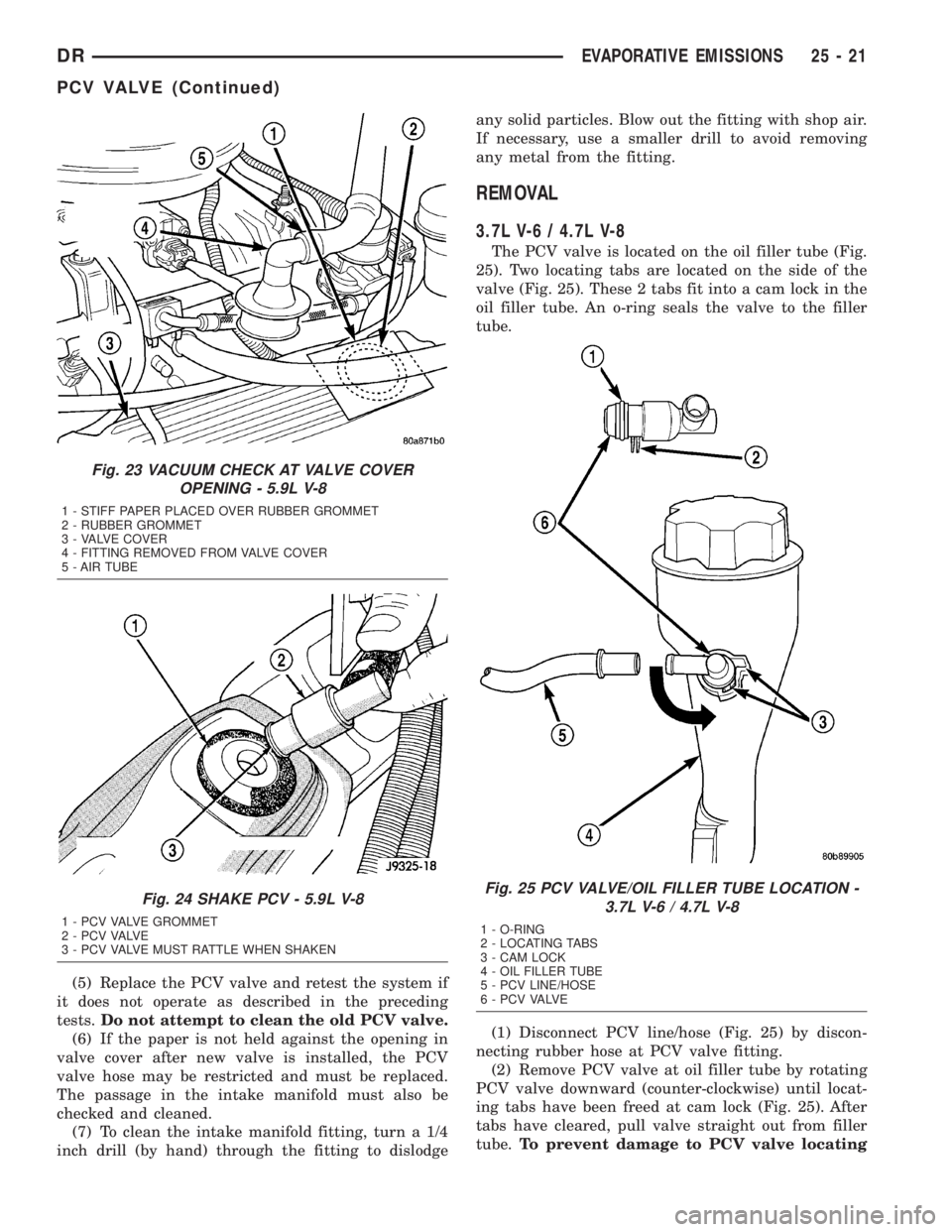
(5) Replace the PCV valve and retest the system if
it does not operate as described in the preceding
tests.Do not attempt to clean the old PCV valve.
(6) If the paper is not held against the opening in
valve cover after new valve is installed, the PCV
valve hose may be restricted and must be replaced.
The passage in the intake manifold must also be
checked and cleaned.
(7) To clean the intake manifold fitting, turn a 1/4
inch drill (by hand) through the fitting to dislodgeany solid particles. Blow out the fitting with shop air.
If necessary, use a smaller drill to avoid removing
any metal from the fitting.
REMOVAL
3.7L V-6 / 4.7L V-8
The PCV valve is located on the oil filler tube (Fig.
25). Two locating tabs are located on the side of the
valve (Fig. 25). These 2 tabs fit into a cam lock in the
oil filler tube. An o-ring seals the valve to the filler
tube.
(1) Disconnect PCV line/hose (Fig. 25) by discon-
necting rubber hose at PCV valve fitting.
(2) Remove PCV valve at oil filler tube by rotating
PCV valve downward (counter-clockwise) until locat-
ing tabs have been freed at cam lock (Fig. 25). After
tabs have cleared, pull valve straight out from filler
tube.To prevent damage to PCV valve locating
Fig. 23 VACUUM CHECK AT VALVE COVER
OPENING - 5.9L V-8
1 - STIFF PAPER PLACED OVER RUBBER GROMMET
2 - RUBBER GROMMET
3 - VALVE COVER
4 - FITTING REMOVED FROM VALVE COVER
5 - AIR TUBE
Fig. 24 SHAKE PCV - 5.9L V-8
1 - PCV VALVE GROMMET
2 - P C V VA LV E
3 - PCV VALVE MUST RATTLE WHEN SHAKEN
Fig. 25 PCV VALVE/OIL FILLER TUBE LOCATION -
3.7L V-6 / 4.7L V-8
1 - O-RING
2 - LOCATING TABS
3 - CAM LOCK
4 - OIL FILLER TUBE
5 - PCV LINE/HOSE
6 - P C V VA LV E
DREVAPORATIVE EMISSIONS 25 - 21
PCV VALVE (Continued)
Page 2851 of 2895

tabs, valve must be pointed downward for
removal. Do not force valve from oil filler tube.
(3) After valve is removed, check condition of valve
o-ring (Fig. 25).
5.7L V-8
The PCV valve is mounted into the top of the
intake manifold, located to the right / rear of the
throttle body (Fig. 12). The PCV valve is sealed to
the intake manifold with 2 o-rings (Fig. 13).
(1) Remove PCV valve by rotating counter-clock-
wise 90 degrees until locating tabs have been freed.
After tabs have cleared, pull valve straight up from
intake manifold.
(2) After valve is removed, check condition of 2
valve o-rings.
INSTALLATION
3.7L V6 / 4.7L V-8
The PCV valve is located on the oil filler tube. Two
locating tabs are located on the side of the valve.
These 2 tabs fit into a cam lock in the oil filler tube.
An o-ring seals the valve to the filler tube.
(1) Return PCV valve back to oil filler tube by
placing valve locating tabs into cam lock. Press PCV
valve in and rotate valve upward. A slight click will
be felt when tabs have engaged cam lock. Valve
should be pointed towards rear of vehicle.
(2) Connect PCV line/hose and rubber hose to PCV
valve.
5.7L V-8
(1) Clean out intake manifold opening.
(2) Check condition of 2 o-rings on PCV valve.
(3) Apply engine oil to 2 o-rings.
(4) Place PCV valve into intake manifold and
rotate 90 degrees clockwise for installation.
VACUUM LINES
DESCRIPTION
A vacuum schematic for emission related items can
be found on the vehicles VECI label. Refer to Vehicle
Emission Control Information (VECI) Label for label
location.
VAPOR CANISTER
DESCRIPTION
Two, maintenance free, EVAP canisters are used.
Both canisters are mounted into a two-piece support
bracket located near the front of the fuel tank (Fig.
26).
OPERATION
Two, maintenance free, EVAP canisters are
used.The EVAP canisters are filled with granules of
an activated carbon mixture. Fuel vapors entering
the EVAP canisters are absorbed by the charcoal
granules.
Fuel tank pressure vents into the EVAP canisters.
Fuel vapors are temporarily held in the canisters
until they can be drawn into the intake manifold.
The duty cycle EVAP canister purge solenoid allows
the EVAP canisters to be purged at predetermined
times and at certain engine operating conditions.
REMOVAL
Two, maintenance free, EVAP canisters are used.
Both canisters are mounted into a two-piece support
bracket located near the front of the fuel tank (Fig.
26).
(1) Raise and support vehicle.
(2) Remove fuel tubes/lines at each EVAP canister.
Note location of tubes/lines before removal for easier
installation.
(3) Remove lower support bracket (Fig. 27).
(4) Remove mounting nuts at top of each canister
(Fig. 27).
Fig. 26 LOCATION, EVAP CANISTERS
1 - LDP
2 - LDP MOUNTING BOLT
3 - ELEC. CONNEC.
4 - FILTER MOUNTING BOLT
5 - LDP FILTER
6 - CONNECTING HOSE
7 - EVAP CANISTER MOUNTING BRACKET
8 - EVAP CANISTERS (2)
25 - 22 EVAPORATIVE EMISSIONSDR
PCV VALVE (Continued)
Page 2861 of 2895

CARDAN UNIVERSAL JOINTS -
DISASSEMBLY, SINGLE..................3-9
CARGO BOX - INSTALLATION...........23-37
CARGO BOX - REMOVAL...............23-37
CARGO BOX - TIE DOWN -
INSTALLATION.......................23-37
CARGO BOX - TIE DOWN - REMOVAL....23-37
CARGO LAMP INDICATOR -
DESCRIPTION.......................8J-20
CARGO LAMP INDICATOR - OPERATION . . 8J-20
CARPETS AND FLOOR MATS -
INSTALLATION.......................23-66
CARPETS AND FLOOR MATS - REMOVAL . 23-66
CASCADE OVERFLOW VALVE -
DESCRIPTION.......................14-77
CASCADE OVERFLOW VALVE -
OPERATION.........................14-77
CASE - NV241 GENII - ASSEMBLY,
TRANSFER.........................21-604
CASE - NV241 GENII - CLEANING,
TRANSFER.........................21-602
CASE - NV241 GENII - DESCRIPTION,
TRANSFER............................0-4
CASE - NV241 GENII - DESCRIPTION,
TRANSFER.........................21-591
CASE - NV241 GENII - DIAGNOSIS AND
TESTING, TRANSFER.................21-592
CASE - NV241 GENII - DISASSEMBLY,
TRANSFER.........................21-593
CASE - NV241 GENII - INSPECTION,
TRANSFER.........................21-602
CASE - NV241 GENII - INSTALLATION,
TRANSFER.........................21-614
CASE - NV241 GENII - OPERATION,
TRANSFER.........................21-591
CASE - NV241 GENII - REMOVAL,
TRANSFER.........................21-593
CASE - NV243 - ASSEMBLY, TRANSFER . . 21-670
CASE - NV243 - CLEANING, TRANSFER . . 21-668
CASE - NV243 - DESCRIPTION,
TRANSFER............................0-4
CASE - NV243 - DESCRIPTION,
TRANSFER.........................21-658
CASE - NV243 - DIAGNOSIS AND
TESTING, TRANSFER.................21-659
CASE - NV243 - DISASSEMBLY,
TRANSFER.........................21-660
CASE - NV243 - INSPECTION, TRANSFER . 21-668
CASE - NV243 - INSTALLATION,
TRANSFER.........................21-679
CASE - NV243 - OPERATION, TRANSFER . 21-659
CASE - NV243 - REMOVAL, TRANSFER . . 21-660
CASE - NV271 - ASSEMBLY, TRANSFER . . 21-637
CASE - NV271 - CLEANING, TRANSFER . . 21-635
CASE - NV271 - DESCRIPTION,
TRANSFER............................0-4
CASE - NV271 - DESCRIPTION,
TRANSFER.........................21-623
CASE - NV271 - DIAGNOSIS AND
TESTING, TRANSFER.................21-624
CASE - NV271 - DISASSEMBLY,
TRANSFER.........................21-625
CASE - NV271 - INSPECTION, TRANSFER . 21-635
CASE - NV271 - INSTALLATION,
TRANSFER.........................21-649
CASE - NV271 - OPERATION, TRANSFER . 21-623
CASE - NV271 - REMOVAL, TRANSFER . . 21-625
CASE - NV273 - ASSEMBLY, TRANSFER . . 21-701
CASE - NV273 - CLEANING, TRANSFER . . 21-698
CASE - NV273 - DESCRIPTION,
TRANSFER............................0-4
CASE - NV273 - DESCRIPTION,
TRANSFER.........................21-687
CASE - NV273 - DIAGNOSIS AND
TESTING, TRANSFER.................21-688
CASE - NV273 - DISASSEMBLY,
TRANSFER.........................21-689
CASE - NV273 - INSPECTION, TRANSFER . 21-699
CASE - NV273 - INSTALLATION,
TRANSFER.........................21-713
CASE - NV273 - OPERATION, TRANSFER
. 21-688
CASE - NV273 - REMOVAL, TRANSFER
. . 21-689
CASE BEARINGS - INSTALLATION,
DIFFERENTIAL
......3-121,3-148,3-39,3-65,3-94
CASE BEARINGS - REMOVAL,
DIFFERENTIAL
......3-121,3-148,3-39,3-64,3-93
CASE CONTROL MODULE -
DESCRIPTION, TRANSFER
.............8E-15CASE CONTROL MODULE - OPERATION,
TRANSFER..........................8E-15
CASE, NV241 GENII - TRANSFER.......21-614
CASE, NV241/NV243 - TRANSFER......21-615,
21-680
CASE, NV243 - TRANSFER............21-680
CASE, NV271 - TRANSFER............21-649
CASE NV271/NV273, SPECIAL TOOLS -
TRANSFER...................21-650,21-714
CASE, NV273 - TRANSFER............21-713
CASE SKID PLATE - INSTALLATION,
TRANSFER..........................13-26
CASE SKID PLATE - REMOVAL,
TRANSFER..........................13-26
CASTER ADJUSTMENT - STANDARD
PROCEDURE, CAMBER..................2-4
CASTER AND TOE ADJUSTMENT -
STANDARD PROCEDURE, CAMBER........2-4
CATALYTIC CONVERTER - DESCRIPTION . . . 11-4
CATALYTIC CONVERTER - OPERATION.....11-4
CATCH - INSTALLATION, LATCH STRIKER
/ SECONDARY.......................23-48
CATCH - REMOVAL, LATCH STRIKER /
SECONDARY........................23-48
CAUSES OF BURNT FLUID - DIAGNOSIS
AND TESTING..........21-201,21-381,21-541
CAUTION - SERVICE CAUTIONS.........24-33
CAUTION, HALF SHAFT.................3-11
CAUTION, INTERIOR..................23-63
CAUTION, REFRIGERANT HOSES/LINES/
TUBES PRECAUTIONS..................24-33
CAUTIONS, CAUTION - SERVICE.........24-33
CENTER - DESCRIPTION, ELECTRONIC
VEHICLE INFO.......................8M-7
CENTER - DIAGNOSIS AND TESTING,
ELECTRONIC VEHICLE INFORMATION.....8M-8
CENTER - INSTALLATION, ELECTRONIC
VEHICLE INFO......................8M-10
CENTER & LEFT OUTBOARD -
INSTALLATION......................8O-45
CENTER & LEFT OUTBOARD - REMOVAL . . 8O-43
CENTER - OPERATION, ELECTRONIC
VEHICLE INFO.......................8M-8
CENTER - REMOVAL, ELECTRONIC
VEHICLE INFO......................8M-10
CENTER ANCHOR & RIGHT OUTBOARD -
INSTALLATION......................8O-45
CENTER ANCHOR & RIGHT OUTBOARD -
REMOVAL..........................8O-43
CENTER ARMREST / SEAT BACK -
INSTALLATION.......................23-78
CENTER ARMREST / SEAT BACK -
REMOVAL..........................23-77
CENTER BEARING - ADJUSTMENTS........3-8
CENTER BEARING - INSTALLATION........3-8
CENTER BEARING - REMOVAL............3-8
CENTER BEZEL - INSTALLATION,
INSTRUMENT PANEL..................23-58
CENTER BEZEL - REMOVAL,
INSTRUMENT PANEL..................23-58
CENTER HIGH MOUNTED STOP LAMP -
INSTALLATION.......................8L-10
CENTER HIGH MOUNTED STOP LAMP -
REMOVAL..........................8L-10
CENTER HIGH MOUNTED STOP LAMP
UNIT - INSTALLATION.................8L-10
CENTER HIGH MOUNTED STOP LAMP
UNIT - REMOVAL
....................8L-10
CENTER PROGRAMMING - STANDARD
PROCEDURE, ELECTRONIC VEHICLE
INFORMATION
.......................8M-8
CENTER SEAT - INSTALLATION
..........23-77
CENTER SEAT - REMOVAL
.............23-76
CENTER SEAT BACK HINGE -
INSTALLATION
.......................23-80
CENTER SEAT BACK HINGE - REMOVAL
. . . 23-79
CENTER SEAT BACK INERTIA HINGE
COVER - INSTALLATION
...............23-78
CENTER SEAT BACK INERTIA HINGE
COVER - REMOVAL
...................23-78
CENTER SEAT BACK LID - INSTALLATION
. 23-80
CENTER SEAT BACK LID - REMOVAL
.....23-80
CENTER SEAT BELT - INSTALLATION,
FRONT
.............................8O-27
CENTER SEAT BELT - REMOVAL, FRONT
. . 8O-26
CENTER SEAT BELT & RETRACTOR -
INSTALLATION, FRONT
................8O-26CENTER SEAT BELT & RETRACTOR -
INSTALLATION, REAR.................8O-40
CENTER SEAT BELT & RETRACTOR -
REMOVAL, FRONT....................8O-25
CENTER SEAT BELT & RETRACTOR -
REMOVAL, REAR....................8O-39
CENTER SEAT CUSHION - INSTALLATION . . 23-80
CENTER SEAT CUSHION - REMOVAL.....23-80
CENTER SEAT CUSHION COVER -
INSTALLATION.......................23-81
CENTER SEAT CUSHION COVER -
REMOVAL..........................23-81
CENTERING - STANDARD PROCEDURE,
CLOCKSPRING......................8O-19
CERTIFICATION LABEL - DESCRIPTION,
VEHICLE SAFETY...................Intro.-1
CHAIN COVER(S) - INSTALLATION,
TIMING BELT..........9-169,9-278,9-404,9-81
CHAIN COVER(S) - REMOVAL, TIMING
BELT ................9-168,9-278,9-404,9-80
CHAIN STRETCH - INSPECTION,
MEASURING TIMING.............9-279,9-405
CHAIN WEAR - STANDARD PROCEDURE,
MEASURING TIMING..................9-165
CHAIN WEAR, STANDARD PROCEDURE -
MEASURING TIMING...................9-76
CHAIN/TENSIONER - DESCRIPTION,
TIMING............................9-222
CHAIN/TENSIONER - OPERATION,
TIMING............................9-222
CHANNEL - INSTALLATION, GLASS RUN . . 23-21,
23-31
CHANNEL - REMOVAL, GLASS RUN . . 23-21,23-30
CHARGE - STANDARD PROCEDURE,
REFRIGERANT SYSTEM..........24-35,24-52
CHARGE AIR COOLER AND PLUMBING -
CLEANING..........................11-16
CHARGE AIR COOLER AND PLUMBING -
DESCRIPTION.......................11-15
CHARGE AIR COOLER AND PLUMBING -
INSPECTION........................11-16
CHARGE AIR COOLER AND PLUMBING -
INSTALLATION.......................11-16
CHARGE AIR COOLER AND PLUMBING -
OPERATION.........................11-15
CHARGE AIR COOLER AND PLUMBING -
REMOVAL..........................11-15
CHARGE AIR COOLER SYSTEM - LEAKS
- DIAGNOSIS AND TESTING............11-15
CHARGE CAPACITY - SPECIFICATIONS....24-35
CHARGING - DESCRIPTION.............8F-19
CHARGING - OPERATION..............8F-19
CHARGING - STANDARD PROCEDURE,
BATTERY............................8F-8
CHARGING SYSTEM - DIAGNOSIS AND
TESTING...........................8F-19
CHARGING SYSTEM - SPECIFICATIONS,
TORQUE - GENERATOR................8F-20
CHART - SPECIFICATIONS, TORQUE........5-6
CHART, SPECIFICATIONS - TORQUE.......5-40
CHART, SPECIFICATIONS - TORQUE.....19-18,
19-22,19-34,19-41
CHART, SPECIFICATIONS - TORQUE . . 2-10,2-28,
2-39
CHART, SPECIFICATIONS - TORQUE......22-13
CHARTS - DIAGNOSIS AND TESTING,
DIAGNOSIS..................21-144,21-325
CHARTS - DIAGNOSIS AND TESTING,
SMOKE DIAGNOSIS
...................9-285
CHECK - STANDARD PROCEDURE,
COOLANT LEVEL
......................7-17
CHECK - STANDARD PROCEDURE, FLUID
LEVEL
................21-201,21-381,21-542
CHECK - STANDARD PROCEDURE, OIL
PUMP VOLUME
.....................21-563
CHECK CABLE - INSTALLATION
.........23-15
CHECK CABLE - REMOVAL
.............23-15
CHECK GAUGES INDICATOR -
DESCRIPTION
.......................8J-21
CHECK GAUGES INDICATOR -
OPERATION
.........................8J-21
CHECK VALVE - DESCRIPTION
...........8R-8
CHECK VALVE - INSTALLATION
..........8R-9
CHECK VALVE - OPERATION
.............8R-8
CHECK VALVE - REMOVAL
..............8R-8
CHECKING - STANDARD PROCEDURE,
POWER STEERING FLUID LEVEL
........19-42
6 INDEXDR
Description Group-Page Description Group-Page Description Group-Page
Page 2862 of 2895

CHECKING ENGINE OIL PRESSURE -
DIAGNOSIS AND TESTING....9-150,9-214,9-64
CHECKING TRANSMISSION CLUTCH
OPERATION - DIAGNOSIS AND
TESTING, AIR......................21-494
CHECKS - DIAGNOSIS AND TESTING,
PRELIMINARY........................7-10
CHILD RESTRAINT ANCHOR -
DESCRIPTION.......................8O-14
CHILD RESTRAINT ANCHOR -
INSTALLATION......................8O-17
CHILD RESTRAINT ANCHOR -
OPERATION.........................8O-16
CHILD RESTRAINT ANCHOR - REMOVAL . . 8O-16
CHIME CONDITIONS - DIAGNOSIS AND
TESTING............................8B-2
CHIME/BUZZER - DESCRIPTION..........8B-1
CHIME/BUZZER - OPERATION............8B-1
CIGAR LIGHTER OUTLET - DESCRIPTION . 8W-97-2
CIGAR LIGHTER OUTLET - DIAGNOSIS
AND TESTING.....................8W-97-2
CIGAR LIGHTER OUTLET - OPERATION . 8W-97-2
CIRCUIT - DIAGNOSIS AND TESTING,
AMBIENT TEMPERATURE SENSOR......8M-11
CIRCUIT - OPERATION, FUEL DRAIN.....14-78
CIRCUIT ACTUATION TEST MODE -
DESCRIPTION........................25-1
CIRCUIT FUNCTIONS - DESCRIPTION . . 8W-01-6
CIRCUIT INFORMATION - DESCRIPTION . 8W-01-5
CIRCUIT SENSE - DESCRIPTION,
IGNITION...........................8E-10
CIRCUIT SENSE - OPERATION, IGNITION . . 8E-12
CIRCUITS - OPERATION, NON-
MONITORED.........................25-8
CLAMPS - DESCRIPTION, HOSE...........7-3
CLAMPS - OPERATION, HOSE.............7-5
CLEANING/REVERSE FLUSHING -
STANDARD PROCEDURE, COOLING
SYSTEM............................7-17
CLEARANCE - STANDARD PROCEDURE,
CONNECTING ROD BEARING AND
CRANKSHAFT JOURNAL...............9-321
CLEARANCE - STANDARD PROCEDURE,
MAIN BEARING......................9-322
CLEARANCE LAMP - INSTALLATION, CAB . 8L-10
CLEARANCE LAMP - REMOVAL, CAB.....8L-10
CLOCKSPRING - DESCRIPTION.........8O-18
CLOCKSPRING - INSTALLATION.........8O-21
CLOCKSPRING - OPERATION...........8O-18
CLOCKSPRING - REMOVAL............8O-20
CLOCKSPRING CENTERING - STANDARD
PROCEDURE........................8O-19
CLUSTER - ASSEMBLY, INSTRUMENT....8J-15
CLUSTER - DESCRIPTION, INSTRUMENT . . . 8J-2
CLUSTER - DIAGNOSIS AND TESTING,
INSTRUMENT........................8J-10
CLUSTER - DISASSEMBLY, INSTRUMENT . . 8J-14
CLUSTER - INSTALLATION, INSTRUMENT . 8J-16
CLUSTER - OPERATION, INSTRUMENT.....8J-6
CLUSTER - REMOVAL, INSTRUMENT.....8J-14
CLUSTER BEZEL - INSTALLATION........23-50
CLUSTER BEZEL - REMOVAL...........23-50
CLUTCH - 5.9L DIESEL - DESCRIPTION,
FAN DRIVE VISCOUS...................7-55
CLUTCH - 5.9L DIESEL - OPERATION,
FAN DRIVE VISCOUS...................7-55
CLUTCH - ASSEMBLY, FRONT....21-206,21-386
CLUTCH - ASSEMBLY, LOW/REVERSE . . . 21-561
CLUTCH - ASSEMBLY, REAR.....21-250,21-428
CLUTCH - CLEANING, LOW/REVERSE....21-561
CLUTCH - CLEANING, REAR.....21-250,21-428
CLUTCH - DESCRIPTION.................6-1
CLUTCH - DESCRIPTION, A/C
COMPRESSOR........................24-9
CLUTCH - DESCRIPTION, FAN DRIVE
VISCOUS............................7-54
CLUTCH - DESCRIPTION, FRONT . 21-204,21-384
CLUTCH - DESCRIPTION, OVERDRIVE . . . 21-218,
21-396
CLUTCH - DESCRIPTION, REAR . . 21-248,21-426
CLUTCH - DIAGNOSIS AND TESTING.......6-2
CLUTCH - DISASSEMBLY, FRONT . 21-205,21-384
CLUTCH - DISASSEMBLY, LOW/REVERSE
. 21-560
CLUTCH - DISASSEMBLY, REAR
. . 21-249,21-427
CLUTCH - INSPECTION, A/C
COMPRESSOR
.......................24-12
CLUTCH - INSPECTION, FRONT
. . 21-206,21-385
CLUTCH - INSPECTION, LOW/REVERSE
. . 21-561CLUTCH - INSPECTION, REAR . . . 21-250,21-428
CLUTCH - INSTALLATION, A/C
COMPRESSOR.......................24-12
CLUTCH - OPERATION..................6-1
CLUTCH - OPERATION, A/C
COMPRESSOR........................24-9
CLUTCH - OPERATION, FAN DRIVE
VISCOUS............................7-54
CLUTCH - OPERATION, FRONT . . . 21-204,21-384
CLUTCH - OPERATION, OVERDRIVE....21-218,
21-396
CLUTCH - OPERATION, REAR....21-249,21-427
CLUTCH - REMOVAL, A/C COMPRESSOR . . 24-10
CLUTCH - SPECIFICATIONS...............6-6
CLUTCH - WARNING....................6-2
CLUTCH AND BAND OPERATION -
DIAGNOSIS AND TESTING, AIR
TESTING TRANSMISSION.......21-143,21-324
CLUTCH ASSEMBLY - ASSEMBLY, INPUT . 21-552
CLUTCH ASSEMBLY - DESCRIPTION,
INPUT............................21-549
CLUTCH ASSEMBLY - DISASSEMBLY,
INPUT............................21-550
CLUTCH ASSEMBLY - OPERATION,
INPUT............................21-549
CLUTCH BREAK-IN - STANDARD
PROCEDURE, A/C COMPRESSOR........24-10
CLUTCH CAM/OVERDRIVE PISTON
RETAINER - ASSEMBLY,
OVERRUNNING...............21-239,21-416
CLUTCH CAM/OVERDRIVE PISTON
RETAINER - CLEANING, OVERRUNNING. . . 21-238,
21-416
CLUTCH CAM/OVERDRIVE PISTON
RETAINER - DESCRIPTION,
OVERRUNNING...............21-237,21-415
CLUTCH CAM/OVERDRIVE PISTON
RETAINER - DISASSEMBLY,
OVERRUNNING...............21-238,21-415
CLUTCH CAM/OVERDRIVE PISTON
RETAINER - INSPECTION,
OVERRUNNING...............21-238,21-416
CLUTCH CAM/OVERDRIVE PISTON
RETAINER - OPERATION,
OVERRUNNING...............21-237,21-415
CLUTCH COIL - DIAGNOSIS AND
TESTING, A/C COMPRESSOR...........24-10
CLUTCH DISC - INSTALLATION............6-6
CLUTCH DISC - REMOVAL...............6-6
CLUTCH HOUSING - DIAGNOSIS AND
TESTING.............................6-8
CLUTCH HOUSING - INSTALLATION.......6-10
CLUTCH HOUSING - REMOVAL...........6-10
CLUTCH OPERATION - DIAGNOSIS AND
TESTING, AIR CHECKING
TRANSMISSION.....................21-494
CLUTCH PEDAL POSITION SWITCH -
DESCRIPTION........................6-14
CLUTCH PEDAL POSITION SWITCH -
DIAGNOSIS AND TESTING..............6-14
CLUTCH PEDAL POSITION SWITCH -
OPERATION..........................6-14
CLUTCH RELAY - DESCRIPTION, A/C
COMPRESSOR.......................24-13
CLUTCH RELAY - DIAGNOSIS AND
TESTING, COMPRESSOR...............24-13
CLUTCH RELAY - INSTALLATION, A/C
COMPRESSOR.......................24-14
CLUTCH RELAY - OPERATION, A/C
COMPRESSOR.......................24-13
CLUTCH RELAY - REMOVAL, A/C
COMPRESSOR.......................24-14
CLUTCH RELEASE BEARING -
INSTALLATION........................6-11
CLUTCH RELEASE BEARING - REMOVAL . . . 6-11
CLUTCHES - DESCRIPTION, HOLDING . . . 21-546
CLUTCHES - OPERATION, HOLDING.....21-546
COAT HOOK - INSTALLATION...........23-67
COAT HOOK - REMOVAL...............23-67
CODE - DESCRIPTION, PAINT...........23-74
CODE PLATE - DESCRIPTION, BODY
....Intro.-4
CODES - DESCRIPTION, DIAGNOSTIC
TROUBLE
............................25-1
CODES - SPECIFICATIONS, PAINT
........23-74
CODES - STANDARD PROCEDURE,
ERASING TRANSMITTER
..............8M-12
CODES - STANDARD PROCEDURE,
SETTING TRANSMITTER
..............8M-12COIL - DESCRIPTION, IGNITION.........8I-19
COIL - DIAGNOSIS AND TESTING, A/C
COMPRESSOR CLUTCH...............24-10
COIL - INSTALLATION, IGNITION.........8I-24
COIL - OPERATION, IGNITION...........8I-20
COIL - REMOVAL, IGNITION............8I-23
COIL CAPACITOR - DESCRIPTION,
IGNITION...........................8I-33
COIL CAPACITOR - INSTALLATION,
IGNITION...........................8I-33
COIL CAPACITOR - OPERATION,
IGNITION...........................8I-33
COIL CAPACITOR - REMOVAL, IGNITION . . . 8I-33
COIL RESISTANCE, 3.7L V-6 - IGNITION....8I-6
COIL RESISTANCE, 4.7L V-8 - IGNITION....8I-6
COIL RESISTANCE, 5.7L V-8 - IGNITION....8I-6
COIL RESISTANCE, 5.9L - IGNITION.......8I-6
COIL RESISTANCE, 8.0L V-10 ENGINE -
IGNITION............................8I-6
COLUMN - DESCRIPTION...............19-6
COLUMN - DIAGNOSIS AND TESTING,
STEERING...........................19-7
COLUMN - INSTALLATION...............19-9
COLUMN - REMOVAL..................19-7
COLUMN OPENING COVER -
INSTALLATION, STEERING.............23-61
COLUMN OPENING COVER - REMOVAL,
STEERING..........................23-61
COLUMN OPENING SUPPORT BRACKET
- INSTALLATION, STEERING..............23-62
COLUMN OPENING SUPPORT BRACKET
- REMOVAL, STEERING................23-61
COMBUSTION PRESSURE LEAKAGE -
DIAGNOSIS AND TESTING, CYLINDER....9-182,
9-231,9-359,9-8,9-92
COMMUNICATION - DESCRIPTION........8E-1
COMMUNICATION - OPERATION..........8E-2
COMPASS CALIBRATION - STANDARD
PROCEDURE.........................8M-3
COMPASS DEMAGNETIZING -
STANDARD PROCEDURE...............8M-4
COMPASS MINI-TRIP COMPUTER -
DIAGNOSIS AND TESTING..............8M-7
COMPASS VARIATION ADJUSTMENT -
STANDARD PROCEDURE...............8M-4
COMPASS/MINI-TRIP COMPUTER -
DESCRIPTION........................8M-6
COMPASS/MINI-TRIP COMPUTER -
INSTALLATION.......................8M-7
COMPASS/MINI-TRIP COMPUTER -
OPERATION.........................8M-7
COMPASS/MINI-TRIP COMPUTER -
REMOVAL...........................8M-7
COMPRESSION PRESSURE - DIAGNOSIS
AND TESTING, CYLINDER . . . 9-182,9-231,9-359,
9-8,9-92
COMPRESSION/LEAKAGE TESTS -
DIAGNOSIS AND TESTING, CYLINDER....9-288
COMPRESSOR CLUTCH - DESCRIPTION,
A/C ................................24-9
COMPRESSOR CLUTCH - INSPECTION,
A/C................................24-12
COMPRESSOR CLUTCH - INSTALLATION,
A/C
................................24-12
COMPRESSOR CLUTCH - OPERATION,
A/C
................................24-9
COMPRESSOR CLUTCH - REMOVAL, A/C
. . 24-10
COMPRESSOR CLUTCH BREAK-IN -
STANDARD PROCEDURE, A/C
...........24-10
COMPRESSOR CLUTCH COIL -
DIAGNOSIS AND TESTING, A/C
..........24-10
COMPRESSOR CLUTCH RELAY -
DESCRIPTION, A/C
...................24-13
COMPRESSOR CLUTCH RELAY -
DIAGNOSIS AND TESTING
.............24-13
COMPRESSOR CLUTCH RELAY -
INSTALLATION, A/C
...................24-14
COMPRESSOR CLUTCH RELAY -
OPERATION, A/C
.....................24-13
COMPRESSOR CLUTCH RELAY -
REMOVAL, A/C
......................24-14
COMPRESSOR NOISE - DIAGNOSIS AND
TESTING, A/C
.......................24-36
COMPUTER - DESCRIPTION, COMPASS/
MINI-TRIP
..........................8M-6
COMPUTER - DIAGNOSIS AND TESTING,
COMPASS MINI-TRIP
..................8M-7
DRINDEX 7
Description Group-Page Description Group-Page Description Group-Page