Power seat adjustment DODGE RAM 2003 Service Repair Manual
[x] Cancel search | Manufacturer: DODGE, Model Year: 2003, Model line: RAM, Model: DODGE RAM 2003Pages: 2895, PDF Size: 83.15 MB
Page 191 of 2895
(8) Install ring gear side adjuster lock and bolt. Do
not tighten adjuster lock bolt at this time.
(9) Tighten pinion gear side adjuster firmly
against the differential case bearing cup.
(10) Rotate the pinion several times to seat the dif-
ferential bearings.
(11) Loosen pinion gear side adjuster until it is no
longer in contact with the bearing cup.
(12) Tighten pinion gear side adjuster until it just
makes contact with the bearing cup.
(13) Tighten pinion gear side adjuster an addi-
tional:
²New Bearings6 Adjuster Holes
²Original Bearings4 Adjuster Holes
(14) Install pinion gear side adjuster lock and bolt.
Do not tighten adjuster lock bolt at this time.
(15) Tighten bearing cap bolts to 165 N´m (122 ft.
lbs.).
(16) Tighten adjuster lock bolts to 25 N´m (18 ft.
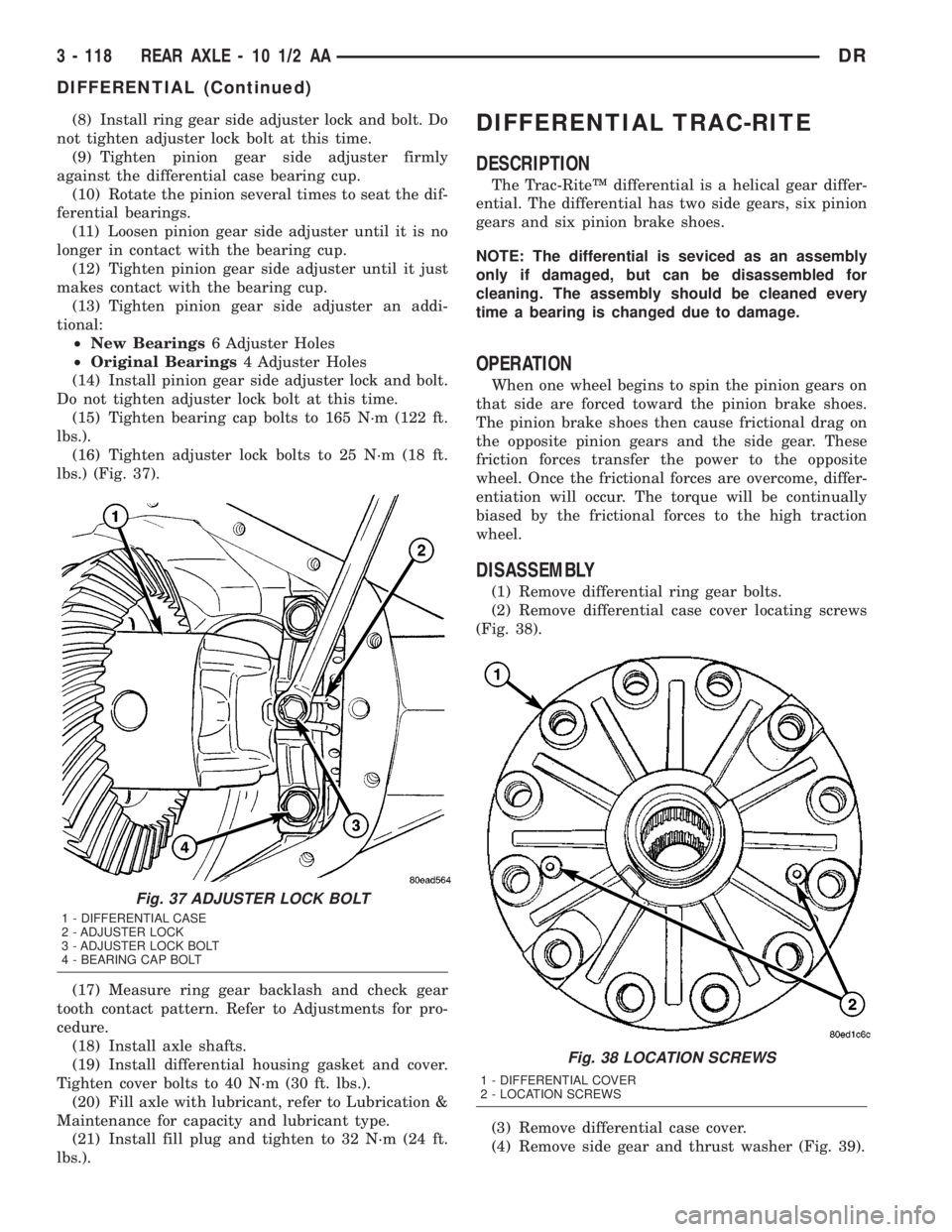
lbs.) (Fig. 37).
(17) Measure ring gear backlash and check gear
tooth contact pattern. Refer to Adjustments for pro-
cedure.
(18) Install axle shafts.
(19) Install differential housing gasket and cover.
Tighten cover bolts to 40 N´m (30 ft. lbs.).
(20) Fill axle with lubricant, refer to Lubrication &
Maintenance for capacity and lubricant type.
(21) Install fill plug and tighten to 32 N´m (24 ft.
lbs.).DIFFERENTIAL TRAC-RITE
DESCRIPTION
The Trac-RiteŸ differential is a helical gear differ-
ential. The differential has two side gears, six pinion
gears and six pinion brake shoes.
NOTE: The differential is seviced as an assembly
only if damaged, but can be disassembled for
cleaning. The assembly should be cleaned every
time a bearing is changed due to damage.
OPERATION
When one wheel begins to spin the pinion gears on
that side are forced toward the pinion brake shoes.
The pinion brake shoes then cause frictional drag on
the opposite pinion gears and the side gear. These
friction forces transfer the power to the opposite
wheel. Once the frictional forces are overcome, differ-
entiation will occur. The torque will be continually
biased by the frictional forces to the high traction
wheel.
DISASSEMBLY
(1) Remove differential ring gear bolts.
(2) Remove differential case cover locating screws
(Fig. 38).
(3) Remove differential case cover.
(4) Remove side gear and thrust washer (Fig. 39).
Fig. 37 ADJUSTER LOCK BOLT
1 - DIFFERENTIAL CASE
2 - ADJUSTER LOCK
3 - ADJUSTER LOCK BOLT
4 - BEARING CAP BOLT
Fig. 38 LOCATION SCREWS
1 - DIFFERENTIAL COVER
2 - LOCATION SCREWS
3 - 118 REAR AXLE - 10 1/2 AADR
DIFFERENTIAL (Continued)
Page 218 of 2895
(8) Install ring gear side adjuster lock and bolt. Do
not tighten adjuster lock bolt at this time.
(9) Tighten pinion gear side adjuster firmly
against the differential case bearing cup.
(10) Rotate the pinion several times to seat the dif-
ferential bearings.
(11) Loosen pinion gear side adjuster until it is no
longer in contact with the bearing cup.
(12) Tighten pinion gear side adjuster until it just
makes contact with the bearing cup.
(13)
Tighten pinion gear side adjuster an additional:
²New Bearings6 Adjuster Holes
²Original Bearings4 Adjuster Holes
(14) Install pinion gear side adjuster lock and bolt.
Do not tighten adjuster lock bolt at this time.
(15) Tighten bearing cap bolts to 281 N´m (207 ft.
lbs.).
(16) Tighten adjuster lock bolts to 25 N´m (18 ft.
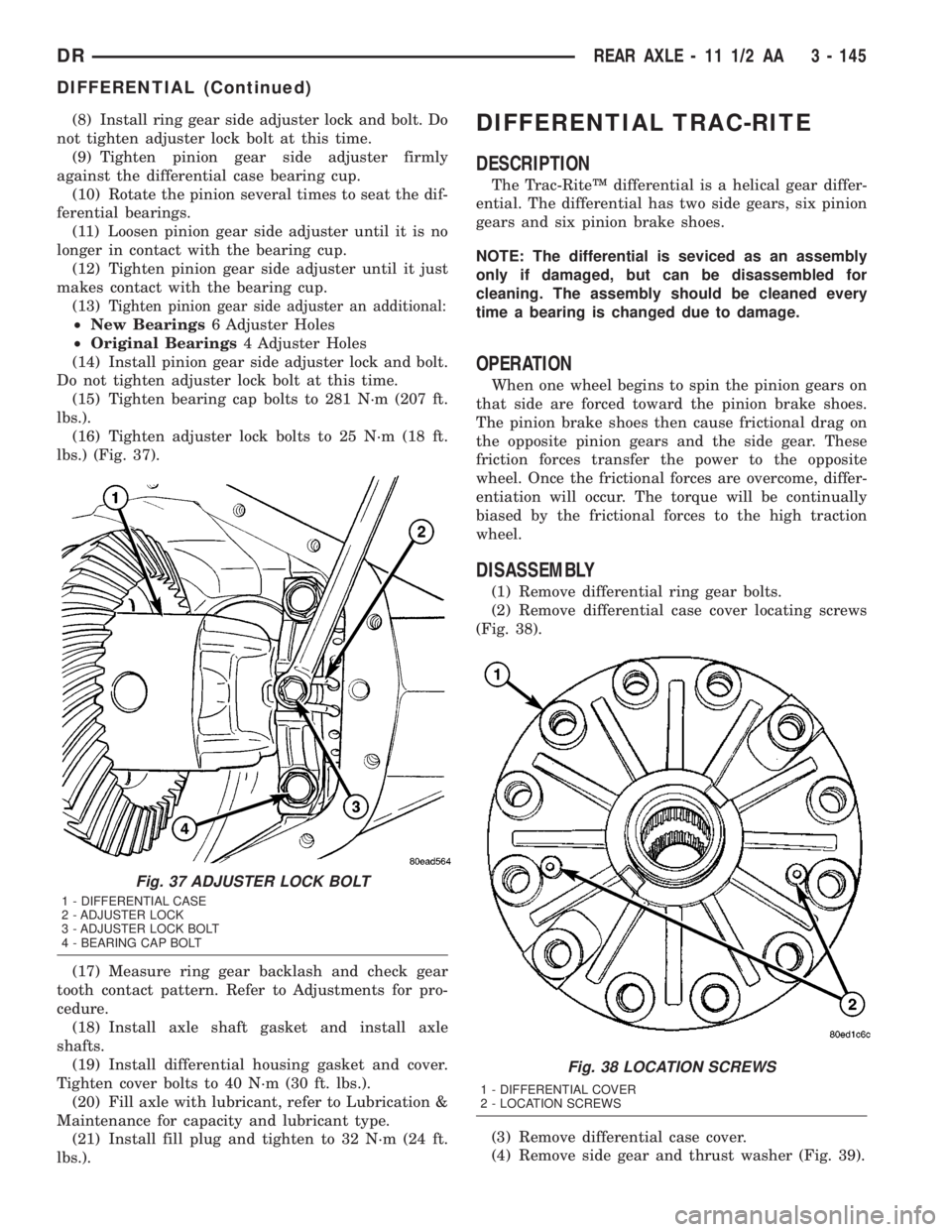
lbs.) (Fig. 37).
(17) Measure ring gear backlash and check gear
tooth contact pattern. Refer to Adjustments for pro-
cedure.
(18) Install axle shaft gasket and install axle
shafts.
(19) Install differential housing gasket and cover.
Tighten cover bolts to 40 N´m (30 ft. lbs.).
(20) Fill axle with lubricant, refer to Lubrication &
Maintenance for capacity and lubricant type.
(21) Install fill plug and tighten to 32 N´m (24 ft.
lbs.).
DIFFERENTIAL TRAC-RITE
DESCRIPTION
The Trac-RiteŸ differential is a helical gear differ-
ential. The differential has two side gears, six pinion
gears and six pinion brake shoes.
NOTE: The differential is seviced as an assembly
only if damaged, but can be disassembled for
cleaning. The assembly should be cleaned every
time a bearing is changed due to damage.
OPERATION
When one wheel begins to spin the pinion gears on
that side are forced toward the pinion brake shoes.
The pinion brake shoes then cause frictional drag on
the opposite pinion gears and the side gear. These
friction forces transfer the power to the opposite
wheel. Once the frictional forces are overcome, differ-
entiation will occur. The torque will be continually
biased by the frictional forces to the high traction
wheel.
DISASSEMBLY
(1) Remove differential ring gear bolts.
(2) Remove differential case cover locating screws
(Fig. 38).
(3) Remove differential case cover.
(4) Remove side gear and thrust washer (Fig. 39).
Fig. 37 ADJUSTER LOCK BOLT
1 - DIFFERENTIAL CASE
2 - ADJUSTER LOCK
3 - ADJUSTER LOCK BOLT
4 - BEARING CAP BOLT
Fig. 38 LOCATION SCREWS
1 - DIFFERENTIAL COVER
2 - LOCATION SCREWS
DRREAR AXLE - 11 1/2 AA 3 - 145
DIFFERENTIAL (Continued)
Page 592 of 2895
DRIVER SEAT SWITCH
DESCRIPTION
The power seat on this model can be adjusted in
eight different directions, up, down, front up, front
down, rear up, rear down, rearward and forward.
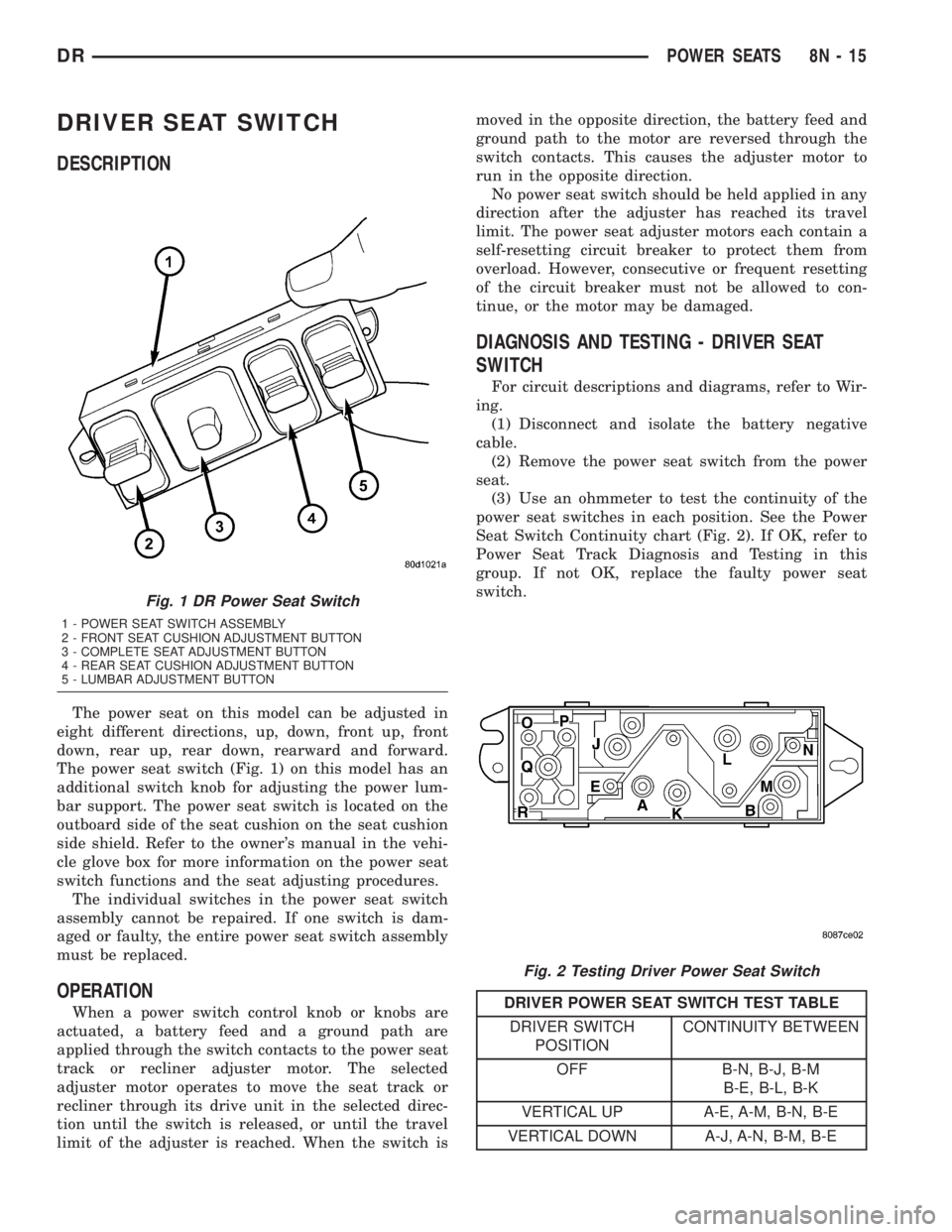
The power seat switch (Fig. 1) on this model has an
additional switch knob for adjusting the power lum-
bar support. The power seat switch is located on the
outboard side of the seat cushion on the seat cushion
side shield. Refer to the owner's manual in the vehi-
cle glove box for more information on the power seat
switch functions and the seat adjusting procedures.
The individual switches in the power seat switch
assembly cannot be repaired. If one switch is dam-
aged or faulty, the entire power seat switch assembly
must be replaced.
OPERATION
When a power switch control knob or knobs are
actuated, a battery feed and a ground path are
applied through the switch contacts to the power seat
track or recliner adjuster motor. The selected
adjuster motor operates to move the seat track or
recliner through its drive unit in the selected direc-
tion until the switch is released, or until the travel
limit of the adjuster is reached. When the switch ismoved in the opposite direction, the battery feed and
ground path to the motor are reversed through the
switch contacts. This causes the adjuster motor to
run in the opposite direction.
No power seat switch should be held applied in any
direction after the adjuster has reached its travel
limit. The power seat adjuster motors each contain a
self-resetting circuit breaker to protect them from
overload. However, consecutive or frequent resetting
of the circuit breaker must not be allowed to con-
tinue, or the motor may be damaged.
DIAGNOSIS AND TESTING - DRIVER SEAT
SWITCH
For circuit descriptions and diagrams, refer to Wir-
ing.
(1) Disconnect and isolate the battery negative
cable.
(2) Remove the power seat switch from the power
seat.
(3) Use an ohmmeter to test the continuity of the
power seat switches in each position. See the Power
Seat Switch Continuity chart (Fig. 2). If OK, refer to
Power Seat Track Diagnosis and Testing in this
group. If not OK, replace the faulty power seat
switch.
DRIVER POWER SEAT SWITCH TEST TABLE
DRIVER SWITCH
POSITIONCONTINUITY BETWEEN
OFF B-N, B-J, B-M
B-E, B-L, B-K
VERTICAL UP A-E, A-M, B-N, B-E
VERTICAL DOWN A-J, A-N, B-M, B-E
Fig. 1 DR Power Seat Switch
1 - POWER SEAT SWITCH ASSEMBLY
2 - FRONT SEAT CUSHION ADJUSTMENT BUTTON
3 - COMPLETE SEAT ADJUSTMENT BUTTON
4 - REAR SEAT CUSHION ADJUSTMENT BUTTON
5 - LUMBAR ADJUSTMENT BUTTON
Fig. 2 Testing Driver Power Seat Switch
DRPOWER SEATS 8N - 15
Page 593 of 2895
DRIVER POWER SEAT SWITCH TEST TABLE
DRIVER SWITCH
POSITIONCONTINUITY BETWEEN
HORIZONTAL
FORWARDA-L, B-K
HORIZONTAL
REARWARDA-K, B-L
FRONT TILT UP A-M, B-N
FRONT TILT DOWN A-N, B-M
REAR TILT UP A-E, B-J
REAR TILT DOWN A-J, B-E
LUMBAR OFF O-P, O-R, P-R
LUMPAR UP (INFLATE) O-P, Q-R
LUMBAR DOWN
(DEFLATE)O-R, P-Q
REMOVAL
(1) Disconnect and isolate the battery negative
cable.
(2) Remove the seat cushion side shield from the
seat. Refer to the Body section of the service manual
for the procedure.
(3) Pull the switch bezel or side shield unit out
from the seat far enough to access the switch wire
harness connector. Gently pry the locking tabs of the
switch away from the wire harness connector and
carefully unplug the connector from the power seat
switch module.
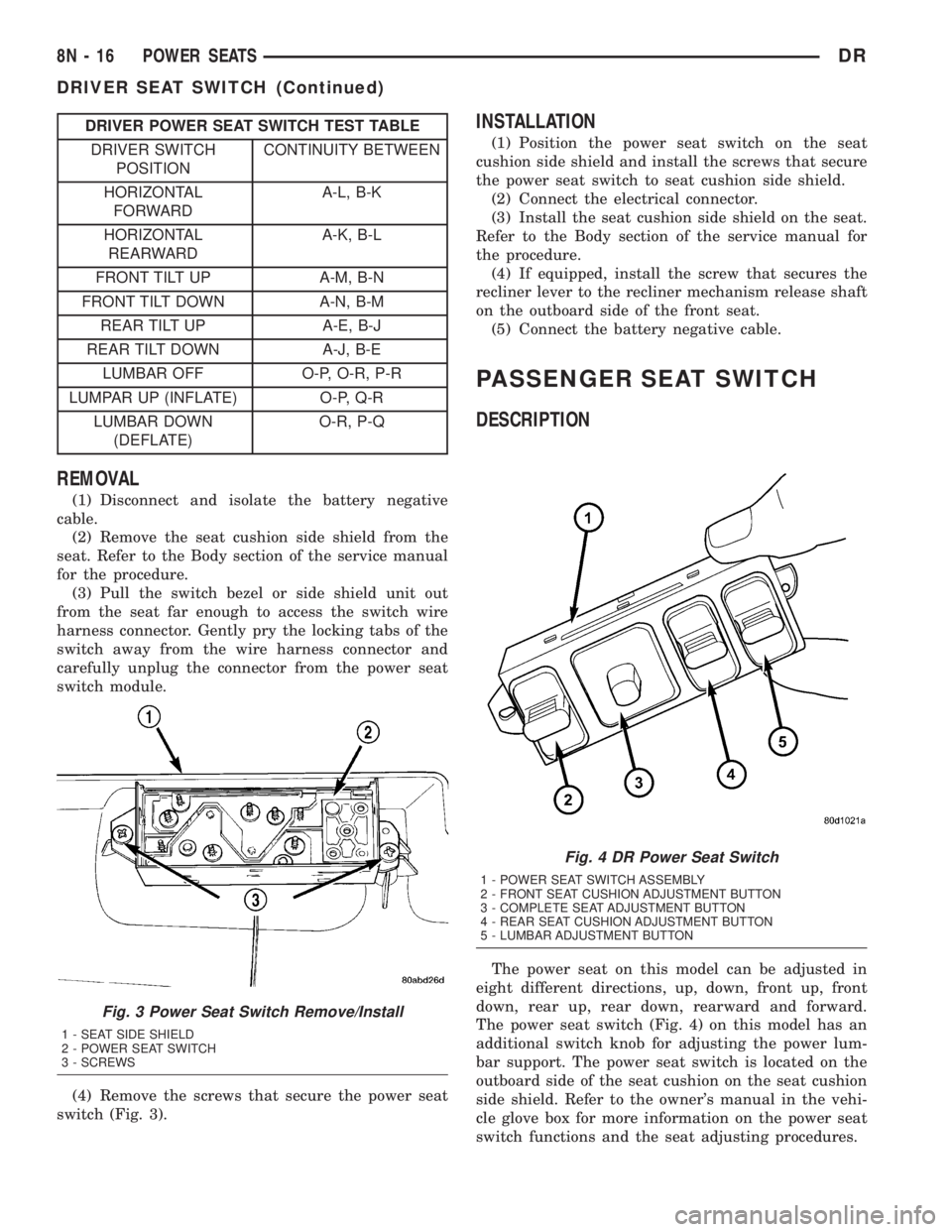
(4) Remove the screws that secure the power seat
switch (Fig. 3).
INSTALLATION
(1) Position the power seat switch on the seat
cushion side shield and install the screws that secure
the power seat switch to seat cushion side shield.
(2) Connect the electrical connector.
(3) Install the seat cushion side shield on the seat.
Refer to the Body section of the service manual for
the procedure.
(4) If equipped, install the screw that secures the
recliner lever to the recliner mechanism release shaft
on the outboard side of the front seat.
(5) Connect the battery negative cable.
PASSENGER SEAT SWITCH
DESCRIPTION
The power seat on this model can be adjusted in
eight different directions, up, down, front up, front
down, rear up, rear down, rearward and forward.
The power seat switch (Fig. 4) on this model has an
additional switch knob for adjusting the power lum-
bar support. The power seat switch is located on the
outboard side of the seat cushion on the seat cushion
side shield. Refer to the owner's manual in the vehi-
cle glove box for more information on the power seat
switch functions and the seat adjusting procedures.
Fig. 3 Power Seat Switch Remove/Install
1 - SEAT SIDE SHIELD
2 - POWER SEAT SWITCH
3 - SCREWS
Fig. 4 DR Power Seat Switch
1 - POWER SEAT SWITCH ASSEMBLY
2 - FRONT SEAT CUSHION ADJUSTMENT BUTTON
3 - COMPLETE SEAT ADJUSTMENT BUTTON
4 - REAR SEAT CUSHION ADJUSTMENT BUTTON
5 - LUMBAR ADJUSTMENT BUTTON
8N - 16 POWER SEATSDR
DRIVER SEAT SWITCH (Continued)
Page 595 of 2895
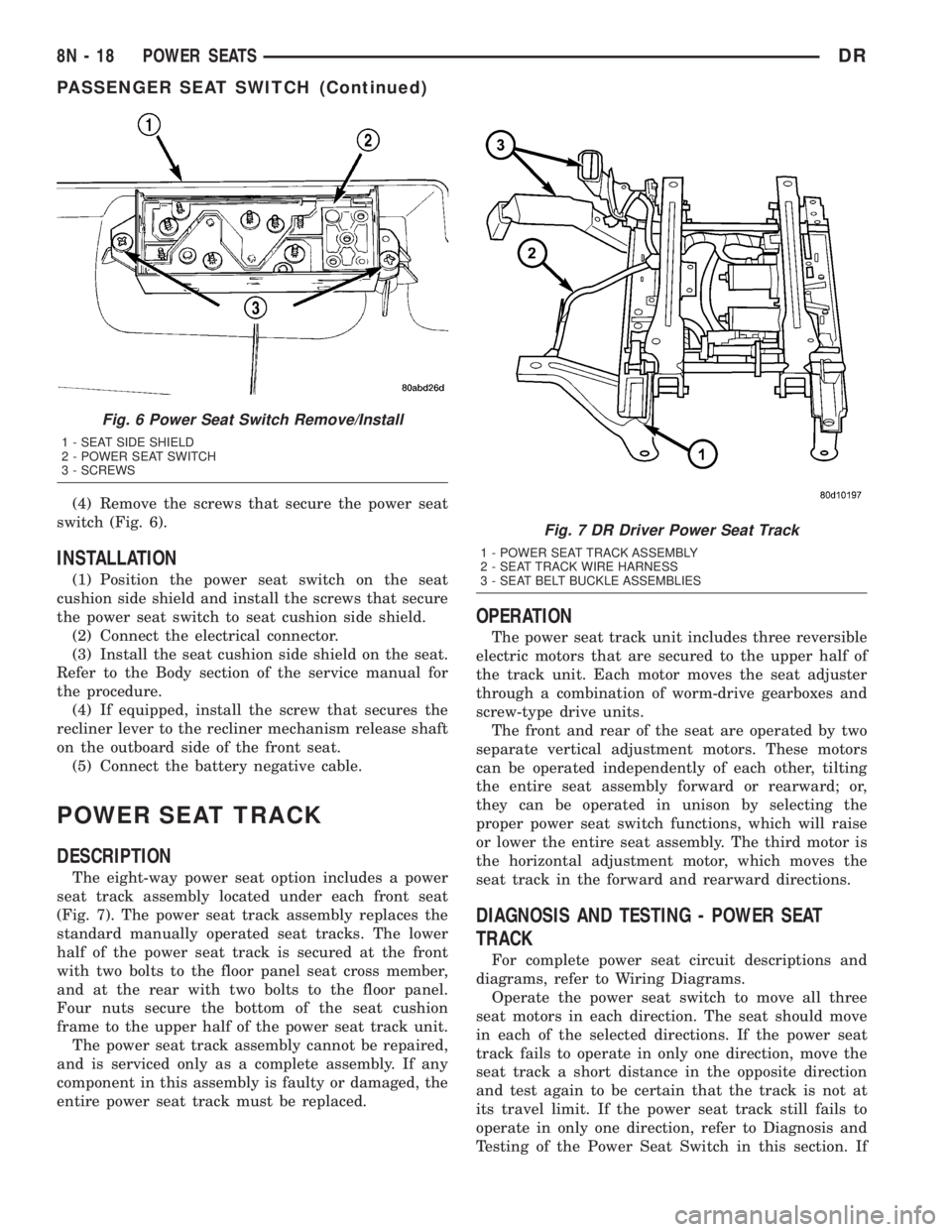
(4) Remove the screws that secure the power seat
switch (Fig. 6).
INSTALLATION
(1) Position the power seat switch on the seat
cushion side shield and install the screws that secure
the power seat switch to seat cushion side shield.
(2) Connect the electrical connector.
(3) Install the seat cushion side shield on the seat.
Refer to the Body section of the service manual for
the procedure.
(4) If equipped, install the screw that secures the
recliner lever to the recliner mechanism release shaft
on the outboard side of the front seat.
(5) Connect the battery negative cable.
POWER SEAT TRACK
DESCRIPTION
The eight-way power seat option includes a power
seat track assembly located under each front seat
(Fig. 7). The power seat track assembly replaces the
standard manually operated seat tracks. The lower
half of the power seat track is secured at the front
with two bolts to the floor panel seat cross member,
and at the rear with two bolts to the floor panel.
Four nuts secure the bottom of the seat cushion
frame to the upper half of the power seat track unit.
The power seat track assembly cannot be repaired,
and is serviced only as a complete assembly. If any
component in this assembly is faulty or damaged, the
entire power seat track must be replaced.
OPERATION
The power seat track unit includes three reversible
electric motors that are secured to the upper half of
the track unit. Each motor moves the seat adjuster
through a combination of worm-drive gearboxes and
screw-type drive units.
The front and rear of the seat are operated by two
separate vertical adjustment motors. These motors
can be operated independently of each other, tilting
the entire seat assembly forward or rearward; or,
they can be operated in unison by selecting the
proper power seat switch functions, which will raise
or lower the entire seat assembly. The third motor is
the horizontal adjustment motor, which moves the
seat track in the forward and rearward directions.
DIAGNOSIS AND TESTING - POWER SEAT
TRACK
For complete power seat circuit descriptions and
diagrams, refer to Wiring Diagrams.
Operate the power seat switch to move all three
seat motors in each direction. The seat should move
in each of the selected directions. If the power seat
track fails to operate in only one direction, move the
seat track a short distance in the opposite direction
and test again to be certain that the track is not at
its travel limit. If the power seat track still fails to
operate in only one direction, refer to Diagnosis and
Testing of the Power Seat Switch in this section. If
Fig. 6 Power Seat Switch Remove/Install
1 - SEAT SIDE SHIELD
2 - POWER SEAT SWITCH
3 - SCREWS
Fig. 7 DR Driver Power Seat Track
1 - POWER SEAT TRACK ASSEMBLY
2 - SEAT TRACK WIRE HARNESS
3 - SEAT BELT BUCKLE ASSEMBLIES
8N - 18 POWER SEATSDR
PASSENGER SEAT SWITCH (Continued)
Page 1536 of 2895
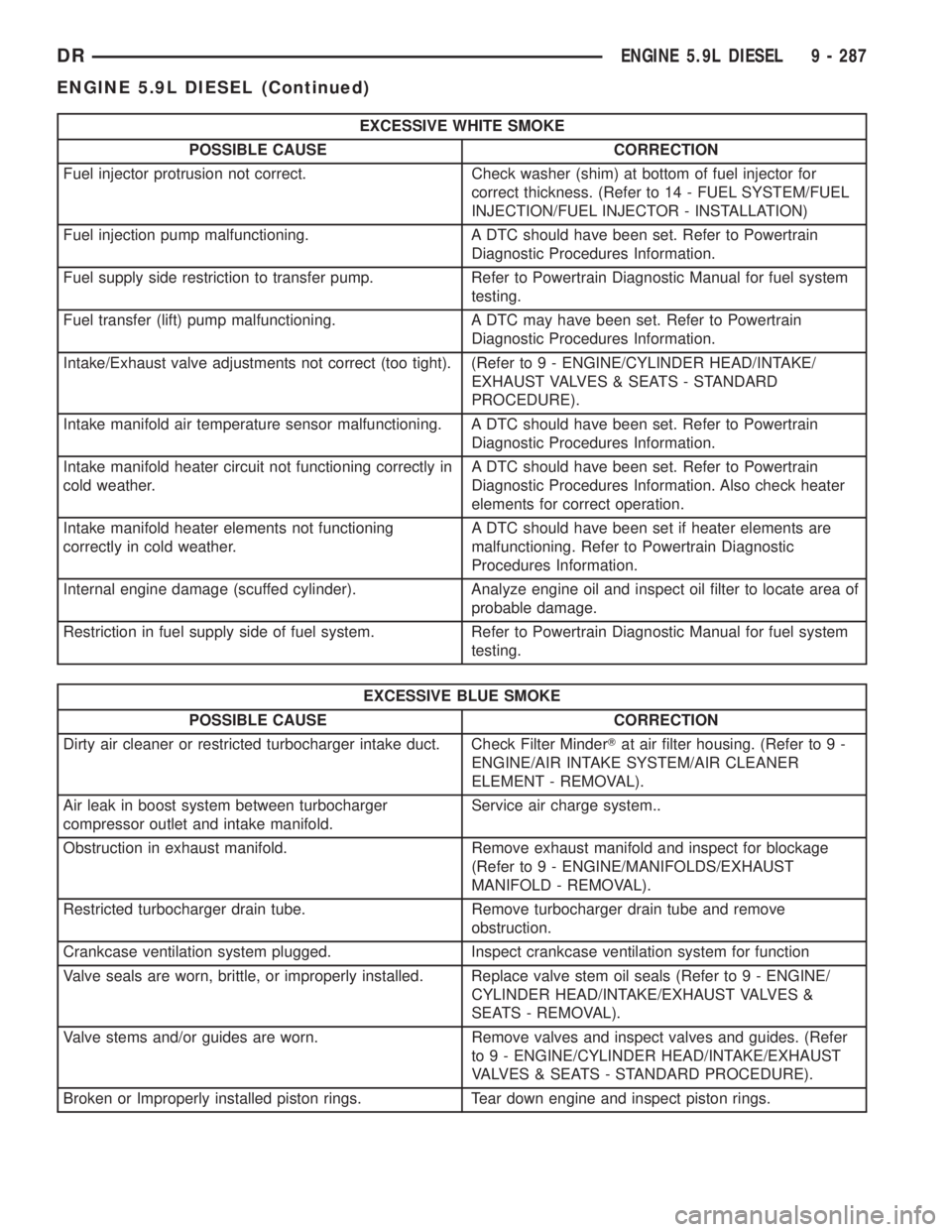
EXCESSIVE WHITE SMOKE
POSSIBLE CAUSE CORRECTION
Fuel injector protrusion not correct. Check washer (shim) at bottom of fuel injector for
correct thickness. (Refer to 14 - FUEL SYSTEM/FUEL
INJECTION/FUEL INJECTOR - INSTALLATION)
Fuel injection pump malfunctioning. A DTC should have been set. Refer to Powertrain
Diagnostic Procedures Information.
Fuel supply side restriction to transfer pump. Refer to Powertrain Diagnostic Manual for fuel system
testing.
Fuel transfer (lift) pump malfunctioning. A DTC may have been set. Refer to Powertrain
Diagnostic Procedures Information.
Intake/Exhaust valve adjustments not correct (too tight). (Refer to 9 - ENGINE/CYLINDER HEAD/INTAKE/
EXHAUST VALVES & SEATS - STANDARD
PROCEDURE).
Intake manifold air temperature sensor malfunctioning. A DTC should have been set. Refer to Powertrain
Diagnostic Procedures Information.
Intake manifold heater circuit not functioning correctly in
cold weather.A DTC should have been set. Refer to Powertrain
Diagnostic Procedures Information. Also check heater
elements for correct operation.
Intake manifold heater elements not functioning
correctly in cold weather.A DTC should have been set if heater elements are
malfunctioning. Refer to Powertrain Diagnostic
Procedures Information.
Internal engine damage (scuffed cylinder). Analyze engine oil and inspect oil filter to locate area of
probable damage.
Restriction in fuel supply side of fuel system. Refer to Powertrain Diagnostic Manual for fuel system
testing.
EXCESSIVE BLUE SMOKE
POSSIBLE CAUSE CORRECTION
Dirty air cleaner or restricted turbocharger intake duct. Check Filter MinderTat air filter housing. (Refer to 9 -
ENGINE/AIR INTAKE SYSTEM/AIR CLEANER
ELEMENT - REMOVAL).
Air leak in boost system between turbocharger
compressor outlet and intake manifold.Service air charge system..
Obstruction in exhaust manifold. Remove exhaust manifold and inspect for blockage
(Refer to 9 - ENGINE/MANIFOLDS/EXHAUST
MANIFOLD - REMOVAL).
Restricted turbocharger drain tube. Remove turbocharger drain tube and remove
obstruction.
Crankcase ventilation system plugged. Inspect crankcase ventilation system for function
Valve seals are worn, brittle, or improperly installed. Replace valve stem oil seals (Refer to 9 - ENGINE/
CYLINDER HEAD/INTAKE/EXHAUST VALVES &
SEATS - REMOVAL).
Valve stems and/or guides are worn. Remove valves and inspect valves and guides. (Refer
to 9 - ENGINE/CYLINDER HEAD/INTAKE/EXHAUST
VALVES & SEATS - STANDARD PROCEDURE).
Broken or Improperly installed piston rings. Tear down engine and inspect piston rings.
DRENGINE 5.9L DIESEL 9 - 287
ENGINE 5.9L DIESEL (Continued)
Page 1823 of 2895
REMOVAL - DIESEL
(1) Separate the pitman arm from the gear box
(Refer to 19 - STEERING/LINKAGE/PITMAN ARM -
REMOVAL).
(2) Remove the steering gear box (Refer to 19 -
STEERING/GEAR - REMOVAL).
(3) Install the steering gear in a soft jawed bench
vise.
(4) Clean exposed end of pitman shaft and housing
with a wire brush.
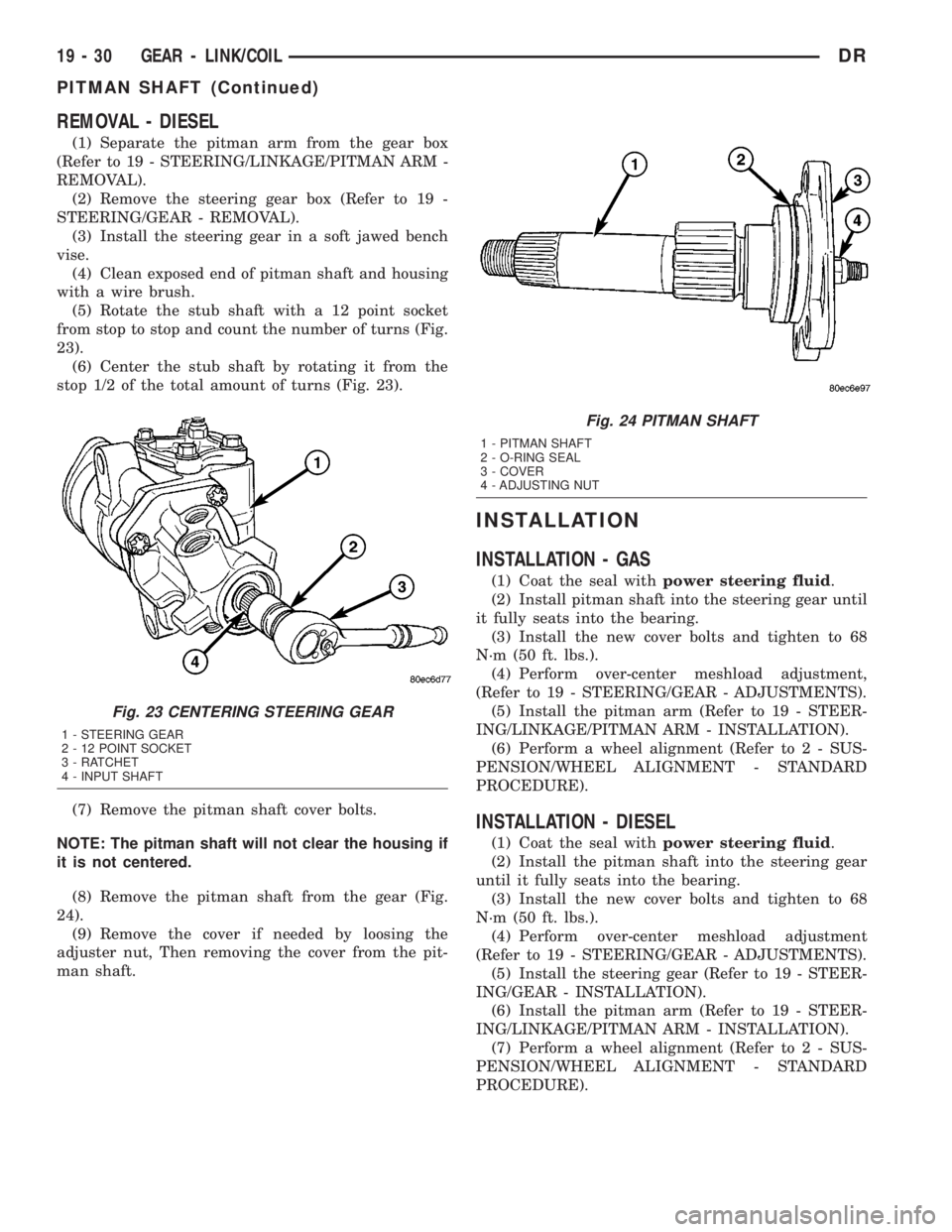
(5) Rotate the stub shaft with a 12 point socket
from stop to stop and count the number of turns (Fig.
23).
(6) Center the stub shaft by rotating it from the
stop 1/2 of the total amount of turns (Fig. 23).
(7) Remove the pitman shaft cover bolts.
NOTE: The pitman shaft will not clear the housing if
it is not centered.
(8) Remove the pitman shaft from the gear (Fig.
24).
(9) Remove the cover if needed by loosing the
adjuster nut, Then removing the cover from the pit-
man shaft.
INSTALLATION
INSTALLATION - GAS
(1) Coat the seal withpower steering fluid.
(2) Install pitman shaft into the steering gear until
it fully seats into the bearing.
(3) Install the new cover bolts and tighten to 68
N´m (50 ft. lbs.).
(4) Perform over-center meshload adjustment,
(Refer to 19 - STEERING/GEAR - ADJUSTMENTS).
(5) Install the pitman arm (Refer to 19 - STEER-
ING/LINKAGE/PITMAN ARM - INSTALLATION).
(6) Perform a wheel alignment (Refer to 2 - SUS-
PENSION/WHEEL ALIGNMENT - STANDARD
PROCEDURE).
INSTALLATION - DIESEL
(1) Coat the seal withpower steering fluid.
(2) Install the pitman shaft into the steering gear
until it fully seats into the bearing.
(3) Install the new cover bolts and tighten to 68
N´m (50 ft. lbs.).
(4) Perform over-center meshload adjustment
(Refer to 19 - STEERING/GEAR - ADJUSTMENTS).
(5) Install the steering gear (Refer to 19 - STEER-
ING/GEAR - INSTALLATION).
(6) Install the pitman arm (Refer to 19 - STEER-
ING/LINKAGE/PITMAN ARM - INSTALLATION).
(7) Perform a wheel alignment (Refer to 2 - SUS-
PENSION/WHEEL ALIGNMENT - STANDARD
PROCEDURE).
Fig. 23 CENTERING STEERING GEAR
1 - STEERING GEAR
2 - 12 POINT SOCKET
3 - RATCHET
4 - INPUT SHAFT
Fig. 24 PITMAN SHAFT
1 - PITMAN SHAFT
2 - O-RING SEAL
3 - COVER
4 - ADJUSTING NUT
19 - 30 GEAR - LINK/COILDR
PITMAN SHAFT (Continued)
Page 2599 of 2895
LATCH STRIKER
REMOVAL
(1) Using a grease pencil or equivalent, mark the
position of the striker.
(2) Remove the bolts and remove the striker.
INSTALLATION
(1) Install the striker and install the bolts.
(2) Tighten the bolts to 28 N´m (21 ft. lbs.).
(3) Adjust the striker if needed. (Refer to 23 -
BODY/DOOR - FRONT/LATCH STRIKER - ADJUST-
MENTS)
ADJUSTMENTS
ADJUSTMENT
(1) Using a grease pencil or equivalent, mark the
position of the striker to aid in adjustment.
(2) Loosen the striker bolts.
(3) Change the striker position to adjust the rear
gap and flush measurement. (Refer to 23 - BODY/
BODY STRUCTURE/GAP AND FLUSH - SPECIFI-
CATIONS)
(4) Tighten the bolts to 28 N´m (21 ft. lbs.).
LOCK CYLINDER
REMOVAL
(1) Remove the exterior handle. (Refer to 23 -
BODY/DOOR - FRONT/EXTERIOR HANDLE -
REMOVAL)
(2) Remove the clip and remove the lock cylinder
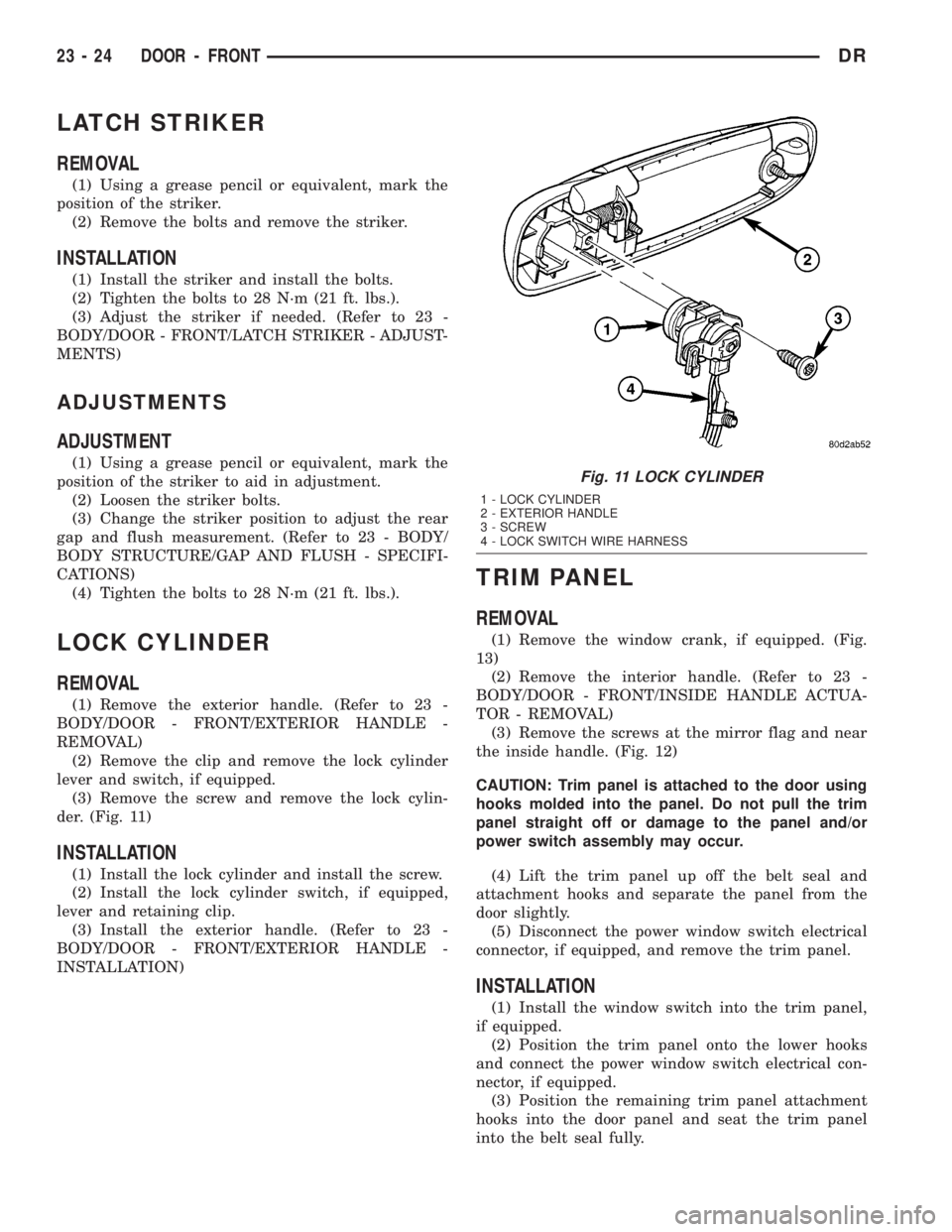
lever and switch, if equipped.
(3) Remove the screw and remove the lock cylin-
der. (Fig. 11)
INSTALLATION
(1) Install the lock cylinder and install the screw.
(2) Install the lock cylinder switch, if equipped,
lever and retaining clip.
(3) Install the exterior handle. (Refer to 23 -
BODY/DOOR - FRONT/EXTERIOR HANDLE -
INSTALLATION)
TRIM PANEL
REMOVAL
(1) Remove the window crank, if equipped. (Fig.
13)
(2) Remove the interior handle. (Refer to 23 -
BODY/DOOR - FRONT/INSIDE HANDLE ACTUA-
TOR - REMOVAL)
(3) Remove the screws at the mirror flag and near
the inside handle. (Fig. 12)
CAUTION: Trim panel is attached to the door using
hooks molded into the panel. Do not pull the trim
panel straight off or damage to the panel and/or
power switch assembly may occur.
(4) Lift the trim panel up off the belt seal and
attachment hooks and separate the panel from the
door slightly.
(5) Disconnect the power window switch electrical
connector, if equipped, and remove the trim panel.
INSTALLATION
(1) Install the window switch into the trim panel,
if equipped.
(2) Position the trim panel onto the lower hooks
and connect the power window switch electrical con-
nector, if equipped.
(3) Position the remaining trim panel attachment
hooks into the door panel and seat the trim panel
into the belt seal fully.
Fig. 11 LOCK CYLINDER
1 - LOCK CYLINDER
2 - EXTERIOR HANDLE
3 - SCREW
4 - LOCK SWITCH WIRE HARNESS
23 - 24 DOOR - FRONTDR
Page 2608 of 2895
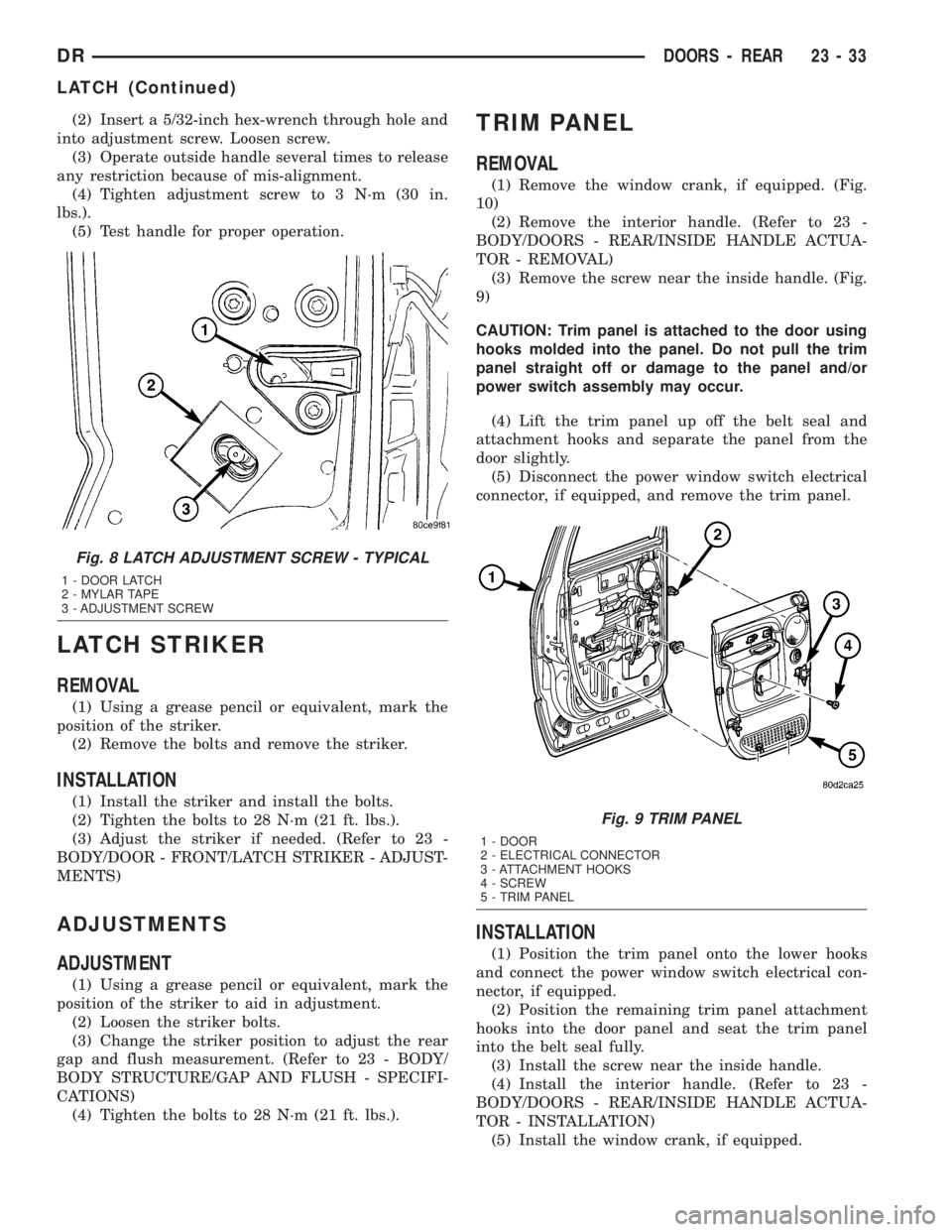
(2) Insert a 5/32-inch hex-wrench through hole and
into adjustment screw. Loosen screw.
(3) Operate outside handle several times to release
any restriction because of mis-alignment.
(4) Tighten adjustment screw to 3 N´m (30 in.
lbs.).
(5) Test handle for proper operation.
LATCH STRIKER
REMOVAL
(1) Using a grease pencil or equivalent, mark the
position of the striker.
(2) Remove the bolts and remove the striker.
INSTALLATION
(1) Install the striker and install the bolts.
(2) Tighten the bolts to 28 N´m (21 ft. lbs.).
(3) Adjust the striker if needed. (Refer to 23 -
BODY/DOOR - FRONT/LATCH STRIKER - ADJUST-
MENTS)
ADJUSTMENTS
ADJUSTMENT
(1) Using a grease pencil or equivalent, mark the
position of the striker to aid in adjustment.
(2) Loosen the striker bolts.
(3) Change the striker position to adjust the rear
gap and flush measurement. (Refer to 23 - BODY/
BODY STRUCTURE/GAP AND FLUSH - SPECIFI-
CATIONS)
(4) Tighten the bolts to 28 N´m (21 ft. lbs.).
TRIM PANEL
REMOVAL
(1) Remove the window crank, if equipped. (Fig.
10)
(2) Remove the interior handle. (Refer to 23 -
BODY/DOORS - REAR/INSIDE HANDLE ACTUA-
TOR - REMOVAL)
(3) Remove the screw near the inside handle. (Fig.
9)
CAUTION: Trim panel is attached to the door using
hooks molded into the panel. Do not pull the trim
panel straight off or damage to the panel and/or
power switch assembly may occur.
(4) Lift the trim panel up off the belt seal and
attachment hooks and separate the panel from the
door slightly.
(5) Disconnect the power window switch electrical
connector, if equipped, and remove the trim panel.
INSTALLATION
(1) Position the trim panel onto the lower hooks
and connect the power window switch electrical con-
nector, if equipped.
(2) Position the remaining trim panel attachment
hooks into the door panel and seat the trim panel
into the belt seal fully.
(3) Install the screw near the inside handle.
(4) Install the interior handle. (Refer to 23 -
BODY/DOORS - REAR/INSIDE HANDLE ACTUA-
TOR - INSTALLATION)
(5) Install the window crank, if equipped.
Fig. 8 LATCH ADJUSTMENT SCREW - TYPICAL
1 - DOOR LATCH
2 - MYLAR TAPE
3 - ADJUSTMENT SCREW
Fig. 9 TRIM PANEL
1 - DOOR
2 - ELECTRICAL CONNECTOR
3 - ATTACHMENT HOOKS
4 - SCREW
5 - TRIM PANEL
DRDOORS - REAR 23 - 33
LATCH (Continued)
Page 2859 of 2895
BIN - INSTALLATION, STORAGE.........23-62
BIN - INSTALLATION, UNDER SEAT
STORAGE...........................23-81
BIN - REMOVAL, STORAGE.............23-62
BIN - REMOVAL, UNDER SEAT STORAGE . . 23-81
BIN COVERING - INSTALLATION, UNDER
SEAT STORAGE......................23-81
BIN COVERING - REMOVAL, UNDER
SEAT STORAGE......................23-81
BIN LATCH - INSTALLATION, UNDER
SEAT STORAGE......................23-81
BIN LATCH - REMOVAL, UNDER SEAT
STORAGE...........................23-81
BLADE - DESCRIPTION, WIPER.........8R-19
BLADE - INSTALLATION, WIPER.........8R-20
BLADE - OPERATION, WIPER...........8R-19
BLADE - REMOVAL, WIPER............8R-19
BLEEDING - STANDARD PROCEDURE......5-27
BLEEDING - STANDARD PROCEDURE,
ABS BRAKE..........................5-40
BLEEDING - STANDARD PROCEDURE,
MANUAL.............................5-5
BLEEDING - STANDARD PROCEDURE,
MASTER CYLINDER...................5-20
BLEEDING - STANDARD PROCEDURE,
PRESSURE...........................5-5
BLEND DOOR - INSTALLATION..........24-25
BLEND DOOR - REMOVAL.............24-24
BLEND DOOR ACTUATOR -
DESCRIPTION.......................24-16
BLEND DOOR ACTUATOR -
INSTALLATION.......................24-17
BLEND DOOR ACTUATOR - OPERATION . . . 24-16
BLEND DOOR ACTUATOR - REMOVAL....24-17
BLOCK - CLEANING, ENGINE . 9-127,9-200,9-249,
9-38,9-380
BLOCK - DESCRIPTION, BLOWER
MOTOR RESISTOR...................24-17
BLOCK - DESCRIPTION, ENGINE.....9-126,9-37
BLOCK - INSPECTION, ENGINE....9-127,9-200,
9-249,9-38,9-380
BLOCK - INSTALLATION, BLOWER
MOTOR RESISTOR...................24-18
BLOCK - INSTALLATION, BRAKE
JUNCTION...........................5-19
BLOCK - OPERATION, BLOWER MOTOR
RESISTOR..........................24-17
BLOCK - REMOVAL, BLOWER MOTOR
RESISTOR..........................24-18
BLOCK - REMOVAL, BRAKE JUNCTION....5-19
BLOCK HEATER - 5.9L DIESEL -
DESCRIPTION, ENGINE.................7-43
BLOCK HEATER - 5.9L DIESEL -
INSTALLATION, ENGINE................7-44
BLOCK HEATER - 5.9L DIESEL -
OPERATION, ENGINE...................7-43
BLOCK HEATER - 5.9L DIESEL -
REMOVAL, ENGINE....................7-43
BLOCK HEATER - DESCRIPTION, ENGINE . . . 7-42
BLOCK HEATER - DIAGNOSIS AND
TESTING, ENGINE.....................7-42
BLOCK HEATER - INSTALLATION,
ENGINE.............................7-43
BLOCK HEATER - OPERATION, ENGINE....7-42
BLOCK HEATER - REMOVAL, ENGINE......7-43
BLOCK REFACING - STANDARD
PROCEDURE, CYLINDER
...............9-312
BLOWER MOTOR - DESCRIPTION
.......24-25
BLOWER MOTOR - DIAGNOSIS AND
TESTING
...........................24-26
BLOWER MOTOR - INSTALLATION
.......24-26
BLOWER MOTOR - OPERATION
.........24-25
BLOWER MOTOR - REMOVAL
...........24-26
BLOWER MOTOR RESISTOR -
DIAGNOSIS AND TESTING
.............24-18
BLOWER MOTOR RESISTOR BLOCK -
DESCRIPTION
.......................24-17
BLOWER MOTOR RESISTOR BLOCK -
INSTALLATION
.......................24-18
BLOWER MOTOR RESISTOR BLOCK -
OPERATION
.........................24-17
BLOWER MOTOR RESISTOR BLOCK -
REMOVAL
..........................24-18
BLOWER MOTOR SWITCH -
DESCRIPTION
.......................24-18
BLOWER MOTOR SWITCH - DIAGNOSIS
AND TESTING
.......................24-18BLOWER MOTOR SWITCH -
INSTALLATION.......................24-19
BLOWER MOTOR SWITCH - OPERATION . . 24-18
BLOWER MOTOR SWITCH - REMOVAL . . . 24-19
BODY - ADJUSTMENTS, VALVE . . 21-308,21-487
BODY - ASSEMBLY, VALVE......21-299,21-477,
21-590
BODY & CABLE - DESCRIPTION,
ANTENNA...........................8A-4
BODY & CABLE - INSTALLATION,
ANTENNA...........................8A-6
BODY & CABLE - OPERATION, ANTENNA . . . 8A-4
BODY & CABLE - REMOVAL, ANTENNA....8A-6
BODY - CLEANING, VALVE......21-298,21-476,
21-588
BODY - DESCRIPTION, THROTTLE.......14-45
BODY - DESCRIPTION, VALVE . . . 21-267,21-445,
21-584
BODY - DISASSEMBLY, VALVE . . . 21-287,21-465,
21-586
BODY - INSPECTION, VALVE....21-298,21-476,
21-588
BODY - INSTALLATION, THROTTLE.......14-47
BODY - INSTALLATION, VALVE . . . 21-307,21-486,
21-590
BODY - OPERATION, THROTTLE.........14-45
BODY - OPERATION, VALVE.....21-272,21-450,
21-585
BODY - REMOVAL, THROTTLE..........14-45
BODY - REMOVAL, VALVE . 21-286,21-464,21-585
BODY AND CABLE - DIAGNOSIS AND
TESTING, ANTENNA...................8A-4
BODY CODE PLATE - DESCRIPTION.....Intro.-4
BODY ISOLATORS - INSTALLATION......23-37
BODY ISOLATORS - REMOVAL..........23-36
BODY LUBRICATION - STANDARD
PROCEDURE.........................23-3
BODY OPENING DIMENSIONS -
SPECIFICATIONS.....................23-99
BODY PANEL REPAIR - STANDARD
PROCEDURE, PLASTIC.................23-3
BODY SIDE MOLDINGS - INSTALLATION . . 23-36
BODY SIDE MOLDINGS - REMOVAL......23-36
BODY, SPECIAL TOOLS................23-14
BODY VENT - INSTALLATION...........23-72
BODY VENT - REMOVAL...............23-72
BOOST PRESSURE - DIAGNOSIS AND
TESTING, TURBOCHARGER.............11-10
BOOSTER - DESCRIPTION, POWER
BRAKE..............................5-25
BOOSTER - DIAGNOSIS AND TESTING,
HYDRAULIC..........................5-25
BOOSTER - DIAGNOSIS AND TESTING,
MASTER CYLINDER/POWER.............5-20
BOOSTER - INSTALLATION, HYDRO-
BOOST BRAKE........................5-27
BOOSTER - INSTALLATION, POWER
BRAKE..............................5-25
BOOSTER - OPERATION, POWER BRAKE . . . 5-25
BOOSTER - REMOVAL, HYDRO-BOOST
BRAKE..............................5-27
BOOSTER - REMOVAL, POWER BRAKE....5-25
BOOT - INSTALLATION, 4WD FLOOR
SHIFT..............................23-64
BOOT - INSTALLATION, EXTENSION
HOUSING SEAL AND DUST......21-652,21-716
BOOT - REMOVAL, 4WD FLOOR SHIFT....23-63
BOOT - REMOVAL, EXTENSION HOUSING
SEAL AND DUST..............21-652,21-716
BORE - DE-GLAZE - STANDARD
PROCEDURE, CYLINDER...............9-313
BORE HONING - STANDARD
PROCEDURE, CYLINDER . 9-126,9-233,9-360,9-37
BORE REPAIR - STANDARD
PROCEDURE, CAM...................9-315
BORE REPAIR - STANDARD
PROCEDURE, CYLINDER...............9-313
BOX - INSTALLATION, CARGO..........23-37
BOX - INSTALLATION, GLOVE...........23-53
BOX - REMOVAL, CARGO..............23-37
BOX - REMOVAL, GLOVE..............23-53
BOX - TIE DOWN - INSTALLATION,
CARGO
............................23-37
BOX - TIE DOWN - REMOVAL, CARGO
....23-37
BOX LAMP/SWITCH - INSTALLATION,
GLOVE
.............................8L-25
BOX LAMP/SWITCH - REMOVAL, GLOVE
. . 8L-25
BOX LATCH - INSTALLATION, GLOVE
.....23-53BOX LATCH - REMOVAL, GLOVE.........23-53
B-PILLAR GRAB HANDLE -
INSTALLATION.......................23-69
B-PILLAR GRAB HANDLE - REMOVAL....23-69
B-PILLAR LOWER TRIM - INSTALLATION . . 23-65
B-PILLAR LOWER TRIM - REMOVAL.....23-64
B-PILLAR UPPER TRIM - INSTALLATION . . 23-65
B-PILLAR UPPER TRIM - REMOVAL......23-65
BRACKET - INSTALLATION, REARVIEW
MIRROR SUPPORT...................23-71
BRACKET - INSTALLATION, STEERING
COLUMN OPENING SUPPORT...........23-62
BRACKET - REMOVAL, STEERING
COLUMN OPENING SUPPORT...........23-61
BRACKETS - INSTALLATION, SEAT BACK
REAR - FOOTMANS LOOP..............23-85
BRACKETS - REMOVAL, SEAT BACK
REAR - FOOTMANS LOOP..............23-85
BRAKE - CLEANING, REAR DRUM IN
HAT ................................5-33
BRAKE - DESCRIPTION, CONTROLLER
ANTILOCK...........................8E-3
BRAKE - DESCRIPTION, PARKING........5-30
BRAKE - INSPECTION, REAR DRUM IN
HAT ................................5-33
BRAKE - INSTALLATION, CONTROLLER
ANTILOCK...........................8E-3
BRAKE - OPERATION, CONTROLLER
ANTILOCK...........................8E-3
BRAKE - OPERATION, PARKING..........5-30
BRAKE - REMOVAL, CONTROLLER
ANTILOCK...........................8E-3
BRAKE BLEEDING - STANDARD
PROCEDURE, ABS.....................5-40
BRAKE BOOSTER - DESCRIPTION,
POWER.............................5-25
BRAKE BOOSTER - INSTALLATION,
HYDRO-BOOST.......................5-27
BRAKE BOOSTER - INSTALLATION,
POWER.............................5-25
BRAKE BOOSTER - OPERATION, POWER . . . 5-25
BRAKE BOOSTER - REMOVAL,
HYDRO-BOOST.......................5-27
BRAKE BOOSTER - REMOVAL, POWER....5-25
BRAKE CABLE - INSTALLATION, FRONT
PARKING............................5-32
BRAKE CABLE - INSTALLATION, REAR
PARK...............................5-32
BRAKE CABLE - REMOVAL, FRONT
PARKING............................5-31
BRAKE CABLE - REMOVAL, REAR PARK . . . 5-31
BRAKE CALIPER ADAPTER MOUNT -
INSTALLATION, DISC...................5-17
BRAKE CALIPERS - DESCRIPTION, DISC . . . 5-11
BRAKE CALIPERS - OPERATION, DISC.....5-12
BRAKE FLUID CONTAMINATION -
DIAGNOSIS AND TESTING..............5-18
BRAKE FLUID LEVEL - STANDARD
PROCEDURE.........................5-18
BRAKE FLUID, SPECIFICATIONS..........5-18
BRAKE HOSE - INSTALLATION, FRONT......5-9
BRAKE HOSE - INSTALLATION, REAR.......5-9
BRAKE HOSE - REMOVAL, REAR..........5-8
BRAKE INDICATOR - DESCRIPTION,
BRAKE/PARK........................8J-18
BRAKE INDICATOR - DIAGNOSIS AND
TESTING...........................8J-19
BRAKE INDICATOR - OPERATION,
BRAKE/PARK........................8J-19
BRAKE JUNCTION BLOCK -
INSTALLATION........................5-19
BRAKE JUNCTION BLOCK - REMOVAL.....5-19
BRAKE LAMP - INSTALLATION...........8L-8
BRAKE LAMP - REMOVAL...............8L-8
BRAKE LAMP SWITCH - DESCRIPTION....8L-8
BRAKE LAMP SWITCH - DIAGNOSIS
AND TESTING........................8L-9
BRAKE LAMP SWITCH - INSTALLATION . . . 8L-10
BRAKE LAMP SWITCH - OPERATION......8L-8
BRAKE LAMP SWITCH - REMOVAL.......8L-9
BRAKE PADS/SHOES - INSTALLATION.....5-10
BRAKE PADS/SHOES - REMOVAL
.........5-10
BRAKE PROPORTIONING -
DESCRIPTION, ELECTRONIC VARIABLE
....5-43
BRAKE PROPORTIONING - OPERATION,
ELECTRONIC VARIABLE
................5-43
BRAKE SHOES - ADJUSTMENT, PARKING
. . 5-34
BRAKE, SPECIFICATIONS - BASE
..........5-7
4 INDEXDR
Description Group-Page Description Group-Page Description Group-Page