steering DODGE RAM 2500 DIESEL 2004 3.G Owner's Manual
[x] Cancel search | Manufacturer: DODGE, Model Year: 2004, Model line: RAM 2500 DIESEL, Model: DODGE RAM 2500 DIESEL 2004 3.GPages: 426, PDF Size: 7.22 MB
Page 242 of 426

ABS Warning Light
The Anti-lock Brake System includes an amber warning
light, located in the instrument cluster. When the light is
illuminated, the Anti-lock Brake System is not function-
ing. The system reverts to standard non-anti-lock brakes.
WARNING!
Pumping of the anti-lock brakes will diminish their
effectiveness and may lead to an accident. Pumping
makes the stopping distance longer. Just press firmly
on your brake pedal when you need to slow down or
stop.
POWER STEERING
Your power steering system will provide mechanical
steering capability if power assist is lost.
If for any reason the hydraulic pressure is interrupted, it
will still be possible to steer your vehicle. Under these
conditions you will experience a substantial increase in
steering effort.
242 STARTING AND OPERATING
Page 251 of 426

WARNING!
Overloading of your tire is dangerous. Overloading
can cause tire failure, affect vehicle handling, and
increase your stopping distance. Use tires of the
recommended load capacity for your vehicle. Never
overload them.
TIRESÐGENERAL INFORMATION
Tire Pressure
Proper tire inflation pressure is essential to the safe and
satisfactory operation of your vehicle. Three primary
areas are affected by improper tire pressure:1. SafetyÐ
WARNING!
Improperly inflated tires are dangerous and can
cause accidents.
²Under inflation increases tire flexing and can result
in tire failure.
²Over inflation reduces a tire's ability to cushion
shock. Objects on the road and chuck holes can cause
damage that results in tire failure.
²Unequal tire pressures can cause steering prob-
lems. You could lose control of your vehicle.
²Over inflated or under inflated tires can affect
vehicle handling and can fail suddenly, resulting in
loss of vehicle control.
²Unequal tire pressures from one side of the vehicle
to the other can cause the vehicle to drift to the right
or left.
Always drive with each tire inflated to the recom-
mended cold tire inflation pressure.
STARTING AND OPERATING 251
5
Page 258 of 426

WARNING!
²Do not use a tire, wheel size or rating other than
that specified for your vehicle. Some combina-
tions of unapproved tires and wheels may change
suspension dimensions and performance charac-
teristics, resulting in changes to steering, han-
dling, and braking of your vehicle. This can cause
unpredictable handling and stress to steering and
suspension components. You could lose control
and have an accident resulting in serious injury or
death. Use only the tire and wheel sizes with load
ratings approved for your vehicle.
²Never use a tire with a smaller load index or
capacity, other than what was originally equipped
on your vehicle. Using a tire with a smaller load
index could result in tire overloading and failure.
You could lose control and have an accident.
²Failure to equip your vehicle with tires having
adequate speed capability can result in sudden
tire failure and loss of vehicle control.
CAUTION!
Replacing original tires with tires of a different size
may result in false speedometer and odometer read-
ings.
Alignment And Balance
Poor suspension alignment may result in:
²Fast tire wear.
²Uneven tire wear, such as feathering and one-sided
wear.
²Vehicle pull to right or left.
Tires may also cause the vehicle to pull to the left or right.
Alignment will not correct this condition. See your dealer
for proper diagnosis.
258 STARTING AND OPERATING
Page 261 of 426

SNOW TIRES
Snow tires should be of the same size and type construc-
tion as the front tires. Consult the manufacturer of the
snow tire to determine any maximum vehicle speed
requirement associated with the tire. These tires should
always be operated at the vehicle maximum capacity
inflation pressures under any load condition.
While studded tires improve performance on ice, skid
and traction capability on wet or dry surfaces may be
poorer than that of non-studded tires. Some states pro-
hibit studded tires; therefore, local laws should be
checked before using these tire types.
TIRE ROTATION RECOMMENDATIONS
Tires on the front and rear axles of vehicles operate at
different loads and perform different steering, driving,
and braking functions. For these reasons, they wear at
unequal rates, and develop irregular wear patterns.
These effects can be reduced by timely rotation of tires.
The benefits of rotation are especially worthwhile with
aggressive tread designs such as those on On/Off Road
type tires. Rotation will increase tread life, help to main-
tain mud, snow, and wet traction levels, and contribute to
a smooth, quiet ride.
STARTING AND OPERATING 261
5
Page 273 of 426
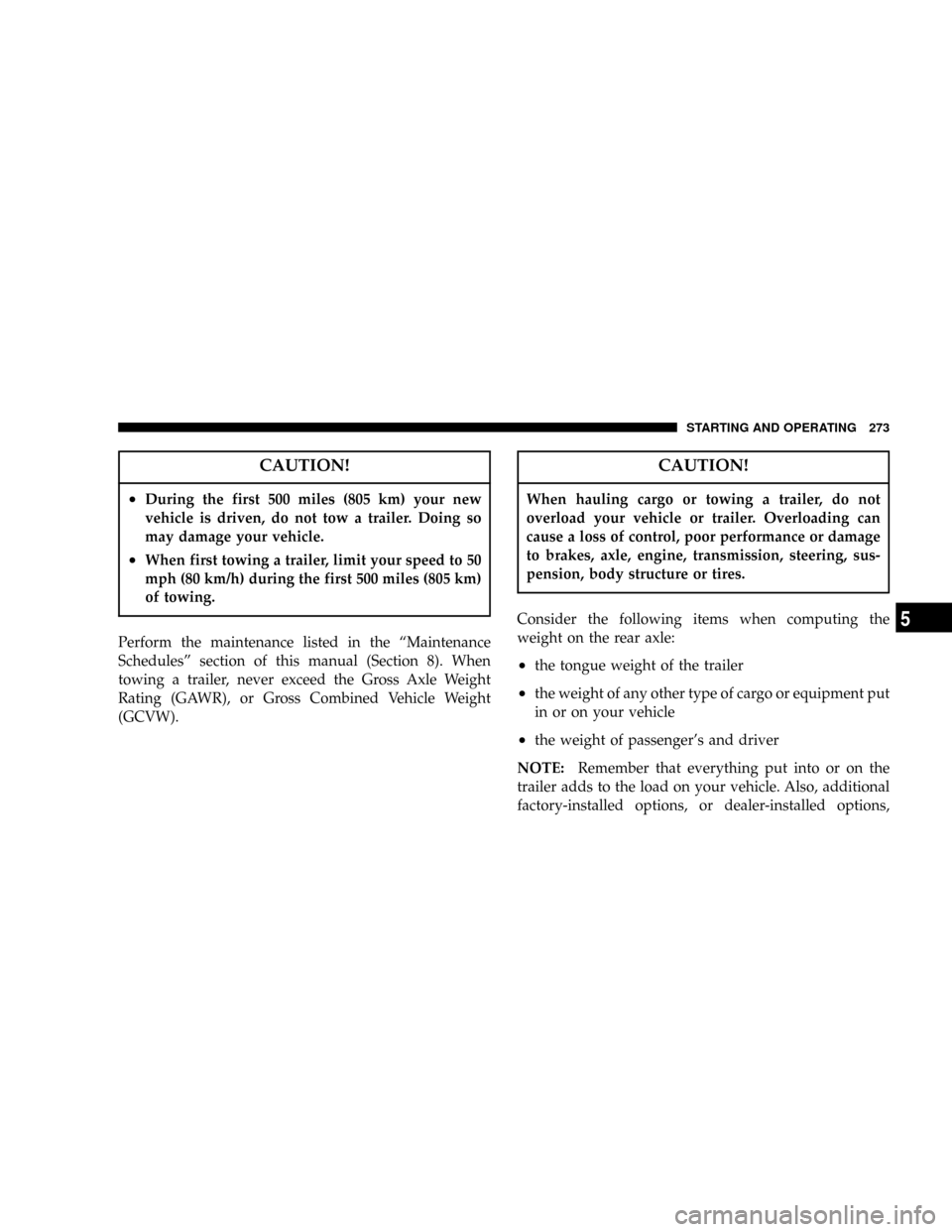
CAUTION!
²During the first 500 miles (805 km) your new
vehicle is driven, do not tow a trailer. Doing so
may damage your vehicle.
²When first towing a trailer, limit your speed to 50
mph (80 km/h) during the first 500 miles (805 km)
of towing.
Perform the maintenance listed in the ªMaintenance
Schedulesº section of this manual (Section 8). When
towing a trailer, never exceed the Gross Axle Weight
Rating (GAWR), or Gross Combined Vehicle Weight
(GCVW).
CAUTION!
When hauling cargo or towing a trailer, do not
overload your vehicle or trailer. Overloading can
cause a loss of control, poor performance or damage
to brakes, axle, engine, transmission, steering, sus-
pension, body structure or tires.
Consider the following items when computing the
weight on the rear axle:
²the tongue weight of the trailer
²the weight of any other type of cargo or equipment put
in or on your vehicle
²the weight of passenger's and driver
NOTE:Remember that everything put into or on the
trailer adds to the load on your vehicle. Also, additional
factory-installed options, or dealer-installed options,
STARTING AND OPERATING 273
5
Page 296 of 426

HAZARD WARNING LIGHTS
The Hazard Warning switch is mounted on the top of the
steering column as shown in the illustration.
To engage the Hazard Warning lights, depress the button
on the top of the steering column. When the Hazard
Warning switch is activated, all directional turn signalswill flash off and on to warn oncoming traffic of an
emergency. Push the button a second time to turn off the
flashers.
This is an emergency warning system and should not be
used when the vehicle is in motion. Use it when your
vehicle is disabled and is creating a safety hazard for
other motorists.
When you must leave the vehicle to seek assistance, the
Hazard Warning lights will continue to operate even
though the ignition switch is OFF.
NOTE:With extended use, the Hazard Warning lights
may discharge your battery.
296 WHAT TO DO IN EMERGENCIES
Page 317 of 426

MAINTAINING YOUR VEHICLE
CONTENTS
mEngine Compartment....................320
N5.9L/5.9L HO Cummins Turbo Diesel.......320
mOnboard Diagnostic System (OBD II).........321
mReplacement Parts......................322
mDealer Service.........................322
mService Information.....................322
mMaintenance Procedures..................325
NEngine Oil..........................325
NDrive Belt...........................331NEngine Air Cleaner Filter................331
NDraining Fuel/Water Separator Filter.......334
NMaintenance Free Batteries...............336
NAir Conditioner Maintenance.............338
NPower Steering Ð Fluid Check............339
NFront Suspension Ball Joints..............340
NSteering Linkage Ð Inspection............340
NFront Axle Universal Drive Joints And Pivot
Bearings............................340
7
Page 339 of 426

Refrigerant Recovery and Recycling
R-134a Air Conditioning Refrigerant is a hydrofluorocar-
bon (HFC) that is endorsed by the Environmental Pro-
tection Agency and is an ozone-saving product. How-
ever, the manufacturer recommends that air conditioning
service be performed by dealers or other service facilities
using recovery and recycling equipment.
NOTE:Air Conditioning systems found to be contami-
nated with A/C System Sealers, Stop Leak Products, Seal
Conditioners, Compressor Oil, or Refrigerants not ap-
proved by the manufacturer, voids the warranty for the
Air Conditioning system.
Power Steering Ð Fluid Check
Checking the power steering fluid level at a defined
service interval is not required. The fluid should only be
checked if a leak is suspected, abnormal noises areapparent, and/or the system is not functioning as antici-
pated. Coordinate inspection efforts through a certified
DaimlerChrysler Dealership.9
WARNING!
Fluid level should be checked on a level surface and
with the engine off to prevent injury from moving
parts and to insure accurate fluid level reading. Do
not overfill. Use only manufacturers recommended
power steering fluid.
If necessary, add fluid to restore to the proper indicated
level. With a clean cloth, wipe any spilled fluid from all
surfaces. Refer to Recommended Fluids, Lubricants, and
Genuine Parts for correct fluid type.
MAINTAINING YOUR VEHICLE 339
7
Page 340 of 426

Front Suspension Ball Joints
The ball joints originally supplied with the vehicle are
permanently lubricated at the factory and do not require
service. The ball joints and seals should be inspected
whenever the vehicle is serviced for other reasons.
Steering Linkage Ð Inspection
Whenever the vehicle is hoisted, all steering linkage
joints should be inspected for evidence of damage. If
seals are damaged, parts should be replaced to prevent
leakage or contamination of the grease.
Front Axle Universal Drive Joints And Pivot
Bearings
The front axle universal joint and pivot bearings are
permanently lubricated and do not require servicing.
Body Lubrication
Locks and all body pivot points, including such items as
seat tracks, doors,liftgate and hood hinges, should be
lubricated periodically to assure quiet, easy operation
and to protect against rust and wear. Prior to the appli-
cation of any lubricant, the parts concerned should be
wiped clean to remove dust and grit; after lubricating
excess oil and grease should be removed. Particular
attention should also be given to hood latching compo-
nents to insure proper function. When performing other
underhood services, the hood latch, release mechanism
and safety catch should be cleaned and lubricated.
The external lock cylinders should be lubricated twice a
year, preferably in the fall and spring. Apply a small
amount of a high quality lubricant such as MopartLock
Cylinder Lubricant directly into the lock cylinder.
340 MAINTAINING YOUR VEHICLE
Page 381 of 426
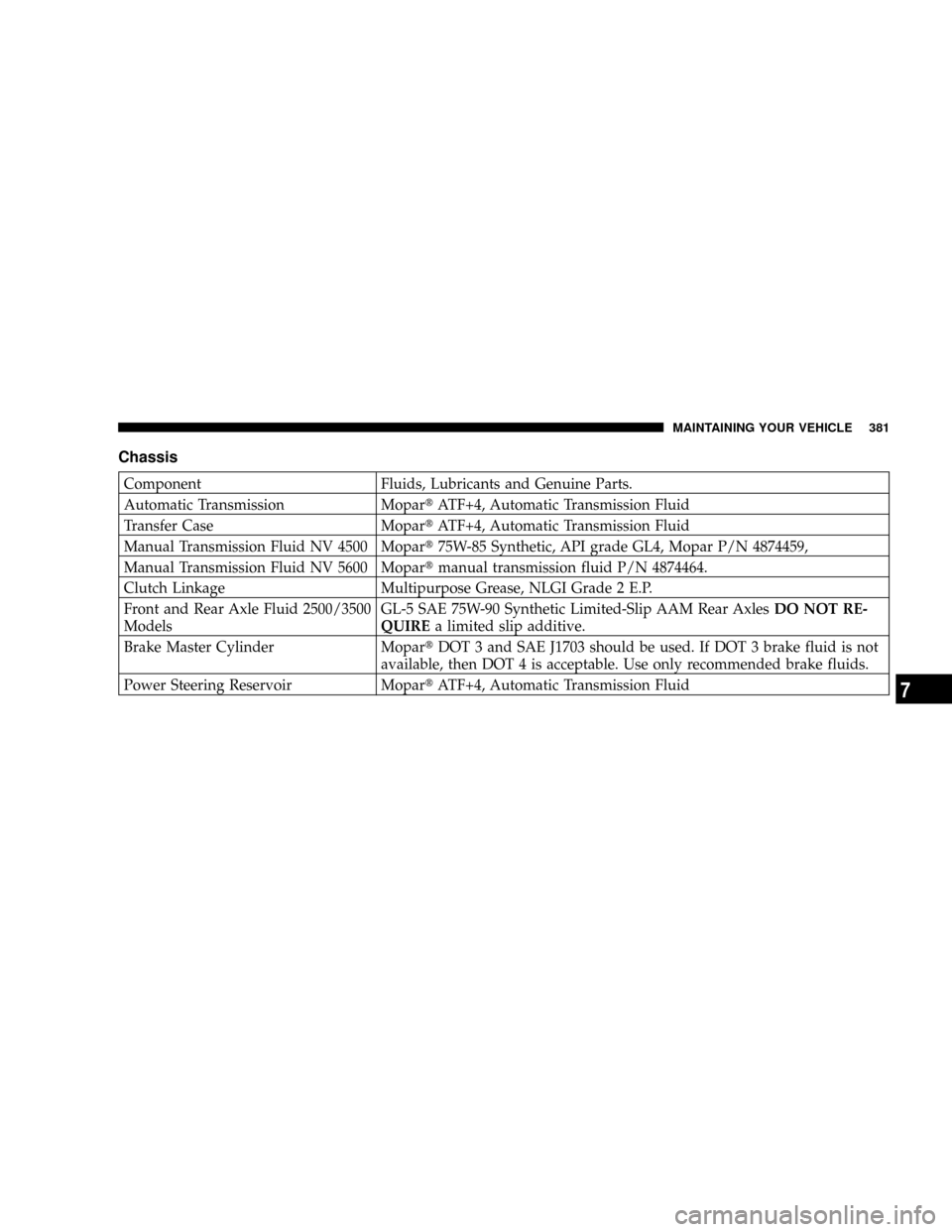
Chassis
Component Fluids, Lubricants and Genuine Parts.
Automatic Transmission MopartATF+4, Automatic Transmission Fluid
Transfer Case MopartATF+4, Automatic Transmission Fluid
Manual Transmission Fluid NV 4500 Mopart75W-85 Synthetic, API grade GL4, Mopar P/N 4874459,
Manual Transmission Fluid NV 5600 Mopartmanual transmission fluid P/N 4874464.
Clutch Linkage Multipurpose Grease, NLGI Grade 2 E.P.
Front and Rear Axle Fluid 2500/3500
ModelsGL-5 SAE 75W-90 Synthetic Limited-Slip AAM Rear AxlesDO NOT RE-
QUIREa limited slip additive.
Brake Master Cylinder MopartDOT 3 and SAE J1703 should be used. If DOT 3 brake fluid is not
available, then DOT 4 is acceptable. Use only recommended brake fluids.
Power Steering Reservoir MopartATF+4, Automatic Transmission Fluid
MAINTAINING YOUR VEHICLE 381
7