engine DODGE RAM 2500 DIESEL 2004 3.G Manual Online
[x] Cancel search | Manufacturer: DODGE, Model Year: 2004, Model line: RAM 2500 DIESEL, Model: DODGE RAM 2500 DIESEL 2004 3.GPages: 426, PDF Size: 7.22 MB
Page 290 of 426

NOTE:Items 1 through 5 are requirements that must be
met prior to depressing the Neutral (N) selection button,
and must continue to be met until the 4 seconds elaspes
and the shift has been completed. If any of these require-
ments (with the exception of 3 - Key ON) are not met
prior to depressing the Neutral (N) button or are no
longer met during the 4 second timer, then the Neutral
(N) indicator light will flash continuously until all re-
quirements are met or until the Neutral (N) button is
released.
NOTE:The ignition key must be ON for a shift to take
place and for the position indicator lights to be operable.
If the key in not ON, the shift will not take place and no
position indicator lights will be on or flashing.
NOTE:Flashing neutral (N) position indicator light
indicates that shift requirements have not been met.CAUTION!
Damage to the transmission may occur if the trans-
mission is shifted into Park (P) with the transfer case
in Neutral (N) and the engine RUNNING. With the
transfer case in Neutral (N) ensure that the engine is
OFF prior to shifting the transmission into Park (P).
Returning to Normal Operation Ð Electronic Shift
Transfer Case
Use the following procedure to prepare your vehicle for
normal usage.
1. Bring vehicle to a complete stop.
2. Shut OFF the engine.
3. Place ignition key in the ON position.
290 STARTING AND OPERATING
Page 294 of 426

3. Replace tires when tread wear indicators first become
visible.
4. Keep tires properly inflated.
5. Maintain sufficient distance between your vehicle and
the car in front to avoid a collision in a sudden stop.ENGINE DATA PLATE
Use the information from the engine data plate when
discussing service or sourcing parts for your engine. The
engine data plate is located on the intake side of the
breather cover.
294 STARTING AND OPERATING
Page 297 of 426

ADDING FUEL Ð 24±VALVE CUMMINS TURBO
DIESEL
WARNING!
A fire may result if fuel is pumped into a portable
container that is on a truck bed. You could be
burned. Always place fuel containers on the ground
while filling.
NOTE:When a diesel engine is allowed to run out of
fuel, air is pulled into the fuel system.
You may try priming as described below. However, if the
engine will not start, refer to the fuel priming procedure
in the Service Manual or have the vehicle towed to an
authorized Dodge dealer.
WARNING!
Do not open the high pressure fuel system with the
engine running. Engine operation causes high fuel
pressure. High pressure fuel spray can cause serious
injury or death.
Priming if the engine has run out of fuel
1. Add a substantial quantity of fuel to the tank 5 to 10
gallons (19 to 38L).
2. Crank the engine for 1 to 2 seconds. If the engine does
not start, then release the key or starter button back to the
RUN position (do not turn the key back to the OFF
position). The electric fuel transfer pump will continue to
run and purge air from the system for about 25 seconds.
After 25 seconds, attempt to start the engine again.
3. Start the engine using the Normal Starting Procedure.
WHAT TO DO IN EMERGENCIES 297
6
Page 298 of 426

4. Repeat the procedure if the engine does not start.
CAUTION!
Do not engage the starter motor for more than 15
seconds at a time. Allow two minutes between the
cranking intervals.
NOTE:The engine may run rough until the air is forced
from all the fuel lines.
JACK LOCATION
All Models
The jack and jack tools are stored under the passenger
seat. Lift the flap on the side of the seat for access.Remove the jack and tools by loosening the thumb screw
and sliding the assembly from under the seat.
298 WHAT TO DO IN EMERGENCIES
Page 300 of 426
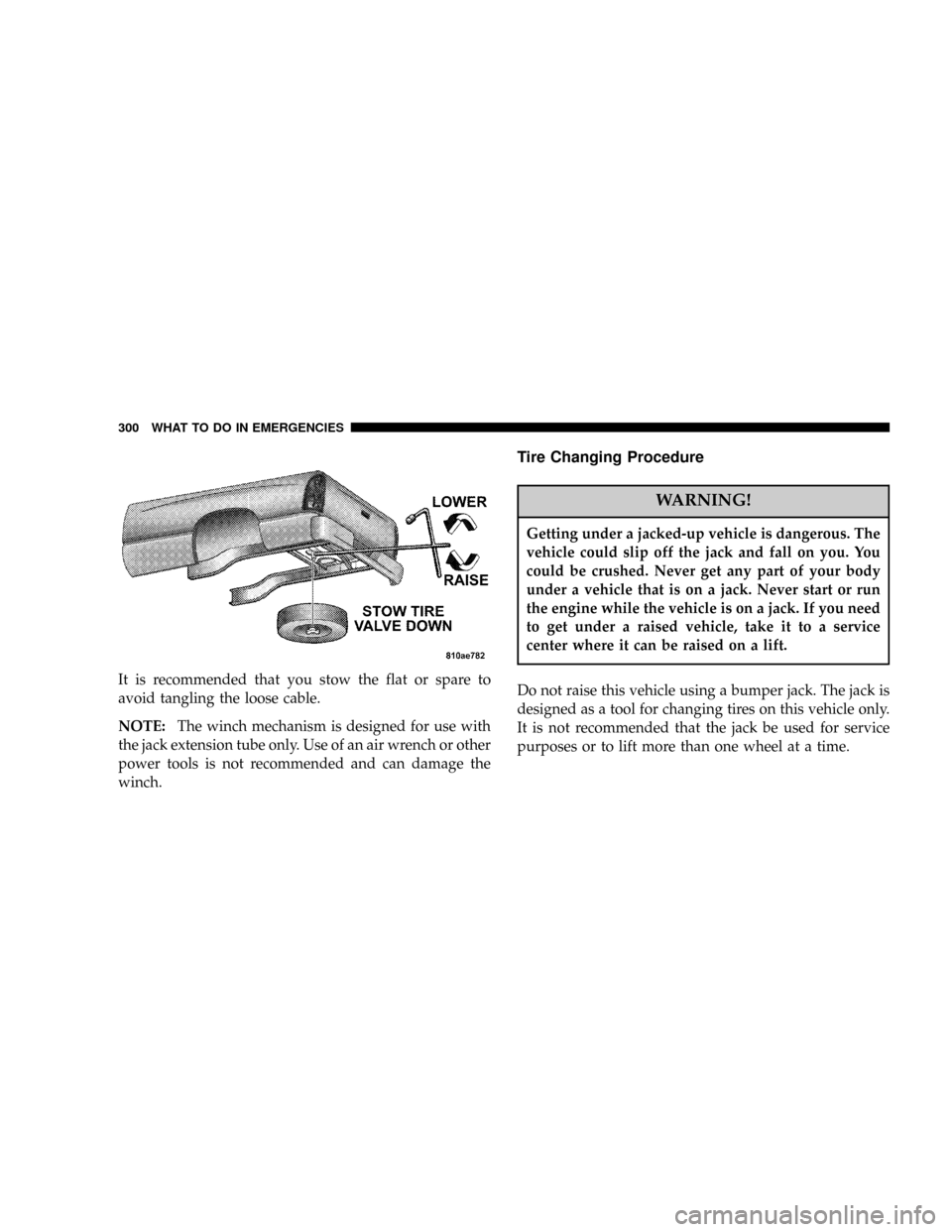
It is recommended that you stow the flat or spare to
avoid tangling the loose cable.
NOTE:The winch mechanism is designed for use with
the jack extension tube only. Use of an air wrench or other
power tools is not recommended and can damage the
winch.
Tire Changing Procedure
WARNING!
Getting under a jacked-up vehicle is dangerous. The
vehicle could slip off the jack and fall on you. You
could be crushed. Never get any part of your body
under a vehicle that is on a jack. Never start or run
the engine while the vehicle is on a jack. If you need
to get under a raised vehicle, take it to a service
center where it can be raised on a lift.
Do not raise this vehicle using a bumper jack. The jack is
designed as a tool for changing tires on this vehicle only.
It is not recommended that the jack be used for service
purposes or to lift more than one wheel at a time.
300 WHAT TO DO IN EMERGENCIES
Page 302 of 426
Instructions
WARNING!
Carefully follow these tire changing warnings to
help prevent personal injury or damage to your
vehicle:
²Always park on a firm, level surface as far from
the edge of the roadway as possible before raising
the vehicle.
²Block the wheel diagonally opposite the wheel to
be raised.
²Apply the parking brake firmly before jacking.
²Never start the engine with the vehicle on a jack.
²Do not let anyone sit in the vehicle when it is on
a jack.
²Do not get under the vehicle when it is on a jack.
²Only use the jack in the positions indicated.
²If working on or near a roadway, be extremely
careful of motor traffic.
1. Remove the spare wheel, jack, and tools from storage.
2. Using the wheel wrench, loosen, but do not remove,
the wheel nuts by turning them counterclockwise one
turn while the wheel is still on the ground.
3. For 2500/3500 4x2 series trucks, when changing a
front wheel, place the bottle jack under the frame rail
behind the wheel. Locate the jack as far forward as
possible on the straight part of the frame.
For 2500/3500 4x4 series trucks, when changing the front
wheel, assemble the jack drive tube to the jack and
connect the drive tube to the extension tube. Place the
jack under the axle as close to the tire as possible with the
drive tubes extending to the front. Connect the jack tube
extension and wheel wrench.
302 WHAT TO DO IN EMERGENCIES
Page 310 of 426
JUMP-STARTING
WARNING!
To prevent personal injury or damage to clothing, do
not allow battery fluid to contact eyes, skin or
fabrics. Do not lean over a battery when connecting
jumper cables or allow cable clamps to touch each
other. Keep open flames or sparks away from battery
vent holes. Always wear eye protection when work-
ing with batteries.
Do not use a booster battery or any other booster
source that has a greater than 12 volt system, i.e. do
not use a 24 volt power source.
NOTE:Replacement batteries should both be of equal
size to prevent damage to the vehicles charging system.
Your vehicle is equipped with two 12±volt batteries. If it
becomes necessary to use a booster battery, with jumper
cables, to start a vehicle's engine because its batteries are
discharged, the following procedure should be followed:
Set the parking brake and place an automatic transmis-
sion in PARK (or NEUTRAL for a manual transmission).
Turn off lights, heater and other electrical loads. Observe
charge indicator (if equipped) in both batteries. If indica-
tor (if equipped) is light or yellow on either battery,
replace that battery.
310 WHAT TO DO IN EMERGENCIES
Page 312 of 426

2. Connect one end of the other jumper cable to negative
(-) post of booster battery. Connect the other end of the
jumper cable to a good ground on the engine block of the
vehicle with the discharged battery. Make sure a good
connection is made, free of dirt and grease.
WARNING!
²Do not connect the cable to the negative post of
the discharge battery. The resulting electrical
spark could cause the battery to explode.
²During cold weather when temperatures are be-
low freezing point, electrolyte in a discharged
battery may freeze. Do not attempt jump starting
because the battery could rupture or explode. The
battery temperature must be brought up above
freezing point before attempting jump start.
3. Take care that the clamps from one cable do not
inadvertently touch clamps from the other cable. Do not
lean over the battery when making connection. The
negative connection must provide good electrical con-
ductivity and current carrying capacity.
4. After the engine is started or if the engine fails to start,
cables must be disconnected in the following order:
a. Disconnect the negative cable at the engine ground.
b. Disconnect the negative cable at the negative post
on booster battery.
c. Disconnect the cable from the positive post of both
batteries.
312 WHAT TO DO IN EMERGENCIES
Page 313 of 426

WARNING!
Any procedure other than above could result in:
1. Personal injury caused by electrolyte squirting
out the battery vent;
2. Personal injury or property damage due to battery
explosion;
3. Damage to charging system of booster vehicle or
of immobilized vehicle.
With Portable Starting Unit
There are many types of these units available. Follow the
manufacturer's instructions for necessary precautions
and operation.
CAUTION!
It is very important that the starting unit operating
voltage does not exceed 12 Volts D.C. or damage to
battery, starter motor, alternator, or electrical system
may occur.
FREEING A STUCK VEHICLE
If vehicle becomes stuck in snow, sand, or mud, it can
often be moved by a rocking motion. Move the gear
selector rhythmically between DRIVE and REVERSE,
while applying slight pressure to the accelerator.
In general, the least amount of accelerator pedal pressure
to maintain the rocking motion without spinning the
wheels or racing the engine is most effective. Racing the
engine or spinning the wheels, due to the frustration of
not freeing the vehicle, may lead to transmission over-
heating and failure. Allow the engine to idle with the
WHAT TO DO IN EMERGENCIES 313
6
Page 317 of 426

MAINTAINING YOUR VEHICLE
CONTENTS
mEngine Compartment....................320
N5.9L/5.9L HO Cummins Turbo Diesel.......320
mOnboard Diagnostic System (OBD II).........321
mReplacement Parts......................322
mDealer Service.........................322
mService Information.....................322
mMaintenance Procedures..................325
NEngine Oil..........................325
NDrive Belt...........................331NEngine Air Cleaner Filter................331
NDraining Fuel/Water Separator Filter.......334
NMaintenance Free Batteries...............336
NAir Conditioner Maintenance.............338
NPower Steering Ð Fluid Check............339
NFront Suspension Ball Joints..............340
NSteering Linkage Ð Inspection............340
NFront Axle Universal Drive Joints And Pivot
Bearings............................340
7