seats DODGE RAM 2500 DIESEL 2008 3.G User Guide
[x] Cancel search | Manufacturer: DODGE, Model Year: 2008, Model line: RAM 2500 DIESEL, Model: DODGE RAM 2500 DIESEL 2008 3.GPages: 527, PDF Size: 8.88 MB
Page 72 of 527
WARNING!
An incorrectly anchored tether strap could lead to
seat failure and injury to the child. In a collision, the
seat could come loose and allow the child to crash
into the inside of the vehicle or other passengers, or
even be thrown from the vehicle. Use only the anchor
positions directly behind the child seat to secure a
child restraint top tether strap. Follow the instruc-
tions below. See your authorized dealer for help, if
necessary.
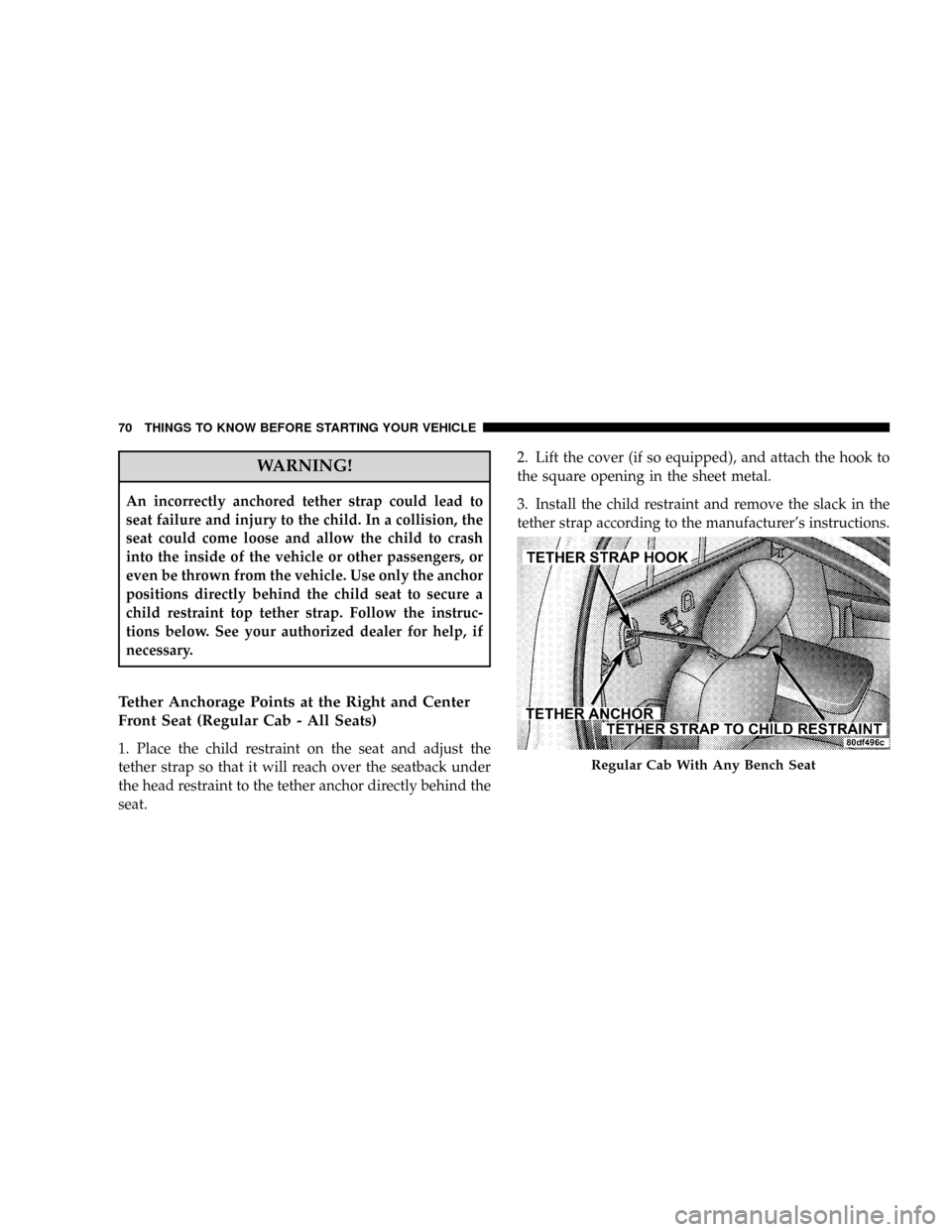
Tether Anchorage Points at the Right and Center
Front Seat (Regular Cab - All Seats)
1. Place the child restraint on the seat and adjust the
tether strap so that it will reach over the seatback under
the head restraint to the tether anchor directly behind the
seat.2. Lift the cover (if so equipped), and attach the hook to
the square opening in the sheet metal.
3. Install the child restraint and remove the slack in the
tether strap according to the manufacturer's instructions.
Regular Cab With Any Bench Seat
70 THINGS TO KNOW BEFORE STARTING YOUR VEHICLE
Page 73 of 527
Multiple Child Restraint Installation Sequence -
(Quad CabtRear Seats)
1. Obtain tether straps by raising the head restraints and
reaching between the rear glass and rear seat. The tether
strap may be retained with an elastic band. Accessibility
to the tether strap is greatly improved by raising the seat
cushion to the ªupº position. Remove the elastic before
use.
2. Place a child restraint on each outboard rear seat and
adjust the tether strap so that it will reach under the head
restraint to the tether anchor directly behind the seat and
then to the anchor directly behind the center rear seat.
3. Pass each tether strap hook under the head restraint
and through the loop of webbing behind the child seat.4. Route each tether strap to the anchor behind the center
seat, and attach the hooks to the metal ring.
5. Place a child restraint on the center rear seat and
adjust the tether strap so that it will reach under the head
restraint to the tether anchor directly behind the seat and
to the anchor directly behind the right seat.
6. Install each child restraint and remove the slack in the
tether strap according to the child restraint manufactur-
er's instructions.
THINGS TO KNOW BEFORE STARTING YOUR VEHICLE 71
2
Page 75 of 527
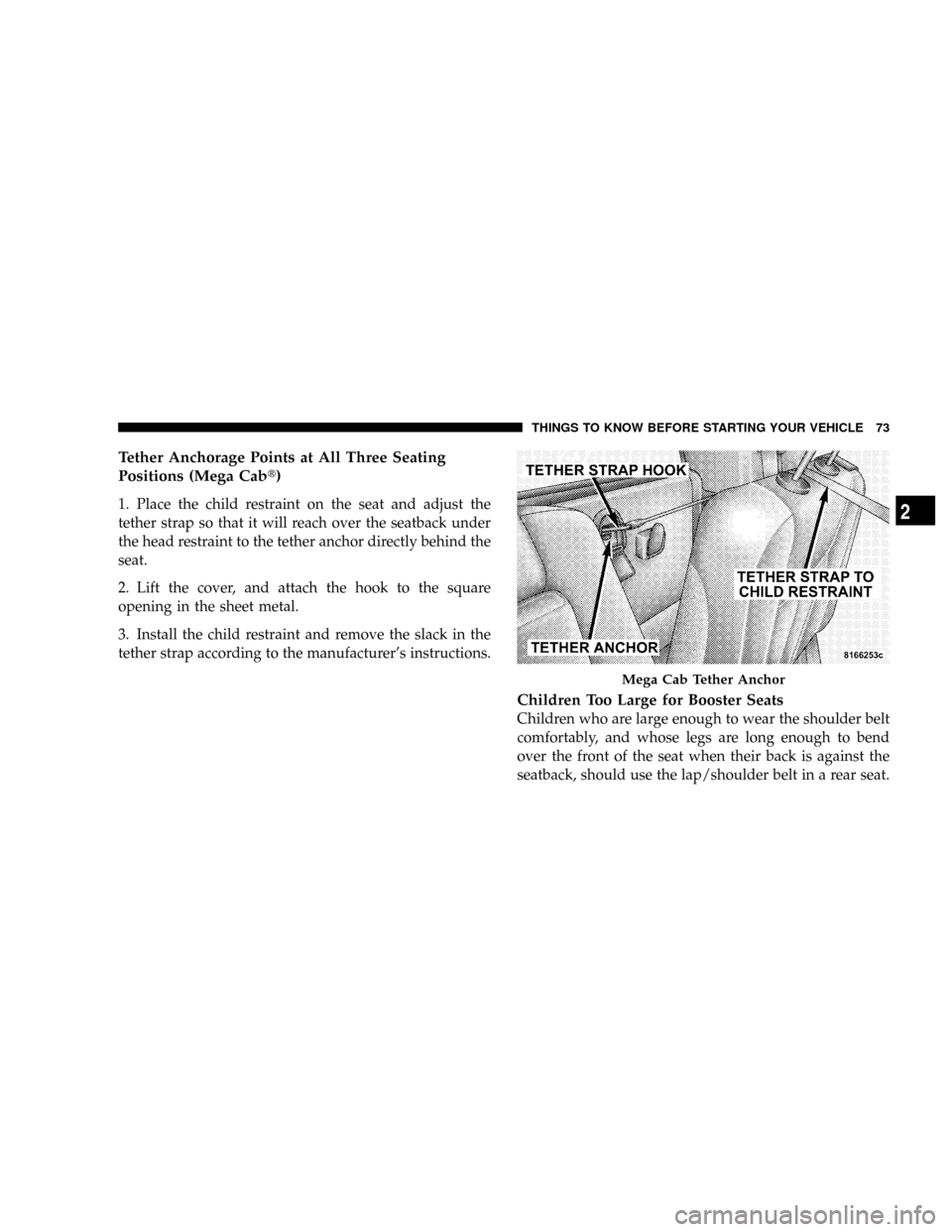
Tether Anchorage Points at All Three Seating
Positions (Mega Cabt)
1. Place the child restraint on the seat and adjust the
tether strap so that it will reach over the seatback under
the head restraint to the tether anchor directly behind the
seat.
2. Lift the cover, and attach the hook to the square
opening in the sheet metal.
3. Install the child restraint and remove the slack in the
tether strap according to the manufacturer's instructions.
Children Too Large for Booster Seats
Children who are large enough to wear the shoulder belt
comfortably, and whose legs are long enough to bend
over the front of the seat when their back is against the
seatback, should use the lap/shoulder belt in a rear seat.
Mega Cab Tether Anchor
THINGS TO KNOW BEFORE STARTING YOUR VEHICLE 73
2
Page 77 of 527
²Check the coolant and oil levels frequently.
²Vary throttle position at highway speeds when carry-
ing or towing significant weight.
Because of the construction of the CumminstDiesel
engine, engine run-in is enhanced by loaded operating
conditions which allow the engine parts to achieve final
finish and fit during the first 6,000 mi (10 000 km).
CAUTION!
²During the first 500 mi (805 km) that your vehicle
is driven, do not tow a trailer. Doing so may
damage your vehicle.
²Limit your speed to 50 mph (80 km/h) during the
first 500 mi (805 km) of towing.
SAFETY TIPS
Transporting Passengers
This vehicle is designed to carry passengers in the cab
only. For safety reasons, NEVER TRANSPORT PASSEN-
GERS IN THE CARGO AREA.
WARNING!
It is extremely dangerous to ride in a cargo area,
inside or outside of a vehicle. In a collision, people
riding in these areas are more likely to be seriously
injured or killed.
Do not allow people to ride in any area of your
vehicle that is not equipped with seats and seat belts.
Be sure everyone in your vehicle is in a seat and
using a seat belt properly.
THINGS TO KNOW BEFORE STARTING YOUR VEHICLE 75
2
Page 82 of 527
mSeats................................115
N40-20-40 Front Seat....................116
NReclining Seats.......................117
NAdjustable Head Restraints..............118
NManual Rotary Lumbar Support Adjustment Ð
If Equipped.........................119
NPower Seats Ð If Equipped..............119
NRear Seat Features Ð Mega Cab Models.....121
NHeated Seats Ð If Equipped.............126
mTo Open And Close The Hood.............127
mLights...............................129
NInterior Lights.......................129
NBattery Saver........................130
NHeadlamp Delay......................131NHeadlights, Parking Lights, Panel Lights.....131
NDaytime Running Lights (Canada Only And
Fleet Vehicles)........................132
NLights-On Reminder...................132
NFog Lights Ð If Equipped...............132
NCargo Light Ð If Equipped..............133
NMultifunction Control Lever..............133
mWindshield Wipers And Washers............135
NWindshield Wipers....................135
NWindshield Washers...................136
mTilt Steering Column....................137
mDriver Adjustable Pedals Ð If Equipped......138
NAdjustment.........................139
80 UNDERSTANDING THE FEATURES OF YOUR VEHICLE
Page 84 of 527
NPinch Protect Override.................159
NVenting Sunroof - Express...............160
NSunshade Operation...................160
NWind Buffeting.......................160
NSunroof Maintenance...................160
NSunroof Fully Closed...................160
mElectrical Power Outlets..................160
mCigar Lighter And Ash Receiver............162
mCupholders...........................163
NFront Instrument Panel Cupholders (40±20±40
Seats) Ð Automatic Transmission..........163
NFront Instrument Panel Cupholders (Bucket
Seats) Ð Automatic Transmission..........165NFront Instrument Panel Cupholders Ð
Manual Transmission..................165
NRear Cupholder (Quad Cabt)Ð
If Equipped.........................166
NRear Cupholder (Mega Cabt).............166
mStorage..............................167
NCenter Storage Compartment (40±20±40 Seat) ±
If Equipped.........................167
NCenter Storage Compartment (Bucket Seats) ±
If Equipped.........................168
NStorage And Seats (Quad CabtModels).....170
NStorage And Seats (Mega Cab Models)......171
NPlastic Grocery Bag Retainers (Mega Cab
Models)............................172
82 UNDERSTANDING THE FEATURES OF YOUR VEHICLE
Page 117 of 527
General Information
This device complies with Part 15 of the FCC rules and
RSS 210 of Industry Canada. Operation is subject to the
following conditions:
²This device may not cause harmful interference.
²This device must accept any interference received,
including interference that may cause undesired op-
eration.
SEATS
The seating options available in this truck are the result of
extensive customer research and evaluations.
Seats are also a primary part of the Occupant Restraint
(protection) System of the vehicle. They need to be used
properly for safe operation of the vehicle.
WARNING!
It is extremely dangerous to ride in a cargo area,
inside or outside of a vehicle. In a collision, people
riding in these areas are more likely to be seriously
injured or killed.
Do not allow people to ride in any area of your
vehicle that is not equipped with seats and seat belts.
Be sure everyone in your vehicle is in a seat and
using a seat belt properly.
UNDERSTANDING THE FEATURES OF YOUR VEHICLE 115
3
Page 119 of 527
Reclining Seats
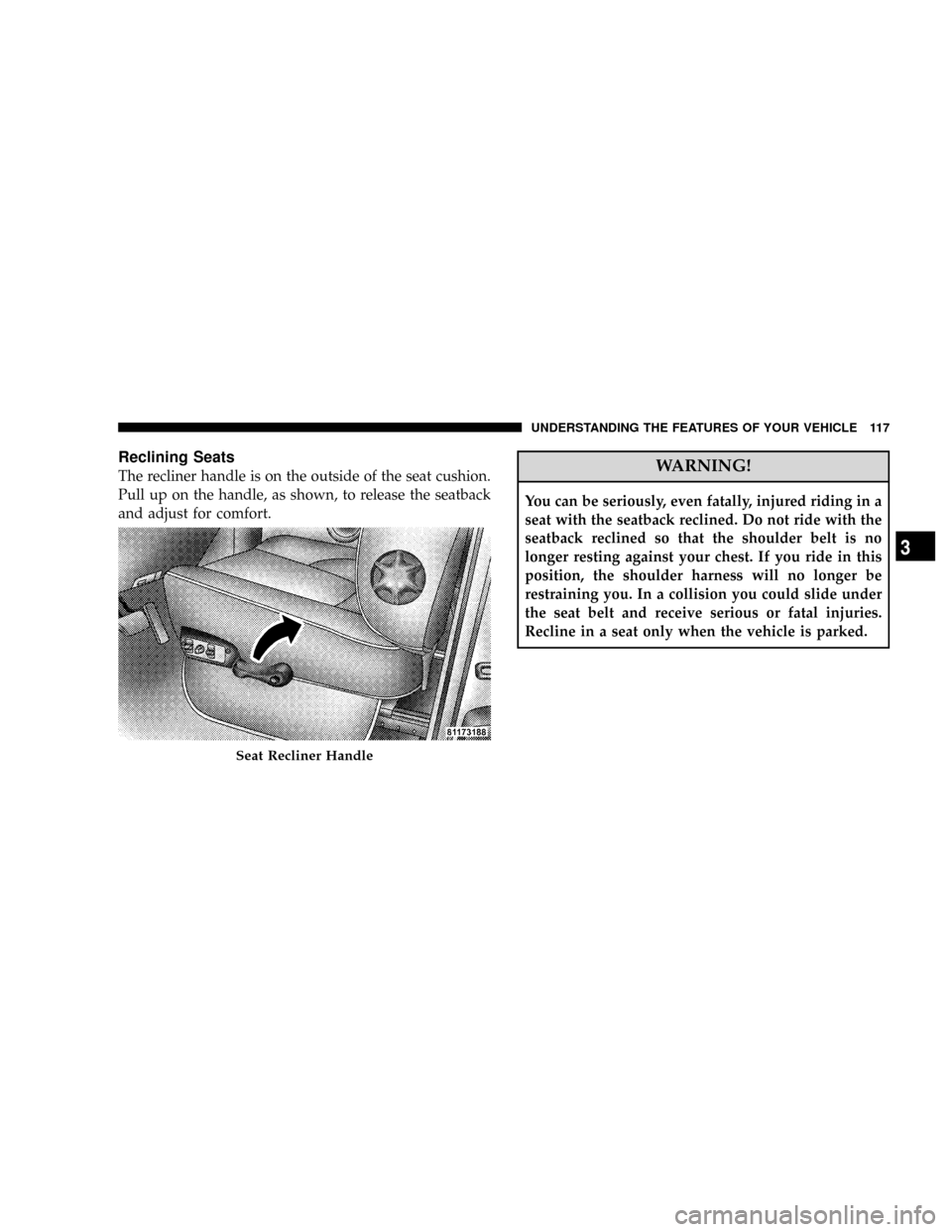
The recliner handle is on the outside of the seat cushion.
Pull up on the handle, as shown, to release the seatback
and adjust for comfort.WARNING!
You can be seriously, even fatally, injured riding in a
seat with the seatback reclined. Do not ride with the
seatback reclined so that the shoulder belt is no
longer resting against your chest. If you ride in this
position, the shoulder harness will no longer be
restraining you. In a collision you could slide under
the seat belt and receive serious or fatal injuries.
Recline in a seat only when the vehicle is parked.
Seat Recliner Handle
UNDERSTANDING THE FEATURES OF YOUR VEHICLE 117
3
Page 121 of 527
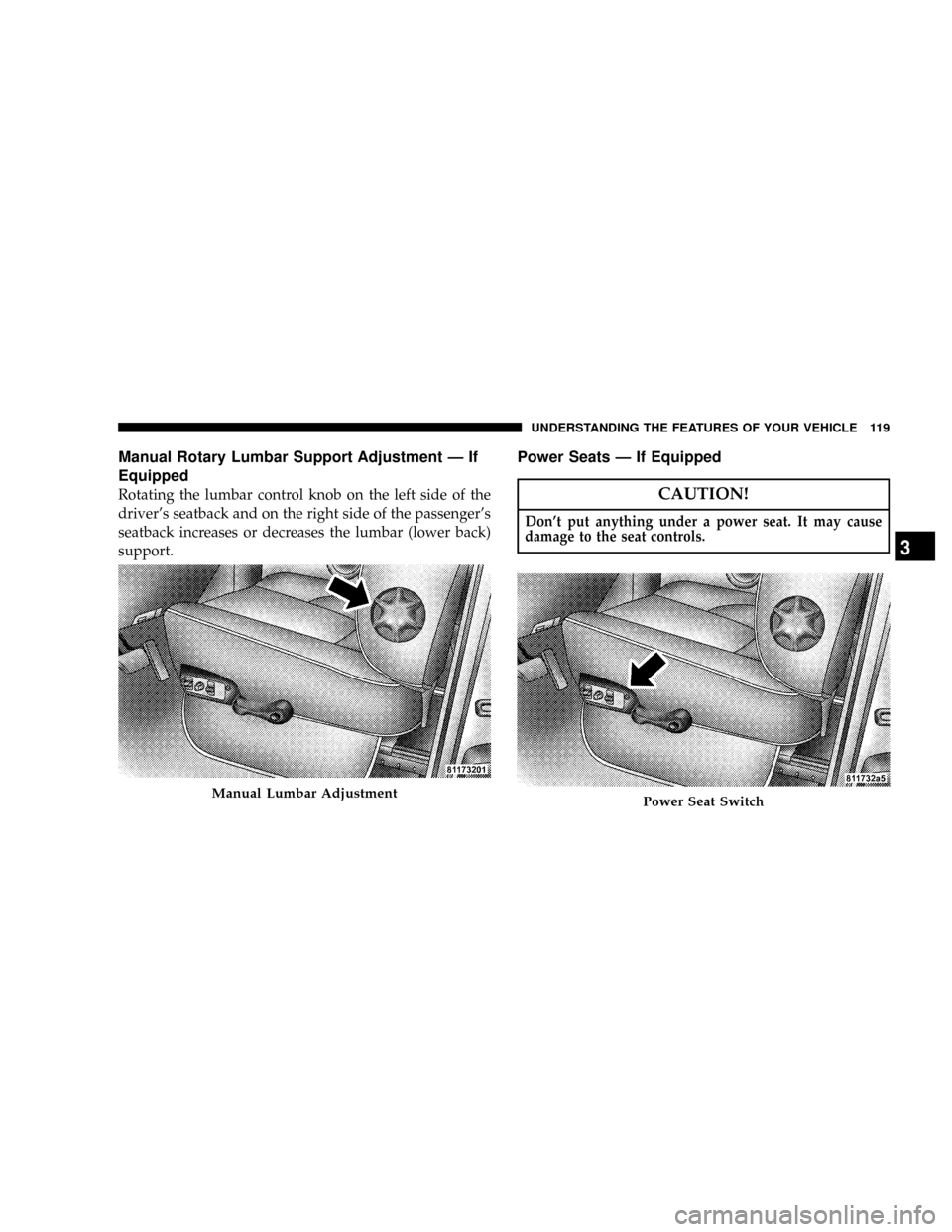
Manual Rotary Lumbar Support Adjustment Ð If
Equipped
Rotating the lumbar control knob on the left side of the
driver's seatback and on the right side of the passenger's
seatback increases or decreases the lumbar (lower back)
support.
Power Seats Ð If Equipped
CAUTION!
Don't put anything under a power seat. It may cause
damage to the seat controls.
Manual Lumbar AdjustmentPower Seat Switch
UNDERSTANDING THE FEATURES OF YOUR VEHICLE 119
3
Page 123 of 527
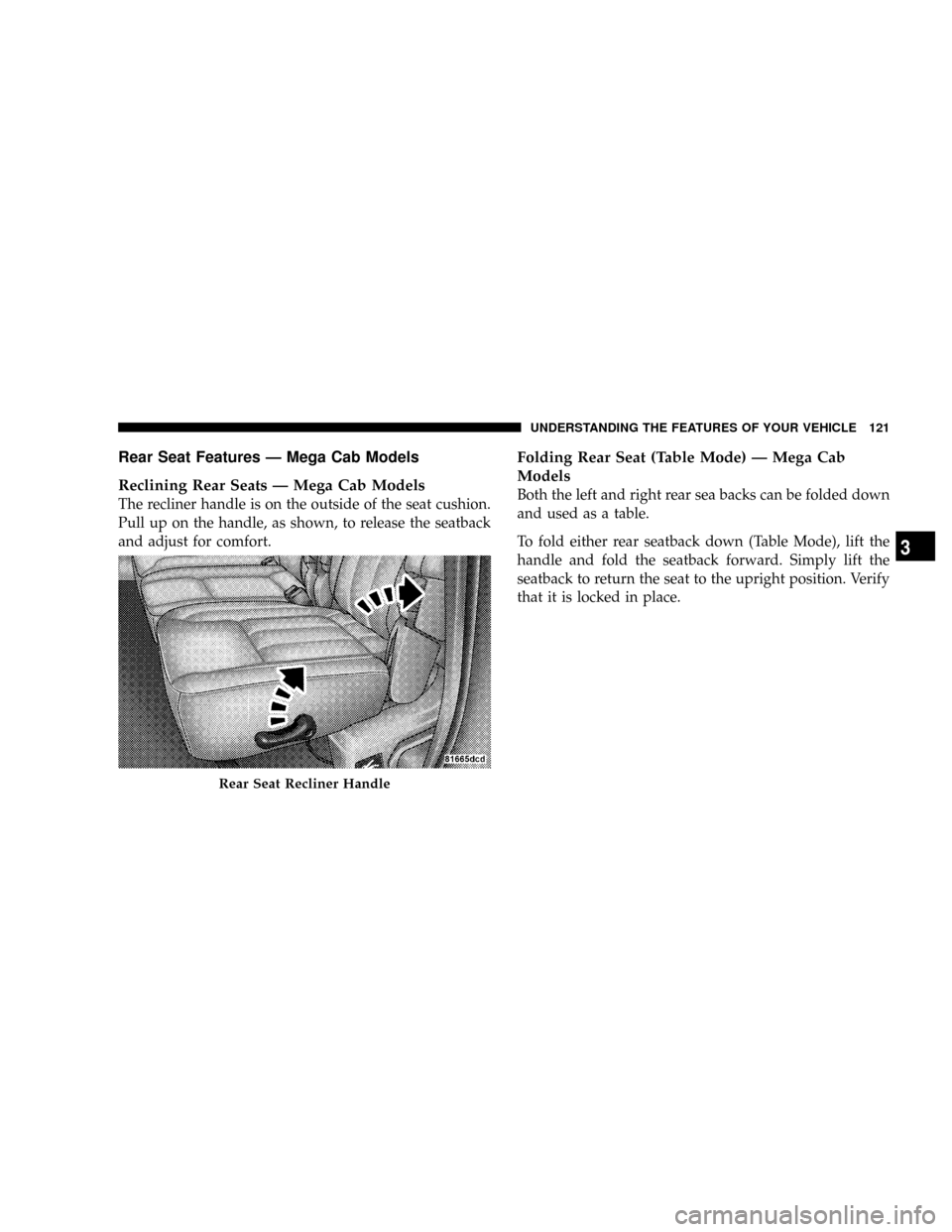
Rear Seat Features Ð Mega Cab Models
Reclining Rear Seats Ð Mega Cab Models
The recliner handle is on the outside of the seat cushion.
Pull up on the handle, as shown, to release the seatback
and adjust for comfort.
Folding Rear Seat (Table Mode) Ð Mega Cab
Models
Both the left and right rear sea backs can be folded down
and used as a table.
To fold either rear seatback down (Table Mode), lift the
handle and fold the seatback forward. Simply lift the
seatback to return the seat to the upright position. Verify
that it is locked in place.
Rear Seat Recliner Handle
UNDERSTANDING THE FEATURES OF YOUR VEHICLE 121
3