check engine DODGE RAM 2500 DIESEL 2008 3.G Owner's Manual
[x] Cancel search | Manufacturer: DODGE, Model Year: 2008, Model line: RAM 2500 DIESEL, Model: DODGE RAM 2500 DIESEL 2008 3.GPages: 527, PDF Size: 8.88 MB
Page 414 of 527
WARNING!
To maintain your vehicle safely and avoid personal injury, follow these
guidelines:
²Never spray or pour diesel fuel, flammable liquid or starting fluids
(ether) into the air cleaner assembly, air intake piping or turbocharger
inlet in an attempt to start the vehicle, unintended engine acceleration
may occur.
²Do not use alcohol or gasoline as a fuel blending agent. They can be
unstable under certain conditions and be hazardous or explosive
when mixed with diesel fuel.
²If an engine has been operating and the coolant is hot, allow the
engine to cool before you slowly loosen the filler cap and relieve the
pressure from the cooling system.
²To avoid burns, remember that the engine components will stay hot
after the engine is shut off.
²Do not use gasoline or other flammable materials to clean parts.
Always use approved cleaning solvents.
²Relieve all pressure in the fuel, oil and cooling systems before any
lines, fittings or related items are removed or disconnected. Be alert
for possible pressure when disconnecting any device from a system
that utilizes pressure. Do not check for pressure leaks with your hand.
High pressure oil or fuel can cause personal injury.
²Important: All maintenance other than that listed in this manual, as
well as some procedures listed here, MUST be performed by your
authorized dealer. Your authorized dealer has been trained and has
the necessary parts to maintain your engine.
WARNING!
Do not open the high pressure fuel system with the
engine running. Engine operation causes high fuel
pressure. High pressure fuel spray can cause serious
injury or death.
MAINTENANCE PROCEDURES
The pages that follow contain therequiredmaintenance
services determined by the engineers who designed your
vehicle.
Besides the maintenance items for which there are fixed
maintenance intervals, there are other items that should
operate satisfactorily without periodic maintenance.
However, if a malfunction of these items does occur, it
could adversely affect the engine or vehicle performance.
These items should be inspected if a malfunction is
observed or suspected.
412 MAINTAINING YOUR VEHICLE
Page 415 of 527
Engine Oil
Checking Oil Level
To assure proper lubrication of your vehicle's engine, the
engine oil must be maintained at the correct level. Check
the oil level at regular intervals. The best time to check
the oil level is before starting the engine after it has been
parked overnight. When checking oil after operating the
engine, first ensure the engine is at full operating tem-
perature, then wait at least 30 minutes after engine
shutdown to check the oil.
Checking the vehicle while it's on level ground will also
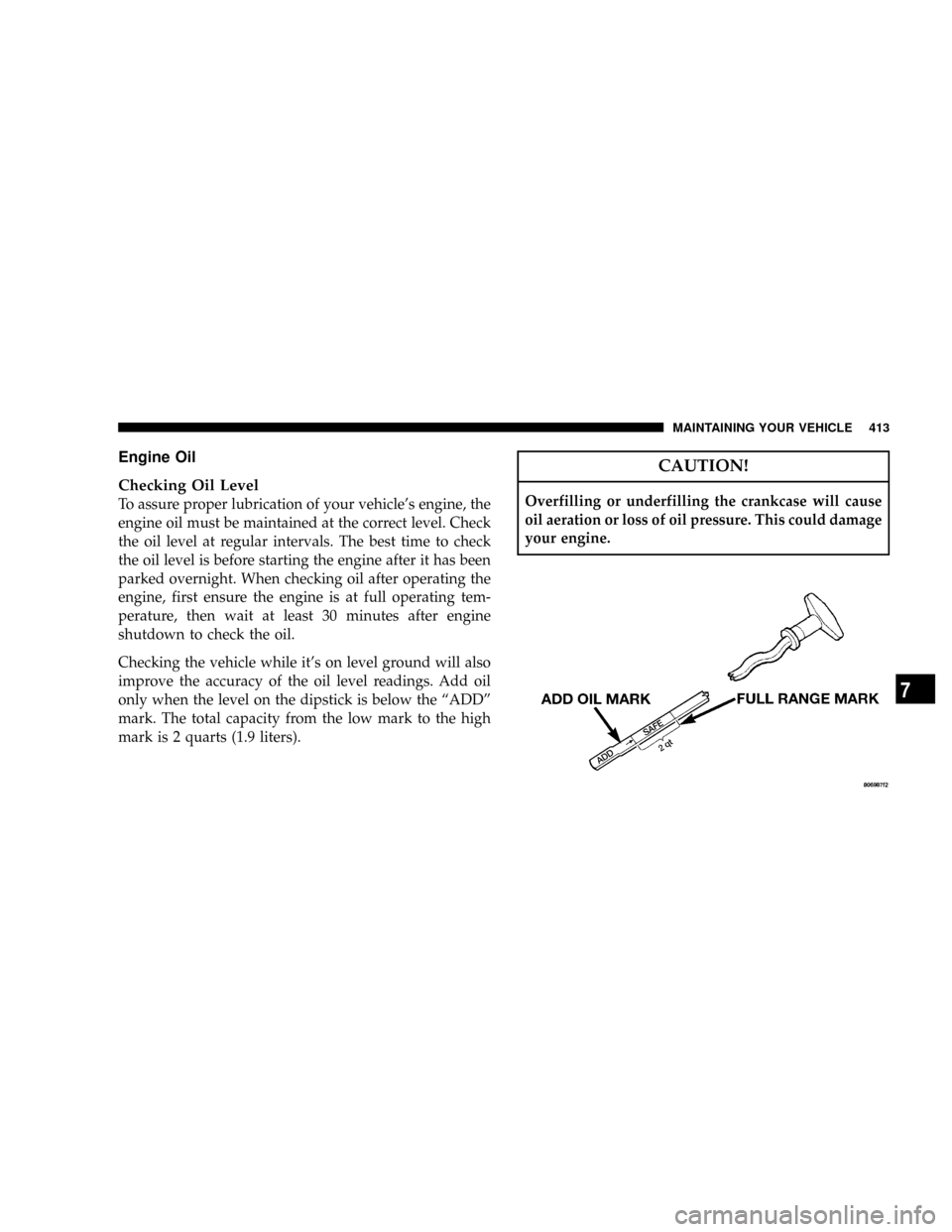
improve the accuracy of the oil level readings. Add oil
only when the level on the dipstick is below the ªADDº
mark. The total capacity from the low mark to the high
mark is 2 quarts (1.9 liters).
CAUTION!
Overfilling or underfilling the crankcase will cause
oil aeration or loss of oil pressure. This could damage
your engine.
MAINTAINING YOUR VEHICLE 413
7
Page 418 of 527
Engine Oil Filter
Refer to Fluids, Lubricants and Genuine Parts for the
correct part number. The engine oil filter should be
changed ateveryengine oil change.
Engine Oil And Filter Ð Change
Operate the engine until the coolant temperature reaches
140ÉF (60ÉC). Shut the engine OFF. Remove the oil drain
plug.
Use a container that can hold at least 12 quarts (11.3
Liters) to hold the used oil.
Always check the condition of the used oil. This can give
you an indication of some engine problems that might
exist.
²Thin, black oil indicates fuel dilution.
²Milky discoloration indicates coolant dilution.Clean the area around the oil filter base. Remove the filter
from the underside of the vehicle using a cap style oil
filter wrench.
Clean the gasket surface of the filter mount. The filter
gasket can stick on the filter mount. Make sure it is
removed.
Change the engine oil filter with every engine oil change.
Only a high quality Mopartfilter should be used to
assure most efficient service.
CAUTION!
The filtering medium of other aftermarket filters
may disintegrate. Debris from failed filters may plug
the piston oil cooling nozzles, resulting in scuffed
pistons and engine failure.
416 MAINTAINING YOUR VEHICLE
Page 419 of 527
CAUTION!
Fill the oil filter element with clean oil before instal-
lation. Use the same type oil that will be used in the
engine. When filling the oil filter, prevent foreign
material from falling into the filter. Severe engine
damage may occur.
Apply a light film of lubricating oil to the sealing surface
of the filter gasket before installing the filter.
CAUTION!
Overtightening may distort the threads or damage
the filter element seal.Install the filter as specified by the filter manufacturer.
Turn the filter 3/4 to one full turn after making contact
with the gasket.
Check the condition of the threads and sealing surface on
the oil pan and drain plug.
Install the drain plug and sealing washer and tighten to
37 ft-lbs. (50 N´m).
Use only high-quality multi-grade lubricating oil in your
CumminstDiesel Engine. Choose the correct oil for your
operating conditions as outlined in the Selection of
Engine Oil.
CumminstTurbo Diesel
Fill the engine with the correct grade of new oil. The
engine capacity is 11 quarts (10.4 liters) in the crankcase
and 1 quart (.95 liter) in the lubricating oil filter.
MAINTAINING YOUR VEHICLE 417
7
Page 420 of 527
Start the engine and operate it at idle for several minutes.
Check for leaks at the lubricating oil filter and oil pan
drain plug.
Run the engine until it has reached operating tempera-
ture, stop the engine. Wait approximately 15 minutes to
let the oil in the upper parts of the engine drain back to
the pan. Check the oil level again.
Add oil as necessary to bring the level to the ªSAFEº
mark on the dipstick.
Disposing Of Used Engine Oil And Filter
Care should be taken in disposing of used engine oil and
oil filters from your vehicle. Used oil and oil filters,
indiscriminately discarded, can present a problem to the
environment. Contact your authorized dealer, service
station, or governmental agency for advice on how and
where used oil and oil filters can be safely discarded in
your area.
Drive Belt
Inspection
Check the belt for intersecting cracks.
²Transverse (across the belt width) cracks are accept-
able.
²Longitudinal (direction of belt length) cracks that
intersect with transverse cracks are NOT acceptable.
Replace the belt if it has unacceptable cracks, is frayed or
has pieces of material missing.
The engine speed sensor, located near the damper, should
be inspected for damage if a belt is frayed.
418 MAINTAINING YOUR VEHICLE
Page 432 of 527
Battery Blanket Usage
A battery loses 60% of its cranking power as the battery
temperature decreases to 0ÉF (-18ÉC). For the same de-
crease in temperature, the engine requires twice as much
power to crank at the same RPM. The use of 120 VAC
powered battery blankets will greatly increase starting
capability at low temperatures. Suitable battery blankets
are available from your authorized Mopartdealer.
Air Conditioner Maintenance
For best possible performance, your air conditioner
should be checked and serviced by an authorized dealer
at the start of each warm season. This service should
include cleaning of the condenser fins and a performance
test. Drive belt tension should also be checked at this
time.
WARNING!
²Use only refrigerants and compressor lubricants
approved by the manufacturer for your air condi-
tioning system. Some unapproved refrigerants are
flammable and can explode, injuring you. Other
unapproved refrigerants or lubricants can cause
the system to fail, requiring costly repairs. Refer to
Section 3 of the Warranty Information book for
further warranty information.
²The air conditioning system contains refrigerant
under high pressure. To avoid risk of personal
injury or damage to the system, adding refrigerant
or any repair requiring lines to be disconnected
should be done by an experienced repairman.
430 MAINTAINING YOUR VEHICLE
Page 433 of 527
NOTE:Use only manufacturer approved A/C System
Sealers, Stop Leak Products, Seal Conditioners, Compres-
sor Oil, or Refrigerants.
Refrigerant Recovery and Recycling
R-134a Air Conditioning Refrigerant is a hydrofluorocar-
bon (HFC) that is endorsed by the Environmental Pro-
tection Agency and is an ozone-saving product. How-
ever, the manufacturer recommends that air conditioning
service be performed by dealers or other service facilities
using recovery and recycling equipment.
Power Steering Ð Fluid Check
Checking the power steering fluid level at a defined
service interval is not required. The fluid should only be
checked if a leak is suspected, abnormal noises are
apparent, and/or the system is not functioning as antici-
pated. Coordinate inspection efforts through a certified
DaimlerChrysler Dealership.
WARNING!
Fluid level should be checked on a level surface and
with the engine off to prevent injury from moving
parts and to ensure accurate fluid level reading. Do
not overfill. Use only manufacturer recommended
power steering fluid.
If necessary, add fluid to restore to the proper indicated
level. With a clean cloth, wipe any spilled fluid from all
surfaces. Refer to Fluids, Lubricants, and Genuine Parts
for correct fluid type.
Front Suspension Ball Joints
The ball joints originally supplied with the vehicle are
permanently lubricated at the factory and do not require
service. The ball joints and seals should be inspected
whenever the vehicle is serviced for other reasons.
MAINTAINING YOUR VEHICLE 431
7
Page 436 of 527
Windshield Washers
The fluid reservoir is located under the hood and should
be checked for fluid level at regular intervals. Fill the
reservoir with windshield washer solvent only (not ra-
diator antifreeze). When refilling the washer fluid reser-
voir, take some washer fluid and apply it to a cloth or
towel and wipe the wiper blades clean. This will help
blade performance.
To prevent freeze-up of your windshield washer system
in cold weather, select a solution or mixture that meets or
exceeds the temperature range of your climate. This
rating information can be found on most washer fluid
containers.
The washer fluid reservoir will hold a full gallon of fluid
when the Low Washer Fluid Light illuminates.WARNING!
Commercially available windshield washer solvents
are flammable. They could ignite and burn you. Care
must be exercised when filling or working around
the washer solution.
After the engine has warmed, operate the defroster for a
few minutes to reduce the possibility of smearing or
freezing the fluid on the cold windshield. MopartAll
Weather Windshield Washer Solution, used with water as
directed on the container, aids cleaning action, reduces
the freezing point to avoid line clogging, and is not
harmful to paint or trim.
434 MAINTAINING YOUR VEHICLE
Page 438 of 527
Cooling System
WARNING!
You or others can be badly burned by hot coolant or
steam from your radiator. If you see or hear steam
coming from under the hood, don't open the hood
until the radiator has had time to cool. Never try to
open a cooling system pressure cap when the radiator
is hot.
Engine Coolant Checks
Check the engine coolant (antifreeze) protection every 12
months (before the onset of freezing weather, where
applicable). If coolant is dirty or rusty in appearance, the
system should be drained, flushed and refilled with fresh
coolant. Check the front of the A/C condenser for anyaccumulation of bugs, leaves, etc. If dirty, clean by gently
spraying water from a garden hose vertically down the
face of the condenser.
Check the coolant recovery bottle tubing for brittle rub-
ber, cracking, tears, cuts and tightness of the connection
at the bottle and radiator. Inspect the entire system for
leaks.
Extremely cold ambient temperatures may require the
addition of a ªwinter frontº for effective operation of the
cab heating/cooling system. Make certain that a percent-
age of the radiator is exposed for adequate air flow
through the charge air cooler and automatic transmission
oil cooler. The percentage of opening must be increased
with the increasing ambient air temperature and/or
engine load. If the cooling fan can be heard cycling
frequently, increase the size of the opening in the winter
front.
436 MAINTAINING YOUR VEHICLE
Page 439 of 527
Coolant bottle level check
The coolant reserve system provides a quick visual
method of determining that the coolant level is adequate.
With the engine idling and warmed to the normal
operating temperature, the level of the coolant on the
coolant bottle should be between the fluid level marks.
Check the coolant level whenever the hood is raised.
The radiator normally remains completely full, so there is
no longer a need to remove the coolant pressure cap
except for checking coolant freeze point or replacement
with new antifreeze coolant.WARNING!
Never add coolant to the radiator when the engine is
overheated. Do not loosen or remove pressure cap to
cool overheated engine! The coolant is under pres-
sure and severe scalding could result.
Cooling System Ð Drain, Flush and Refill
At the intervals shown on the Maintenance Schedules,
the system should be drained, flushed and refilled. See
you authorized dealer for service.
MAINTAINING YOUR VEHICLE 437
7