warning DODGE RAM 2500 DIESEL 2008 3.G Owner's Manual
[x] Cancel search | Manufacturer: DODGE, Model Year: 2008, Model line: RAM 2500 DIESEL, Model: DODGE RAM 2500 DIESEL 2008 3.GPages: 527, PDF Size: 8.88 MB
Page 53 of 527
WARNING!
²Relying on the airbags alone could lead to more
severe injuries in a collision. The airbags work
with your seat belt to restrain you properly. In
some collisions the airbags won't deploy at all.
Always wear your seat belts even though you have
airbags.
²Being too close to the steering wheel or instrument
panel during airbag deployment could cause seri-
ous injury. Airbags need room to inflate. Sit back,
comfortably extending your arms to reach the
steering wheel or instrument panel.
²If the vehicle has window bags, they also need
room to inflate. Do not lean against the door or
window. Sit upright in the center of the seat.
Airbag System Components
The airbag system consists of the following:
²Occupant Restraint Controller
²Side Remote Acceleration Sensors (if equipped)
²Airbag Warning Light
²Driver Airbag
²Passenger Airbag
²Window Bags above Side Windows (if equipped)
²Steering Wheel and Column
²Instrument Panel
²Interconnecting Wiring
²Knee Impact Bolsters
²Front Acceleration Sensors (1500 Vehicles Only)
THINGS TO KNOW BEFORE STARTING YOUR VEHICLE 51
2
Page 54 of 527
²Driver and Front Passenger Seat Belt Pretensioners (if
equipped)
²Driver Seat Track Position Sensor (if equipped)
²Passenger Side Frontal Airbag ON/OFF Switch (2500/
3500 Regular Cab Vehicles Only)
²Passenger Airbag Disable (PAD) Indicator Light
(2500/3500 Regular Cab Vehicles Only)
How the Airbag System Works
²
TheOccupant Restraint Controller (ORC)determines
if a frontal collision is severe enough to require the
airbags to inflate. The front airbag inflators are de-
signed to provide different rates of airbag inflation
from information provided by the ORC. The ORC will
not detect rollover or rear collisions.The ORC also monitors the readiness of the electronic
parts of the system whenever the ignition switch is in
the START or RUN positions. These include all of the
items listed above except the steering wheel and
column, and knee bolsters. If the key is in the OFF
position, in the ACC position, or not in the ignition,
the airbags are not on and will not inflate.
Also, the ORC turns on the AIRBAG warn-
ing light in the instrument panel for six to
eight seconds for a self-check when the
ignition is first turned on. After the self-
check, the AIRBAG warning light will turn off. If the
ORC detects a malfunction in any part of the system, it
turns on the AIRBAG warning light either momen-
tarily or continuously. A single chime will sound if the
light comes on again after initial start up.
52 THINGS TO KNOW BEFORE STARTING YOUR VEHICLE
Page 55 of 527
WARNING!
Ignoring the AIRBAG warning light in your instru-
ment panel could mean you won't have the airbags to
protect you in a collision. If the light does not come
on, stays on after you start the vehicle, or if it comes
on as you drive, have the airbag system checked right
away.
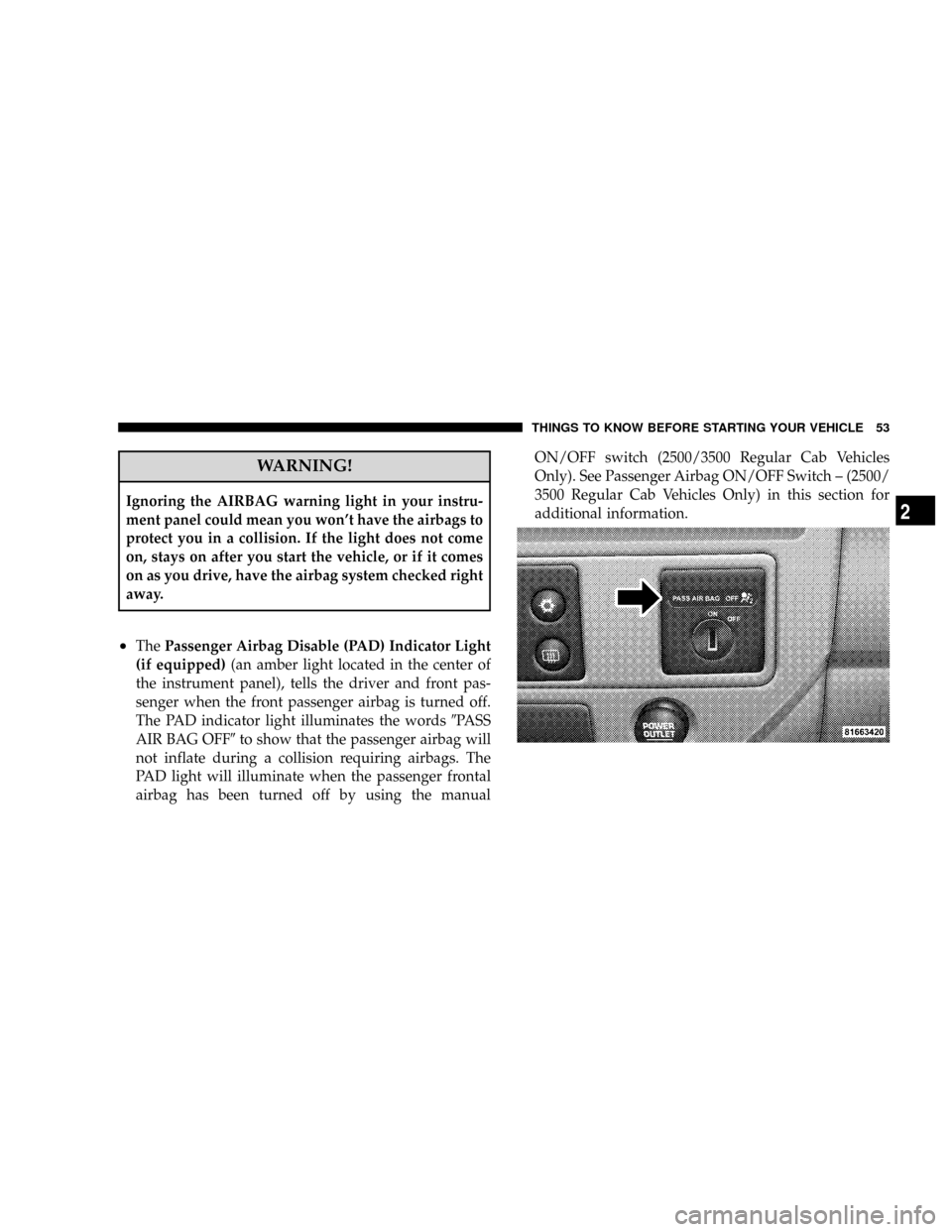
²ThePassenger Airbag Disable (PAD) Indicator Light
(if equipped)(an amber light located in the center of
the instrument panel), tells the driver and front pas-
senger when the front passenger airbag is turned off.
The PAD indicator light illuminates the words9PASS
AIR BAG OFF9to show that the passenger airbag will
not inflate during a collision requiring airbags. The
PAD light will illuminate when the passenger frontal
airbag has been turned off by using the manualON/OFF switch (2500/3500 Regular Cab Vehicles
Only). See Passenger Airbag ON/OFF Switch ± (2500/
3500 Regular Cab Vehicles Only) in this section for
additional information.
THINGS TO KNOW BEFORE STARTING YOUR VEHICLE 53
2
Page 58 of 527
WARNING!
Whenever an airbag is turned off, even a lap/
shoulder belted passenger may hit their head, neck,
or chest on the dashboard (instrument panel) or
windshield in a crash. This may result in serious
injury or death.
To Shut Off the Passenger Airbag (2500/3500 Regular
Cab Vehicles Only)
Place the ignition key in the Passenger Airbag ON/OFF
Switch, push the key in and turn clockwise, and remove
the key from the switch. This will shut off the passenger
side airbag. The OFF light near the switch will illuminate
when the ignition switch is turned to the ON position.To Turn On the Passenger Airbag (2500/3500 Regular
Cab Vehicles Only)
Place the ignition key in the Passenger Airbag ON/OFF
Switch, push the key in and turn counterclockwise, and
remove the key from the switch. This will turn ON the
passenger airbag. The OFF light near the switch will be
off when the ignition switch is turned to the ON position.
If A Deployment Occurs
The airbag system is designed to deploy the airbags
when the impact sensors detect a moderate-to-severe
frontal collision, to help restrain the driver and front
passenger, and then immediately deflate.
NOTE:A frontal collision that is not severe enough to
need airbag protection will not activate the system. This
does not mean something is wrong with the airbag
system.
56 THINGS TO KNOW BEFORE STARTING YOUR VEHICLE
Page 59 of 527
If you do have a collision which deploys the airbags, any
or all of the following may occur:
²The nylon airbag material may sometimes cause abra-
sions and/or skin reddening to the driver and front
passenger as the airbags deploy and unfold. The
abrasions are similar to friction rope burns or those
you might get sliding along a carpet or gymnasium
floor. They are not caused by contact with chemicals.
They are not permanent and normally heal quickly.
However, if you haven't healed significantly within a
few days, or if you have any blistering, see your doctor
immediately. As the airbags deflate you may see some
smoke-like particles. The particles are a normal by-
product of the process that generates the nontoxic gas
used for airbag inflation. These airborne particles may
irritate the skin, eyes, nose, or throat. If you have skin
or eye irritation, rinse the area with cool water. For
nose or throat irritation, move to fresh air. If theirritation continues, see your doctor. If these particles
settle on your clothing, follow the garment manufac-
turer's instructions for cleaning.
²It is not advisable to drive your vehicle after the
airbags have deployed. If you are involved in another
collision, the airbags will not be in place to protect you.
WARNING!
Deployed airbags and seat belt pretensioners (if
equipped) cannot protect you in another collision.
Have the airbags, seat belt pretensioners, and the
front passenger seat belt retractor assembly, replaced
by an authorized dealer as soon as possible.
THINGS TO KNOW BEFORE STARTING YOUR VEHICLE 57
2
Page 60 of 527
Maintaining Your Airbag System
WARNING!
²Modifications to any part of the airbag system
could cause it to fail when you need it. You could
be injured if the airbag system is not there to
protect you. Do not modify the components or
wiring, including adding any kind of badges or
stickers to the steering wheel hub trim cover or the
upper right side of the instrument panel. Do not
modify the front bumper, vehicle body structure,
or add aftermarket side steps or running boards.
²You need proper knee impact protection in a
collision. Do not mount or locate any aftermarket
equipment on or behind the knee bolsters.
²It is dangerous to try to repair any part of the
airbag system yourself. Be sure to tell anyone who
works on your vehicle that it has an airbag system.NOTE:
Perchlorate Material ± special handling may ap-
ply, see www.dtsc.ca.gov/hazardouswaste/perchlorate
Enhanced Accident Response System
If the airbags deploy after an impact and the electrical
system remains functional, vehicles equipped with
power door locks will unlock automatically. In addition,
approximately five seconds after the vehicle has stopped
moving, the interior lights will light until the ignition
switch is turned off.
Airbag Light
You will want to have the airbags ready to
inflate for your protection in an impact. While
the airbag system is designed to be mainte-
nance free, if any of the following occurs, have
an authorized dealer service the system promptly:
²The airbag light does not come on or flickers during
the six to eight seconds when the ignition switch is
first turned ON.
58 THINGS TO KNOW BEFORE STARTING YOUR VEHICLE
Page 62 of 527
In the event that an investigation is undertaken by
DaimlerChrysler Corporation (regardless of initiative),
the company or its designated representative will first
obtain permission of the appropriate custodial entity for
the vehicle (usually the vehicle owner or lessee) before
accessing the electronic data stored, unless ordered to
download data by a court with legal jurisdiction (i.e.,
pursuant to a warrant). A copy of the data will be
provided to the custodial entity upon request. General
data that does not identify particular vehicles or crashes
may be released for incorporation in aggregate crash
databases, such as those maintained by the U.S. govern-
ment and various states. Data of a potentially sensitive
nature, such as would identify a particular driver, ve-
hicle, or crash, will be treated confidentially. Confidential
data will not be disclosed by DaimlerChrysler
Corporation to any third party except when:1. Used for research purposes, such as to match data
with a particular crash record in an aggregate database,
provided confidentiality of personal data is thereafter
preserved
2. Used in defense of litigation involving a
DaimlerChrysler Corporation product
3. Requested by police under a legal warrant
4. Otherwise required by law
Data Parameters that May Be Recorded:
²Diagnostic trouble code(s) (DTC's) and warning lamp
status for electronically-controlled safety systems, in-
cluding the airbag system
²Airbag disable lamp status (if equipped)
²9Time9of airbag deployment (in terms of ignition
cycles and vehicle mileage)
60 THINGS TO KNOW BEFORE STARTING YOUR VEHICLE
Page 64 of 527
WARNING!
In a collision, an unrestrained child, even a tiny baby,
can become a missile inside the vehicle. The force
required to hold even an infant on your lap can
become so great that you could not hold the child, no
matter how strong you are. The child and others
could be badly injured. Any child riding in your
vehicle should be in a proper restraint for the child's
size.
Infants and Small Children
There are different sizes and types of restraints for
children from newborn size to the child almost large
enough for an adult safety belt. Use the restraint that is
correct for your child:
²Safety experts recommend that children ride
rearward-facing in the vehicle until they are at leastone year old and weigh at least 20 lbs (9 kg). Two types
of child restraints can be used rearward-facing: infant
carriers and9convertible9child seats. Both types of
child restraints are held in the vehicle by the lap/
shoulder belt.
²The infant carrier is only used rearward-facing in the
vehicle. It is recommended for children who weigh up
to about 20 lbs (9 kg).9Convertible9child seats can be
used either rearward-facing or forward-facing in the
vehicle. Convertible child seats often have a higher
weight limit in the rearward-facing direction than
infant carriers do, so they can be used rearward-facing
by children who weigh more than 20 lbs (9 kg) but are
less than one year old.
²Rearward-facing child seats mustNEVERbe used in
the front seat of a vehicle with a front passenger airbag
62 THINGS TO KNOW BEFORE STARTING YOUR VEHICLE
Page 65 of 527
unless the airbag is turned off. An airbag deployment
could cause severe injury or death to infants in this
position.
²Children who weigh more than 20 lbs (9 kg) and who
are older than one year can ride forward-facing in the
vehicle. Forward-facing child seats and convertible
child seats used in the forward-facing direction are for
children who weigh 20 to 40 lbs (9 to 18 kg) and who
are older than one year. These child seats are also held
in the vehicle by the lap/shoulder belt.
²The belt-positioning booster seat is for children weigh-
ing more than 40 lbs (18 kg), but who are still too small
to fit the vehicle's seat belts properly. If the child
cannot sit with knees bent over the vehicle's seat
cushion while the child's back is against the seat back,
they should use a belt-positioning-booster seat. The
child and booster seat are held in the vehicle by the
lap/shoulder belt. (Some booster seats are equippedwith a front shield and are held in the vehicle by the
lap portion.) For further information refer to
www.seatcheck.org.
WARNING!
²Improper installation can lead to failure of an
infant or child restraint. It could come loose in a
collision. The child could be badly injured or
killed. Follow the manufacturer's directions ex-
actly when installing an infant or child restraint.
²A rearward facing child restraint should only be
used in a rear seat, or in the front seat if the
passenger's front airbag is OFF. If the airbag is left
ON, a rearward facing child restraint in the front
seat may be struck by a deploying passenger
airbag which may cause severe or fatal injury to
the infant.
THINGS TO KNOW BEFORE STARTING YOUR VEHICLE 63
2
Page 67 of 527
around, and insert the latch plate into the buckle
again. If you still can't make the child restraint secure,
try a different seating position.
²Buckle the child into the seat according to the child
restraint manufacturer's directions.
²When your child restraint is not in use, secure it in the
vehicle with the seat belt or remove it from the vehicle.
Do not leave it loose in the vehicle. In a sudden stop or
collision, it could strike the occupants or seatbacks and
cause serious personal injury.
WARNING!
Improper installation can lead to failure of an infant
or child restraint. It could come loose in a collision.
The child could be badly injured or killed. Follow
the manufacturer's directions exactly when installing
an infant or child restraint.
Lower Anchors and Tether for CHildren (LATCH)
Each vehicle is equipped with the child restraint anchor-
age system called LATCH, which stands for Lower
Anchors and Tether for CHildren. LATCH child restraint
anchorage systems are installed in the 2500/3500 Regular
Cab passenger seat position and the Quad Cabtrear seat
outboard positions. LATCH-equipped seating positions
feature both lower anchor bars, located at the back of the
seat cushion, and tether strap anchorages, located behind
the seatback. (Refer to Child Restraint Tether Anchor
later in this section.)
Identification dots are located above the standard cab
front seat lower anchorages as a guide for locating lower
anchors.
THINGS TO KNOW BEFORE STARTING YOUR VEHICLE 65
2