heater DODGE RAM 2500 DIESEL 2008 3.G Owners Manual
[x] Cancel search | Manufacturer: DODGE, Model Year: 2008, Model line: RAM 2500 DIESEL, Model: DODGE RAM 2500 DIESEL 2008 3.GPages: 527, PDF Size: 8.88 MB
Page 9 of 527
WARNINGS AND CAUTIONS
This Owner's Manual containsWARNINGSagainst op-
erating procedures which could result in an accident or
bodily injury. It also containsCAUTIONSagainst proce-
dures which could result in damage to your vehicle. If
you do not read this entire manual, you may miss
important information. Observe all Warnings and Cau-
tions.
VAN CONVERSIONS/CAMPERS
The Manufacturer's Warranty does not apply to body
modifications or special equipment installed by van
conversion/camper manufacturers/body builders. Refer
to the Warranty information book, Section 2.1.C. Such
equipment includes video monitors, VCRs, heaters,
stoves, refrigerators, etc. For warranty coverage and
service on these items, contact the applicable manufac-
turer.Operating instructions for the special equipment in-
stalled by the conversion/camper manufacturer should
also be supplied with your vehicle. If these instructions
are missing, please contact your authorized selling dealer
for assistance in obtaining replacement documents from
the applicable manufacturer.
For information on the Body Builders Guide refer to:
www.dodgebodybuilder.com. This website contains di-
mensional and technical specifications for your vehicle. It
is intended for Second Stage Manufacturer's technical
support. For service issues, contact your authorized
dealer.
INTRODUCTION 7
1
Page 79 of 527
Safety Checks You Should Make Inside The
Vehicle
Heater Defroster Ducts
Inspect the heater defroster ducts for proper operation.
Check for proper airflow through all defroster ducts. If
there are any questions regarding the operation of your
heater defroster ducts, have the system checked by an
authorized dealer.
Seat Belts
Inspect the belt system periodically, checking for cuts,
frays and loose parts. Damaged parts must be replaced
immediately. Do not disassemble or modify the system.Seat belt assemblies must be replaced after an accident if
they have been damaged (bent retractor, torn webbing,
etc.) or if the front airbags have deployed. If there is any
question regarding belt or retractor condition, replace the
belt.
Airbag Light
The light should come on and remain on for six to eight
seconds as a bulb check when the ignition switch is first
turned ON. If the light is not lit during starting, see your
authorized dealer. If the light stays on, flickers or comes
on while driving, have the system checked by an autho-
rized dealer. If there is a problem with the airbag light,
the seat belt light will flash.
THINGS TO KNOW BEFORE STARTING YOUR VEHICLE 77
2
Page 129 of 527
WARNING!
Persons who are unable to feel pain to the skin
because of advanced age, chronic illness, diabetes,
spinal cord injury, medication, alcohol use, exhaus-
tion or other physical condition must exercise care
when using the seat heater. It may cause burns even
at low temperatures, especially if used for long
periods of time.
Do not place anything on the seat that insulates
against heat, such as a blanket or cushion. This may
cause the seat heater to overheat.
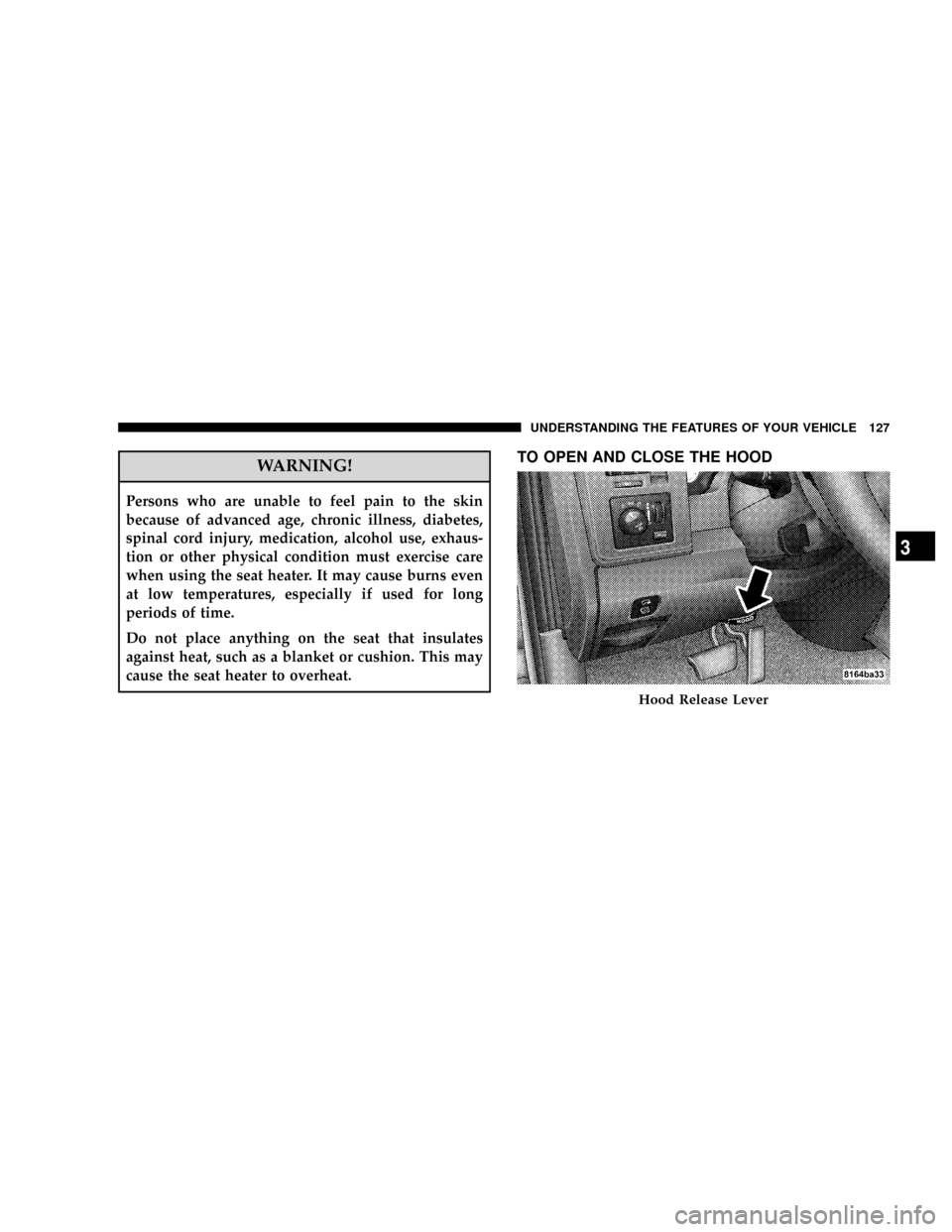
TO OPEN AND CLOSE THE HOOD
Hood Release Lever
UNDERSTANDING THE FEATURES OF YOUR VEHICLE 127
3
Page 188 of 527
NSatellite Antenna......................245
NReception Quality.....................245
mRemote Sound System Controls Ð If Equipped . . 246
NRadio Operation......................246
NTape Player.........................247
NCD Player..........................247
mCassette Tape And Player Maintenance.......247
mCompact Disc Maintenance................248
mRadio Operation And Cellular Phones........249mClimate Controls.......................249
NHeater Only Ð If Equipped..............250
NAir Conditioning And Heating Ð
If Equipped.........................252
NAir Conditioning With Dual Zone Temperature
Control Ð If Equipped.................255
NOperating Tips.......................260
NOperating Tips Chart...................262
186 UNDERSTANDING YOUR INSTRUMENT PANEL
Page 191 of 527
INSTRUMENT CLUSTER DESCRIPTION
1. Check Gauges
This light illuminates when the Voltmeter, Engine
Oil Pressure or Engine Coolant Temperature
gauges indicate a reading either too high or too low.
Examine the gauges carefully, and follow the instructions
contained below for each indicated problem.
NOTE:When the ignition switch is turned to OFF, the
Fuel Gauge, Voltmeter, Oil Pressure and Engine Coolant
Temperature gauges may not show accurate readings.
When the engine is not running, turn the ignition switch
to ON to obtain accurate readings.
2. Voltmeter
When the engine is running, the gauge indicates
the electrical system voltage. The pointer should
stay within the normal range if the battery is charged. Ifthe pointer moves to either extreme left or right and
remains there during normal driving, the electrical sys-
tem should be serviced.
NOTE:If the gauge pointer moves to either extreme of
the gauge, the ªCheck Gaugesº indicator will illuminate
and a single chime will sound.
NOTE:
²The voltmeter may show a gauge fluctuation at vari-
ous engine temperatures. This cycling operation is
caused by the post-heat cycle of the intake manifold
heater system. The number of cycles and the length of
the cycling operation is controlled by the engine
control module. Post-heat operation can run for sev-
eral minutes, and then the electrical system and volt-
meter needle will stabilize.
²The cycling action will cause temporary dimming of
the headlights, interior lights, and also a noticeable
reduction in blower motor speed.
UNDERSTANDING YOUR INSTRUMENT PANEL 189
4
Page 252 of 527
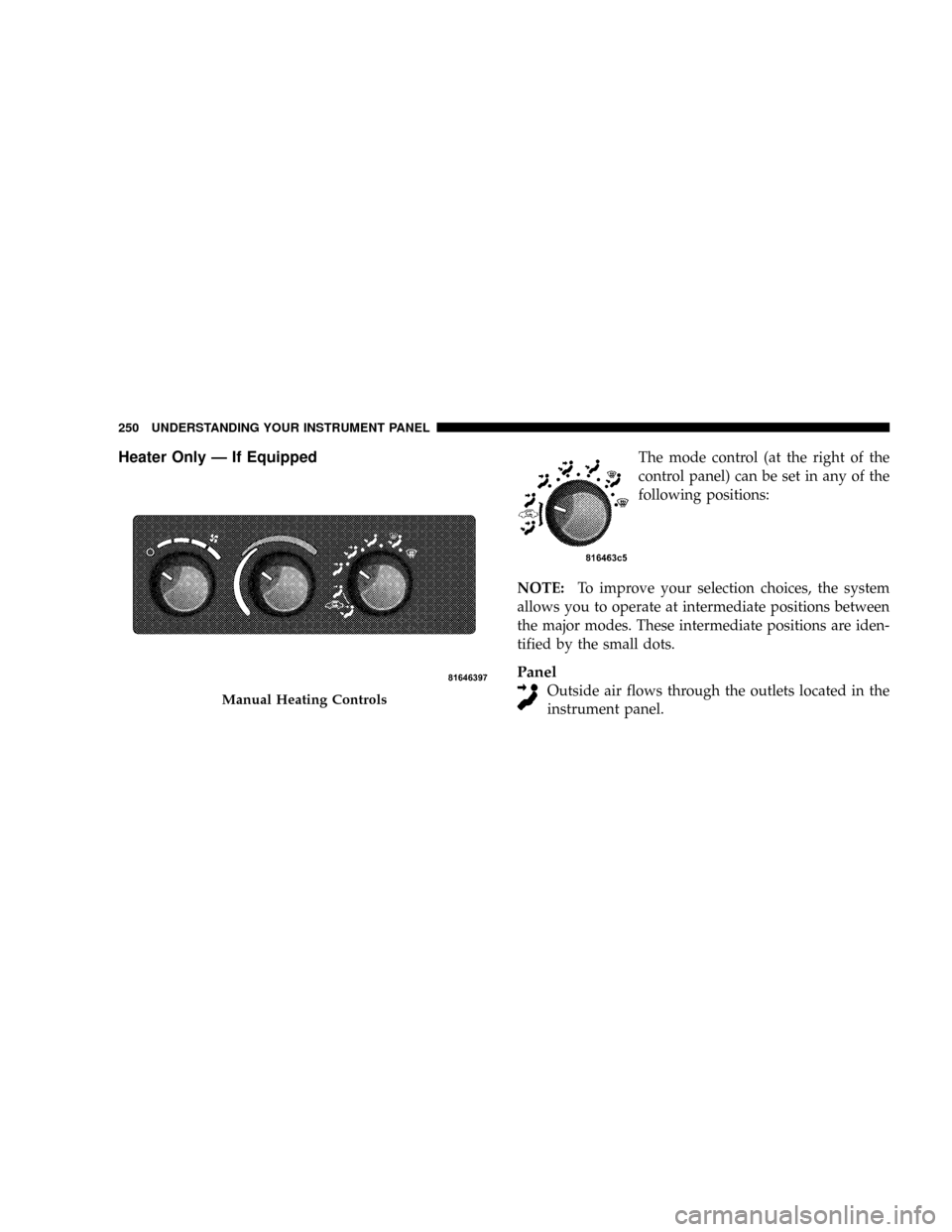
Heater Only Ð If EquippedThe mode control (at the right of the
control panel) can be set in any of the
following positions:
NOTE:To improve your selection choices, the system
allows you to operate at intermediate positions between
the major modes. These intermediate positions are iden-
tified by the small dots.
Panel
Outside air flows through the outlets located in the
instrument panel.Manual Heating Controls
250 UNDERSTANDING YOUR INSTRUMENT PANEL
Page 270 of 527
STARTING PROCEDURES ± DIESEL ENGINES
Before starting your vehicle, adjust your seat, adjust both
inside and outside mirrors, and fasten your seat belts.
The starter should not be operated for more than 15-
second intervals. Waiting a few minutes between such
intervals will protect the starter from overheating.
WARNING!
Be sure to turn off the engine and remove the key
from the ignition switch if you want to rest or sleep
in your vehicle. Accidents can be caused by inadvert-
ently moving the shift lever or by pressing the
accelerator pedal. This may cause excessive heat in
the exhaust system, resulting in overheating and
vehicle fire which may cause serious or fatal injuries.
WARNING!
Do not leave children or animals inside parked
vehicles in hot weather. Interior heat build up may
cause serious injury or death.
Automatic Transmission ± If Equipped
Start the engine with the shift lever in NEUTRAL or
PARK position. Apply the brake before shifting to any
driving range.
The CumminstDiesel engine is equipped with several
features designed to assist cold weather starting and
operation:
²The engine block heater is a resistance heater installed
in the water jacket of the engine just above and behind
the oil filter. It requires a 110±115 volt AC electrical
outlet with a grounded, three-wire extension cord.
268 STARTING AND OPERATING
Page 271 of 527
NOTE:The engine block heater cord is a factory in-
stalled option. If your vehicle is not equipped, heater
cords are available from your authorized Mopartdealer.
²A 12±volt heater built into the fuel filter housing aids
in preventing fuel gelling. It is controlled by a built-in
thermostat.
²A heated intake air system both improves engine
starting and reduces the amount of white smoke
generated by a warming engine.
Manual Transmission ± If Equipped
Apply the parking brake, place the shift lever in NEU-
TRAL and depress the clutch pedal to the floor before
starting the vehicle. This vehicle is equipped with a
clutch interlocking ignition system. It will not start unless
the clutch is fully depressed.
Normal Starting Procedure ± Engine Manifold Air
Temperature Above 66ÉF (19ÉC)
Observe the instrument panel cluster lights when starting
the engine.
1. Always apply the parking brake.
2. Shift into PARK for an automatic transmission. For
vehicles equipped with manual transmissions, fully de-
press and hold the clutch pedal and shift into NEUTRAL.
3. Turn the ignition key to the ON position and watch the
instrument panel cluster lights.
STARTING AND OPERATING 269
5
Page 272 of 527
CAUTION!
If WATER IN FUEL indicator light remains on DO
NOT START engine before you drain water from the
fuel filter to avoid engine damage. Refer to ªDrain-
ing Fuel/Water Separator Filter (6.7L Diesel Engine)º
under ªMaintenance Proceduresº in Section 7.
4. Turn the ignition key to START and crank the engine.
Do not press the accelerator during starting.
CAUTION!
Do not crank engine for more than 15 seconds at a
time as starter motor damage may result. Turn key to
OFF and wait at least two minutes before trying
again.5. When the engine starts, release the key.
6. Check to see that there is oil pressure.
7. Release the parking brake.
Starting Procedure ± Engine Manifold Air
Temperature Below 66ÉF (19ÉC)
NOTE:The temperature displayed on the overhead
console (if equipped) does not necessarily reflect the
engine manifold air temperature. When certain engine
temperatures fall below 66ÉF (19ÉC) the lights will remain
on indicating the intake manifold heater system is active.
270 STARTING AND OPERATING
Page 273 of 527
Follow the steps in the Normal Starting Procedure ex-
cept:
CAUTION!
Do not crank engine for more than 15 seconds at a
time or starter motor damage may result. Turn key to
OFF and wait at least two minutes for starter to cool
before repeating start procedure.
²The WAIT TO START light will remain on for a period
of time (length of time depends on engine tempera-
ture).
²After the WAIT TO START light goes off, turn the
ignition key to START. Do not press the accelerator
during starting.
²After engine start-up, check to see that there is oil
pressure.
²Allow the engine to idle about three minutes until
the manifold heaters have completed the post-heat
cycle.
²Release the parking brake and drive.
NOTE:Engine idle speed will automatically increase to
1000 RPM at low coolant temperatures to improve engine
warm-up.
NOTE:If the engine stalls or if the ignition switch is left
ON for more than two minutes after the WAIT TO START
light goes out, reset the grid heaters by turning the
ignition switch to OFF for at least five seconds and then
back ON. Repeat steps 3 through 7 of the normal starting
procedure.
STARTING AND OPERATING 271
5