torque DODGE RAM 2500 DIESEL 2009 4.G User Guide
[x] Cancel search | Manufacturer: DODGE, Model Year: 2009, Model line: RAM 2500 DIESEL, Model: DODGE RAM 2500 DIESEL 2009 4.GPages: 532, PDF Size: 9.37 MB
Page 345 of 532
overcome, turn ESP back on by momentarily depressing
the ESP OFF switch. This may be done while the vehicle
is in motion.
WARNING!
In the “Partial Off” mode, the engine torque reduc-
tion and stability features are desensitized. There-
fore, the enhanced vehicle stability offered by ESP is
unavailable.All 4WD vehicles in Auto and 4HI Modes can also
choose the following ESP operating mode. This is
the only ESP operating mode in 4LO:Full Off
This mode is intended for off-road use when ESP stability
features could inhibit vehicle maneuverability due to trail
conditions. This mode is entered by depressing and
holding the ESP OFF switch for five seconds when thevehicle is stopped and the engine is running. After five
seconds, the “ESP/TCS Indicator Light” will illuminate
and the “ESP OFF” message will appear in the odometer.
Press and release the trip odometer button located on the
instrument cluster to clear this message.
NOTE:
The “ESP OFF” message will display and the
audible chime will sound when the shift lever is placed
into the PARK position from any other position, and then
moved out of the PARK position. This will occur even if
the message was previously cleared.
In this mode, ESP and TCS, except for the “Limited Slip”
feature described in the TCS section, are turned off until
the vehicle reaches a speed of 40 mph (64 km/h). At
40 mph (64 km/h), the system returns to “Partial Off”
mode, described above. When the vehicle speed drops
below 35 mph (56 km/h), the ESP system shuts off. ESP
is off at low vehicle speeds so that it will not interfere
with off-road driving but ESP function returns to provide
STARTING AND OPERATING 343
5
Page 416 of 532
face. Lightly tighten the nuts. To avoid risk of forcing the
vehicle off the jack, do not fully tighten the nuts until the
vehicle has been lowered.
6. Using the wheel wrench, finish tightening the nuts
using a crisscross pattern. The correct nut tightness is
135 ft lbs (183 N·m) torque for 2500/3500 single-rear
wheel (SRW) models, and 145 ft lbs (197 N·m) for 3500
dual rear-wheel models. If in doubt about the correct
tightness, have them checked with a torque wrench by
your authorized dealer or at a service station.
WARNING!
A loose tire or jack thrown forward in a collision or
hard stop could injure someone in the vehicle. Al-
ways stow the jack parts and the extra tire and wheel
in the places provided.7. Install wheel center cap and remove wheel blocks. Do
not install chrome or aluminum wheel center caps on the
spare wheel. This may result in cap damage.
8. Lower the jack to its fully closed position. If the bottle
jack will not lower by turning the dial (thumbwheel) by
hand, it may be necessary to use the jack drive tube in
order to lower the jack. Stow the replaced tire, jack, and
tools as previously described.
9. Adjust the tire pressure when possible.
NOTE:
Do not oil wheel studs. For chrome wheels, do
not substitute with chrome plated wheel nuts.
Hub Caps/Wheel CoversThe hub caps must be removed before raising the vehicle
off the ground.
For 2500/3500 single rear-wheel (SRW) models, use the
blade on the end of the lug wrench to pry the hub cap off.
414 WHAT TO DO IN EMERGENCIES
Page 419 of 532
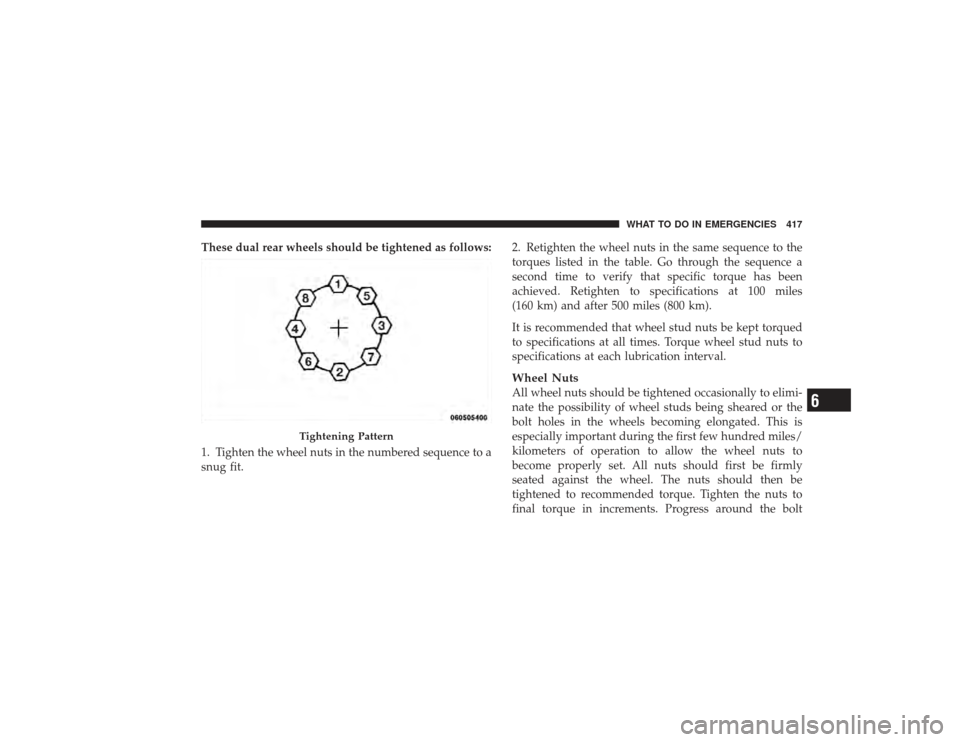
These dual rear wheels should be tightened as follows:
1. Tighten the wheel nuts in the numbered sequence to a
snug fit.2. Retighten the wheel nuts in the same sequence to the
torques listed in the table. Go through the sequence a
second time to verify that specific torque has been
achieved. Retighten to specifications at 100 miles
(160 km) and after 500 miles (800 km).
It is recommended that wheel stud nuts be kept torqued
to specifications at all times. Torque wheel stud nuts to
specifications at each lubrication interval.
Wheel NutsAll wheel nuts should be tightened occasionally to elimi-
nate the possibility of wheel studs being sheared or the
bolt holes in the wheels becoming elongated. This is
especially important during the first few hundred miles/
kilometers of operation to allow the wheel nuts to
become properly set. All nuts should first be firmly
seated against the wheel. The nuts should then be
tightened to recommended torque. Tighten the nuts to
final torque in increments. Progress around the bolt
Tightening Pattern
WHAT TO DO IN EMERGENCIES 417
6
Page 420 of 532
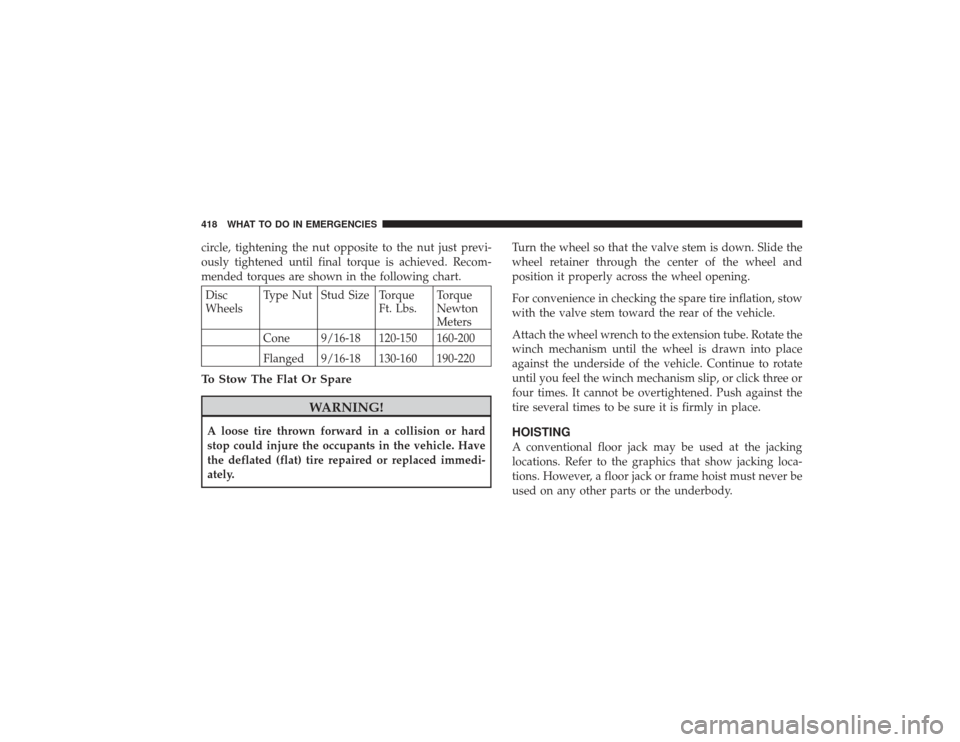
circle, tightening the nut opposite to the nut just previ-
ously tightened until final torque is achieved. Recom-
mended torques are shown in the following chart.Disc
WheelsType Nut Stud Size Torque
Ft. Lbs.Torque
Newton
Meters
Cone 9/16-18 120-150 160-200
Flanged 9/16-18 130-160 190-220To Stow The Flat Or Spare
WARNING!
A loose tire thrown forward in a collision or hard
stop could injure the occupants in the vehicle. Have
the deflated (flat) tire repaired or replaced immedi-
ately. Turn the wheel so that the valve stem is down. Slide the
wheel retainer through the center of the wheel and
position it properly across the wheel opening.
For convenience in checking the spare tire inflation, stow
with the valve stem toward the rear of the vehicle.
Attach the wheel wrench to the extension tube. Rotate the
winch mechanism until the wheel is drawn into place
against the underside of the vehicle. Continue to rotate
until you feel the winch mechanism slip, or click three or
four times. It cannot be overtightened. Push against the
tire several times to be sure it is firmly in place.
HOISTINGA conventional floor jack may be used at the jacking
locations. Refer to the graphics that show jacking loca-
tions. However, a floor jack or frame hoist must never be
used on any other parts or the underbody.
418 WHAT TO DO IN EMERGENCIES
Page 452 of 532
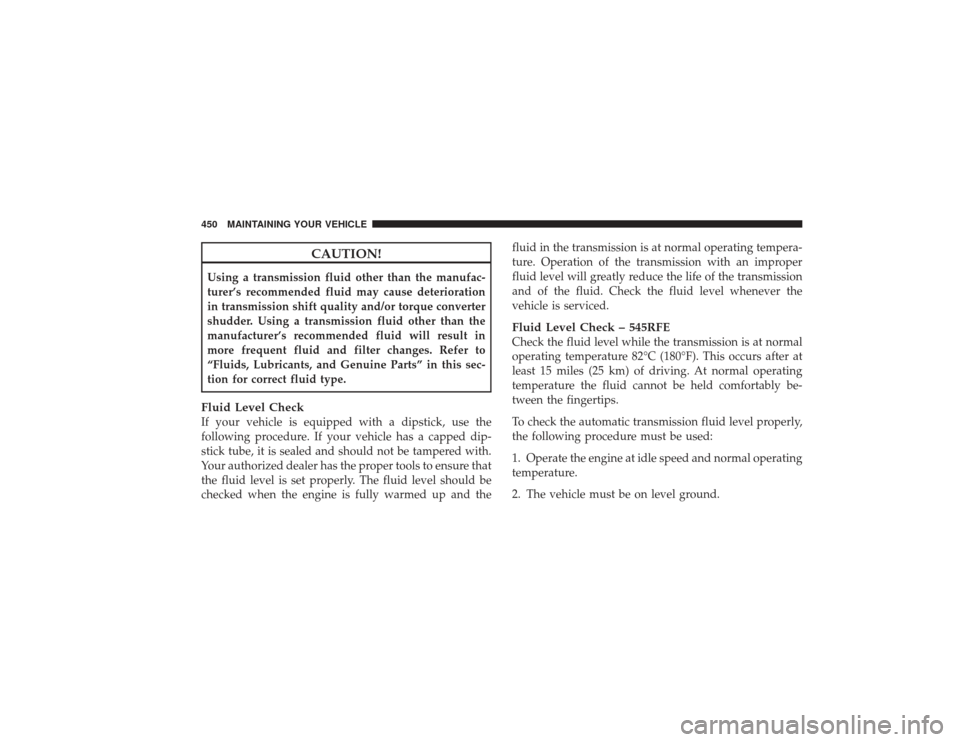
CAUTION!
Using a transmission fluid other than the manufac-
turer’s recommended fluid may cause deterioration
in transmission shift quality and/or torque converter
shudder. Using a transmission fluid other than the
manufacturer’s recommended fluid will result in
more frequent fluid and filter changes. Refer to
“Fluids, Lubricants, and Genuine Parts” in this sec-
tion for correct fluid type.Fluid Level CheckIf your vehicle is equipped with a dipstick, use the
following procedure. If your vehicle has a capped dip-
stick tube, it is sealed and should not be tampered with.
Your authorized dealer has the proper tools to ensure that
the fluid level is set properly. The fluid level should be
checked when the engine is fully warmed up and thefluid in the transmission is at normal operating tempera-
ture. Operation of the transmission with an improper
fluid level will greatly reduce the life of the transmission
and of the fluid. Check the fluid level whenever the
vehicle is serviced.
Fluid Level Check – 545RFECheck the fluid level while the transmission is at normal
operating temperature 82°C (180°F). This occurs after at
least 15 miles (25 km) of driving. At normal operating
temperature the fluid cannot be held comfortably be-
tween the fingertips.
To check the automatic transmission fluid level properly,
the following procedure must be used:
1. Operate the engine at idle speed and normal operating
temperature.
2. The vehicle must be on level ground.
450 MAINTAINING YOUR VEHICLE
Page 527 of 532
Life of Tires.......................... 359
Load Capacity ..................... 350,351
Pressure Monitor System (TPMS) ........... 366
Pressure Warning Light .................. 197
Quality Grading ....................... 506
Radial .............................. 357
Replacement ......................... 359
Rotation ............................ 363
Safety ........................... 346,354
Sizes ............................... 347
Snow Tires ........................... 363
Spare Tire ........................... 408
Spinning ............................ 357
Tread Wear Indicators ................... 358
Wheel Mounting ...................... 409
Wheel Nut Torque ..................... 414
Tongue Weight/Trailer Weight .............. 389
Torque Converter Clutch .................. 259
Tow Hooks, Emergency ................... 422 Towing
............................... 383
24-Hour Towing Assistance ............... 101
Disabled Vehicle ....................... 422
Guide .............................. 389
Recreational .......................... 397
Weight .............................. 389
Towing Assistance ....................... 101
Traction .............................. 304
Traction Control ......................... 334
Trailer Sway Control (TSC) ................. 345
Trailer Towing .......................... 383
Cooling System Tips .................... 396
Hitches ............................. 388
Minimum Requirements ................. 390
Mirrors .............................. 85
Trailer and Tongue Weight ............... 389
Wiring .............................. 393
Trailer Towing Guide ..................... 389
Trailer Weight .......................... 389
INDEX 525
10
Page 529 of 532
WaterDriving Through ...................... 305
Wheel and Wheel Trim .................... 454
Wheel and Wheel Trim Care ................ 454
Wheel Cover ........................... 414
Wheel Mounting ........................ 409
Wheel Nut Torque .................... 414,417
Winch ................................ 308
Accessories .......................... 312
Operation ........................... 313
Rigging Techniques ..................... 325
Usage .............................. 308 Wind Buffeting
....................... 33,161
Window Fogging ........................ 244
Windows .............................. 32
Power ............................... 32
Rear Sliding .......................... 174
Windshield Defroster ................76,235,238
Windshield Washers ................ 138,139,438
Fluid ............................... 438
Windshield Wiper Blades .................. 437
Windshield Wipers ....................... 138
Wiper Blade Replacement .................. 437
Wipers, Intermittent ...................... 138
INDEX 527
10