ignition DODGE RAM 2500 DIESEL 2009 4.G Manual PDF
[x] Cancel search | Manufacturer: DODGE, Model Year: 2009, Model line: RAM 2500 DIESEL, Model: DODGE RAM 2500 DIESEL 2009 4.GPages: 532, PDF Size: 9.37 MB
Page 346 of 532
the stability feature at speeds above 40 mph (64 km/h).
The “ESP/TCS Indicator Light” will always be illumi-
nated when ESP is off. To turn ESP on again, momen-
tarily depress the ESP OFF switch. This will restore the
normal “ESP On” mode of operation.
“ESP Off” is the only operating mode for ESP in 4WD
LOW. Whenever the vehicle is started in 4WD LOW or
the transfer case (if equipped) is shifted from 4WD LOCK
or Neutral, to 4WD LOW, the ESP system will be in this
mode.
WARNING!
With the ESP switched off, the enhanced vehicle
stability offered by ESP is unavailable. In an emer-
gency evasive maneuver, the ESP system will not
engage to assist in maintaining stability. “ESP Off”
mode is intended for off-highway or off-road use,
only.
ESP/BAS Warning Light and ESP/TCS Indicator
LightThe malfunction indicator for the ESP is combined with
the BAS indicator. The “ESP/BAS Warning Light” and
the “ESP/TCS Indicator Light” in the instrument cluster
both come on when the ignition switch is turned to the
ON position. They should both go out with the engine
running. If the “ESP/BAS Warning Light” comes on
continuously with the engine running, a malfunction has
been detected in either the ESP or BAS system, or both. If
this light remains on after several ignition cycles, and the
vehicle has been driven several miles/kilometers at
speeds greater than 30 mph (48 km/h), see your autho-
rized dealer as soon as possible to have the problem
diagnosed and corrected.
NOTE:•
The “ESP Indicator Light” and the “ESP/BAS Warning
Light” come on momentarily each time the ignition
switch is turned ON.
344 STARTING AND OPERATING
Page 347 of 532
•
Each time the ignition is turned ON, the ESP System
will be ON even if it was turned off previously.
•
The ESP Control System will make buzzing or clicking
sounds when it is active. This is normal. The sounds
will stop when ESP becomes inactive following the
maneuver that caused the ESP activation.
TSC (Trailer Sway Control)The TSC system uses sensors in the vehicle to recognize
an excessively swaying trailer and will take the appro-
priate actions to attempt to stop the sway. The system
may reduce engine power and apply the brake of the
appropriate wheel(s) to counteract the sway of the trailer.
TSC will become active automatically once an excessively
swaying trailer is recognized. No driver action is re-
quired. Note that TSC cannot stop all trailers from
swaying. Always use caution when towing a trailer and
follow the trailer tongue weight recommendations. Refer
to “Trailer Towing” in Section 5 of this manual for moreinformation on towing a trailer with your vehicle. When
TSC is functioning, the “ESP/TCS Indicator Light” will
flash, the engine power may be reduced and you may
feel the brakes being applied to individual wheels to
attempt to stop the trailer from swaying. TSC is disabled
when the ESP system is in the Partial Off or Full Off
modes.
TSC is only active in the default “ESP On” mode. TSC can
be disabled by pressing the ESP OFF switch and entering
“ESP Partial Off” mode. It is not active in the “ESP Partial
Off” or “ESP Off” modes. Please refer to the ESP portion
of this section for an explanation of the different ESP
operating modes.
WARNING!
If TSC activates while driving, slow the vehicle
down, stop at the nearest safe location, and adjust the
trailer load to eliminate trailer sway.
STARTING AND OPERATING 345
5
Page 372 of 532
Tire Light Load Inflation Switch Operation – If
Equipped
•
This vehicle may have different recommended tire
pressure values between the front and rear tires as
shown in both the Tire Loading Information Label and
the Supplemental Tire Pressure Information Label. It is
also equipped to be driven with tire pressures appro-
priate to either a Light Load condition or the vehicle
Max Load condition.
•
The tire light load inflation switch will allow the driver
to change between the max load inflation pressure
(cold) low pressure warning threshold and the light
load inflation pressure (cold) low pressure warning
threshold depending on the vehicle’s load condition.
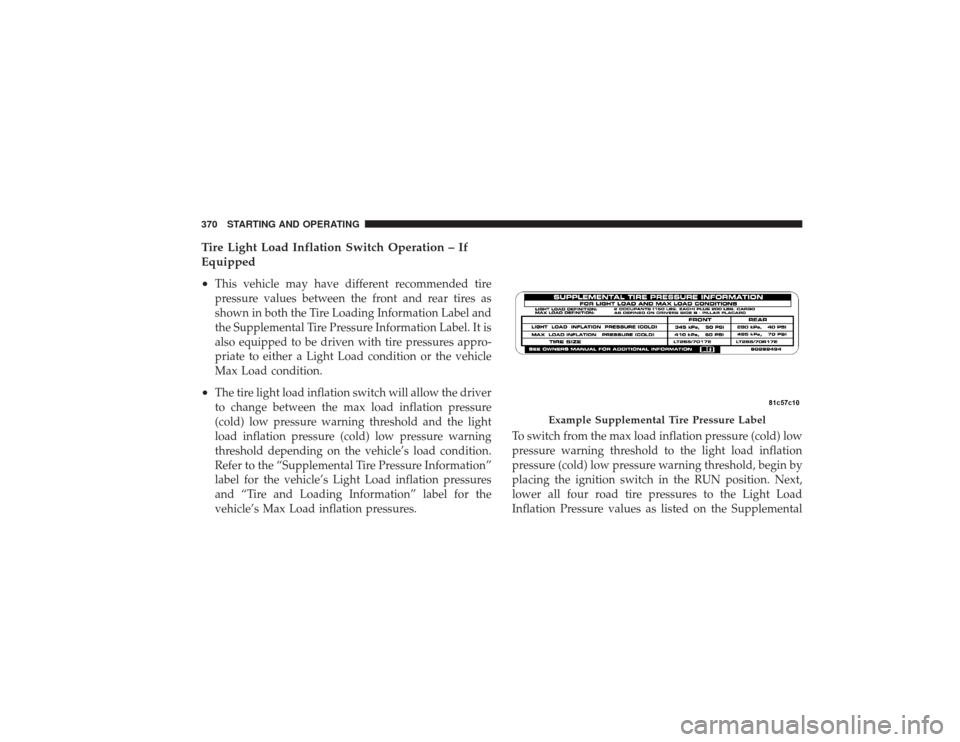
Refer to the “Supplemental Tire Pressure Information”
label for the vehicle’s Light Load inflation pressures
and “Tire and Loading Information” label for the
vehicle’s Max Load inflation pressures.To switch from the max load inflation pressure (cold) low
pressure warning threshold to the light load inflation
pressure (cold) low pressure warning threshold, begin by
placing the ignition switch in the RUN position. Next,
lower all four road tire pressures to the Light Load
Inflation Pressure values as listed on the Supplemental
Example Supplemental Tire Pressure Label
370 STARTING AND OPERATING
Page 375 of 532
Tire Pressure Monitoring Low Pressure Warnings
The “Tire Pressure Monitoring Telltale Light” will
illuminate in the instrument cluster, and an au-
dible chime will be activated when one or more of
the four active road tire pressures are low. Should this
occur, you should stop as soon as possible, check the
inflation pressure of each tire on your vehicle and inflate
each tire to the vehicle’s recommended cold placard
pressure value. The system will automatically update
and the “Tire Pressure Monitoring Telltale Light” will
extinguish once the updated tire pressures have been
received. The vehicle may need to be driven for up to
20 minutes above 15 mph (25 km/h) to receive this
information.
Check TPMS WarningsThe “Tire Pressure Monitoring Telltale Light” (located in
the instrument cluster) will flash on and off for 75 sec-
onds and will remain on solid when a system fault is
detected. The system fault will also sound a chime. If the ignition key is cycled, this sequence will repeat, provid-
ing the system fault still exists. A system fault can occur
by any of the following scenarios:
1. Signal interference due to electronic devices or driving
next to facilities emitting the same Radio Frequencies as
the TPM sensors.
2. Installing aftermarket window tinting that affects ra-
dio wave signals.
3. Accumulation of snow or ice around the wheels or
wheel housings.
4. Using tire chains on the vehicle.
5. Using wheels/tires not equipped with TPM sensors.
6. Loss of communication with the trigger modules or
tire pressure monitoring sensors.
NOTE: Your vehicle is equipped with a non-matching
full size spare wheel and tire assembly.
STARTING AND OPERATING 373
5
Page 376 of 532
1. This spare tire does not have a tire pressure monitor-
ing sensor. Therefore, the TPMS will not monitor the tire
pressure in the spare tire.
2. If you install the full size spare tire in place of a road
tire that has a pressure below the low-pressure warning
limit, upon the next ignition key cycle, a chime will
sound and the “TPM Telltale Light” will still turn ON
due to the low tire.
3. However, after driving the vehicle for up to 20 min-
utes above 15 mph (25 km/h), the “TPM Telltale Light”
will flash on and off for 75 seconds and then remain on
solid.
4. For each subsequent ignition key cycle, a chime will
sound and the “TPM Telltale Light” will flash on and off
for 75 seconds and then remain on solid.5. Once you repair or replace the original road tire, and
reinstall it on the vehicle in place of the full size spare tire,
the TPMS will update automatically and the “TPM
Telltale Light” will turn OFF, as long as no tire pressure is
below the low-pressure warning limit in any of the four
active road tires. The vehicle may need to be driven for
up to 20 minutes above 15 mph (25 km/h) in order for the
TPMS to receive this information.
General InformationThis device complies with part 15 of the FCC rules and
RSS 210 of Industry Canada. Operation is subject to the
following conditions:•
This device may not cause harmful interference.
•
This device must accept any interference received,
including interference that may cause undesired
operation.
374 STARTING AND OPERATING
Page 380 of 532
Fuel System Cautions
CAUTION!
Follow these guidelines to maintain your vehicle’s
performance:•
The use of leaded gas is prohibited by Federal law.
Using leaded gasoline can impair engine performance,
damage the emission control system.
•
An out-of-tune engine, or certain fuel or ignition
malfunctions, can cause the catalytic converter to
overheat. If you notice a pungent burning odor or
some light smoke, your engine may be out of tune or
malfunctioning and may require immediate service.
Contact your authorized dealer for service assistance.
•
When pulling a heavy load or driving a fully-loaded
vehicle when the humidity is low and the temperature
is high, use a premium unleaded fuel to help prevent
spark knock. If spark knock persists, lighten the load,
or engine piston damage may result.
•
The use of fuel additives which are now being sold as
octane enhancers is not recommended. Many of these
products contain high concentrations of methanol.
Fuel system damage or vehicle performance problems
resulting from the use of such fuels or additives is not
the responsibility of the manufacturer.
NOTE: Intentional tampering with emissions control
systems can result in civil penalties being assessed
against you.
378 STARTING AND OPERATING
Page 400 of 532
Recreational Towing Procedure — Manual Shift
Transfer Case — If EquippedUse the following procedure to prepare your vehicle for
recreational towing:
CAUTION!
It is necessary to follow these steps to be certain that
the transfer case is fully in NEUTRAL before recre-
ational towing to prevent damage to internal parts.
1. Bring the vehicle to a complete stop.
2. Shut OFF the engine.
3. Depress the brake pedal.
4. Shift the transmission into NEUTRAL.
5. Shift the transfer case lever into NEUTRAL. 6. Start the engine.
7. Shift the transmission into REVERSE.
8. Release the brake pedal for five seconds and ensure
that there is no vehicle movement.
9. Repeat steps 7 and 8 with the transmission in DRIVE.
10. Shut OFF the engine and place the ignition key in the
unlocked OFF position.
11. Shift the transmission into PARK.
12. Apply the parking brake.
13. Attach the vehicle to the tow vehicle with the tow bar.
14. Release the parking brake.398 STARTING AND OPERATING
Page 402 of 532
CAUTION!
•
Do not use a bumper-mounted clamp-on tow bar
on your vehicle. The bumper face bar will be
damaged.
•
Do not disconnect the rear driveshaft because
fluid will leak from the transfer case and damage
the internal parts.
Recreational Towing Procedure — Electronic Shift
Transfer Case — If EquippedUse the following procedure to prepare your vehicle for
recreational towing:
CAUTION!
It is necessary to follow these steps to be certain that
the transfer case is fully in NEUTRAL before recre-
ational towing, to prevent damage to internal parts.1. Bring the vehicle to a complete stop.
2. Shut OFF the engine.
3. Turn the ignition key to the ON position, but do not
start the engine.
4. Depress the brake pedal.
5. Shift the transmission into NEUTRAL.
6. Using the point of a ballpoint pen or similar object,
depress the recessed transfer case NEUTRAL button for
four seconds.
7. After shift is completed and the NEUTRAL light
comes on, release the NEUTRAL button.
8. Start the engine.
9. Shift the transmission into REVERSE.
10. Release the brake pedal for five seconds and ensure
that there is no vehicle movement.400 STARTING AND OPERATING
Page 403 of 532
11. Repeat steps 9 and 10 with the transmission in
DRIVE.
12. Shut the engine OFF and place ignition key in the
unlocked OFF position.
13. Shift the transmission into PARK.
14. Apply the parking brake.
15. Attach the vehicle to the tow vehicle with the tow bar.
16. Release the parking brake.
NOTE:•
Steps 1 through 5 are requirements that must be met
prior to depressing the NEUTRAL selection button,
and must continue to be met until the four seconds
elapses and the shift has been completed. If any of
these requirements (with the exception of 3 - Key ON)
are not met prior to depressing the NEUTRAL button
or are no longer met during the four second timer, thenthe NEUTRAL indicator light will flash continuously
until all requirements are met or until the NEUTRAL
button is released.
•
The ignition key must be ON for a shift to take place
and for the position indicator lights to be operable. If
the key in not ON, the shift will not take place and no
position indicator lights will be on or flashing.
•
Flashing NEUTRAL position indicator light indicates
that shift requirements have not been met.
CAUTION!
Damage to the transmission may occur if the trans-
mission is shifted into PARK with the transfer case in
NEUTRAL and the engine running. With the transfer
case in NEUTRAL, ensure that the engine is OFF
prior to shifting the transmission into PARK.
STARTING AND OPERATING 401
5
Page 404 of 532

Returning to Normal Operation — Electronic Shift
Transfer CaseUse the following procedure to prepare your vehicle for
normal usage:
1. Bring the vehicle to a complete stop.
2. Shut OFF the engine.
3. Turn the ignition key to the ON position, but do not
start the engine.
4. Depress the brake pedal.
5. Shift the transmission into NEUTRAL.
6. Using the point of a ballpoint pen or similar object,
depress the recessed transfer case Neutral (N) button for
one second.
7. After the Neutral indicator light turns off, release the
Neutral (N) button.8. After the Neutral (N) button has been released, the
transfer case will shift into the position identified by the
selector switch.
9. Shift the transmission into PARK.
NOTE:
•
The transfer case cannot be shifted into NEUTRAL
from the 4AUTO (if equipped) position.
•
Steps 1 through 5 are requirements that must be met
prior to depressing the transfer case Neutral (N)
button, and must continue to be met until one second
elapses and the shift has been completed. If any of
these requirements (with the exception of ste
p3-key
ON) are not met prior to depressing the Neutral (N)
button, or are no longer met during the one second
time, then all of the mode position indicator lights will
flash continuously until all requirements are met, or
until the Neutral (N) button is released.
402 STARTING AND OPERATING