oil level DODGE RAM 2500 DIESEL 2009 4.G Owners Manual
[x] Cancel search | Manufacturer: DODGE, Model Year: 2009, Model line: RAM 2500 DIESEL, Model: DODGE RAM 2500 DIESEL 2009 4.GPages: 532, PDF Size: 9.37 MB
Page 203 of 532
33. Charging System LightThis light shows the status of the electrical charg-
ing system. The light should come on when the
ignition switch is first turned ON and remain on briefly
as a bulb check. If the light stays on or comes on while
driving, turn off some of the vehicle’s non-essential
electrical devices or increase engine speed (if at idle). If
the charging system light remains on, it means that the
vehicle is experiencing a problem with the charging
system. Obtain SERVICE IMMEDIATELY. See an autho-
rized dealer.
34. Oil Pressure Warning Light This light indicates low engine oil pressure. The
light should turn on momentarily when the engine
is started. If the light turns on while driving, stop the
vehicle and shut off the engine as soon as possible. A
chime will sound for four minutes when this light turns
on. Do not operate the vehicle until the cause is corrected.
This light does not indicate how much oil is in the engine.
The engine oil level must be checked under the hood.
ELECTRONIC DIGITAL CLOCKThe clock and radio each use the display panel built into
the radio. A digital readout shows the frequency and/or
time in hours and minutes (depending on your radio
model) whenever the ignition switch is in the ON or ACC
position.
When the ignition switch is in the OFF position, or when
the radio frequency is being displayed, time keeping is
accurately maintained.
On the RAQ radio the time button alternates the location
of the time and frequency on the display. On the REF only
one of the two, time or frequency, is displayed at a time.
UNDERSTANDING YOUR INSTRUMENT PANEL 201
4
Page 379 of 532
To fix a Non-FFV vehicle inadvertently fueled once with
E-85 perform the following:•
drain the fuel tank (see your authorized dealer)
•
change the engine oil and oil filter
•
disconnect and reconnect the battery to reset the
engine controller memory
More extensive repairs will be required for prolonged
exposure to E-85 fuel.
MMT In GasolineMMT is a manganese containing metallic additive that is
blended into some gasoline to increase octane. Gasoline
blended with MMT provides no performance advantage
beyond gasoline of the same octane number without
MMT. Gasoline blended with MMT reduces spark plug life and reduces emission system performance in some
vehicles. The manufacturer recommends that gasoline
without MMT be used in your vehicle. The MMT content
of gasoline may not be indicated on the gasoline pump,
therefore, you should ask your gasoline retailer whether
or not the gasoline contains MMT. It is even more
important to look for gasolines without MMT in Canada,
because MMT can be used at levels higher than those
allowed in the United States. MMT is prohibited in
Federal and California reformulated gasoline.
Materials Added To FuelAll gasolines sold in the United States are required to
contain effective detergent additives. Use of additional
detergents or other additives is not needed under normal
conditions and would result in unnecessary cost. There-
fore, you should not have to add anything to the fuel.
STARTING AND OPERATING 377
5
Page 433 of 532
your vehicle. Refer to these manuals before attempting
any procedure yourself.
NOTE:Intentional tampering with emissions control
systems can result in civil penalties being assessed
against you.
WARNING!
You can be badly injured working on or around a
motor vehicle. Do only that service work for which
you have the knowledge and the proper equipment.
If you have any doubt about your ability to perform
a service job, take your vehicle to a competent
mechanic.MAINTENANCE PROCEDURESThe pages that follow contain the requiredmaintenance
services determined by the engineers who designed your
vehicle. Besides the maintenance items for which there are fixed
maintenance intervals, there are other items that should
operate satisfactorily without periodic maintenance.
However, if a malfunction of these items does occur, it
could adversely affect the engine or vehicle performance.
These items should be inspected if a malfunction is
observed or suspected.
Engine Oil
Checking Oil LevelTo assure proper lubrication of your vehicle’s engine, the
engine oil must be maintained at the correct level. The
best time to check the engine oil level is about five
minutes after a fully warmed up engine is shut off or
before starting the engine after it has sat overnight.
Checking the oil while the vehicle is on level ground will
improve the accuracy of the oil level readings. Always
maintain the oil level within the SAFE zone on the
MAINTAINING YOUR VEHICLE 431
7
Page 449 of 532
•
Do not change the thermostat for Summer or Winter
operation. If replacement is ever necessary, install
ONLY the correct type thermostat. Other designs may
result in unsatisfactory coolant performance, poor gas
mileage, and increased emissions.
Brake System
Master Cylinder — Brake Fluid Level CheckThe fluid level of the master cylinder should be checked
when performing under the hood service, or immedi-
ately if the brake system warning lamp indicates system
failure.
The brake master cylinder has a translucent plastic
reservoir. On the outboard side of the reservoir, there is a
“FULL” mark and an “ADD” mark. The fluid level must
be kept within these two marks. Do not add fluid above
the “FULL” mark, because leakage may occur at the cap.With disc brakes the fluid level can be expected to fall as
the brake linings wear. However, an unexpected drop in
fluid level may be caused by a leak and a system check
should be conducted.
Refer to “Fluids, Lubricants, and Genuine Parts” in this
section for the correct fluid type.
WARNING!
•
Use of a brake fluid that may have a lower initial
boiling point, or is unidentified as to specification,
may result in sudden brake failure during hard
prolonged braking. You could have an accident.
•
Overfilling the brake fluid reservoir can result in
spilling brake fluid on hot engine parts and the
brake fluid catching fire.
(Continued)
MAINTAINING YOUR VEHICLE 447
7
Page 450 of 532
WARNING! (Continued)
•
Use only brake fluid that has been in a tightly-
closed container to avoid contamination from for-
eign matter or moisture.
CAUTION!
Do not allow a petroleum-base fluid to contaminate
the brake fluid. Seal damage may result.Rear Axle And 4x4 Front Driving Axle Fluid LevelFor normal service, periodic fluid level checks are not
required. When the vehicle is serviced for other reasons
the exterior surfaces of the axle assembly should be
inspected. If gear oil leakage is suspected inspect the
fluid level. Refer to “Fluids, Lubricants, and Genuine
Parts” in this section for the correct fluid type.This inspection should be made with the vehicle in a level
position. The fluid level should be even with the bottom
of the fill hole for the manufacturer’s C205F HD front
axles. The fluid level should be 5/8 in (16 mm) below the
fill hole on 9 1/4 in manufacturer’s rear axles.
For all 2500/3500 Model axles, the fluid level should be
1/4” ± 1/4 in (6.4 mm ± 6.4 mm) below the fill hole on
the 9.25 in front and 3/4 in ± 1/4 in (19 mm ± 6.4 mm) on
10.5 in rear axles. The 11.5 in rear axle level should be
1/4 in ± 1/4 in (6.4 mm ± 6.4 mm) below the fill hole.
Drain and RefillRefer to the “Maintenance Schedule” in Section 8 for the
proper maintenance intervals.Lubricant SelectionRefer to “Fluids, Lubricants, and Genuine Parts” in this
section for the correct fluid type.
448 MAINTAINING YOUR VEHICLE
Page 451 of 532
NOTE:The presence of water in the gear lubricant will
result in corrosion and possible failure of differential
components. Operation of the vehicle in water, as may be
encountered in some off-highway types of service, will
require draining and refilling the axle to avoid damage.
2500/3500 Model Axles DO NOT REQUIREany limited
slip oil additive (friction modifiers).Transfer Case
Drain And RefillRefer to the “Maintenance Schedule” in Section 8 for the
proper maintenance intervals.Lubricant SelectionRefer to “Fluids, Lubricants, and Genuine Parts” in this
section for the correct fluid type.
Fluid Level CheckThis fluid level can be checked by removing the filler
plug. The fluid level should be to the bottom edge of the
filler plug hole with the vehicle in a level position.Automatic Transmission
Selection Of LubricantIt is important that the proper lubricant is used in the
transmission to assure optimum transmission perfor-
mance. Use only the manufacturer ’s recommended trans-
mission fluid. Refer to “Fluids, Lubricants, and Genuine
Parts” in this section for the correct fluid type. It is
important that the transmission fluid be maintained at
the prescribed level using the recommended fluid. No
chemical flushes should be used in any transmission;
only the approved lubricant may be used.
MAINTAINING YOUR VEHICLE 449
7
Page 453 of 532
3. Fully apply the parking brake and press the brake
pedal.
4. Place the shift lever momentarily into each gear posi-
tion ending with the lever in PARK.
5. Remove the dipstick, wipe it clean and reinsert it until
seated.
6. Remove the dipstick again and note the fluid level on
both sides. The fluid level should be between the “HOT”
(upper) reference holes on the dipstick at normal operat-
ing temperature. Verify that solid coating of oil is seen on
both sides of the dipstick. If the fluid is low, add as
required into the dipstick tube.Do not overfill.After
adding any quantity of oil through the oil fill tube, wait
a minimum of two minutes for the oil to fully drain into
the transmission before rechecking the fluid level.
NOTE: If it is necessary to check the transmission below
the operating temperature, the fluid level should be between the two “COLD” (lower) holes on the dipstick
with the fluid at approximately 70°F (21°C) (room tem-
perature). If the fluid level is correctly established at
room temperature, it should be between the “HOT”
(upper) reference holes when the transmission reaches
180°F (82°C). Remember it is best to check the level at the
normal operating temperature.
CAUTION!
Be aware that if the fluid temperature is below 50°F
(10°C) it may not register on the dipstick. Do not add
fluid until the temperature is elevated enough to
produce an accurate reading.
7. Check for leaks. Release parking brake.
To prevent dirt and water from entering the transmission
after checking or replenishing fluid, make certain that the
dipstick cap is properly reseated. It is normal for the
MAINTAINING YOUR VEHICLE 451
7
Page 486 of 532
At Each Stop for Fuel•
Check the engine oil level about 5 minutes after a fully
warmed engine is shut off. Checking the oil level while
the vehicle is on level ground will improve the accu-
racy of the oil level reading. Add oil only when the
level is at or below the ADD or MIN mark.
•
Check the windshield washer solvent and add if
required.
Once a Month
•
Check tire pressure and look for unusual wear or
damage.
•
Inspect the battery, clean and tighten the terminals as
required.
•
Check the fluid levels of the coolant reservoir, brake
master cylinder, power steering and transmission and
add as needed.
•
Check all lights and other electrical items for correct
operation.
At Each Oil Change
•
Change the engine oil filter.
•
Inspect the brake hoses and lines.
CAUTION!
Failure to perform the required maintenance items
may result in damage to the vehicle.Required Maintenance IntervalsRefer to the Maintenance Schedules on the following
pages for the required maintenance intervals.
484 MAINTENANCE SCHEDULES
8M A I
N T
E
N A
N CE
S
C
H E
D
U L
E
S
Page 516 of 532
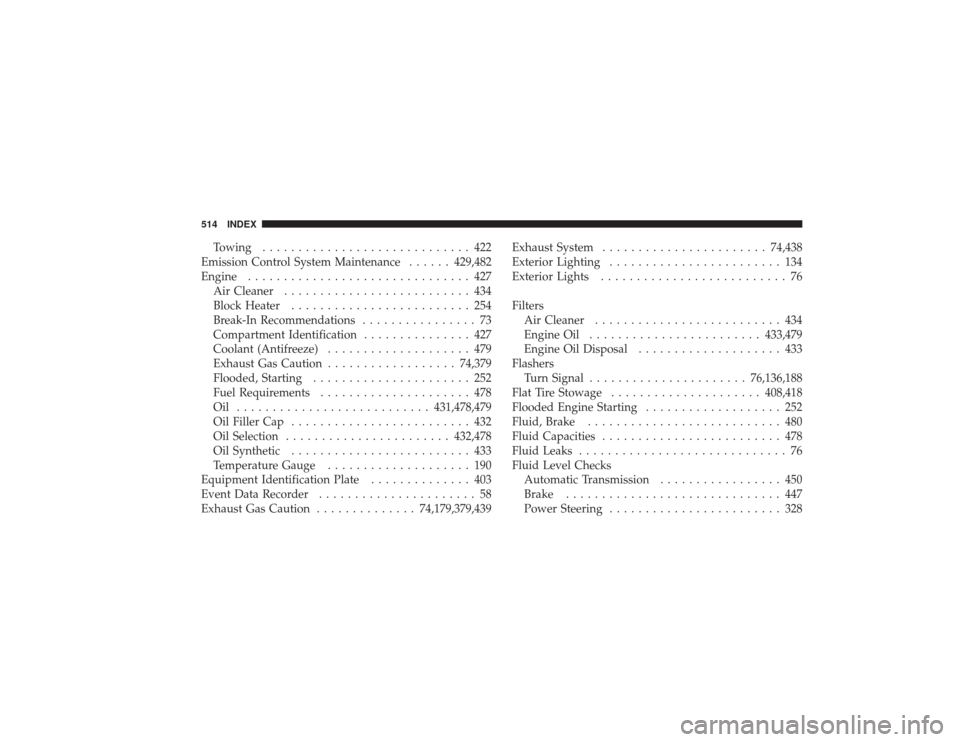
Towing............................. 422
Emission Control System Maintenance ......429,482
Engine ............................... 427
Air Cleaner .......................... 434
Block Heater ......................... 254
Break-In Recommendations ................ 73
Compartment Identification ............... 427
Coolant (Antifreeze) .................... 479
Exhaust Gas Caution .................. 74,379
Flooded, Starting ...................... 252
Fuel Requirements ..................... 478
Oil ........................... 431,478,479
Oil Filler Cap ......................... 432
Oil Selection ....................... 432,478
Oil Synthetic ......................... 433
Temperature Gauge .................... 190
Equipment Identification Plate .............. 403
Event Data Recorder ...................... 58
Exhaust Gas Caution ..............74,179,379,439Exhaust System
....................... 74,438
Exterior Lighting ........................ 134
Exterior Lights .......................... 76
Filters Air Cleaner .......................... 434
Engine Oil ........................ 433,479
Engine Oil Disposal .................... 433
Flashers Turn Signal ...................... 76,136,188
Flat Tire Stowage ..................... 408,418
Flooded Engine Starting ................... 252
Fluid, Brake ........................... 480
Fluid Capacities ......................... 478
Fluid Leaks ............................. 76
Fluid Level Checks Automatic Transmission ................. 450
Brake .............................. 447
Power Steering ........................ 328514 INDEX
Page 530 of 532

INTRODUCTION INTRODUCTION HOW TO USE THIS MANUAL WARNINGS AND CAUTIONS VAN CONVERSIONS/CAMPERS VEHICLE IDENTIFICATION NUMBER VEHICLE MODIFICATIONS/ALTERATIONS THINGS TO KNOW BEFORE STARTING YOUR VEHICLE
A WORD ABOUT YOUR KEYS Ignition Key RemovalLocking Doors With A KeySTEERING WHEEL LOCK - IF EQUIPPED To Manually Lock the Steering WheelTo Release the Steering Wheel LockAutomatic Transmission Ignition Interlock SystemSENTRY KEY Replacement
KeysCustomer Key ProgrammingGeneral InformationVEHICLE SECURITY ALARM - IF EQUIPPED Rearming of the SystemTo Set the AlarmTo Disarm the SystemILLUMINATED ENTRY SYSTEM - IF EQUIPPED REMOTE KEYLESS ENTRY (RKE) - IF EQUIPPED To
Unlock the DoorsTo Lock the DoorsUsing the Panic AlarmProgramming Additional RKE TransmittersGeneral InformationRKE Transmitter Battery ServiceREMOTE STARTING SYSTEM - IF EQUIPPED How to Use Remote StartDOOR LOCKS Manual Door LocksPower
Door Locks - If EquippedChild Protection Door LockWINDOWS Power Windows-If Equipped Wind BuffetingOCCUPANT RESTRAINTS Lap/Shoulder BeltsAdjustable Upper Shoulder Belt AnchorageAutomatic Locking Retractors (ALR) Mode - If EquippedCenter Lap Belts
Seat Belt Pretensioners - If EquippedEnhanced Seat Belt Use Reminder System (BeltAlert) Seat Belts and Pregnant WomenSeat Belt ExtenderDriver And Right Front Passenger Supplemental Restraint System (SRS) - Airbags Event Data Recorder (EDR)Child Restraints
ENGINE BREAK-IN RECOMMENDATIONS SAFETY TIPS Transporting PassengersExhaust GasSafety Checks You Should Make Inside the VehiclePeriodic Safety Checks You Should Make Outside the VehicleUNDERSTANDING THE FEATURES OF YOUR VEHICLE
MIRRORS Inside Day/Night MirrorAutomatic Dimming Mirror - If EquippedOutside MirrorsOutside Mirrors Folding FeaturePower Mirrors - If EquippedHeated Mirrors - If EquippedTrailer Towing Mirrors - If Equippeduconnect phone - IF EQUIPPED OperationPhone Call
Featuresuconnect phone FeaturesAdvanced Phone ConnectivityThings You Should Know About Your uconnect phoneGeneral InformationVOICE RECOGNITION (VR) SYSTEM - IF EQUIPPED Voice Recognition (VR) System OperationCommandsVoice TrainingSEATS
Manual Seat Adjuster - If EquippedReclining Seats (Quad Cab Models)Reclining Seats (2500/3500 Models)Adjustable Head RestraintsManual Lumbar Support - If EquippedPower Seats - If EquippedRear Seat FeaturesHeated Seats - If EquippedTO OPEN AND CLOSE
THE HOOD LIGHTS Interior LightsBattery SaverHeadlight DelayHeadlights, Parking Lights and Panel LightsDaytime Running Lights (Canada Only and Fleet Vehicles)Lights-on ReminderFog Lights - If EquippedCargo Light - If EquippedMultifunction LeverWINDSHIELD
WIPERS AND WASHERS Intermittent Wiper SystemWindshield WashersTILT STEERING COLUMN DRIVER ADJUSTABLE PEDALS - IF EQUIPPED AdjustmentELECTRONIC SPEED CONTROL - IF EQUIPPED To ActivateTo Set a Desired SpeedTo DeactivateTo Resume
SpeedTo Vary the Speed SettingTo Accelerate for PassingOVERHEAD CONSOLE - IF EQUIPPED Courtesy/Reading LightsOVERHEAD CONSOLE WITH COMPASS/TEMPERATURE MINI-TRIP COMPUTER - IF EQUIPPED US/M ButtonReset ButtonGlobal ResetStep
ButtonAverage Fuel Economy (AVG ECO)Distance To Empty (DTE)Trip Odometer (ODO)Elapsed Time (ET)C/T ButtonAutomatic Compass CalibrationManual Compass CalibrationRecalibrating The CompassOutside TemperatureGARAGE DOOR OPENER - IF EQUIPPED
Programming HomeLinkGate Operator/Canadian ProgrammingUsing HomeLinkReprogramming A Single HomeLink ButtonSecurityTroubleshooting TipsGeneral InformationPOWER SUNROOF - IF EQUIPPED Open Sunroof - Express ModeClosing Sunroof - ExpressPinch
Protect FeaturePinch Protect OverrideVenting Sunroof - ExpressSunshade OperationWind BuffetingSunroof MaintenanceSunroof Fully ClosedELECTRICAL POWER OUTLETS CIGAR LIGHTER AND ASH RECEIVER CUPHOLDERS Front Instrument Panel Cupholders
(40-20-40 Seats) - Automatic TransmissionFront Instrument Panel Cupholders (Bucket Seats)Rear Cupholder (Quad Cab) - If EquippedSTORAGE Center Storage Compartment (40-20-40 Seat) - If EquippedCenter Storage Compartment (Bucket Seats) - If EquippedStorage
and Seats (Quad Cab Models)Plastic Grocery Bag Retainers - If EquippedREAR WINDOW FEATURES Rear Window Defroster and Heated Outside Mirrors - If EquippedPower Sliding Rear Window - If EquippedSliding Rear Window - If EquippedFOLD FLAT LOAD FLOOR
- IF EQUIPPED PICKUP BOX SLIDE-IN CAMPERS Camper ApplicationsEASY-OFF TAILGATE UNDERSTANDING YOUR INSTRUMENT PANEL INSTRUMENT PANEL FEATURES RAM TRUCK POWER WAGON INSTRUMENT CLUSTER - BASE INSTRUMENT
CLUSTER - PREMIUM INSTRUMENT CLUSTER DESCRIPTION ELECTRONIC DIGITAL CLOCK Clock Setting ProcedureSALES CODE RAQ - AM/FM/CD (6-DISC) RADIO WITH OPTIONAL uconnect studios (SATELLITE RADIO), uconnect phone, AND VIDEO
ENTERTAINMENT SYSTEMS (VES) CAPABILITIES Operating Instructions - Radio ModeOperation Instructions - (CD Mode for CD Audio Play)LOAD/EJECT Button (CD Mode for CD Audio Play)Notes On Playing MP3 FilesOperation Instructions - (CD Mode for MP3 Audio
Play)LOAD/EJECT Button (CD Mode for MP3 Play)SALES CODE REF - AM/FM/CD (SINGLE-DISC) RADIO WITH OPTIONAL uconnect studios (SATELLITE RADIO) AND uconnect phone CAPABILITY Operating Instructions - Radio ModeOperating Instructions - CD Mode
Operating Instructions - Auxiliary ModeOperating Instructions - uconnect phone - If EquippedOperating Instructions - uconnect studios (Satellite Radio) - If EquippedSALES CODE REC - AM/FM/CD (6-DISC) RADIO WITH uconnect gps (NAVIGATION) Operating Instructions
- uconnect studios (Satellite Radio) - If EquippedREC Setting the Clockuconnect studios (SATELLITE RADIO) - IF EQUIPPED System ActivationElectronic Serial Number/Sirius Identification Number (ESN/SID)Selecting uconnect studios (Satellite) Mode in REF, RAQ, And
RAK RadiosSelecting A ChannelStoring And Selecting Preset ChannelsUsing The PTY (Program Type) Button - If EquippedPTY Button SCANPTY Button SEEKSatellite AntennaReception QualityVIDEO ENTERTAINMENT SYSTEM (VES) - IF EQUIPPED REMOTE SOUND
SYSTEM CONTROLS - IF EQUIPPED Radio OperationCD PlayerCD/DVD MAINTENANCE RADIO OPERATION AND CELLULAR PHONES CLIMATE CONTROLS Heater Only - If Equipped Air Conditioning and Heating - If Equipped Air Conditioning with Dual Zone
Temperature Control - If EquippedOperating TipsOperating Tips Chart STARTING AND OPERATING STARTING PROCEDURES Normal StartingAutomatic TransmissionIf Engine Fails To StartAfter StartingENGINE BLOCK HEATER - IF EQUIPPED AUTOMATIC
TRANSMISSION Automatic Transmission with OverdriveFOUR-WHEEL DRIVE OPERATION - IF EQUIPPED Manually Shifted Transfer Case Operating Information/PrecautionsShifting Procedure - Manually Shifted Transfer Case Transfer Case Position Indicator Light
Electronically Shifted Transfer Case Operating Information/Precautions (Five Position Switch) - If EquippedShifting Procedure - Electronically Shifted Transfer CaseElectronically Shifted Transfer Case Operating Information/Precautions (Four Position Switch) - If Equipped
Shifting Procedure - Electronically Shifted Transfer CaseAXLE LOCKER SYSTEM - POWER WAGON ONLY STABILIZER/SWAY BAR SYSTEM - POWER WAGON ONLY SAFE OFF-ROAD DRIVING - POWER WAGON ONLY Off-Road Driving Tips and Vehicle
CharacteristicsDriving In Snow, Mud And SandCrossing Obstacles (Rocks And Other High Points)Hill ClimbingDriving Through WaterAiring Down For Off-Road DrivingVehicle RecoveryAfter Driving Off-RoadLIMITED-SLIP DIFFERENTIAL - IF EQUIPPED DRIVING ON
SLIPPERY SURFACES DRIVING THROUGH WATER Flowing/Rising WaterShallow Standing WaterDRIVING OFF-ROAD - RAM TRUCK ONLY WINCH USAGE - IF EQUIPPED (POWER WAGON ONLY) Things To Know Before Using Your WinchUnderstanding The Features
Of Your Winch Winch AccessoriesOperating Your WinchRigging TechniquesPOWER STEERING Power Steering Fluid CheckPARKING BRAKE BRAKE SYSTEM 3500 Dual Rear Wheel Models OnlyFour-Wheel Anti-Lock Brake SystemELECTRONIC BRAKE CONTROL
SYSTEM - IF EQUIPPED Anti-Lock Brake System (ABS)Traction Control System (TCS)Brake Assist System (BAS)Hill Start Assist (HSA)Electronic Roll Mitigation (ERM)Electronic Stability Program (ESP)TSC (Trailer Sway Control)TIRE SAFETY INFORMATION Tire Markings
Tire Identification Number (TIN)Tire Loading and Tire PressureTIRES - GENERAL INFORMATION Tire PressureTire Inflation PressuresTire Pressures for High Speed OperationRadial Ply TiresTire SpinningTread Wear IndicatorsLife of TireReplacement TiresSUPPLEMENTAL
TIRE PRESSURE
INFORMATION - IF EQUIPPED TIRE CHAINS SNOW TIRES TIRE ROTATION RECOMMENDATIONS Dual Rear Wheels TIRE PRESSURE MONITOR SYSTEM (TPMS) - IF EQUIPPED Tire Pressure Monitor System (TPMS) Tire Light Load Inflation Switch Description
- If EquippedTire Pressure Monitor System ComponentsGeneral InformationFUEL REQUIREMENTS Reformulated GasolineGasoline/Oxygenate BlendsE-85 Usage In Non-Flex Fuel VehiclesMMT In GasolineMaterials Added To FuelFuel System CautionsCarbon Monoxide
WarningsADDING FUEL Loose Fuel Filler Cap (Gas Cap) MessageVEHICLE LOADING Certification LabelTRAILER TOWING Common Towing DefinitionsTrailer Hitch ClassificationTrailer Towing Weights (Maximum Trailer Weight Ratings)Trailer and Tongue WeightTowing
RequirementsTowing TipsSNOWPLOW RECREATIONAL TOWING (BEHIND MOTORHOME, ETC.) Recreational Towing - Two-Wheel Drive ModelsRecreational Towing - Four-Wheel Drive ModelsEQUIPMENT IDENTIFICATION PLATE WHAT TO DO IN EMERGENCIES
HAZARD WARNING FLASHER JACKING INSTRUCTIONS Jack LocationRemoving The Spare TireTire Changing ProcedurePreparationsInstructionsHub Caps/Wheel CoversHOISTING JUMP-STARTING PROCEDURES FREEING A STUCK VEHICLE EMERGENCY TOW
HOOKS - IF EQUIPPED TOWING A DISABLED VEHICLE 4-Wheel Drive Vehicles2-Wheel Drive VehiclesMAINTAINING YOUR VEHICLE ENGINE COMPARTMENT- 5.7L ONBOARD DIAGNOSTIC SYSTEM (OBD II) Loose Fuel Filler Cap MessageEMISSIONS
INSPECTION AND MAINTENANCE PROGRAMS REPLACEMENT PARTS DEALER SERVICE MAINTENANCE PROCEDURES Engine OilEngine Oil FilterEngine Air Cleaner FilterMaintenance-Free BatteryAir Conditioner MaintenanceFront Prop Shaft Lubrication -
2500/3500 (4X4) ModelsBody LubricationWindshield Wiper BladesAdding Washer FluidExhaust SystemCooling SystemBrake SystemRear Axle And 4x4 Front Driving Axle Fluid LevelTransfer CaseAutomatic TransmissionAppearance Care and Protection from Corrosion
FUSES Integrated Power ModuleVEHICLE STORAGE REPLACEMENT LIGHT BULBS BULB REPLACEMENT Headlight (Halogen)/Front Park and Turn LightsFog LightsTail, Stop, Turn and Backup LightsCenter High-Mounted Stoplight (CHMSL) With Cargo LightCab Top
Clearance Lights - If EquippedTailgate ID Lights (Dual Rear Wheels) - If EquippedRear Light Bar ID Marker (Dual Rear Wheel) - If EquippedSide Marker Lights (Dual Rear Wheels) FLUIDS AND CAPACITIES FLUIDS, LUBRICANTS AND GENUINE PARTS EngineChassis
MAINTENANCE SCHEDULES EMISSIONS CONTROL SYSTEM MAINTENANCE MAINTENANCE SCHEDULE Required Maintenance IntervalsIF YOU NEED CONSUMER ASSISTANCE SUGGESTIONS FOR OBTAINING SERVICE FOR YOUR VEHICLE Prepare For
The AppointmentPrepare A ListBe Reasonable With RequestsIF YOU NEED ASSISTANCE Chrysler LLC Customer CenterChrysler Canada Inc. Customer CenterIn Mexico contactCustomer Assistance For The Hearing Or Speech Impaired (TDD/TTY)Service Contract
WARRANTY INFORMATION (U.S. Vehicles Only) MOPAR PARTS REPORTING SAFETY DEFECTS In The 50 United States And Washington, D.CIn CanadaPUBLICATION ORDER FORMS DEPARTMENT OF TRANSPORTATION UNIFORM TIRE QUALITY GRADES
TreadwearTraction GradesTemperature GradesINDEX