traction control DODGE RAM 2500 GAS 2008 3.G User Guide
[x] Cancel search | Manufacturer: DODGE, Model Year: 2008, Model line: RAM 2500 GAS, Model: DODGE RAM 2500 GAS 2008 3.GPages: 554, PDF Size: 9.93 MB
Page 327 of 554
ABS (Anti-Lock Brake System)
This ABS system aids the driver in maintaining vehicle
control under adverse braking conditions. The system
controls hydraulic brake pressure to prevent wheel
lockup and help avoid skidding on slippery surfaces
during braking. For more information about ABS, refer to
ªAnti-Lock Brake Systemº under ªBrake Systemº in
Section 5 of this manual.
NOTE:ABS improves steering control of the vehicle
during hard braking maneuvers.
WARNING!
²ABS cannot prevent the natural laws of physics
from acting on the vehicle, nor can it increase
braking or steering efficiency beyond that af-
forded by the condition of the vehicle brakes and
tires or the traction afforded.
²The ABS cannot prevent accidents, including
those resulting from excessive speed in turns,
following another vehicle too closely, or hydro-
planing. Only a safe, attentive, and skillful driver
can prevent accidents.
²The capabilities of an ABS-equipped vehicle must
never be exploited in a reckless or dangerous
manner which could jeopardize the user's safety
or the safety of others.
STARTING AND OPERATING 325
5
Page 328 of 554
Traction Control System (TCS)
The TCS system monitors the amount of wheel spin of
each of the driven wheels. If wheel spin is detected, brake
pressure is applied to the slipping wheel(s), and engine
power is reduced to provide enhanced acceleration and
stability. A feature of the TCS system functions similar to
a limited-slip differential and controls the wheel spin
across a driven axle. If one wheel on a driven axle is
spinning faster than the other, the system will apply the
brake of the spinning wheel. This will allow more engine
torque to be applied to the wheel that is not spinning.
This feature remains active even if TCS and ESP are in the
ªPartial Offº mode. Refer to ªESP (Electronic Stability
Program)º in this Section of this manual. This brake
pressure modulation transfers drive torque from slipping
to non-slipping wheels to provide optimal forward trac-
tion.
BAS (Brake Assist System)
The BAS is designed to optimize the vehicle's braking
capability during emergency braking maneuvers. The
BAS system detects an emergency braking situation by
sensing the rate and amount of brake application and
then applies optimum pressure to the brakes. The system
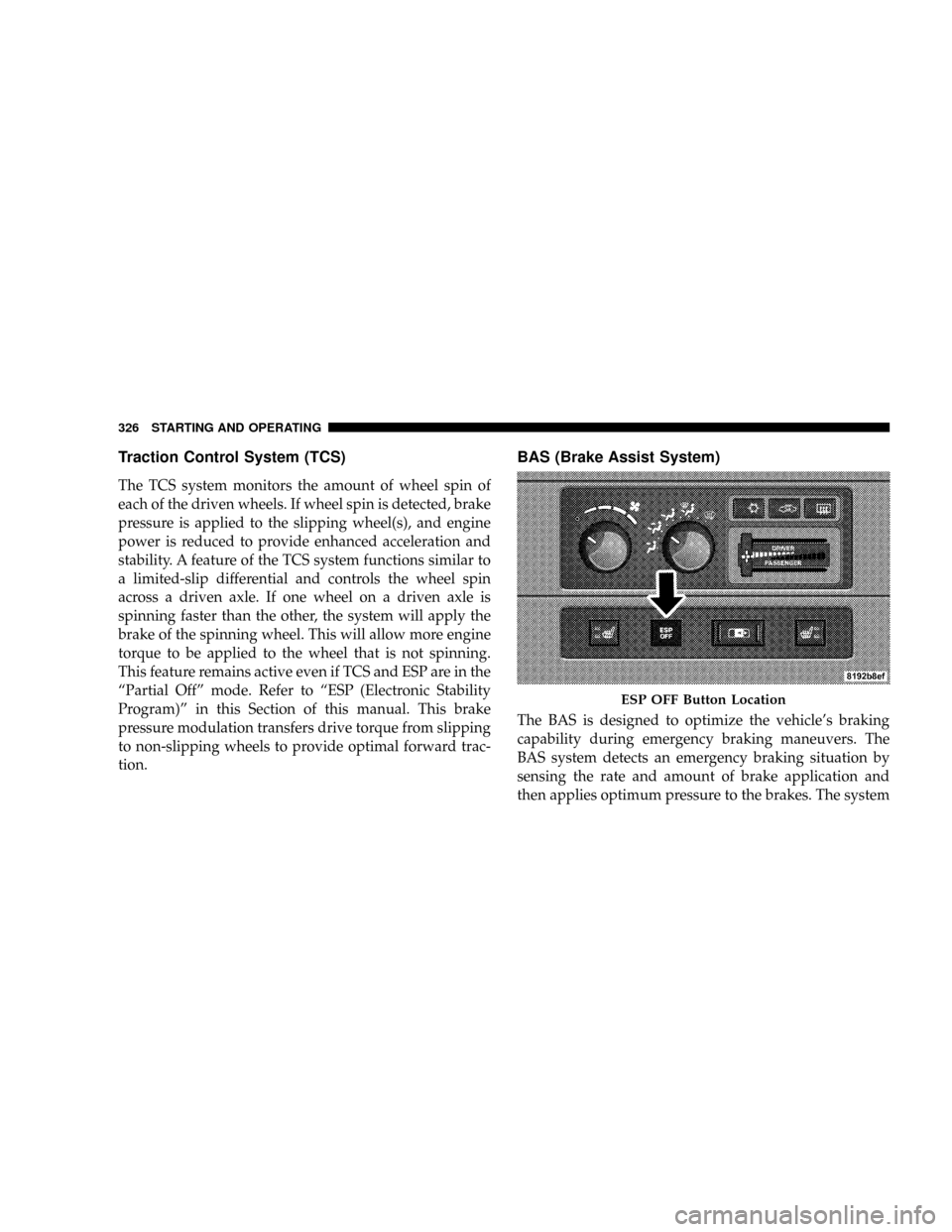
ESP OFF Button Location
326 STARTING AND OPERATING
Page 335 of 554
ESP (Electronic Stability Program)
The ESP system enhances directional control and stability
of the vehicle under various driving conditions. ESP
corrects for oversteering or understeering of the vehicle
by applying the brake of the appropriate wheel to assist
in counteracting the oversteer or understeer condition.
Engine power may also be reduced to help the vehicle
maintain the desired path.
ESP uses sensors in the vehicle to determine the vehicle
path intended by the driver and compares it to the actual
path of the vehicle. When the actual path does not match
the intended path, ESP applies the brake of the appropri-
ate wheel to assist in counteracting the oversteer or
understeer condition.
²Oversteer - when the vehicle is turning more than
appropriate for the steering wheel position.
²Understeer - when the vehicle is turning less than
appropriate for the steering wheel position.
ESP/TCS Indicator Light
The ªESP/TCS Indicator Lightº located in the
instrument cluster, starts to flash as soon as the
tires lose traction and the ESP system becomes
active. The ªESP/TCS Indicator Lightº also
flashes when TCS is active. If the ªESP/TCS Indicator
Lightº begins to flash during acceleration, ease up on the
accelerator and apply as little throttle as possible. Be sure
to adapt your speed and driving to the prevailing road
conditions.
STARTING AND OPERATING 333
5
Page 337 of 554
ESP Partial Off
This mode is entered by momentarily depressing the
9ESP OFFº switch. When in9Partial Off9mode, the TCS
portion of ESP, except for the ªlimited slipº feature
described in the TCS section, has been disabled and the
9ESP/TCS Indicator Light9will be illuminated. All other
stability features of ESP function normally. This mode is
intended to be used if the vehicle is in deep snow, sand,
or gravel conditions and more wheel spin than ESP
would normally allow is required to gain traction. To
turn ESP on again, momentarily depress the9ESP OFFº
switch. This will restore the normal ªESP Onº mode of
operation.
NOTE:To improve the vehicle's traction when driving
with snow chains, or starting off in deep snow, sand or
gravel, it may be desirable to switch to the ªPartial Offº
mode by pressing the ESP switch. Once the situation
requiring ESP to be switched to the ªPartial Offº mode isovercome, turn ESP back on by momentarily depressing
the ªESP Control Switchº. This may be done while the
vehicle is in motion.
WARNING!
In the Partial Off mode, the engine torque reduction
and stability features are desensitized. Therefore, the
enhanced vehicle stability offered by ESP is
unavailable.
All 4WD vehicles in Auto and 4HI Modes can also
choose the following ESP operating mode. This is
the only ESP operating mode in 4LO:
Full Off
This mode is intended for off-road use when ESP stability
features could inhibit vehicle maneuverability due to trail
conditions. This mode is entered by depressing and
STARTING AND OPERATING 335
5
Page 531 of 554
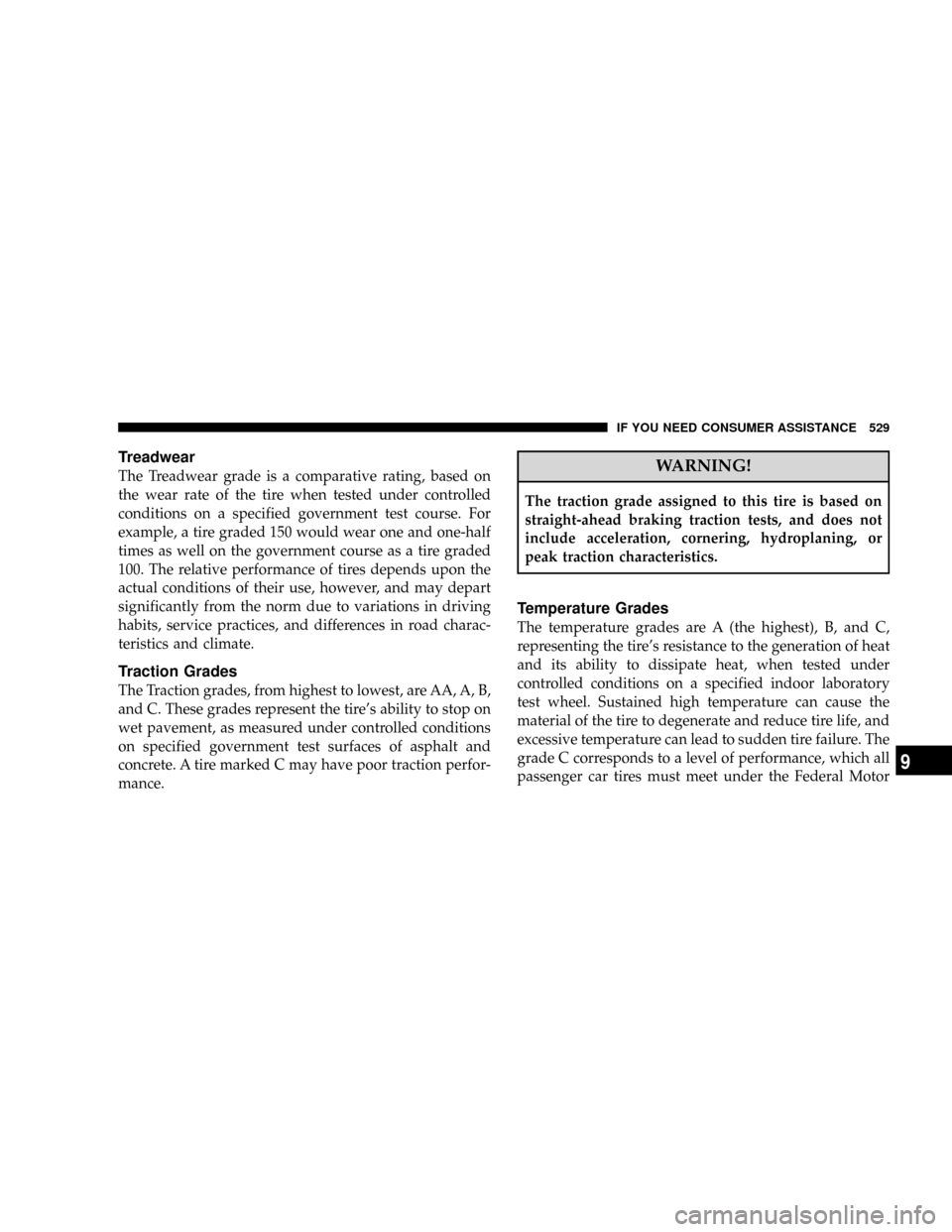
Treadwear
The Treadwear grade is a comparative rating, based on
the wear rate of the tire when tested under controlled
conditions on a specified government test course. For
example, a tire graded 150 would wear one and one-half
times as well on the government course as a tire graded
100. The relative performance of tires depends upon the
actual conditions of their use, however, and may depart
significantly from the norm due to variations in driving
habits, service practices, and differences in road charac-
teristics and climate.
Traction Grades
The Traction grades, from highest to lowest, are AA, A, B,
and C. These grades represent the tire's ability to stop on
wet pavement, as measured under controlled conditions
on specified government test surfaces of asphalt and
concrete. A tire marked C may have poor traction perfor-
mance.
WARNING!
The traction grade assigned to this tire is based on
straight-ahead braking traction tests, and does not
include acceleration, cornering, hydroplaning, or
peak traction characteristics.
Temperature Grades
The temperature grades are A (the highest), B, and C,
representing the tire's resistance to the generation of heat
and its ability to dissipate heat, when tested under
controlled conditions on a specified indoor laboratory
test wheel. Sustained high temperature can cause the
material of the tire to degenerate and reduce tire life, and
excessive temperature can lead to sudden tire failure. The
grade C corresponds to a level of performance, which all
passenger car tires must meet under the Federal Motor
IF YOU NEED CONSUMER ASSISTANCE 529
9
Page 538 of 554
Electronic Stability Program............... 333
Traction Control System................. 326
Electronic Roll Mitigation (ERM)............. 332
Electronic Speed Control (Cruise Control)...... 145
Electronic Stability Program (ESP).........204,333
Electronically Shifted Transfer Case........298,306
Emergency Brake........................ 318
Emergency, In Case of
Freeing Vehicle When Stuck............... 437
Hazard Warning Flasher................. 416
Jacking............................. 423
Jump Starting......................... 434
Tow Hooks.......................... 438
Towing............................. 439
Emission Control System Maintenance......... 514
Emission Related Components.............. 457
Engine..........................444,445,446
Air Cleaner.......................... 455
Block Heater......................... 282Break-In Recommendations................ 76
Compartment Identification.........444,445,446
Coolant (Antifreeze).................... 510
Exhaust Gas Caution.................... 375
Flooded, Starting...................... 280
Fuel Requirements..................... 508
Multi-Displacement..................... 338
Oil ...........................451,508,510
Oil Filler Cap......................... 452
Oil Selection.......................452,508
Oil Synthetic......................... 453
Temperature Gauge..................... 198
Equipment Identification Plate.............. 413
Event Data Recorder...................... 60
Exhaust Gas Caution..............78,187,375,465
Exhaust System....................78,464,465
Exterior Lighting........................ 136
Fabric Care............................ 486
536 INDEX
Page 543 of 554
Seat Belt Reminder..................... 197
Service...........................494,495
Side Marker.......................... 507
Tire Pressure Monitoring (TPMS)........... 204
Traction Control....................... 333
Transfer Case......................... 298
Transmission Warning................... 207
Turn Signal..................139,196,495,499
Warning (Instrument Cluster Description)..... 196
Limited-Slip Differential................313,475
Loading Vehicle......................... 381
Tires ............................... 343
Locks................................. 27
Child Protection........................ 31
Door................................ 27
Keys................................ 12
Power Door........................... 28
Steering Wheel......................... 18Lower Anchors and Tether for CHildren
(LATCH).............................. 66
Lubrication, Body....................... 462
Lug Nuts............................. 428
Lumbar Support........................ 122
Maintenance........................... 450
Maintenance Free Battery.................. 457
Maintenance Procedures................... 450
Maintenance Schedule.................... 514
Malfunction Indicator Light (Check Engine)..... 448
Manual, Service......................... 527
Manual Transmission...............288,291,476
Fluid Level Check...................475,476
Lubricant Selection..................476,511
Shift Speeds.......................... 290
Mirrors................................ 86
Automatic Dimming..................... 87
Electric Powered....................... 88
INDEX 541
10
Page 550 of 554
Spinning............................ 353
Tread Wear Indicators................... 353
Wheel Mounting....................... 423
Wheel Nut Torque..................... 428
Tongue Weight/Trailer Weight.............. 390
Torque Converter Clutch.................. 288
Tow Hooks, Emergency................... 438
Towing............................... 385
24-Hour Towing Assistance............... 104
Disabled Vehicle....................... 439
Guide.............................. 390
Recreational.......................... 406
Weight.............................. 390
Towing Assistance....................... 104
Traction.............................. 314
Traction Control......................206,326
Trailer Sway Control (TSC)................. 337
Trailer Towing.......................... 385
Cooling System Tips.................... 399Hitches............................. 389
Minimum Requirements................. 392
Mirrors...........................89,400
Trailer and Tongue Weight................ 390
Wiring.............................. 396
Trailer Towing Guide..................... 390
Trailer Weight.......................... 390
Transaxle
Automatic............................ 12
Manual.............................. 14
Transfer Case........................... 475
Electronically Shifted.................298,306
Fluid............................... 511
Transmission
Automatic........................283,476
Fluid............................... 511
Maintenance.......................... 476
Manual.....................279,288,291,476
Shifting..........................282,291
548 INDEX