cooling DODGE RAM 2500 POWER WAGON 2008 3.G User Guide
[x] Cancel search | Manufacturer: DODGE, Model Year: 2008, Model line: RAM 2500 POWER WAGON, Model: DODGE RAM 2500 POWER WAGON 2008 3.GPages: 504, PDF Size: 8.17 MB
Page 428 of 504

CAUTION!
Mixing of coolants other than specified HOAT en-
gine coolants, may result in engine damage and may
decrease corrosion protection. If a non-HOAT coolant
is introduced into the cooling system in an emer-
gency, it should be replaced with the specified cool-
ant as soon as possible.
Do not use plain water alone or alcohol base engine
coolant (antifreeze) products. Do not use additional
rust inhibitors or antirust products, as they may not
be compatible with the radiator engine coolant and
may plug the radiator.
This vehicle has not been designed for use with
Propylene Glycol based coolants. Use of Propylene
Glycol based coolants is not recommended.
Adding Coolant
Your vehicle has been built with an improved engine
coolant that allows extended maintenance intervals. This
coolant can be used up to 5 Years or 100,000 miles before
replacement. To prevent reducing this extended mainte-
nance period, it is important that you use the same
coolant throughout the life of your vehicle. Please review
these recommendations for using Hybrid Organic Addi-
tive Technology (HOAT) coolant.
When adding coolant, a minimum solution of 50% rec-
ommended Mopar Antifreeze/ Coolant 5 Year/100,000
Mile Formula HOAT (Hybrid Organic Additive Technol-
ogy), or equivalent, in water should be used. Use higher
concentrations (not to exceed 70%) if temperatures below
234ÉF (237ÉC ) are anticipated.
Use only high purity water such as distilled or deionized
water when mixing the water/engine coolant solution.
428 MAINTAINING YOUR VEHICLE
Page 429 of 504

The use of lower quality water will reduce the amount of
corrosion protection in the engine cooling system.
Please note that it is the owner's responsibility to main-
tain the proper level of protection against freezing ac-
cording to the temperatures occurring in the area where
the vehicle is operated.
NOTE:Mixing coolant types will decrease the life of the
engine coolant and will require more frequent coolant
changes.
Cooling System Pressure Cap
The cap must be fully tightened to prevent loss of
coolant, and to insure that coolant will return to the
radiator from the coolant recovery bottle.
The cap should be inspected and cleaned if there is any
accumulation of foreign material on the sealing surfaces.
WARNING!
²The warning words ªDO NOT OPEN HOTº on
the cooling system pressure cap are a safety pre-
caution. Never add coolant when the engine is
overheated. Do not loosen or remove the cap to
cool an overheated engine. Heat causes pressure to
build up in the cooling system. To prevent scald-
ing or injury, do not remove the pressure cap while
the system is hot or under pressure.
²Do not use a pressure cap other than the one
specified for your vehicle. Personal injury or en-
gine damage may result.
Disposal of Used Engine Coolant
Used ethylene glycol based engine coolant is a regulated
substance requiring proper disposal. Check with your
local authorities to determine the disposal rules for your
MAINTAINING YOUR VEHICLE 429
7
Page 431 of 504

²Check coolant freeze point in the radiator and in the
coolant recovery bottle. If antifreeze needs to be
added, contents of coolant recovery bottle must also be
protected against freezing.
²If frequent coolant additions are required, or if the
level in the coolant recovery bottle does not drop when
the engine cools, the cooling system should be pres-
sure tested for leaks.
²Maintain coolant concentration at 50% HOAT engine
coolant (minimum) and distilled water for proper
corrosion protection of your engine which contains
aluminum components.
²Make sure that the radiator and coolant recovery
bottle overflow hoses are not kinked or obstructed.
²Keep the front of the radiator clean. If your vehicle is
equipped with air conditioning, keep the front of the
condenser clean, also.
²Do not change the thermostat for summer or winter
operation. If replacement is ever necessary, install
ONLY the correct type thermostat. Other designs may
result in unsatisfactory coolant performance, poor gas
mileage, and increased emissions.
Hoses And Vacuum/Vapor Harnesses
Inspect surfaces of hoses and nylon tubing for evidence
of heat and mechanical damage. Hard or soft spots,
brittle rubber, cracking, tears, cuts, abrasions, and exces-
sive swelling indicate deterioration of the rubber.
Pay particular attention to those hoses nearest to high
heat sources such as the exhaust manifold. Inspect hose
routing to be sure hoses do not come in contact with any
heat source or moving component which may cause heat
damage or mechanical wear.
Insure nylon tubing in these areas has not melted or
collapsed.
MAINTAINING YOUR VEHICLE 431
7
Page 441 of 504

EXHAUST SYSTEM
²Removal or rendering inoperative exhaust system
components including the muffler or tailpipe.
ENGINE COOLING SYSTEM
²Removal or rendering inoperative the fan clutch.
²Removal of the fan shroud.
Noise Emission Warranty
The manufacturer warrants that this vehicle as manufac-
tured by the manufacturer, was designed, built and
equipped to conform at the time it left the manufacturers
control with all applicable U.S. EPA Noise Control Regu-
lations.This warranty covers this vehicle as designed, built and
equipped by the manufacturer, and is not limited to any
particular part, component or system of the vehicle
manufactured by the manufacturer. Defects in design,
assembly or in any part, component or system of the
vehicle as manufactured by the manufacturer, which, at
the time it left the manufacturers control, caused noise
emissions to exceed Federal standards, are covered by
this warranty for the life of the vehicle.
MAINTAINING YOUR VEHICLE 441
7
Page 464 of 504
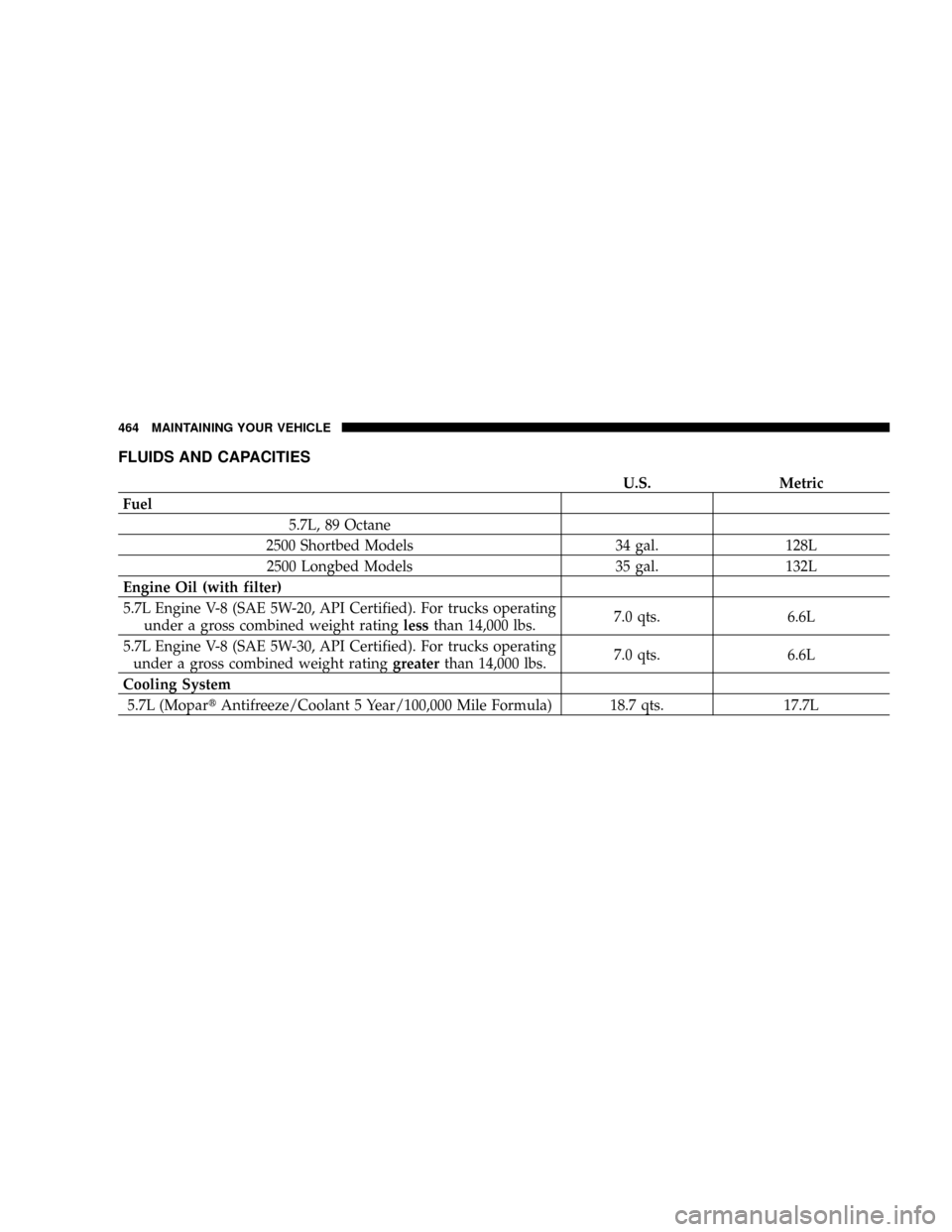
FLUIDS AND CAPACITIES
U.S. Metric
Fuel
5.7L, 89 Octane
2500 Shortbed Models 34 gal. 128L
2500 Longbed Models 35 gal. 132L
Engine Oil (with filter)
5.7L Engine V-8 (SAE 5W-20, API Certified). For trucks operating
under a gross combined weight ratinglessthan 14,000 lbs.7.0 qts. 6.6L
5.7L Engine V-8 (SAE 5W-30, API Certified). For trucks operating
under a gross combined weight ratinggreaterthan 14,000 lbs.7.0 qts. 6.6L
Cooling System
5.7L (MopartAntifreeze/Coolant 5 Year/100,000 Mile Formula) 18.7 qts. 17.7L
464 MAINTAINING YOUR VEHICLE
Page 488 of 504

Center High Mounted Stop Light............ 459
Center Lap Belts......................... 44
Center Seat Storage Compartment............ 163
Certification Label....................... 364
Chart, Tire Sizing........................ 328
Check Engine Light (Malfunction Indicator
Light)................................ 184
Child Restraint........................61,62
Child Restraint Tether Anchors.............65,69
Child Seat............................62,68
Cigar Lighter........................... 161
Cleaning
Wheels............................. 445
Climate Control......................... 239
Clock.....................190,194,202,215,228
Clutch............................... 433
Clutch Linkage Maintenance................ 433
Compact Disc (CD) Maintenance............. 238
Compact Spare Tire...................... 339Compass.............................. 147
Compass Calibration..................... 147
Compass Variance....................... 148
Computer, Trip/Travel.................... 143
Console, Overhead....................... 142
Contract, Service........................ 478
Coolant Pressure Cap (Radiator Cap).......... 429
Cooling System......................... 426
Adding Coolant (Antifreeze).............. 428
Coolant Capacity...................... 464
Coolant Level......................426,430
Disposal of Used Coolant................ 429
Drain, Flush, and Refill.................. 427
Inspection........................... 430
Points to Remember.................... 430
Pressure Cap......................... 429
Radiator Cap......................... 429
Selection of Coolant (Antifreeze)......427,464,465
Temperature Gauge..................... 181
488 INDEX
Page 501 of 504

Snow Tires........................... 345
Spare Tire........................... 392
Spinning............................ 340
Tread Wear Indicators................... 341
Wheel Mounting....................... 393
Wheel Nut Torque..................... 396
Tongue Weight/Trailer Weight.............. 372
Torque Converter Clutch.................. 267
Tow Hooks, Emergency................... 402
Towing............................... 367
Disabled Vehicle....................... 403
Guide.............................. 372
Recreational.......................... 384
Weight.............................. 372
Traction.............................. 276
Trailer Towing.......................... 367
Cooling System Tips.................... 381
Hitches............................. 371
Minimum Requirements................. 373Mirrors...........................92,381
Trailer and Tongue Weight................ 372
Wiring.............................. 377
Trailer Towing Guide..................... 372
Trailer Weight.......................... 372
Transaxle
Automatic............................ 13
Manual.............................. 14
Transfer Case........................... 435
Fluid............................... 466
Transmission
Automatic........................262,436
Fluid............................... 466
Maintenance.......................435,436
Manual........................258,268,435
Shifting............................. 262
Transmitter, Garage Door Opener (HomeLinkt) . . 150
Tread Wear Indicators.................... 341
Trip Computer.......................... 143
INDEX 501
10
Page 504 of 504
INTRODUCTION INTRODUCTION HOW TO USE THIS MANUAL WARNINGS AND CAUTIONS VAN CONVERSIONS/CAMPERS VEHICLE IDENTIFICATION NUMBER VEHICLE MODIFICATIONS/ALTERATIONS THINGS TO KNOW BEFORE STARTING YOUR VEHICLE
POWER WAGON: THINGS TO KNOW BEFORE STARTING YOUR VEHICLE FeaturesInstrument Panel and ControlsOperationEmergenciesA WORD ABOUT YOUR KEYS Ignition Key RemovalLocking Doors With The KeySENTRY KEY Replacement KeysCustomer Key
ProgrammingGeneral InformationSTEERING WHEEL LOCK - IF EQUIPPED If You Wish To Manually Lock The Steering WheelTo Release The Steering Wheel LockAutomatic Transmission Ignition Interlock SystemSECURITY ALARM SYSTEM - IF EQUIPPED Rearming
of the SystemTo Set the AlarmTo Disarm the SystemILLUMINATED ENTRY SYSTEM - IF EQUIPPED REMOTE KEYLESS ENTRY - IF EQUIPPED To unlock the doorsTo lock the doorsUsing the Panic AlarmGeneral InformationTransmitter Battery Service REMOTE
STARTING SYSTEM - IF EQUIPPED DOOR LOCKS Manual Door LocksPower Door Locks - If EquippedChild Protection Door LockWINDOWS Power Windows-If EquippedWind BuffetingOCCUPANT RESTRAINTS Lap/Shoulder BeltsAdjustable Upper Shoulder Belt
AnchorageAutomatic Locking Retractors (ALR) Mode - If EquippedCenter Lap BeltsSeat Belt Pretensioners - If EquippedEnhanced Seat Belt Reminder System (BeltAlert) Seat Belts and Pregnant WomenSeat Belt ExtenderDriver And Right Front Passenger Supplemental
Restraint System (SRS)-Airbags Event Data Recorder (EDR)Child RestraintENGINE BREAK-IN RECOMMENDATIONS SAFETY TIPS Transporting PassengersLock Your VehicleExhaust GasSafety Checks You Should Make Inside The VehicleSafety Checks You Should
Make Outside The VehicleUNDERSTANDING THE FEATURES OF YOUR VEHICLE POWER WAGON FEATURES Locking Front and Rear Differentials4.56:1 GearsElectronically Disconnecting Stabilizer/Sway BarIncreased Ride Height12,000 lb. WinchHigh-Pressure
Monotube Shocks/New Front and Rear SpringsOff-Road TiresSkid Plates And Underbody ProtectionWheel FlaresWheelsStandard package featuresMoparOptionsMIRRORS Inside MirrorAutomatic Dimming Mirror - If EquippedOutside MirrorsExterior Mirrors Folding Feature
Electronic Power Mirrors - If Equipped Electric Rear Window Defroster and Heated Sideview Mirrors - If EquippedTrailer Towing Mirrors - If EquippedHANDS-FREE COMMUNICATION (UConnect) - IF EQUIPPED OperationPhone Call FeaturesUConnect System Features
Advanced Phone ConnectivityThings You Should Know About Your UConnect SystemGeneral InformationSEATS 40-20-40 Front Seat Reclining SeatsAdjustable Head RestraintsManual Rotary Lumbar Support Adjustment - If EquippedPower Seats - If EquippedHeated Seats
- If EquippedTO OPEN AND CLOSE THE HOOD LIGHTS Interior Lights Battery SaverHeadlamp DelayHeadlights, Parking Lights, Panel LightsDaytime RunningLights (Canada Only and Fleet Vehicles)Lights-on ReminderFog Lights - If EquippedCargo Light - If Equipped
Multifunction Control LeverWINDSHIELD WIPERS AND WASHERS Windshield Wipers Windshield WashersTILT STEERING COLUMN ELECTRONIC SPEED CONTROL - IFEQUIPPED To ActivateTo Set At A Desired SpeedTo DeactivateTo Resume SpeedTo Vary The
Speed SettingTo Accelerate For PassingOVERHEAD CONSOLE - IF EQUIPPED Courtesy/Reading LightsOVERHEAD CONSOLE WITH COMPASS/TEMPERATURE MINI-TRIP COMPUTER - IF EQUIPPED US/M Button RESET Button Global ResetStep Button Average
Fuel Economy (AVG ECO)Distance To Empty (DTE)Trip Odometer (ODO)Elapsed Time (ET)C/T Button Automatic Compass CalibrationManual Compass CalibrationRecalibrating The CompassOutside TemperatureGARAGE DOOR OPENER - IF EQUIPPED Programming
HomeLinkGate Operator/Canadian ProgrammingUsing HomeLinkReprogramming a Single HomeLink ButtonSecurityTroubleshooting TipsGeneral InformationPOWER SUNROOF - IF EQUIPPED Open Sunroof - Express ModeComfort StopClosing Sunroof - ExpressPinch
Protect FeaturePinch Protect OverrideVenting Sunroof - ExpressSunshade OperationWind BuffetingSunroof MaintenanceSunroof Fully ClosedELECTRICAL POWER OUTLETS CIGAR LIGHTER AND ASH RECEIVER CUPHOLDERS Front Instrument Panel Cupholders
Rear Cupholder - Quad Cab - If EquippedSTORAGE Center Storage Compartment - If Equipped Storage and Seats - If EquippedREAR WINDOW FEATURES Electric Rear Window Defroster and Heated Side view Mirrors - If EquippedPower Sliding Rear Window - If Equipped
Sliding Rear Window - If EquippedFOLD FLAT LOAD FLOOR - IF EQUIPPED PICKUP BOX SLIDE-IN CAMPERS EASY-OFF TAILGATE UNDERSTANDING YOUR INSTRUMENT PANEL INSTRUMENTS AND CONTROLS INSTRUMENT CLUSTER INSTRUMENT
CLUSTER DESCRIPTION ELECTRONIC DIGITAL CLOCK Clock Setting ProcedureRADIO GENERAL INFORMATION Radio Broadcast SignalsTwo Types of SignalsElectrical DisturbancesAM ReceptionFM ReceptionSALES CODE REF - AM/FM/CD (SINGLE DISC) RADIO
WITH OPTIONAL SATELLITE RADIO AND HANDS FREE PHONE CAPABILITY Operating Instructions - Radio ModeOperation Instructions - CD ModeOperation Instructions - Auxiliary ModeOperating Instructions - Hands Free Phone - If EquippedOperating Instructions
- Satellite Radio - If EquippedSALES CODE RAQ - AM/FM/CD (6-DISC) RADIO WITH OPTIONAL SATELLITE RADIO, HANDS FREE PHONE, AND VEHICLE ENTERTAINMENT SYSTEMS (VES) CAPABILITIES Operating Instructions - Radio ModeOperation Instructions
- (CD MODE for CD Audio Play)LOAD/EJECT Button (CD Mode for CD Audio Play)Notes On Playing MP3 FilesOperation Instructions - (CD Mode for MP3 Audio Play)LOAD/EJECT Button (CD Mode for MP3 Play)SALES CODE RAK - AM/FM/CASSETTE/CD (6-DISC)
RADIO WITH OPTIONAL SATELLITE RADIO, HANDS FREE PHONE, VIDEO, MP3, and WMA CAPABILITIES Operating Instructions - Radio ModeOperating Instructions- Tape PlayerSeek ButtonFast Forward (FF)Rewind (RW)Tape EjectScan ButtonChanging Tape
DirectionMetal Tape SelectionPinch Roller ReleaseNoise ReductionOperation Instructions - (CD MODE for CD Audio Play)LOAD/EJECT Button (CD Mode for CD Audio Play)Notes On Playing MP3 FilesOperation Instructions - (CD Mode for MP3 and WMA Audio Play)
LOAD/EJECT Button (CD Mode for MP3 and WMA Play)SALES CODE REC - AM/FM/CD (6-DISC) RADIO WITH NAVIGATION SYSTEM Operating Instructions - Satellite Radio (If Equipped)REC Setting the ClockAudio Clock DisplaySATELLITE RADIO - IF EQUIPPED
System ActivationElectronic Serial Number/Sirius Identification Number (ESN/SID)Selecting Satellite Mode in REF, RAQ, and RAK RadiosSelectinga ChannelStoring and Selecting Pre-Set ChannelsUsing the PTY (Program Type) Button - If EquippedPTY Button SCAN
PTY Button SEEKSatellite AntennaReception QualityREMOTE SOUND SYSTEM CONTROLS - IF EQUIPPED Radio OperationTape PlayerCD PlayerCASSETTE TAPE AND PLAYER MAINTENANCE COMPACT DISC MAINTENANCE RADIO OPERATION AND CELLULAR
PHONES CLIMATE CONTROLS Heater Only - Fleet Vehicles Air Conditioning and Heating - If Equipped Air Conditioning with Dual Zone Temperature Control -If EquippedOperating TipsOperating Tips Chart STARTING AND OPERATING STARTING PROCEDURES -
GAS ENGINES Manual Transmission - If EquippedAutomatic Transmission - If EquippedNormal StartingIf Engine Fails To StartAfter StartingENGINE BLOCK HEATER - IF EQUIPPED AUTOMATIC TRANSMISSION Automatic Transmission with OverdriveMANUAL
TRANSMISSION Manual Transmission - 6 Speed (G56)Recommended Vehicle Shift SpeedsDownshifting - All Manual TransmissionsFOUR-WHEEL- DRIVE OPERATION Manually Shifted Transfer Case Operating Information/PrecautionsShifting Procedure - Manually
Shifted Transfer Case Transfer Case Reminder LightLIMITED-SLIP DIFFERENTIAL - IF EQUIPPED DRIVING ON SLIPPERY SURFACES Axle Locker System Stabilizer/Sway Bar System POWER WAGON - SAFE OFF-ROAD DRIVING Off-Road Driving Tips and Vehicle
CharacteristicsDriving in Snow, Mud and SandCrossing Obstacles (Rocks And Other High Points)Hill ClimbingDriving Through WaterAiring Down For Off-Road DrivingVehicle RecoveryAfter Driving Off-RoadWINCH USAGE - IF EQUIPPED Things To Know Before Using
Your WinchUNDERSTANDING THE FEATURES OF YOUR WINCH WINCH ACCESSORIESOPERATING YOUR WINCHRIGGING TECHNIQUESPARKING BRAKE BRAKE SYSTEM Brake NoiseFour-Wheel Anti-Lock Brake System (ABS) - If EquippedPOWER STEERING MULTI DISPLACEMENT SYSTEM (MDS) - 5.7L Engine Only TIRE SAFETY INFORMATION Tire Markings Tire Identification Number (TIN)Tire Loading and Tire PressureTIRES - GENERAL INFORMATION Tire PressureTire Inflation PressuresRadial-Ply TiresCompact Spare
Tire - If EquippedLimited Use Spare - If EquippedTire SpinningTread Wear IndicatorsLife of TireReplacement TiresAlignment And BalanceSUPPLEMENTAL TIRE PRESSURE INFORMATION - IF EQUIPPED TIRE CHAINS SNOW TIRES TIRE ROTATION
RECOMMENDATIONS TIRE PRESSURE MONITOR SYSTEM (TPMS) - IF EQUIPPED Tire Pressure Monitor System (TPMS) Light Load Reset Switch Description - If EquippedTire Pressure Monitor System ComponentsGeneral InformationFUEL REQUIREMENTS
Reformulated GasolineGasoline/Oxygenate BlendsMMT In GasolineSulfur In GasolineMaterials Added To FuelFuel System CautionsCarbon Monoxide WarningsADDING FUEL Adding Fuel (Gas Engines)VEHICLE LOADING Certification LabelTRAILER TOWING Common
Towing DefinitionsTrailer Hitch ClassificationTrailer Towing Weights (Maximum Trailer Weight Ratings)Trailer and Tongue WeightTowing RequirementsTowing TipsTrailer Towing Mirrors - If EquippedSNOWPLOW RECREATIONAL TOWING - 4-WHEEL DRIVE VEHICLES
(BEHIND MOTORHOME, ETC.) Recreational Towing Procedure - Manual Shift Transfer Case - If EquippedReturning to Normal Operation - Manual Shift Transfer CaseEQUIPMENT IDENTIFICATION PLATE WHAT TO DO IN EMERGENCIES HAZARD WARNING FLASHER
JACKING AND TIRE CHANGING All Models - If EquippedJACKING INSTRUCTIONS Removing The Spare TireTire Changing ProcedureHOISTING JUMP-STARTING FREEING A STUCK VEHICLE EMERGENCY TOW HOOKS - IF EQUIPPED TOWING A DISABLED
VEHICLE 4-Wheel-Drive VehiclesWINCH USAGE MAINTAINING YOUR VEHICLE ENGINE COMPARTMENT- 5.7L GAS ENGINE ONBOARD DIAGNOSTIC SYSTEM (OBD II) Loose Fuel Filler Cap MessageEMISSIONS INSPECTION AND MAINTENANCE PROGRAMS
REPLACEMENT PARTS DEALER SERVICE MAINTENANCE PROCEDURES Engine OilEngine Oil FilterDrive Belts - Check Condition and TensionSpark Plugs (Gas Engines)Engine Air Cleaner FilterEngine Fuel FilterCatalytic ConverterEmission-Related Components
Maintenance Free BatteryAir Conditioner MaintenancePower Steering - Fluid CheckFront Suspension Ball JointsSteering Linkage - InspectionFrontProp Shaft LubricationBody LubricationWindshield Wiper BladesWindshield WashersExhaust SystemCooling SystemHoses
And Vacuum/Vapor HarnessesBrake SystemClutch Hydraulic SystemClutch LinkageRear Axle And 4x4 Front Driving Axle Fluid LevelTransfer CaseFront Drive ShaftManual TransmissionAutomatic TransmissionFront Wheel BearingsNoise Control System Required
Maintenance and WarrantyAppearance Care and Protection from CorrosionFUSES (INTEGRATED POWER MODULE) VEHICLE STORAGE EPLACEMENT LIGHT BULBS BULB REPLACEMENT Headlight (Halogen)/Front Park and Turn LightsTail, Stop, Turn and Backup
LightsCenter High-Mounted Stoplight With Cargo LightCab Top Clearance Lights - If EquippedFog LightsFLUIDS AND CAPACITIES FLUIDS, LUBRICANTS ANDGENUINE PARTS EngineChassisMAINTENANCE SCHEDULES EMISSION CONTROL SYSTEM
MAINTENANCE MAINTENANCE SCHEDULE Required Maintenance IntervalsIF YOU NEED CONSUMER ASSISTANCE SUGGESTIONS FOR OBTAINING SERVICE FOR YOUR VEHICLE Prepare For The AppointmentPrepare A ListBe Reasonable With RequestsIF YOU
NEED ASSISTANCE WARRANTY INFORMATION (U.S. Vehicles Only) MOPAR PARTS REPORTING SAFETY DEFECTS In CanadaPUBLICATION ORDER FORMS DEPARTMENT OF TRANSPORTATION UNIFORM TIRE QUALITY GRADES TreadwearTraction Grades
Temperature GradesINDEX