engine coolant DODGE RAM 2500 POWER WAGON 2008 3.G User Guide
[x] Cancel search | Manufacturer: DODGE, Model Year: 2008, Model line: RAM 2500 POWER WAGON, Model: DODGE RAM 2500 POWER WAGON 2008 3.GPages: 504, PDF Size: 8.17 MB
Page 428 of 504
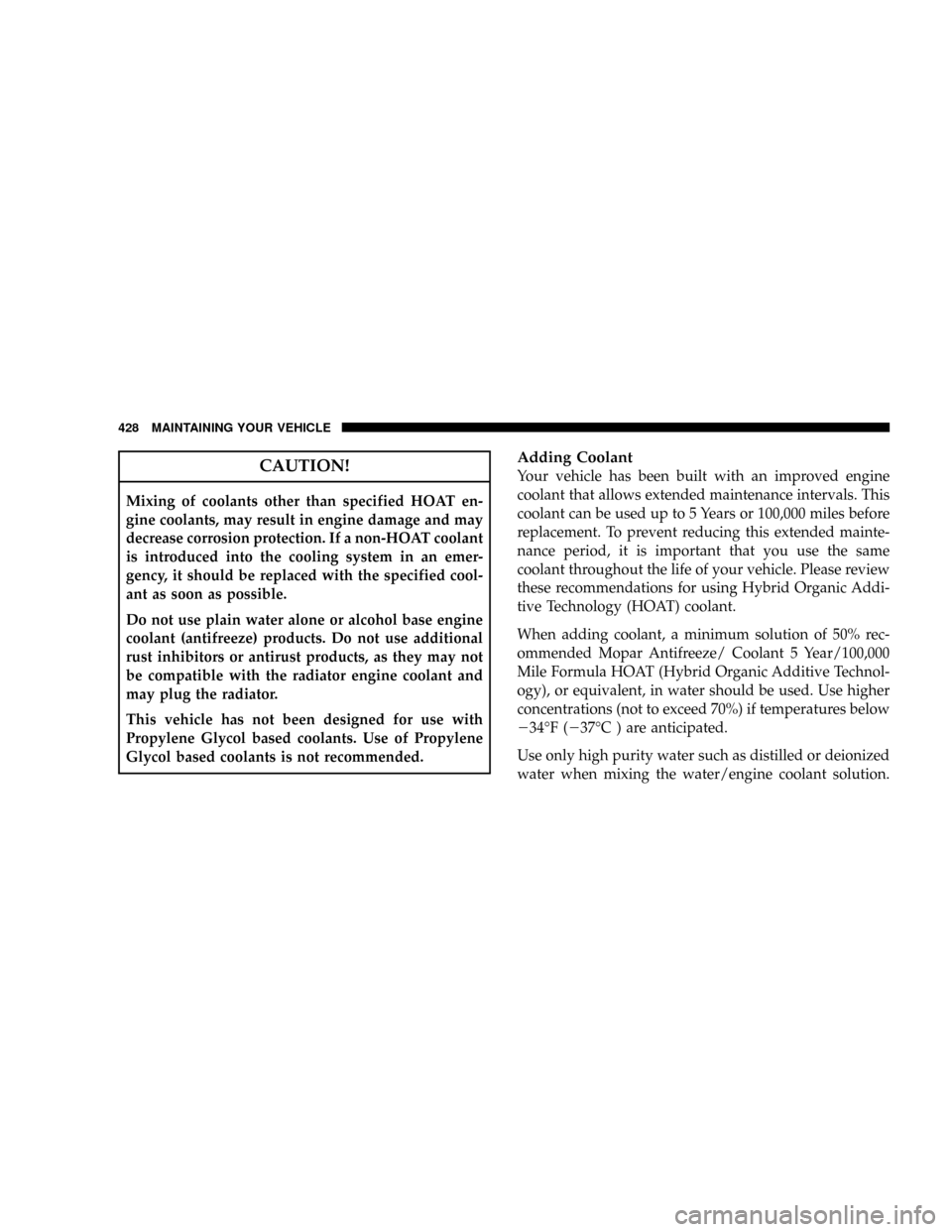
CAUTION!
Mixing of coolants other than specified HOAT en-
gine coolants, may result in engine damage and may
decrease corrosion protection. If a non-HOAT coolant
is introduced into the cooling system in an emer-
gency, it should be replaced with the specified cool-
ant as soon as possible.
Do not use plain water alone or alcohol base engine
coolant (antifreeze) products. Do not use additional
rust inhibitors or antirust products, as they may not
be compatible with the radiator engine coolant and
may plug the radiator.
This vehicle has not been designed for use with
Propylene Glycol based coolants. Use of Propylene
Glycol based coolants is not recommended.
Adding Coolant
Your vehicle has been built with an improved engine
coolant that allows extended maintenance intervals. This
coolant can be used up to 5 Years or 100,000 miles before
replacement. To prevent reducing this extended mainte-
nance period, it is important that you use the same
coolant throughout the life of your vehicle. Please review
these recommendations for using Hybrid Organic Addi-
tive Technology (HOAT) coolant.
When adding coolant, a minimum solution of 50% rec-
ommended Mopar Antifreeze/ Coolant 5 Year/100,000
Mile Formula HOAT (Hybrid Organic Additive Technol-
ogy), or equivalent, in water should be used. Use higher
concentrations (not to exceed 70%) if temperatures below
234ÉF (237ÉC ) are anticipated.
Use only high purity water such as distilled or deionized
water when mixing the water/engine coolant solution.
428 MAINTAINING YOUR VEHICLE
Page 429 of 504

The use of lower quality water will reduce the amount of
corrosion protection in the engine cooling system.
Please note that it is the owner's responsibility to main-
tain the proper level of protection against freezing ac-
cording to the temperatures occurring in the area where
the vehicle is operated.
NOTE:Mixing coolant types will decrease the life of the
engine coolant and will require more frequent coolant
changes.
Cooling System Pressure Cap
The cap must be fully tightened to prevent loss of
coolant, and to insure that coolant will return to the
radiator from the coolant recovery bottle.
The cap should be inspected and cleaned if there is any
accumulation of foreign material on the sealing surfaces.
WARNING!
²The warning words ªDO NOT OPEN HOTº on
the cooling system pressure cap are a safety pre-
caution. Never add coolant when the engine is
overheated. Do not loosen or remove the cap to
cool an overheated engine. Heat causes pressure to
build up in the cooling system. To prevent scald-
ing or injury, do not remove the pressure cap while
the system is hot or under pressure.
²Do not use a pressure cap other than the one
specified for your vehicle. Personal injury or en-
gine damage may result.
Disposal of Used Engine Coolant
Used ethylene glycol based engine coolant is a regulated
substance requiring proper disposal. Check with your
local authorities to determine the disposal rules for your
MAINTAINING YOUR VEHICLE 429
7
Page 430 of 504

community. To prevent ingestion by animals or children
do not store ethylene glycol based engine coolant in open
containers or allow it to remain in puddles on the
ground. If ingested by a child, contact a physician
immediately. Clean up any ground spills immediately.
Coolant Level
The coolant bottle provides a quick visual method for
determining that the coolant level is adequate. With the
engine cold, the level of the coolant in the coolant
recovery bottle should be between the ranges indicated
on the bottle.
The radiator normally remains completely full, so there is
no need to remove the radiator cap unless checking for
coolant freeze point or replacing coolant. Advise your
service attendant of this. As long as the engine operating
temperature is satisfactory, the coolant bottle need only
be checked once a month.When additional coolant is needed to maintain the
proper level, it should be added to the coolant bottle. Do
not overfill.
Points To Remember
NOTE:When the vehicle is stopped after a few miles (a
few kilometers) of operation, you may observe vapor
coming from the front of the engine compartment. This is
normally a result of moisture from rain, snow, or high
humidity accumulating on the radiator and being vapor-
ized when the thermostat opens, allowing hot coolant to
enter the radiator.
If an examination of your engine compartment shows no
evidence of radiator or hose leaks, the vehicle may be
safely driven. The vapor will soon dissipate.
²Do not overfill the coolant recovery bottle.
430 MAINTAINING YOUR VEHICLE
Page 431 of 504

²Check coolant freeze point in the radiator and in the
coolant recovery bottle. If antifreeze needs to be
added, contents of coolant recovery bottle must also be
protected against freezing.
²If frequent coolant additions are required, or if the
level in the coolant recovery bottle does not drop when
the engine cools, the cooling system should be pres-
sure tested for leaks.
²Maintain coolant concentration at 50% HOAT engine
coolant (minimum) and distilled water for proper
corrosion protection of your engine which contains
aluminum components.
²Make sure that the radiator and coolant recovery
bottle overflow hoses are not kinked or obstructed.
²Keep the front of the radiator clean. If your vehicle is
equipped with air conditioning, keep the front of the
condenser clean, also.
²Do not change the thermostat for summer or winter
operation. If replacement is ever necessary, install
ONLY the correct type thermostat. Other designs may
result in unsatisfactory coolant performance, poor gas
mileage, and increased emissions.
Hoses And Vacuum/Vapor Harnesses
Inspect surfaces of hoses and nylon tubing for evidence
of heat and mechanical damage. Hard or soft spots,
brittle rubber, cracking, tears, cuts, abrasions, and exces-
sive swelling indicate deterioration of the rubber.
Pay particular attention to those hoses nearest to high
heat sources such as the exhaust manifold. Inspect hose
routing to be sure hoses do not come in contact with any
heat source or moving component which may cause heat
damage or mechanical wear.
Insure nylon tubing in these areas has not melted or
collapsed.
MAINTAINING YOUR VEHICLE 431
7
Page 464 of 504
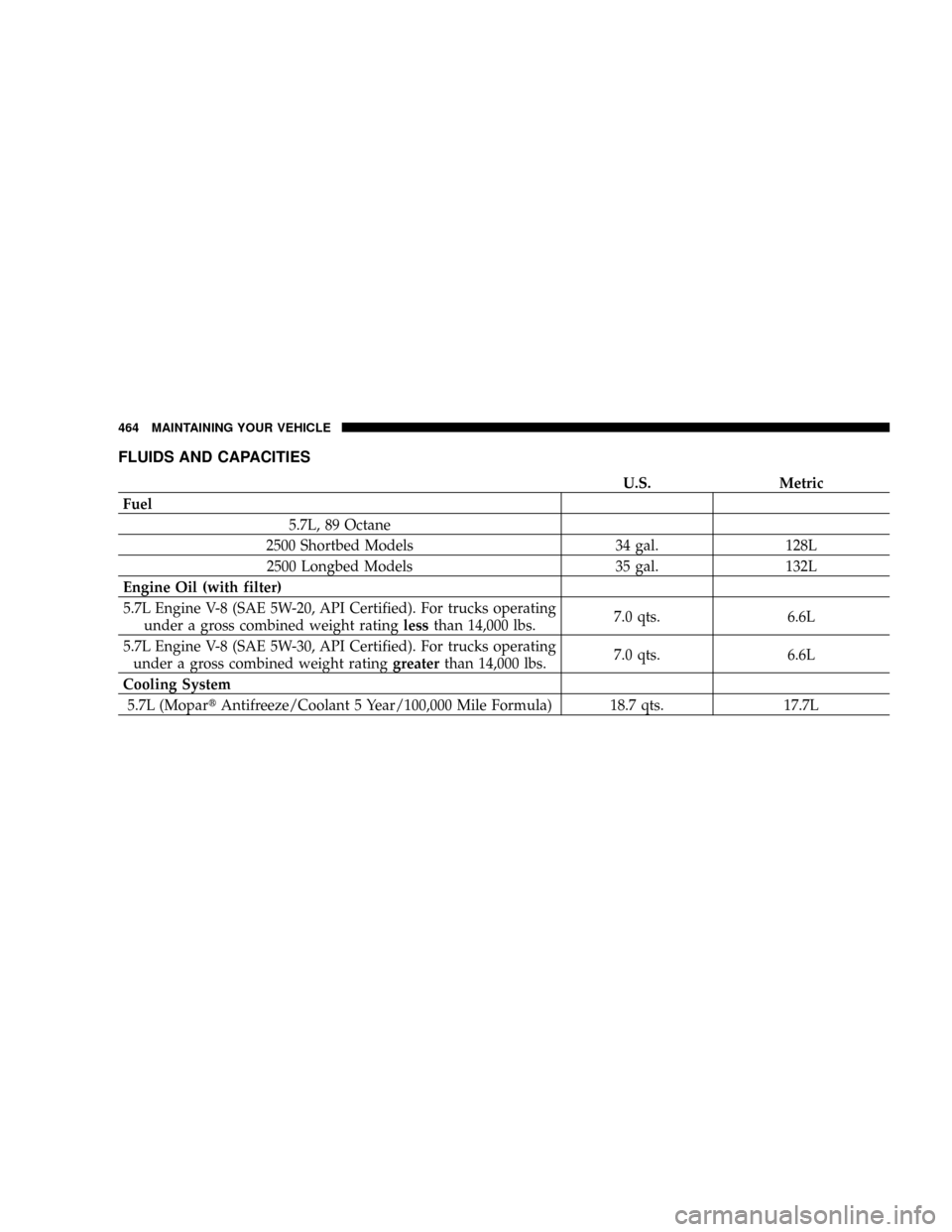
FLUIDS AND CAPACITIES
U.S. Metric
Fuel
5.7L, 89 Octane
2500 Shortbed Models 34 gal. 128L
2500 Longbed Models 35 gal. 132L
Engine Oil (with filter)
5.7L Engine V-8 (SAE 5W-20, API Certified). For trucks operating
under a gross combined weight ratinglessthan 14,000 lbs.7.0 qts. 6.6L
5.7L Engine V-8 (SAE 5W-30, API Certified). For trucks operating
under a gross combined weight ratinggreaterthan 14,000 lbs.7.0 qts. 6.6L
Cooling System
5.7L (MopartAntifreeze/Coolant 5 Year/100,000 Mile Formula) 18.7 qts. 17.7L
464 MAINTAINING YOUR VEHICLE
Page 465 of 504
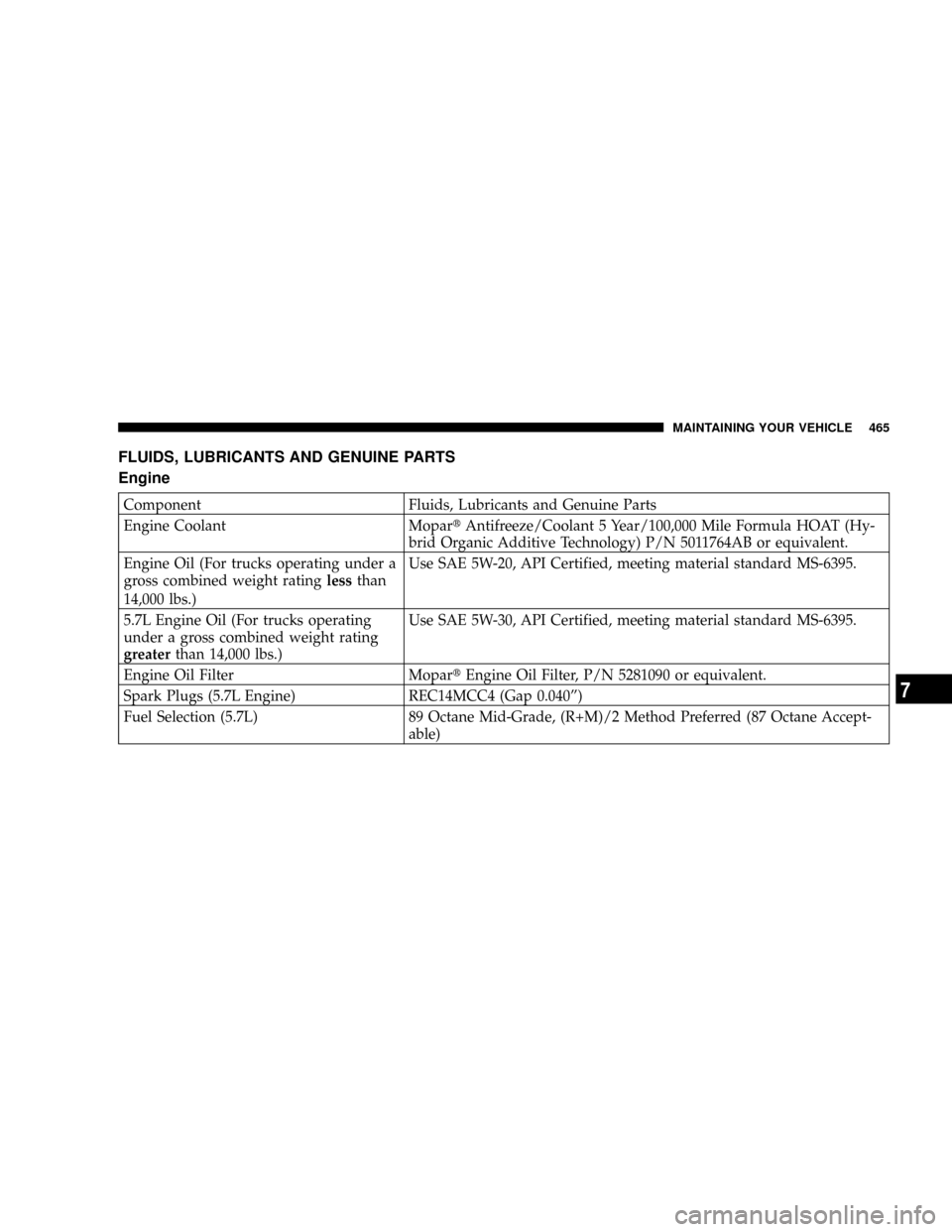
FLUIDS, LUBRICANTS AND GENUINE PARTS
Engine
Component Fluids, Lubricants and Genuine Parts
Engine Coolant MopartAntifreeze/Coolant 5 Year/100,000 Mile Formula HOAT (Hy-
brid Organic Additive Technology) P/N 5011764AB or equivalent.
Engine Oil (For trucks operating under a
gross combined weight ratinglessthan
14,000 lbs.)Use SAE 5W-20, API Certified, meeting material standard MS-6395.
5.7L Engine Oil (For trucks operating
under a gross combined weight rating
greaterthan 14,000 lbs.)Use SAE 5W-30, API Certified, meeting material standard MS-6395.
Engine Oil Filter MopartEngine Oil Filter, P/N 5281090 or equivalent.
Spark Plugs (5.7L Engine) REC14MCC4 (Gap 0.040º)
Fuel Selection (5.7L) 89 Octane Mid-Grade, (R+M)/2 Method Preferred (87 Octane Accept-
able)
MAINTAINING YOUR VEHICLE 465
7
Page 469 of 504

²Change your engine oil more often if you drive your
vehicle off-road for an extended period of time.
²Under no circumstances should oil change intervals
exceed 6,000 miles (10,000 km) or 6 months, whichever
comes first.
Your dealer will reset the oil change indicator message
after completing the scheduled oil change. If this sched-
uled oil change is performed by someone other than your
dealer the message can be reset by referring to the steps
described under ªOdometer/Trip Odometerº under ªIn-
strument Cluster Descriptionº in Section 4 of this
manual.
At Each Stop for Fuel
²Check the engine oil level about 5 minutes after a fully
warmed engine is shut off. Checking the oil level whilethe vehicle is on level ground will improve the accu-
racy of the oil level reading. Add oil only when the
level is at or below the ADD or MIN mark.
²Check the windshield washer solvent and add if
required.
Once a Month
²Check tire pressure and look for unusual wear or
damage.
²Inspect the battery and clean and tighten the terminals
as required.
²Check the fluid levels of coolant reservoir, brake
master cylinder, power steering and transmission and
add as needed.
²Check all lights and other electrical items for correct
operation.
MAINTENANCE SCHEDULES 469
8
M
A
I
N
T
E
N
A
N
C
E
S
C
H
E
D
U
L
E
S
Page 473 of 504
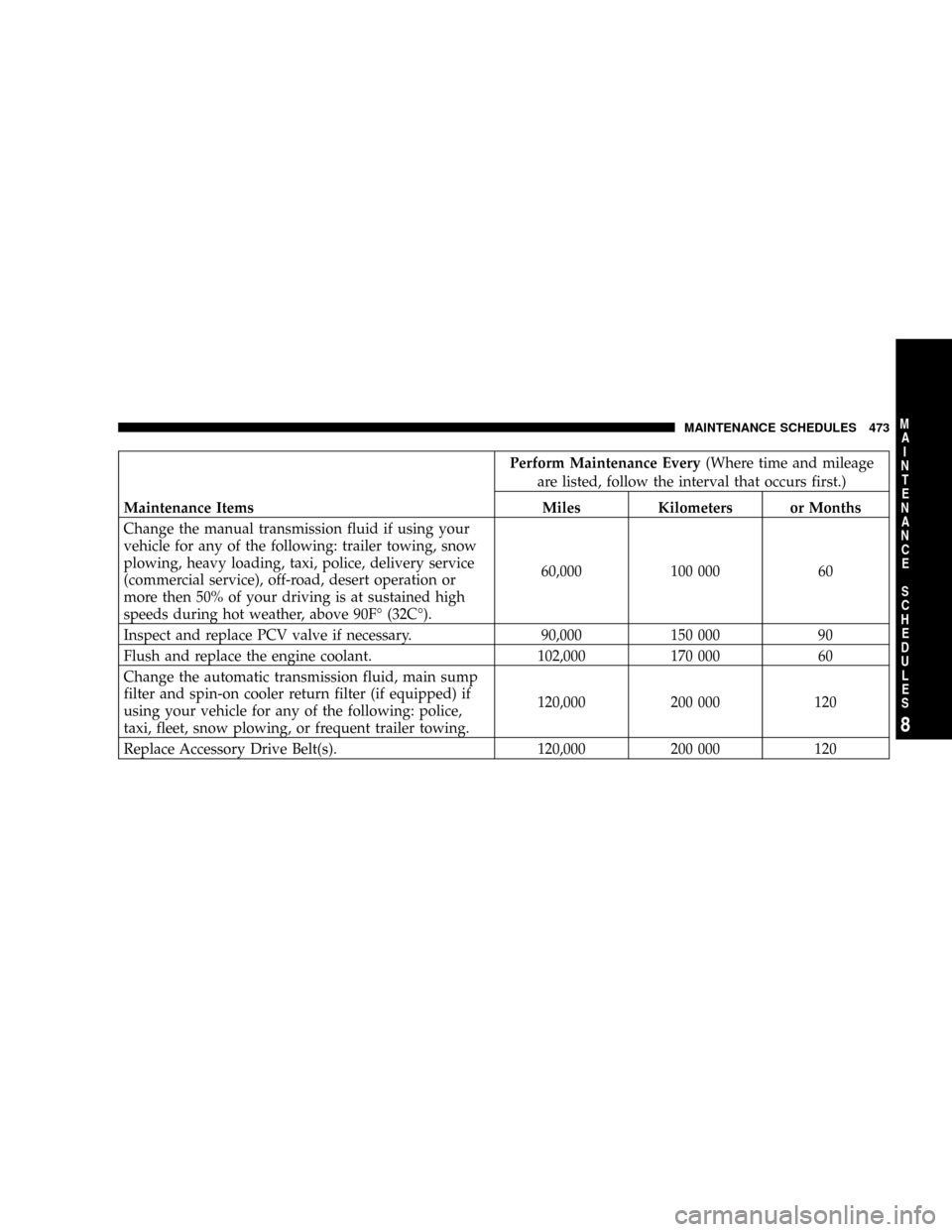
Perform Maintenance Every(Where time and mileage
are listed, follow the interval that occurs first.)
Maintenance Items Miles Kilometers or Months
Change the manual transmission fluid if using your
vehicle for any of the following: trailer towing, snow
plowing, heavy loading, taxi, police, delivery service
(commercial service), off-road, desert operation or
more then 50% of your driving is at sustained high
speeds during hot weather, above 90FÉ (32CÉ).60,000 100 000 60
Inspect and replace PCV valve if necessary. 90,000 150 000 90
Flush and replace the engine coolant. 102,000 170 000 60
Change the automatic transmission fluid, main sump
filter and spin-on cooler return filter (if equipped) if
using your vehicle for any of the following: police,
taxi, fleet, snow plowing, or frequent trailer towing.120,000 200 000 120
Replace Accessory Drive Belt(s). 120,000 200 000 120
MAINTENANCE SCHEDULES 473
8
M
A
I
N
T
E
N
A
N
C
E
S
C
H
E
D
U
L
E
S
Page 486 of 504

Adding Fuel........................... 362
Air Cleaner, Engine (Engine Air Cleaner
Filter).............................416,440
Air Conditioner Maintenance............... 420
Air Conditioning Refrigerant.............420,421
Air Conditioning System................242,420
Air Conditioning System, Zone Control........ 245
Air Pressure, Tires....................336,344
Airbag............................34,47,55
Airbag Light.......................58,77,180
Airbag On/Off Switch..................... 55
Alarm (Security Alarm).................19,182
Alarm System (Security Alarm)............... 19
Alignment and Balance................... 343
Alterations/Modifications, Vehicle............. 7
Antenna, Satellite Radio................... 234
Antifreeze (Engine Coolant)...........427,428,464
Disposal............................ 429Anti-Lock Warning Light...............185,323
Anti-Theft Security Alarm (Theft Alarm)........ 19
Anti-Theft System.....................19,182
Appearance Care........................ 443
Ashtray............................... 161
Automatic Dimming Mirror................. 89
Automatic Transaxle...................... 13
Interlock System........................ 19
Automatic Transmission
Adding Fluid......................... 436
Fluid and Filter Changes................. 438
Fluid Level Check...................... 436
Fluid Type........................437,466
Shift Indicator........................ 182
Shifting............................. 262
Special Additives...................... 438
Axle Fluid..........................434,466
Axle Lubrication (Axle Fluid)............... 434
486 INDEX
Page 487 of 504

Ball Joints............................. 422
Bar, Stabilizer/Sway System................ 279
Battery............................... 419
Emergency Starting..................... 399
Saving Feature (Protection)............... 130
Bearings.............................. 439
Belts, Drive............................ 416
Belts, Seat.............................. 35
Body Builders Guide....................... 6
Body Mechanism Lubrication............... 424
B-Pillar Location........................ 331
Brake Fluid............................ 466
Brake System........................322,432
Anti-Lock (ABS)....................... 323
Disc Brakes.......................... 432
Hoses.............................. 433
Master Cylinder....................... 432
Parking............................. 321
Warning Light........................ 185Break-In Recommendations, New Vehicle........ 74
Bulb Replacement....................... 453
Bulbs, Light............................ 453
Cab Top Clearance Lights.................. 461
Calibration, Compass..................... 147
Camper............................... 171
Capacities, Fluid........................ 464
Caps, Filler
Oil (Engine).......................... 414
Power Steering........................ 421
Radiator (Coolant Pressure)............... 429
Car Washes............................ 443
Carbon Monoxide Warning...............76,361
Cargo Light............................ 132
Cassette Tape and Player Maintenance......... 237
Catalytic Converter...................... 417
CD (Compact Disc) Player............192,200,213
Cellular Phone.......................... 93
INDEX 487
10