ECO mode DODGE RAM 3500 DIESEL 2009 4.G Service Manual
[x] Cancel search | Manufacturer: DODGE, Model Year: 2009, Model line: RAM 3500 DIESEL, Model: DODGE RAM 3500 DIESEL 2009 4.GPages: 532, PDF Size: 9.37 MB
Page 239 of 532
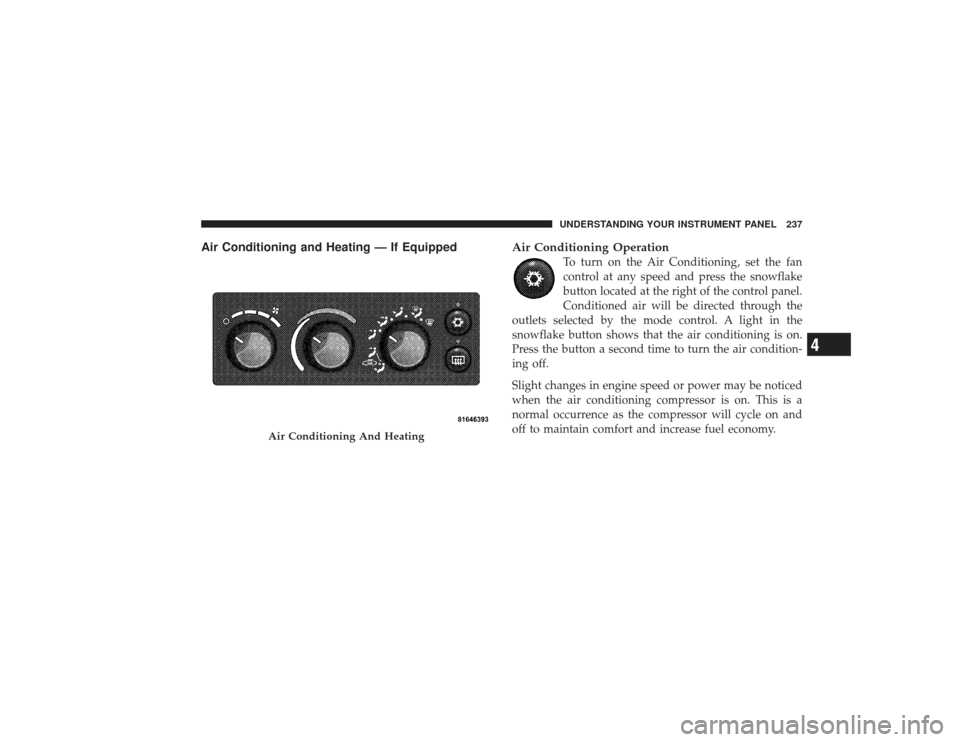
Air Conditioning and Heating — If EquippedAir Conditioning Operation
To turn on the Air Conditioning, set the fan
control at any speed and press the snowflake
button located at the right of the control panel.
Conditioned air will be directed through the
outlets selected by the mode control. A light in the
snowflake button shows that the air conditioning is on.
Press the button a second time to turn the air condition-
ing off.
Slight changes in engine speed or power may be noticed
when the air conditioning compressor is on. This is a
normal occurrence as the compressor will cycle on and
off to maintain comfort and increase fuel economy.
Air Conditioning And Heating
UNDERSTANDING YOUR INSTRUMENT PANEL 237
4
Page 242 of 532
edges of the instrument panel. The demisters also pro-
vide extra air ducts for circulation. They are in operation
whenever the Floor, Mix or Defrost modes are in use. To
remove frost from the side windows, it is best to use the
full defrost mode.
NOTE:When you turn off the engine you may hear a
hissing sound from under the hood for a short period of
time. This is a normal condition that occurs if the air
conditioning system has been on. It is not an indication of
a problem with the air conditioning system.Air Conditioning with Dual Zone Temperature
Control — If EquippedWith the Dual Zone Temperature Control System, each
front seat occupant can independently control the tem-
perature of air coming from the outlets on their side of
the vehicle.
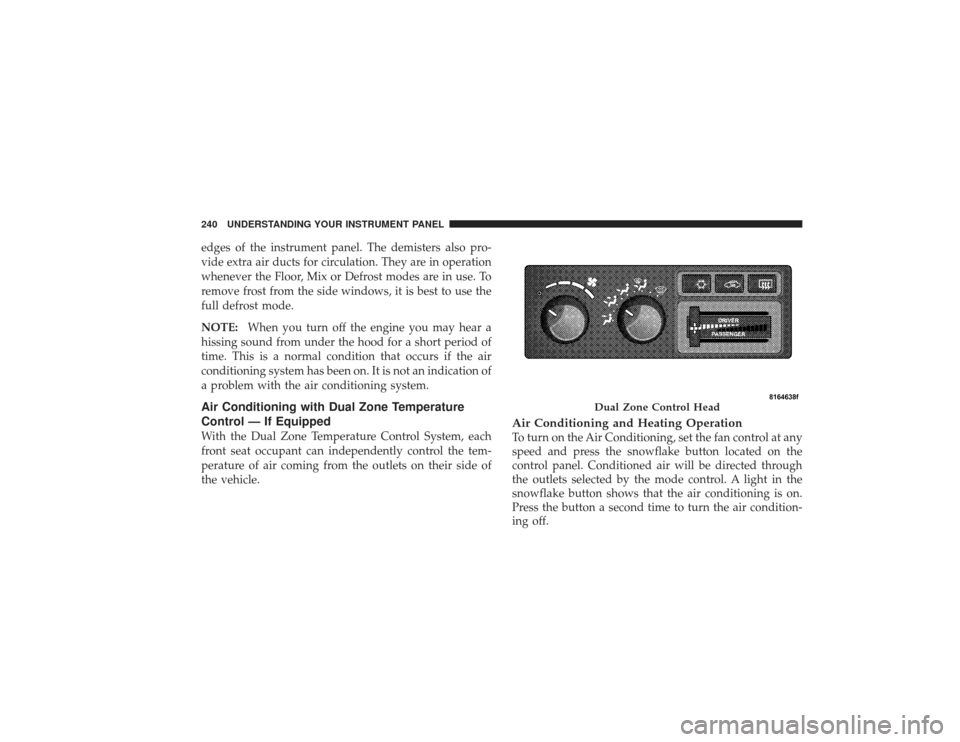
Air Conditioning and Heating OperationTo turn on the Air Conditioning, set the fan control at any
speed and press the snowflake button located on the
control panel. Conditioned air will be directed through
the outlets selected by the mode control. A light in the
snowflake button shows that the air conditioning is on.
Press the button a second time to turn the air condition-
ing off.
Dual Zone Control Head
240 UNDERSTANDING YOUR INSTRUMENT PANEL
Page 243 of 532
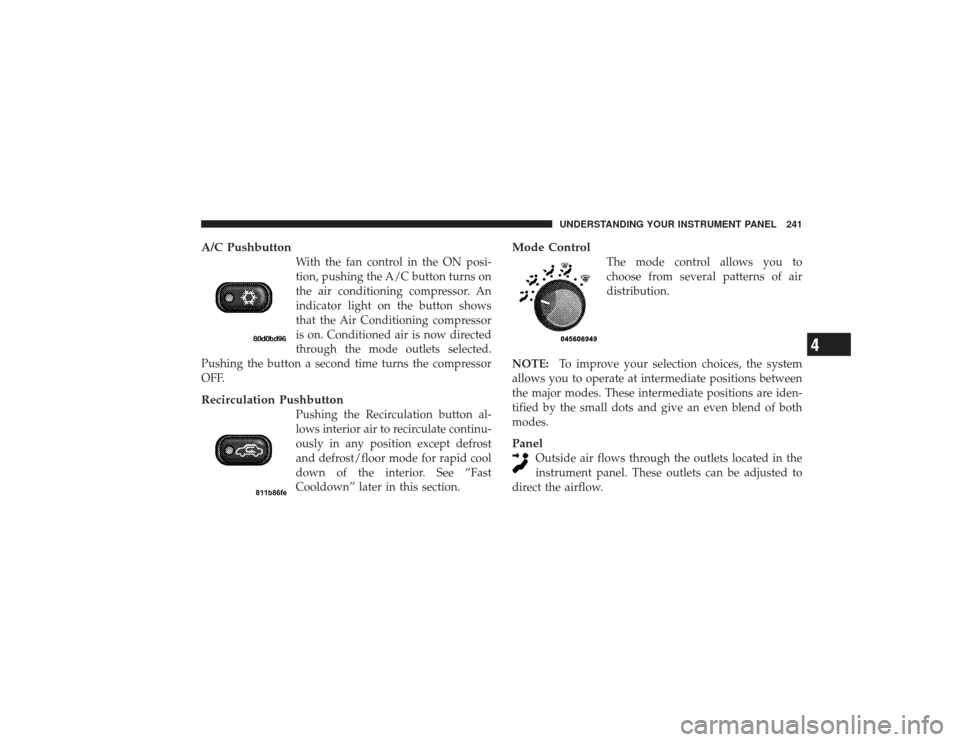
A/C Pushbutton
With the fan control in the ON posi-
tion, pushing the A/C button turns on
the air conditioning compressor. An
indicator light on the button shows
that the Air Conditioning compressor
is on. Conditioned air is now directed
through the mode outlets selected.
Pushing the button a second time turns the compressor
OFF.
Recirculation Pushbutton
Pushing the Recirculation button al-
lows interior air to recirculate continu-
ously in any position except defrost
and defrost/floor mode for rapid cool
down of the interior. See “Fast
Cooldown” later in this section.
Mode Control
The mode control allows you to
choose from several patterns of air
distribution.
NOTE: To improve your selection choices, the system
allows you to operate at intermediate positions between
the major modes. These intermediate positions are iden-
tified by the small dots and give an even blend of both
modes.
Panel
Outside air flows through the outlets located in the
instrument panel. These outlets can be adjusted to
direct the airflow.
UNDERSTANDING YOUR INSTRUMENT PANEL 241
4
Page 247 of 532
Summer OperationAir conditioned vehicles must be protected with a high
quality antifreeze coolant during summer to provide
proper corrosion protection and to raise the boiling point
of the coolant for protection against overheating. A 50 %
concentration is recommended. For proper coolant type,
refer to “Recommended Fluids and Genuine Parts” in
Section 7.
When using the air conditioner in extremely heavy traffic
in hot weather, especially when towing a trailer, addi-
tional engine cooling may be required. If this situation is
encountered, operate the transmission in a lower gear to
increase engine RPM, coolant flow and fan speed. When
stopped in heavy traffic, it may be necessary to shift into
NEUTRAL and depress the accelerator slightly for fast
idle operation to increase coolant flow and fan speed.NOTE:
On models equipped with Diesel engines, the
idle speed will automatically increase to 1000 rpm at
elevated coolant temperatures to improve engine cooling.
Your air conditioning system is also equipped with an
automatic recirculation system. When the system senses
a heavy load or high heat conditions, it may use partial
Recirculation A/C mode to provide additional comfort.
Winter OperationWhen operating the system during the Winter months,
make sure the air intake, located directly in front of the
windshield, is free of ice, slush, snow, or other obstructions.
UNDERSTANDING YOUR INSTRUMENT PANEL 245
4
Page 259 of 532
DRIVE
This position provides all forward gears, including 3rd
gear direct and 4th or 5th gear overdrive (see Overdrive
Operation). Use this range for most city and highway
driving.
SECOND
Use this position for driving slowly in heavy city traffic
or on mountain roads where more precise speed control
is desirable. Use it also when climbing long grades, and
for engine braking when descending moderately steep
grades. To prevent excessive engine speed do not exceed
45 mph (72 km/h) in this range.
FIRST
Use this position for driving up very steep hills and for
engine braking at low speeds 20 mph (32 km/h) or less
when going downhill. To prevent excessive engine speed,
do not exceed 25 mph (40 km/h) in this range.NOTE:
Use caution when operating a heavily loaded
vehicle in SECOND or FIRST gear selections in high
ambients as torque converter slip can impose significant
additional heat load on the cooling system.
Overdrive OperationThe overdrive automatic transmission contains an elec-
tronically controlled fourth and fifth (if equipped) speed
(Overdrive). The transmission will automatically shift
from DRIVE to Overdrive if the following conditions are
present:•
the shift lever is in DRIVE;
•
the engine coolant has reached normal operating tem-
perature;
•
vehicle speed is above approximately 30 mph
(48 km/h);
•
the “TOW HAUL O/D OFF” switch has not been
activated;
STARTING AND OPERATING 257
5
Page 260 of 532
•
transmission has reached normal operating
temperature.
NOTE:
•
If the vehicle is started in extremely cold temperatures,
the transmission may not shift into Overdrive and will
automatically select the most desirable gear for opera-
tion at this temperature. Normal operation will re-
sume when the transmission fluid temperature has
risen to a suitable level. Refer to the “Note” under
“Torque Converter Clutch” in this section.
•
If the transmission temperature gets extremely hot, the
transmission will automatically select the most desir-
able gear for operation at this temperature. If the
transmission temperature becomes hot enough the
“Transmission Temperature Warning Light” may illu-
minate and the transmission may downshift out of Overdrive until the transmission cools down. After
cool down, the transmission will resume normal
operation.
The transmission will downshift from Overdrive to
DRIVE if the accelerator pedal is fully depressed at
vehicle speeds above approximately 35 mph (56 km/h).
When To Use “TOW HAUL” and “O/D OFF”
ModesWhen driving in hilly areas, towing a trailer, carrying a
heavy load, etc., and frequent transmission shifting oc-
curs, press the “TOW HAUL O/D OFF” button once to
select TOW HAUL.
258 STARTING AND OPERATING
Page 261 of 532
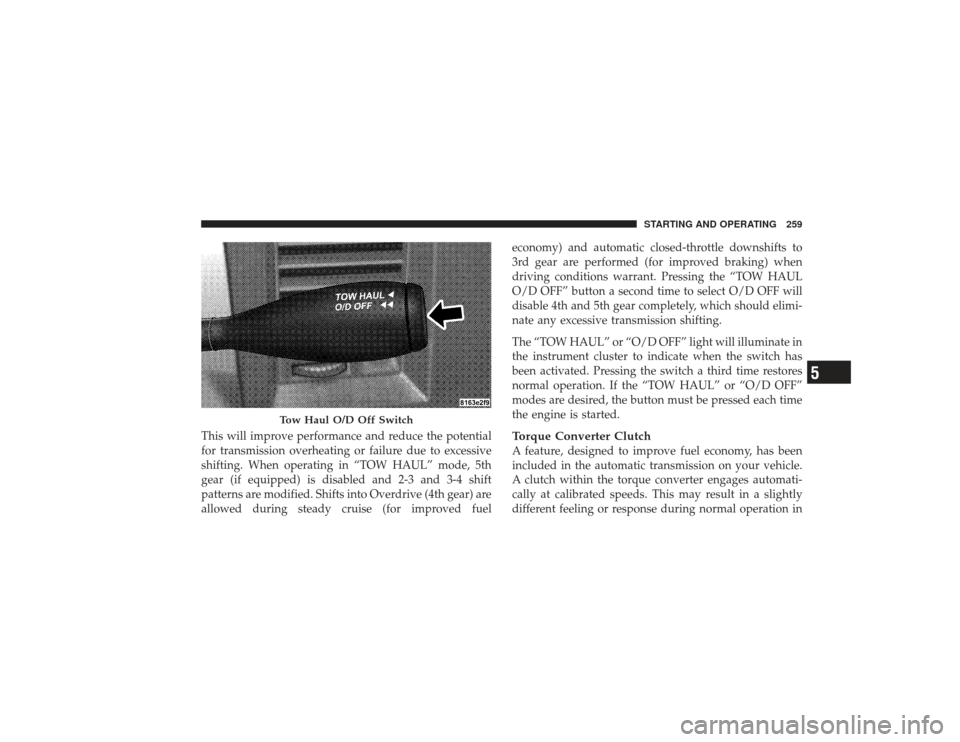
This will improve performance and reduce the potential
for transmission overheating or failure due to excessive
shifting. When operating in “TOW HAUL” mode, 5th
gear (if equipped) is disabled and 2-3 and 3-4 shift
patterns are modified. Shifts into Overdrive (4th gear) are
allowed during steady cruise (for improved fueleconomy) and automatic closed-throttle downshifts to
3rd gear are performed (for improved braking) when
driving conditions warrant. Pressing the “TOW HAUL
O/D OFF” button a second time to select O/D OFF will
disable 4th and 5th gear completely, which should elimi-
nate any excessive transmission shifting.
The “TOW HAUL” or “O/D OFF” light will illuminate in
the instrument cluster to indicate when the switch has
been activated. Pressing the switch a third time restores
normal operation. If the “TOW HAUL” or “O/D OFF”
modes are desired, the button must be pressed each time
the engine is started.
Torque Converter ClutchA feature, designed to improve fuel economy, has been
included in the automatic transmission on your vehicle.
A clutch within the torque converter engages automati-
cally at calibrated speeds. This may result in a slightly
different feeling or response during normal operation in
Tow Haul O/D Off Switch
STARTING AND OPERATING 259
5
Page 262 of 532
the upper gears. When the vehicle speed drops or during
acceleration when the transmission downshifts to second
gear, the clutch automatically disengages.
NOTE:•
The torque converter clutch will not engage until the
transmission fluid and engine coolant are warm [usu-
ally after 1-3 miles (1.6 - 4.8 km) of driving]. Because
the engine speed is higher when the torque converter
clutch is not engaged, it may seem as if the transmis-
sion is not shifting into Overdrive when cold. This is
normal. Pressing the “TOW HAUL O/D OFF” button,
when the transmission is sufficiently warm, will dem-
onstrate that the transmission is able to shift into and
out of overdrive.
•
If the vehicle has not been driven in several days, the
first few seconds of operation after shifting the trans-
mission into gear may seem sluggish. This is due to the
fluid partially draining from the torque converter intothe transmission. This condition is normal and will not
cause damage to the transmission. The torque con-
verter will refill within five seconds of shifting from
PARK into any other gear position.
FOUR-WHEEL DRIVE OPERATION — IF
EQUIPPEDFour-wheel drive trucks are equipped with either a
manually shifted transfer case or an electronically shifted
transfer case. Refer to the operating instructions for your
transfer case, located in this section.Manually Shifted Transfer Case Operating
Information/PrecautionsThe transfer case provides four mode positions.•
Two-wheel drive high range (2H)
•
Four-wheel drive high range (4H)
•
Neutral (N)
•
Four-wheel drive low range (4L)
260 STARTING AND OPERATING
Page 267 of 532
This electronically shifted transfer case provides five
mode positions.•
Two-wheel drive high range (2WD)
•
Four-wheel drive automatic range (4WD AUTO)
•
Four-wheel drive lock range (4WD LOCK)
•
Four-wheel drive low range (4WD LOW)
•
Neutral (N)
This electronically shifted transfer case is designed to be
driven in the two–wheel drive position (2WD) or four-
wheel drive position (4WD AUTO) for normal street and
highway conditions (dry hard surfaced roads). Driving
the vehicle in 2WD will have greater fuel economy
benefits, as the front axle is not engaged in 2WD. For variable driving conditions, the 4WD AUTO mode
can be used. In this mode, the front axle is engaged, but
the vehicle’s power is sent to the rear wheels. Four-wheel
drive will be automatically engaged when the vehicle
senses a loss of traction. Because the front axle is en-
gaged, this mode will result in lower fuel economy than
the 2WD mode.
When additional traction is required, the 4WD LOCK
and 4WD LOW positions can be used to lock the front
and rear driveshafts together and force the front and rear
wheels to rotate at the same speed. This is accomplished
by rotating the 4WD Control Switch to the desired
position. Refer to “Shifting Procedure” for specific shift-
ing instructions. The 4WD LOCK and 4WD LOW posi-
tions are designed for loose, slippery road surfaces only.
STARTING AND OPERATING 265
5
Page 278 of 532
For additional information on the appropriate use of each
transfer case mode position see the information below:
2WD
Rear Wheel Drive High Range - This range is for normal
street and highway driving on dry hard surfaced roads.
4WD LOCK
Four-Wheel Drive Lock Range - This range locks the front
and rear driveshafts together forcing the front and rear
wheels to rotate at the same speed. Additional traction
for loose, slippery road surfaces only.
4WD LOW
Four-Wheel Drive Low Range - Locks the front and rear
driveshafts together forcing the front and rear wheels to
rotate at the same speed. Additional traction and maxi-
mum pulling power for loose, slippery road surfaces
only. Do not exceed 25 mph (40 km/h).N
Neutral - This range disengages the front and rear
driveshafts from the powertrain. To be used for flat
towing behind another vehicle. Refer to “Recreational
Towing” in this section.
Shifting Procedure — Electronically Shifted
Transfer CaseNOTE:•
If any of the requirements to select a new transfer case
position have not been met, the transfer case will not
shift. The “Transfer Case Position Indicator Light” for
the previous position will remain ON and the newly
selected “Transfer Case Position Indicator Light” will
continue to flash until all the requirements for the
selected position have been met. To retry a shift: return
the control knob back to the original position, make
certain all shift requirements have been met, wait five
seconds and try the shift again.
276 STARTING AND OPERATING