battery DODGE RAM 5500 CHASSIS CAB 2008 3.G Owner's Manual
[x] Cancel search | Manufacturer: DODGE, Model Year: 2008, Model line: RAM 5500 CHASSIS CAB, Model: DODGE RAM 5500 CHASSIS CAB 2008 3.GPages: 528, PDF Size: 7.84 MB
Page 392 of 528

2. Connect one end of the other jumper cable to negative
(-) post of booster battery. Connect the other end of the
jumper cable to a good ground on the engine block of the
vehicle with the discharged battery. Make sure a good
connection is made, free of dirt and grease.
WARNING!
²Do not connect the cable to the negative post of the
discharge battery. The resulting electrical spark
could cause the battery to explode.
²During cold weather when temperatures are be-
low freezing point, electrolyte in a discharged
battery may freeze. Do not attempt jump starting
because the battery could rupture or explode. The
battery temperature must be brought up above
freezing point before attempting jump start.3. Take care that the clamps from one cable do not
inadvertently touch clamps from the other cable. Do not
lean over the battery when making connection. The
negative connection must provide good electrical con-
ductivity and current carrying capacity.
4. After the engine is started or if the engine fails to start,
cables must be disconnected in the following order:
a. Disconnect the negative cable at the engine ground.
b. Disconnect the negative cable at the negative post
on booster battery.
c. Disconnect the cable from the positive post of both
batteries.
392 WHAT TO DO IN EMERGENCIES
Page 393 of 528

WARNING!
Any procedure other than above could result in:
1. Personal injury caused by electrolyte squirting out
the battery vent;
2. Personal injury or property damage due to battery
explosion;
3. Damage to charging system of booster vehicle or
of immobilized vehicle.
With Portable Starting Unit
There are many types of these units available. Follow the
manufacturer's instructions for necessary precautions
and operation.
CAUTION!
It is very important that the starting unit operating
voltage does not exceed 12 Volts D.C. or damage to
battery, starter motor, alternator, or electrical system
may occur.
FREEING A STUCK VEHICLE
If vehicle becomes stuck in snow, sand, or mud, it can
often be moved by a rocking motion. Move the gear
selector rhythmically between DRIVE and REVERSE
(automatic transmissions) and between 1st and RE-
VERSE (manual transmissions), while applying slight
pressure to the accelerator.
WHAT TO DO IN EMERGENCIES 393
6
Page 398 of 528

NCatalytic Converter (Gas Engines).........420
NIntervention Regeneration Strategy ± EVIC
Message Process Flow (Catalyst Full Message)
(Diesel Engines Only)..................422
NEmission-Related Components (Gas Engines) . . 425
NMaintenance Free Battery (Gas Engines).....425
NMaintenance Free Batteries (Diesel Engines) . . . 426
NAir Conditioner Maintenance.............427
NPower Steering Ð Fluid Check............428
NFront Suspension Ball Joints..............429
NSteering Linkage Ð Inspection............429
NFront Prop Shaft Lubrication.............430
NFront Axle Universal Drive Joints And
Ball Joints...........................430NBody Lubrication.....................430
NWindshield Wiper Blades................431
NWindshield Washers...................431
NExhaust System......................432
NCooling System.......................433
NFan ...............................439
NCharge Air Cooler Ð Inter-Cooler
(Diesel Engines)......................439
NHoses And Vacuum/Vapor Harnesses.......440
NFuel System Connections................440
NBrake System........................440
NClutch Hydraulic System................443
NClutch Linkage.......................443
398 MAINTAINING YOUR VEHICLE
Page 413 of 528

Drive Belts (Gas Engines)
Belt tension is controlled by means of an automatic
tensioner. No belt tension adjustments are required.
However, belt and belt tensioner condition should be
inspected at the specified intervals and replaced if re-
quired. See your authorized dealer for service.
At the mileage indicated in the maintenance schedule, all
belts and tensioner should be checked for condition.
Improper belt tension can cause belt slippage and failure.
Belts should be inspected for evidence of cuts, cracks,
glazing or frayed cords and replaced if there is indication
of damage which could result in belt failure. Low gen-
erator belt tension can cause battery failure.
Also check belt routing to make sure there is no interfer-
ence between the belts and other engine components.
Drive Belt (Diesel Engines)
Inspection
Check the belt for intersecting cracks.
²Transverse (across the belt width) cracks are accept-
able.
²Longitudinal (direction of belt length) cracks that
intersect with transverse cracks are NOT acceptable.
Replace the belt if it has unacceptable cracks, is frayed or
has pieces of material missing.
The engine speed sensor, located near the damper, should
be inspected for damage if a belt is frayed.
Engine Air Cleaner Filter (Gas Engines)
Follow the appropriate Maintenance Schedule for recom-
mended Air Cleaner Replacement intervals.
MAINTAINING YOUR VEHICLE 413
7
Page 425 of 528

Emission-Related Components (Gas Engines)
Positive Crankcase (PCV) Valve
Proper operation of the crankcase ventilation system
requires that the PCV valve be free of sticking or plug-
ging from deposits. Deposits can accumulate in the PCV
valve and passages with increasing mileage. Have the
PCV valve, hoses, and passages checked for proper
operation at the intervals specified. If the valve is
plugged or sticking, replace with a new valveÐdo not
attempt to clean the old PCV valve!Check the ventila-
tion hoses for indications of damage, weepage or plug-
ging with deposits. Replace if necessary.
Maintenance Free Battery (Gas Engines)
The top of the maintenance free battery is permanently
sealed. You will never have to add water, nor is periodic
maintenance required.
WARNING!
²Battery fluid is a corrosive acid solution and can
burn or even blind you. Don't allow battery fluid
to contact your eyes, skin or clothing. Don't lean
over a battery when attaching clamps. If acid
splashes in eyes or on skin, flush the area imme-
diately with large amounts of water.
²Battery gas is flammable and explosive. Keep
flame or sparks away from the battery. Don't use a
booster battery or any other booster source with an
output greater than 12 volts. Don't allow cable
clamps to touch each other.
²Battery posts, terminals and related accessories
contain lead and lead compounds. Wash hands
after handling.
MAINTAINING YOUR VEHICLE 425
7
Page 426 of 528

CAUTION!
²It is essential when replacing the cables on the
battery that the positive cable is attached to the
positive post and the negative cable is attached to
the negative post. Battery posts are marked (+)
positive and negative (-) and identified on the
battery case.
²If a ªfast chargerº is used while battery is in
vehicle, disconnect both vehicle battery cables
before connecting the charger to battery. Do not
use a ªfast chargerº to provide starting voltage.
Maintenance Free Batteries (Diesel Engines)
The top of the maintenance free batteries are perma-
nently sealed. You will never have to add water, nor is
periodic maintenance required.
NOTE:Replacement batteries should both be of equal
capacity to prevent damage to the vehicle's charging
system.
426 MAINTAINING YOUR VEHICLE
Page 427 of 528

CAUTION!
It is essential when replacing the cables on the
battery that the positive cable is attached to the
positive post and the negative cable is attached to the
negative post. Battery posts are marked (+) positive
and negative (-) and identified on the battery case.
Also, if a ªfast chargerº is used while battery is in
vehicle, disconnect both vehicle battery cables before
connecting the charger to battery. Do not use a ªfast
chargerº to provide starting voltage.
WARNING!
Battery posts, terminals, and related accessories con-
tain lead and lead compounds. Always wash hands
after handling the battery.
Battery Blanket Usage
A battery loses 60% of its cranking power as the battery
temperature decreases to 0ÉF (-18É). For the same de-
crease in temperature, the engine requires twice as much
power to crank at the same RPM. The use of 120 VAC
powered battery blankets will greatly increase starting
capability at low temperatures. Suitable battery blankets
are available from your authorized Mopartdealer.
Air Conditioner Maintenance
For best possible performance, your air conditioner
should be checked and serviced by an Authorized Dealer
at the start of each warm season. This service should
include cleaning of the condenser fins and a performance
test. Drive belt tension should also be checked at this
time.
NOTE:Refer to Section 3 of the Warranty Information
book for further warranty information.
MAINTAINING YOUR VEHICLE 427
7
Page 462 of 528

FUSES (INTEGRATED POWER MODULE)
An integrated Power Module is located in the engine
compartment near the battery. This center contains car-
tridge fuses and mini fuses. A description of each fuse
and component may be stamped on the inside cover
otherwise the cavity number of each fuse is stamped on
the inside cover that corresponds to the following chart.
Integrated Power Module Location
462 MAINTAINING YOUR VEHICLE
Page 464 of 528
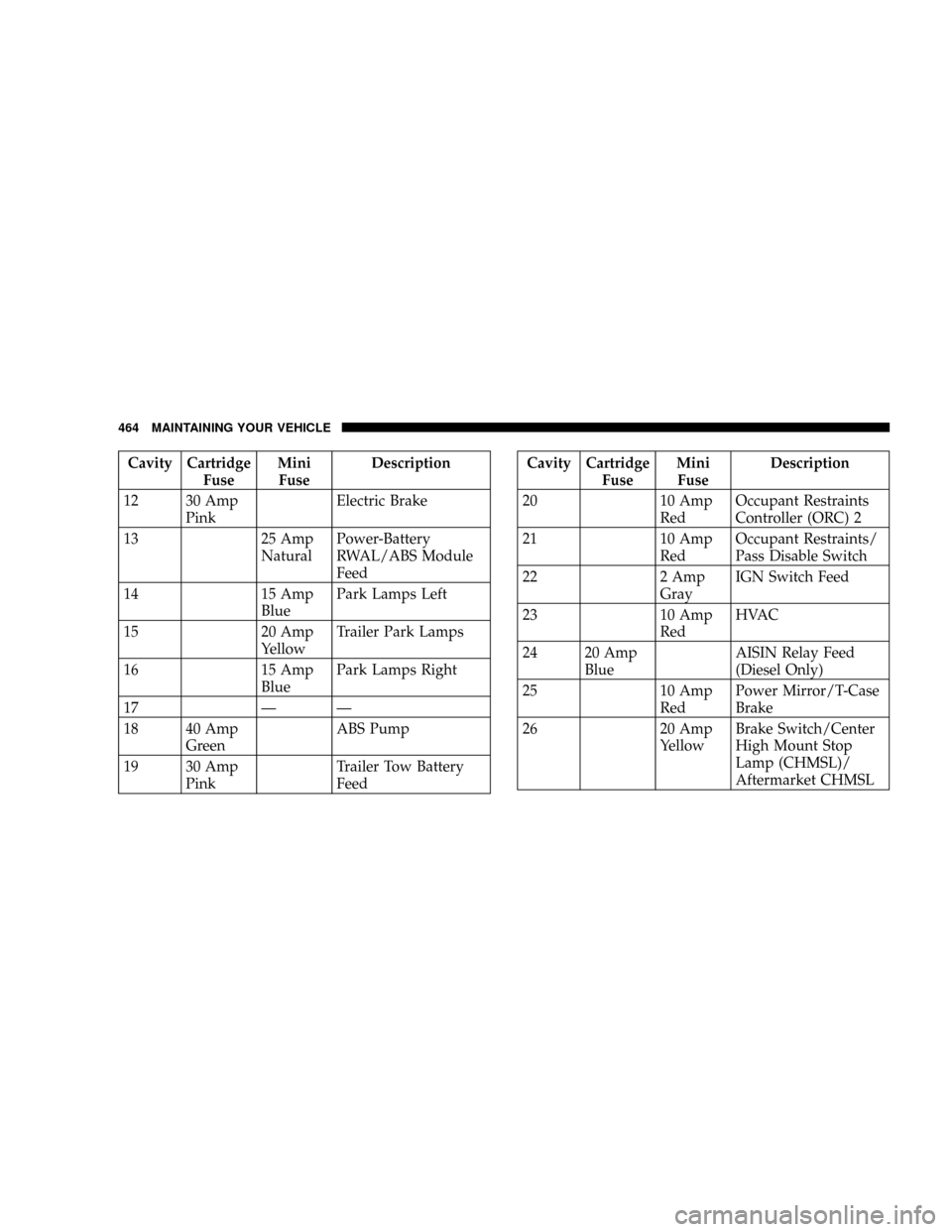
Cavity Cartridge
FuseMini
FuseDescription
12 30 Amp
PinkElectric Brake
13 25 Amp
NaturalPower-Battery
RWAL/ABS Module
Feed
14 15 Amp
BluePark Lamps Left
15 20 Amp
YellowTrailer Park Lamps
16 15 Amp
BluePark Lamps Right
17 Ð Ð
18 40 Amp
GreenABS Pump
19 30 Amp
PinkTrailer Tow Battery
FeedCavity Cartridge
FuseMini
FuseDescription
20 10 Amp
RedOccupant Restraints
Controller (ORC) 2
21 10 Amp
RedOccupant Restraints/
Pass Disable Switch
22 2 Amp
GrayIGN Switch Feed
23 10 Amp
RedHVAC
24 20 Amp
BlueAISIN Relay Feed
(Diesel Only)
25 10 Amp
RedPower Mirror/T-Case
Brake
26 20 Amp
YellowBrake Switch/Center
High Mount Stop
Lamp (CHMSL)/
Aftermarket CHMSL
464 MAINTAINING YOUR VEHICLE
Page 467 of 528

VEHICLE STORAGE
If you are storing your vehicle for more than 21 days, we
recommend that you take the following steps to mini-
mize the drain on your vehicle's battery:
²Disconnect the Ignition-Off Draw fuse (I.O.D.) fuse
located in the Integrated Power Module, located in the
engine compartment. The I.O.D. cavity includes a
snap-in retainer that allows the fuse to be discon-
nected, without removing it from the fuse block.
²The electronic shift transfer case should be placed in
the 4HI mode and kept in this position to minimize the
battery drain.
²As an alternative to the above steps you may, discon-
nect the negative cables from both batteries.
²Anytime you store your vehicle, or keep it out of
service (i.e. vacation) for two weeks or more, run the
air conditioning system at idle for about five minutesin the fresh air and high blower setting. This will
insure adequate system lubrication to minimize the
possibility of compressor damage when the system is
started again.
NOTE:When reinstalling the IOD fuse push firmly until
fully seated, the gages in the Instrument Cluster will do
a full sweep, when the ignition key is cycled to RUN. This
is a normal condition.
NOTE:When the vehicle is shipped from the factory,
the IOD fuse is in the up, or extracted position. If the
radio, interior lamps, keyless entry, or other features do
not work with the key off, check the position of the fuse
(or check to see if the fuse is blown) to ensure that it is
fully seated. When the IOD fuse is extracted, the instru-
ment cluster, in the odometer window, will display9NO
FUSE
MAINTAINING YOUR VEHICLE 467
7