sensor DODGE RAM SRT-10 2006 Service Repair Manual
[x] Cancel search | Manufacturer: DODGE, Model Year: 2006, Model line: RAM SRT-10, Model: DODGE RAM SRT-10 2006Pages: 5267, PDF Size: 68.7 MB
Page 2377 of 5267
page page
SENSOR-ACCELERATOR PEDAL POSITION
DESCRIPTION ............................... 141
OPERATION ................................. 141
REMOVAL ................................... 141
INSTALLATION .............................. 142
SENSOR-CAMSHAFT POSITION
DESCRIPTION ............................... 143
OPERATION ................................. 143
REMOVAL ................................... 143
INSTALLATION .............................. 144
SENSOR-CRANKSHAFT POSITION
DESCRIPTION ............................... 145
OPERATION ................................. 145
REMOVAL ................................... 146
INSTALLATION .............................. 146
ACTUATOR - FUEL CONTROL
DESCRIPTION ............................... 147
OPERATION ................................. 147
REMOVAL ................................... 147
INSTALLATION .............................. 147
INJECTOR - FUEL
DESCRIPTION ............................... 148
OPERATION ................................. 149
REMOVAL ................................... 149
INSTALLATION .............................. 153
FUEL INJECTOR RAIL
DESCRIPTION ............................... 155
OPERATION ................................. 155REMOVAL ................................... 155
INSTALLATION .............................. 156
SENSOR-TEMPERATURE/PRESSURE-INTAKE
DESCRIPTION ............................... 157
OPERATION ................................. 157
REMOVAL ................................... 157
INSTALLATION .............................. 159
HEATER - INTAKE AIR
DESCRIPTION ............................... 160
OPERATION ................................. 160
REMOVAL ................................... 160
INSTALLATION .............................. 162
RELAY - INTAKE AIR HEATER
DESCRIPTION ............................... 163
OPERATION ................................. 163
REMOVAL ................................... 163
INSTALLATION .............................. 164
SENSOR-TEMPERATURE/PRESSURE-MAP
DESCRIPTION ............................... 165
OPERATION ................................. 165
REMOVAL ................................... 165
INSTALLATION .............................. 166
SENSOR-MAP
DESCRIPTION ............................... 167
SWITCH - PTO
DESCRIPTION ............................... 168
OPERATION ................................. 168
Page 2378 of 5267
SENSOR-ACCELERATOR PEDAL POSITION
DESCRIPTION
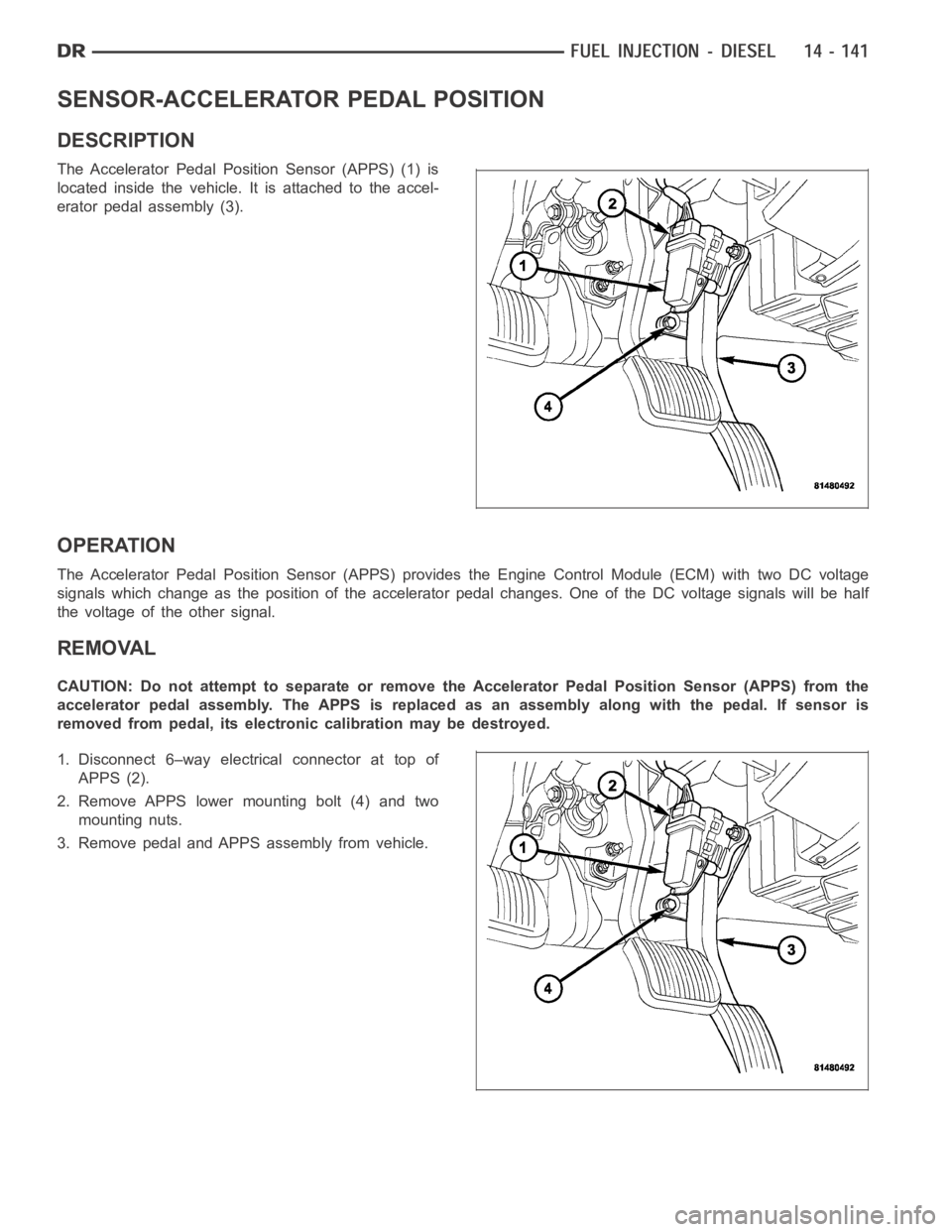
The Accelerator Pedal Position Sensor (APPS) (1) is
located inside the vehicle.It is attached to the accel-
erator pedal assembly (3).
OPERATION
The Accelerator Pedal Position Sensor (APPS) provides the Engine ControlModule (ECM) with two DC voltage
signals which change as the position of the accelerator pedal changes. Oneof the DC voltage signals will be half
the voltage of the other signal.
REMOVAL
CAUTION: Do not attempt to separate or remove the Accelerator Pedal Position Sensor (APPS) from the
accelerator pedal assembly. The APPS is replaced as an assembly along withthe pedal. If sensor is
removed from pedal, its electronic calibration may be destroyed.
1. Disconnect 6–way electrical connector at top of
APPS (2).
2. Remove APPS lower mounting bolt (4) and two
mounting nuts.
3. Remove pedal and APPS assembly from vehicle.
Page 2379 of 5267
INSTALLATION
CAUTION: Do not attempt to separate or remove the Accelerator Pedal Position Sensor (APPS) from the
accelerator pedal assembly. The APPS is replaced as an assembly along withthe pedal. If sensor is
removed from pedal, its electronic calibration may be destroyed.
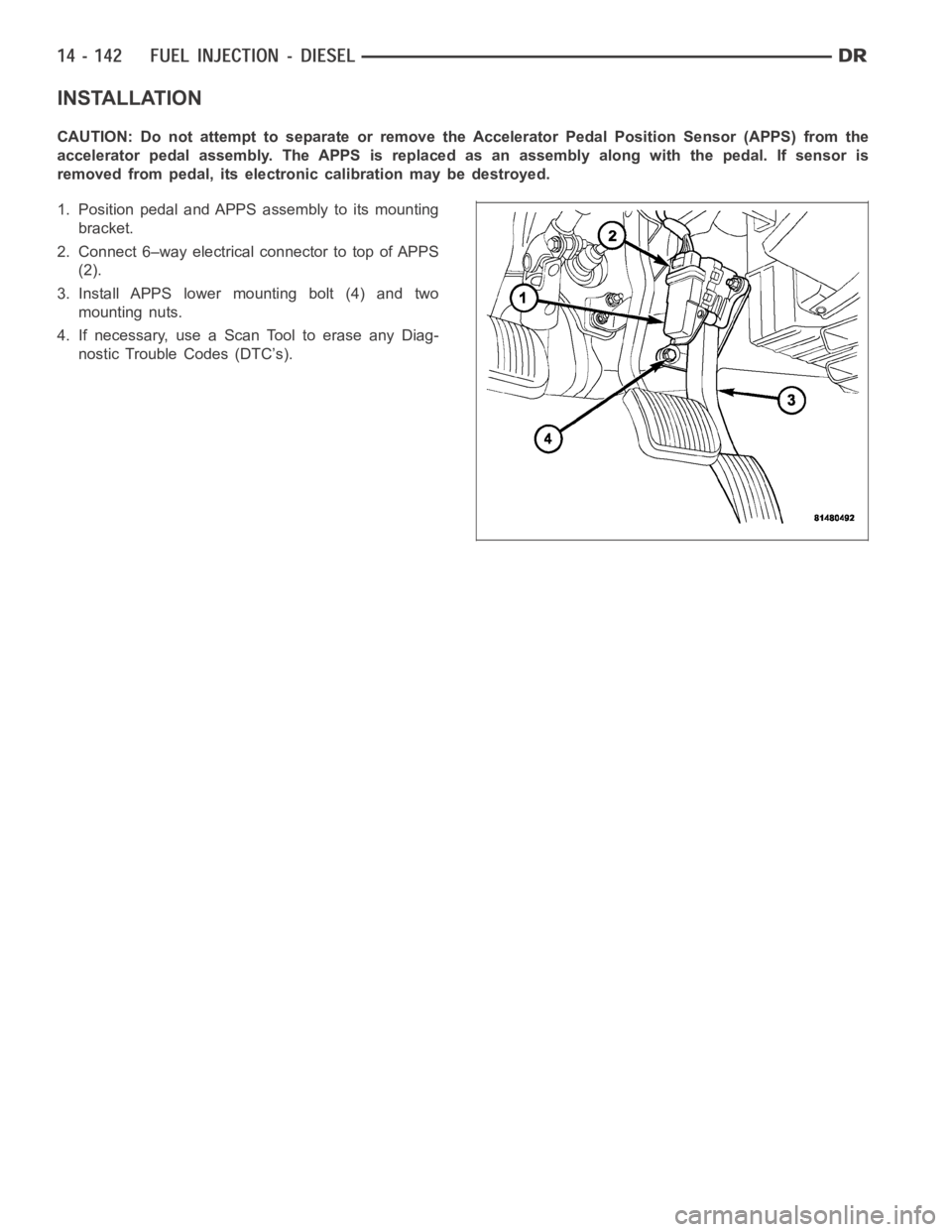
1. Position pedal and APPS assembly to its mounting
bracket.
2. Connect 6–way electrical connector to top of APPS
(2).
3. Install APPS lower mounting bolt (4) and two
mounting nuts.
4. If necessary, use a Scan Tool to erase any Diag-
nostic Trouble Codes (DTC’s).
Page 2380 of 5267
SENSOR-CAMSHAFT POSITION
DESCRIPTION
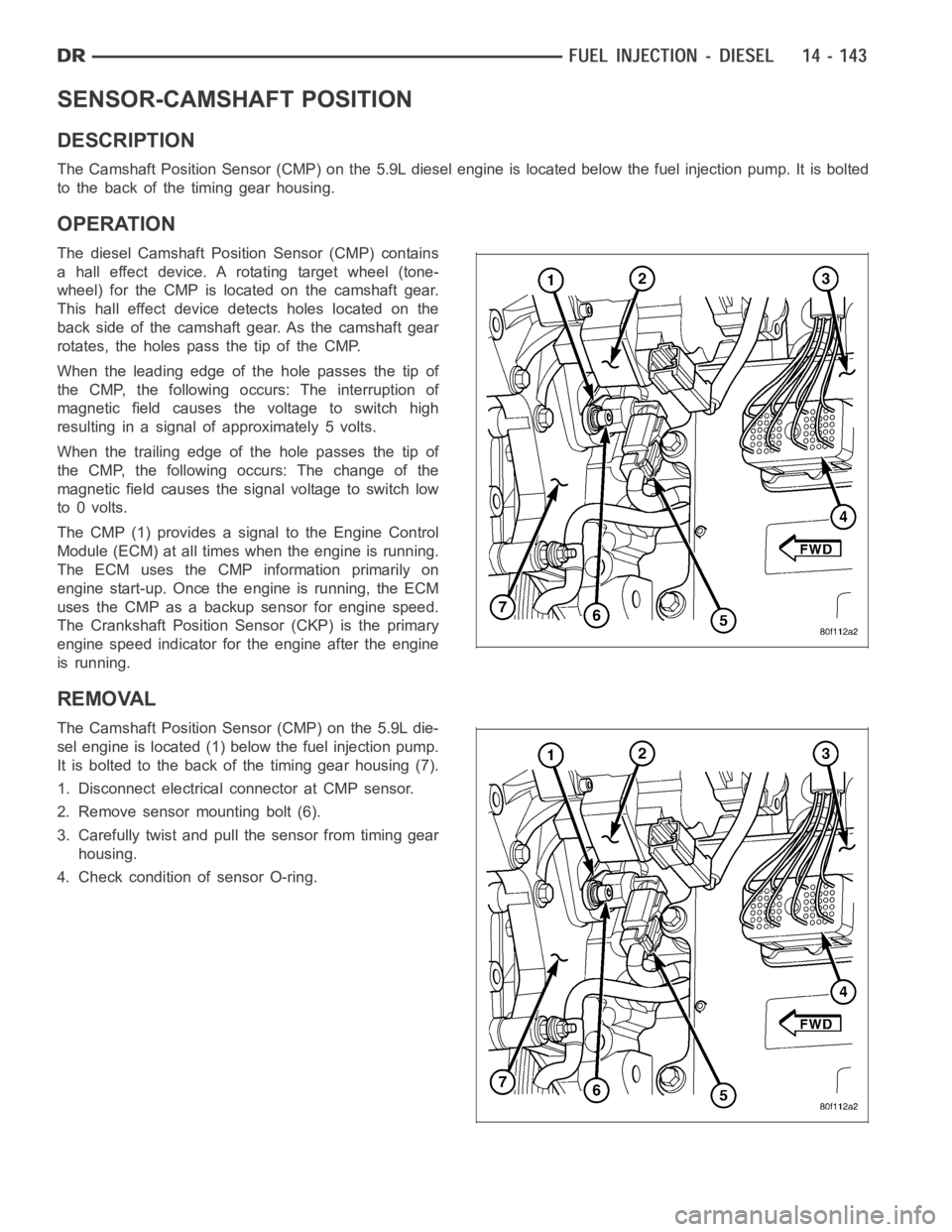
The Camshaft Position Sensor (CMP) on the 5.9L diesel engine is located below the fuel injection pump. It is bolted
to the back of the timing gear housing.
OPERATION
The diesel Camshaft Position Sensor (CMP) contains
a hall effect device. A rotating target wheel (tone-
wheel) for the CMP is located on the camshaft gear.
This hall effect device detects holes located on the
back side of the camshaft gear. As the camshaft gear
rotates, the holes pass the tip of the CMP.
When the leading edge of the hole passes the tip of
the CMP, the following occurs: The interruption of
magnetic field causes the voltage to switch high
resulting in a signal of approximately 5 volts.
When the trailing edge of the hole passes the tip of
the CMP, the following occurs: The change of the
magnetic field causes the signal voltage to switch low
to 0 volts.
The CMP (1) provides a signal to the Engine Control
Module (ECM) at all times when the engine is running.
TheECMusestheCMPinformationprimarilyon
engine start-up. Once the engine is running, the ECM
uses the CMP as a backup sensor for engine speed.
The Crankshaft Position Sensor (CKP) is the primary
engine speed indicator for the engine after the engine
is running.
REMOVAL
The Camshaft Position Sensor (CMP) on the 5.9L die-
sel engine is located (1) below the fuel injection pump.
It is bolted to the back of the timing gear housing (7).
1. Disconnect electrical connector at CMP sensor.
2. Remove sensor mounting bolt (6).
3. Carefully twist and pull the sensor from timing gear
housing.
4. Check condition of sensor O-ring.
Page 2381 of 5267
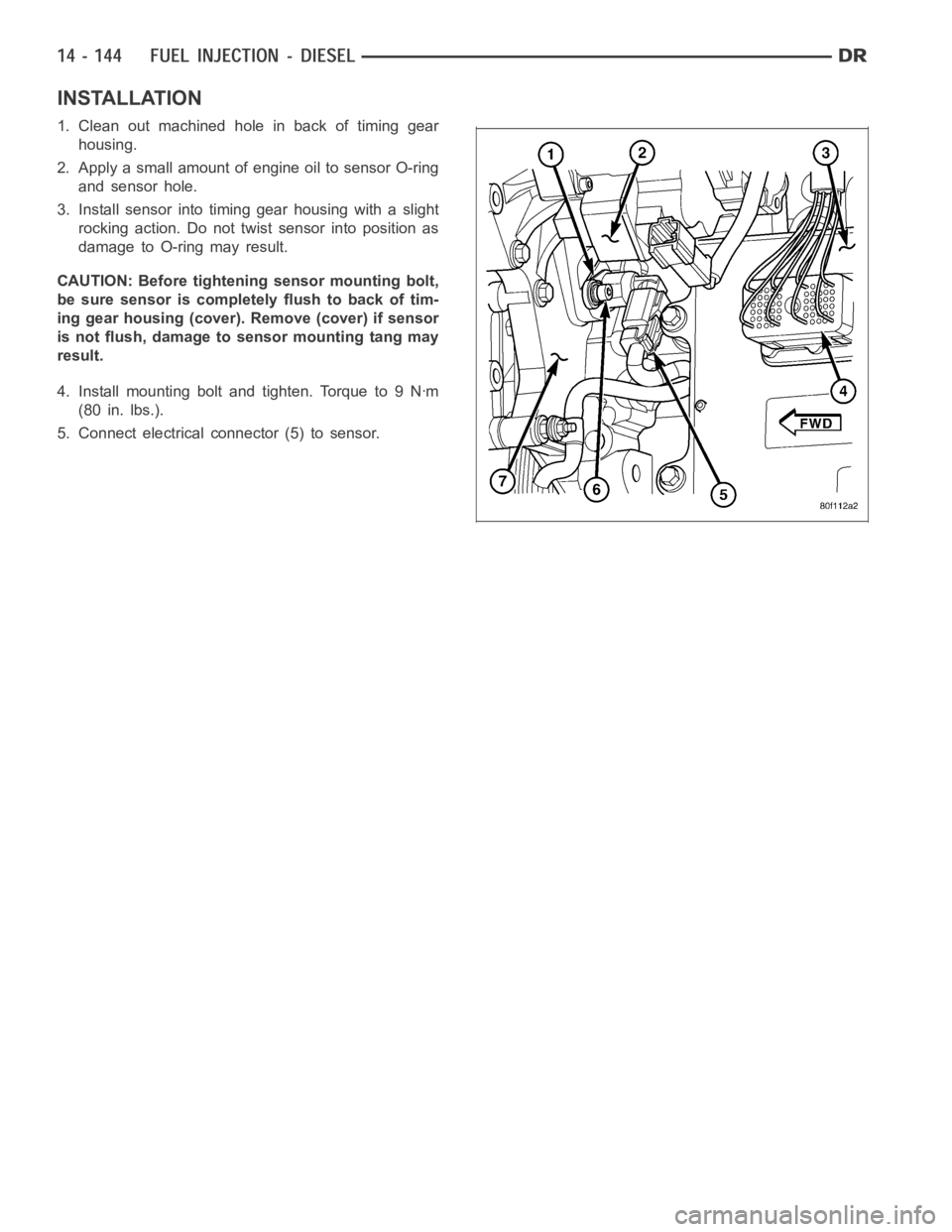
INSTALLATION
1. Clean out machined hole in back of timing gear
housing.
2. Apply a small amount of engine oil to sensor O-ring
and sensor hole.
3. Install sensor into timing gear housing with a slight
rocking action. Do not twist sensor into position as
damagetoO-ringmayresult.
CAUTION: Before tightening sensor mounting bolt,
be sure sensor is completely flush to back of tim-
ing gear housing (cover). Remove (cover) if sensor
is not flush, damage to sensor mounting tang may
result.
4. Install mounting bolt and tighten. Torque to 9 Nꞏm
(80 in. lbs.).
5. Connect electrical connector (5) to sensor.
Page 2382 of 5267
SENSOR-CRANKSHAFT POSITION
DESCRIPTION
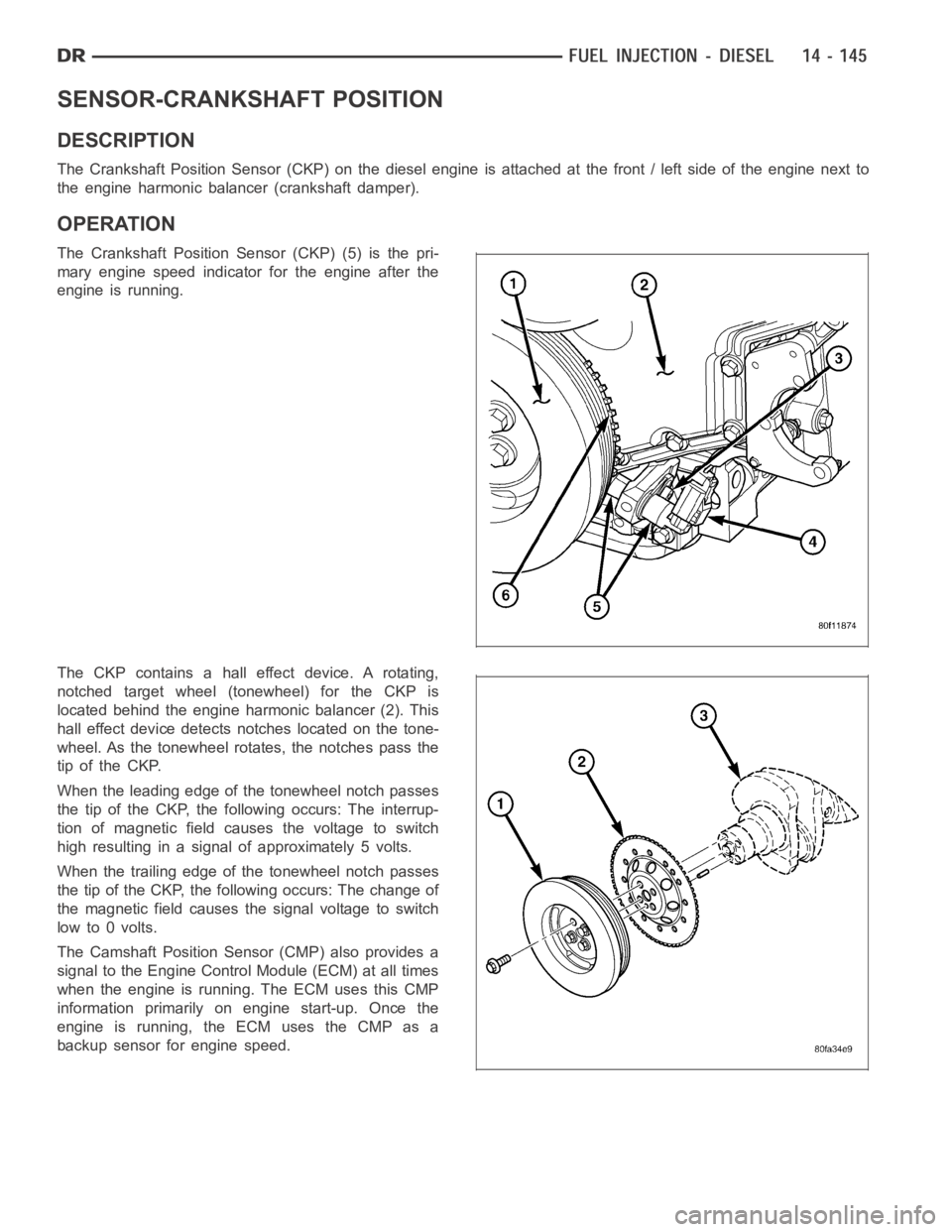
The Crankshaft Position Sensor (CKP) on the diesel engine is attached at thefront/leftsideoftheenginenextto
the engine harmonic balancer (crankshaft damper).
OPERATION
The Crankshaft Position Sensor (CKP) (5) is the pri-
mary engine speed indicator for the engine after the
engine is running.
The CKP contains a hall effect device. A rotating,
notched target wheel (tonewheel) for the CKP is
located behind the engine harmonic balancer (2). This
hall effect device detects notches located on the tone-
wheel. As the tonewheel rotates, the notches pass the
tip of the CKP.
When the leading edge of the tonewheel notch passes
the tip of the CKP, the following occurs: The interrup-
tion of magnetic field causes the voltage to switch
high resulting in a signal of approximately 5 volts.
When the trailing edge of the tonewheel notch passes
the tip of the CKP, the following occurs: The change of
the magnetic field causes the signal voltage to switch
lowto0volts.
The Camshaft Position Sensor (CMP) also provides a
signal to the Engine Control Module (ECM) at all times
when the engine is running. The ECM uses this CMP
information primarily on engine start-up. Once the
engine is running, the ECM uses the CMP as a
backup sensor for engine speed.
Page 2383 of 5267
REMOVAL
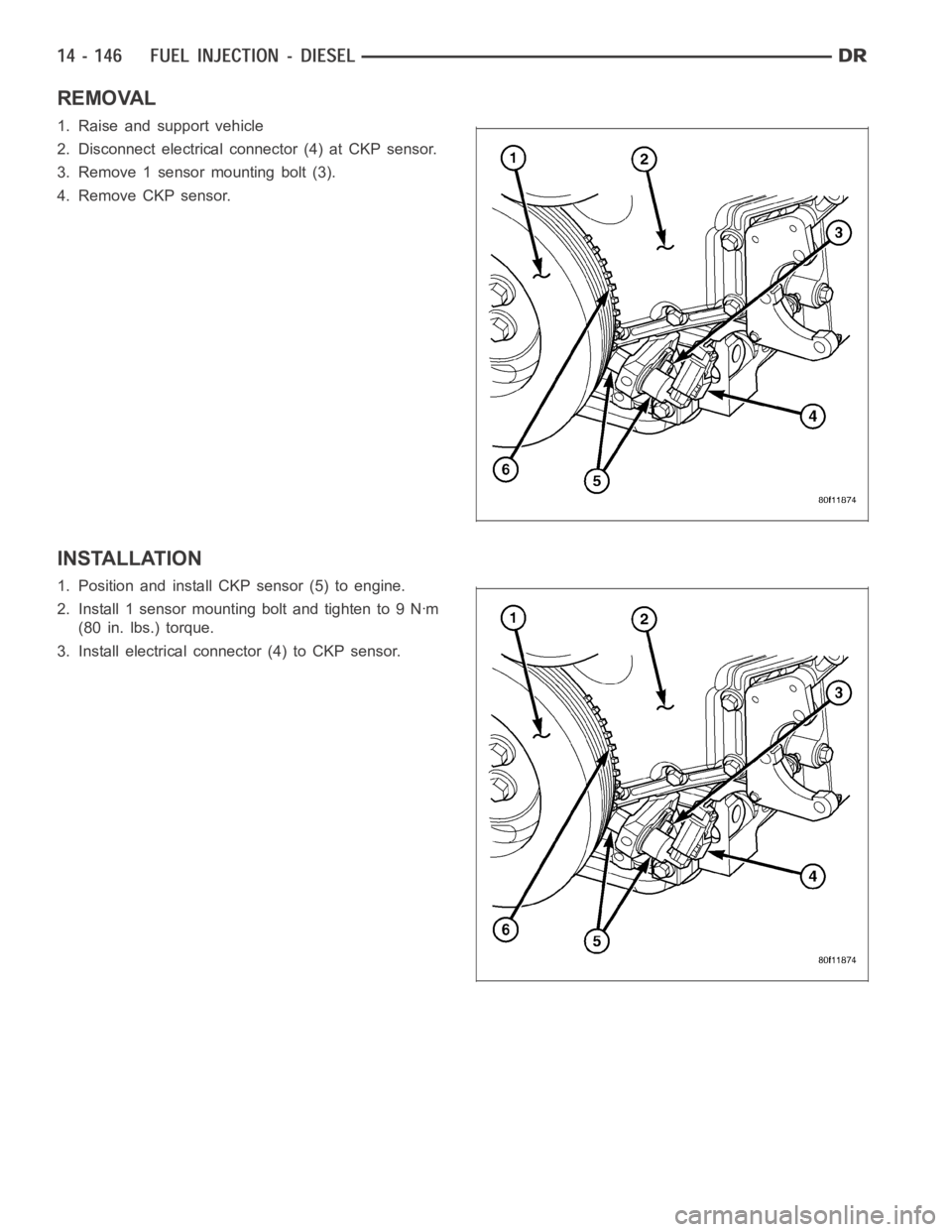
1. Raise and support vehicle
2. Disconnect electrical connector (4) at CKP sensor.
3. Remove 1 sensor mounting bolt (3).
4. Remove CKP sensor.
INSTALLATION
1. Position and install CKP sensor (5) to engine.
2. Install 1 sensor mounting bolt and tighten to 9 Nꞏm
(80 in. lbs.) torque.
3. Install electrical connector (4) to CKP sensor.
Page 2392 of 5267
FUEL INJECTOR RAIL
DESCRIPTION
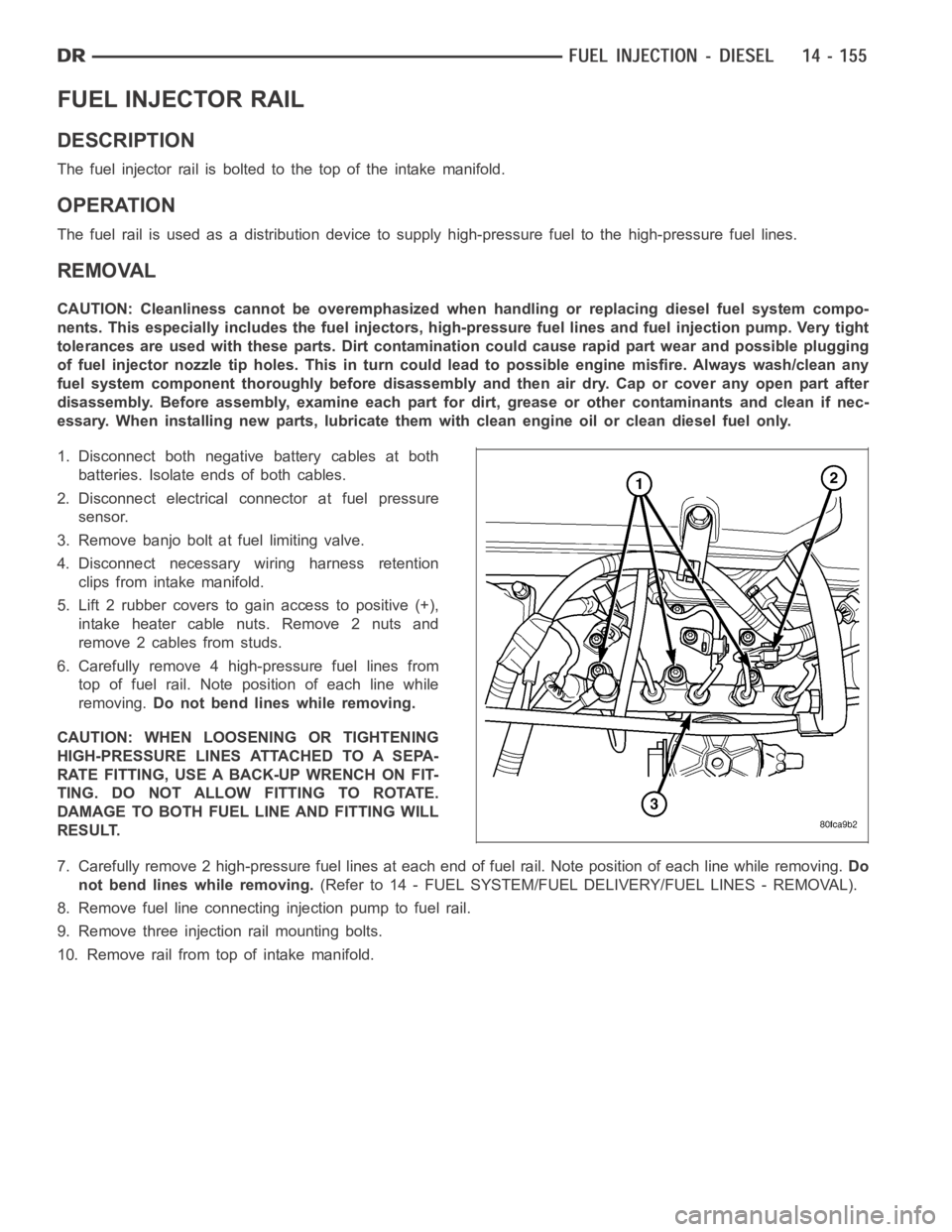
The fuel injector rail is bolted to the top of the intake manifold.
OPERATION
The fuel rail is used as a distribution device to supply high-pressure fuelto the high-pressure fuel lines.
REMOVAL
CAUTION: Cleanliness cannot be overemphasized when handling or replacingdieselfuelsystemcompo-
nents. This especially includes the fuel injectors, high-pressure fuel lines and fuel injection pump. Very tight
tolerances are used with these parts. Dirt contamination could cause rapid part wear and possible plugging
of fuel injector nozzle tip holes. This in turn could lead to possible engine misfire. Always wash/clean any
fuel system component thoroughly before disassembly and then air dry. Capor cover any open part after
disassembly. Before assembly, examine each part for dirt, grease or othercontaminants and clean if nec-
essary. When installing new parts, lubricate them with clean engine oil orclean diesel fuel only.
1. Disconnect both negative battery cables at both
batteries. Isolate ends of both cables.
2. Disconnect electrical connector at fuel pressure
sensor.
3. Remove banjo bolt at fuel limiting valve.
4. Disconnect necessary wiring harness retention
clips from intake manifold.
5. Lift 2 rubber covers to gain access to positive (+),
intake heater cable nuts. Remove 2 nuts and
remove 2 cables from studs.
6. Carefully remove 4 high-pressure fuel lines from
top of fuel rail. Note position of each line while
removing.Do not bend lines while removing.
CAUTION: WHEN LOOSENING OR TIGHTENING
HIGH-PRESSURE LINES ATTACHED TO A SEPA-
RATE FITTING, USE A BACK-UP WRENCH ON FIT-
TING. DO NOT ALLOW FITTING TO ROTATE.
DAMAGE TO BOTH FUEL LINE AND FITTING WILL
RESULT.
7. Carefully remove 2 high-pressure fuel lines at each end of fuel rail. Note position of each line while removing.Do
not bend lines while removing.(Refer to 14 - FUEL SYSTEM/FUEL DELIVERY/FUEL LINES - REMOVAL).
8. Remove fuel line connectinginjection pump to fuel rail.
9. Remove three injection rail mounting bolts.
10. Remove rail from top of intake manifold.
Page 2394 of 5267
SENSOR-TEMPERATURE/PRESSURE-INTAKE
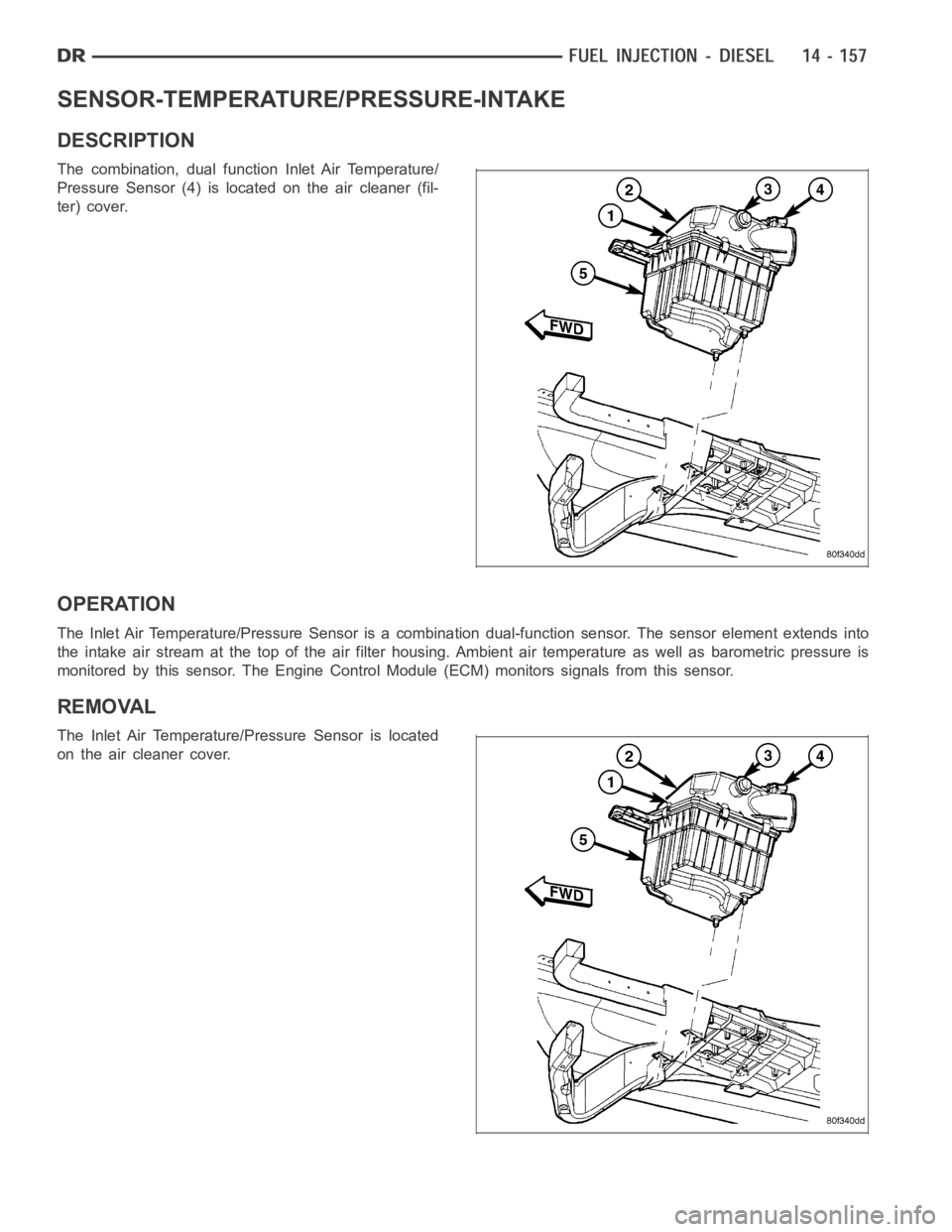
DESCRIPTION
The combination, dual function Inlet Air Temperature/
Pressure Sensor (4) is located on the air cleaner (fil-
ter) cover.
OPERATION
The Inlet Air Temperature/Pressure Sensor is a combination dual-function sensor. The sensor element extends into
the intake air stream at the top of the air filter housing. Ambient air temperature as well as barometric pressure is
monitored by this sensor. The Engine Control Module (ECM) monitors signals from this sensor.
REMOVAL
The Inlet Air Temperature/Pressure Sensor is located
on the air cleaner cover.
Page 2395 of 5267
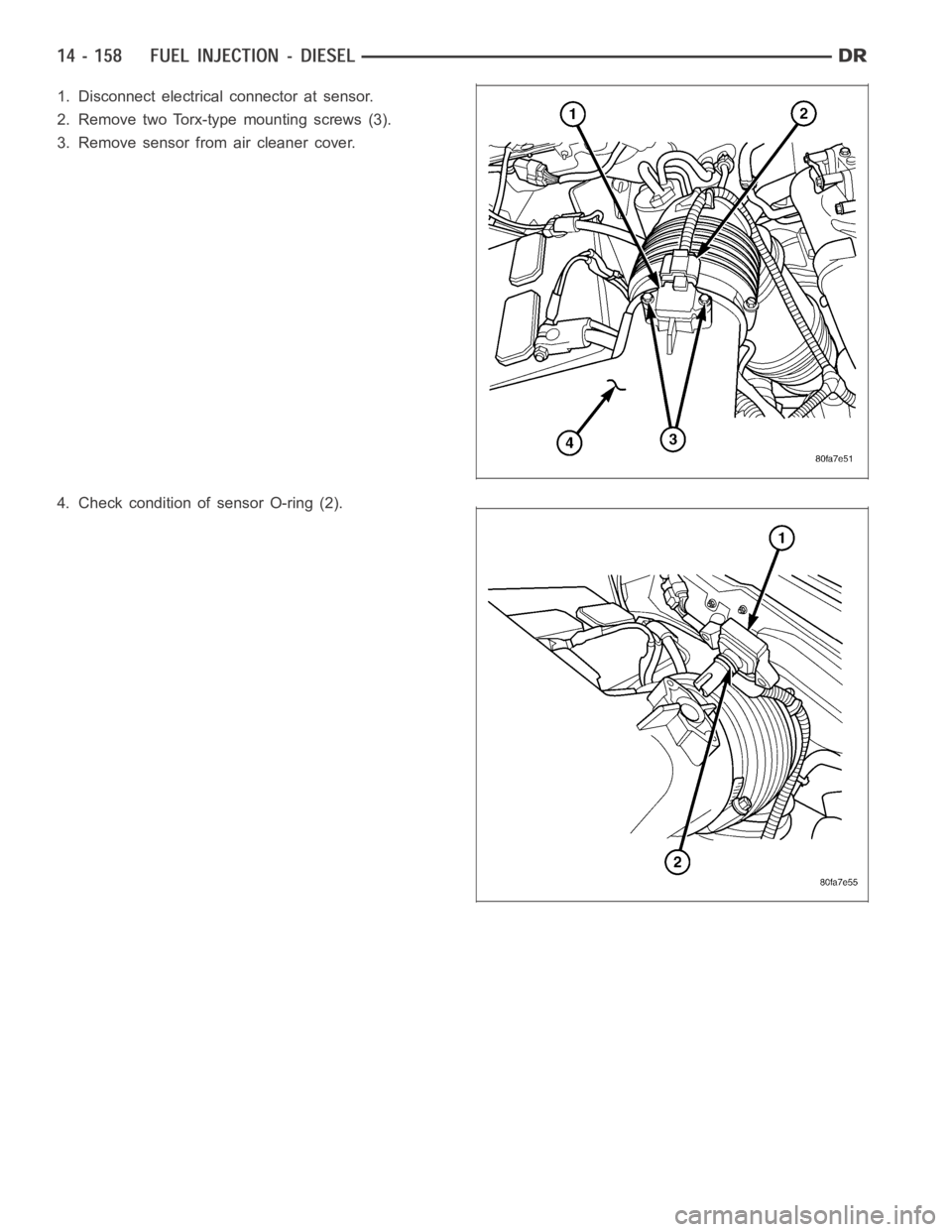
1. Disconnect electrical connector at sensor.
2. Remove two Torx-type mounting screws (3).
3. Remove sensor from air cleaner cover.
4. Check condition of sensor O-ring (2).