Coolant leak DODGE RAM SRT-10 2006 Service Repair Manual
[x] Cancel search | Manufacturer: DODGE, Model Year: 2006, Model line: RAM SRT-10, Model: DODGE RAM SRT-10 2006Pages: 5267, PDF Size: 68.7 MB
Page 175 of 5267
When Monitored:
With the engine running in closed loop mode, the ambient/battery temperature above (-7°C) 20°F, altitude
below 8500 ft.
Set Condition:
If the PCM multiplies short term compensation by long term adaptive as wellas a purge fuel multiplier and the
result is below a certain value for 30 seconds over two trips, a freeze frameis stored, the MIL illuminates and
a trouble code is stored. Two Trip Fault. Three good trips to turn off the MIL.
Possible Causes
EXHAUST LEAK
ENGINE MECHANICAL
1/2O2SENSOR
(K141) O2 SENSOR 1/2 SIGNAL CIRCUIT
(K299) O2 1/2 HEATER CONTROL CIRCUIT
(K904) O2 RETURN DOWNSTREAM CIRCUIT
FUEL CONTAMINATION
Always perform the Pre-Diagnostic Troubleshooting procedure before proceeding. (Refer to 9 - ENGINE -
DIAGNOSIS AND TESTING).
Diagnostic Test
1.ACTIVE DTC
NOTE: Check the vehicle repair history. If the 1/2 O2 has been replaced makesure that the O2 sensor was
properly installed and meets OEM specification.
NOTE: Check for contaminants that may have damaged the O2 Sensor: contaminated fuel, unapproved sil-
icone, oil and coolant.
Ignition on, engine not running.
With a scan tool, read DTCs.
Is the DTC active at this time?
Ye s>>
Go To 2
No>>
Refer to the INTERMITTENT CONDITION Diagnostic Procedure.
Perform the POWERTRAIN VERIFICATION TEST. (Refer to 9 - ENGINE - STANDARD PROCEDURE)
2.EXHAUST LEAK
Turn the ignition off.
WARNING: To avoid personal injury from the exhaust system being hot, allowthe exhaust to cool down to
a safe temperature before performing a physical inspection. Failure to follow these instructions can result in
personal injury or death.
Visually and Physically inspect the exhaust system for holes, cracks and blockage in the exhaust system.
Is the exhaust system is good condition?
Ye s>>
Go To 3
No>>
Repair or Replace as necessary.
Perform the POWERTRAIN VERIFICATION TEST. (Refer to 9 - ENGINE - STANDARD PROCEDURE)
Page 180 of 5267
When Monitored:
With the engine running in closed loop mode, the ambient/battery temperature above (-7°C) 20°F, altitude
below 8500 ft.
Set Condition:
If the PCM multiplies short term compensation by long term adaptive as wellas a purge fuel multiplier and the
result is below a certain value for 30 seconds over two trips, a freeze frameis stored, the MIL illuminates and
a trouble code is stored. Two Trip Fault. Three good trips to turn off the MIL.
Possible Causes
EXHAUST LEAK
ENGINE MECHANICAL
1/2O2SENSOR
(K141) O2 SENSOR 1/2 SIGNAL CIRCUIT
(K299) O2 HEATER 1/2 CONTROL CIRCUIT
(K904) O2 RETURN DOWNSTREAM CIRCUIT
FUEL CONTAMINATION
Always perform the Pre-Diagnostic Troubleshooting procedure before proceeding. (Refer to 9 - ENGINE -
DIAGNOSIS AND TESTING).
Diagnostic Test
1.ACTIVE DTC
NOTE: Check the vehicle repair history. If the 1/2 O2 has been replaced makesure that the O2 sensor was
properly installed and meets OEM specification.
NOTE: Check for contaminants that may have damaged the O2 Sensor: contaminated fuel, unapproved sil-
icone, oil and coolant.
Ignition on, engine not running.
With a scan tool, read DTCs.
Is the DTC active at this time?
Ye s>>
Go To 2
No>>
Refer to the INTERMITTENT CONDITION Diagnostic Procedure.
Perform the POWERTRAIN VERIFICATION TEST. (Refer to 9 - ENGINE - STANDARD PROCEDURE)
2.EXHAUST LEAK
Turn the ignition off.
WARNING: To avoid personal injury from the exhaust system being hot, allowthe exhaust to cool down to
a safe temperature before performing a physical inspection. Failure to follow these instructions can result in
personal injury or death.
Visually and Physically inspect the exhaust system for holes, cracks and blockage in the exhaust system.
Is the exhaust system is good condition?
Ye s>>
Go To 3
No>>
Repair or Replace as necessary.
Perform the POWERTRAIN VERIFICATION TEST. (Refer to 9 - ENGINE - STANDARD PROCEDURE)
Page 186 of 5267
When Monitored:
With the engine running in closed loop mode, the ambient/battery temperature above (-7°C) 20°F, altitude
below 8500 ft and fuel level greater than 15%.
Set Condition:
If the PCM multiplies short term compensation by long term adaptive and a certain percentage is exceeded for
two trips, a freeze frame is stored, the MIL illuminates and a trouble code is stored. Two Trip Fault. Three good
trips to turn off the MIL.
Possible Causes
EXHAUST LEAK
ENGINE MECHANICAL
2/2O2SENSOR
(K243) O2 2/2 SIGNAL CIRCUIT
(K399) O2 HEATER 2/2 CONTROL CIRCUIT
(K904) O2 RETURN DOWNSTREAM CIRCUIT
FUEL CONTAMINATION
Always perform the Pre-Diagnostic Troubleshooting procedure before proceeding. (Refer to 9 - ENGINE -
DIAGNOSIS AND TESTING).
Diagnostic Test
1.ACTIVE DTC
NOTE: Check the vehicle repair history. If the 2/2 O2 has been replaced makesure that the O2 sensor was
properly installed and meets OEM specification.
NOTE: Check for contaminants that may have damaged the O2 Sensor: contaminated fuel, unapproved sil-
icone, oil and coolant.
Ignition on, engine not running.
With a scan tool, read DTCs.
Is the DTC active at this time?
Ye s>>
Go To 2
No>>
Refer to the INTERMITTENT CONDITION Diagnostic Procedure.
Perform the POWERTRAIN VERIFICATION TEST. (Refer to 9 - ENGINE - STANDARD PROCEDURE)
2.EXHAUST LEAK
Turn the ignition off.
WARNING: To avoid personal injury from the exhaust system being hot, allowthe exhaust to cool down to
a safe temperature before performing a physical inspection. Failure to follow these instructions can result in
personal injury or death.
Visually and Physically inspect the exhaust system for holes, cracks and blockage in the exhaust system.
Is the exhaust system is good condition?
Ye s>>
Go To 3
No>>
Repair or Replace as necessary.
Perform the POWERTRAIN VERIFICATION TEST. (Refer to 9 - ENGINE - STANDARD PROCEDURE)
Page 191 of 5267
When Monitored:
With the engine running in closed loop mode, the ambient/battery temperature above (-7°C) 20°F, altitude
below 8500 ft.
Set Condition:
If the PCM multiplies short term compensation by long term adaptive as wellas a purge fuel multiplier and the
result is below a certain value for 30 seconds over two trips, a freeze frameis stored, the MIL illuminates and
a trouble code is stored. Two Trip Fault. Three good trips to turn off the MIL.
Possible Causes
EXHAUST LEAK
ENGINE MECHANICAL
2/2O2SENSOR
(K342) O2 SENSOR 2/2 SIGNAL CIRCUIT
(K399) O2 SENSOR 2/2 HEATER CONTROL CIRCUIT
(K904) O2 RETURN DOWNSTREAM CIRCUIT
FUEL CONTAMINATION
Always perform the Pre-Diagnostic Troubleshooting procedure before proceeding. (Refer to 9 - ENGINE -
DIAGNOSIS AND TESTING).
Diagnostic Test
1.ACTIVE DTC
NOTE: Check the vehicle repair history. If the 2/2 O2 has been replaced makesure that the O2 sensor was
properly installed and meets OEM specification.
NOTE: Check for contaminants that may have damaged the O2 Sensor: contaminated fuel, unapproved sil-
icone, oil and coolant.
Ignition on, engine not running.
With a scan tool, read DTCs.
Is the DTC active at this time?
Ye s>>
Go To 2
No>>
Refer to the INTERMITTENT CONDITION Diagnostic Procedure.
Perform the POWERTRAIN VERIFICATION TEST. (Refer to 9 - ENGINE - STANDARD PROCEDURE)
2.EXHAUST LEAK
Turn the ignition off.
WARNING: To avoid personal injury from the exhaust system being hot, allowthe exhaust to cool down to
a safe temperature before performing a physical inspection. Failure to follow these instructions can result in
personal injury or death.
Visually and Physically inspect the exhaust system for holes, cracks and blockage in the exhaust system.
Is the exhaust system is good condition?
Ye s>>
Go To 3
No>>
Repair or Replace as necessary.
Perform the POWERTRAIN VERIFICATION TEST. (Refer to 9 - ENGINE - STANDARD PROCEDURE)
Page 311 of 5267
Inspect the coolant system for proper level and condition.
Is the coolant level and condition OK?
Ye s>>
Go To 3
No>>
Inspect the vehicle for a coolant leak and add the necessary amount of coolant.
Perform the POWERTRAIN VERIFICATION TEST. (Refer to 9 - ENGINE - STANDARD PROCEDURE)
3.THERMOSTAT
NOTE: This test works best if performed on a cold engine (cold soak).
Ignition on, engine not running.
With a scan tool, read the Eng Coolant Tmp Deg value. If the engine was allowed to sit overnight (cold soak), the
temperature value should be a sensible value that is somewhere close to theambient temperature.
NOTE: If engine coolant temperature is above 82°C (180°F), allow the engine to cool until 65°C (150°F) is
reached.
Start the Engine.
During engine warm-up monitor the Eng Coolant Tmp Deg value. The temp deg value change should be a smooth
transition from start up to normal operating temp 82°C (180°F). Also monitor the actual coolant temperature with a
thermometer.
NOTE: As the engine warms up to operating temperature, the actual coolant temperature (thermometer read-
ing) and the Eng Coolant Tmp Deg on the scan tool should stay relatively closetoeachother.
Using the appropriate service information, determine the proper openingtemperature of the thermostat.
Did the thermostat open at the proper temperature?
Ye s>>
Go To 4
No>>
Replace the thermostat.
Perform the POWERTRAIN VERIFICATION TEST. (Refer to 9 - ENGINE - STANDARD PROCEDURE)
4.ECT SENSOR
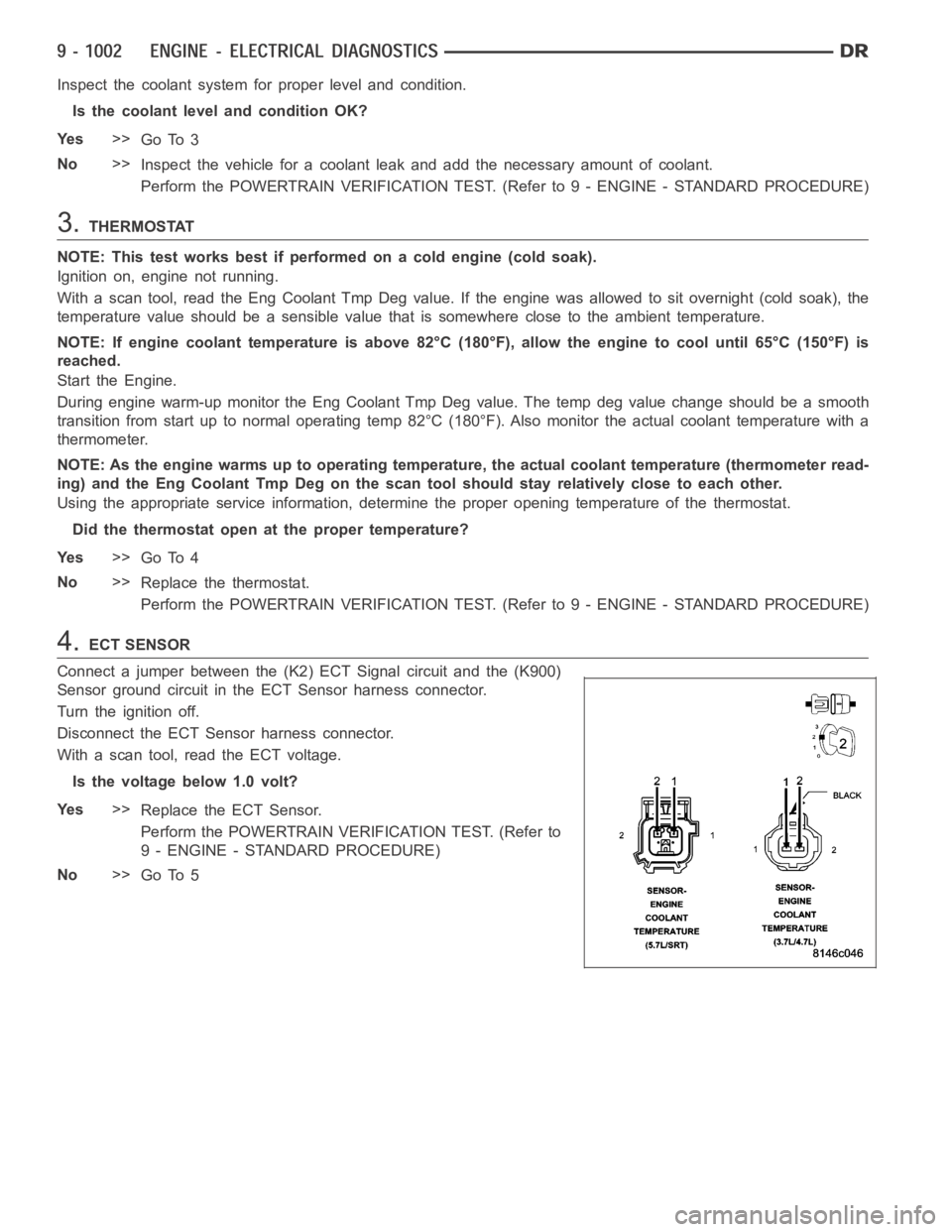
Connect a jumper between the (K2) ECT Signal circuit and the (K900)
Sensor ground circuit in the ECT Sensor harness connector.
Turn the ignition off.
Disconnect the ECT Sensor harness connector.
With a scan tool, read the ECT voltage.
Is the voltage below 1.0 volt?
Ye s>>
Replace the ECT Sensor.
Perform the POWERTRAIN VERIFICATION TEST. (Refer to
9 - ENGINE - STANDARD PROCEDURE)
No>>
Go To 5
Page 449 of 5267
4.TP SENSOR NO.1 VOLTAGE GREATER THAN0.92 VOLTS WITH THROTTLE CLOSED
With the scan tool, read Throttle Position Sensor No.1 voltage.
Throttle must be against its stop.
Is the voltage 0.92 or less with the Throttle closed?
Ye s>>
Go To 5
No>>
Check for a binding throttle condition. If OK, replace the Throttle Position Sensor or the Throttle Body
Assemblyona5.7L.
Perform the POWERTRAIN VERIFICATION TEST. (Refer to 9 - ENGINE - STANDARD PROCEDURE)
5.ECT SENSOR OPERATION
NOTE: For this test to be valid, the thermostat must be operating correctly.
NOTE: This test works best if performed on a cold engine (cold soaked).
NOTE: If the vehicle was allowed to sit over night with no engine start, coolant temperature should be near
ambient temperatures.
Ignition on, engine not running.
With the scan tool, read the ECT value.
NOTE: If engine coolant temperature is above 82° C (180° F), allow the engine to cool until 65° C (150° F) is
reached.
Start the engine.
During engine warm-up, monitor the Engine Coolant Temperature value. Thetemperature value change should be a
smooth transition from start up to normal operating temp 82° C (180° F). Thevalue should reach at least 82° C
(180° F).
Did the Engine Temperature value increase smoothly and did it reach at least 82° C (180° F)?
Ye s>>
Go To 6
No>>
Replace the Engine Coolant Temperature Sensor.
Perform the POWERTRAIN VERIFICATION TEST. (Refer to 9 - ENGINE - STANDARD PROCEDURE)
6.OTHER POSSIBLE CAUSES OF START AND STALL CONDITION
The following additional items should be checked as a possible cause for a start and stall condition.
Refer to any Technical Service Bulletins (TSBs) that may apply to the symptom.
The exhaust system must be free of any restrictions.
The engine compression must be within specifications.
The engine valve timing must be within specifications.
Theenginemustbefreefromvacuumleaks.
The throttle body must be free of carbon buildup and dirt.
Do any of the above conditions exist?
Ye s>>
Repair as necessary.
Perform the POWERTRAIN VERIFICATION TEST. (Refer to 9 - ENGINE - STANDARD PROCEDURE)
No>>
Go To 7
Page 987 of 5267
Theory of Operation
The engine coolant temperature sensor is a negative temperature coefficient thermistor-type sensor whose resis-
tance varies inversely with temperature. At cold temperatures the sensorresistance is high so the voltage is high.
As the coolant temperature increases the resistance decreases and the voltage becomes low. The INSUFFICIENT
COOLANT TEMP FOR CLOSED-LOOP FUEL CONTROL determines if the engine coolant temperature will reach
theclosedloopfuelingcontroltemperaturelimitinaregulatedtimeafterstart.
When Monitored:
With battery voltage greater than 10.4 volts and after engine is started.
Set Condition:
The engine temperature does not go above -10°C (15°F). Failure time depends on start-up coolant tempera-
ture and ambient temperature. (i.e. 2 minutes for a start temp of -10°C (15°F) or up to 10 minutes for a vehicle
with a start-up temp of -28°C (5°F). Two Trip Fault. Three good trips to turnoff the MIL.
Possible Causes
LOW COOLANT LEVEL
THERMOSTAT
ECT SENSOR
Always perform the Pre-Diagnostic Troubleshooting procedure before proceeding. (Refer to 9 - ENGINE -
DIAGNOSIS AND TESTING).
Diagnostic Test
1.CHECKING COOLANT LEVEL AND CONDITION
Ignition on, engine not running.
With a scan tool, read DTCs.
NOTE: If an Engine Coolant Temperature (ECT) DTC is set along with this code, diagnose the ECT DTC first.
NOTE: Inspect the ECT terminals and related PCM terminals. Make sure the terminals are free from corro-
sion and damage.
NOTE: The best way to diagnose this DTC is to allow the vehicle to sit overnight outside in order to have
a totally cold soaked engine.
NOTE: Extremely cold outside ambient temperatures may have caused this DTCtoset.
WARNING: Never open the cooling system when the engine is hot. The system isunder pressure. Extreme
burns or scalding may result. Failure to follow these instructions can result in personal injury or death.
Allow the engine to cool before opening the cooling system.
Inspect the coolant system for proper level and condition.
Is the coolant level and condition OK?
Ye s>>
Go To 2
No>>
Inspect the vehicle for a coolant leak, make the appropriate repairs, and add the correct amount of
coolant.
Perform the POWERTRAIN VERIFICATION TEST. (Refer to 9 - ENGINE - STANDARD PROCEDURE)
Page 998 of 5267
When Monitored:
With ECT greater than 147°F, after reaching a vehicle speed of 10 mph, and the throttle remaining open (off
idle) for 2 minutes, bring the vehicle to a stop and allow the engine to idle with the transmission in DRIVE.
Set Condition:
The oxygen sensor signal voltage is switching from below 0.27 of a volt to above 0.62 of a volt and back fewer
times than required.
Possible Causes
EXHAUST LEAK
(K41) O2 1/1 SIGNAL CIRCUIT
(K900) SENSOR GROUND CIRCUIT
O2 SENSOR
Always perform the Pre-Diagnostic Troubleshooting procedure before proceeding. (Refer to 9 - ENGINE -
DIAGNOSIS AND TESTING).
Diagnostic Test
1.ACTIVE DTC
NOTE: Check for contaminants that may have damaged the O2 Sensor: contaminated fuel, unapproved sil-
icone, oil and coolant.
Ignition on, engine not running.
NOTE: After the repairs have been made, verify proper O2 Sensor operation.If all the O2 Sensor voltage
readings have not returned to normal, follow the diagnostic procedure forthe remaining O2 Sensors.
With a scan tool, read DTCs.
Is the DTC active at this time?
Ye s>>
Go To 2
No>>
Refer to the INTERMITTENT CONDITION Symptom. (Refer to 9 - ENGINE - DIAGNOSIS AND TEST-
ING)
2.EXHAUST LEAK
Start the engine.
Inspect the exhaust system for leaks between the engine and the O2 Sensors.
Are there any exhaust leaks?
Ye s>>
Repair or replace the leaking exhaust parts as necessary.
Perform the POWERTRAIN VERIFICATION TEST. (Refer to 9 - ENGINE - STANDARD PROCEDURE)
No>>
Go To 3
3.(K41) O2 1/1 SIGNAL CIRCUIT VOLTAGE DROP
Turn the ignition off.
While backprobing, measure the voltage of the (K41) O2 Sensor 1/1 Signal circuit between the 1/1 O2 Sensor har-
ness connector and PCM harness connector.
NOTE: Make sure the voltmeter leads meet the terminals in the connector andthat there is good terminal to
wire connection and are connected for positive polarity.
Start the engine.
Page 1016 of 5267
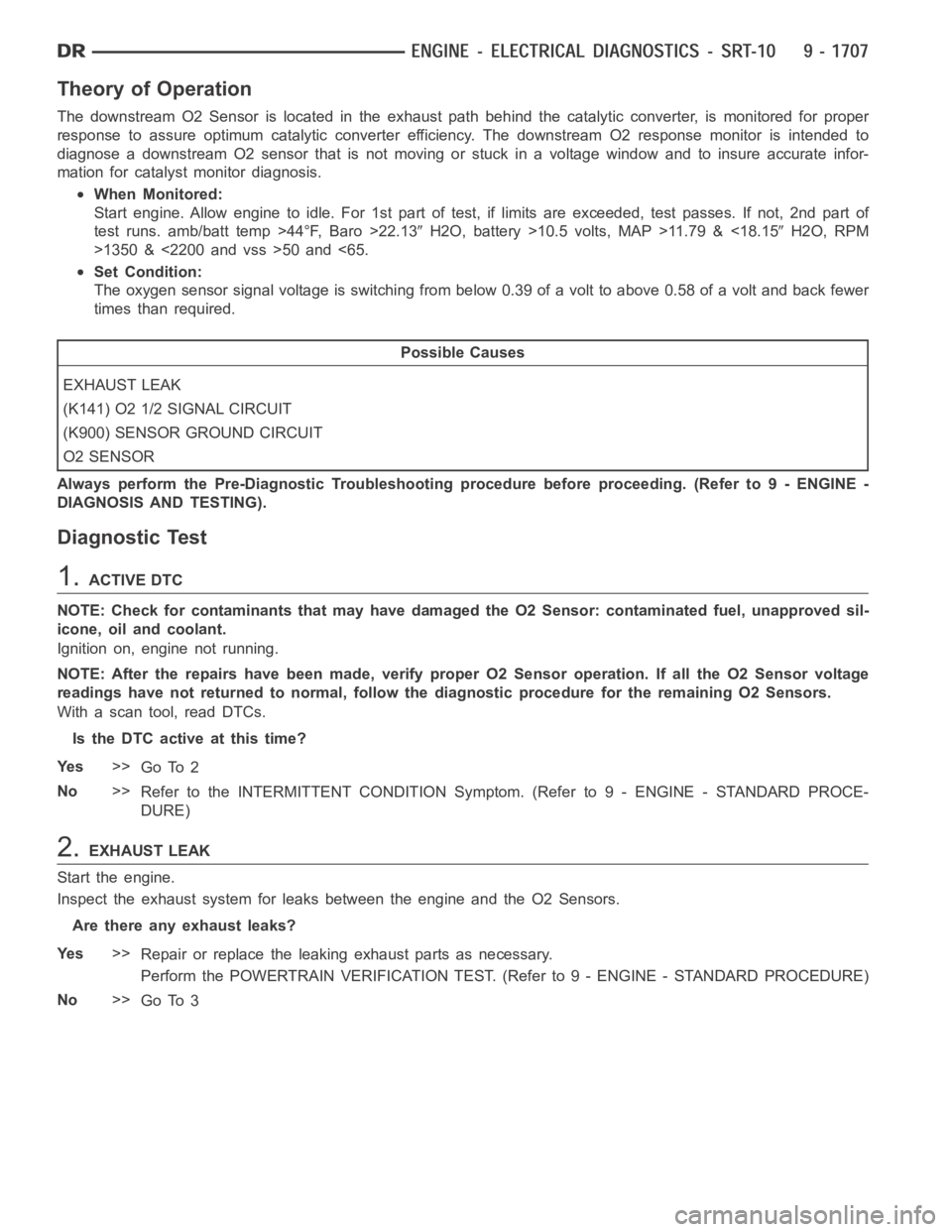
Theory of Operation
The downstream O2 Sensor is located in the exhaust path behind the catalytic converter, is monitored for proper
response to assure optimum catalytic converter efficiency. The downstream O2 response monitor is intended to
diagnose a downstream O2 sensor that is not moving or stuck in a voltage window and to insure accurate infor-
mation for catalyst monitor diagnosis.
When Monitored:
Start engine. Allow engine to idle. For 1st part of test, if limits are exceeded, test passes. If not, 2nd part of
test runs. amb/batt temp >44°F, Baro >22.13
H2O, battery >10.5 volts, MAP >11.79 & <18.15H2O, RPM
>1350 & <2200 and vss >50 and <65.
Set Condition:
The oxygen sensor signal voltage is switching from below 0.39 of a volt to above 0.58 of a volt and back fewer
times than required.
Possible Causes
EXHAUST LEAK
(K141) O2 1/2 SIGNAL CIRCUIT
(K900) SENSOR GROUND CIRCUIT
O2 SENSOR
Always perform the Pre-Diagnostic Troubleshooting procedure before proceeding. (Refer to 9 - ENGINE -
DIAGNOSIS AND TESTING).
Diagnostic Test
1.ACTIVE DTC
NOTE: Check for contaminants that may have damaged the O2 Sensor: contaminated fuel, unapproved sil-
icone, oil and coolant.
Ignition on, engine not running.
NOTE: After the repairs have been made, verify proper O2 Sensor operation.If all the O2 Sensor voltage
readings have not returned to normal, follow the diagnostic procedure forthe remaining O2 Sensors.
With a scan tool, read DTCs.
Is the DTC active at this time?
Ye s>>
Go To 2
No>>
Refer to the INTERMITTENT CONDITION Symptom. (Refer to 9 - ENGINE - STANDARD PROCE-
DURE)
2.EXHAUST LEAK
Start the engine.
Inspect the exhaust system for leaks between the engine and the O2 Sensors.
Are there any exhaust leaks?
Ye s>>
Repair or replace the leaking exhaust parts as necessary.
Perform the POWERTRAIN VERIFICATION TEST. (Refer to 9 - ENGINE - STANDARD PROCEDURE)
No>>
Go To 3
Page 1031 of 5267
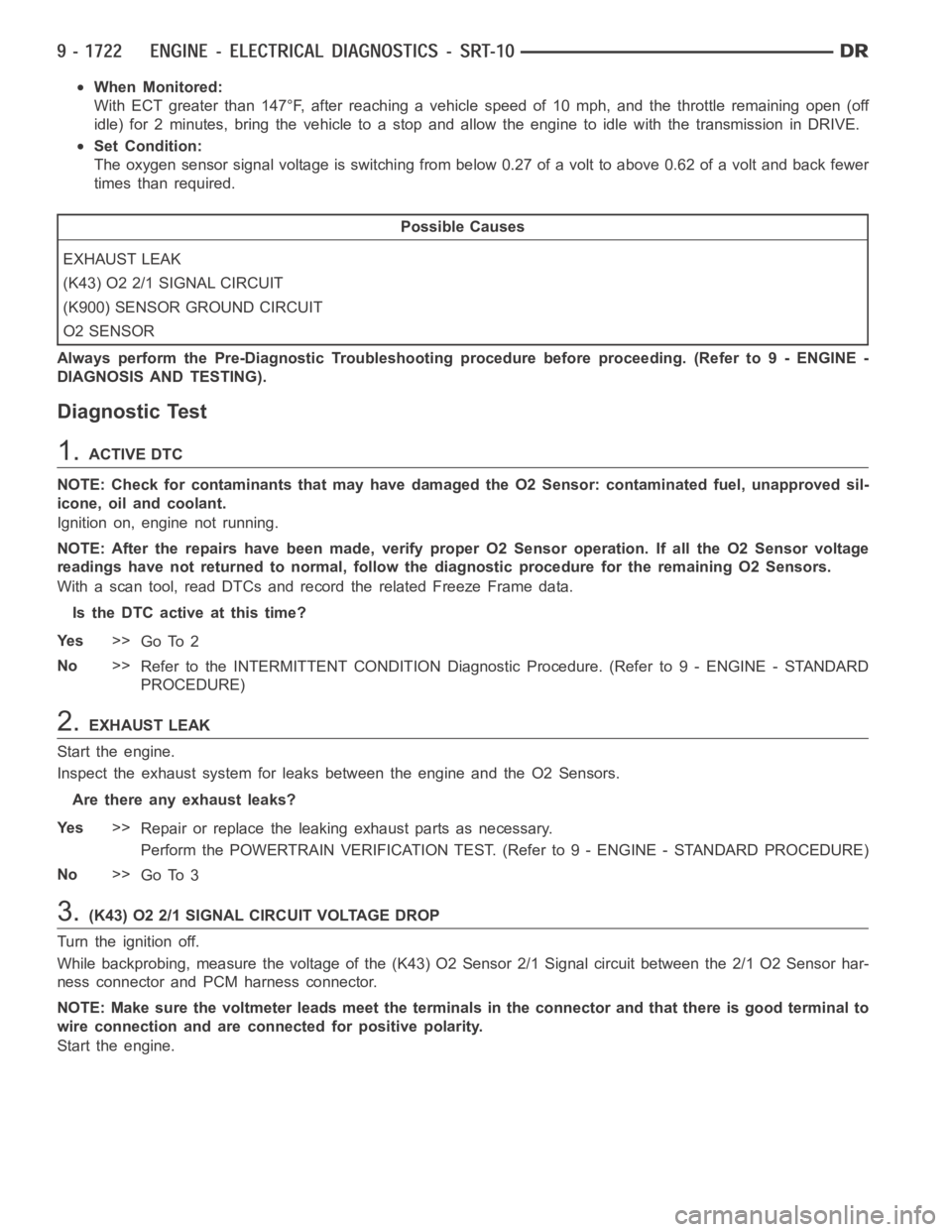
When Monitored:
With ECT greater than 147°F, after reaching a vehicle speed of 10 mph, and the throttle remaining open (off
idle) for 2 minutes, bring the vehicle to a stop and allow the engine to idle with the transmission in DRIVE.
Set Condition:
The oxygen sensor signal voltage is switching from below 0.27 of a volt to above 0.62 of a volt and back fewer
times than required.
Possible Causes
EXHAUST LEAK
(K43) O2 2/1 SIGNAL CIRCUIT
(K900) SENSOR GROUND CIRCUIT
O2 SENSOR
Always perform the Pre-Diagnostic Troubleshooting procedure before proceeding. (Refer to 9 - ENGINE -
DIAGNOSIS AND TESTING).
Diagnostic Test
1.ACTIVE DTC
NOTE: Check for contaminants that may have damaged the O2 Sensor: contaminated fuel, unapproved sil-
icone, oil and coolant.
Ignition on, engine not running.
NOTE: After the repairs have been made, verify proper O2 Sensor operation.If all the O2 Sensor voltage
readings have not returned to normal, follow the diagnostic procedure forthe remaining O2 Sensors.
With a scan tool, read DTCs and record the related Freeze Frame data.
Is the DTC active at this time?
Ye s>>
Go To 2
No>>
Refer to the INTERMITTENT CONDITION Diagnostic Procedure. (Refer to 9 - ENGINE - STANDARD
PROCEDURE)
2.EXHAUST LEAK
Start the engine.
Inspect the exhaust system for leaks between the engine and the O2 Sensors.
Are there any exhaust leaks?
Ye s>>
Repair or replace the leaking exhaust parts as necessary.
Perform the POWERTRAIN VERIFICATION TEST. (Refer to 9 - ENGINE - STANDARD PROCEDURE)
No>>
Go To 3
3.(K43) O2 2/1 SIGNAL CIRCUIT VOLTAGE DROP
Turn the ignition off.
While backprobing, measure the voltage of the (K43) O2 Sensor 2/1 Signal circuit between the 2/1 O2 Sensor har-
ness connector and PCM harness connector.
NOTE: Make sure the voltmeter leads meet the terminals in the connector andthat there is good terminal to
wire connection and are connected for positive polarity.
Start the engine.