ESP DODGE RAM SRT-10 2006 Service Repair Manual
[x] Cancel search | Manufacturer: DODGE, Model Year: 2006, Model line: RAM SRT-10, Model: DODGE RAM SRT-10 2006Pages: 5267, PDF Size: 68.7 MB
Page 396 of 5267
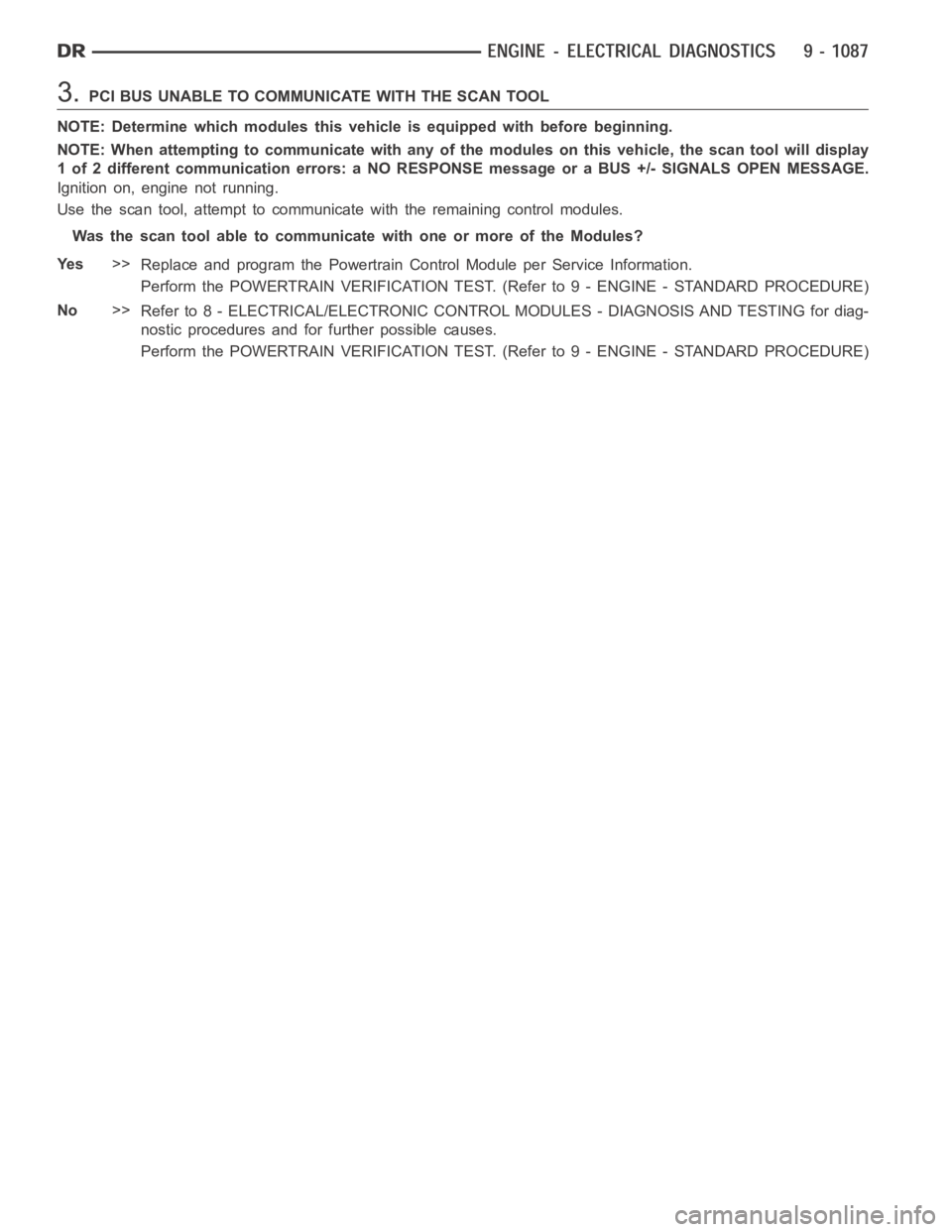
3.PCI BUS UNABLE TO COMMUNICATE WITH THE SCAN TOOL
NOTE: Determine which modules this vehicle is equipped with before beginning.
NOTE: When attempting to communicate with any of the modules on this vehicle, the scan tool will display
1 of 2 different communication errors: a NO RESPONSE message or a BUS +/- SIGNALS OPEN MESSAGE.
Ignition on, engine not running.
Use the scan tool, attempt to communicate with the remaining control modules.
Was the scan tool able to communicate with one or more of the Modules?
Ye s>>
Replace and program the Powertrain Control Module per Service Information.
Perform the POWERTRAIN VERIFICATION TEST. (Refer to 9 - ENGINE - STANDARD PROCEDURE)
No>>
Refer to 8 - ELECTRICAL/ELECTRONIC CONTROL MODULES - DIAGNOSIS AND TESTING for diag-
nostic procedures and for further possible causes.
Perform the POWERTRAIN VERIFICATION TEST. (Refer to 9 - ENGINE - STANDARD PROCEDURE)
Page 417 of 5267
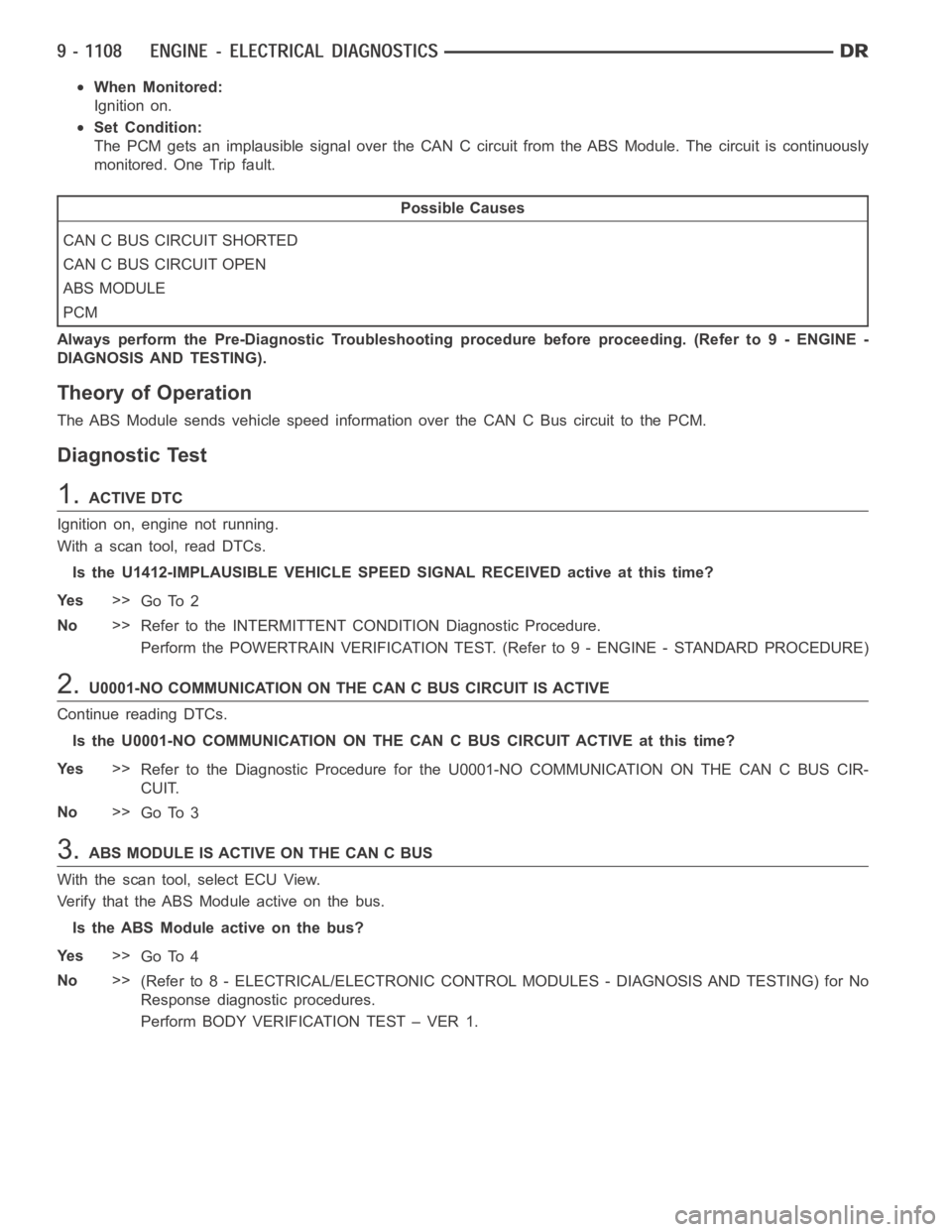
When Monitored:
Ignition on.
Set Condition:
The PCM gets an implausible signal over the CAN C circuit from the ABS Module. The circuit is continuously
monitored. One Trip fault.
Possible Causes
CAN C BUS CIRCUIT SHORTED
CAN C BUS CIRCUIT OPEN
ABS MODULE
PCM
Always perform the Pre-Diagnostic Troubleshooting procedure before proceeding. (Refer to 9 - ENGINE -
DIAGNOSIS AND TESTING).
Theory of Operation
The ABS Module sends vehicle speed information over the CAN C Bus circuit tothe PCM.
Diagnostic Test
1.ACTIVE DTC
Ignition on, engine not running.
With a scan tool, read DTCs.
Is the U1412-IMPLAUSIBLE VEHICLE SPEED SIGNAL RECEIVED active at this time?
Ye s>>
Go To 2
No>>
Refer to the INTERMITTENT CONDITION Diagnostic Procedure.
Perform the POWERTRAIN VERIFICATION TEST. (Refer to 9 - ENGINE - STANDARD PROCEDURE)
2.U0001-NO COMMUNICATION ON THE CAN C BUS CIRCUIT IS ACTIVE
Continue reading DTCs.
Is the U0001-NO COMMUNICATION ON THE CAN C BUS CIRCUIT ACTIVE at this time?
Ye s>>
Refer to the Diagnostic Procedure for the U0001-NO COMMUNICATION ON THE CANCBUSCIR-
CUIT.
No>>
Go To 3
3.ABS MODULE IS ACTIVE ON THE CAN C BUS
With the scan tool, select ECU View.
Verify that the ABS Module active on the bus.
Is the ABS Module active on the bus?
Ye s>>
Go To 4
No>>
(Refer to 8 - ELECTRICAL/ELECTRONIC CONTROL MODULES - DIAGNOSIS AND TESTING) for No
Response diagnostic procedures.
Perform BODY VERIFICATION TEST – VER 1.
Page 420 of 5267
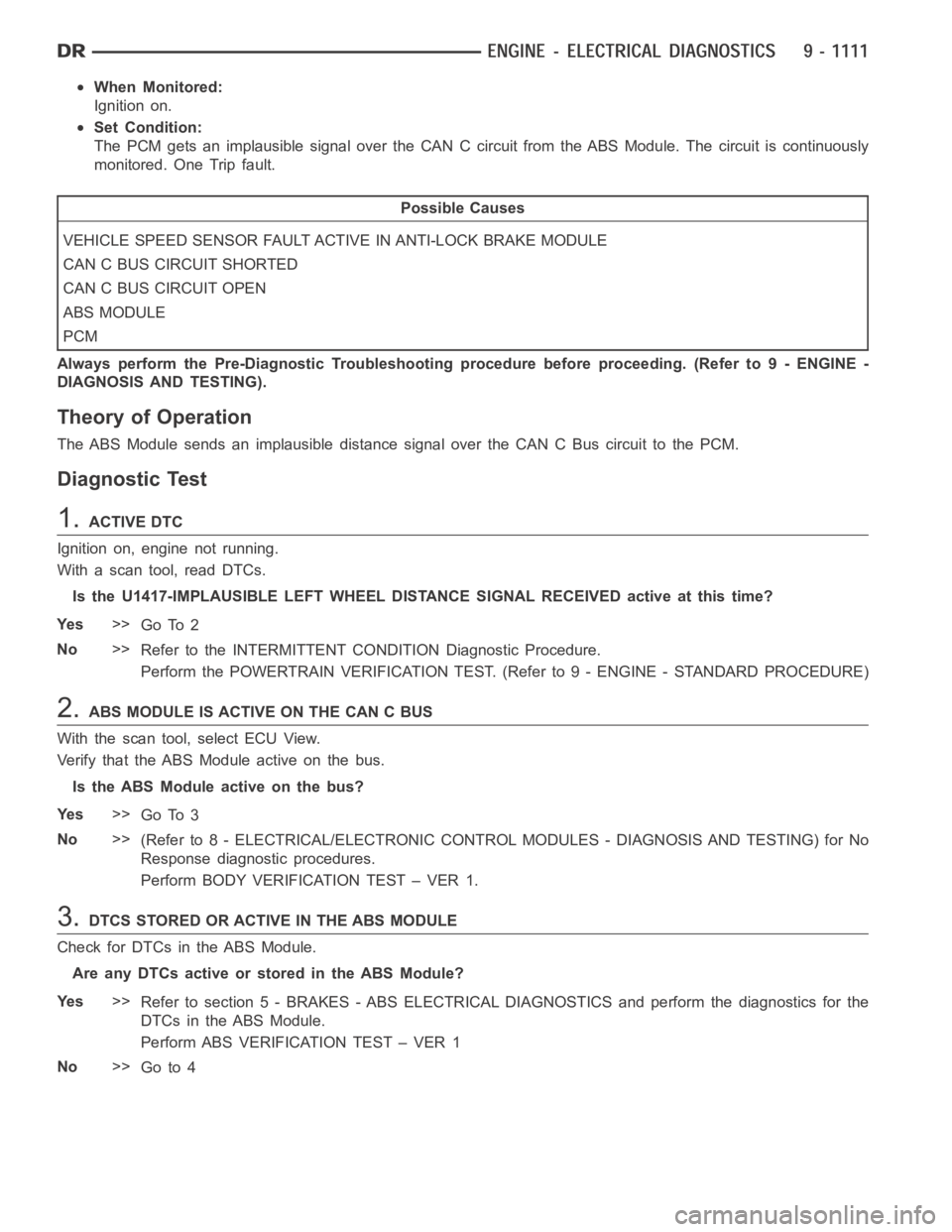
When Monitored:
Ignition on.
Set Condition:
The PCM gets an implausible signal over the CAN C circuit from the ABS Module. The circuit is continuously
monitored. One Trip fault.
Possible Causes
VEHICLE SPEED SENSOR FAULT ACTIVE IN ANTI-LOCK BRAKE MODULE
CAN C BUS CIRCUIT SHORTED
CAN C BUS CIRCUIT OPEN
ABS MODULE
PCM
Always perform the Pre-Diagnostic Troubleshooting procedure before proceeding. (Refer to 9 - ENGINE -
DIAGNOSIS AND TESTING).
Theory of Operation
The ABS Module sends an implausible distance signal over the CAN C Bus circuit to the PCM.
Diagnostic Test
1.ACTIVE DTC
Ignition on, engine not running.
With a scan tool, read DTCs.
Is the U1417-IMPLAUSIBLE LEFT WHEEL DISTANCE SIGNAL RECEIVED active at this time?
Ye s>>
Go To 2
No>>
Refer to the INTERMITTENT CONDITION Diagnostic Procedure.
Perform the POWERTRAIN VERIFICATION TEST. (Refer to 9 - ENGINE - STANDARD PROCEDURE)
2.ABS MODULE IS ACTIVE ON THE CAN C BUS
With the scan tool, select ECU View.
Verify that the ABS Module active on the bus.
Is the ABS Module active on the bus?
Ye s>>
Go To 3
No>>
(Refer to 8 - ELECTRICAL/ELECTRONIC CONTROL MODULES - DIAGNOSIS AND TESTING) for No
Response diagnostic procedures.
Perform BODY VERIFICATION TEST – VER 1.
3.DTCS STORED OR ACTIVE IN THE ABS MODULE
Check for DTCs in the ABS Module.
Are any DTCs active or stored in the ABS Module?
Ye s>>
Refer to section 5 - BRAKES - ABS ELECTRICAL DIAGNOSTICS and perform the diagnostics for the
DTCs in the ABS Module.
Perform ABS VERIFICATION TEST – VER 1
No>>
Go to 4
Page 423 of 5267
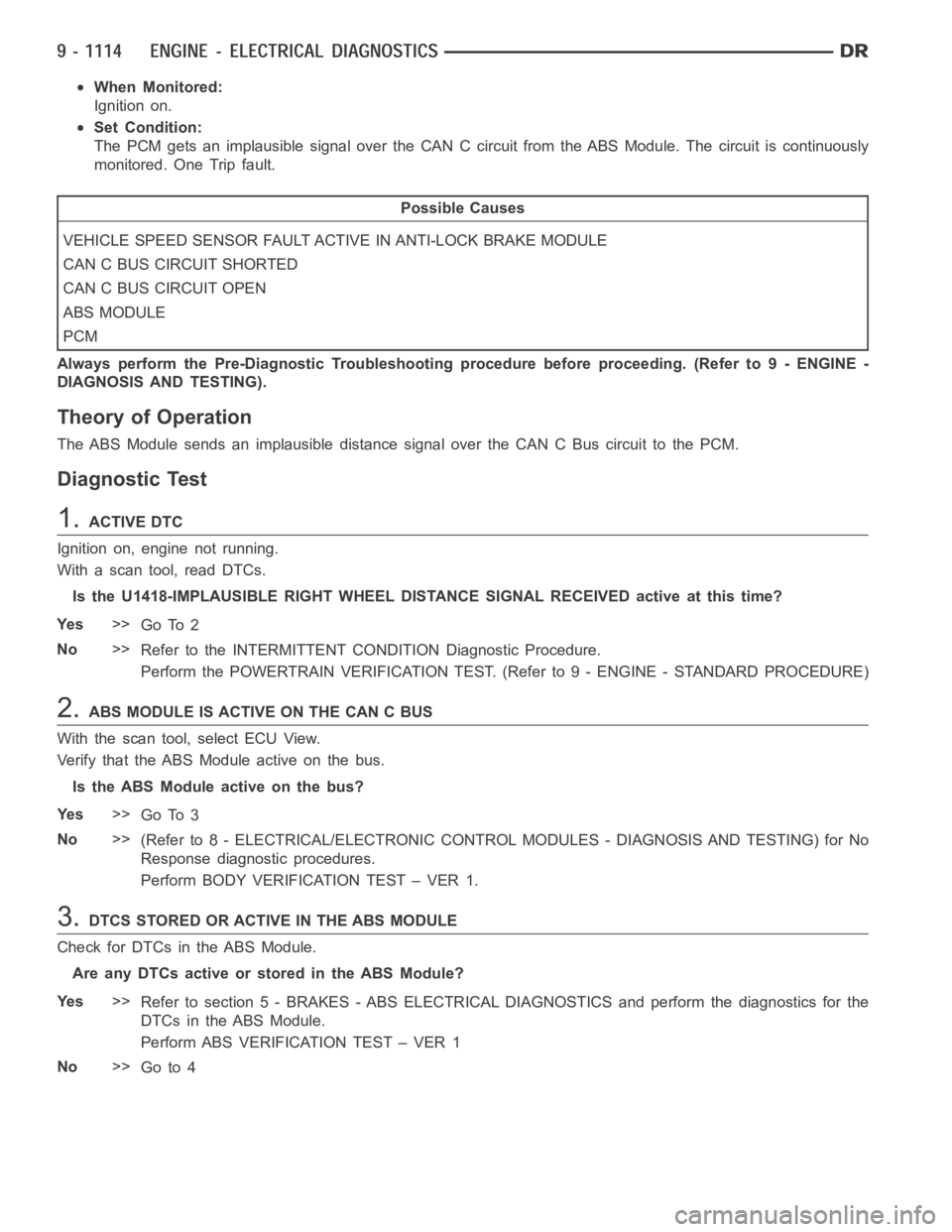
When Monitored:
Ignition on.
Set Condition:
The PCM gets an implausible signal over the CAN C circuit from the ABS Module. The circuit is continuously
monitored. One Trip fault.
Possible Causes
VEHICLE SPEED SENSOR FAULT ACTIVE IN ANTI-LOCK BRAKE MODULE
CAN C BUS CIRCUIT SHORTED
CAN C BUS CIRCUIT OPEN
ABS MODULE
PCM
Always perform the Pre-Diagnostic Troubleshooting procedure before proceeding. (Refer to 9 - ENGINE -
DIAGNOSIS AND TESTING).
Theory of Operation
The ABS Module sends an implausible distance signal over the CAN C Bus circuit to the PCM.
Diagnostic Test
1.ACTIVE DTC
Ignition on, engine not running.
With a scan tool, read DTCs.
Is the U1418-IMPLAUSIBLE RIGHT WHEEL DISTANCE SIGNAL RECEIVED active at this time?
Ye s>>
Go To 2
No>>
Refer to the INTERMITTENT CONDITION Diagnostic Procedure.
Perform the POWERTRAIN VERIFICATION TEST. (Refer to 9 - ENGINE - STANDARD PROCEDURE)
2.ABS MODULE IS ACTIVE ON THE CAN C BUS
With the scan tool, select ECU View.
Verify that the ABS Module active on the bus.
Is the ABS Module active on the bus?
Ye s>>
Go To 3
No>>
(Refer to 8 - ELECTRICAL/ELECTRONIC CONTROL MODULES - DIAGNOSIS AND TESTING) for No
Response diagnostic procedures.
Perform BODY VERIFICATION TEST – VER 1.
3.DTCS STORED OR ACTIVE IN THE ABS MODULE
Check for DTCs in the ABS Module.
Are any DTCs active or stored in the ABS Module?
Ye s>>
Refer to section 5 - BRAKES - ABS ELECTRICAL DIAGNOSTICS and perform the diagnostics for the
DTCs in the ABS Module.
Perform ABS VERIFICATION TEST – VER 1
No>>
Go to 4
Page 433 of 5267
Possible Causes
NO START PRE-TEST
POWERTRAIN FUSES OPEN
SECONDARY INDICATORS PRESENT
ENGINE MECHANICAL
(K342) ASD RELAY OUTPUT CIRCUITS OPEN
FUEL CONTAMINATION
Diagnostic Test
1.NO START PRE-TEST
NOTE: The following list of items must be checked before continuing with any no start tests.
The battery must be fully charged and in good condition. A low charged battery may produce invalid test results. If
the battery is low, charge the battery and then attempt to start the vehicleby cranking the engine for 15 seconds,
3 consecutive times.
This will allow any DTCs to set that may have been erased due to a dead battery.
Try to communicate with PCM if not able to communicate check fuses.
Make sure the Powers and Ground to the PCM are OK.
Make sure the PCM communicates with the scan tool and that there are no DTCs stored in the PCM memory. If the
PCM reports a No Response condition, refer to section 8 Electrical Electronic Control Module Electrical Diagnostics
for the proper tests.
Read the PCM DTCs with the scan tool. If any DTCs are present, they must be repaired before continuing with any
other No Start diagnostic tests. Refer to the Table of Contents for the related P-code that is reported by the PCM.
Make sure that the Bus is functional. Attempt to communicate with the Instrument Cluster and VTSS, If you are
unable to establish communications refer to 8 Electrical Electronic Control Module Electrical Diagnostics for the
proper Diagnostic procedures.
The Sentry Key Immobilizer System mustbe operating properly. Check for proper communication with the scan tool
and check for DTCs that may be stored in the Sentry Key Immobilizer Module (SKIM). Repair the DTC(s) before
continuing.
If no DTCs are found, using the scan tool, select Clear PCM (BATT Disconnect).
Crank the engine several times. Using the scan tool, read DTCs. If a DTC is present perform the DTC diagnostics
before continuing.
Were any problems found?
Ye s>>
Repair as necessary.
Perform the POWERTRAIN VERIFICATION TEST. (Refer to 9 - ENGINE - STANDARD PROCEDURE)
No>>
Go To 2
2.OPEN FUSE
Check for any open fuses in the IPM or Junction Block that may be related to theNoStartcondition.
Are any of the fuses open?
Ye s>>
Replace the open fuse and check the related circuit(s) for a short to ground.
Perform the POWERTRAIN VERIFICATION TEST. (Refer to 9 - ENGINE - STANDARD PROCEDURE)
No>>
Go To 3
Page 442 of 5267
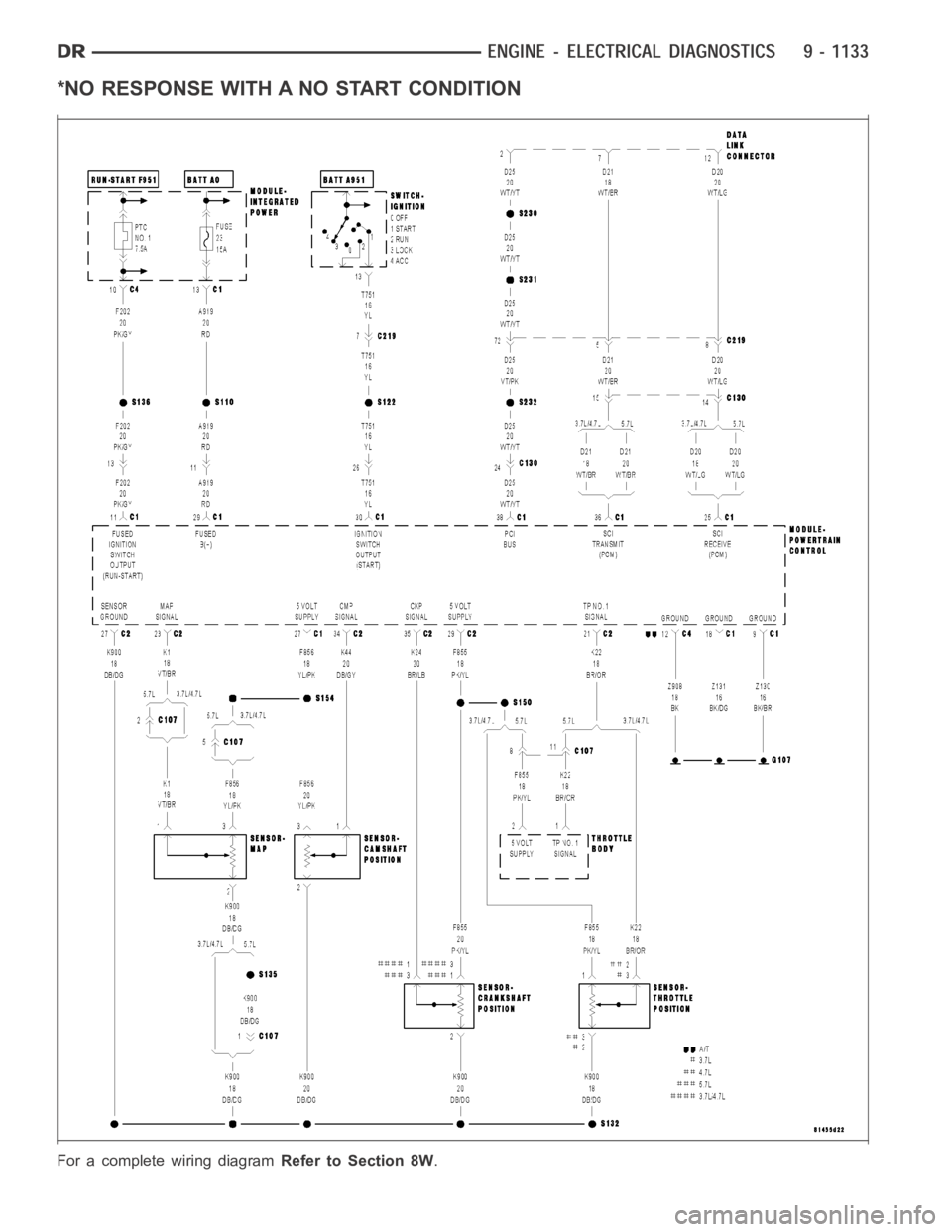
*NO RESPONSE WITH A NO START CONDITION
For a complete wiring diagramRefer to Section 8W.
Page 443 of 5267
Possible Causes
(A919) PCM FUSED B+ CIRCUIT
PCM NO RESPONSE
(F202) (F1) (T751) PCM FUSED IGNITION SWITCH OUTPUT CIRCUITS
(Z130) (Z131) PCM GROUND CIRCUITS
CRANKSHAFT POSITION SENSOR
(F855) 5-VOLT SENSOR OPEN/SHORTED
(F855) 5-VOLT SUPPLY CIRCUIT SHORTED TO GROUND
(F856) 5-VOLT SUPPLY CIRCUIT SHORTED TO GROUND
PCM
Diagnostic Test
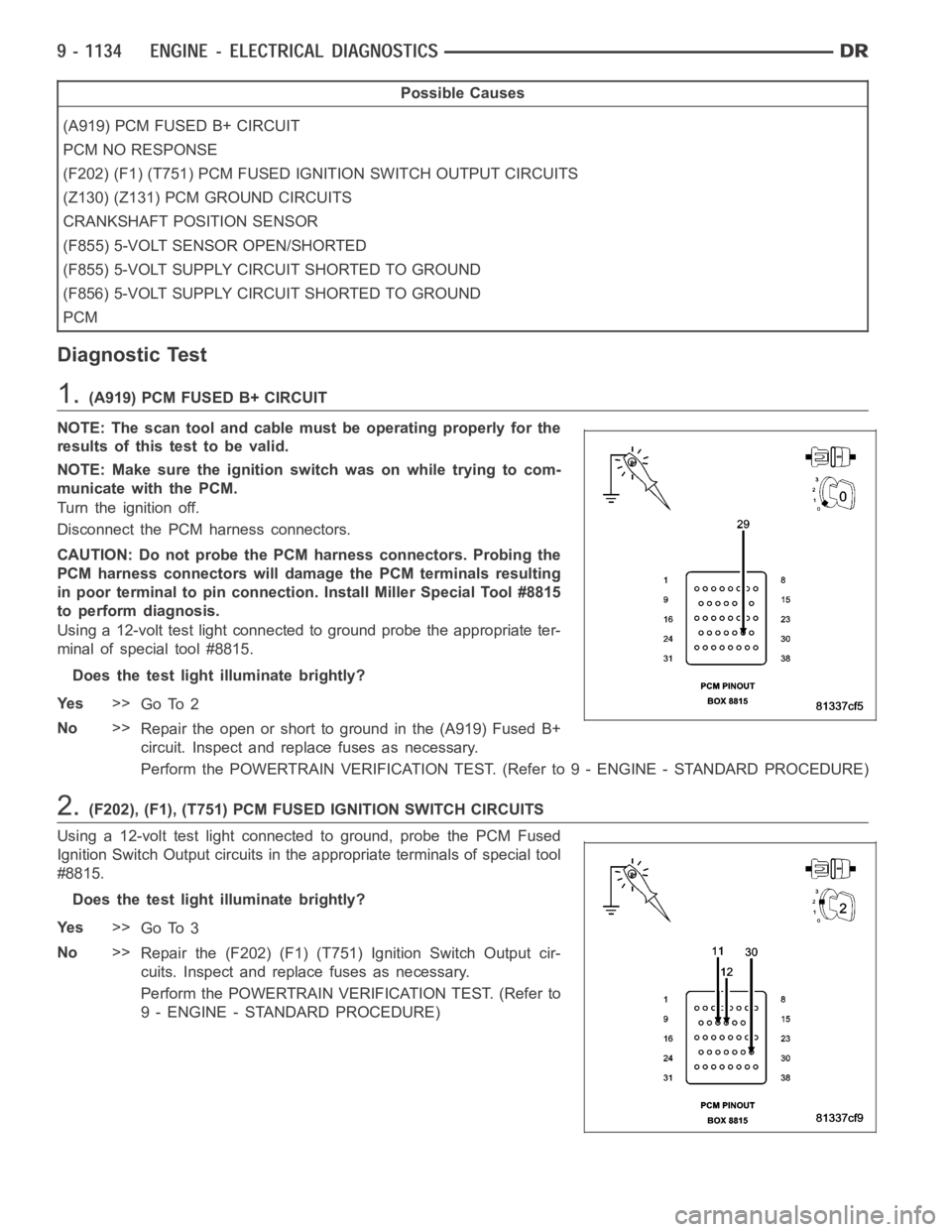
1.(A919) PCM FUSED B+ CIRCUIT
NOTE: The scan tool and cable must be operating properly for the
resultsofthistesttobevalid.
NOTE: Make sure the ignition switch was on while trying to com-
municate with the PCM.
Turn the ignition off.
Disconnect the PCM harness connectors.
CAUTION: Do not probe the PCM harness connectors. Probing the
PCM harness connectors will damage the PCM terminals resulting
in poor terminal to pin connection. Install Miller Special Tool #8815
to perform diagnosis.
Using a 12-volt test light connected to ground probe the appropriate ter-
minal of special tool #8815.
Does the test light illuminate brightly?
Ye s>>
Go To 2
No>>
Repair the open or short to ground in the (A919) Fused B+
circuit. Inspect and replace fuses as necessary.
Perform the POWERTRAIN VERIFICATION TEST. (Refer to 9 - ENGINE - STANDARD PROCEDURE)
2.(F202), (F1), (T751) PCM FUSED IGNITION SWITCH CIRCUITS
Using a 12-volt test light connected to ground, probe the PCM Fused
Ignition Switch Output circuits in the appropriate terminals of special tool
#8815.
Does the test light illuminate brightly?
Ye s>>
Go To 3
No>>
Repair the (F202) (F1) (T751) Ignition Switch Output cir-
cuits. Inspect and replace fuses as necessary.
Perform the POWERTRAIN VERIFICATION TEST. (Refer to
9 - ENGINE - STANDARD PROCEDURE)
Page 459 of 5267
PRE-DIAGNOSTIC TROUBLESHOOTING PROCEDURE
For a complete wiring diagramRefer to Section 8W.
Diagnostic Test
1.NO RESPONSE
Make sure the scan tool will communicate with the appropriate modules.
Are you currently experiencing a NO RESPONSE condition?
Ye s>>
The NO RESPONSE condition must be properly diagnosed before continuing.
Refer to the appropriate BUS Communication test in Section 8 ELECTRONIC CONTROL MODULES -
ELECTRICAL DIAGNOSTICS.
No>>
Go To 2
2.NO START
Is the customer complaint a NO START condition?
Ye s>>
Check the vehicle for any NO START related PCM DTC(s) or Vehicle Theft Security related DTC(s).
If no Theft related DTC(s) are present, refer to the Non DTC Diagnostic Procedures that relate to Fuel
and Starting.
No>>
Go To 3
3.VEHICLE HISTORY AND TSB(s)
Continue by reading PCM DTC(s) and record the related Freeze Frame data if any DTC(s) are present.
Whether or not any DTC(s) are present you will want to check the following items which may assist in repairing the
customers complaint successfully.
Check the vehicles repair history.
If the vehicle has a repair history that pertains to the customer’s currentcomplaint, review the repair.
Inspect the vehicle for any aftermarket accessories that may have been installed incorrectly.
Check for any TSB(s) related to the customer’s complaint or DTC(s).
If a TSB applies, follow the instructions per the TSB.
Choose the following scenario that best applies.
The TSB repaired the customers complaint.
Testing complete.
A DTC is present, no TSB applies, or the TSB didn’t repair the customers complaint.
Go To 4
No DTC(s) are present.
Refer to the INTERMITTENT CONDITION Diagnostic Procedure.
Page 905 of 5267
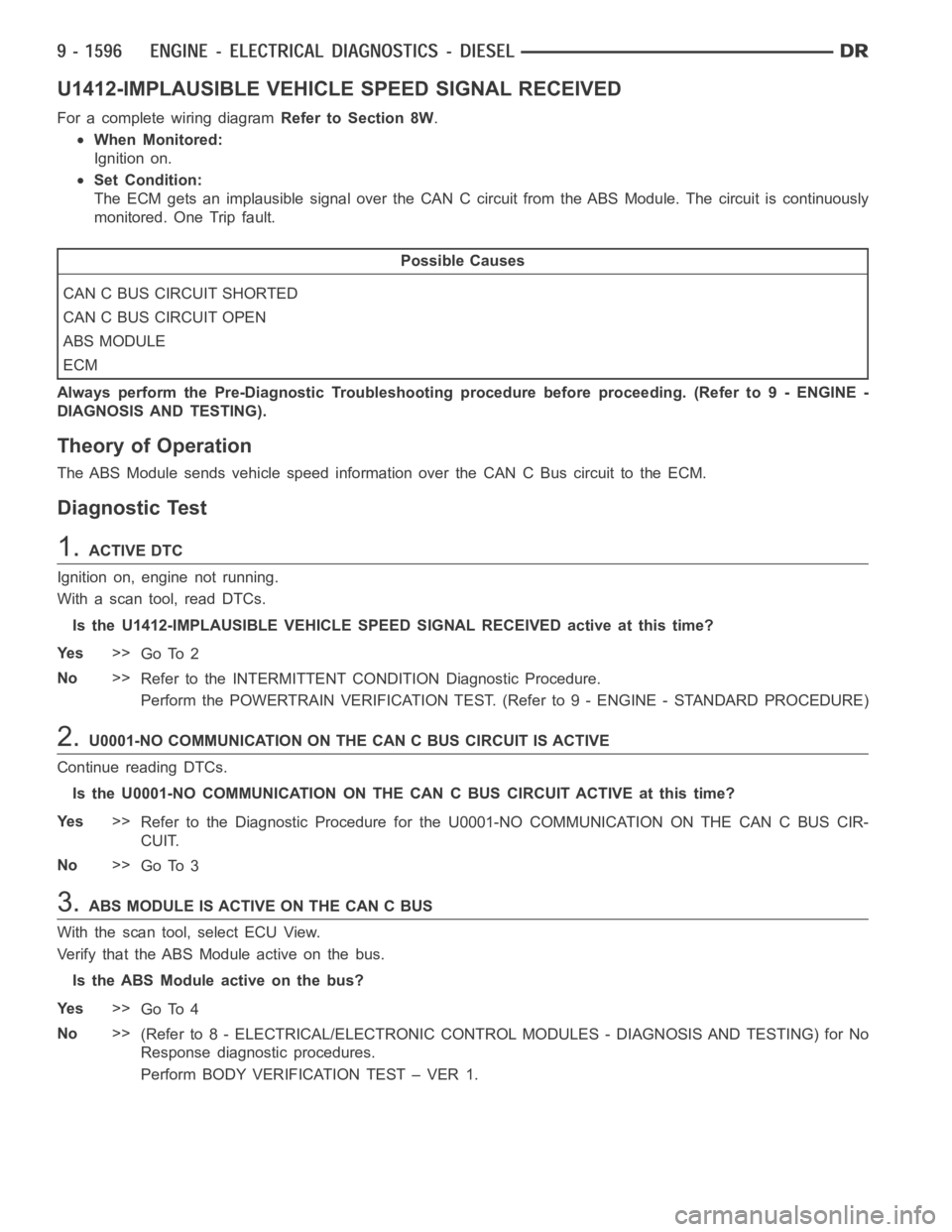
U1412-IMPLAUSIBLE VEHICLE SPEED SIGNAL RECEIVED
For a complete wiring diagramRefer to Section 8W.
When Monitored:
Ignition on.
Set Condition:
The ECM gets an implausible signal over the CAN C circuit from the ABS Module. The circuit is continuously
monitored. One Trip fault.
Possible Causes
CAN C BUS CIRCUIT SHORTED
CAN C BUS CIRCUIT OPEN
ABS MODULE
ECM
Always perform the Pre-Diagnostic Troubleshooting procedure before proceeding. (Refer to 9 - ENGINE -
DIAGNOSIS AND TESTING).
Theory of Operation
The ABS Module sends vehicle speed information over the CAN C Bus circuit tothe ECM.
Diagnostic Test
1.ACTIVE DTC
Ignition on, engine not running.
With a scan tool, read DTCs.
Is the U1412-IMPLAUSIBLE VEHICLE SPEED SIGNAL RECEIVED active at this time?
Ye s>>
Go To 2
No>>
Refer to the INTERMITTENT CONDITION Diagnostic Procedure.
Perform the POWERTRAIN VERIFICATION TEST. (Refer to 9 - ENGINE - STANDARD PROCEDURE)
2.U0001-NO COMMUNICATION ON THE CAN C BUS CIRCUIT IS ACTIVE
Continue reading DTCs.
Is the U0001-NO COMMUNICATION ON THE CAN C BUS CIRCUIT ACTIVE at this time?
Ye s>>
Refer to the Diagnostic Procedure for the U0001-NO COMMUNICATION ON THE CANCBUSCIR-
CUIT.
No>>
Go To 3
3.ABS MODULE IS ACTIVE ON THE CAN C BUS
With the scan tool, select ECU View.
Verify that the ABS Module active on the bus.
Is the ABS Module active on the bus?
Ye s>>
Go To 4
No>>
(Refer to 8 - ELECTRICAL/ELECTRONIC CONTROL MODULES - DIAGNOSIS AND TESTING) for No
Response diagnostic procedures.
Perform BODY VERIFICATION TEST – VER 1.
Page 911 of 5267
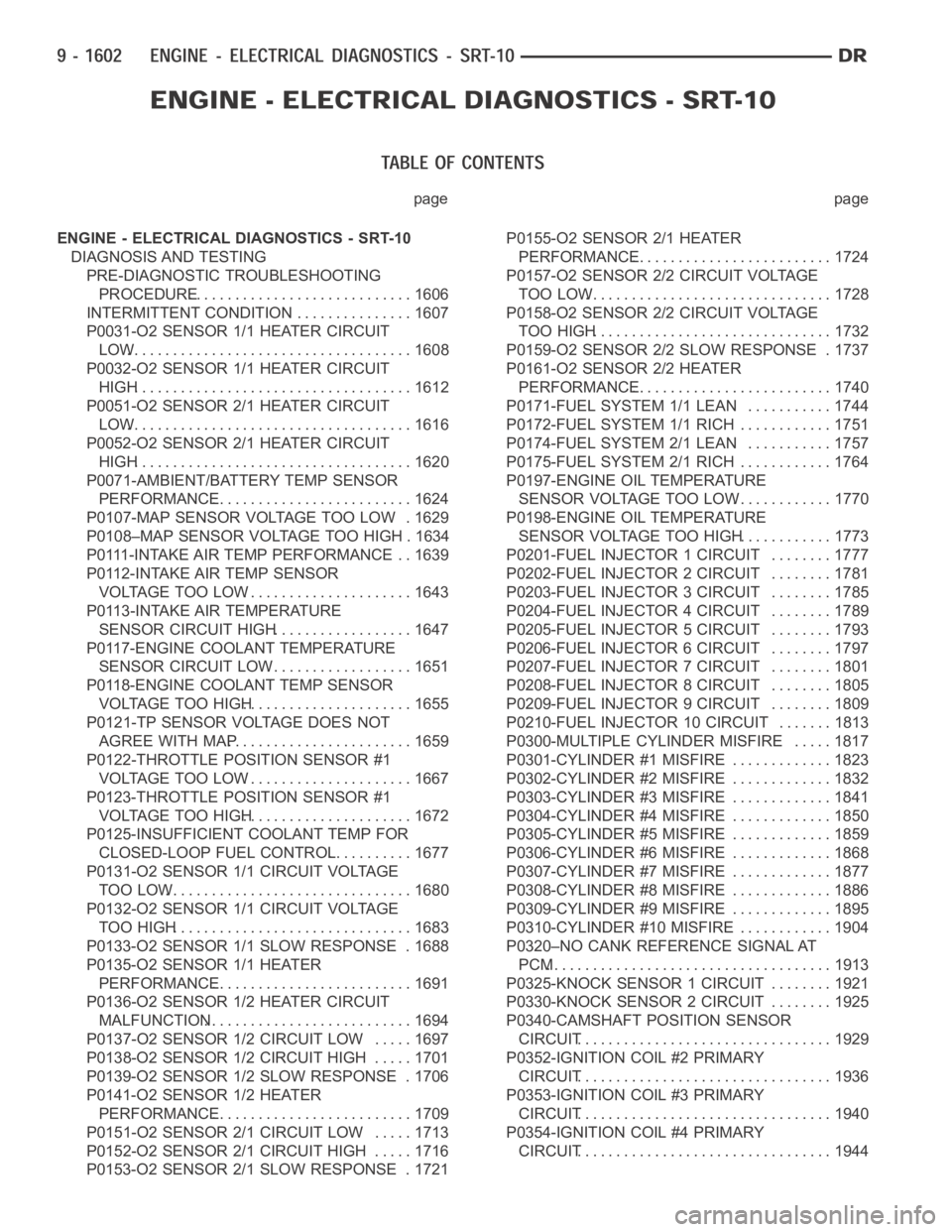
page page
ENGINE - ELECTRICAL DIAGNOSTICS - SRT-10
DIAGNOSIS AND TESTING
PRE-DIAGNOSTIC TROUBLESHOOTING
PROCEDURE............................. 1606
INTERMITTENT CONDITION ............... 1607
P0031-O2 SENSOR 1/1 HEATER CIRCUIT
LOW..................................... 1608
P0032-O2 SENSOR 1/1 HEATER CIRCUIT
HIGH.................................... 1612
P0051-O2 SENSOR 2/1 HEATER CIRCUIT
LOW..................................... 1616
P0052-O2 SENSOR 2/1 HEATER CIRCUIT
HIGH.................................... 1620
P0071-AMBIENT/BATTERY TEMP SENSOR
PERFORMANCE.......................... 1624
P0107-MAP SENSOR VOLTAGE TOO LOW . 1629
P0108–MAP SENSOR VOLTAGE TOO HIGH . 1634
P0111-INTAKE AIR TEMP PERFORMANCE . . 1639
P0112-INTAKE AIR TEMP SENSOR
VOLTAGE TOO LOW...................... 1643
P0113-INTAKE AIR TEMPERATURE
SENSOR CIRCUIT HIGH.................. 1647
P0117-ENGINE COOLANT TEMPERATURE
SENSOR CIRCUIT LOW................... 1651
P0118-ENGINE COOLANT TEMP SENSOR
VOLTAGE TOO HIGH...................... 1655
P0121-TP SENSOR VOLTAGE DOES NOT
AGREE WITH MAP........................ 1659
P0122-THROTTLE POSITION SENSOR #1
VOLTAGE TOO LOW...................... 1667
P0123-THROTTLE POSITION SENSOR #1
VOLTAGE TOO HIGH...................... 1672
P0125-INSUFFICIENT COOLANT TEMP FOR
CLOSED-LOOP FUEL CONTROL........... 1677
P0131-O2 SENSOR 1/1 CIRCUIT VOLTAGE
TOO LOW................................ 1680
P0132-O2 SENSOR 1/1 CIRCUIT VOLTAGE
TOO HIGH............................... 1683
P0133-O2 SENSOR 1/1 SLOW RESPONSE . 1688
P0135-O2 SENSOR 1/1 HEATER
PERFORMANCE.......................... 1691
P0136-O2 SENSOR 1/2 HEATER CIRCUIT
MALFUNCTION........................... 1694
P0137-O2 SENSOR 1/2 CIRCUIT LOW ..... 1697
P0138-O2 SENSOR 1/2 CIRCUIT HIGH ..... 1701
P0139-O2 SENSOR 1/2 SLOW RESPONSE . 1706
P0141-O2 SENSOR 1/2 HEATER
PERFORMANCE.......................... 1709
P0151-O2 SENSOR 2/1 CIRCUIT LOW ..... 1713
P0152-O2 SENSOR 2/1 CIRCUIT HIGH ..... 1716
P0153-O2 SENSOR 2/1 SLOW RESPONSE . 1721P0155-O2 SENSOR 2/1 HEATER
PERFORMANCE.......................... 1724
P0157-O2 SENSOR 2/2 CIRCUIT VOLTAGE
TOO LOW................................ 1728
P0158-O2 SENSOR 2/2 CIRCUIT VOLTAGE
TOO HIGH............................... 1732
P0159-O2 SENSOR 2/2 SLOW RESPONSE . 1737
P0161-O2 SENSOR 2/2 HEATER
PERFORMANCE.......................... 1740
P0171-FUEL SYSTEM 1/1 LEAN ........... 1744
P0172-FUEL SYSTEM 1/1 RICH ............ 1751
P0174-FUEL SYSTEM 2/1 LEAN ........... 1757
P0175-FUEL SYSTEM 2/1 RICH ............ 1764
P0197-ENGINE OIL TEMPERATURE
SENSOR VOLTAGE TOO LOW............. 1770
P0198-ENGINE OIL TEMPERATURE
SENSOR VOLTAGE TOO HIGH............ 1773
P0201-FUEL INJECTOR 1 CIRCUIT ........ 1777
P0202-FUEL INJECTOR 2 CIRCUIT ........ 1781
P0203-FUEL INJECTOR 3 CIRCUIT ........ 1785
P0204-FUEL INJECTOR 4 CIRCUIT ........ 1789
P0205-FUEL INJECTOR 5 CIRCUIT ........ 1793
P0206-FUEL INJECTOR 6 CIRCUIT ........ 1797
P0207-FUEL INJECTOR 7 CIRCUIT ........ 1801
P0208-FUEL INJECTOR 8 CIRCUIT ........ 1805
P0209-FUEL INJECTOR 9 CIRCUIT ........ 1809
P0210-FUEL INJECTOR 10 CIRCUIT....... 1813
P0300-MULTIPLE CYLINDER MISFIRE ..... 1817
P0301-CYLINDER #1 MISFIRE ............. 1823
P0302-CYLINDER #2 MISFIRE ............. 1832
P0303-CYLINDER #3 MISFIRE ............. 1841
P0304-CYLINDER #4 MISFIRE ............. 1850
P0305-CYLINDER #5 MISFIRE ............. 1859
P0306-CYLINDER #6 MISFIRE ............. 1868
P0307-CYLINDER #7 MISFIRE ............. 1877
P0308-CYLINDER #8 MISFIRE ............. 1886
P0309-CYLINDER #9 MISFIRE ............. 1895
P0310-CYLINDER #10 MISFIRE ............ 1904
P0320–NO CANK REFERENCE SIGNAL AT
PCM..................................... 1913
P0325-KNOCK SENSOR 1 CIRCUIT ........ 1921
P0330-KNOCK SENSOR 2 CIRCUIT ........ 1925
P0340-CAMSHAFT POSITION SENSOR
CIRCUIT................................. 1929
P0352-IGNITION COIL #2 PRIMARY
CIRCUIT................................. 1936
P0353-IGNITION COIL #3 PRIMARY
CIRCUIT................................. 1940
P0354-IGNITION COIL #4 PRIMARY
CIRCUIT................................. 1944