brake sensor DODGE RAM SRT-10 2006 Service Repair Manual
[x] Cancel search | Manufacturer: DODGE, Model Year: 2006, Model line: RAM SRT-10, Model: DODGE RAM SRT-10 2006Pages: 5267, PDF Size: 68.7 MB
Page 166 of 5267
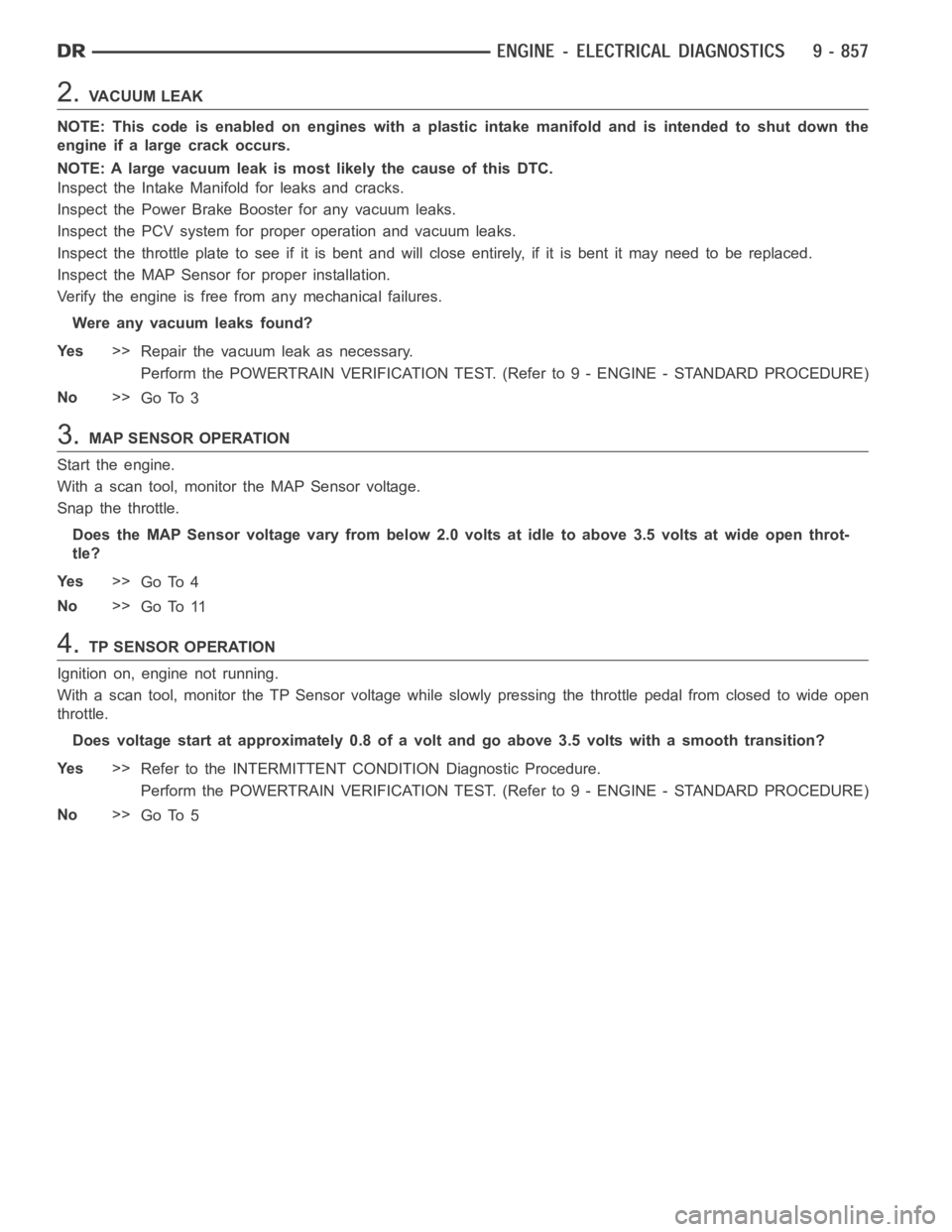
2.VACUUM LEAK
NOTE: This code is enabled on engines with a plastic intake manifold and is intended to shut down the
engine if a large crack occurs.
NOTE: A large vacuum leak is most likely the cause of this DTC.
Inspect the Intake Manifold for leaks and cracks.
Inspect the Power Brake Booster for any vacuum leaks.
Inspect the PCV system for proper operation and vacuum leaks.
Inspect the throttle plate to see if it is bent and will close entirely, if itis bent it may need to be replaced.
Inspect the MAP Sensor for proper installation.
Verify the engine is free from any mechanical failures.
Were any vacuum leaks found?
Ye s>>
Repair the vacuum leak as necessary.
Perform the POWERTRAIN VERIFICATION TEST. (Refer to 9 - ENGINE - STANDARD PROCEDURE)
No>>
Go To 3
3.MAP SENSOR OPERATION
Start the engine.
With a scan tool, monitor the MAP Sensor voltage.
Snap the throttle.
Does the MAP Sensor voltage vary from below 2.0 volts at idle to above 3.5 volts at wide open throt-
tle?
Ye s>>
Go To 4
No>>
Go To 11
4.TP SENSOR OPERATION
Ignition on, engine not running.
With a scan tool, monitor the TP Sensor voltage while slowly pressing the throttle pedal from closed to wide open
throttle.
Does voltage start at approximately 0.8 of a volt and go above 3.5 volts witha smooth transition?
Ye s>>
Refer to the INTERMITTENT CONDITION Diagnostic Procedure.
Perform the POWERTRAIN VERIFICATION TEST. (Refer to 9 - ENGINE - STANDARD PROCEDURE)
No>>
Go To 5
Page 176 of 5267
3.ENGINE MECHANICAL
Check for any of the following conditions/mechanical problems.
AIR INDUCTION SYSTEM - must be free from leaks
ENGINE VACUUM - must be at least 13 inches in neutral
ENGINE VALVE TIMING - must be within specifications
ENGINE COMPRESSION - must be within specifications
ENGINE EXHAUST SYSTEM - must be free of any restrictions or leaks
ENGINE PCV SYSTEM - must flow freely
TORQUE CONVERTER STALL SPEED - must be within specifications
POWER BRAKE BOOSTER - no internal vacuum leaks
FUEL - must be free of contamination
FUEL INJECTOR - plugged or restricted injector; control wire not connectedtocorrectinjector
Are there any engine mechanical problems?
Ye s>>
Repair as necessary.
Perform the POWERTRAIN VERIFICATION TEST. (Refer to 9 - ENGINE - STANDARD PROCEDURE)
No>>
Go To 4
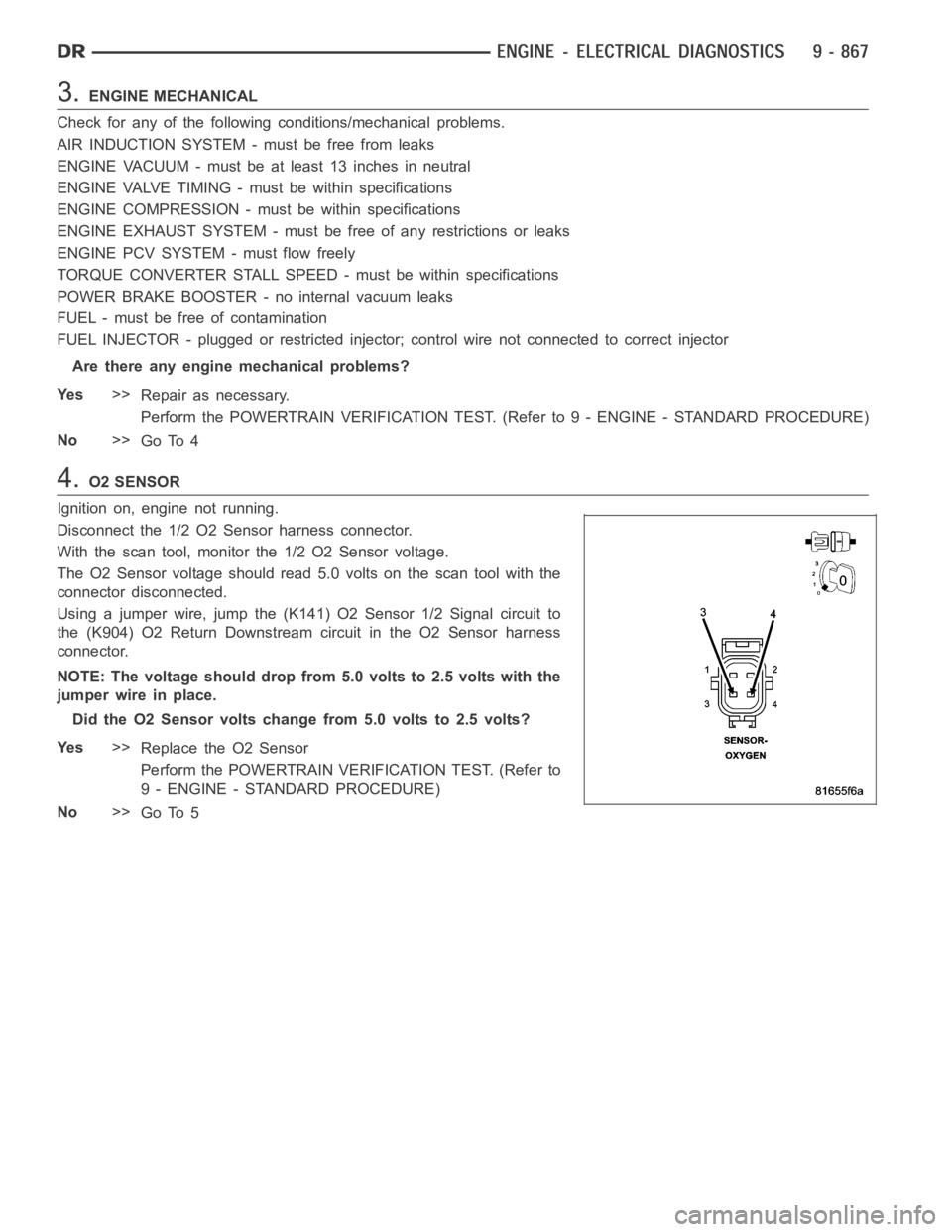
4.O2 SENSOR
Ignition on, engine not running.
Disconnect the 1/2 O2 Sensor harness connector.
With the scan tool, monitor the 1/2 O2 Sensor voltage.
The O2 Sensor voltage should read 5.0 volts on the scan tool with the
connector disconnected.
Using a jumper wire, jump the (K141) O2 Sensor 1/2 Signal circuit to
the (K904) O2 Return Downstream circuit in the O2 Sensor harness
connector.
NOTE: The voltage should drop from 5.0 volts to 2.5 volts with the
jumper wire in place.
Did the O2 Sensor volts change from 5.0 volts to 2.5 volts?
Ye s>>
Replace the O2 Sensor
Perform the POWERTRAIN VERIFICATION TEST. (Refer to
9 - ENGINE - STANDARD PROCEDURE)
No>>
Go To 5
Page 181 of 5267
3.ENGINE MECHANICAL
Check for any of the following conditions/mechanical problems
AIR INDUCTION SYSTEM - must be free from leaks.
ENGINE VACUUM - must be at least 13 inches in neutral
ENGINE VALVE TIMING - must be within specifications
ENGINE COMPRESSION - must be within specifications
ENGINE EXHAUST SYSTEM - must be free of any restrictions or leaks
ENGINE PCV SYSTEM - must flow freely
TORQUE CONVERTER STALL SPEED - must be within specifications
POWER BRAKE BOOSTER - no internal vacuum leaks
FUEL - must be free of contamination
FUEL INJECTOR - plugged or restricted injector; control wire not connectedtocorrectinjector
Are there any engine mechanical problems?
Ye s>>
Repair as necessary.
Perform the POWERTRAIN VERIFICATION TEST. (Refer to 9 - ENGINE - STANDARD PROCEDURE)
No>>
Go To 4
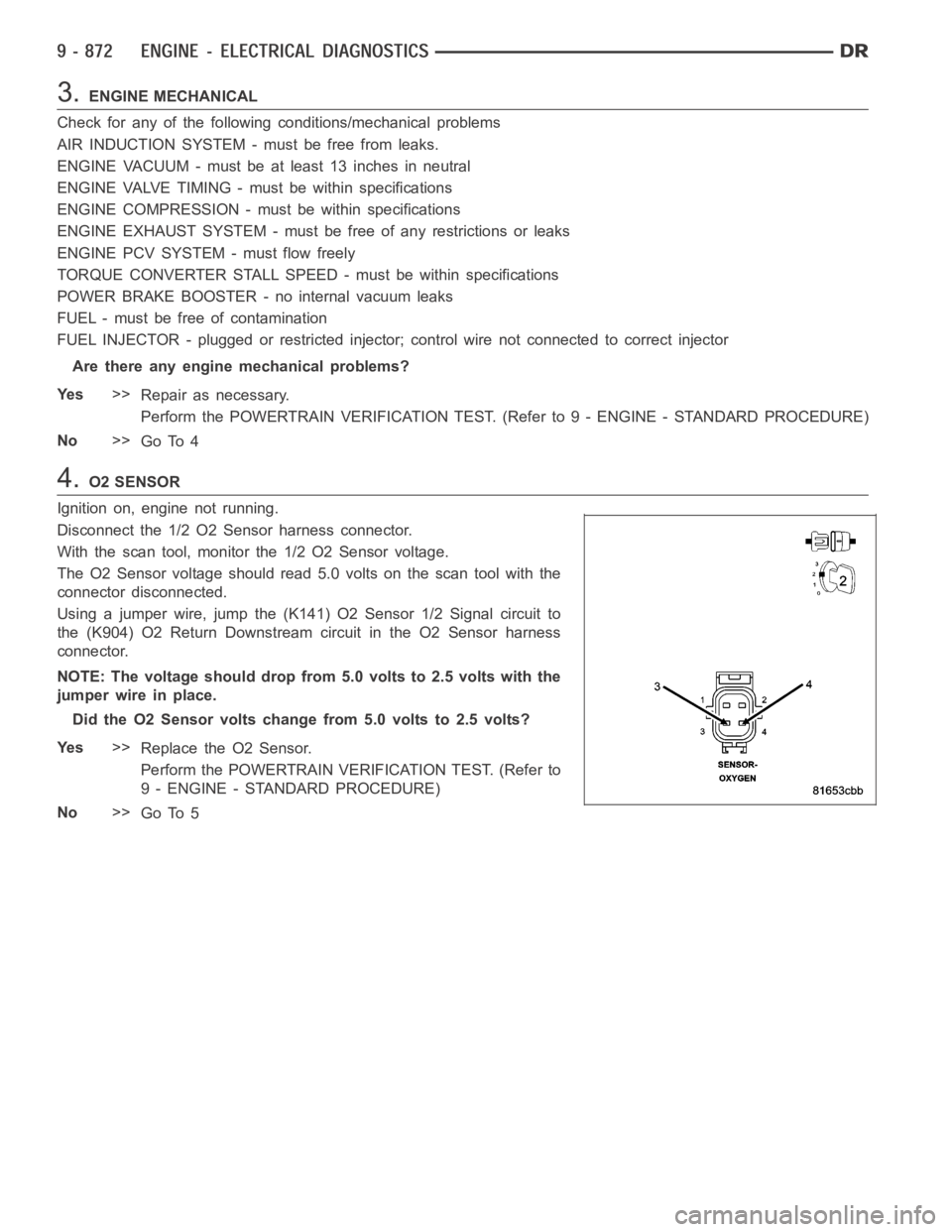
4.O2 SENSOR
Ignition on, engine not running.
Disconnect the 1/2 O2 Sensor harness connector.
With the scan tool, monitor the 1/2 O2 Sensor voltage.
The O2 Sensor voltage should read 5.0 volts on the scan tool with the
connector disconnected.
Using a jumper wire, jump the (K141) O2 Sensor 1/2 Signal circuit to
the (K904) O2 Return Downstream circuit in the O2 Sensor harness
connector.
NOTE: The voltage should drop from 5.0 volts to 2.5 volts with the
jumper wire in place.
Did the O2 Sensor volts change from 5.0 volts to 2.5 volts?
Ye s>>
Replace the O2 Sensor.
Perform the POWERTRAIN VERIFICATION TEST. (Refer to
9 - ENGINE - STANDARD PROCEDURE)
No>>
Go To 5
Page 187 of 5267
3.ENGINE MECHANICAL
Check for any of the following conditions/mechanical problems.
AIR INDUCTION SYSTEM - must be free from leaks
ENGINE VACUUM - must be at least 13 inches in neutral
ENGINE VALVE TIMING - must be within specifications
ENGINE COMPRESSION - must be within specifications
ENGINE EXHAUST SYSTEM - must be free of any restrictions or leaks
ENGINE PCV SYSTEM - must flow freely
TORQUE CONVERTER STALL SPEED - must be within specifications
POWER BRAKE BOOSTER - no internal vacuum leaks
FUEL - must be free of contamination
FUEL INJECTOR - plugged or restricted injector; control wire not connectedtocorrectinjector
Are there any engine mechanical problems?
Ye s>>
Repair as necessary.
Perform the POWERTRAIN VERIFICATION TEST. (Refer to 9 - ENGINE - STANDARD PROCEDURE)
No>>
Go To 4
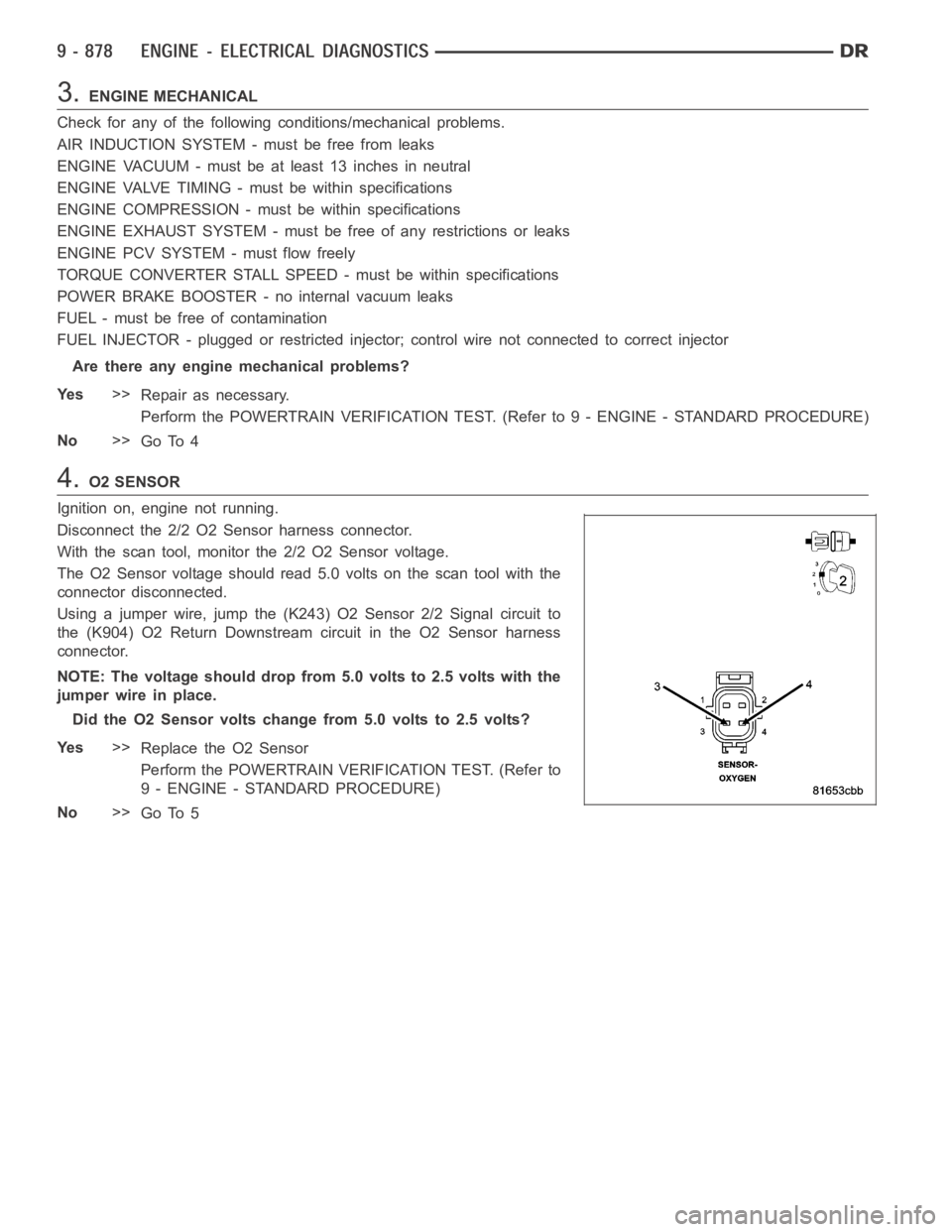
4.O2 SENSOR
Ignition on, engine not running.
Disconnect the 2/2 O2 Sensor harness connector.
With the scan tool, monitor the 2/2 O2 Sensor voltage.
The O2 Sensor voltage should read 5.0 volts on the scan tool with the
connector disconnected.
Using a jumper wire, jump the (K243) O2 Sensor 2/2 Signal circuit to
the (K904) O2 Return Downstream circuit in the O2 Sensor harness
connector.
NOTE: The voltage should drop from 5.0 volts to 2.5 volts with the
jumper wire in place.
Did the O2 Sensor volts change from 5.0 volts to 2.5 volts?
Ye s>>
Replace the O2 Sensor
Perform the POWERTRAIN VERIFICATION TEST. (Refer to
9 - ENGINE - STANDARD PROCEDURE)
No>>
Go To 5
Page 192 of 5267
3.ENGINE MECHANICAL
Check for any of the following conditions/mechanical problems.
AIR INDUCTION SYSTEM - must be free from leaks
ENGINE VACUUM - must be at least 13 inches in neutral
ENGINE VALVE TIMING - must be within specifications
ENGINE COMPRESSION - must be within specifications
ENGINE EXHAUST SYSTEM - must be free of any restrictions or leaks
ENGINE PCV SYSTEM - must flow freely
TORQUE CONVERTER STALL SPEED - must be within specifications
POWER BRAKE BOOSTER - no internal vacuum leaks
FUEL - must be free of contamination
FUEL INJECTOR - plugged or restricted injector; control wire not connectedtocorrectinjector
Are there any engine mechanical problems?
Ye s>>
Repair as necessary.
Perform the POWERTRAIN VERIFICATION TEST. (Refer to 9 - ENGINE - STANDARD PROCEDURE)
No>>
Go To 4
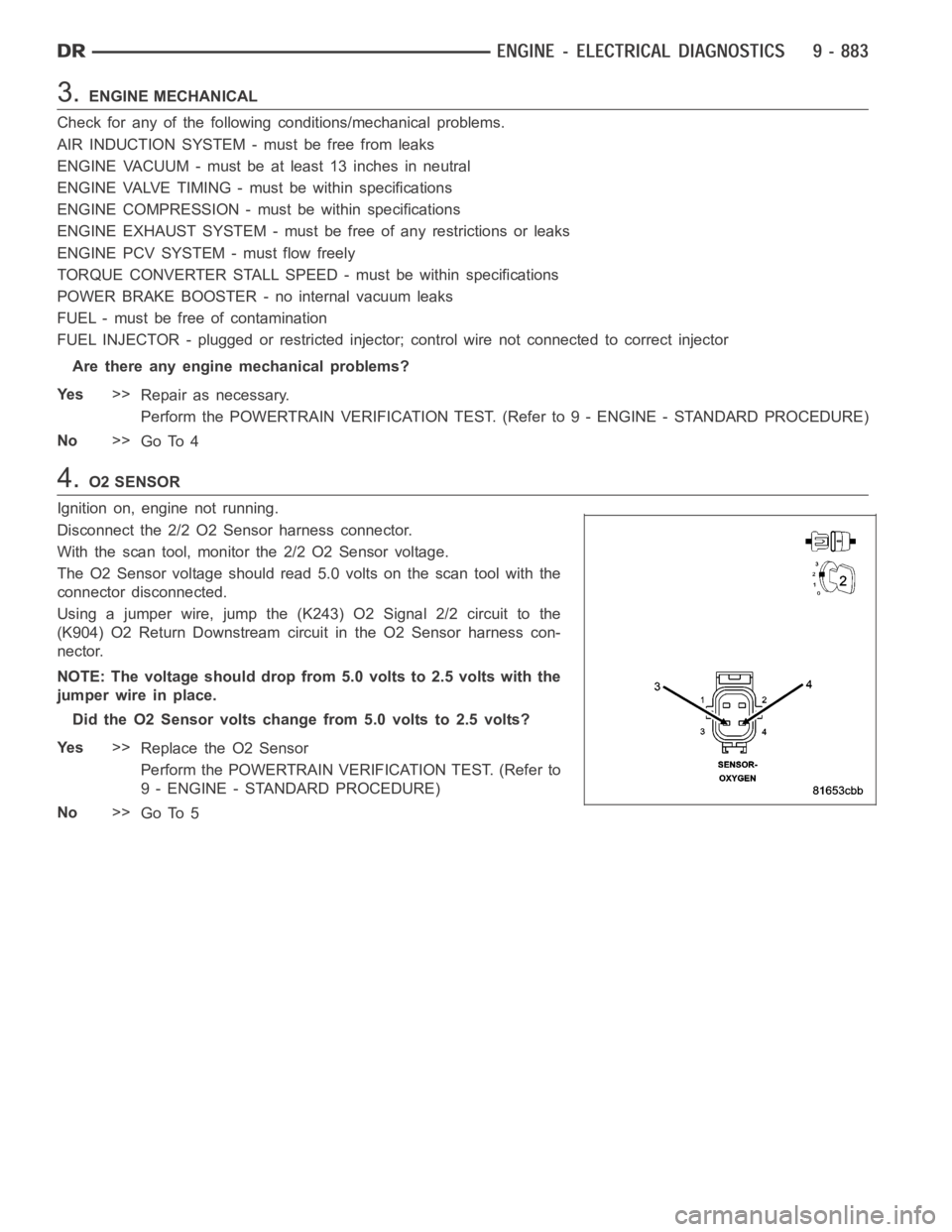
4.O2 SENSOR
Ignition on, engine not running.
Disconnect the 2/2 O2 Sensor harness connector.
With the scan tool, monitor the 2/2 O2 Sensor voltage.
The O2 Sensor voltage should read 5.0 volts on the scan tool with the
connector disconnected.
Using a jumper wire, jump the (K243) O2 Signal 2/2 circuit to the
(K904) O2 Return Downstream circuit in the O2 Sensor harness con-
nector.
NOTE: The voltage should drop from 5.0 volts to 2.5 volts with the
jumper wire in place.
Did the O2 Sensor volts change from 5.0 volts to 2.5 volts?
Ye s>>
Replace the O2 Sensor
Perform the POWERTRAIN VERIFICATION TEST. (Refer to
9 - ENGINE - STANDARD PROCEDURE)
No>>
Go To 5
Page 230 of 5267
When Monitored:
With the ignition on and no other APPS No.1 DTCs present.
Set Condition:
When the APP Sensor No.1 voltage is toolow. Engine will additionally idle if the brake pedal is pressed or has
failed. Acceleration rate and Engine output are limited. One trip fault and the code will set within 5 seconds.
ETC light is flashing.
Possible Causes
(F855) 5-VOLT SUPPLY CIRCUIT OPEN
(F855) 5-VOLT SUPPLY CIRCUIT SHORTED TO GROUND
(K23) APP SENSOR NO.1 SIGNAL CIRCUIT OPEN
(K23) APP SENSOR NO.1 SIGNAL CIRCUIT SHORTED TO GROUND
(K23) APP SENSOR NO.1 SIGNAL CIRCUIT SHORTED TO THE (K167) APP SENSOR NO.1 RETURN CIRCUIT
(K23) APP SENSOR NO.1 SIGNAL CIRCUIT SHORTED TO THE (K400) APP SENSOR NO.2 RETURN CIRCUIT
APP SENSOR
PCM
Always perform the Pre-Diagnostic Troubleshooting procedure before proceeding. (Refer to 9 - ENGINE -
DIAGNOSIS AND TESTING).
Diagnostic Test
1.APP SENSOR BELOW 0.25 OF A VOLT
Ignition on, engine not running.
With a scan tool, read the APP Sensor No.1 voltage.
Is the voltage below 0.25 of a volt?
Ye s>>
Go To 2
No>>
Go To 11
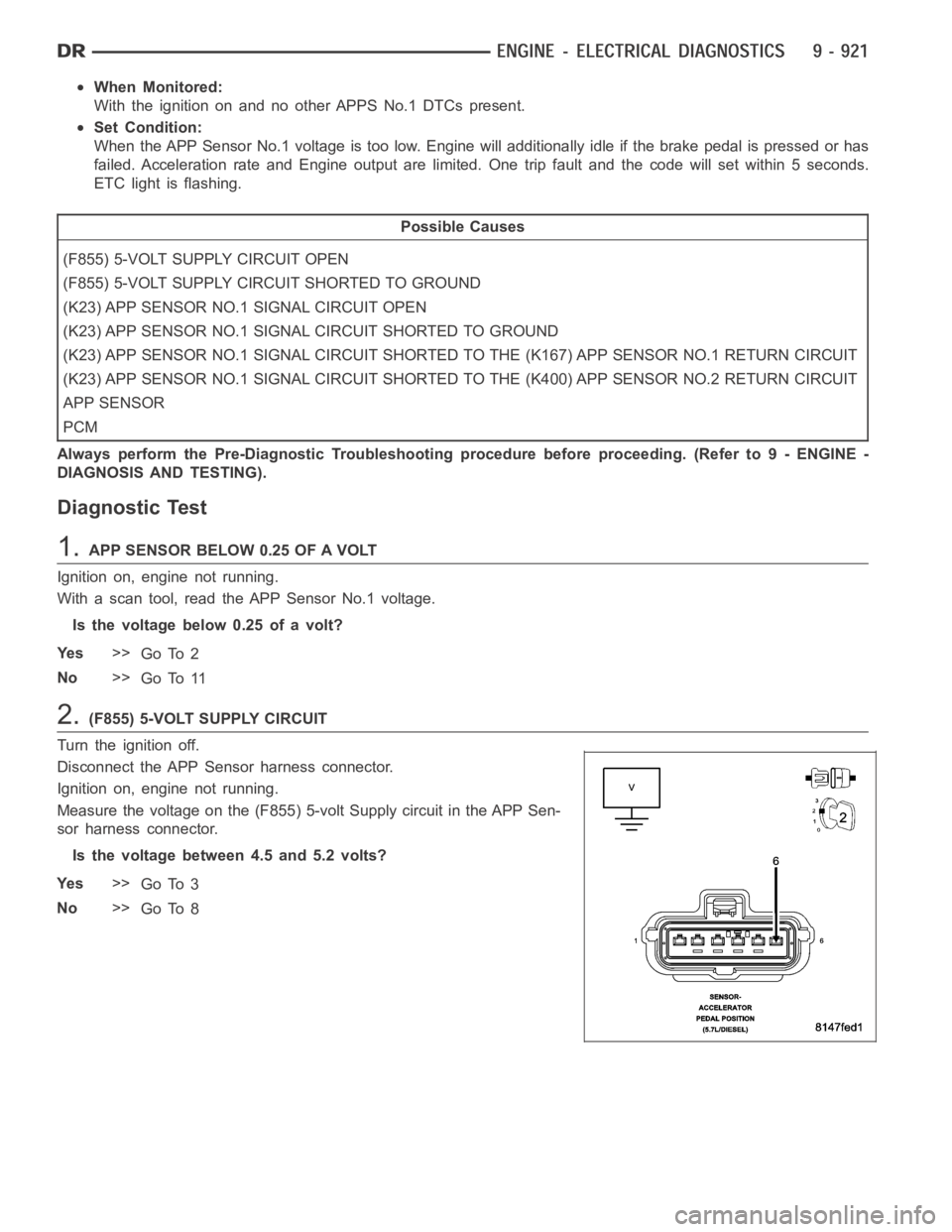
2.(F855) 5-VOLT SUPPLY CIRCUIT
Turn the ignition off.
Disconnect the APP Sensor harness connector.
Ignition on, engine not running.
Measure the voltage on the (F855) 5-volt Supply circuit in the APP Sen-
sor harness connector.
Is the voltage between 4.5 and 5.2 volts?
Ye s>>
Go To 3
No>>
Go To 8
Page 236 of 5267
When Monitored:
With the ignition on and no other APPS No.1 DTCs present.
Set Condition:
When APP Sensor No.1 voltage is too high. Engine will additionally idle if the brake pedal is pressed or has
failed. Acceleration rate and Engine output are limited. One trip fault and the code will set within 5 seconds.
ETC light is flashing.
Possible Causes
(K23) APP SENSOR NO.1 SIGNAL CIRCUIT SHORTED TO BATTERY VOLTAGE
(K23) APP SENSOR NO.1 SIGNAL SHORTED TO THE (F855) 5-VOLT SUPPLY CIRCUIT
(K23) APP SENSOR NO.1 SIGNAL SHORTED TO THE (F856) 5-VOLT SUPPLY CIRCUIT
(K167) APP SENSOR NO.1 RETURN CIRCUIT OPEN
APP SENSOR
PCM
Always perform the Pre-Diagnostic Troubleshooting procedure before proceeding. (Refer to 9 - ENGINE -
DIAGNOSIS AND TESTING).
Diagnostic Test
1.APPS NO.1 VOLTAGE ABOVE 4.8 VOLTS
Ignition on, engine not running.
With a scan tool, read the APP Sensor No.1 voltage.
Is the voltage above 4.8 volts?
Ye s>>
Go To 2
No>>
Go To 8
2.ACCELERATOR PEDAL POSITION SENSOR
Turn the ignition off.
Disconnect the APP Sensor harness connector.
Ignition on, engine not running.
With a scan tool, monitor the Accelerator Pedal Position Sensor voltage.
Is the voltage between 4.5 and 5.2 volts?
Ye s>>
Go To 3
No>>
Replace the APP Sensor Assembly per Service Information. After installation is complete, use a scan
tool and select the ETC RELEARN function to relearn the APPS values.
Perform the POWERTRAIN VERIFICATION TEST. (Refer to 9 - ENGINE - STANDARD PROCEDURE)
Page 240 of 5267
When Monitored:
With the ignition on and no other APPS No.2 DTCs present.
Set Condition:
When the APP Sensor No.2 voltage is too low. Engine will only idle if the Brake pedal is Pressed or has failed.
Acceleration rate and Engine output are limited. One trip fault and the code will set within 5 seconds. ETC light
is flashing.
Possible Causes
(F856) 5-VOLT SUPPLY CIRCUIT OPEN
(F856) 5-VOLT SUPPLY CIRCUIT SHORTED TO GROUND
(K29) APP SENSOR NO.2 SIGNAL CIRCUIT OPEN
(K29) APP SENSOR NO.2 SIGNAL CIRCUIT SHORTED TO GROUND
(K29) APP SENSOR NO.2 SIGNAL CIRCUIT SHORTED TO THE (K167) APP SENSOR NO.1 RETURN CIRCUIT
(K29) APP SENSOR NO.2 SIGNAL CIRCUIT SHORTED TO THE (K400) APP SENSOR NO.2 RETURN CIRCUIT
APP SENSOR
PCM
Always perform the Pre-Diagnostic Troubleshooting procedure before proceeding. (Refer to 9 - ENGINE -
DIAGNOSIS AND TESTING).
Diagnostic Test
1.APP SENSOR BELOW 0.25 OF A VOLT
Ignition on, engine not running.
With a scan tool, read the APP Sensor No.1 voltage.
NOTE: Sensor No. 2 is pulled low by the PCM as part of its system testing. Thistest happens a couple of
times a second. So you can expect to see voltages close to zero occasionallywith a normal sensor.
Is the voltage consistently below 0.25 of a volt?
Ye s>>
Go To 2
No>>
Go To 11
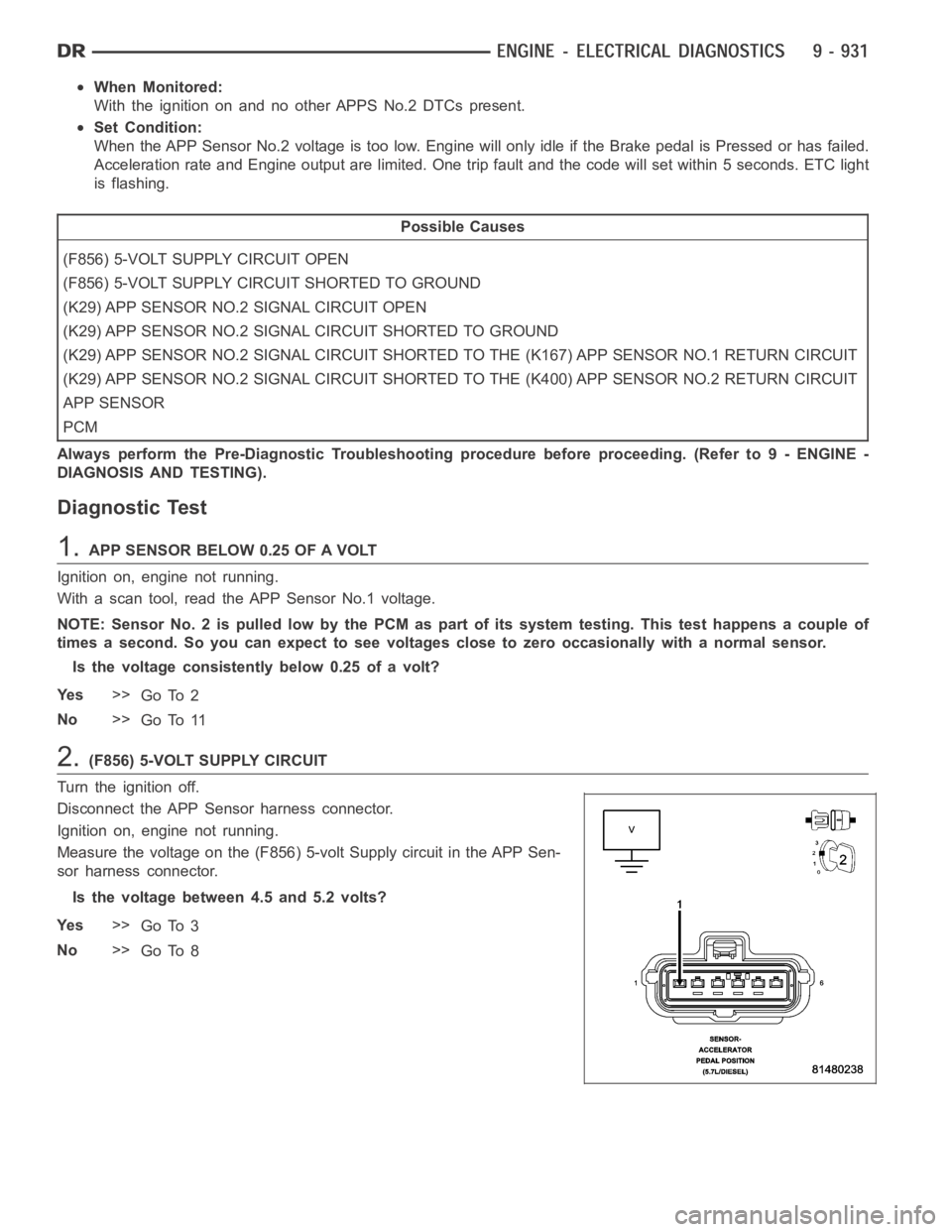
2.(F856) 5-VOLT SUPPLY CIRCUIT
Turn the ignition off.
Disconnect the APP Sensor harness connector.
Ignition on, engine not running.
Measure the voltage on the (F856) 5-volt Supply circuit in the APP Sen-
sor harness connector.
Is the voltage between 4.5 and 5.2 volts?
Ye s>>
Go To 3
No>>
Go To 8
Page 246 of 5267
When Monitored:
With the ignition on and no other APPS No.2 DTCs present.
Set Condition:
When APP Sensor No.2 voltage is too high. Idle is additionally forced any time the brake is applied or failed.
Acceleration rate and Engine output are limited. One trip fault and the code will set within 5 seconds. ETC light
is flashing.
Possible Causes
(K29) APP SENSOR NO.2 SIGNAL CIRCUIT SHORTED TO BATTERY VOLTAGE
(K29) APP SENSOR NO.2 SIGNAL SHORTED TO THE (F856) 5-VOLT SUPPLY CIRCUIT
(K29) APP SENSOR NO.2 SIGNAL SHORTED TO THE (F855) 5-VOLT SUPPLY CIRCUIT
(K400) APP SENSOR NO.2 RETURN CIRCUIT OPEN
APP SENSOR
PCM
Always perform the Pre-Diagnostic Troubleshooting procedure before proceeding. (Refer to 9 - ENGINE -
DIAGNOSIS AND TESTING).
Diagnostic Test
1.APPS NO.2 VOLTAGE ABOVE 3.0 VOLTS
Ignition on, engine not running.
With a scan tool, read the APP Sensor No.2 voltage.
NOTE: Diagnose any 5-Volt Supply DTCs before continuing.
Is the voltage above 3.0 volts?
Ye s>>
Go To 2
No>>
Go To 8
2.ACCELERATOR PEDAL POSITION SENSOR
Turn the ignition off.
Disconnect the APPS harness connector.
Ignition on, engine not running.
With a scan tool, monitor the Accelerator Pedal Position Sensor voltage.
Is the voltage above 3.0 volts?
Ye s>>
Go To 3
No>>
Replace the APP Sensor Assembly per Service Information. After installation is complete, use a scan
tool and select the ETC RELEARN function to relearn the APPS values.
Perform the POWERTRAIN VERIFICATION TEST. (Refer to 9 - ENGINE - STANDARD PROCEDURE)
Page 258 of 5267
When Monitored:
With the ignition on and no APPS No.1 and APPS No.2 DTC present.
Set Condition:
APPS values No.1 and No.2 are not coherent. Idle is additionally forced when the brake pedal is pressed or
failed. Acceleration rate and Engine output are limited. One trip fault and the code will set within 5 seconds.
ETC light is flashing.
Possible Causes
EXCESSIVE RESISTANCE IN THE (F855) 5-VOLT SUPPLY CIRCUIT
EXCESSIVE RESISTANCE IN THE (F856) 5-VOLT SUPPLY CIRCUIT
EXCESSIVE RESISTANCE IN THE (K167) SENSOR NO.1 RETURN CIRCUIT
EXCESSIVE RESISTANCE IN THE (K400) SENSOR NO.2 RETURN CIRCUIT
EXCESSIVE RESISTANCE IN THE (K23) APP SENSOR NO.1 SIGNAL CIRCUIT
EXCESSIVE RESISTANCE IN THE (K29) APP SENSOR NO.2 SIGNAL CIRCUIT
APP SENSOR
PCM
Always perform the Pre-Diagnostic Troubleshooting procedure before proceeding. (Refer to 9 - ENGINE -
DIAGNOSIS AND TESTING).
Diagnostic Test
1.ACTIVE DTC
Ignition on, engine not running.
With a scan tool, read DTCs.
NOTE: Repair any other 5-Volt Supply or APPS High and Low DTCs before diagnosing P2138.
Is the DTC active at this time?
Ye s>>
Go To 2
No>>
Refer to the INTERMITTENT CONDITION Diagnostic Procedure.
Perform the POWERTRAIN VERIFICATION TEST. (Refer to 9 - ENGINE - STANDARD PROCEDURE)