hood release DODGE RAM SRT-10 2006 Service Repair Manual
[x] Cancel search | Manufacturer: DODGE, Model Year: 2006, Model line: RAM SRT-10, Model: DODGE RAM SRT-10 2006Pages: 5267, PDF Size: 68.7 MB
Page 4341 of 5267
POSSIBLE CAUSE OF WIND NOISE
Moldings standing away from body surface can catch wind and whistle.
Gaps in sealed areas behind overhanging body flanges can cause wind-rushing sounds.
Misaligned movable components.
Missing or improperly installed plugs in pillars.
Weld burn through holes.
Improperly installed roof rack cross bars.
STANDARD PROCEDURE
BODY LUBRICATION
All mechanisms and linkages should be lubricated when necessary. This will maintain ease of operation and provide
protection against rust and excessive wear. The weatherstrip seals should be lubricated to prolong their life as well
as to improve door sealing.
All applicable exterior and interior vehicle operating mechanisms should be inspected and cleaned. Pivot/sliding con-
tact areas on the mechanisms should then be lubricated.
1. When necessary, lubricate the operating mechanisms with the specifiedlubricants.
2. Apply silicone lubricant to a clothand wipe it on door seals to avoid over-spray that can soil passenger’s cloth-
ing.
3. Before applying lubricant, the component should be wiped clean. After lubrication, any excess lubricant should be
removed.
4. The hood latch, latch release mechanism, latch striker, and safety latch should be lubricated periodically.
5. The door lock cylinders should be lubricated twice each year (preferably autumn and spring).
Spray a small amount of lock cylinder lubricant directly into the lock cylinder.
Apply a small amount to the key and insert it into the lock cylinder.
Rotate it to the locked position and then back to the unlocked position several times.
Remove the key. Wipe the lubricant from it with a clean cloth to avoid soiling of clothing.
HEAT STAKING
1. Remove trim panel.
2. Bend or move the trim panel components at the heat staked joints. Observethe heat staked locations and/or
component seams for looseness.
3. Heat stake the components.
a. If the heat staked or component seam location is loose, hold the two components tightly together and using
a soldering gun with a flat tip, melt the material securing the components together. Do not over heat the
affected area, damage to the exterior of the trim panel may occur.
b. Iftheheatstakedmaterialisbrokenormissing,useahotglueguntoapplynewmaterialtotheareatobe
repaired. The panels that are being heat staked must be held together whiletheapplyingtheglue.Oncethe
new material is in place, it may be necessary to use a soldering gun to melt the newly applied material. Do
not over heat the affected area, damage to the exterior of the trim panel mayoccur.
4. Allow the repaired area to cool and verify the repair.
5. Install trim panel.
BUZZ, SQUEAK & RATTLE
Buzz, Squeak & Rattles (BSR) may be caused by any one or more of the followingand may be corrected as indi-
cated:
Loose fasteners should be tightened to specifications.
Damaged or missing clips should be replaced.
Damaged trim panels should be replaced.
Incorrectly installed trim panels should be reinstalled properly.
Page 4463 of 5267
page page
BEZEL-HOOD SRT-10
REMOVAL ................................... 127
INSTALLATION .............................. 128
HINGE
REMOVAL ................................... 130
INSTALLATION .............................. 130
HOOD
REMOVAL ................................... 132
INSTALLATION .............................. 132
LATCH
REMOVAL ................................... 133INSTALLATION .............................. 133
LATCH RELEASE CABLE/HANDLE ASSEMBLY
REMOVAL
REMOVAL ................................ 134
INSTALLATION .............................. 134
LATCH STRIKER / SECONDARY CATCH
REMOVAL ................................... 135
INSTALLATION .............................. 135
SUPPORT CYLINDER
REMOVAL ................................... 136
INSTALLATION .............................. 137
Page 4471 of 5267
LATCH RELEASE CABLE/HANDLE ASSEMBLY
REMOVAL
REMOVAL
1.Removethehoodlatch(Referto23-BODY/
HOOD/LATCH - REMOVAL).
2. Remove the battery tray from the left side of the
engine compartment (Refer to 8 - ELECTRICAL/
BATTERY SYSTEM/TRAY - REMOVAL).
3. Remove the three hood release cable retainers
from the upper radiator crossmember and the left
fender rail.
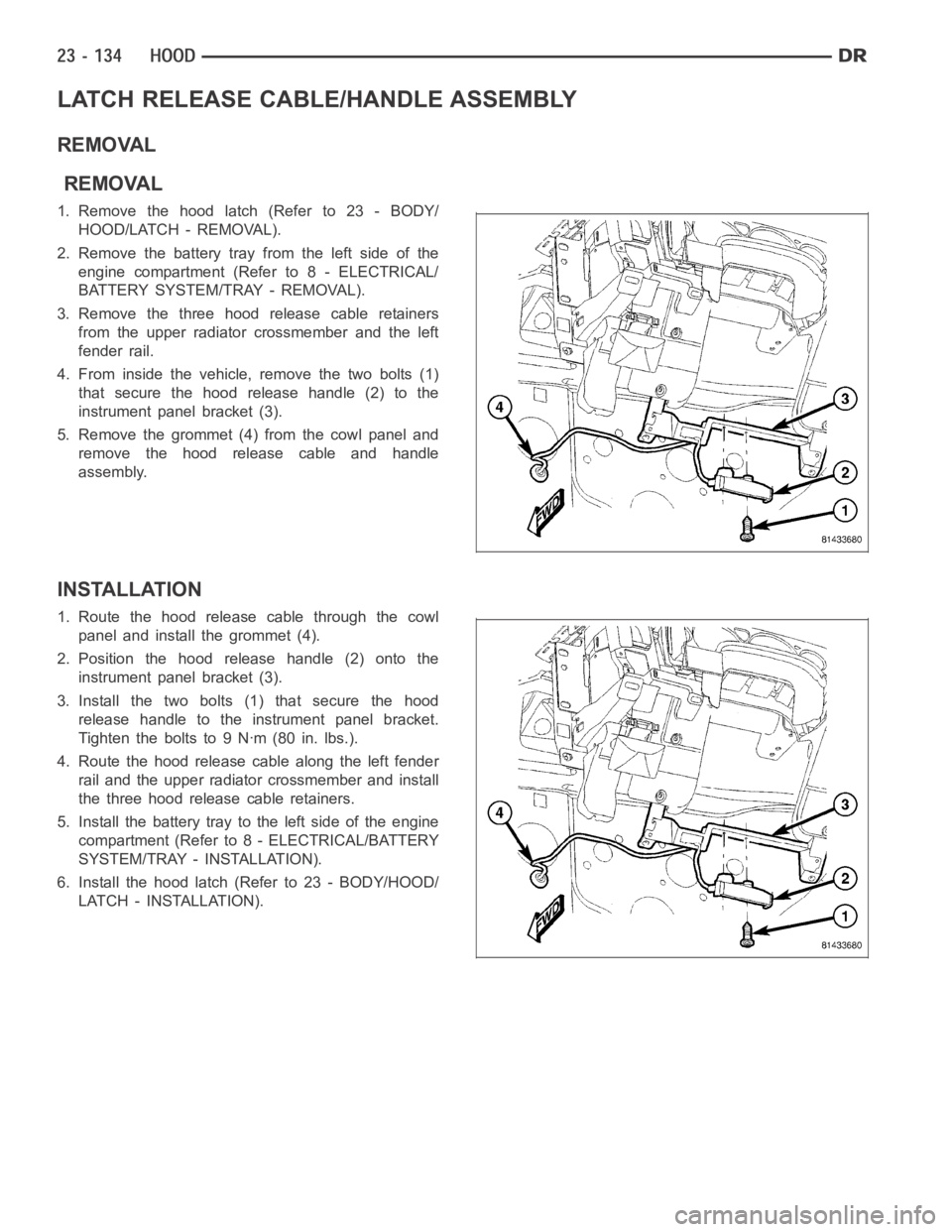
4. From inside the vehicle, remove the two bolts (1)
that secure the hood release handle (2) to the
instrument panel bracket (3).
5. Remove the grommet (4) from the cowl panel and
remove the hood release cable and handle
assembly.
INSTALLATION
1. Route the hood release cable through the cowl
panel and install the grommet (4).
2. Position the hood release handle (2) onto the
instrument panel bracket (3).
3. Install the two bolts (1) that secure the hood
release handle to the instrument panel bracket.
Tightentheboltsto9Nꞏm(80in.lbs.).
4. Route the hood release cable along the left fender
rail and the upper radiator crossmember and install
the three hood release cable retainers.
5. Install the battery tray to the left side of the engine
compartment (Refer to 8 - ELECTRICAL/BATTERY
SYSTEM/TRAY - INSTALLATION).
6. Install the hood latch (Refer to 23 - BODY/HOOD/
LATCH - INSTALLATION).
Page 4472 of 5267
LATCH STRIKER / SECONDARY CATCH
REMOVAL
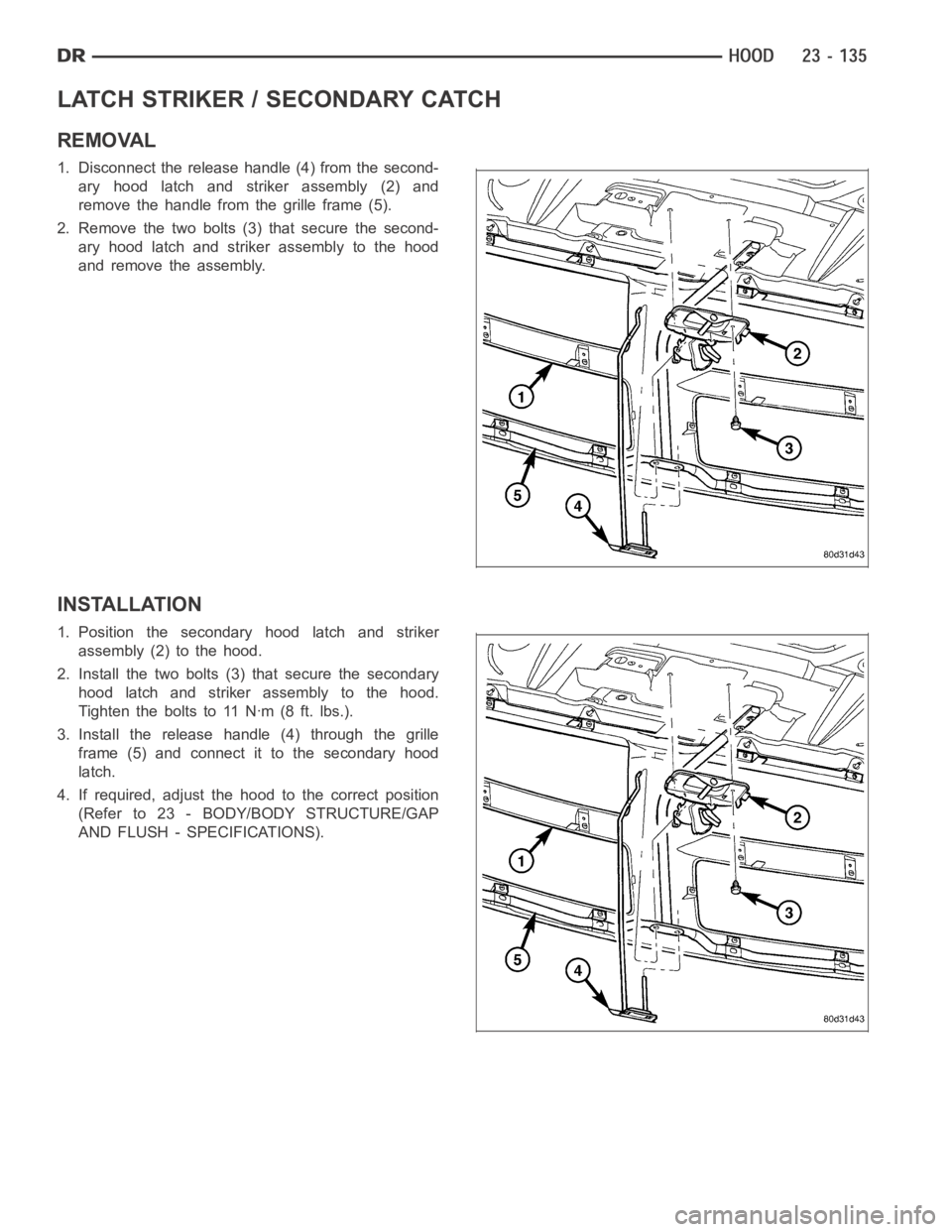
1. Disconnect the release handle (4) from the second-
ary hood latch and striker assembly (2) and
remove the handle from the grille frame (5).
2. Remove the two bolts (3) that secure the second-
ary hood latch and striker assembly to the hood
and remove the assembly.
INSTALLATION
1. Position the secondary hood latch and striker
assembly (2) to the hood.
2. Install the two bolts (3) that secure the secondary
hood latch and striker assembly to the hood.
Tighten the bolts to 11 Nꞏm (8 ft. lbs.).
3. Install the release handle (4) through the grille
frame (5) and connect it to the secondary hood
latch.
4. If required, adjust the hood to the correct position
(Refer to 23 - BODY/BODY STRUCTURE/GAP
AND FLUSH - SPECIFICATIONS).
Page 4473 of 5267
SUPPORT CYLINDER
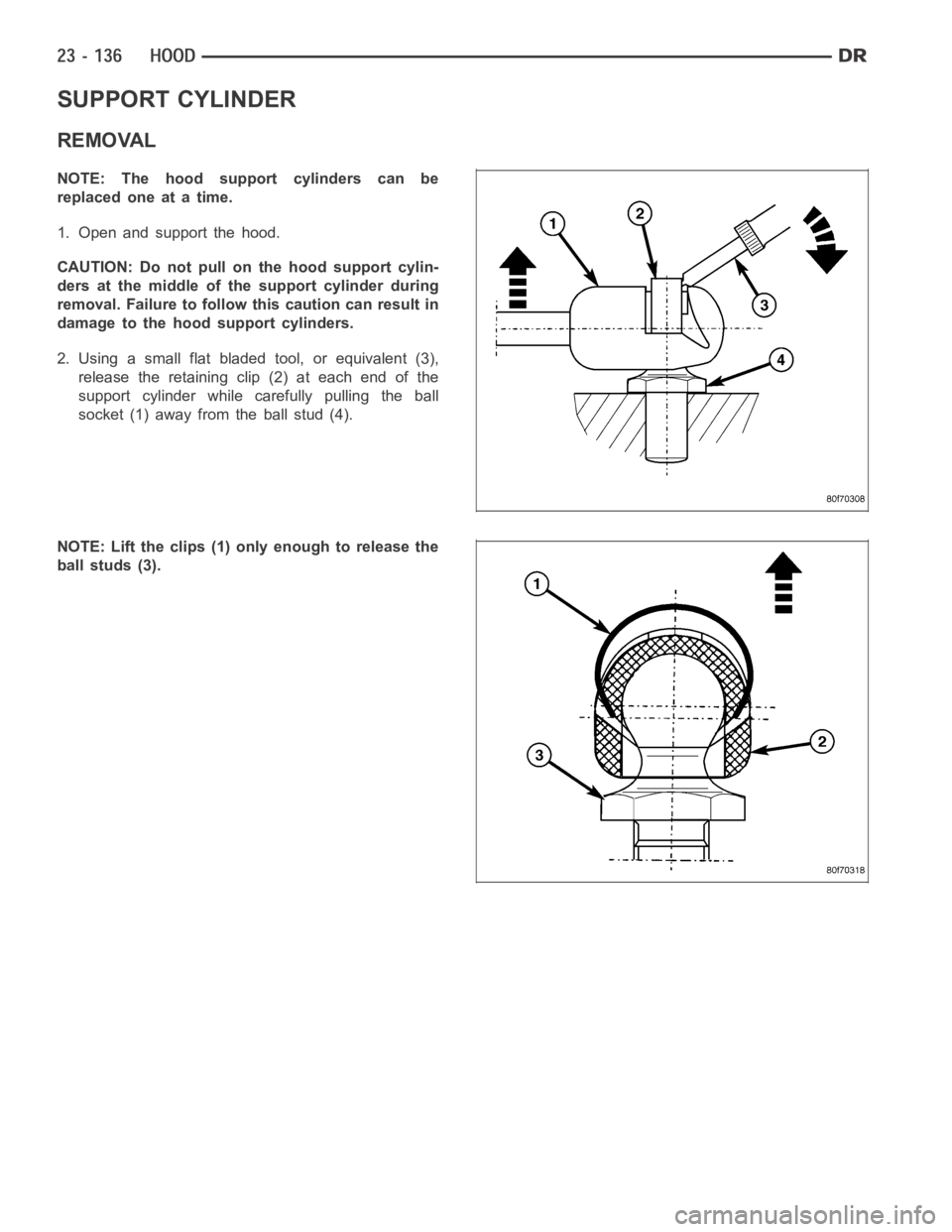
REMOVAL
NOTE: The hood support cylinders can be
replaced one at a time.
1. Open and support the hood.
CAUTION: Do not pull on the hood support cylin-
ders at the middle of the support cylinder during
removal. Failure to followthis caution can result in
damage to the hood support cylinders.
2. Using a small flat bladed tool, or equivalent (3),
release the retaining clip (2) at each end of the
support cylinder while carefully pulling the ball
socket (1) away from the ball stud (4).
NOTE: Lift the clips (1) only enough to release the
ball studs (3).
Page 4474 of 5267
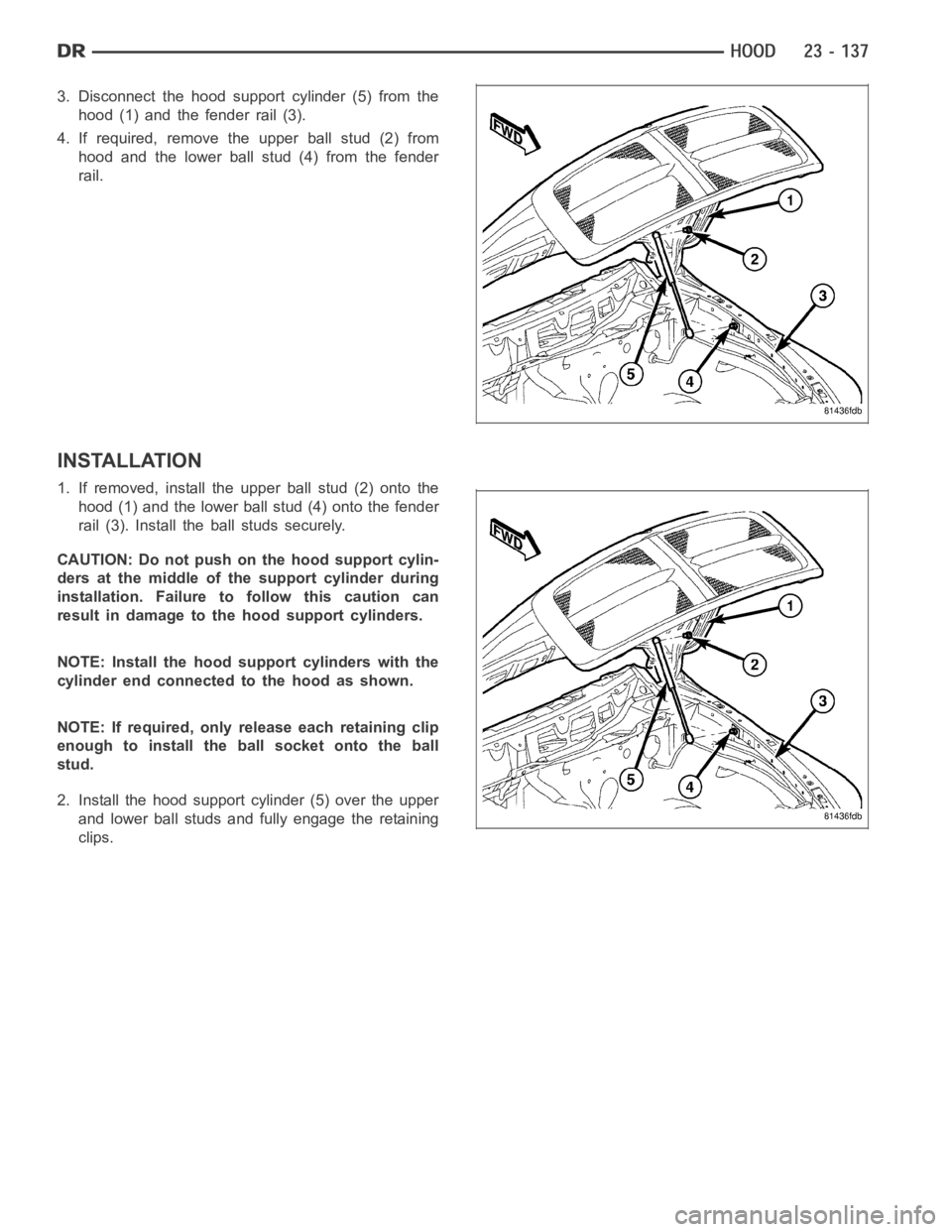
3. Disconnect the hood support cylinder (5) from the
hood (1) and the fender rail (3).
4. If required, remove the upper ball stud (2) from
hood and the lower ball stud (4) from the fender
rail.
INSTALLATION
1. If removed, install the upper ball stud (2) onto the
hood (1) and the lower ball stud (4) onto the fender
rail (3). Install the ball studs securely.
CAUTION: Do not push on the hood support cylin-
ders at the middle of the support cylinder during
installation. Failure to follow this caution can
result in damage to the hood support cylinders.
NOTE: Install the hood support cylinders with the
cylinder end connected to the hood as shown.
NOTE: If required, only release each retaining clip
enough to install the ball socket onto the ball
stud.
2. Install the hood support cylinder (5) over the upper
and lower ball studs and fully engage the retaining
clips.
Page 4510 of 5267
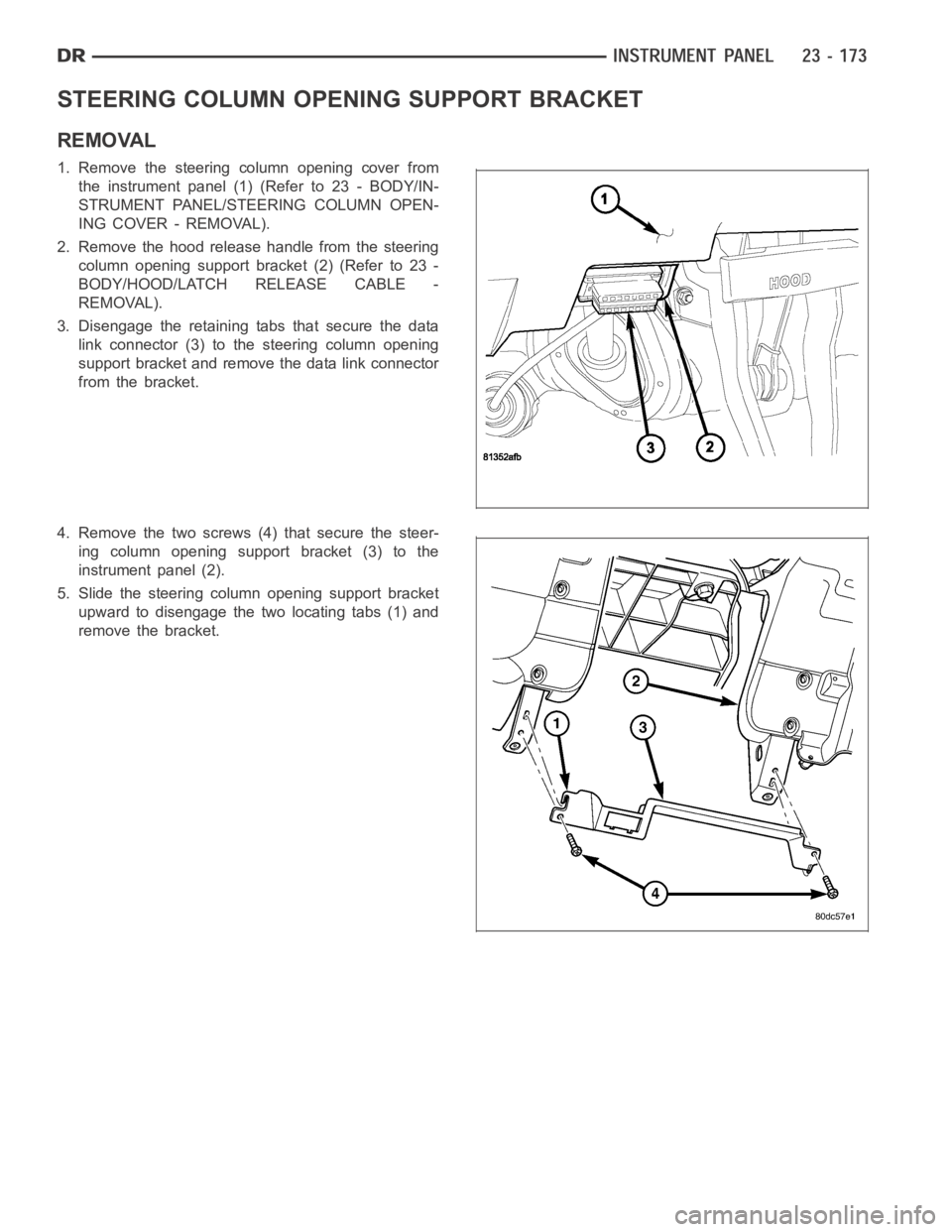
STEERING COLUMN OPENING SUPPORT BRACKET
REMOVAL
1. Remove the steering column opening cover from
the instrument panel (1) (Refer to 23 - BODY/IN-
STRUMENT PANEL/STEERING COLUMN OPEN-
ING COVER - REMOVAL).
2. Remove the hood release handle from the steering
column opening support bracket (2) (Refer to 23 -
BODY/HOOD/LATCH RELEASE CABLE -
REMOVAL).
3. Disengage the retaining tabs that secure the data
link connector (3) to the steering column opening
support bracket and remove the data link connector
from the bracket.
4. Remove the two screws (4) that secure the steer-
ing column opening support bracket (3) to the
instrument panel (2).
5. Slide the steering column opening support bracket
upward to disengage the two locating tabs (1) and
remove the bracket.
Page 4511 of 5267
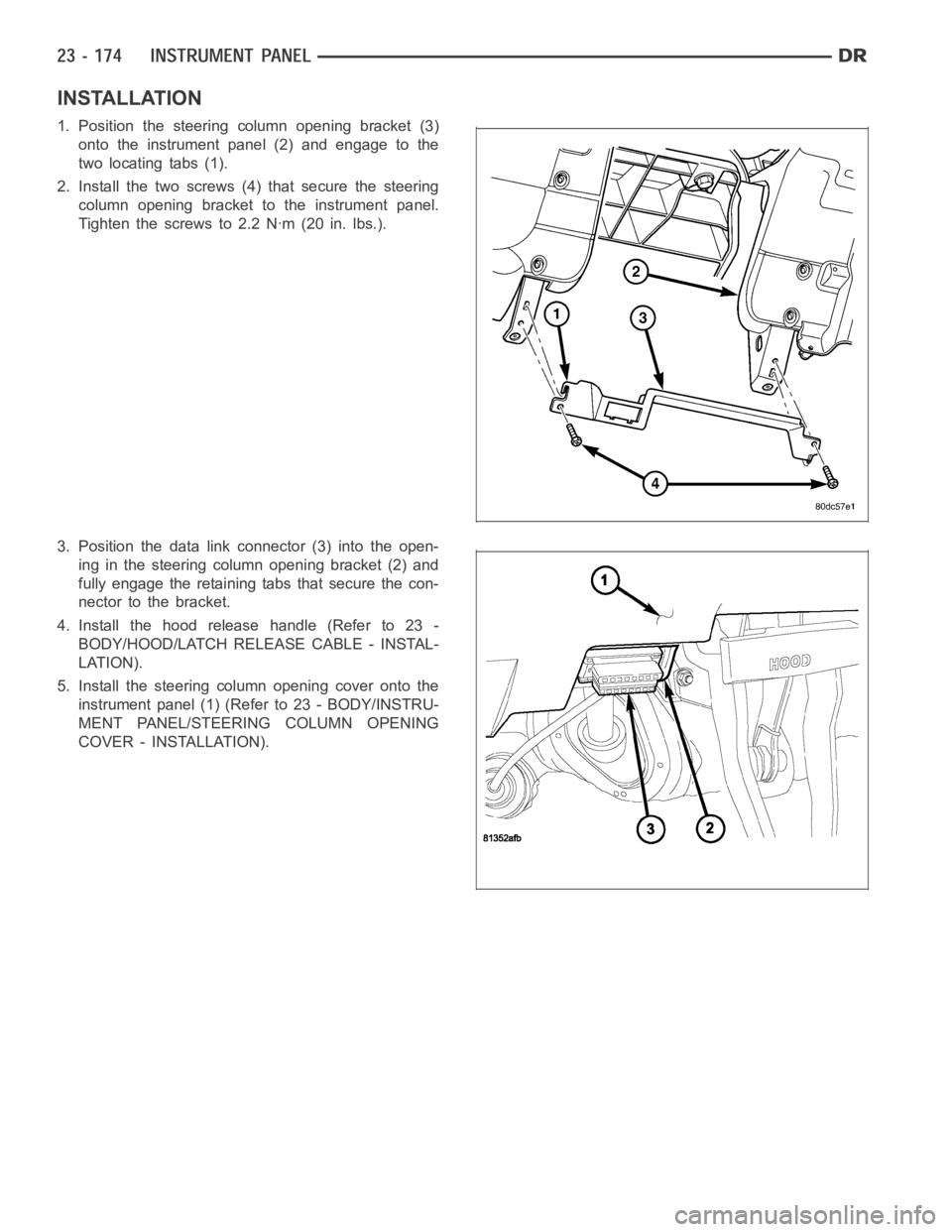
INSTALLATION
1. Position the steering column opening bracket (3)
onto the instrument panel (2) and engage to the
two locating tabs (1).
2. Install the two screws (4) that secure the steering
column opening bracket to the instrument panel.
Tighten the screws to 2.2 Nꞏm (20 in. lbs.).
3. Position the data link connector (3) into the open-
ing in the steering column opening bracket (2) and
fully engage the retaining tabs that secure the con-
nector to the bracket.
4. Install the hood release handle (Refer to 23 -
BODY/HOOD/LATCH RELEASE CABLE - INSTAL-
LATION).
5. Install the steering column opening cover onto the
instrument panel (1) (Refer to 23 - BODY/INSTRU-
MENT PANEL/STEERING COLUMN OPENING
COVER - INSTALLATION).