brake DODGE SPRINTER 2004 1.G Service Manual
[x] Cancel search | Manufacturer: DODGE, Model Year: 2004, Model line: SPRINTER, Model: DODGE SPRINTER 2004 1.GPages: 272, PDF Size: 22.71 MB
Page 182 of 272
182 STARTING AND OPERATING
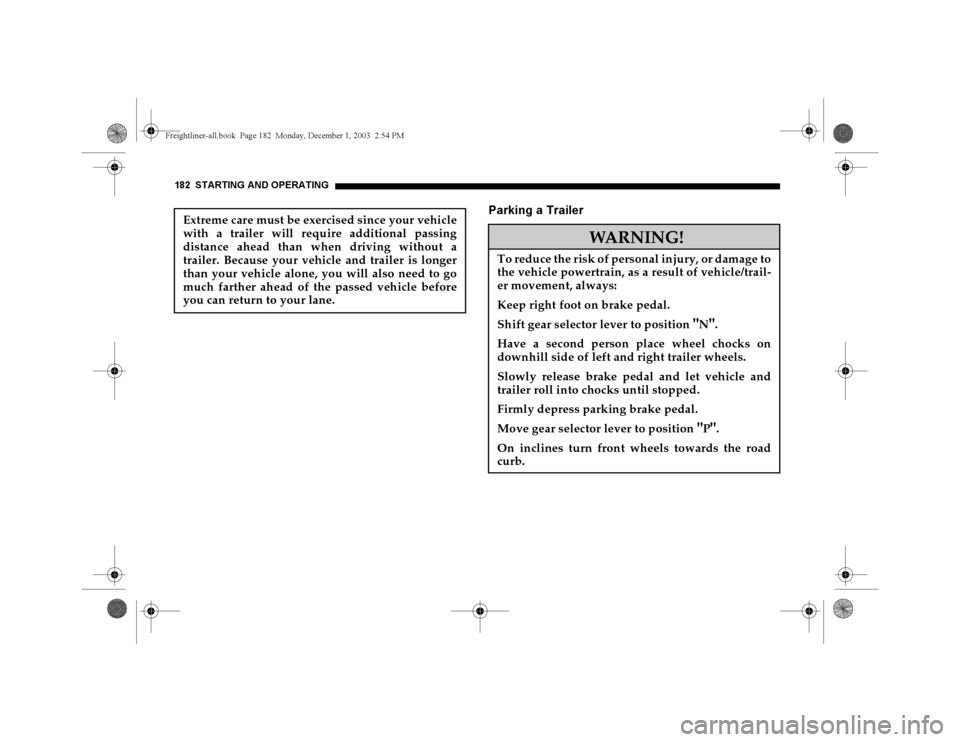
Parking a Trailer
Extreme care must be exercised since your vehicle
with a trailer will require additional passing
distance ahead than when driving without a
trailer. Because your vehicle and trailer is longer
than your vehicle alone, you will also need to go
much farther ahead of the passed vehicle before
you can return to your lane.
WARNING!
T o r e d u ce t h e r is k o f p e r s o n a l i n ju r y , o r d am a g e t o
the vehicle powertrain, as a result of vehicle/trail-
er movement, always:
Keep right foot on brake pedal.
Shift gear selector lever to position
"N".
Have a second person place wheel chocks on
downhill side of left and right trailer wheels.
Slowly release brake pedal and let vehicle and
trailer roll into chocks until stopped.
Firmly depress parking brake pedal.
Move gear selector lever to position
"P".
On inclines turn front wheels towards the road
curb.
Freightliner-all.book Pag e 182 Monday, December 1, 2003 2:54 PM
Page 188 of 272
188 WHAT TO DO IN EMERGENCIES
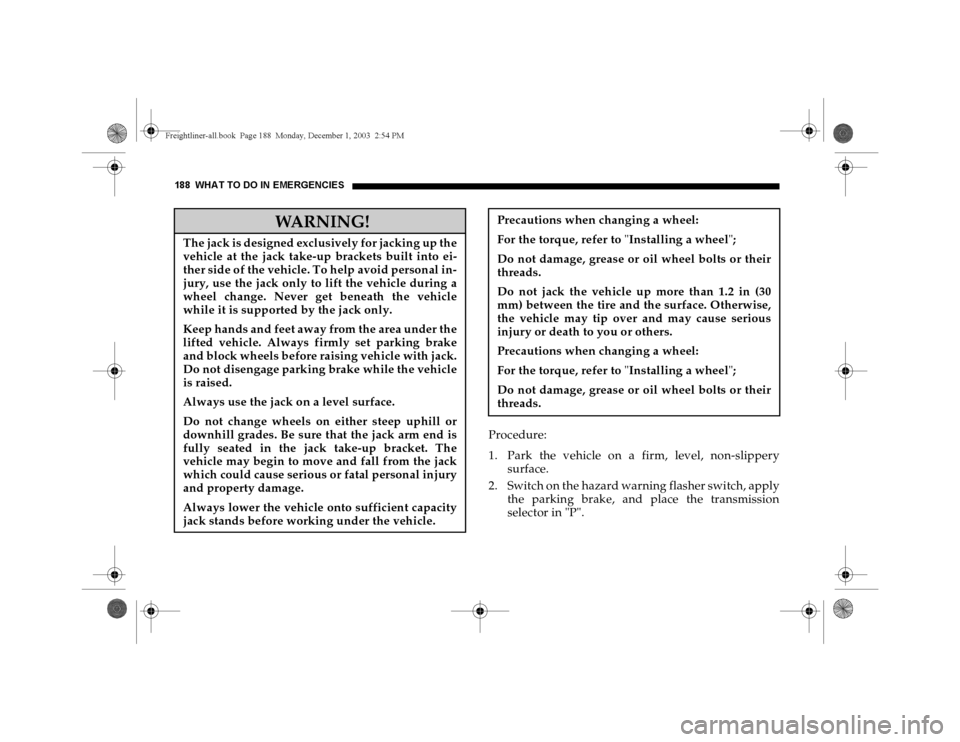
Procedure:
1. Park the vehicle on a firm, level, non-slippery
surface.
2. Switch on the hazard warning flasher switch, apply
the parking brake, and place the transmission
selector in "P".
WARNING!
The jack is designed exclusively for jacking up the
vehicle at the jack take-up brackets built into ei-
ther side of the vehicle. To help avoid personal in-
jury, use the jack only to lift the vehicle during a
wheel change. Never get beneath the vehicle
while it is supported by the jack only.
Keep hands and feet away from the area under the
lifted vehicle. Always firmly set parking brake
and block wheels before raising vehicle with jack.
Do not disengage parking brake while the vehicle
is raised.
Always use the jack on a level surface.
Do not change wheels on either steep uphill or
downhill grades. Be sure that the jack arm end is
fully seated in the jack take-up bracket. The
vehicle may begin to move and fall from the jack
which could cause serious or fatal personal injury
and property damage.
Always lower the vehicle onto sufficient capacity
jack stands before working under the vehicle.
Precautions when changing a wheel:
For the torque, refer to "Installing a wheel";
Do not damage, grease or oil wheel bolts or their
threads.
Do not jack the vehicle up more than 1.2 in (30
mm) between the tire and the surface. Otherwise,
the vehicle may tip over and may cause serious
injury or death to you or others.
Precautions when changing a wheel:
For the torque, refer to "Installing a wheel";
Do not damage, grease or oil wheel bolts or their
threads.
Freightliner-all.book Pag e 188 Monday, December 1, 2003 2:54 PM
Page 201 of 272
WHAT TO DO IN EMERGENCIES 201
6
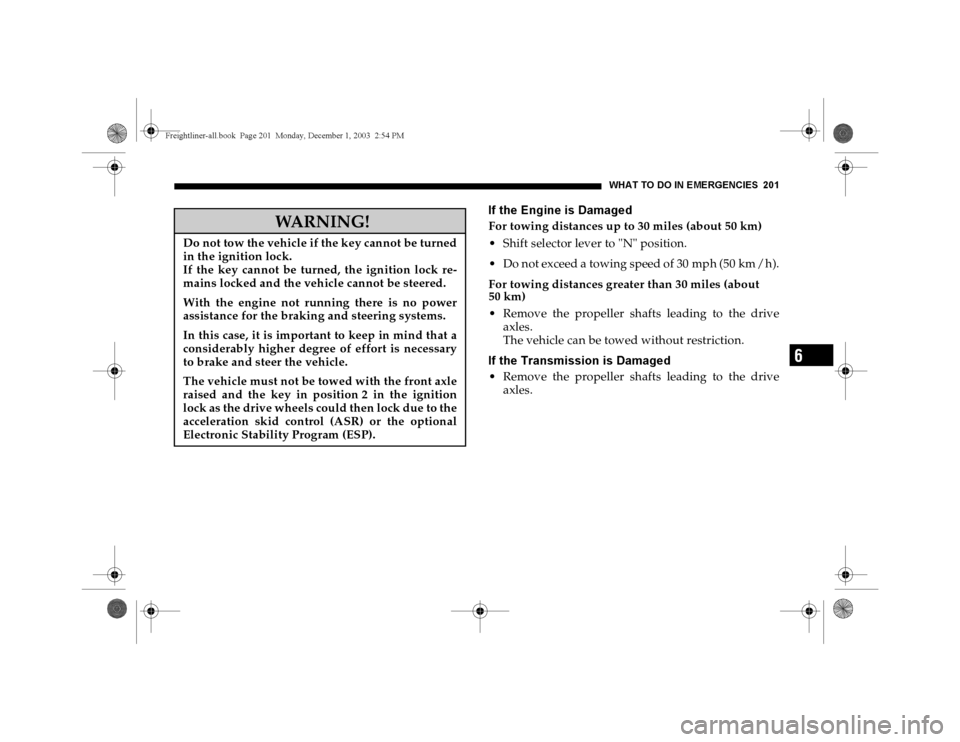
If the Engine is DamagedFor towing distances up to 30 miles (about 50 km)
Shift selector lever to "N" position.
Do not exceed a towing speed of 30 mph (50 km / h).
For towing distances greater than 30 miles (about
50 km)
Remove the propeller shafts leading to the drive
axles.
The vehicle can be towed without restriction.If the Transmission is Damaged Remove the propeller shafts leading to the drive
axles.
WARNING!
Do not tow the vehicle if the key cannot be turned
in the ignition lock.
If the key cannot be turned, the ignition lock re-
mains locked and the vehicle cannot be steered.
With the engine not running there is no power
assistance for the braking and steering systems.
In this case, it is important to keep in mind that a
considerably higher degree of effort is necessary
to brake and steer the vehicle.
The vehicle must not be towed with the front axle
raised and the key in position 2 in the ignition
lock as the drive wheels could then lock due to the
acceleration skid control (ASR) or the optional
Electronic Stability Program (ESP).
Freightliner-all.book Pag e 201 Monday, December 1, 2003 2:54 PM
Page 203 of 272
MAINTAINING YOUR VEHICLE
7
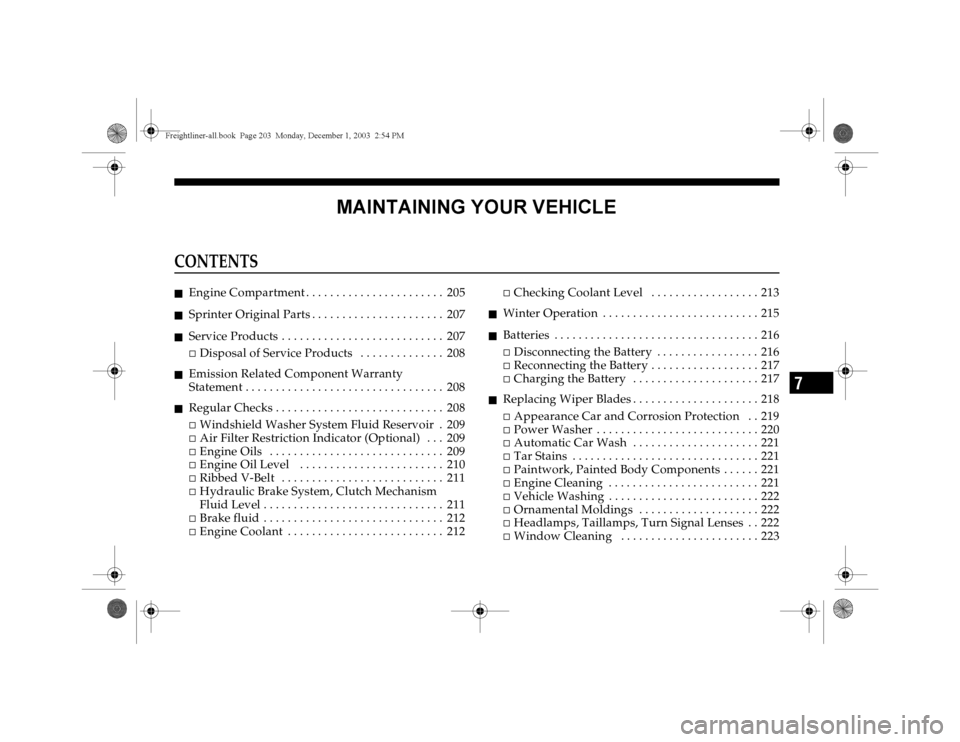
CONTENTS
Engine Compartment . . . . . . . . . . . . . . . . . . . . . . . 205
Sprinter Original Parts . . . . . . . . . . . . . . . . . . . . . . 207
Service Products . . . . . . . . . . . . . . . . . . . . . . . . . . . 207Disposal of Service Products . . . . . . . . . . . . . . 208
Emission Related Component Warranty
Statement . . . . . . . . . . . . . . . . . . . . . . . . . . . . . . . . . 208
Regular Checks . . . . . . . . . . . . . . . . . . . . . . . . . . . . 208Windshield Washer System Fluid Reservoir . 209Air Filter Restriction Indicator (Optional) . . . 209Engine Oils . . . . . . . . . . . . . . . . . . . . . . . . . . . . . 209Engine Oil Level . . . . . . . . . . . . . . . . . . . . . . . . 210Ribbed V-Belt . . . . . . . . . . . . . . . . . . . . . . . . . . . 211Hydraulic Brake System, Clutch Mechanism
Fluid Level . . . . . . . . . . . . . . . . . . . . . . . . . . . . . . 211Brake fluid . . . . . . . . . . . . . . . . . . . . . . . . . . . . . . 212Engine Coolant . . . . . . . . . . . . . . . . . . . . . . . . . . 212
Checking Coolant Level . . . . . . . . . . . . . . . . . . 213
Winter Operation . . . . . . . . . . . . . . . . . . . . . . . . . . 215
Batteries . . . . . . . . . . . . . . . . . . . . . . . . . . . . . . . . . . 216Disconnecting the Battery . . . . . . . . . . . . . . . . . 216Reconnecting the Battery . . . . . . . . . . . . . . . . . . 217Charging the Battery . . . . . . . . . . . . . . . . . . . . . 217
Replacing Wiper Blades . . . . . . . . . . . . . . . . . . . . . 218Appearance Car and Corrosion Protection . . 219Power Washer . . . . . . . . . . . . . . . . . . . . . . . . . . . 220Automatic Car Wash . . . . . . . . . . . . . . . . . . . . . 221Tar Stains . . . . . . . . . . . . . . . . . . . . . . . . . . . . . . . 221Paintwork, Painted Body Components . . . . . . 221Engine Cleaning . . . . . . . . . . . . . . . . . . . . . . . . . 221Vehicle Washing . . . . . . . . . . . . . . . . . . . . . . . . . 222Ornamental Moldings . . . . . . . . . . . . . . . . . . . . 222Headlamps, Taillamps, Turn Signal Lenses . . 222Window Cleaning . . . . . . . . . . . . . . . . . . . . . . . 223
Freightliner-all.book Pag e 203 Monday, December 1, 2003 2:54 PM
Page 204 of 272
204 MAINTAINING YOUR VEHICLE
Wiper Blade . . . . . . . . . . . . . . . . . . . . . . . . . . . . . 223Light Alloy Wheels . . . . . . . . . . . . . . . . . . . . . . 224Instrument Cluster . . . . . . . . . . . . . . . . . . . . . . . 224Steering Wheel and Gear Selector Lever . . . . 224Cup Holder . . . . . . . . . . . . . . . . . . . . . . . . . . . . . 224Seat Belts . . . . . . . . . . . . . . . . . . . . . . . . . . . . . . . 224Headliner and Shelf Below Rear Window . . . 224Upholstery . . . . . . . . . . . . . . . . . . . . . . . . . . . . . . 224Hard Plastic Trim Items . . . . . . . . . . . . . . . . . . 225Plastic and Rubber Parts . . . . . . . . . . . . . . . . . . 225
Electrical Fuses . . . . . . . . . . . . . . . . . . . . . . . . . . . . 225Standard Fuse and Relay Equipment . . . . . . . 226Relay Assignment, Standard Equipment . . . . 230Fuse and Relay Optional Equipment . . . . . . . 230
Bulb Replacement . . . . . . . . . . . . . . . . . . . . . . . . . . 233Front Lamp Unit . . . . . . . . . . . . . . . . . . . . . . . . . 233Taillamps . . . . . . . . . . . . . . . . . . . . . . . . . . . . . . . 238
License Plate Lamps
(Cargo/Passenger Vans Only) . . . . . . . . . . . . . 240Additional Brake Lamp
(Cargo/Passenger Vans Only) . . . . . . . . . . . . . 240Side-Mounted Turn Signals . . . . . . . . . . . . . . . 241Side-Marker Lamps,
Standing Lamps (Optional) . . . . . . . . . . . . . . . . 241Interior Lighting in Passenger Compartment
and Load Compartment . . . . . . . . . . . . . . . . . . 242Interior Lighting with Reading Lamp . . . . . . . 242Interior Lighting with Interior Sensor
Protection . . . . . . . . . . . . . . . . . . . . . . . . . . . . . . . 243Exit Lamps (Optional) . . . . . . . . . . . . . . . . . . . . 243
Capacities . . . . . . . . . . . . . . . . . . . . . . . . . . . . . . . . . 244Recommended Fluids and Lubricants . . . . . . 245
Freightliner-all.book Pag e 204 Monday, December 1, 2003 2:54 PM
Page 206 of 272
206 MAINTAINING YOUR VEHICLELegend For Engine Compartment
1. Windshield washer system fluid reservoir.
2. Maintenance indicator for air cleaner element
(Optional).
3. Oil dipstick.
4. Oil filler neck.
5. Ribbed V-belt.
Auxiliary drive (Optional) refer to “Auxiliary
drive“.6. Fuel filter with water separator.
7. Hydraulic brake fluid reservoir.
8. Coolant reservoir.
9. Battery
The auxiliary battery is located underneath the
front passenger seat (optional equipment).
10. Fuse box
(These special fuses should only be replaced at by
an authorized Sprinter Dealer).Freightliner-all.book Pag e 206 Monday, December 1, 2003 2:54 PM
Page 207 of 272
MAINTAININ G YOUR VEHICLE 207
7
SPRINTER ORIGINAL PARTSEvery authorized Sprinter Dealer maintains a stock of
Sprinter original parts for maintenance and repair
work.
Sprinter original parts are subjected to the most
stringent quality inspections and will ensure that the
vehicle is maintained at a high level of operating
efficiency and safety, and that it maintains its value.
Each part has been specifically designed and
manufactured or selected and approved for use in
Sprinter vehicles.
It is therefore best to use only Sprinter original parts.
For cost-effective repairs in accordance with sound
recycling principles, the use of non-genuine parts and
accessories not authorized by the manufacturer could
damage the vehicle or compromise its durability or
safety.
When ordering original parts, always provide the
vehicle identification number and the engine number.
SERVICE PRODUCTSMechanical elements and the lubricants used for them
must be carefully matched.
For this reason, only brands tested and approved by
the manufacturer should be used. Please contact your
Sprinter Dealer to obtain the necessary information.
No lubricant additives should be used.
The use of such additives could affect your warranty
rights. Information is available from any authorized
Sprinter Dealer.
For specifications of engine oils, coolant and brake
fluid, contact your
authorized
Sprinter
Dealer.
WARNING!
If handled incorrectly, service products can consti-
tute a health risk for people and an environmental
hazard.
Always observe relevant guidelines for handling,
storing and disposing of service products.
Freightliner-all.book Pag e 207 Monday, December 1, 2003 2:54 PM
Page 208 of 272
208 MAINTAINING YOUR VEHICLEDisposal of Service ProductsDispose of service products and of parts which come
into contact with them (e.g. filters) in an
environmentally responsible manner. Comply with
applicable bars and regulations.EMISSION RELA TED COMPONENT WA RRA NTY
STATEMENTThe Manufacturer warrants to the original and each
subsequent owner of a MERCEDES-BENZ heavy-duty
on highway diesel engine that:
(1) the engine was designed, built and equipped so as
to conform at the time of sale with the applicable
regulations adopted by the Federal Environmental
Protection Agency
(2) the emission control system of such engine is free
from defects in materials and workmanship which
would cause it not to conform with those regulations
for a period of use of five years or 100 000 miles or
3 000 hours of engine operation, whichever occurs
first.
REGULA R CHECKSThe following checks should be performed at regular
intervals (for example once a week or each time the
vehicle is refueled):
Windshield cleaner system – fluid reservoir.
Air strainer, in vehicles with an air strainer element
maintenance indicator (optional equipment).
Engine oil level.
Checking ribbed V-belt.
Hydraulic brake system, clutch mechanism fluid
level.
Coolant level.
Tire and spare wheel condition and pressures of the
same. For more information, refer to "Wheels and
Tires".
Vehicle lighting.
Freightliner-all.book Pag e 208 Monday, December 1, 2003 2:54 PM
Page 211 of 272
MAINTAININ G YOUR VEHICLE 211
7
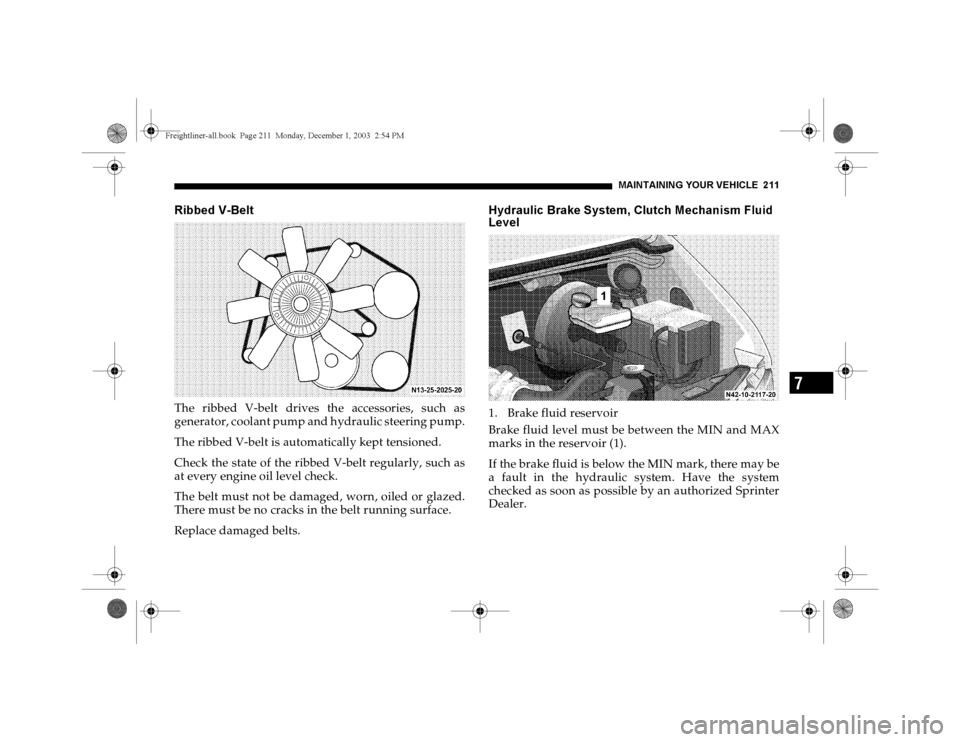
Ribbed V-BeltThe ribbed V-belt drives the accessories, such as
generator, coolant pump and hydraulic steering pump.
The ribbed V-belt is automatically kept tensioned.
Check the state of the ribbed V-belt regularly, such as
at every engine oil level check.
The belt must not be damaged, worn, oiled or glazed.
There must be no cracks in the belt running surface.
Replace damaged belts.
Hydraulic Brake System, Clutch Mechanism Fluid
Level1. Brake fluid reservoir
Brake fluid level must be between the MIN and MAX
marks in the reservoir (1).
If the brake fluid is below the MIN mark, there may be
a fault in the hydraulic system. Have the system
checked as soon as possible by an authorized Sprinter
Dealer.
Freightliner-all.book Pag e 211 Monday, December 1, 2003 2:54 PM
Page 212 of 272
212 MAINTAINING YOUR VEHICLEBrake fluidUse brake fluid approved to MB 331.0, or a DOT 4
brake fluid with: minimum dry boiling point (ERBP)
500
°F, minimum wet boiling point (WERBP)
356°F, maximum viscosity 1500 mm
2/s,
conforming to FMVSS116 and ISO 4925.
In the course of its service life, the boiling point of the
brake fluid will fall due to the continuous absorption of
moisture from the atmosphere.
If the brakes are placed under heavy loads (e.g., on
steep hills) bubbles of steam can then form in the brake
system.
This will adversely affect the brakes' effectiveness.
Engine CoolantThe coolant is a mixture of water and a corrosion
inhibitor/antifreeze additive. Within the cooling
system, the corrosion inhibitor/antifreeze ensures
anti-corrosion protection
antifreeze protection
a higher boiling point.
The coolant added in the factory ensures adequate
antifreeze and anti-corrosion protection.
Use coolant approved to MB 325.0, such as Valvoline
GO5, or an equivalent Extended Life Coolant.
To avoid damage to the cooling system, only use
manufacturer approved corrosion inhibitor/
antifreeze additives.
Information on the corrosion inhibitor/antifreeze
additive is available from any Sprinter Dealer.
For reasons of anti-corrosion protection and to increase
the boiling point, the coolant added to the cooling
system is designed for all year round operation – even
in countries with high prevailing temperatures.
Freightliner-all.book Pag e 212 Monday, December 1, 2003 2:54 PM