fuel DODGE SPRINTER 2005 1.G Owner's Manual
[x] Cancel search | Manufacturer: DODGE, Model Year: 2005, Model line: SPRINTER, Model: DODGE SPRINTER 2005 1.GPages: 288, PDF Size: 27.89 MB
Page 184 of 288
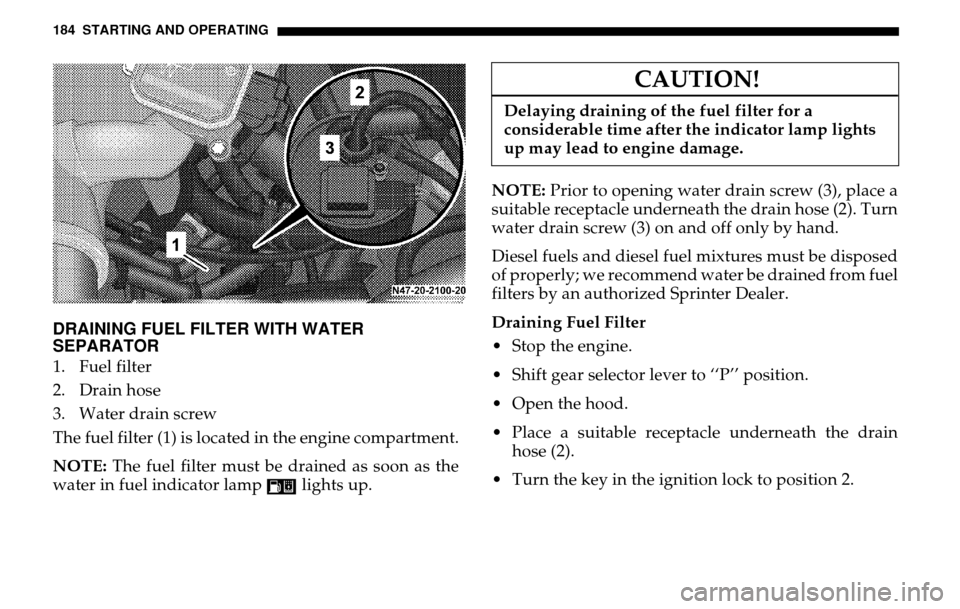
184 STARTING AND OPERATINGDRAINING FUEL FILTER WITH WATER
SEPARATOR1. Fuel filter
2. Drain hose
3. Water drain screw
The fuel filter (1) is located in the engine compartment.
NOTE: The fuel filter must be drained as soon as the
water in fuel indicator lamp lights up. NOTE:
Prior to opening water drain screw (3), place a
suitable receptacle underneath the drain hose (2). Turn
water drain screw (3) on and off only by hand.
Diesel fuels and diesel fuel mixtures must be disposed
of properly; we recommend water be drained from fuel
filters by an authorized Sprinter Dealer.
Draining Fuel Filter
Stop the engine.
Shift gear selector lever to ‘‘P’’ position.
Open the hood.
Place a suitable receptacle underneath the drain hose (2).
Turn the key in the ignition lock to position 2.
CAUTION!
Delaying draining of the fuel filter for a
considerable time after the indicator lamp lights
up may lead to engine damage.
Page 185 of 288

STARTING AND OPERATING 185
5
Open immediately the water drain screw (3) about 1 turn (counterclockwise) until fluid emerges. Ensure
that the fluid is collected in the receptacle.
Close the water drain screw (3) as soon as about 0.25 US qt (0.2 liters) are emerged.
After draining, return the key in the ignition lock to position 0.
Dispose of the collected fluid in an environmentally responsible manner.
If the filter is still saturated, drain the filter once more.
After draining, the engine may run briefly but stall for
lack of fuel. If this occurs, bleed the system.
NOTE: Should the water in the fuel indicator lamp
still not go out after the fuel filter has been drained
twice, the cause should be examined by an authorized
Sprinter Dealer.
Bleeding the Diesel Fuel SystemThe diesel fuel system must be bled before starting the
engine.
Turn the key in the ignition lock position 2 for at
least 30 seconds.
Return the key to position 0.
Start the engine three to four times. The engine control unit indicator lamp ± must go out.
NOTE: Too many attempts to start the engine could
drain the battery. If the engine does not start after
several attempts, consult an authorized Sprinter
Dealer.
Page 187 of 288

STARTING AND OPERATING 187
5
Vehicle and Trailer Weights and RatingsGross Vehicle Weight Rating (GVWR) is the maximum
permissible vehicle weight: 8,550 lbs (3,878 kgs),
9,990 lbs (4,531 kgs) or 10,200 lbs (4,627 kgs).
NOTE: The weight of your Sprinter is indicated on the
type plate. For type plate, see Identification Labels.
Gross Vehicle Weight (GVW): comprises weight of
vehicle including fuel, tools, spare wheel, installed
accessories, passengers, cargo and trailer tongue. It
must never exceed the GVWR.
Gross Axle Weight Rating (GAWR) is the maximum
permissible axle weight: Gross Trailer Weight (GTW) is the maximum
permissible trailer weight to be towed:
5,000 lbs. (2,260 kgs)
Trailer Tongue Weight Rating (TWR) is the maximum
permissible weight of the trailer tongue:
500 lbs. (225 kgs) limit for Sprinter approved hitch
receiver.
Loading a TrailerWhen loading a trailer, you should observe that
neither the permissible GTW, nor the GVWR are
exceeded.
Maximum permissible values are listed on the safety
compliance certification labels for the vehicle and for
the trailer to be towed. The lowest value listed must be
selected when determining how the vehicle and trailer
are loaded.
We recommend loading the trailer in such a manner
that it has a tongue weight (TW) between 10% and 15%
of the GTW.
The tongue weight at the hitch ball must be added to
the GVW to prevent exceeding your Sprinter tow
vehicle’s rear GAWR.
Type GVWR GAWR (FA) GAWR (RA)
2500
C/HC / SHC 8,550 lbs
3,878 kgs 3,860 lbs
(1,751 kgs) 5,360 lbs
(2,431 kgs)
3500
C/HC / SHC 9,990 lbs
4,531 kgs 3,860 lbs
(1,751 kgs) 7,060 lbs
(3,202 kgs)
10,200 lbs 4,627 kgs 3,860 lbs
(1,751 kgs) 7,060 lbs
(3,202 kgs)
Page 216 of 288

216 MAINTAINING YOUR VEHICLELegend For Engine Compartment
1. Windshield washer system fluid reservoir.
2. Maintenance indicator for air cleaner element (Optional).
3. Oil dipstick.
4. Oil filler neck.
5. Ribbed V-belt. Auxiliary drive (Optional) refer to “Auxiliary
drive“. 6. Fuel filter with water separator.
7. Hydraulic brake fluid reservoir.
8. Coolant reservoir.
9. Battery
The auxiliary battery is located underneath the
front passenger seat (optional equipment).
10. Fuse box (These special fuses should only be replaced at by
an authorized Sprinter Dealer).
Page 218 of 288

218 MAINTAINING YOUR VEHICLEDisposal of Service ProductsDispose of service products and of parts which come
into contact with them (e.g. filters) in an
environmentally responsible manner. Comply with
applicable bars and regulations.EMISSION RELATED COMPONENT WARRANTY
STATEMENTThe Manufacturer warrants to the original and each
subsequent owner of a Sprinter heavy-duty on
highway diesel engine that:
(1) the engine was designed, built and equipped so as
to conform at the time of sale with the applicable
regulations adopted by the Federal Environmental
Protection Agency, and
(2) the emission control system of such engine is free
from defects in materials and workmanship which
would cause it not to conform with those regulations
for a period of use of five years or 100 000 miles or
3 000 hours of engine operation, whichever occurs
first.
REGULAR CHECKSThe following checks should be performed at regular
intervals (for example once a week or each time the
vehicle is refueled):
Windshield cleaner system – fluid reservoir.
Air strainer, in vehicles with an air strainer element maintenance indicator (optional equipment).
Engine oil level.
Checking ribbed V-belt.
Hydraulic brake system, clutch mechanism fluid level.
Coolant level.
Tire and spare wheel condition and pressures of the same. For more information, refer to "Wheels and
Tires".
Vehicle lighting.
Page 231 of 288
MAINTAINING YOUR VEHICLE 231
7
Appearance Care and Corrosion ProtectionIn operation, your vehicle is subjected to varying
external influences which, if gone unchecked, can
attack the paintwork as well as the underbody and
cause lasting damage.
Such damage is caused not only by extreme and
varying climatic conditions, but also by air pollution,
road salt, tar, gravel and stone chipping. Grease and
oil, fuel, coolant, brake flui d, bird droppings, insects, tree resins etc. should be removed immediately to
avoid paint damage. Frequent washing reduces and/
or eliminates the aggressiveness and potency of the
above adverse influences.
More frequent washings are necessary to deal with
unfavorable conditions; for example operation near the
ocean, in industrial areas (smoke, exhaust emissions),
or during the winter months.
You should check your vehicle from time to time for
stone chipping or other damage. Any damage should
be repaired as soon as possible to prevent the start of
corrosion.
In doing so, do not neglect the underside of the vehicle.
A prerequisite for a thorough check is a washing of the
underbody followed by a thorough inspection.
Damaged areas need to be undercoated again.
Your vehicle has been treated at the factory with a wax-
base rustproofing in the body cavities which will last
for the lifetime of the vehicle. Post-production
treatment is neither necessary nor recommended by
DaimlerChrysler Corporation.
WARNING!
Many cleaning products can be hazardous. Some
are poisonous, others are flammable. Always
keep cleaning products sealed and out of the
reach of children. Always follow the instructions
on the particular container. Always open your ve-
hicle’s doors or windows when cleaning the in-
side.
Never use fluids or solvents that are not designed
for cleaning your vehicle. Do not use fuel as a
cleaning agent. Fuel is flammable and constitutes
a health hazard.
Page 257 of 288

MAINTAINING YOUR VEHICLE 257
7
CAPACITIES
Engine with oil filter Engine oil Fuel tank Cooling system Windshield washer
system
Including
reserve fuel
All vehicles about 9.5 US qt
(9.0 l) about
26.4 US gal
(100 l) about
2.8 US gal
(10.5 l) about
2.7 US gal
(10.0 l) about
7.4 US qt
(7.0 l)
Page 265 of 288

MAINTENANCE SCHEDULES 265
8M A
I
N T
E
N A
N CE
S
C
H E
D
U L
E
S
The use of Special lubricant additives is not
recommended. The use of such additives may affect
your warranty rights. With regard to legal stipulations
concerning emissions control, please note that engines
have to be serviced and adjusted in accordance with
special instructions and using special measuring
equipment. Modifications to or interference with the
emissions control systems are not permissible.
All Sprinter Dealer are familiar with the relevant and
appliable regulations.
MAINTENANCE - WITHOUT ASSYST
MAINTENANCE COMPUTER
Maintenance IntervalsAdditional work must be carried out at yearly
intervals.
As a general rule, to avoid unnecessary visits to the
workshop you should try to have necessary repair
work performed together with other maintenance
work. Oil service and fuel filter
replacement
– Refer to
Normal Operation every
10,000 miles or
16,000 km or 12 months
Maintenance service every
30,000 miles or
48,000 km
Page 266 of 288

266 MAINTENANCE SCHEDULES
M A I
N T
E
N A
N
C E
S
C
H
E
D
U L
E
S8
MAINTENANCE - WITH ASSYST MAINTENANCE
COMPUTERASSYST provides you with information on the best
possible timing for maintenance work.
When the next maintenance service is due, this will be
indicated in the multi-function display with the
symbol
9 Oil service and fuel filter replacement
9 Maintenance service - displayed in km/miles
or days.
9
If the display shows the number of days, the symbol
È will also appear in the multi-function display.
You should have the maintenance performed within
the stated period/distance.
The service indicator will be reset by your Sprinter
Dealer after an oil service and/or maintenance service
has been performed.
REGULAR CHECK-UPSTo maintain the safe operation of your vehicle, it is
recommended that you perform the following tasks on
a regular basis (i.e., weekly or whenever the vehicle is
refueled). Check:
Engine oil level
Brake system, clutch mechanism – fluid level
Battery – acid level
Windshield washer system and headlamp cleaning
system – fluid level
Mechanical assemblies (e. g. ,engine, transmission, etc.) – check for leaks
Condition of tires and tire pressures
All exterior lights
Page 267 of 288

MAINTENANCE SCHEDULES 267
8M A
I
N T
E
N A
N CE
S
C
H E
D
U L
E
S
SPECIAL MAINTENANCE REQUIREMENTSIf bodies built by manufacturers other than
DaimlerChrysler Corporation are fitted to the vehicle, the
maintenance requirements and lubrication intervals
specified by the body manufacturer must be adhered to,
in addition to all standard maintenance requirements.Brake FluidOnly use brake fluids approved by the manufacturer
(DOT 4 plus). Information about brake fluids is
available from your Sprinter Dealer.CoolantHave the corrosion inhibitor/antifreeze concentration
in the coolant checked before the onset of winter (once
a year in countries with h igh prevailing temperatures).
Have the coolant renewed every five years or 100,000
miles.Dust Filter for Heating/Ventilation ReplacementThe dust filter and the tailgate interior filter are
renewed during routine maintenance service.
However, if operating conditions are dusty, these
filters should be renewed more frequently.
ENGINE OIL CHANGE AND FILTER
REPLACEMENTIn a minimum, change the engine oil and oil filter once
a year - even if the vehicle mileage per year is extremly
low. For standard oil service schedules, please see the
chapter oil service and maintenance service.Once a YearSelect the viscosity of the engine oil (SAE classes)
according to the outside air temperature.
Only use engine oil approved by DaimlerChrysler
Corporation if following the ASSYST system
guidelines.
Information is available from your Sprinter Dealer.
If the fuel used has a sulphur content exceeding 0.05 %
by weight, the service interval s should be split in half.
If the sulphur content of the fuel used is between 0.3%
and 0.8% by weight, the service intervals should be
split in half (i.e. every 5,000 miles instead of every
10,000 miles).