ignition DODGE SPRINTER 2005 1.G Repair Manual
[x] Cancel search | Manufacturer: DODGE, Model Year: 2005, Model line: SPRINTER, Model: DODGE SPRINTER 2005 1.GPages: 288, PDF Size: 27.89 MB
Page 185 of 288

STARTING AND OPERATING 185
5
Open immediately the water drain screw (3) about 1 turn (counterclockwise) until fluid emerges. Ensure
that the fluid is collected in the receptacle.
Close the water drain screw (3) as soon as about 0.25 US qt (0.2 liters) are emerged.
After draining, return the key in the ignition lock to position 0.
Dispose of the collected fluid in an environmentally responsible manner.
If the filter is still saturated, drain the filter once more.
After draining, the engine may run briefly but stall for
lack of fuel. If this occurs, bleed the system.
NOTE: Should the water in the fuel indicator lamp
still not go out after the fuel filter has been drained
twice, the cause should be examined by an authorized
Sprinter Dealer.
Bleeding the Diesel Fuel SystemThe diesel fuel system must be bled before starting the
engine.
Turn the key in the ignition lock position 2 for at
least 30 seconds.
Return the key to position 0.
Start the engine three to four times. The engine control unit indicator lamp ± must go out.
NOTE: Too many attempts to start the engine could
drain the battery. If the engine does not start after
several attempts, consult an authorized Sprinter
Dealer.
Page 211 of 288
WHAT TO DO IN EMERGENCIES 211
6
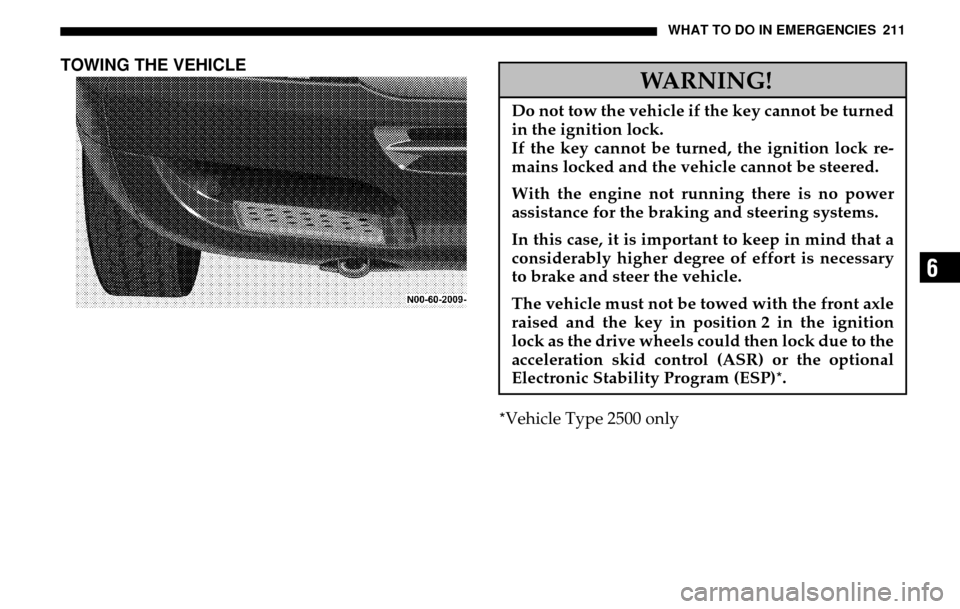
TOWING THE VEHICLE
*Vehicle Type 2500 only
WARNING!
Do not tow the vehicle if the key cannot be turned
in the ignition lock.
If the key cannot be turned, the ignition lock re-
mains locked and the vehicle cannot be steered.
With the engine not running there is no power
assistance for the braking and steering systems.
In this case, it is important to keep in mind that a
considerably higher degree of effort is necessary
to brake and steer the vehicle.
The vehicle must not be towed with the front axle
raised and the key in position 2 in the ignition
lock as the drive wheels could then lock due to the
acceleration skid control (ASR) or the optional
Electronic Stability Program (ESP)
*.
Page 225 of 288
MAINTAINING YOUR VEHICLE 225
7
Open the hood.
At first, only turn the radiator cap to the first detent to release the pressure from the cooling system.
Only then should the radiator cap be removed
completely.
To add coolant: If the engine is cold:
Add coolant until the coolant level reaches the base
area which is visible through the filler opening (area
moistened).
WARNING!
In order to avoid any possibly serious burns:
If you see flames or smoke coming from the engine compartment, or if the coolant
temperature gauge indicates that the engine is
overheated, do not open the hood. Move away
from the vehicle and do not open the hood until
the engine has cooled. If necessary, call the fire
department.
Do not remove pressure cap on coolant reservoir if engine temperature is above 194 °F (+90 ×C).
A l l o w e n g i n e t o c o o l do w n b e f o r e r e m o v i ng c a p .
The coolant reservoir contains hot fluid and is
under pressure.
Using a rag, slowly open cap approximately 1/2 turn to relieve excess pressure. If opened
immediately, scalding hot fluid and steam will
be blown out under pressure.
WARNING!
Do not spill antifreeze on hot engine parts. Anti-freeze contains ethylene glycol which may burn
if it comes into contact with hot engine parts.
Check coolant level only with the engine switched off and the key in position 0 in the
ignition lock.
Page 227 of 288
MAINTAINING YOUR VEHICLE 227
7
BATTERIESThe standard battery is located in the engine
compartment. The auxiliary battery is lo
cated underneath the front
passenger seat (optional equipment).
The battery will not achieve its maximum service life
unless it is kept adequately charged at all times. If the
vehicle is used primarily for short distances, or left
parked for lengthy periods, have the battery charge
checked more frequently.
Disconnecting the Battery
WARNING!
Failure to follow these instructions can result in
severe personal injuries and death.
Never lean over batteries while connecting, you
might get injured, if the battery explodes.
Battery fluid contains sulfuric acid. Do not allow
this fluid to come in contact with eyes, skin or
clothing. In case it does, immediately flush
affected area with water and seek medical help if
necessary.
A battery will also produce hydrogen gas, which
is flammable and explosive. Keep flames or
sparks away from battery, avoid improper
connection of jumper cables, smoking etc.
Use only impact-resistant batteries with a central
gas release cover to prevent corrosion damage and
to prevent occupants from caustic burns in the
event of an accident.
CAUTION!
Do not loosen or remove the battery terminal
clamps while the engine is running or the key is in
the ignition lock as this could damage electrical or
electronic equipment beyond repair. All electrical
consumers must be switched off.
Do not place any metal objects on the battery.
Doing so may cause a short-circuit.
Loosen and remove the negative terminal clamp
first, then the positive terminal.
Afterwards disconnect vent tube from the fitting.
Page 236 of 288

236 MAINTAINING YOUR VEHICLEWiper BladeClean the wiper blade rubber with a clean cloth and
detergent solution.
Light Alloy WheelsA wheel care product should be used for regular
cleaning of the light alloy wheels.
If possible, clean wheels once a week, using a soft
bristle brush and a strong spray of water.
Follow instructions on container.
NOTE: Use only acid-free cleaning materials. The acid
could lead to corrosion.Instrument ClusterUse a gentle dishwashing detergent or mild detergent
for delicate fabrics as a washing solution. Wipe with a
cloth moistened in lukewarm solution. Do not use
scouring agents.Steering Wheel and Gear Selector LeverWipe with a damp cloth and dry thoroughly or clean
with a leather care product.
WARNING!
For safety reasons, remove key from ignition lock
before cleaning the windshield, otherwise the
wiper motor can suddenly turn on and cause in-
jury.
Dirty or iced-up steps create a risk of slipping or
falling. Do not use the step in the front bumper
when it is icy or dirty.
WARNING!
For safety reasons, remove key from ignition lock
before cleaning the wiper blade, otherwise the
wiper motor can suddenly turn on and cause se-
vere personal injuries and death.
Page 238 of 288
238 MAINTAINING YOUR VEHICLEPlastic and Rubber PartsDo not use oil or wax on these parts.
Do not use any caustic or alcohol-based or solvent-
based substances to clean plastic surfaces.
Avoid the use of stain removers, iodine tincture, nail
varnish and nail varnish remover, acetone, methylated
spirits, chlorine or ammonium-based cleaning agents,
cleaning agents containing abrasive substances.ELECTRICAL FUSESDamaged fuses are recognizable from their burnt-out
filament.
Prior to exchanging a fuse, turn the key in the ignition-
column lock to the 0 position and switch off the
consumer involved.
NOTE: Fuses must not be bridged. Replace fuses with
specified rated current. Only replace fuses when the
cause of the malfunction has been rectified.
NOTE: Fuses and relays (standard equipment) are on
the underside of the ignition column, refer to "Fuses
and Relays Standard Equipment". Fuses, relays and diodes (optional equipment) are
below the driver’s seat, refer to "Optional Fuse and
Relay Equipment".
CAUTION!
When replacing a blown fuse, it is important to
use only a fuse having the correct amperage
rating. The use of a fuse with a rating other than
indicated may result in a dangerous electrical
system overload. If a properly rated fuse
continues to blow, it indicates a problem in the
circuit that must be corrected.
Page 241 of 288

MAINTAINING YOUR VEHICLE 241
7
No. Rated Circuit
1. 10A Parking lamp right, taillamp right
2. 10A High beam head lamp,right
3. 10A High beam head lamp, left, high beam indicator lamp
4. 10A Backup lamp
5. 10A Brake lamp
6. 20A Windshield wiper motor
7. 15A Horn, heated rear window, air recirculation switch,
optional equipment relay (terminal 15)
8. 20A Interior lighting, cigarette lighter, radio (terminal 30)
9. 15A Clock, hazard warning lamps, parking lamps 10. 10A Instrument lighting, license plate lamp
daytime driving lamps
11. 10A Side lamp, left; taillamp, left
12. 10A Low beam headlamp, right
13. 10A Low beam headlamp, left
14. 15A Fog lamp
15. 10A Radio (terminal 15)
16. 25A Engine control unit
17. 15A Engine control unit
18. 15A Ignition (terminal 15)
19. 15A Not in use
20. 15A Heater controls (terminal 30)
21. 30A Heater blower (terminal 30)
Page 282 of 288

282 INDEXHeadlamp Range Control. . . . . . . . . . . . . . . . . . . . . . . 68
Headlamps, taillamps, turn signal lenses . . . . . . . . 234
Heated Rear Window . . . . . . . . . . . . . . . . . . . . . . . . . 121
Heater, Seat. . . . . . . . . . . . . . . . . . . . . . . . . . . . . . . . . . . 63
Heating . . . . . . . . . . . . . . . . . . . . . . . . . . . . . . . . . 116, 118
Hood . . . . . . . . . . . . . . . . . . . . . . . . . . . . . . . . . . . . . . . . 66
Hydroplaning. . . . . . . . . . . . . . . . . . . . . . . . . . . . . . . . 175IIgnitionLock. . . . . . . . . . . . . . . . . . . . . . . . . . . . . . . . . . . . . . . 13
Starter Switch . . . . . . . . . . . . . . . . . . . . . . . . . . . . . . 13
Immobilizer . . . . . . . . . . . . . . . . . . . . . . . . . . . . . . . . . . 14
Indicator Lamp Symbols . . . . . . . . . . . . . . . . . . . . . . 108
Inhalation of Exhaust Gas . . . . . . . . . . . . . . . . . . . . . . 54
Installing a Wheel . . . . . . . . . . . . . . . . . . . . . . . . . . . . 206
Instrument and Display Lighting . . . . . . . . . . . . . . . . 97
Instrument Cluster Battery Charge Indicator Lamp . . . . . . . . . . . . . . 104
Clock . . . . . . . . . . . . . . . . . . . . . . . . . . . . . . . . . . . . . . 96
Coolant Level Indicator Lamp . . . . . . . . . . . . . . . 106
Coolant Temperature Gauge. . . . . . . . . . . . . . . . . 101
Engine Control Unit Indicator Lamp . . . . . . . . . . 107 Engine Oil Level Indicator Lamp . . . . . . . . . . . . . 105
Tachometer . . . . . . . . . . . . . . . . . . . . . . . . . . . . . . . 101
Trip Meter . . . . . . . . . . . . . . . . . . . . . . . . . . . . . . . . . 97
Water in Fuel Indicator Lamp . . . . . . . . . . . . . . . . 104
Instrument Cluster and Indicator Lamps. . . . . . . . . . 91
Instruments and Controls . . . . . . . . . . . . . . . . . . . . . . . 89
Interior Lighting . . . . . . . . . . . . . . . . . . . . . . . . . . . . . . . 69 Cargo Area . . . . . . . . . . . . . . . . . . . . . . . . . . . . . . . . . 71
Driver and Rear-Seat Passenger/Cargo Area. . . . 69
Interior Sensor Protection . . . . . . . . . . . . . . . . . . . . 69
Reading Lamp . . . . . . . . . . . . . . . . . . . . . . . . . . . . . . 70
Intervals, Maintenance . . . . . . . . . . . . . . . . . . . . . . . . 265
Introduction . . . . . . . . . . . . . . . . . . . . . . . . . . . . . . . . . . . 4
Intrument Cluster Fuel Gauge . . . . . . . . . . . . . . . . . . . . . . . . . . . . . . . . 103
JJack . . . . . . . . . . . . . . . . . . . . . . . . . . . . . . . . . . . . . . . . . 203Location . . . . . . . . . . . . . . . . . . . . . . . . . . . . . . . . . . 203
Jump Starting . . . . . . . . . . . . . . . . . . . . . . . . . . . . . . . . 209LLamps Acceleration Skid Control . . . . . . . . . . . . . . . . . . . 164
Page 283 of 288

INDEX 283
10
Acceleration Skid Control Warning Lamp . 143, 166
Additional Brake Lamp . . . . . . . . . . . . . . . . . . . . . 252
Anti-Lock Brake System (ABS) Indicator Lamp. 161
Battery Charge Indicator Lamp . . . . . . . . . . . . . . 104
Brake Lamp . . . . . . . . . . . . . . . . . . . . . . . . . . . . . . . 157
Brake System . . . . . . . . . . . . . . . . . . . . . . . . . . . . . . 164
Coolant Level Indicator Lamp . . . . . . . . . . . . . . . 106
Electronic Brake Force Distribution . . . . . . . . . . . 157
Engine Control Unit Indicator Lamp . . . . . . . . . . 107
Engine Oil Level . . . . . . . . . . . . . . . . . . . . . . . . . . . 115
Engine Oil Level Indicator Lamp . . . . . . . . . . . . . 105
Exit Lamps . . . . . . . . . . . . . . . . . . . . . . . . . . . . . . . . 256
Indicator Lamps . . . . . . . . . . . . . . . . . . . . . . . . . . . . 91
License Plate Lamp . . . . . . . . . . . . . . . . . . . . . . . . . 252
Reading Lamp . . . . . . . . . . . . . . . . . . . . . . . . . . . . . 255
Reserve Fuel Indicator Lamp . . . . . . . . . . . . . . . . 103
Seat Belt Warning Lamp . . . . . . . . . . . . . . . . . . . . . 44
Side-Marker Lamp . . . . . . . . . . . . . . . . . . . . . . . . . 253
SRS Malfunction Indicator Lamp . . . . . . . . . . . . . . 49
Taillamp . . . . . . . . . . . . . . . . . . . . . . . . . . . . . . . . . . 250
Water in Fuel Indicator Lamp . . . . . . . . . . . . . . . . 104 Lifting Points . . . . . . . . . . . . . . . . . . . . . . . . . . . . . . . . 203
Lighter, Cigar . . . . . . . . . . . . . . . . . . . . . . . . . . . . . . . . . 82
Lighting, Interior . . . . . . . . . . . . . . . . . . . . . . . . . . . . . . 69
Loading . . . . . . . . . . . . . . . . . . . . . . . . . . . . . . . . . . . . . 150
Lock, Ignition . . . . . . . . . . . . . . . . . . . . . . . . . . . . . . . . . 13
Locking, Central . . . . . . . . . . . . . . . . . . . . . . . . . . . . . . . 15
Lumbar Support . . . . . . . . . . . . . . . . . . . . . . . . . . . . . . . 61
MMaintenance Computer . . . . . . . . . . . . . . . . . . . . . . . 110
Maintenance Intervals . . . . . . . . . . . . . . . . . . . . . . . . . 265
Maintenance Schedules
Additional Maintenance Work After ... Years . . 270
Brake Fluid . . . . . . . . . . . . . . . . . . . . . . . . . . . . . . . . 267
Coolant . . . . . . . . . . . . . . . . . . . . . . . . . . . . . . . . . . . 267
Dust Filter for Heating/Ventilation Replacement . .
267
Engine Oil Change and Filter Replacement . . . . 267
Introduction . . . . . . . . . . . . . . . . . . . . . . . . . . . . . . . 264
Oil Service . . . . . . . . . . . . . . . . . . . . . . . . . . . . . . . . 268
Once a Year . . . . . . . . . . . . . . . . . . . . . . . . . . . . . . . 267
Regular Check-Ups . . . . . . . . . . . . . . . . . . . . . . . . . 266
Scope of Work for Maintenance service . . . . . . . 268