engine DODGE SPRINTER 2006 1.G Owners Manual
[x] Cancel search | Manufacturer: DODGE, Model Year: 2006, Model line: SPRINTER, Model: DODGE SPRINTER 2006 1.GPages: 330, PDF Size: 10.82 MB
Page 261 of 330
MAINTAINING YOUR VEHICLE 261
7
Hydraulic Brake System, Clutch Mechanism Fluid
Level
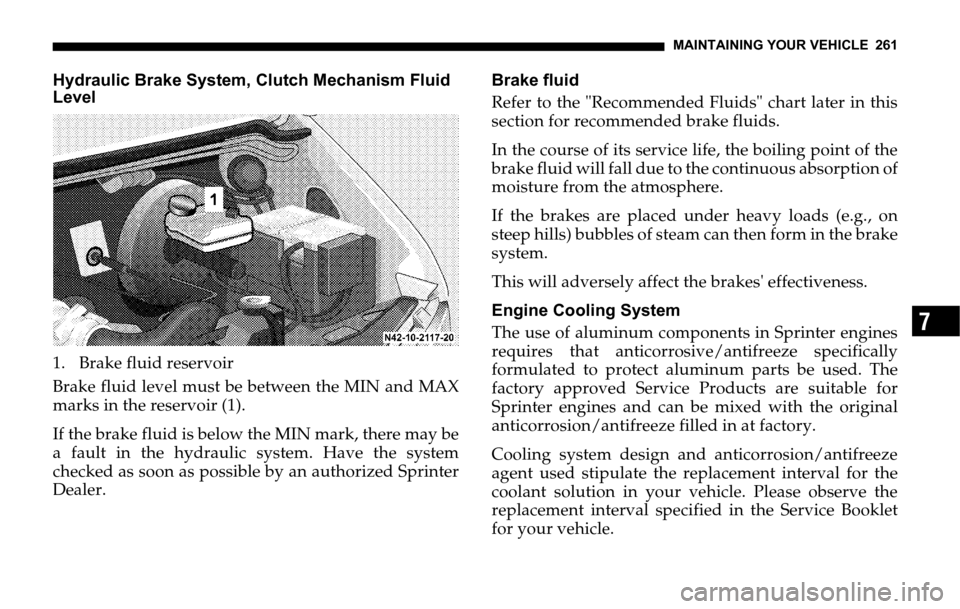
1. Brake fluid reservoir
Brake fluid level must be between the MIN and MAX
marks in the reservoir (1).
If the brake fluid is below the MIN mark, there may be
a fault in the hydraulic system. Have the system
checked as soon as possible by an authorized Sprinter
Dealer.Brake fluid
Refer to the "Recommended Fluids" chart later in this
section for recommended brake fluids.
In the course of its service life, the boiling point of the
brake fluid will fall due to the continuous absorption of
moisture from the atmosphere.
If the brakes are placed under heavy loads (e.g., on
steep hills) bubbles of steam can then form in the brake
system.
This will adversely affect the brakes' effectiveness.
Engine Cooling System
The use of aluminum components in Sprinter engines
requires that anticorrosive/antifreeze specifically
formulated to protect aluminum parts be used. The
factory approved Service Products are suitable for
Sprinter engines and can be mixed with the original
anticorrosion/antifreeze filled in at factory.
Cooling system design and anticorrosion/antifreeze
agent used stipulate the replacement interval for the
coolant solution in your vehicle. Please observe the
replacement interval specified in the Service Booklet
for your vehicle.
Page 262 of 330

262 MAINTAINING YOUR VEHICLE
Failure to use MB 325.0 anticorrosion/antifreeze and/or
equivalent to DaimlerChrysler material standard MS-
9769 and/or adhere to the specified replacement interval
may result in a significantly shortened service life.
For coolant composition and water quality, contact
your authorized Sprinter Dealer.
Engine Coolant
The coolant is a mixture of water and a corrosion
inhibitor/antifreeze additive. Within the cooling
system, the corrosion inhibitor/antifreeze ensures
anti-corrosion protection
antifreeze protection
a higher boiling point.
The coolant added in the factory ensures adequate
antifreeze and anti-corrosion protection.
Refer to the "Recommended Fluids" chart for coolant
recommendations.
For reasons of anti-corrosion protection and to increase
the boiling point, the coolant added to the cooling
system is designed for all year round operation – even
in countries with high prevailing temperatures.Have the coolant renewed at least every 15 years or
after 160,000 miles.
When the coolant is renewed, the new coolant should
contain 50% antifreeze/corrosion inhibitor by volume.
This corresponds to antifreeze protection down to -
37 °C/-35°F.
Do not exceed a proportion of about 55 % by volume
(antifreeze protection down to about -45 °C/-49 °F) as
the heat dissipation properties then deteriorate.
In the event of coolant loss, do not add water only, but
sufficient antifreeze/corrosion inhibitor to maintain
the correct concentration.
The water in the coolant must satisfy certain
requirements. These are often met by tap supply
drinking water.
The water must be specially prepared if the water
quality does not come up to the required standards.
Have the corrosion inhibitor/antifreeze concentration
in the coolant checked at the outset of winter,
respectively once a year in countries with high
prevailing temperatures.
Page 263 of 330
MAINTAINING YOUR VEHICLE 263
7
A regular check is included in the maintenance service.
Checking Coolant Level
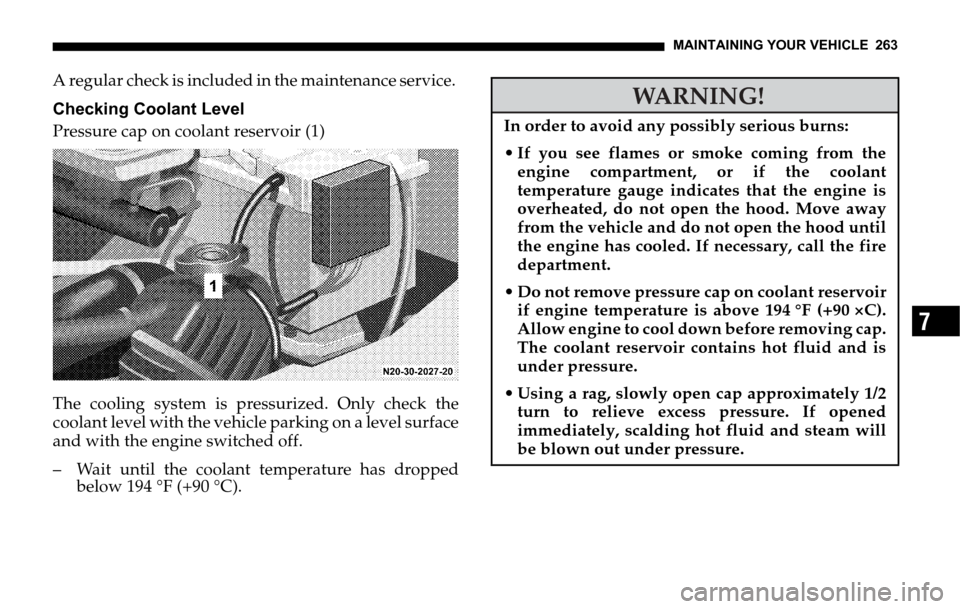
Pressure cap on coolant reservoir (1)
The cooling system is pressurized. Only check the
coolant level with the vehicle parking on a level surface
and with the engine switched off.
– Wait until the coolant temperature has dropped
below 194 °F (+90 °C).
WARNING!
In order to avoid any possibly serious burns:
If you see flames or smoke coming from the
engine compartment, or if the coolant
temperature gauge indicates that the engine is
overheated, do not open the hood. Move away
from the vehicle and do not open the hood until
the engine has cooled. If necessary, call the fire
department.
Do not remove pressure cap on coolant reservoir
if engine temperature is above 194 °F (+90 ×C).
Allow engine to cool down before removing cap.
The coolant reservoir contains hot fluid and is
under pressure.
Using a rag, slowly open cap approximately 1/2
turn to relieve excess pressure. If opened
immediately, scalding hot fluid and steam will
be blown out under pressure.
Page 264 of 330

264 MAINTAINING YOUR VEHICLE
Open the hood.
At first, only turn the pressure cap on coolant
reservoir to the first detent to release the pressure
from the cooling system. Only then should the
pressure cap be removed completely.
To add coolant:
If the engine is cold:
Add coolant until the coolant level reaches the base
area which is visible through the filler opening (area
moistened).If the engine is already at its regular operating
temperature:
Add coolant until the coolant level is about 0.6 inch
(1.5 cm) above the base area which is visible
through the filler opening.
Replace and tighten the pressure cap on coolant
reservoir.
If a large quantity of coolant has been lost, or if smaller
amounts are lost at regular intervals, have the engine
cooling system examined by an authorized Sprinter
Dealer.
For coolant composition and water quality, contact
your Sprinter Dealer.
WARNING!
Do not spill antifreeze on hot engine parts. Anti-
freeze contains ethylene glycol which may burn
if it comes into contact with hot engine parts.
Check coolant level only with the engine
switched off and the key in position 0 in the
ignition lock.
Page 265 of 330

MAINTAINING YOUR VEHICLE 265
7
WINTER OPERATION
Have your vehicle winterized by an authorized
Sprinter Dealer before the onset of winter.
Have the engine oil changed, if the engine oil filled
is not approved for winter use.
Coolant: antifreeze/anti-corrosion concentration in
the coolant checked.
Windshield washer system and headlamp cleaning
system (optional): add windshield washer fluid
"winter wash" to the water, depending on ambient
temperatures.
Battery: the battery will lose capacity as
temperatures drop. Only a well-charged battery will
ensure reliable engine starting even at low outside
temperatures.
Tires: fit M+S radial tires with a minimum tread
depth of approximately 1/6 in (4 mm) on all wheels
for the winter season.BATTERIES
The standard battery is located in the engine
compartment.
WARNING!
Failure to follow these instructions can result in
severe personal injuries and death.
Never lean over batteries while connecting, you
might get injured, if the battery explodes.
Battery fluid contains sulfuric acid. Do not allow
this fluid to come in contact with eyes, skin or
clothing. In case it does, immediately flush
affected area with water and seek medical help if
necessary.
A battery will also produce hydrogen gas, which
is flammable and explosive. Keep flames or
sparks away from battery, avoid improper
connection of jumper cables, smoking etc.
Use only impact-resistant batteries with a central
gas release cover to prevent corrosion damage and
to prevent occupants from caustic burns in the
event of an accident.
Page 266 of 330
266 MAINTAINING YOUR VEHICLE
The auxiliary battery is located underneath the front
passenger seat (optional equipment).
The battery will not achieve its maximum service life
unless it is kept adequately charged at all times. If the
vehicle is used primarily for short distances, or left
parked for lengthy periods, have the battery charge
checked more frequently.
Disconnecting the BatteryReconnecting the Battery
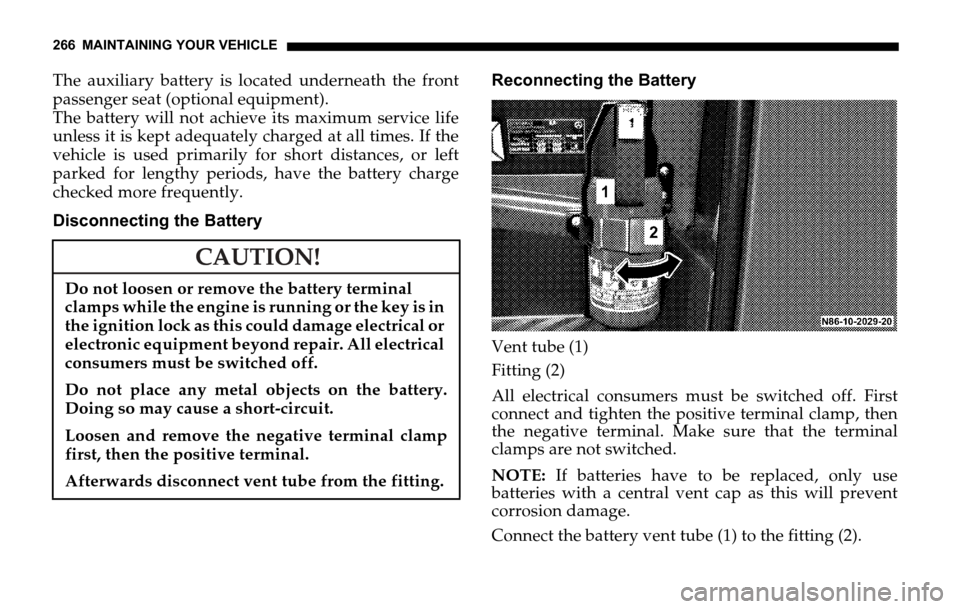
Vent tube (1)
Fitting (2)
All electrical consumers must be switched off. First
connect and tighten the positive terminal clamp, then
the negative terminal. Make sure that the terminal
clamps are not switched.
NOTE: If batteries have to be replaced, only use
batteries with a central vent cap as this will prevent
corrosion damage.
Connect the battery vent tube (1) to the fitting (2).
CAUTION!
Do not loosen or remove the battery terminal
clamps while the engine is running or the key is in
the ignition lock as this could damage electrical or
electronic equipment beyond repair. All electrical
consumers must be switched off.
Do not place any metal objects on the battery.
Doing so may cause a short-circuit.
Loosen and remove the negative terminal clamp
first, then the positive terminal.
Afterwards disconnect vent tube from the fitting.
Page 272 of 330

272 MAINTAINING YOUR VEHICLE
Tar Stains
Quickly remove tar stains before they dry and become
more difficult to remove. A tar remover is
recommended.
Paintwork, Painted Body Components
Paint care should be applied when water drops on the
paint surface do not "bead up", normally every 3 to
5 months, depending on climate and washing
detergent used.
Paint cleaner should be applied if paint surface shows
signs of dirt embedding (i.e. loss of gloss).
Do not apply any of these products or wax if your
vehicle is parked in the sun or if the hood is still hot.
Use the appropriate paint stick for quick and
provisional repairs of minor paint damage (i.e., chips
from stones, vehicle doors etc.).
Engine Cleaning
Prior to cleaning the engine compartment, make sure
to protect electrical components and connectors from
the intrusion of water and cleaning agents.Corrosion protection, such as anticorrosion wax
should be applied to the engine compartment after
every engine cleaning. Before applying, all control
linkage bushings and joints should be lubricated. The
poly-V-belt and all pulleys should be protected from
any wax.
Vehicle Washing
Do not use hot water or wash your vehicle in direct
sunlight. Use only a mild car wash detergent.
Thoroughly spray the vehicle with a diffused jet of
water. Direct only a very weak spray towards the
ventilation intake. Use plenty of water and rinse the
sponge and chamois frequently.
Rinse with clear water and thoroughly wipe dry with a
chamois. Do not allow cleaning agents to dry on the
finish.
Due to the width of the vehicle, prior to running the
vehicle through an automatic car wash, fold back the
outside mirrors to prevent them from getting
damaged.
In the winter, thoroughly remove all traces of road salt
as soon as possible.
Page 280 of 330

280 MAINTAINING YOUR VEHICLE
No. Rated Circuit
1. 10A Parking lamp right, taillamp right
2. 10A High beam head lamp,right
3. 10A High beam head lamp, left,
high beam indicator lamp
4. 10A Backup lamp
5. 10A Brake lamp
6. 20A Windshield wiper motor
7. 15A Horn, heated rear window,
air recirculation switch,
optional equipment relay (terminal 15)
8. 20A Interior lighting, cigarette lighter,
radio (terminal 30)
9. 15A Clock, hazard warning lamps,
parking lamps10. 10A Instrument lighting, license plate lamp
daytime driving lamps
11. 10A Side lamp, left; taillamp, left
12. 10A Low beam headlamp, right
13. 10A Low beam headlamp, left
14. 15A Fog lamp
15. 10A Radio (terminal 15)
16. 25A Engine control unit
17. 15A Engine control unit
18. 15A Ignition (terminal 15)
19. 15A Not in use
20. 15A Heater controls (terminal 30)
21. 30A Heater blower (terminal 30)
Page 281 of 330
MAINTAINING YOUR VEHICLE 281
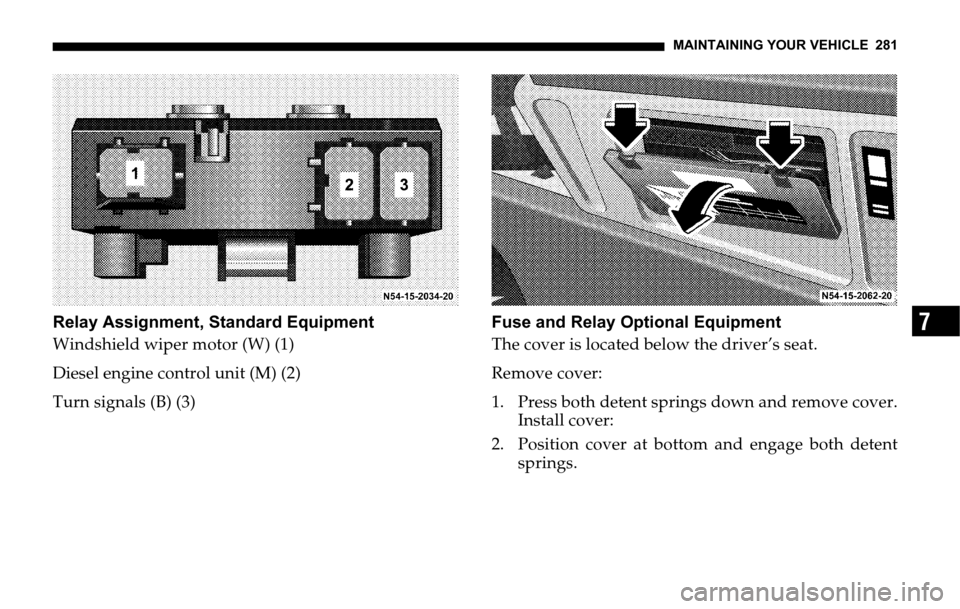
7Relay Assignment, Standard Equipment
Windshield wiper motor (W) (1)
Diesel engine control unit (M) (2)
Turn signals (B) (3)Fuse and Relay Optional Equipment
The cover is located below the driver’s seat.
Remove cover:
1. Press both detent springs down and remove cover.
Install cover:
2. Position cover at bottom and engage both detent
springs.
Page 284 of 330
284 MAINTAINING YOUR VEHICLE
BULB REPLACEMENT
Switch the lights off to prevent short circuits.
Only touch new bulbs with a clean, lint-free cloth. Do
not touch bulbs with wet or greasy fingers.
Only fit 12 volt bulbs of the same type as before and
with the correct wattage rating.Front Lamp Unit
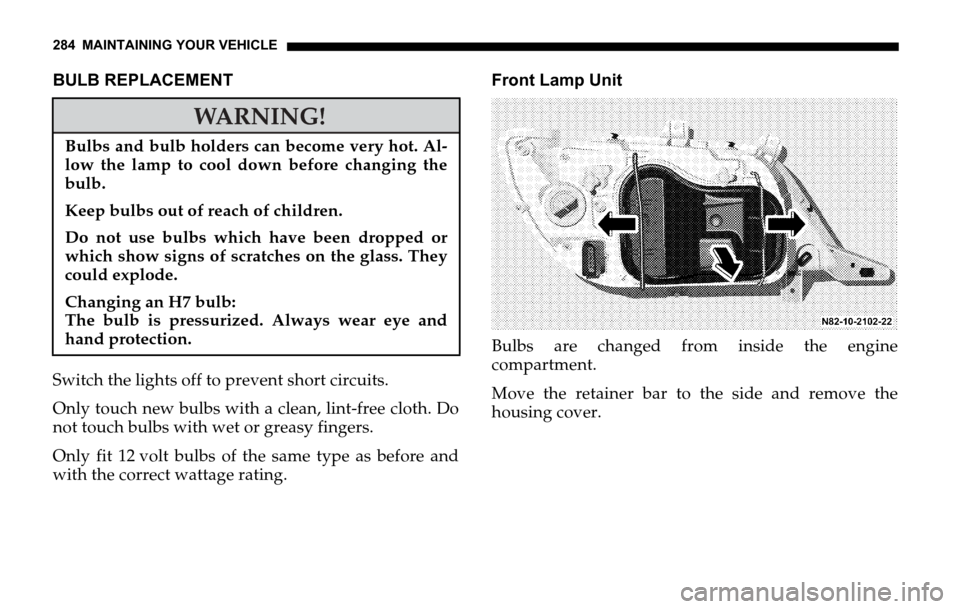
Bulbs are changed from inside the engine
compartment.
Move the retainer bar to the side and remove the
housing cover.
WARNING!
Bulbs and bulb holders can become very hot. Al-
low the lamp to cool down before changing the
bulb.
Keep bulbs out of reach of children.
Do not use bulbs which have been dropped or
which show signs of scratches on the glass. They
could explode.
Changing an H7 bulb:
The bulb is pressurized. Always wear eye and
hand protection.