ESP DODGE SPRINTER 2006 1.G User Guide
[x] Cancel search | Manufacturer: DODGE, Model Year: 2006, Model line: SPRINTER, Model: DODGE SPRINTER 2006 1.GPages: 330, PDF Size: 10.82 MB
Page 50 of 330
50 THINGS TO KNOW BEFORE STARTING YOUR VEHICLE
Safety Precautions for the Airbag
WARNING!
Airbags can seriously injure or kill you, especially
if you are close to the airbag when it deploys.
Always wear your seat belt. Airbags do not
replace seat belts but instead supplement the
protection offered by seat belts. Wearing a seat
belt also makes it less likely that you will be out
of position and will not be injured or killed as the
airbag deploys.
Never place an infant seat which faces to the rear
on the front passenger seat. Children 12 years old
and under, and any child who cannot wear a seat
belt properly, must never ride in the front of this
vehicle.
The airbag does offer an additional degree of
protection, especially to belted occupants, but the
following precautions should still be taken to
prevent injuries when the airbag is inflating.
Do not position the seat closer than necessary to
the airbag inflation point.
WARNING!
Do not lean forward when the vehicle is in mo-
tion.
Do not lean on the doors from inside the vehicle.
Do not put your feet on the dashboard.
Only hold the steering wheel by the outer rim so
that the airbag can inflate unhindered.
No objects should be positioned on the airbag or
between the airbag and the vehicle’s occupants.
If children are traveling, they should always use
an appropriate child restraint system.
Do not touch any hot parts after the airbag has
inflated. Airbags which have triggered in an
accident must be replaced.
The center of the padded steering wheel must not
be covered by any materials or have any labels or
stickers attached to it, or else the airbag may not
function reliably.
Page 53 of 330

THINGS TO KNOW BEFORE STARTING YOUR VEHICLE 53
2
Engine Oil Consumption
When the engine has passed the break-in period, oil
consumption may reach 0.5 % of the fuel consumption
recorded in actual operating circumstances. In isolated
cases and in arduous operating conditions, oil
consumption may increase to 1 % of the fuel
consumption recorded in actual operating
circumstances.
Engine oil consumption depends on the driving style
adopted and the operating conditions. It can only be
judged after the engine has passed the break-in period.SAFETY TIPS
Check the vehicle’s lights and the general condition
of the vehicle before each trip.
Keep tires at the recommended tire inflation
pressure.
All occupants should fasten their seat belts before
each trip.
Driving in an environmentally responsible manner
will reduce noise, fuel consumption and exhaust
emissions.
Allow the engine to warm up under low load use.
Avoid unnecessarily hard acceleration, driving with
the throttle fully open, and carrying loads not
specifically needed on the journey.
Stop the engine during lengthy waiting periods, for
example at traffic lights.
Remove ancillary parts, such as wind deflectors and
roof racks, as soon as they are no longer needed.
Page 65 of 330
UNDERSTANDING THE FEATURES OF YOUR VEHICLE 65
3
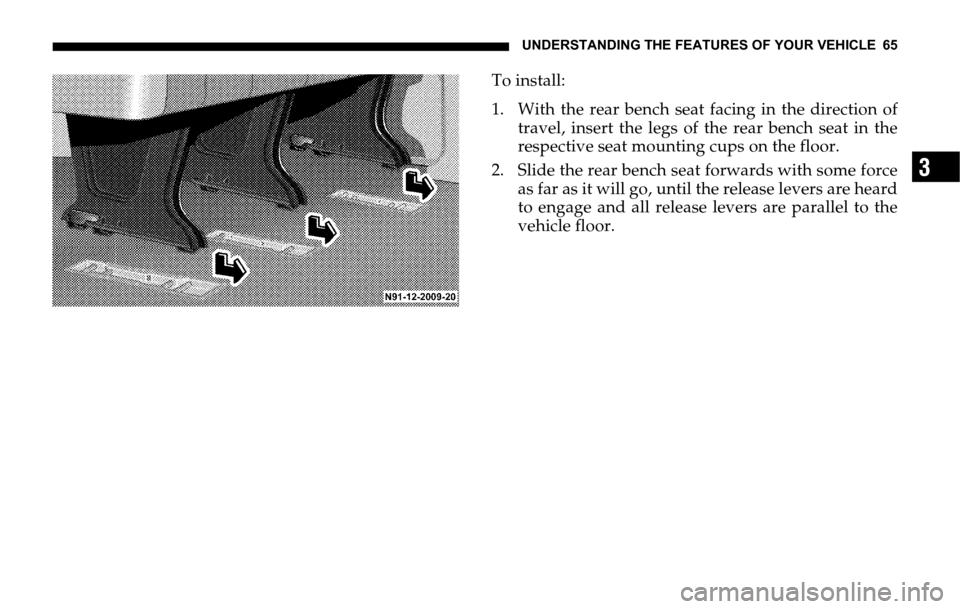
To install:
1. With the rear bench seat facing in the direction of
travel, insert the legs of the rear bench seat in the
respective seat mounting cups on the floor.
2. Slide the rear bench seat forwards with some force
as far as it will go, until the release levers are heard
to engage and all release levers are parallel to the
vehicle floor.
Page 78 of 330

78 UNDERSTANDING THE FEATURES OF YOUR VEHICLE
The speed control allows you to drive in a more
relaxed manner, for example over long distances, as it
automatically maintains the set speed by actively
regulating the throttle setting.
The speed control lever on the steering column is used
to activate and operate the speed control.
NOTE: The responsibility for the driving speed is
always that of the driver. The cruise control is only an
aid for the driver.
NOTE: A change of gear does not shut off the cruise
control.
Every speed traveled above 25 mph (40 km/h) can be
set.
Once the speed is set, it is maintained constant by the
speed control, the accelerator pedal can be released.Setting momentary speed
Briefly push speed control lever up (1) or down (2).
Cancel speed control
Push speed control lever forwards (3) or step on the
brake pedal.
Increase set speed
Push up speed control lever (1) briefly – speed increase
of 0.6 mph (1 km/h) each time.
To increase speed steadily = hold the speed control
lever in the push-up position.
WARNING!
Leaving the Speed Control on when not in use is
dangerous. You could accidently set the system or
cause it to go faster than you want. You could lose
control and have an accident. Always turn the
system off when you are not using it.
Page 84 of 330
84 UNDERSTANDING THE FEATURES OF YOUR VEHICLE
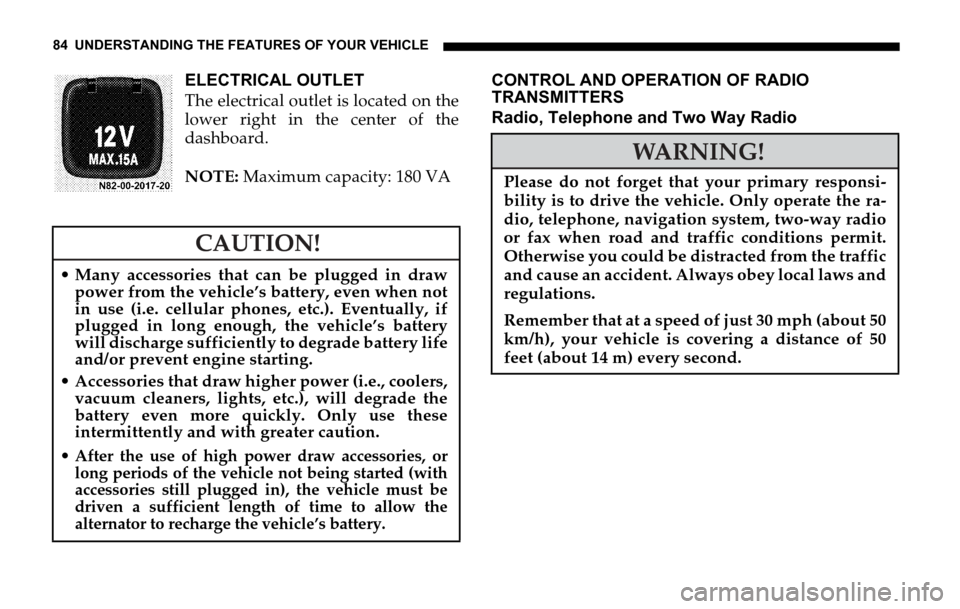
ELECTRICAL OUTLET
The electrical outlet is located on the
lower right in the center of the
dashboard.
NOTE: Maximum capacity: 180 VACONTROL AND OPERATION OF RADIO
TRANSMITTERS
Radio, Telephone and Two Way Radio
CAUTION!
Many accessories that can be plugged in draw
power from the vehicle’s battery, even when not
in use (i.e. cellular phones, etc.). Eventually, if
plugged in long enough, the vehicle’s battery
will discharge sufficiently to degrade battery life
and/or prevent engine starting.
Accessories that draw higher power (i.e., coolers,
vacuum cleaners, lights, etc.), will degrade the
battery even more quickly. Only use these
intermittently and with greater caution.
After the use of high power draw accessories, or
long periods of the vehicle not being started (with
accessories still plugged in), the vehicle must be
driven a sufficient length of time to allow the
alternator to recharge the vehicle’s battery.
WARNING!
Please do not forget that your primary responsi-
bility is to drive the vehicle. Only operate the ra-
dio, telephone, navigation system, two-way radio
or fax when road and traffic conditions permit.
Otherwise you could be distracted from the traffic
and cause an accident. Always obey local laws and
regulations.
Remember that at a speed of just 30 mph (about 50
km/h), your vehicle is covering a distance of 50
feet (about 14 m) every second.
Page 86 of 330
86 UNDERSTANDING THE FEATURES OF YOUR VEHICLE
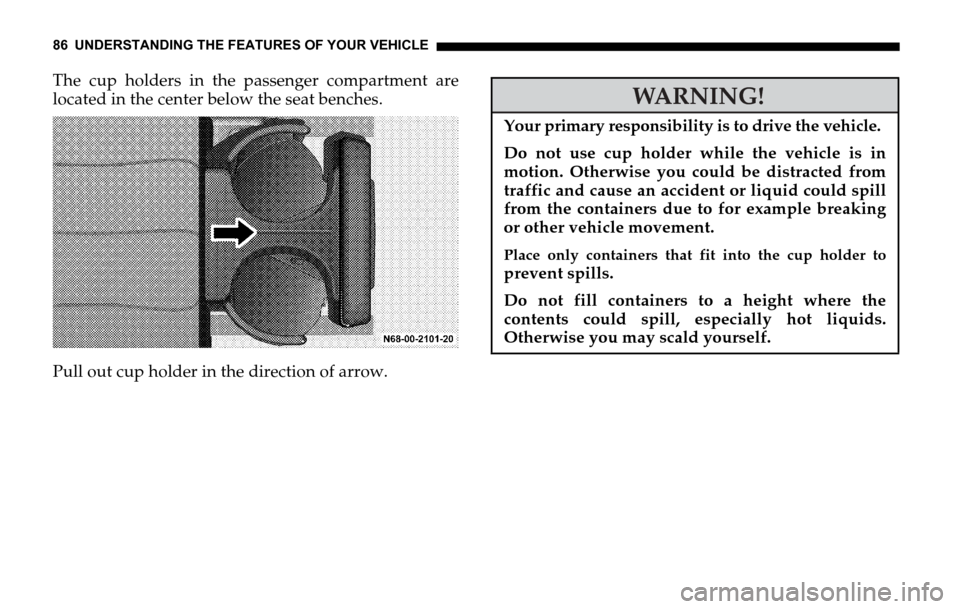
The cup holders in the passenger compartment are
located in the center below the seat benches.
Pull out cup holder in the direction of arrow.
WARNING!
Your primary responsibility is to drive the vehicle.
Do not use cup holder while the vehicle is in
motion. Otherwise you could be distracted from
traffic and cause an accident or liquid could spill
from the containers due to for example breaking
or other vehicle movement.
Place only containers that fit into the cup holder to
prevent spills.
Do not fill containers to a height where the
contents could spill, especially hot liquids.
Otherwise you may scald yourself.
Page 94 of 330

94 UNDERSTANDING YOUR INSTRUMENT PANEL
Legend For Instrument Cluster And Indicator Lamps
1. Tachometer (Engine rpm), refer to "Tachometer
(Engine rpm)".
2. Turn signal indicator lamp (left), refer to
"Multifunction Switch".
3. Turn signal indicator lamp (right), refer to
"Multifunction switch".
4. ASR warning lamp or ESP
®* warning lamp.
5. Speedometer.
6. Multi-function indicator, refer to "Multi-Function
Indicator".
7. Gear selector lever position.
8. Coolant temperature gauge, refer to "Coolant
Temperature Gauge".
* 2500 Type vehicles only9. Fuel gauge with reserve fuel indicator lamp
(yellow), refer to "Fuel Gauge with Reserve Fuel
Indicator Lamp".
10. Warning and indicator lamps.
11. Odometer/trip meter selector, refer to "Odometer
and Trip Meter".
Clock/outside temperature display selector, refer
to "Clock and Outside Temperature Display".
12. Instrument lighting brighter/dimmer, refer to
"Instrument Lighting".
Page 95 of 330
UNDERSTANDING YOUR INSTRUMENT PANEL 95
4
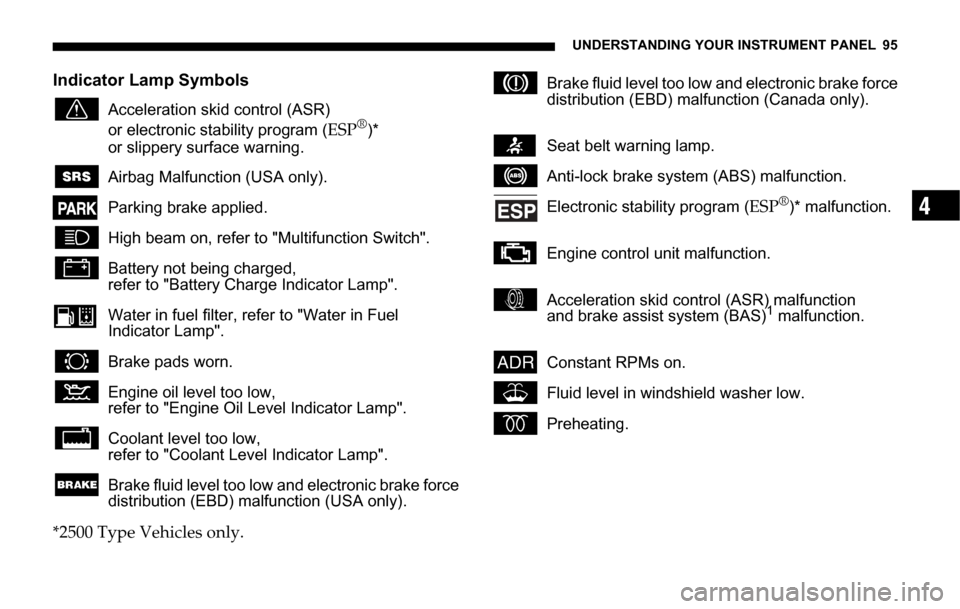
Indicator Lamp Symbols
vAcceleration skid control (ASR)
or electronic stability program (
ESP®)*
or slippery surface warning.
1Airbag Malfunction (USA only).
Parking brake applied.
AHigh beam on, refer to "Multifunction Switch".
#Battery not being charged,
refer to "Battery Charge Indicator Lamp".
Water in fuel filter, refer to "Water in Fuel
Indicator Lamp".
2Brake pads worn.
:Engine oil level too low,
refer to "Engine Oil Level Indicator Lamp".
/Coolant level too low,
refer to "Coolant Level Indicator Lamp".
;Brake fluid level too low and electronic brake force
distribution (EBD) malfunction (USA only).
*2500 Type Vehicles only.
3Brake fluid level too low and electronic brake force
distribution (EBD) malfunction (Canada only).
#Electronic stability program (ESP®)* malfunction.
±Engine control unit malfunction.
kAcceleration skid control (ASR) malfunction
and brake assist system (BAS)1 malfunction.
™Constant RPMs on.
WFluid level in windshield washer low.
qPreheating.
Page 103 of 330
UNDERSTANDING YOUR INSTRUMENT PANEL 103
4
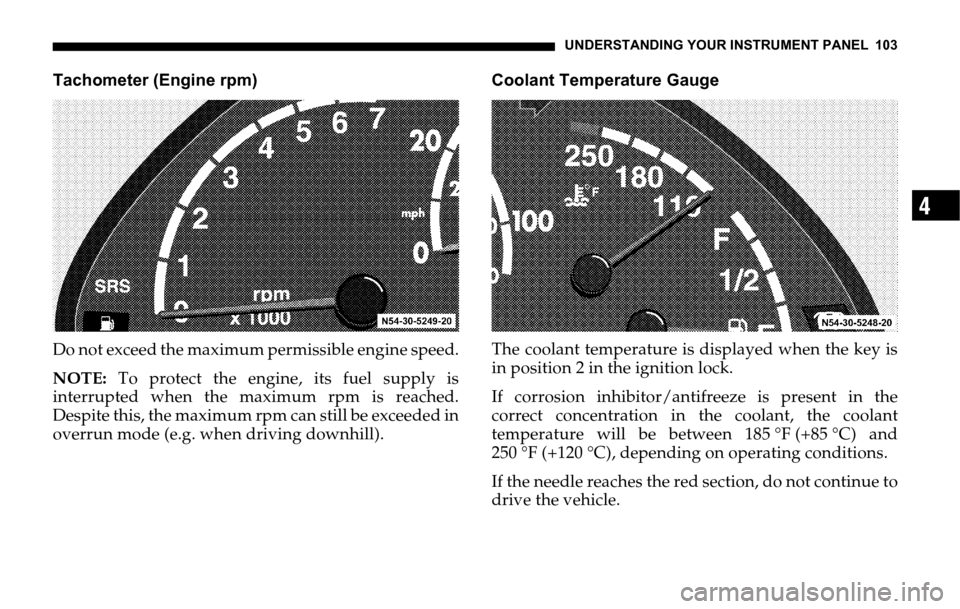
Tachometer (Engine rpm)
Do not exceed the maximum permissible engine speed.
NOTE: To protect the engine, its fuel supply is
interrupted when the maximum rpm is reached.
Despite this, the maximum rpm can still be exceeded in
overrun mode (e.g. when driving downhill).Coolant Temperature Gauge
The coolant temperature is displayed when the key is
in position 2 in the ignition lock.
If corrosion inhibitor/antifreeze is present in the
correct concentration in the coolant, the coolant
temperature will be between 185 °F (+85 °C) and
250 °F (+120 °C), depending on operating conditions.
If the needle reaches the red section, do not continue to
drive the vehicle.
Page 141 of 330

STARTING AND OPERATING
5
CONTENTS
Q Power Assistance . . . . . . . . . . . . . . . . . . . . . . . . . . 144
Q Starting the Engine . . . . . . . . . . . . . . . . . . . . . . . . . 144
…Maximum Engine Speed . . . . . . . . . . . . . . . . . . 145…Constant RPMs (Optional) . . . . . . . . . . . . . . . . 146
Q Stopping the Engine . . . . . . . . . . . . . . . . . . . . . . . . 147
Q Automatic Transmission . . . . . . . . . . . . . . . . . . . . 148
…Driving . . . . . . . . . . . . . . . . . . . . . . . . . . . . . . . . . 148
…Accelerator Position . . . . . . . . . . . . . . . . . . . . . . 149
…Stopping . . . . . . . . . . . . . . . . . . . . . . . . . . . . . . . 149…Maneuvering . . . . . . . . . . . . . . . . . . . . . . . . . . . . 149
…Gear Selector Lever Position . . . . . . . . . . . . . . . 150
…Gear Selection for Special Circumstances . . . . 151
Q Transmission Selector Lever, Manually
Unlocking . . . . . . . . . . . . . . . . . . . . . . . . . . . . . . . . 153
…Reversing Aid (Optional) . . . . . . . . . . . . . . . . . 153
Q Loading the Vehicle . . . . . . . . . . . . . . . . . . . . . . . . 156
…Loading Guidelines . . . . . . . . . . . . . . . . . . . . . . 157
Q Brakes . . . . . . . . . . . . . . . . . . . . . . . . . . . . . . . . . . . . 158
…Service Brake . . . . . . . . . . . . . . . . . . . . . . . . . . . . 158
…Brake Pad Wear Indicator . . . . . . . . . . . . . . . . . 159
…Brake Indicator and Electronic Brake
Force Distribution (EBD) Indicator Lamp . . . 160
…Parking Brake Indicator Lamp . . . . . . . . . . . . . 161
…Parking Brake . . . . . . . . . . . . . . . . . . . . . . . . . . . 162
…Driving Safety Systems . . . . . . . . . . . . . . . . . . . 163…Anti-Lock Brake System (ABS)
Indicator Lamp . . . . . . . . . . . . . . . . . . . . . . . . . . 164
…Anti-Lock Brake System (ABS) . . . . . . . . . . . . . 165
…Electronic Brake Force Distribution (EBD) . . . 167
…Acceleration Skid Control Indicator
Lamp (ASR) and Brake Assist System (BAS)1
if equipped . . . . . . . . . . . . . . . . . . . . . . . . . . . . . 167
…Acceleration Skid Control (ASR) Warning
Lamp and Electronic Stability Program
(ESP®)* – if equipped . . . . . . . . . . . . . . . . . . . . 169
…Acceleration Skid Control (ASR) . . . . . . . . . . . 170