battery DODGE SPRINTER 2006 1.G User Guide
[x] Cancel search | Manufacturer: DODGE, Model Year: 2006, Model line: SPRINTER, Model: DODGE SPRINTER 2006 1.GPages: 330, PDF Size: 10.82 MB
Page 140 of 330

140 UNDERSTANDING YOUR INSTRUMENT PANEL
AUXILIARY HEATER – TIPS FOR COPING WITH
PROBLEMS
NOTE: After three successive attempts to start the
heater, a malfunction will be recorded in the integrated
diagnostic system and no further operation on
auxiliary heater will be available (lock-out). The work
to annul the lock-out must be carried out at an
authorized Sprinter Dealer.
The heater either does not switch on or automatically
switches off:
Insufficient fuel, fill up the fuel tank. Start up heater
two times, until the fuel lines are filled.
The auxiliary heater will automatically switch off if
the fuel level is under about 4 US gal (15 l).
The fuses in the fuse box are damaged. Electric
fuses.
The battery voltage is too low, an undervoltage
protector switches off the heater if the battery
voltage falls below about 10 volts.The heater motor does not run
The battery voltage is too low, check the battery.
Batteries.
The fuses in the fuse box are damaged.
Electric fuses.
The heater motor is damaged.
Overheating
The air channels are clogged.
The heater can be restarted once the fault has been
repaired. When this is done, the heater should be
switched on and off.
The heater will remain switched off after it has been
overheated a number of times (about 10 times in
succession). Have the fault repaired by an
authorized Sprinter Dealer.
NOTE: Repairs should only be made by an authorized
Sprinter Dealer.
Page 144 of 330
144 STARTING AND OPERATING
POWER ASSISTANCE STARTING THE ENGINE
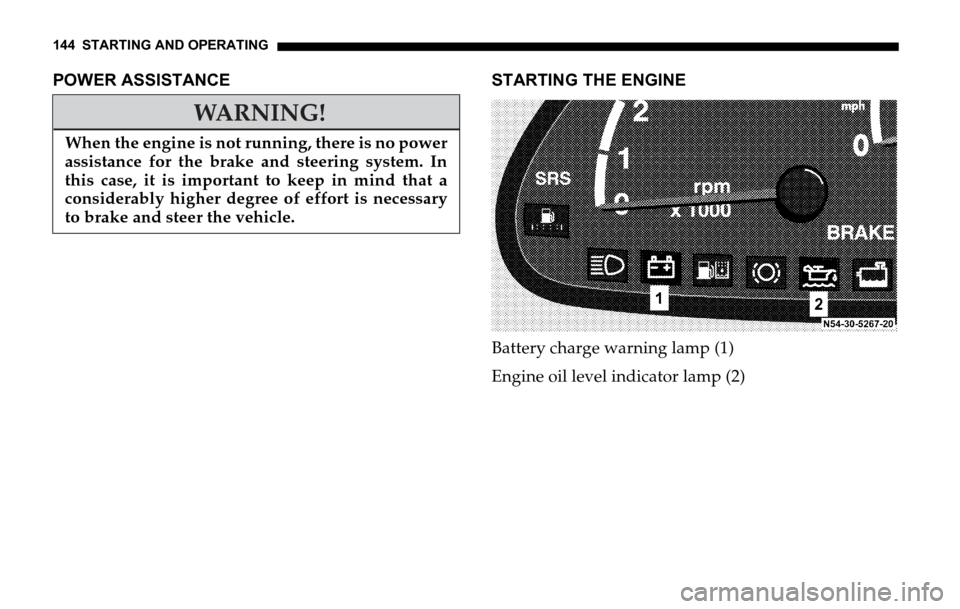
Battery charge warning lamp (1)
Engine oil level indicator lamp (2)
WARNING!
When the engine is not running, there is no power
assistance for the brake and steering system. In
this case, it is important to keep in mind that a
considerably higher degree of effort is necessary
to brake and steer the vehicle.
Page 145 of 330
STARTING AND OPERATING 145
5
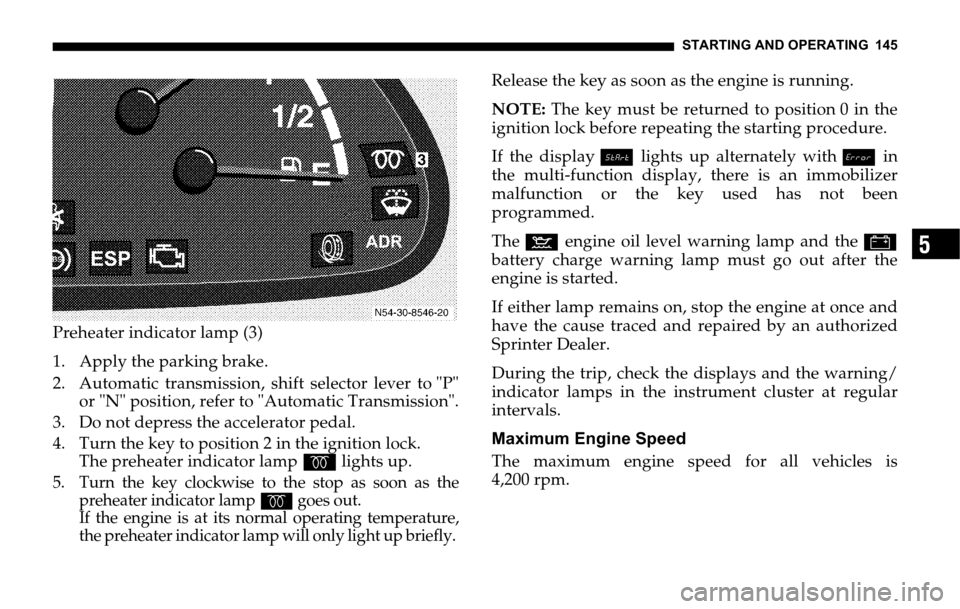
Preheater indicator lamp (3)
1. Apply the parking brake.
2. Automatic transmission, shift selector lever to "P"
or "N" position, refer to "Automatic Transmission".
3. Do not depress the accelerator pedal.
4. Turn the key to position 2 in the ignition lock.
The preheater indicator lampq lights up.
5. Turn the key clockwise to the stop as soon as the
preheater indicator lamp
q goes out.
If the engine is at its normal operating temperature,
the preheater indicator lamp will only light up briefly.
Release the key as soon as the engine is running.
NOTE: The key must be returned to position 0 in the
ignition lock before repeating the starting procedure.
If the displayÁ lights up alternately withî in
the multi-function display, there is an immobilizer
malfunction or the key used has not been
programmed.
The: engine oil level warning lamp and the#
battery charge warning lamp must go out after the
engine is started.
If either lamp remains on, stop the engine at once and
have the cause traced and repaired by an authorized
Sprinter Dealer.
During the trip, check the displays and the warning/
indicator lamps in the instrument cluster at regular
intervals.
Maximum Engine Speed
The maximum engine speed for all vehicles is
4,200 rpm.
Page 202 of 330

202 STARTING AND OPERATING
Kilopascal (kPa)
Themetric unit for air pressure. There are 6.9 kPa to 1
psi; another metric unit for air pressure is bars. There
are 100 kilopascals (kPa) to 1 bar.
Maximum Load Rating
The maximum load in kilograms and pounds that can
be carried by the tire.
Maximum Loaded Vehicle Weight
The sum of curb weight, accessory weight, vehicle
capacity weight and production options weight.
Maximum Tire Inflation Pressure
This number is the greatest amount of air pressure that
should ever be put in the tire under normal driving
conditions.
Normal Occupant Weight
The number of occupants the vehicle is designed to
seat, multiplied by 68 kilograms (150 lbs).
Occupant Distribution
The distribution of occupants in a vehicle at their
designated seating positions.Production Options Weight
The combined weight of those installed regular
production options weighing over 5 lbs (2.3 kilograms)
in excess of those standard items which they replace,
not previously considered in curb weight or accessory
weight, including heavy duty brakes, ride levelers,
roof rack, heavy duty battery, and special trim.
PSI (Pounds per Square Inch)
A standard unit of measure for air pressure. Another
metric unit for air pressure is bars or kilopascal (kPa).
Recommended Tire Inflation Pressure
Recommended tire inflation pressure listed on Tire
and Loading Information placard on the driver’s door
B-pillar for normal driving conditions. Provides best
handling, tread life and riding comfort.
Rim
A metal support for a tire or a tire and tube assembly
upon which the tire beads are seated.
Sidewall
The portion of a tire between the tread and the bead.
Page 214 of 330
214 STARTING AND OPERATING
BLEEDING DIESEL FUEL SYSTEM
If the fuel tank was run empty, the diesel fuel system
must be bled after refueling before starting the engine.
Turn the key in the ignition lock to position 2 for at
least 30 seconds.
Return the key to position 0.
Start the engine three to four times.
The malfunction indicator light (MIL) ± must go
out.
NOTE: Too many attempts to start the engine could
drain the battery. If the engine does not start after
several attempts, consult an authorized Sprinter
Dealer.DRAINING FUEL FILTER WITH WATER
SEPARATOR
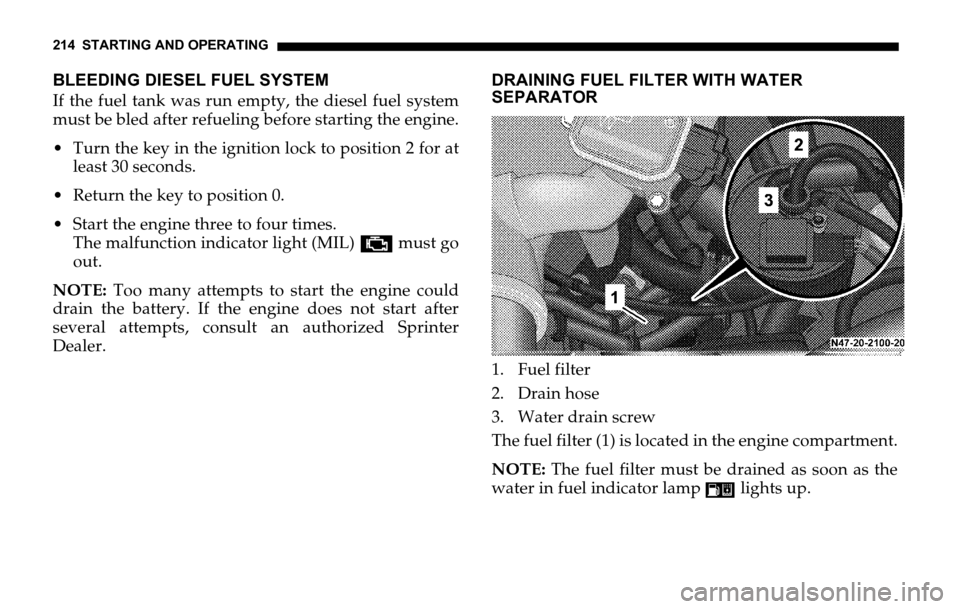
1. Fuel filter
2. Drain hose
3. Water drain screw
The fuel filter (1) is located in the engine compartment.
NOTE: The fuel filter must be drained as soon as the
water in fuel indicator lamp lights up.
Page 216 of 330

216 STARTING AND OPERATING
Bleeding the Diesel Fuel System
The diesel fuel system must be bled before starting the
engine.
Turn the key in the ignition lock position 2 for at
least 30 seconds.
Return the key to position 0.
Start the engine three to four times. The engine
control unit indicator lamp± must go out.
NOTE: Too many attempts to start the engine could
drain the battery. If the engine does not start after
several attempts, consult an authorized Sprinter
Dealer.PERMISSIBLE ROOF LOAD
The maximum permissible roof load is:
Vehicles with low roof 660 lbs (300 kg)
Vehicles with high roof 330 lbs (150 kg)
The weight of any load carried on the roof,
including the roof rack, must not exceed the
maximum permissible roof load.
LOADING THE VEHICLE
Two labels on the vehicle show how much weight it
may properly carry.
The Tire and Loading Information placard can be
found on the driver’s door B-pillar. This placard
tells you important information about the number
of people that can be in the vehicle and the total
weight that can be carried in the vehicle. It also
contains information on the proper size and
recommended tire inflation pressures for the
original equipment tires on the vehicle.
The Certification Label can be found below the
driver’s seat on an outward facing position of the
mounting pillar. It tells you about the gross weight
Page 246 of 330
246 WHAT TO DO IN EMERGENCIES
JUMP STARTING
If the battery is dead, the engine can be started with
jumper cables from another vehicle’s battery.
WARNING!
After changing a wheel, you must, for safety reasons,
have the specified tightening torque checked. The
wheels could otherwise work loose.
check the tire inflation pressure and correct it if
necessary.
retighten the wheel bolts and wheel nuts to the
specified tightening torque once the vehicle has
been driven for 30 miles (50 km). If new or
repainted wheels are fitted, the wheel bolts or nuts
must be retightened again after about 600 to 3,000
miles (about 1,000 to 5,000 km).
have a reversed direction of tire rotation corrected
as soon as possible at a qualified specialist
workshop. The vehicle handling characteristics
could otherwise be affected.WARNING!
A battery will produce hydrogen gas, which is
flammable and very explosive. Avoid open flames
and the formation of sparks in the vicinity of the
batteries. Refrain from smoking or cell phone use.
Avoid improper connection of jumper cables.
Observe safety precautions when handling
batteries.
Exercise care near moving engine components and
electrical cables.
Failure to follow these directions will cause
damage to the electronic components and can lead
to a battery explosion and severe injury or death.
Page 247 of 330
WHAT TO DO IN EMERGENCIES 247
6
A dead battery can freeze at a temperature of 14°F
(–10°C). Never try to start the engine if the battery
is frozen. Thaw the battery out first.
Only use a battery of the same rated voltage and of
approximately the same capacity for jump-starting.
The two vehicles must not touch.
Switch off all electrical accessories.
Run the vehicle with the booster battery at idle.
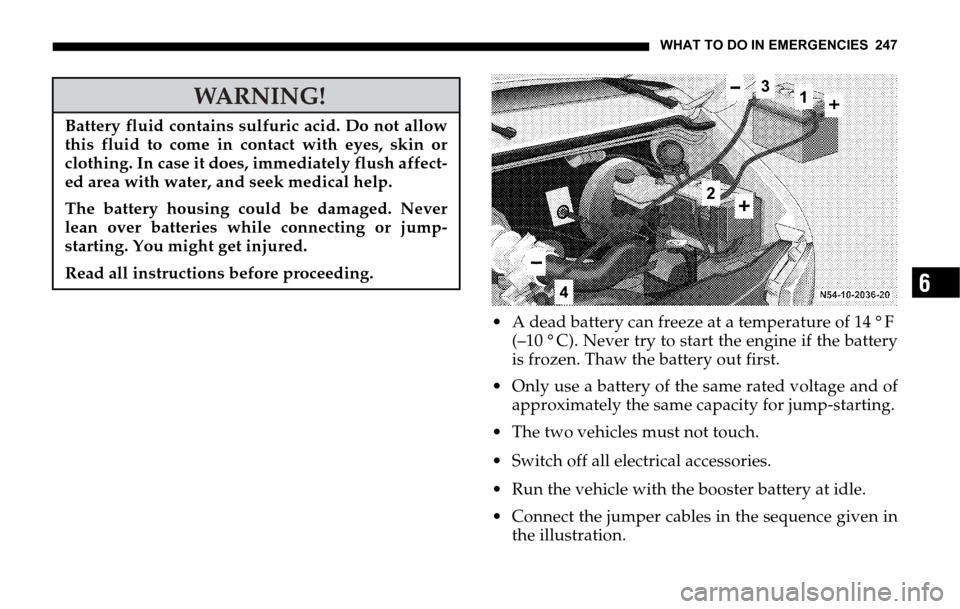
Connect the jumper cables in the sequence given in
the illustration.
WARNING!
Battery fluid contains sulfuric acid. Do not allow
this fluid to come in contact with eyes, skin or
clothing. In case it does, immediately flush affect-
ed area with water, and seek medical help.
The battery housing could be damaged. Never
lean over batteries while connecting or jump-
starting. You might get injured.
Read all instructions before proceeding.
Page 248 of 330
248 WHAT TO DO IN EMERGENCIES
1. First connect the positive terminals of the two
batteries (see illustration, Items 1 + 2). Start with the
booster battery.
2. Then connect the negative terminal of the vehicle
with the booster battery to a vehicle ground point
of the vehicle with the discharged battery, such as
to the engine block (see illustration, Items 3 + 4).
Start with the booster battery.
3. Start the engine in the customary manner.
4. Allow the engine to run for a short time.
5. Before disconnecting the jumper cables from the
vehicle with the booster battery, switch on an
electrical consumer (e.g. the blower, but not the
lamps).
6. Disconnect the jumper cables in the reverse order to
that in which they were connected.
7. Disconnect the jumper cable from negative
terminal and vehicle ground point first (see
illustration, items 3 + 4), then from positive
terminals of the batteries (see illustration 1 + 2).
NOTE: Never try to start the engine with the aid of a
battery quick-charge unit.TOWING THE VEHICLE
Page 251 of 330

MAINTAINING YOUR VEHICLE
7
CONTENTS
Q Engine Compartment . . . . . . . . . . . . . . . . . . . . . . . 253
Q Sprinter Original Parts . . . . . . . . . . . . . . . . . . . . . . 255
Q Service Products . . . . . . . . . . . . . . . . . . . . . . . . . . . 255
…Disposal of Service Products . . . . . . . . . . . . . . 256
Q Emission Related Component Warranty
Statement . . . . . . . . . . . . . . . . . . . . . . . . . . . . . . . . 256
Q Regular Checks . . . . . . . . . . . . . . . . . . . . . . . . . . . . 256
…Windshield Washer System Fluid Reservoir . 257
…Air Filter Restriction Indicator (Optional) . . . 258
…Approved Engine Oils . . . . . . . . . . . . . . . . . . . . 258
…Engine Oil Level . . . . . . . . . . . . . . . . . . . . . . . . 259
…Ribbed V-Belt . . . . . . . . . . . . . . . . . . . . . . . . . . . 260
…Hydraulic Brake System, Clutch
Mechanism Fluid Level . . . . . . . . . . . . . . . . . . . 261
…Brake fluid . . . . . . . . . . . . . . . . . . . . . . . . . . . . . . 261
…Engine Cooling System . . . . . . . . . . . . . . . . . . . 261
…Engine Coolant . . . . . . . . . . . . . . . . . . . . . . . . . . 262
…Checking Coolant Level . . . . . . . . . . . . . . . . . . 263
Q Winter Operation . . . . . . . . . . . . . . . . . . . . . . . . . . 265
Q Batteries . . . . . . . . . . . . . . . . . . . . . . . . . . . . . . . . . . 265
…Disconnecting the Battery . . . . . . . . . . . . . . . . . 266
…Reconnecting the Battery . . . . . . . . . . . . . . . . . . 266
…Charging the Battery . . . . . . . . . . . . . . . . . . . . . 267
Q Replacing Wiper Blades . . . . . . . . . . . . . . . . . . . . . 268
…Appearance Care and Corrosion Protection . 269
…Power Washer . . . . . . . . . . . . . . . . . . . . . . . . . . . 271
…Automatic Car Wash . . . . . . . . . . . . . . . . . . . . . 271
…Tar Stains . . . . . . . . . . . . . . . . . . . . . . . . . . . . . . . 272
…Paintwork, Painted Body Components . . . . . . 272
…Engine Cleaning . . . . . . . . . . . . . . . . . . . . . . . . . 272
…Vehicle Washing . . . . . . . . . . . . . . . . . . . . . . . . . 272
…Ornamental Moldings . . . . . . . . . . . . . . . . . . . . 273