tow DODGE SPRINTER 2006 1.G User Guide
[x] Cancel search | Manufacturer: DODGE, Model Year: 2006, Model line: SPRINTER, Model: DODGE SPRINTER 2006 1.GPages: 330, PDF Size: 10.82 MB
Page 170 of 330

170 STARTING AND OPERATING
Acceleration Skid Control (ASR)
ASR makes it possible to pull away and accelerate on a
slippery surface. A spinning wheel is braked and its
tractive power is transferred to the wheel with full
grip.
The acceleration skid control (ASR) improves driving
stability at all speeds only on vehicles of the chassis
and cargo/passenger vans type 3500 C/HC/SHC
(without ESP
®).
The engine’s torque is limited to improve driving
stability. When this is happening, the warning
lampv in the speedometer flashes.
If the road surface is not capable of providing traction,
bearing in mind the tires, load and grade, it may not be
possible to pull away even with ASR.
If wheels with tires of a different size than those offered
by an authorized Sprinter Dealer are used, the correct
operation of the ASR cannot be guaranteed.
WARNING!
ASR cannot prevent the natural laws of physics
from acting on the vehicle, nor can it increase the
traction afforded.
The ASR cannot prevent accidents, including
those resulting from excessive speed in turns,
following another vehicle too closely, or
hydroplaning. Only a safe, attentive, and skillful
driver can prevent accidents.
The capabilities of an ASR equipped vehicle must
never be exploited in a reckless or dangerous
manner which could jeopardize the user’s safety
or the safety of others.
If the ASR function is used for a prolonged period
of time, the rear axle brakes may fail due to
overheating.
If the vehicle is to be towed away with the front
wheels clear of the ground, or if the brakes are to
be tested on a brake dynamometer, do not pull the
key in position 2 in the ignition lock, because the
drive wheels could lock.
Page 175 of 330
STARTING AND OPERATING 175
5
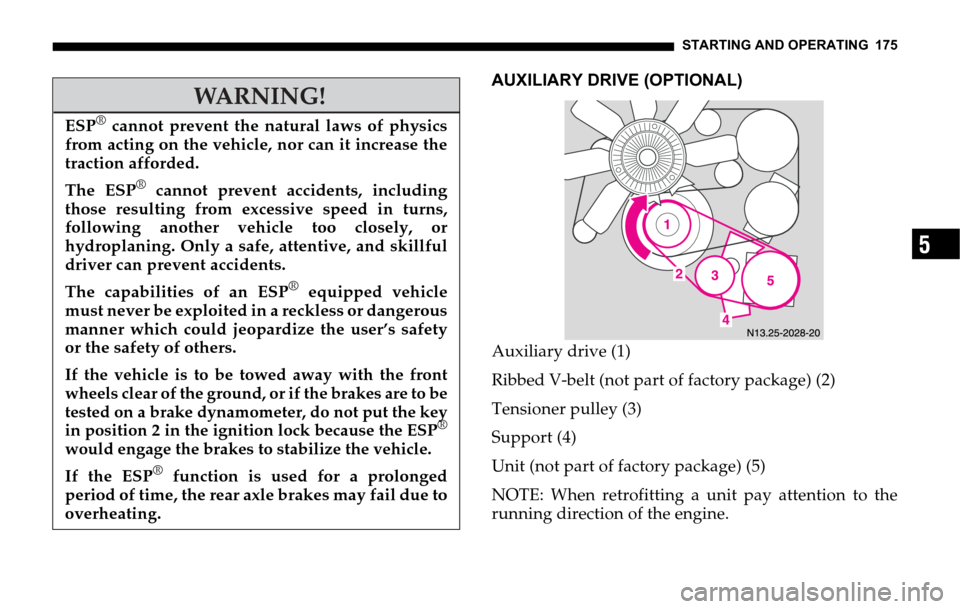
AUXILIARY DRIVE (OPTIONAL)
Auxiliary drive (1)
Ribbed V-belt (not part of factory package) (2)
Tensioner pulley (3)
Support (4)
Unit (not part of factory package) (5)
NOTE: When retrofitting a unit pay attention to the
running direction of the engine.
WARNING!
ESP® cannot prevent the natural laws of physics
from acting on the vehicle, nor can it increase the
traction afforded.
The ESP
® cannot prevent accidents, including
those resulting from excessive speed in turns,
following another vehicle too closely, or
hydroplaning. Only a safe, attentive, and skillful
driver can prevent accidents.
The capabilities of an ESP
® equipped vehicle
must never be exploited in a reckless or dangerous
manner which could jeopardize the user’s safety
or the safety of others.
If the vehicle is to be towed away with the front
wheels clear of the ground, or if the brakes are to be
tested on a brake dynamometer, do not put the key
in position 2 in the ignition lock because the ESP
®
would engage the brakes to stabilize the vehicle.
If the ESP® function is used for a prolonged
period of time, the rear axle brakes may fail due to
overheating.
Page 183 of 330
STARTING AND OPERATING 183
5
If a tire does not have an arrow on the sidewall
indicating the direction of rotation, the wheel can be
mounted either way.
NOTE: The Tire Identification Number (TIN) must
always be visible on the outboard side of the tire.
Treadwear indicators (TWI) are required by law. These
indicators are located in six places on the tread
circumference and become visible at a tread depth of
approximately 1/16 in (1.6 mm), at which point the tire
is considered worn and should be replaced.
The treadwear indicator appears as a solid band across
the tread.
WARNING!
Spare wheels may be mounted against the direc-
tion of rotation (spinning) even with a unidirec-
tional tire for temporary use only until the regular
drive wheel has been repaired or replaced.
Always observe and follow applicable temporary
use restrictions and speed limitations indicated
on the spare wheel.
Have a spare wheel that was mounted against the
direction of rotation replaced with a regular road
wheel as soon as possible.
WARNING!
If you feel a sudden significant vibration or ride
distubance, or you suspect that possible damage
to your vehicle has occurred, you should turn on
the hazard warning flashers, carefully slow down,
and drive with caution to an area which is a safe
distance from the road.
Inspect the tires and the vehicle underbody for
possible damage. If the vehicle or tires appear
unsafe, have the vehicle towed to the nearest
authorized Sprinter dealer or tire dealer for
repairs.
Page 219 of 330

STARTING AND OPERATING 219
5
Step 1
Locate the statement "The combined weight of
occupants and cargo should never exceed XXX kg or
XXX lbs." on your vehicle’s placard.
Step 2
Determine the combined weight of the driver
andpassengers that will be riding in your vehicle.
Step 3
Subtract the combined weight of the driver and
passengers from XXX kilograms or XXX lbs.
Step 4
The resulting figure equals the available amount of
cargo and luggage load capacity. For example, if the
"XXX" amount equals 1400 lbs. and there will be five
150 lbs. passengers in your vehicle, the amount of
available cargo and luggage load capacity is 650 lbs.
(1400 – 750 (5 x 150) = 650 lbs.)
Step 5
Determine the combined weight of luggage and
cargo being loaded on the vehicle. That weight may
not safely exceed the available cargo and luggage
load capacity calculated in step 4.Step 6 (if applicable)
If your vehicle will be towing a trailer, load from
your trailer will be transferred to your vehicle.
Refer to "Trailer Tongue Load" to determine how
this reduces the available cargo and luggage load
capacity of your vehicle.
The following table shows examples on how to
calculate total load, cargo load and towing capacities
with varying seating configurations and number and
size of occupants.
The following examples use a load limit of 1500 lbs.
NOTE: This is for illustration purposes only. Make
sure you are using the actual load limit for your vehicle
stated on the vehicle’s Tire and Loading Information
placard.
Page 221 of 330

STARTING AND OPERATING 221
5
Certification Label
Even after careful determination of the combined
weight of all occupants, cargo and the trailer tongue
load (if applicable) as to not exceed the permissible
load limit, you must make sure that your vehicle never
exceeds the Gross VehicleWeight Rating (GVWR) and
the Gross Axle Weight Rating (GAWR) for either the
front or rear axle.
Under a maximum loaded vehicle condition, gross axle
weight ratings (GAWR’s) for the front and rear axles
must not be exceeded.
To determine the maximum loading conditions of your
vehicle, locate the statement "The combined weight of
occupants and cargo should never exceed XXX kg or
XXX lbs." on the Tire and Loading Information placard.
The combined weight of occupants, cargo/luggage
and trailer tongue weight (if applicable) should never
exceed the weight referenced here.
You can obtain the GVWR and GAWR from the
Certification label. The Certification Label can be
found below the driver’s seat on an outward facing
position of the mounting pillar. For more information on the trailer tongue load, refer
to "Trailer Tongue Load".
TRAILER TOWING
WARNING!
Failure to use proper equipment and driving tech-
nique can result in a loss of vehicle control when
towing a trailer.
Improper towing or failure to follow the
instructions contained in this guide can result in
serious injury. Follow the guidelines below
carefully to assure safe trailer operation.
Ask your authorized Sprinter Dealer, if you
require an explanation of information contained
in this guide.
Page 223 of 330

STARTING AND OPERATING 223
5
Gross Trailer Weight (GTW) is the maximum
permissible trailer weight to be towed:
5,000 lbs. (2,260 kgs)
Trailer Tongue Weight Rating (TWR) is the maximum
permissible weight of the trailer tongue: 500 lbs. (225 kgs)
limit for Sprinter approved hitch receiver.
NOTE: The GVWR and GAWR of your vehicle is
indicated on the Certification Label.
Trailer Tongue Load
The tongue load (tongue weight at the hitch ball) of any
trailer is an important weight tomeasure because it
affects the load you can carry in your vehicle. If a trailer
is towed, the tongue load must be added to the weight
of all occupants riding and any cargo you are carrying
in the vehicle to prevent exceeding your Sprinter tow
vehicle’s rear GAWR. The tongue load typically is
between 10 % and 15 % of the trailer weight and
everything loaded in it.
For example, if the trailer tongue load equals 140 lbs.
and the determined available cargo/luggage and
trailer tongue weight equals 750 lbs., the amount of
available cargo and luggage load capacity is 610 lbs.
(750 – 140 = 610 lbs.)Loading a Trailer
When loading a trailer, you should observe that
neither the permissible GTW, nor the GVWR are
exceeded.
Maximum permissible values are listed on the safety
compliance certification labels for the vehicle and for
the trailer to be towed. The lowest value listed must be
selected when determining how the vehicle and trailer
are loaded.
Load the trailer in such a manner that it has a tongue
weight (TW) between 10% and 15% of the GTW.
The tongue weight at the hitch ball must be added to
the GVW to prevent exceeding your Sprinter tow
vehicle’s rear GAWR.
Page 224 of 330

224 STARTING AND OPERATING
Checking Weights of Vehicle and Trailer
To assure that the tow vehicle and trailer are in
compliance with the maximum permissible weight
limits, and to know the actual weights, have the loaded
vehicle-trailer combination (tow vehicle including
driver, passengers and cargo, trailer fully loaded)
weighed on a commercial scale.
Check the vehicle’s front and rear Gross Axle Weight
(GAW), the GTW and TW. The values as measured
must not be exceeded, according to the weight listed
under “Vehicle and trailer weight and ratings”.
Attaching a Trailer
Please observe maximum permitted trailer dimensions
(width and length).
Most states and all Canadian provinces require safety
chains between your tow vehicle and the trailer. The
chains should be crisscrossed under the trailer tongue.
They must be attached to the hitch receiver, and not to
the vehicle’s bumper or axle. Be sure to leave enough
slack in the chains to permit turning corners.
Most states and all Canadian provinces require a
separate brake system at various trailer weights.
WARNING!
Do not connect a trailer brake system (if trailer is
so equipped) directly to the vehicle’s hydraulic
brake system as your vehicle is equipped with an-
tilock brakes. If you do, neither the vehicle’s
brakes nor the trailer’s brakes will function prop-
erly. This could cause an accident resulting in
property damage, injury or death to you or others.
The provided vehicle electrical wiring harness for
trailer towing has a brake signal wire for hook-up
to a brake controller.
Most states and all Canadian provinces require a
break-away switch on trailers with a separate
brake system. The switch activates the trailer
brakes in the possible event that the trailer might
separate from the tow vehicle.
You should consider using a trailer sway control
system. For further information see your
authorized Sprinter Dealer.
Page 225 of 330

STARTING AND OPERATING 225
5
Towing a Trailer
There are many different laws, including speed limit
restrictions, having to do with trailer towing. Make
sure that your vehicle-trailer combination will be legal,
not only for where you reside, but also for where you
will be driving. A good source for this information can
be the police or local authorities.
Before you start driving with the trailer, check the
trailer hitch, break-away switch, safety chains,
electrical connections, lighting and tires. Also adjust
the mirrors to permit unobstructed view beyond rear
of trailer.
If the trailer has electric brakes, start your vehicle and
trailer moving slowly, and then apply only the trailer
brake controller by hand to be sure the brakes are
working properly.
When towing a trailer, check occasionally to be sure
that the load is secure, and that lighting and trailer
brakes (if so equipped) are functioning properly.
Always secure items in the trailer to prevent load shifts
while driving.Take into consideration that when towing a trailer, the
handling characteristics are different and less stable
from those when operating the vehicle without a
trailer. It is important to avoid sudden maneuvers. The
vehicle and trailer combination is heavier, and
therefore is limited in acceleration and climbing ability,
and requires longer stopping distances. It is more
prone to reacting to side wind gusts, and requires more
sensitive steering input.
In order to gain skill and an understanding of the
vehicle’s behavior, you should practice turning, stopping
and backing up in an area which is free from traffic.
If possible, do not brake abruptly, but rather engage
the brake slightly at first to permit the trailer to activate
its brake. Then increase the braking force.
Page 226 of 330
226 STARTING AND OPERATING
WARNING!
Take into consideration that when towing a trail-
er, the handling characteristics are different and
less stable from those when operating the vehicle
without a trailer.
It is important to avoid sudden maneuvers.
Sudden maneuvers may lead to loss of control
over the vehicle-trailer combination. This could
cause an accident resulting in property damage or
injury to you or others.
CAUTION!
If the transmission hunts between gears on
inclines, manually shift to a lower gear (select
"4",
"3", "2" or"1"). A lower gear and reduction of
speed reduces the chance of engine overloading
and / or overheating.
When going down a long hill, shift into a lower
gear and use the engine’s braking effect. Avoid
riding the brakes, thus overheating the vehicle
and trailer brakes.
If the engine coolant rises to an extremely high
temperature (coolant temperature needle
approaching the red zone) when the air
conditioner is on, turn off the air conditioner.
Engine coolant heat can be additionally vented by
opening the windows, switching the climate
control fan speed to high and setting the
temperature control to the maximum hot position.
Page 227 of 330
STARTING AND OPERATING 227
5
Parking a TrailerCAUTION!
Extreme care must be exercised since your vehicle
with a trailer will require additional passing
distance ahead than when driving without a
trailer. Because your vehicle and trailer is longer
than your vehicle alone, you will also need to go
much farther ahead of the passed vehicle before
you can return to your lane.WARNING!
To reduce the risk of personal injury, or damage to
the vehicle powertrain, as a result of vehicle/trail-
er movement, always:
Keep right foot on brake pedal.
Shift gear selector lever to position
"N".
Have a second person place wheel chocks on
downhill side of left and right trailer wheels.
Slowly release brake pedal and let vehicle and
trailer roll into chocks until stopped.
Firmly depress parking brake pedal.
Move gear selector lever to position
"P".
On inclines turn front wheels towards the road
curb.