weight DODGE SPRINTER 2006 1.G User Guide
[x] Cancel search | Manufacturer: DODGE, Model Year: 2006, Model line: SPRINTER, Model: DODGE SPRINTER 2006 1.GPages: 330, PDF Size: 10.82 MB
Page 204 of 330

204 STARTING AND OPERATING
Vehicle Capacity Weight
Rated cargo and luggage load plus 68 kilograms (150
lbs) times the vehicle’s designated seating capacity.
Vehicle Maximum Load on the Tire
Load on an individual tire that is determined by
distributing to each axle its share of the maximum
loaded vehicle weight and dividing it by two.
Rotating Tires
Tires on the front and rear axles of vehicles operate at
different loads and perform different steering, driving
and braking functions. For these reasons, they wear at
unequal rates, and develop irregular wear patterns.
These effects can be reduced by timely rotation of tires.
The benefits of rotation are especially worthwhile with
aggressive tread designs such as those on On/Off
Road type tires. Rotation will increase tread life, help tomaintain mud, snow, and wet traction levels, and
contribute to a smooth, quiet ride.
If applicable to your vehicle's tire configuration, tires
can be rotated according to the tire manufacturer’s
recommended intervals in the tire manufacturer’s
warranty pamphlet located in your vehicle literature
portfolio. If none is available, tires should be rotated
every 10000 miles (16000 km), or sooner if necessary,
according to the degree of tire wear.
The same rotation (spinning) direction must be
maintained when fitted, see "Direction of Rotation".
Rotate tires before the characteristic tire wear pattern
becomes visible (shoulder wear on front tires and
treadcenter wear on rear tires).
The reasons for any rapid or unusual wear should be
corrected prior to rotation being performed.
Thoroughly clean the mounting face of wheels and
brake disks, i.e. the inner side of the wheels/tires,
during each rotation. Check for and ensure proper tire
inflation pressure, refer to "Recommended Tire
Inflation Pressure".
WARNING!
Rotate front and rear wheels only if the tires are of
the same dimension.
Page 210 of 330

210 STARTING AND OPERATING
If diesel fuels are used with a sulphur content
exceeding 0.5 % by weight, engine oil change intervals
must be shortened. Please contact your Sprinter Dealer
to obtain the necessary information.
Refueling from drums or canisters may lead to the fuel
becoming contaminated. This in turn can cause faults
in the fuel system. Always filter the fuel before adding
it to the vehicle’s tank.Fuel Filter with Water Separator
Check the water separator when the fuel indicator
lamp does not go out or comes on while the engine
is running.
The interval for changing the fuel filter is reduced to
10,000 miles (about 15,000 km).
WARNING!
Under no circumstances should gasoline be mixed
with diesel fuel.
Due to the high pressure and high temperature in
the injection system, there is a risk of fire and
explosion.
In addition, there is a risk of engine damage.
Always follow basic safety rules when working
with any combustible material.
Page 216 of 330

216 STARTING AND OPERATING
Bleeding the Diesel Fuel System
The diesel fuel system must be bled before starting the
engine.
Turn the key in the ignition lock position 2 for at
least 30 seconds.
Return the key to position 0.
Start the engine three to four times. The engine
control unit indicator lamp± must go out.
NOTE: Too many attempts to start the engine could
drain the battery. If the engine does not start after
several attempts, consult an authorized Sprinter
Dealer.PERMISSIBLE ROOF LOAD
The maximum permissible roof load is:
Vehicles with low roof 660 lbs (300 kg)
Vehicles with high roof 330 lbs (150 kg)
The weight of any load carried on the roof,
including the roof rack, must not exceed the
maximum permissible roof load.
LOADING THE VEHICLE
Two labels on the vehicle show how much weight it
may properly carry.
The Tire and Loading Information placard can be
found on the driver’s door B-pillar. This placard
tells you important information about the number
of people that can be in the vehicle and the total
weight that can be carried in the vehicle. It also
contains information on the proper size and
recommended tire inflation pressures for the
original equipment tires on the vehicle.
The Certification Label can be found below the
driver’s seat on an outward facing position of the
mounting pillar. It tells you about the gross weight
Page 217 of 330

STARTING AND OPERATING 217
5
capacity of your vehicle, called the Gross Vehicle
Weight Rating (GVWR). The GVWR includes the
weight of the vehicle, all occupants, fuel and cargo.
The Certification Label also tells you about the front
and rear axle weight capacity, called the Gross Axle
Weight Rating (GAWR). The GAWR is the total
allowable weight that can be carried by a single axle
(front or rear). Never exceed the GVWR or GAWR
for either the front axle or rear axle.
Following is a discussion on how to work with the
information contained on the two placards with
regards to loading your Sprinter vehicle.Tire and Loading Information
WARNING!
Do not overload the tires by exceeding the speci-
fied load limit as indicated on the Tire and Load-
ing Information placard on the driver’s door B-
pillar. Overloading the tires can overheat them,
possibly causing a blowout. Overloading the tires
can also result in handling or steering problems,
or brake failure.
Overloading of tires is dangerous. Overloading
can cause tire failure, affect vehicle handling, and
increase the stopping distance. Use tires of the
recommended load capacity for the vehicle. Never
overload them.
The vehicle maximum load on the tire must not
exceed the load carrying capacity of the tire on
your vehicle. You will not exceed the tire’s load
carrying capacity if you adhere to the loading
conditions, tire size and cold tire inflation
pressures specified on the Tire and Loading
Information placard and this section.
Page 218 of 330
218 STARTING AND OPERATING
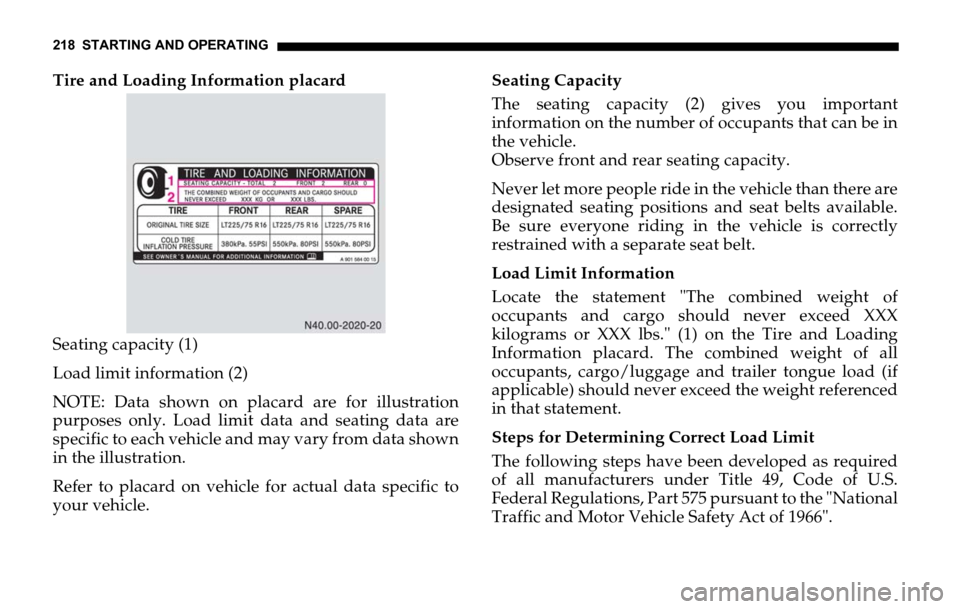
Tire and Loading Information placard
Seating capacity (1)
Load limit information (2)
NOTE: Data shown on placard are for illustration
purposes only. Load limit data and seating data are
specific to each vehicle and may vary from data shown
in the illustration.
Refer to placard on vehicle for actual data specific to
your vehicle.Seating Capacity
The seating capacity (2) gives you important
information on the number of occupants that can be in
the vehicle.
Observe front and rear seating capacity.
Never let more people ride in the vehicle than there are
designated seating positions and seat belts available.
Be sure everyone riding in the vehicle is correctly
restrained with a separate seat belt.
Load Limit Information
Locate the statement "The combined weight of
occupants and cargo should never exceed XXX
kilograms or XXX lbs." (1) on the Tire and Loading
Information placard. The combined weight of all
occupants, cargo/luggage and trailer tongue load (if
applicable) should never exceed the weight referenced
in that statement.
Steps for Determining Correct Load Limit
The following steps have been developed as required
of all manufacturers under Title 49, Code of U.S.
Federal Regulations, Part 575 pursuant to the "National
Traffic and Motor Vehicle Safety Act of 1966".
Page 219 of 330

STARTING AND OPERATING 219
5
Step 1
Locate the statement "The combined weight of
occupants and cargo should never exceed XXX kg or
XXX lbs." on your vehicle’s placard.
Step 2
Determine the combined weight of the driver
andpassengers that will be riding in your vehicle.
Step 3
Subtract the combined weight of the driver and
passengers from XXX kilograms or XXX lbs.
Step 4
The resulting figure equals the available amount of
cargo and luggage load capacity. For example, if the
"XXX" amount equals 1400 lbs. and there will be five
150 lbs. passengers in your vehicle, the amount of
available cargo and luggage load capacity is 650 lbs.
(1400 – 750 (5 x 150) = 650 lbs.)
Step 5
Determine the combined weight of luggage and
cargo being loaded on the vehicle. That weight may
not safely exceed the available cargo and luggage
load capacity calculated in step 4.Step 6 (if applicable)
If your vehicle will be towing a trailer, load from
your trailer will be transferred to your vehicle.
Refer to "Trailer Tongue Load" to determine how
this reduces the available cargo and luggage load
capacity of your vehicle.
The following table shows examples on how to
calculate total load, cargo load and towing capacities
with varying seating configurations and number and
size of occupants.
The following examples use a load limit of 1500 lbs.
NOTE: This is for illustration purposes only. Make
sure you are using the actual load limit for your vehicle
stated on the vehicle’s Tire and Loading Information
placard.
Page 220 of 330

220 STARTING AND OPERATING
The higher the weight of all occupants, the less cargo
and luggage load capacity is available.
For more information, refer to "Trailer Tongue Load".
ExampleCombined
weight limit of
occupants and
cargo from
placardNumber of
occupants
(driver and
passengers)Seating
configurationOccupants weightCombined
weight of all
occupantsAvailable cargo/luggage
and trailer tongue weight
(total load limit from
placard minus combined
weight of all occupants)
1 1500 lbs 5 front: 2
rear: 3Occupant 1: 150 lbs
Occupant 2: 180 lbs
Occupant 3: 160 lbs
Occupant 4: 140 lbs
Occupant 5: 120 lbs.750 lbs 1500 lbs – 750 lbs = 750 lbs
2 1500 lbs 3 front: 1
rear: 2Occupant 1: 200 lbs
Occupant 2: 190 lbs
Occupant 3: 150 lbs 540 lbs 1500 lbs – 540 lbs = 960 lbs
3 1500 lbs 1 front: 1 Occupant 1: 150 lbs 150 lbs 1500 lbs – 150 lbs = 1350 lbs
Page 221 of 330

STARTING AND OPERATING 221
5
Certification Label
Even after careful determination of the combined
weight of all occupants, cargo and the trailer tongue
load (if applicable) as to not exceed the permissible
load limit, you must make sure that your vehicle never
exceeds the Gross VehicleWeight Rating (GVWR) and
the Gross Axle Weight Rating (GAWR) for either the
front or rear axle.
Under a maximum loaded vehicle condition, gross axle
weight ratings (GAWR’s) for the front and rear axles
must not be exceeded.
To determine the maximum loading conditions of your
vehicle, locate the statement "The combined weight of
occupants and cargo should never exceed XXX kg or
XXX lbs." on the Tire and Loading Information placard.
The combined weight of occupants, cargo/luggage
and trailer tongue weight (if applicable) should never
exceed the weight referenced here.
You can obtain the GVWR and GAWR from the
Certification label. The Certification Label can be
found below the driver’s seat on an outward facing
position of the mounting pillar. For more information on the trailer tongue load, refer
to "Trailer Tongue Load".
TRAILER TOWING
WARNING!
Failure to use proper equipment and driving tech-
nique can result in a loss of vehicle control when
towing a trailer.
Improper towing or failure to follow the
instructions contained in this guide can result in
serious injury. Follow the guidelines below
carefully to assure safe trailer operation.
Ask your authorized Sprinter Dealer, if you
require an explanation of information contained
in this guide.
Page 222 of 330

222 STARTING AND OPERATING
Trailer Hitches (Optional)
Only install a trailer hitch receiver approved for your
vehicle. For information on availability and
installation, please see your authorized Sprinter
Dealer.
The bumpers on your vehicle are not designed for use
with clamp-type hitches. Do not attach rental hitches
or other bumper-type hitches to them.
To reduce the possibility of damage, remove the hitch
ball adaptor from the receiver when not in use.
Electrical Connections (Optional)
The Sprinter is available with a variety of pre-installed
conditions (lines and turn signal indicator and brake
module installed and / or not installed). Make sure that
the correct trailer hitch receiver kit is used. For further
information, please see your authorized Sprinter
Dealer.
In order to prevent possible damage to the vehicle’s
electrical system by incorrectly installing the trailer
wiring plug, we recommend having the harness
connected at an authorized Sprinter Dealer.Vehicle and Trailer Weights and Ratings
Gross Vehicle Weight Rating (GVWR) is the maximum
permissible vehicle weight:
8,550 lbs (3,878 kgs),
9,990 lbs (4,531 kgs) or 10,200 lbs (4,627 kgs).
NOTE: The weight of your Sprinter is indicated on the
type plate. For type plate, see Identification Labels.
Gross Vehicle Weight (GVW): comprises weight of
vehicle including fuel, tools, spare wheel, installed
accessories, passengers, cargo and trailer tongue. It
must never exceed the GVWR.
Gross Axle Weight Rating (GAWR) is the maximum
permissible axle weight:
Type GVWR GAWR (FA) GAWR (RA)
2500
C/HC /
SHC8,550 lbs
3,878 kgs3,860 lbs
(1,751 kgs)5,360 lbs
(2,431 kgs)
3500
C/HC /
SHC9,990 lbs
4,531 kgs3,860 lbs
(1,751 kgs)7,060 lbs
(3,202 kgs)
10,200 lbs
4,627 kgs3,860 lbs
(1,751 kgs)7,060 lbs
(3,202 kgs)
Page 223 of 330

STARTING AND OPERATING 223
5
Gross Trailer Weight (GTW) is the maximum
permissible trailer weight to be towed:
5,000 lbs. (2,260 kgs)
Trailer Tongue Weight Rating (TWR) is the maximum
permissible weight of the trailer tongue: 500 lbs. (225 kgs)
limit for Sprinter approved hitch receiver.
NOTE: The GVWR and GAWR of your vehicle is
indicated on the Certification Label.
Trailer Tongue Load
The tongue load (tongue weight at the hitch ball) of any
trailer is an important weight tomeasure because it
affects the load you can carry in your vehicle. If a trailer
is towed, the tongue load must be added to the weight
of all occupants riding and any cargo you are carrying
in the vehicle to prevent exceeding your Sprinter tow
vehicle’s rear GAWR. The tongue load typically is
between 10 % and 15 % of the trailer weight and
everything loaded in it.
For example, if the trailer tongue load equals 140 lbs.
and the determined available cargo/luggage and
trailer tongue weight equals 750 lbs., the amount of
available cargo and luggage load capacity is 610 lbs.
(750 – 140 = 610 lbs.)Loading a Trailer
When loading a trailer, you should observe that
neither the permissible GTW, nor the GVWR are
exceeded.
Maximum permissible values are listed on the safety
compliance certification labels for the vehicle and for
the trailer to be towed. The lowest value listed must be
selected when determining how the vehicle and trailer
are loaded.
Load the trailer in such a manner that it has a tongue
weight (TW) between 10% and 15% of the GTW.
The tongue weight at the hitch ball must be added to
the GVW to prevent exceeding your Sprinter tow
vehicle’s rear GAWR.