fuel DODGE SPRINTER 2006 1.G Owner's Manual
[x] Cancel search | Manufacturer: DODGE, Model Year: 2006, Model line: SPRINTER, Model: DODGE SPRINTER 2006 1.GPages: 330, PDF Size: 10.82 MB
Page 191 of 330
STARTING AND OPERATING 191
5
2. Economy
Improper inflation pressures can cause uneven wear
patterns to develop across the tire tread. These
abnormal wear patterns will reduce tread life resulting
in a need for earlier tire replacement. Underinflation
also increases tire rolling resistance and results in
higher fuel consumption.
3. Ride Comfort and Vehicle Stability
Proper tire inflation contributes to a comfortable ride.
Overinflation produces a jarring and uncomfortable
ride.Tire Labeling
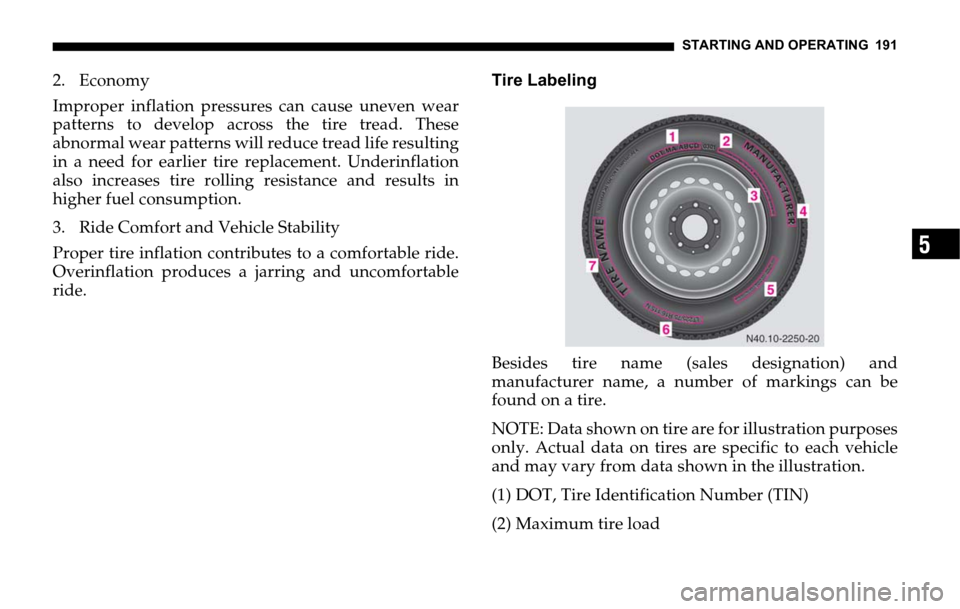
Besides tire name (sales designation) and
manufacturer name, a number of markings can be
found on a tire.
NOTE: Data shown on tire are for illustration purposes
only. Actual data on tires are specific to each vehicle
and may vary from data shown in the illustration.
(1) DOT, Tire Identification Number (TIN)
(2) Maximum tire load
Page 199 of 330
STARTING AND OPERATING 199
5
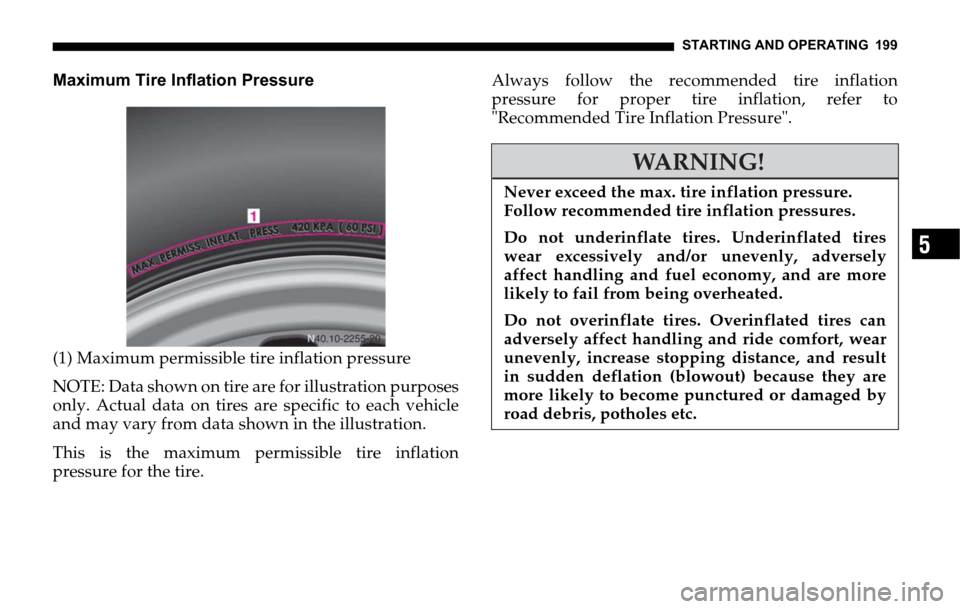
Maximum Tire Inflation Pressure
(1) Maximum permissible tire inflation pressure
NOTE: Data shown on tire are for illustration purposes
only. Actual data on tires are specific to each vehicle
and may vary from data shown in the illustration.
This is the maximum permissible tire inflation
pressure for the tire.Always follow the recommended tire inflation
pressure for proper tire inflation, refer to
"Recommended Tire Inflation Pressure".
WARNING!
Never exceed the max. tire inflation pressure.
Follow recommended tire inflation pressures.
Do not underinflate tires. Underinflated tires
wear excessively and/or unevenly, adversely
affect handling and fuel economy, and are more
likely to fail from being overheated.
Do not overinflate tires. Overinflated tires can
adversely affect handling and ride comfort, wear
unevenly, increase stopping distance, and result
in sudden deflation (blowout) because they are
more likely to become punctured or damaged by
road debris, potholes etc.
Page 201 of 330

STARTING AND OPERATING 201
5
Bead
The tire bead contains steel wires wrapped by steel
cords that hold the tire onto the rim.
Cold Tire Inflation Pressure
Tire inflation pressure when your vehicle has been
sitting for at least 3 hours or d r i v e n n o m o r e t h a n 1 m i l e
(1.6 km).
Curb Weight
The weight of a motor vehicle with standard
equipment including the maximum capacity of fuel,
oil, and coolant, and, if so equipped, air conditioning
and additional optional equipment, but without
passengers and cargo.
DOT (Department of Transportation)
A tire branding symbol which denotes the tire meets
requirements of the U.S. Department of
Transportation.
GAWR (Gross Axle Weight Rating)
The GAWR is the maximum permissible axle weight.
The gross vehicle weight on each axle must never
exceed the GAWR for the front and rear axle indicatedon the Certification Label located below the driver’s
seat on an outward facing position of the mounting
pillar.
GTW (Gross Trailer Weight)
The GTW is the weight of the trailer plus the weight of
all cargo, equipment, luggage etc. loaded on the trailer.
GVW (Gross Vehicle Weight)
The GVW comprises the weight of the vehicle
including fuel, tools, spare wheel, installed accessories,
passengers and cargo and, if applicable, trailer tongue
load. The GWV must never exceed the GWVR
indicated on the Certification Label located below the
driver’s seat on an outward facing position of the
mounting pillar.
GVWR (Gross Vehicle Weight Rating)
This is themaximum permissible vehicle weight of the
fully loaded vehicle (weight of the vehicle including all
options, passengers, fuel, and cargo and, if applicable,
trailer tongue load). It is indicated on the Certification
Label located below the driver’s seat on an outward
facing position of the mounting pillar.
Page 209 of 330

STARTING AND OPERATING 209
5
To avoid damage to your vehicle, tires or chains,
observe the following precautions:
Because of limited chain clearance between tires and
other suspension components, it is important that
only chains in good condition are used. Broken
chains can cause serious vehicle damage. Stop the
vehicle immediately if noise occurs that could
suggest chain breakage. Remove the damaged parts
of the chain before further use.
Install chains as tightly as possible and then
retighten after driving about 1/2 mile (0.8 km).
Do not exceed 30 mph (50 km/h).
Drive cautiously and avoid severe turns and large
bumps, especially with a loaded vehicle.
Do not install tire chains on front wheels.
Do not drive for a prolonged period on dry
pavement.
Observe the tire chain manufacturer’s instructions
on method of installation, operating speed, and
conditions for usage. Always use the lower
suggested operating speed of the chain
manufacturer if different than the speed
recommended by the manufacturer.FUEL REQUIREMENTS
Use only commercially available vehicular diesel fuels
No. 2 or No. 1 (ASTM D 975 No. 2-D or No. 1-D).
NOTE: Because of its better quality the manufacturer
recommends the use of commercially available
vehicular diesel fuel No. 2.
For information on cold weather operation, contact
your authorized Sprinter Dealer.
WARNING!
Marine diesel fuel, Bio diesel fuel, heating oil or
the like must not be used.
Do not blend diesel fuel with marine diesel fuel,
Bio diesel fuel or heating oil.
The use of such non-approved fuels or blending
diesel fuel may result in malfunction or cause
engine damage. Damage or malfunctions
resulting from poor fuel quality or from blending
specific fuel additives are not covered by the
Sprinter Warranty.
Page 210 of 330
210 STARTING AND OPERATING
If diesel fuels are used with a sulphur content
exceeding 0.5 % by weight, engine oil change intervals
must be shortened. Please contact your Sprinter Dealer
to obtain the necessary information.
Refueling from drums or canisters may lead to the fuel
becoming contaminated. This in turn can cause faults
in the fuel system. Always filter the fuel before adding
it to the vehicle’s tank.Fuel Filter with Water Separator
Check the water separator when the fuel indicator
lamp does not go out or comes on while the engine
is running.
The interval for changing the fuel filter is reduced to
10,000 miles (about 15,000 km).
WARNING!
Under no circumstances should gasoline be mixed
with diesel fuel.
Due to the high pressure and high temperature in
the injection system, there is a risk of fire and
explosion.
In addition, there is a risk of engine damage.
Always follow basic safety rules when working
with any combustible material.
Page 211 of 330

STARTING AND OPERATING 211
5
Diesel Fuels for Use at Very Low Temperatures
At very low temperatures the fluidity of No. 2 diesel
fuel may become insufficient due to parraffin
separation. For this reason the vehicle comes equipped
with a fuel preheater. It permits a troublefree engine
operation to a temperature of approximately 14 °F (–
10 °C) when using No. 2 diesel fuel.
To avoid malfunctions, No. 2 diesel fuel of a lowered
cloud point is marketed during the cold season.
At temperatures below 14 °F (–10 °C) use winterized or
No. 1 diesel fuel only. If not available, a certain
quantity of fuel flow improver may be added. Mixing
only to be done within the vehicle’s fuel tank.
Engine power may drop according to the proportion of
fuel flow improver. For this reason, keep percentage of
fuel flow improver added to the minimum
necessitated by the ambient temperature.
Even in extreme climatic conditions, the maximum
mixture ratio should not exceed 50%
Adding of kerosene to diesel fuel is not recommended
even at low temperatures.The following information can be used as a reference,
if adding of kerosene becomes necessary. The mixing
ratios shown refer to the total mixture.
Ambient temperature:
14 °F to –4 °F (–10 °C to –20 °C)
No. 2 Diesel Fuel: 70%
Kerosene: 30%
Ambient temperature:
below –4 °F to (–20 °C)
No. 2 Diesel Fuel: 50 %
Kerosene: 50 %
Even in extreme climatic conditions, the maximum
mixture ratio should not exceed 50 %.
Adding of kerosene to No. 1 diesel fuel is not
recommended even at low temperatures.
Do not blend other specific fuel additives with diesel
fuel except for fuel flow improver. They only result in
unnecessary cost, and may be harmful to the engine
operation.
CAUTION!
Damage or malfunctions resulting from poor fuel
quality or from blending specific fuel additives
are not covered by the Sprinter Warranty.
Page 212 of 330
212 STARTING AND OPERATING
REFUELING
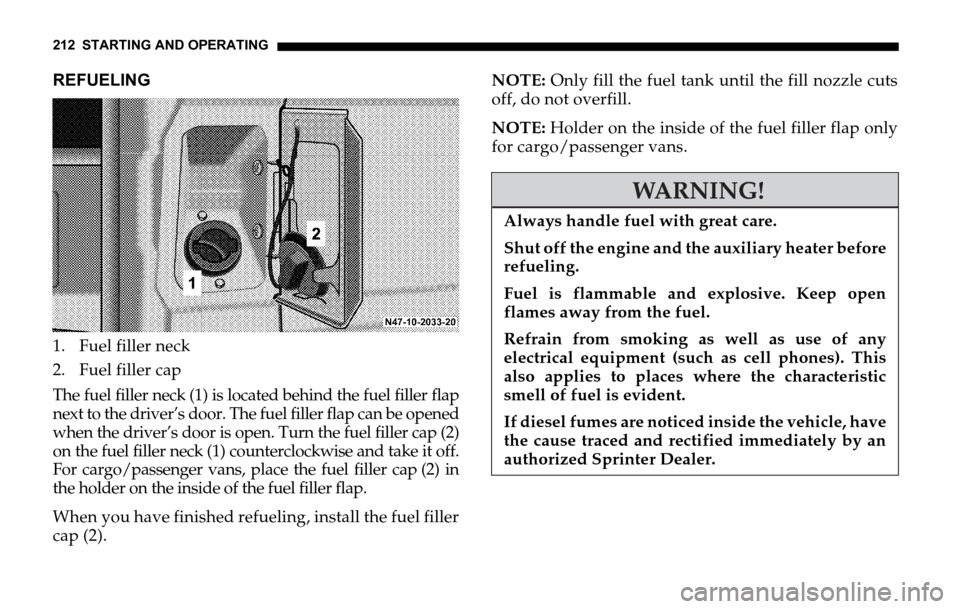
1. Fuel filler neck
2. Fuel filler cap
The fuel filler neck (1) is located behind the fuel filler flap
next to the driver’s door. The fuel filler flap can be opened
when the driver’s door is open. Turn the fuel filler cap (2)
on the fuel filler neck (1) counterclockwise and take it off.
For cargo/passenger vans, place the fuel filler cap (2) in
the holder on the inside of the fuel filler flap.
When you have finished refueling, install the fuel filler
cap (2).NOTE: Only fill the fuel tank until the fill nozzle cuts
off, do not overfill.
NOTE: Holder on the inside of the fuel filler flap only
for cargo/passenger vans.
WARNING!
Always handle fuel with great care.
Shut off the engine and the auxiliary heater before
refueling.
Fuel is flammable and explosive. Keep open
flames away from the fuel.
Refrain from smoking as well as use of any
electrical equipment (such as cell phones). This
also applies to places where the characteristic
smell of fuel is evident.
If diesel fumes are noticed inside the vehicle, have
the cause traced and rectified immediately by an
authorized Sprinter Dealer.
Page 213 of 330

STARTING AND OPERATING 213
5
Capacity
Fuel tank including reserve fuel about 26.4 US gal
(100 l).
PROGRAMMED TOP SPEED (OPTIONAL)
NOTE: The top speed of this vehicle can be
electronically limited to a speed between 19 mph
(30 km / h) and 82 mph (132 km / h). The vehicle’s
electronic speed controller should be programmed
only by a qualified technician by an authorized
Sprinter Dealer.
When programming the electronic speed controller,
the circumference of the specific tires actually mounted
on the vehicle must be determined and that
circumference must be correctly programmed into the
vehicle’s electronic speed controller. It is critical that
the correct tire circumference be programmed
accurately into the vehicle’s electronic speed
controller. Accurate tire circumference information
should be confirmed each time the electronic speed
controller is programmed and each time new wheels or
tires are mounted on the vehicle.
WARNING!
Possible tire damage resulting in serious personal
injury or death may occur if the vehicle’s electron-
ic speed controller is programmed at a speed
above the maximum speed allowed by the manu-
facturer of the specific tires mounted on the vehi-
cle. The maximum speed of the tires prescribed by
the tire manufacturer must be determined and ac-
curately programmed into the electronic speed
controller. The electronic speed controller must
never be programmed at a speed greater than the
maximum allowable tire speed as prescribed by
the manufacturer of the specific tires mounted on
the vehicle.
Page 214 of 330
214 STARTING AND OPERATING
BLEEDING DIESEL FUEL SYSTEM
If the fuel tank was run empty, the diesel fuel system
must be bled after refueling before starting the engine.
Turn the key in the ignition lock to position 2 for at
least 30 seconds.
Return the key to position 0.
Start the engine three to four times.
The malfunction indicator light (MIL) ± must go
out.
NOTE: Too many attempts to start the engine could
drain the battery. If the engine does not start after
several attempts, consult an authorized Sprinter
Dealer.DRAINING FUEL FILTER WITH WATER
SEPARATOR
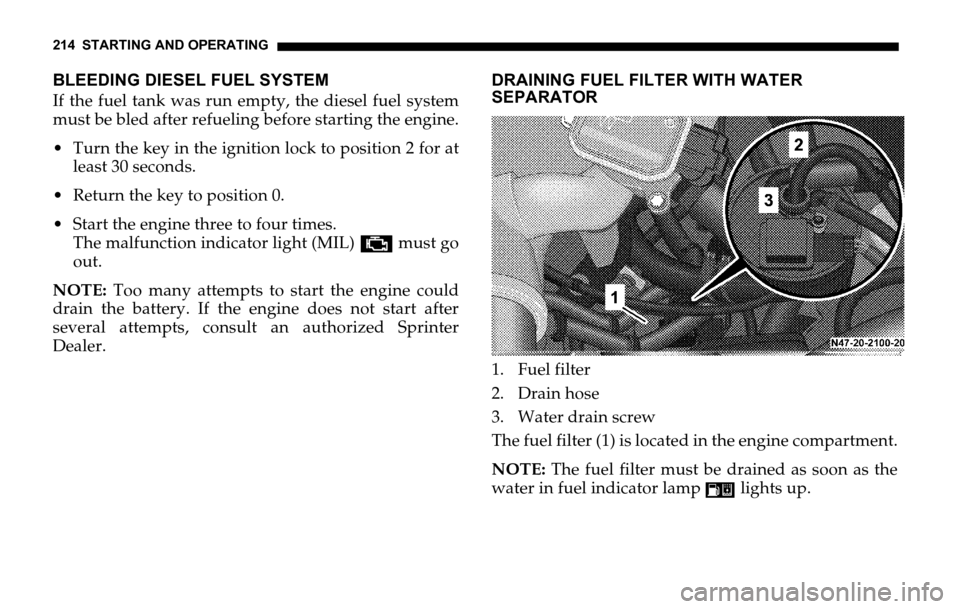
1. Fuel filter
2. Drain hose
3. Water drain screw
The fuel filter (1) is located in the engine compartment.
NOTE: The fuel filter must be drained as soon as the
water in fuel indicator lamp lights up.
Page 215 of 330
STARTING AND OPERATING 215
5
NOTE: Prior to opening water drain screw (3), place a
suitable receptacle underneath the drain hose (2). Turn
water drain screw (3) on and off only by hand.
Diesel fuels and diesel fuel mixtures must be disposed
of properly; we recommend water be drained from fuel
filters by an authorized Sprinter Dealer.
Draining Fuel Filter
Stop the engine.
Shift gear selector lever to ‘‘P’’ position.
Open the hood.
Place a suitable receptacle underneath the drain
hose (2).
Turn the key in the ignition lock to position 2. Open immediately the water drain screw (3) about 1
turn (counterclockwise) until fluid emerges. Ensure
that the fluid is collected in the receptacle.
Close the water drain screw (3) as soon as about 0.25
US qt (0.2 liters) are emerged.
After draining, return the key in the ignition lock to
position 0.
Dispose of the collected fluid in an environmentally
responsible manner.
If the filter is still saturated, drain the filter once
more.
After draining, the engine may run briefly but stall for
lack of fuel. If this occurs, bleed the system.
NOTE: Should the water in the fuel indicator lamp
still not go out after the fuel filter has been drained
twice, the cause should be examined by an authorized
Sprinter Dealer.
CAUTION!
Delaying draining of the fuel filter for a
considerable time after the indicator lamp lights
up may lead to engine damage.